Penns Creek – 06/03/2016

Time: 9:30AM – 8:30PM

Location: Section downstream from the no kill area.

Penns Creek 06/03/2016 Photo Album

I was unaccustomed to sleeping in luxurious accommodations such as the cottage we enjoyed on Wednesday and Thursday night in Aaronsburg, Pa. Normally I am camping and need to take down a wet tent before proceeding to my stream of choice. But here I was at the Schafer Cottages with a bed, a toilet and a shower. What more could a fisherman ask for? In addition to the plush lodging, we had several options for breakfast on Friday morning, so we drove a short distance to downtown Millheim and entered the Inglebean Coffee House. This stop proved to be a nice discovery, and the menu featured breakfast pastries and sandwiches in addition to quality tea and coffee. Jeff sampled a sandwich, while I devoured a yogurt parfait, black tea and a delicious scone. Scones and tea were made for each other.

After breakfast we traveled south and east to the section of Penns Creek below the no kill area. Earlier forecasts predicted heavy rain most of Friday, so we were uncertain we could complete our planned full day of fishing. Jeff checked his radar app in the morning, while we had a strong signal, and he concluded that a large mass of moisture would slide by us to the south. I listened and hoped that his meteorological skills matched his fishing ability. The air did feel humid and quite a few large clouds rolled across the sky causing cool temperatures. Before we settled into our parking space near Penns Creek, Jeff took me on a brief tour to a section of river quite a bit downstream. This location received numerous feeder creeks, and consequently the clarity of the water was somewhat compromised as a result of the heavy rain on Thursday, although Jeff was confident that it was easily within the range where fish would respond to flies and natural insects.

We assembled our rods in the stretch below the No Kill and walked a short distance to the stream, and I was surprised to notice that the water clarity was much improved compared to the downstream segment, although there was slightly more brown color than Thursday. Jeff wanted to introduce me to some water farther upstream than the section that we fished on Wednesday evening, so we walked up a lane a good distance and then cut down to the creek. We met a long slow pool behind a yellow cabin. I asked Jeff if there was faster water, and he directed me upstream. I followed his wave and found an area with numerous deep runs and slots and exposed boulders.

Jeff in the Mist on Friday Morning

On the previous two days I did not experience much luck with dry flies or the dry/dropper approach in the morning, so I decided to experiment with a nymphing rig. I deployed a strike indicator and tied a weighted slumpbuster to my line. As an added enticement, I knotted a section of leader through the eye of the slumpbuster and then tied a prince nymph to the end. I began at the top of the bumpy water and began casting three quarters upstream and then allowed the two flies to tumble through deep slots on a dead drift. When the flies reached the end of their natural drift, I introduced short rapid strips, as I hoped to activate the slumpbuster into a bait fish imitation.

First Brown Came from This Area on a Leadwing Coachman

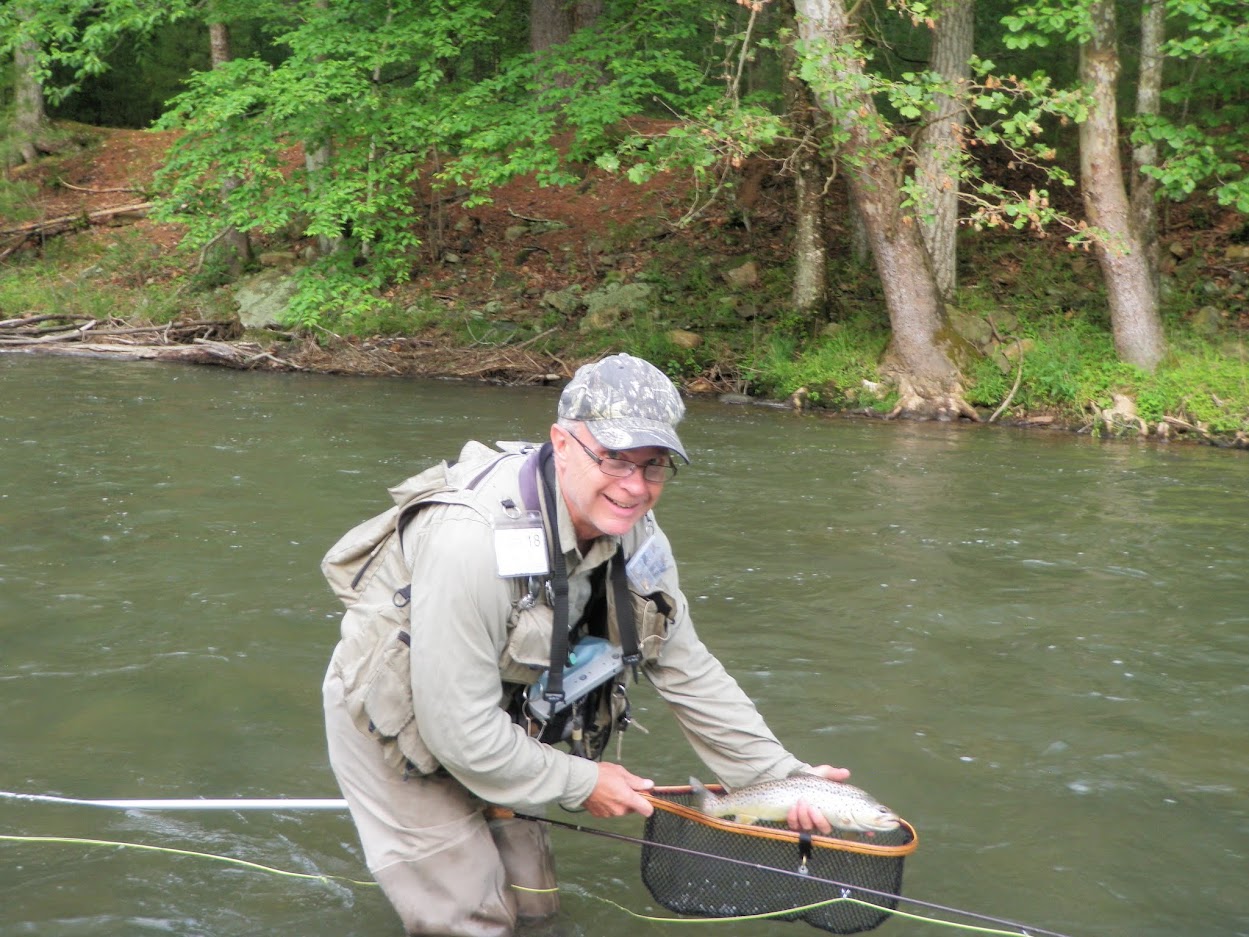
After a half hour of fishing in this manner with two bumps but no landed fish, I decided to substitute the leadwing coachman that Jeff loaned me for the prince nymph. It was longer and probably yielded a better match to the locally present isonychia nymphs. This change proved successful, and at the head of the long deep pool behind the cabin, I felt a bump and then a grab, and then I was attached to a fish. I battled the thrashing weight on my line for a bit, and then lifted it over the edge of my net and celebrated the landing of a fourteen inch brown trout that snatched the leadwing coachman on the strip. I finally cracked the code and landed a fish in the morning on Penns Creek.

Gorgeous Markings on This Brown Trout

I released the brown trout and continued working downstream using the same technique. After another half hour the indicator paused along a deep current seam, and I once again set the hook. I was pleased to feel a throbbing weight and fought another fourteen inch brown trout for a few minutes, until I once again guided it into my net. This brown was slightly longer and heavier than my first catch, and it also displayed the leadwing coachman in its lip.

My enthusiasm for stripping a slumpbuster and leadwing coachman accelerated, but unfortunately the euphoria was short lived, as I continued fishing some attractive water downstream with no reward for my focused efforts. Meanwhile the sky grew darker, so I decided to seek Jeff. Earlier I saw him as he walked above me toward what he described as butter hole, so I climbed to the path on the bank and began walking upstream. I passed behind the last set of cabins in the area and continued until I was forced to clamber up some rocks and through rhododendrons to a narrow path. It was about this time when rain began to descend, so I paused to pull on my raincoat. After another five minutes on the path, I did not spot Jeff, so I concluded that he somehow passed downstream of the area I was fishing.

I retreated and stayed on the upper path until it connected with a lane comprised of two tire tracks. Fortunately I followed this, and it led me to Jeff’s minivan, and he was there when I arrived. We debated our next move, and Jeff suggested that we sample the water near where we were parked for an hour, and then we planned to return to the No Kill. The rain slowed down, and we proceeded to follow Jeff’s plan. As we walked along the road in the morning, Jeff pointed to a fifty yard stretch of the creek that he called “the canyon”. According to Jeff one of the residents of the surrounding cabins caught fish after fish in this fast narrow area using nymphs. This was all I needed to hear to attract me to the canyon, so I crossed at the top and walked down the opposite bank until I was nearly at the bottom of the faster water.

This segment of the creek was more open than the morning stretch, so I decided to return to the dry/dropper technique, but after fifteen minutes or so of fruitless casting and wading, I observed a few sporadic rises. The fish showed no interest in my fat Albert or trailing nymphs, so I decided to switch to a single dry approach. Explosive sporadic rises indicated isonychia to me, so I knotted an iso comparadun to my line. I was unable to provoke additional rises from the area where I spotted fish earlier, but I did manage to hook and land a twelve inch brown that was along a short run near the bank.

I moved up the stream a bit, and once again I was excited to see a couple rises, but they were toward the middle, and on the opposite side of a strong center current. I attempted to counter the drag caused by the intervening run, but I was unsuccessful. It was at this time that the sun reappeared, and I was quite warm in my raincoat, so I removed it and stuffed it in my backpack. Unfortunately the visor on the hood of the raincoat was my only tool to block the suddenly bright sunlight, so I had to hold my left hand above my eyebrows while I cast and drifted my comparadun. This was not an ideal situation, so I hiked back to my initial crossing point and found Jeff, who flipped me a spare key. I returned to the minivan and promptly snugged my hat on my head. I quickly chomped a sandwich and minimal lunch and grabbed a water for Jeff and returned to him with the keys and the bottle of water.

Since I was now on the side of the creek next to the road, I walked down to a place directly across from where I saw the risers. I waded in a bit, and on the fifth drift over the spot of the closest riser, a strong gulp made the comparadun disappear! This brown trout put up a strong fight, and when I examined it nestled in my net, I could see that it was a fine fifteen inch fish. Based on the appearance of the rise, I would never have guessed the trout was that large.

This Beauty Came from The Canyon

Despite Jeff’s suggestion that we give the area an hour, we continued fishing the canyon until four o’clock. I adopted the approach that yielded the fourteen inch brown on the iso comparadun for the remainder of the afternoon, and added one more brown trout in the 14-15 inch range. I scanned the water for the occasional rise, and once a fish revealed its position, I moved within casting range. Four times during this period I hooked a substantial fish on the isonychia comparadun, but the last two slipped free with strong downstream runs and relentless head shaking. After a gang of beer drinking tubers passed through the area, Jeff joined me, and he had some success with his leadwing coachman.

Jeff Works the Leadwing Coachman

By 4PM the action subsided, so Jeff and I returned to the car to discuss plans for the evening. Apparently his weather forecast was accurate, as the skies cleared, and the lack of clouds suggested a pleasant evening. We decided to move downstream a short distance to the scene of the blue winged olive spinner fall on Wednesday. Jeff bought some new spinners at the Feathered Hook, so we were prepared for another feeding frenzy.

The plan partially succeeded as we fished from 5PM until 8:30 in the area around the long island behind the cabins. I landed an eleven inch brown trout on a hare nation nymph from the small eddy at the downstream tip of the island, before I crossed to the far bank along the left channel. Unlike Wednesday evening the creek was now swarming with weekend fly fishermen, and a tall young man occupied the shallow riffle that provided me with abundant surface action two nights earlier. I was forced to station myself in a nice moderate riffle and short pool two thirds of the way down the island. The section was nice water, but it did not appeal to me as much as the upper area.

Sometime between 7:30 and 8:30 I spotted three or four rises along some rose bushes on the island at the downstream portion of the pool. I seined the water and confirmed that blue winged olive spinners were once again floating along with their outstretched flat wings. I quickly knotted one of my old trusty poly wing spinners to my line, and I waded across the tail of the pool so I was below the risers. I executed a huge number of casts to the area, but I was unsuccessful. Because the fish were within a foot or two of the bank, I was careful not to overshoot and hook a rose bush. This caution, however, prevented me from making my usual pile cast with a lot of slack to avoid instant drag. Consequently the flies were probably dragging over the spot of the rises more than half the time. The low light and low riding spinner also made it difficult for me to follow the fly to determine if was dragging or not.

I finally surrendered to the fish and waded back to the bank and then walked upstream looking for more rises. I invited Jeff to cast to the rises I abandoned, since he possesses much better casting skills. He obliged, and while he moved into position at the low end of the pool, I spotted two rises in the center downstream from a large branch that arced over the stream. I began making downstream drifts to the two time riser, and on the fifth attempt saw a slurp in the vicinity of my fly. I quickly set the hook and brought chubby eleven inch brown trout to my net.

Finally Cooperative

The spinner fall on Friday night only lasted for thirty minutes maximum. The short duration and the large population of fishermen constrained my spinner fall fishing experience. By 8:30 the surface of the river was dead, twilight was upon us, and we faced a two hour and fifteen minute drive to Whitehall, Pa. We decided to end our day and carefully waded back to the bank behind the cabins and walked along the road to the car. My 2016 Pennsylvania fishing adventure reached its final chapter.

Friday proved to be my best day from a numbers perspective, as I landed seven fine Pennsylvania brown trout. The afternoon time period when I spotted sporadic rises and followed up with targeted presentations of my isonychia comparadun were the highlight of the day, although landing two nice fish on the leadwing coachman technique was also fun. I am not certain when I will revisit central Pennsylvania, but after listening to Jeff’s description of trips earlier in the season, I get excited over the prospect of fishing to hendricksons and March browns. These hatches overlap during early May, so perhaps that will be my next Pennsylvania field trip.

Fish Landed: 7

Penns Creek – 06/02/2016

Time: 1:00PM – 8:30PM

Location: No kill area.

Penns Creek 06/02/2016 Photo Album

After a leisurely lunch at the rod and gun club, while we waited for the rainstorm to pass, we moved on to the No Kill parking lot. The Penns Creek No Kill area is the holy water of Pennsylvania fly fishing, and up until this time, we devoted only a few hours to it on Wednesday morning. On Thursday Jeff intended to cover a significant segment of the famous 3.9 mile special regulation water. After all, the stream conditions were near ideal, and I traveled all the way from Colorado to hook up with a fabled wild Pennsylvania brown trout from the Penns Creek no kill.

After we parked and retrieved our gear from the rear of the minivan, we carefully side-stepped our way down the hill and began fishing the lower water similar to Wednesday morning. Jeff once again ceded his favorite hot spots to me, but I was unworthy of his generosity in the first location, as I once again failed to interest any fish. Our plan was to hit three or four prime areas that Jeff knew held large healthy fish, and then we would quickly head upstream to attractive spots above the cabin and the adjacent long pool.

Isonychia Comparadun

After I struck out at the first trout lair, I waded across the stream to a nice deep run and pool below a fallen tree. I circled around by land and positioned myself a safe distance below the target area. On Wednesday morning Jeff coached me on the best strategy for covering the riffles, run and pool; and I now applied all of his teachings. The large isonychia duns served as productive searching patterns during a previous early June trip to Penns Creek, so I pulled a comparadun from my box and knotted it to my tippet. I cautiously sprayed casts from left to right with no results, but I saved the juicy deep top half of the run for last.

Out of the Net to Show Off

My confidence received a necessary boost when a sudden slurp materialized near the downstream portion of the riffle. My comparadun was no more than eight feet above my position, when I reacted with a swift hook set, and this action initiated a panicked head shaking response from what appeared to be a decent brown trout. The finned foe made several short bursts around the pool, but fortunately it never attempted to reach the faster water below me. After several minutes of diving, sprinting and head shaking; I slid my net beneath a fifteen inch wild Penns Creek brown trout. It was a moment of gratification, as I snapped some photos and gently released my friend back into his watery lair.

And About to Be Released

Next Jeff and I hiked upstream beyond the cabin quite a ways until we approached a section that he referred to as the splits. Again Jeff graciously gifted me the large right channel that received flows from four separate braids. I was feeling quite confident, as he described several visits when he and his friend landed four to six fish from this area. My adrenaline spiked, as I observed several sporadic rises, while I methodically cast my way upstream along some log jams that paralleled the stream for ten yards or more. Unfortunately my focus and intensity were all in vain, as I failed to add to my fish count despite some fairly regular rises. I switched iso patterns several times, but the fish were having none of them.

Finally I despaired of landing a single fish from the prime run, and I waded to one of the middle braids in the splits. Another fisherman had covered the lower portion of the section I targeted, but that was fifteen or twenty minutes prior. Jeff was positioned in the next channel, so I laid claim to the middle area. Later Jeff referred to the place I fished as rose bush run, since the current rushed toward the opposite bank and then flowed at a rapid pace along some roses. The deepest and enticing portion was the slow pool on the inside of the fast run, but Jeff suggested that I should not ignore the narrow six inch strip of slow water between the rose bushes and the fast current.

I covered the entire stretch very thoroughly with an isonychia dun, but once again the fish did not cooperate. I was weary of fruitless casting of a dry fly, so I decided to make a radical change and converted to a dry/dropper configuration. I returned the pool toy to my line, and beneath it I tied a hares ear nymph and a hare nation. The hare nation is a fly I invented two winters ago that combines the best qualities of a hares ear nymph and salvation nymph. I drifted the three fly offering through the main pool several times and then heeded Jeff’s advice and allowed the trio to glide along the fast current toward the tail. Wham! The pool toy dipped, and I set the hook and battled another gorgeous Penns Creek wild brown trout to my net. My catch rate was below my expectations, but when I was fortunate enough to land a fish, the quality and size of the fish was impressive.

And a Smile

Jeff appeared from below and congratulated me on my success, and then we advanced above the splits to Aumiller pool. Aumiller is a monster long slow moving pool, and rising fish are a constant occurrence. I made a few casts to the stagnant bottom section but quickly realized this was not my game. Jeff and I skipped the bottom two-thirds and moved immediately to the upper portion, where moderate riffles and glides predominated. I mentioned a desire to fish an isonychia nymph, so Jeff offered me one of his size twelve versions that display a light hackle stem along the top. I added this to my three fly arrangement by replacing the prince, so that I now showed the trout a pool toy, hare nation and iso nymph.

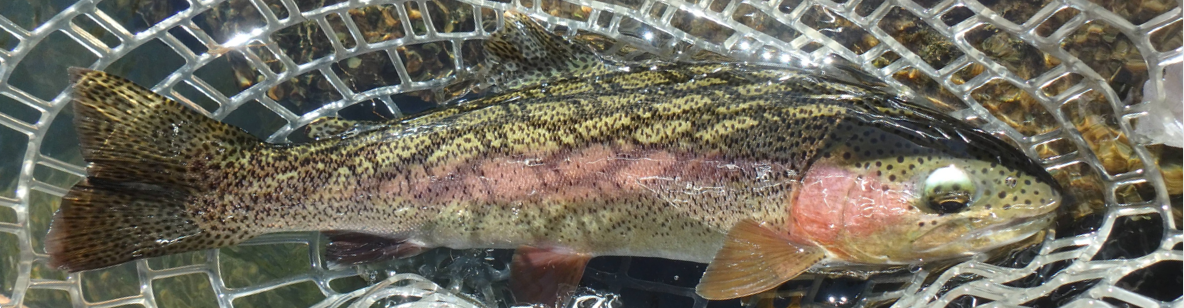
I began making casts toward two o’clock from my position along the bank, and then I mended several times to allow a dead drift. For some reason, however, on one of my three step moves toward the head of the pool, I flicked the flies directly upstream ten feet above a large exposed rock. I was astonished when I noticed a gorgeous trout that materialized from the cushion in front of the rock, but I retained the presence of mind to react with a hook set. Instantly the creek resident streaked toward the middle of the current, but I held tight and raised my rod to maintain tension. When the trout turned near the surface, I was astounded to see a vibrantly colored fish. In fact the color was so vivid that I thought I hooked a rare rainbow trout.

Close Up of a Model Penns Creek Brown Trout

The trout fought valiantly below me, but eventually it tired enough so that I could leverage its head above the water, and I lifted it into my net. It was a brown trout, but the deep body color was so intense that it projected a shade of orange. I was dazzled by the beauty of this wild Penns Creek brown trout, and Jeff assisted by snapping several clear photographs with his camera. By the time I released the fish, dusk began to descend on the valley. I continued fishing for another thirty minutes, but neither Jeff nor I observed rises. In a ridiculous bonehead move, I neglected to pack my headlamp and regular glasses, so we decided to begin our long return hike by 8:30PM.

So Vivid

Thursday was a tough day when measured by fish count, but I was thankful to land three absolute jewels from the hallowed no kill section of Penns Creek. These fish justified my hours of casting and wading, and I felt quite satisfied and fortunate to hold the beauties in my hands. One more day remained, but I proclaimed the trip a success regardless of what Friday might deliver.


Big Fishing Creek – 06/02/2016

Time: 10:30AM – 12:00PM

Location: The Narrows.

Big Fishing Creek 06/02/2016 Photo Album

The central Pennsylvania countryside was lush and verdant, as Jeff navigated numerous rural roads on our ten mile trip to the north and Big Fishing Creek. We did not know what to expect, but Jeff suggested that the green drakes typically emerge later on smaller and colder Big Fishing Creek than is typically the case on Penns Creek. We clung to the hope that this might be true, and perhaps we would intersect with the tail end of the large heavily pursued eastern mayfly emergence during a weekday when crowds are reduced.

Big Fishing Creek

When we arrived at the narrows section of Big Fishing Creek, I elected to move upstream from our parking place to some moderately faster water while Jeff migrated downstream to observe for rises in a slower pool. The water conditions were nearly perfect with a slight tinge of green color and near ideal flows. I was convinced that Big Fishing Creek would break our central Pennsylvania daytime slump. I stayed with my dry/dropper set up, but after no response from the fish in a prime location, I exchanged the prince nymph for a hares ear nymph. Alas, the swap made no difference, as I fished for 1.5 hours with nary a refusal, flash or temporary hook up to justify my efforts.

As noon approached it began to rain, and I slid on my raincoat. Jeff and I had walkie talkies in our possession, and I heard a voice that informed me that he returned to the car. My confidence was at a low, and I was building an appetite, so I readily agreed to return to the car to meet him. We called an end to our Big Fishing Creek experiment and drove south over the wooded hills to Penns Creek. Along the way we stopped at a rod and gun club and used a picnic pavilion to eat lunch, while the clouds opened and dumped volumes of water on the surrounding fields. I was concerned about the impact of an hour of heavy rain on Penns Creek, but Jeff remained confident that clarity and volume would remain nearly ideal. In fact, we both welcomed the cloud cover and hoped for a beneficial impact on our fishing success.

Fish Landed: 0

Penns Creek – 06/02/2016

Time: 8:00AM – 9:30AM

Location:.5 mile downstream from the Coburn humped parking lot.

Penns Creek 06/02/2016 Photo Album

Wednesday’s fishing adventure ended with a flurry, as I landed four nice brown trout during a dense blue winged olive spinner fall. Unfortunately I endured a significant amount of dead time during the daytime hours despite beginning our quest for fish at 8AM. Jeff and I were hopeful that Thursday would be a different story.

Since we slept at the Schafer Cottages in Millheim, we were conveniently positioned near the upper section of Penns Creek below Coburn, Pa., so we made that our starting point. We were encouraged by the cool 65 degree temperature and cloudy skies, as we parked in a gravel lot below Coburn, and then we crossed a narrow bridge and hiked a worn path on the north side of the stream for .5 mile. After moving away from the creek, the path eventually returned, and we took the first decent worn trail to the edge of the water.

Penns Creek in this area consisted of long smooth pools with short faster glides and long pockets in between. I elected to test my dry/dropper technique, and I began my day with a yellow pool toy, emerald caddis pupa, and prince nymph. In 2003 Jeff and I visited this same segment of Penns Creek on a Saturday morning of Bucknell reunion weekend, and I enjoyed a bit of success on the emerald caddis pupa. I attempted to repeat my success, and added the prince nymph to cover the possibility of active isonychia nymphs in the area.

Jeff and I enthusiastically covered the attractive water for 1.5 hours, but once again the central Pennsylvania limestone creek did not reward us for our efforts. I did manage a momentary connection with a medium sized brown trout, but that was the extent of our action. Our best catch was a bundle of five interlocking tippet spools that Jeff spotted on the bank as we moved downstream near the end of our morning venture. I inherited the windfall since Jeff favors brown tinted Maxima tippet for his leader sections.

The temperature rose into the upper seventies, and neither of us were satisfied with our fishing prospects, so we decided to once again shift our focus to another central Pennsylvania stream at 9:30. Could we tolerate another fishless day with no reward for our persistent efforts? I was beginning to have doubts.

Fish Landed: 0

Penns Creek – 06/01/2016

Time and Location: 8:00AM – 12:00PM No Kill area; 1:00PM – 2:00PM Spring Mills; 5:00PM – 9:00PM Water below No Kill

Penns Creek 06/01/2016 Photo Album

Spring creeks in central Pennsylvania are characterized by placid flows with smooth glides over moss covered rounded boulders. Semi-clear deep milky green pools beckon an observant fisherman to execute long fluttering casts, if he or she can manage to avoid the dense canopy of green leaves that cast dark shadows over much of the stream. The wily brown trout reveal their presence with subtle sipping rises in out of the way corners of the limestone creek environment. In the absence of surface clues, fly fishing becomes a waiting game. A sudden appearance of an abundance of one or several aquatic insects shatters the calm, and frantic casting and hatch matching follow, and these are the electric moments that eastern fly fishermen savor and anticipate.

Western fly fishing approaches follow the lead of the streams and rivers that begin in the high Rocky Mountains. These waterways typically rush toward their journey through the large agricultural valleys, and along the way they crash and churn over rocks and logs in a high speed race to the ocean. Whitewater, rapids and plunge pools frequent these rivers and creeks, and the fishing approach mirrors the high energy hydraulics of the targeted environment. Rather than calmly wait and observe in a manner similar to eastern counterparts, the western fly fisherman wades aggressively and casts often in an effort to present a variety of imitations to opportunistic fish. The western trout does not have the luxury of waiting for a dense hatch or to closely inspect its prey. The conveyor belt of food is set on high speed, and anything that looks alive and tasty is fair game. I was about to face the transition from the contrasting styles, as I anticipated my trip from Colorado to Pennsylvania.

In preparation for my trip to Pennsylvania from May 27 through June 4 I reviewed my MFC fly box. My Pennsylvania fishing friend Jeff informed me that the the green drakes and sulfurs were likely over, so I could probably look forward to isonychia, blue winged olives and golden stoneflies. I removed all my western green drakes to create space, and filled the vacant row with six isonychia comparaduns that I tied for a trip five years ago. I also added three isonychia spinners. Jeff promised to lend me some of his expertly constructed flies, but I felt an obligation to transport flies I tied myself to match the relevant insects projected to be present during my stay.

Next I examined my fly box thoroughly, and I was surprised to discover a row that contained six size 14 dark olive comparaduns and another six size 14 medium olive spinners. Why was I carrying these large blue winged olives designed for Pennsylvania mayflies on my Colorado ventures? I could not answer that question, but I was pleased to have them for the pending trip. Finally I checked for size 16 and 18 sulfur imitations in case we encountered stragglers, and I added a few more sulfur comparaduns from my boat box.

On Tuesday evening after dinner at my sister’s house, Jane drove me to Whitehall, Pa. and dropped my off at my friend’s house. Jeff, being the perfect fishing buddy, had the minivan packed with food and fishing gear. We discussed a departure time for Wednesday morning, and given the forecast for hot and muggy conditions, we committed to a 4:30 start.

A Flash Lights Up the Minivan

Despite having a body clock that remained on mountain time, my excitement caused me to wake up before 4:30, and we were on the road by 4:45. This very early departure enabled us to be in the No Kill parking lot by 7:30, and subsequently we were on the water at 8AM. As Jeff texted me earlier in the week, Penns Creek was nearly ideal with flows of 270 cfs and a tinge of color that gave the cautious fisherman a bit of cover upon approaching attractive trout holding locations.

Concentration

Jeff is a veteran of Penns Creek and on a first name basis with many of the large denizens of the premier central Pennsylvania stream, so he stationed me in some prime spots and gave me first shot. I cannot overemphasize the generosity of my long term fishing buddy. We tossed isonychia and golden stoneflies at Linden Tree, Willow Hole and Red Cabin Run; but the educated brown trout of Penns Creek were having none of our fake offerings. The air temperature warmed quickly, and the sky was mainly bright blue with only an occasional white cloud. Simply stated, the conditions were quite challenging, and two veteran fishermen were skunked despite a long morning of focused fishing. In one nice run of moderate depth I experimented with a dry/dropper approach. I tied a fat Albert to my line and trailed an ultra zug bug and beadhead hares ear, and this combination yielded two small creek chubs. I finally felt the tug of something on my line, but chubs were not what I was seeking in Pennsylvania.

With the thermometer rapidly rising, Jeff and I decided to switch venues at noon. We drove to Millheim where we checked out the cottage that was reserved for Wednesday and Thursday night. From there we continued west and eventually headed south until we reached the upper stretches of Penns Creek at Spring Mills, where we crossed a bridge and parked in a vacant lot under some trees. The creek in this locale was a classic limestone spring creek with slightly milky flows and  an abundance of thick aquatic vegetation. Jeff gave me first choice, so I elected the thirty yards of prime water below the bridge. Jeff jumped into the stream farther down at the end of a long deep pool where long branches displayed wide leaves and arched over the small stream. I was actually somewhat intimidated by the prospect of casting in these difficult conditions.

Spring Mill

As I studied the water, I spotted several sporadic rises, but when I gently cast a splash beetle, parachute ant, and Jake’s gulp beetle to the open lanes between the subsurface weeds, I received no response. I plopped my way along the edge until I was positioned at the downstream border of the bridge. I noticed three rising fish at the upstream section in the shadows, but these fish also ignored my presentation. I switched to a size 16 deer hair caddis for a bit, but it too was simply debris to be ignored to these smart Penns Creek trout.

Jeff appeared on the bank below me, and he described a similar lack of success with extremely skittish fish in the warm humid afternoon conditions. Once again we packed our gear and made a move, and this time we transitioned to the section of water behind some cabins below the No Kill area. We were careful to stash our dinner in our backpacks, and I also remembered to carry a headlamp and my regular glasses in case we fished into darkness. We were hoping for an evening hatch, but we had no insight that such an event was probable.

A Nice Loop

When we met the stream, we made a left and continued until we were beyond the last cabin, and here we began our quest to prevent a Penns Creek skunking. Since it was early, and I was not patient enough to wait for a rise or visible sign of a fish, I found some nice fast water that contained long pockets and deep narrow slots. I reverted to the dry/dropper approach with a fat Albert that contained a tan ice dub body. In addition I tied on a prince nymph to represent isonychia nymphs and the much favored beadhead hares ear nymph.

It did not take long before I hooked a medium size fish on the hares ear, but it quickly wiggled free, and I uttered some unkind words while my skunking continued. Shortly after this frustration, I cast to the top of a relatively fast run, and I was shocked when a sizable Penns Creek brown trout utterly smashed the fat Albert. This fly was supposed to be my indicator, so what was going on? Unfortunately I played the brute for a couple minutes before it made a mad dash to the fast water. I was not in a good position to follow the fish downstream, and once again I must report on a long distance release. Unlike the previous incident, however, the larger brown broke off the fat Albert and the other two flies.

Huge Eastern Stonefly

Jeff observed my futile attempt to land the fat Albert eater, and he concluded that the trout took my attractor for a golden stonefly. My size 8 yellow foam imitation was larger than his creations, but he suggested that perhaps his were a bit undersized. I actually saw two golden stoneflies on the creek, and one was much larger, so perhaps the big boys were in egg laying mode earlier than the smaller species. At any rate I did not have any more fat Alberts with a yellow body, so I switched to a size 8 pool toy with a light yellow dubbed body. Boom. It was not long before I endured another momentary hook up to the pool toy. This only confirmed that my hopper imitations seemed to be reasonable approximations of egg laying stoneflies. Unfortunately I was now zero for three, and my scorecard was blank.

First Penns Creek Brown of the Trip

I moved farther upstream to the stair step area behind the cabins, and finally I connected with a twelve inch brown that gobbled the hares ear nymph. This fish was not a trophy, but I was appreciative of landing at least one shrewd Penns Creek brown trout. Next I approached a small eddy that Jeff recently abandoned. The location was just below the point of the long narrow island that separated the stream into two juicy channels. I flipped the pool toy into the nexus of the whirlpool, and in a matter of seconds a large mouth engulfed the buoyant hopper imitation. A tough fight ensued, but in this situation, I held the upper hand, as a strong fourteen inch brown trout nestled in my net. Another fish attacked one of my size eight hopper imitations perhaps mistaking it for an egg laying stonefly.

Fourteen Inch Brown Crushed the Pool Toy

I now crossed the left braid and walked along the bank to the upper faster section, where I prospected with the pool toy and dropper nymphs. I was brimming with a bit of confidence since the large foam hopper flies with yellow bodies yielded three hook ups with solid fish. As I worked a narrow deep slot next to an exposed boulder near the bank, I spotted several barely discernible rises in some fairly fast water. I made numerous drifts without success, so I went to the trouble of removing my dry/dropper flies and switched to a single isonychia comparadun. This fly also failed to generate interest, so I surrendered and moved to the next attractive space.

The creek created a very wide gentle riffle in the area just above the left channel that flowed around the island. Surely the last hour of the day would cause hungry brown trout to spread out in these flats in search of easy meals. Just as this thought crossed my mind, several riseforms appeared fifteen feet above my position. I made some long casts with the isonychia with high expectations, but once again I was sorely disappointed. What should I do? I always carry a seine in an elastic pocket at the base of my net opening and rarely use it, but here was an obvious application. I stretched the seine over the net opening and held it in the creek in front of me for thirty seconds. When I extracted it from the water and peered closely, I discovered five or six crumpled olive-bodied spinners. It was now obvious what the feeding fish were tuned into.

Result of Seine

I went to my MFC fly box and extracted one of the six poly wing spinners that consumed space in my Colorado box for no obvious reason. I tied these six years ago in preparation for a similar trip to Penns Creek, but they never made it to the end of my line, since I did not encounter the elusive blue winged olive spinner fall. On this evening of June 1, however, I was very thankful for the presence of these archived flies.

The fly possessed a deep olive body, dun hackle fiber tails, and white poly wings. The wings were kinked and splayed to each side in a curved style. The naturals in the water matched quite well except for the smooth flat wings that stretched at a ninety degree angle from the body. I was very concerned that my S shaped wings would be a deal breaker for the smart Penns Creek browns.

Gorgeous Spots on This Twilight Fish

Cornuta Spinner

Fortunately this was not the case. In the dwindling light between eight and nine o’clock I managed to hook and land four additional brown trout. All were quite nice specimens that measured in the thirteen to fifteen inch range. Two additional fish were hooked momentarily but managed to shed my heirloom tie. The magical spinner fall hour was the highlight of my trip, and I experienced the dense feeding frenzy that I hoped would commence. It was especially gratifying to pull an old fly out of my box that performed exactly as I hoped. By 9 o’clock the spinner fall ended and the feeding trout returned to their safe harbor holding spots. Jeff and I met above the island and carefully waded to the shore near the cabins and then walked back to his minivan. A night of rest beckoned us to our cottage, and I dreamed about two more days of eastern fishing.

Fish Landed: 6

Better View


South Boulder Creek – 05/25/2016

Time: 11:30AM – 4:00PM

Location: Below Gross Reservoir

South Boulder Creek 05/25/2016 Photo Album

After enjoying a decent but not outstanding day on the South Platte River on Monday, I felt a bit burned out by that waterway. Dealing with the weekday crowds was a significant drawback, and I desired one more fishing trip before our scheduled trip to Pennsylvania and Vermont, but I was not interested in a long drive. As is my custom, I examined the DWR stream flows, and this review yielded three closer options. The South Platte River below Cheesman Lake was running in the low 300’s, and this level is higher than ideal but still within the range of comfortable fishing. The Big Thompson River was up to 125 CFS. This is at the top of the ideal range, but I experienced decent success at these levels in previous years. I was ignoring South Boulder Creek because of extremely low flows (15 CFS), but I now noted that releases bumped the volume below Gross Reservoir to 30 CFS. South Boulder Creek is within an hour drive of my home, so I decided to make this my destination on Wednesday May 25.

After I Cleaned the Lens with My Buff

One hour of driving delivered me to the parking lot high above the creek. Two trucks and one SUV were already present, so after I assembled my Orvis Access four weight and stashed my lunch in my backpack, I descended the steep path and hiked along the trail until I was below the pedestrian bridge that leads to the Crescent Meadows parking lot. I passed four fishermen along the way, so I was hopeful that I had the lower part of the canyon to myself. In order to give myself space I hiked for a decent distance, and then I dropped down the bank to the stream.

The temperature was in the mid-fifties with sporadic strong gusting wind when I departed at the trailhead . Unfortunately the weather never changed until the wind died back between three and four o’clock. This coincided with fewer clouds and longer periods of sunshine. For the most part large clouds blocked the sun, and chilling wind blasted down the canyon. I was pleased to wear my fleece and raincoat, and occasionally rued my decision to leave my hat with earflaps in the car.

Look at All Those Deep Pockets

Although 30 CFS is below what I consider ideal for this small Front Range stream, it was adequate to avoid highly technical fishing. By 11:30 I tied a gray stimulator to my tippet and began prospecting all the likely fish holding nooks. I was hesitant to begin plunking a large foam attractor, since the flows remained on the low side, but the stimulator failed to arouse much interest, so after fifteen minutes I took the plunge. I tied on a fat Albert with an orange floss body, and below that indicator fly I attached an ultra zug bug and a beadhead hares ear.

Yummy Fat Albert

Same Fish from the Side

I continued moving upstream, and I was shocked to land my first fish, a small nine inch brown trout, on the large foam attractor. Sometimes trout can be very unpredictable. The remainder of my day was fairly simple. Up until 2:30 I stayed with the same three flies, and I landed ten additional trout bringing the fish counter to eleven. A rainbow gobbled the fat Albert with total confidence, and the other eight landed fish snatched the trailing beadhead hares ear from the drift. The hares ear nymph has staged a comeback comparable to Michael Jordan’s return from minor league baseball. It has become my favorite fly in this late spring pre-runoff time period in Colorado.

Love the Look of This Fish

The late morning and early afternoon were a fly fishing festival, as I applied my favorite technique of popping short casts to appealing locations. My rapid fire short drifts did not always yield fish, but on a fairly regular basis, a feisty cold water jewel ended up on my line. But in addition to regular action, I was pleased to discover that quite a few of the trout in my net were gorgeous rainbows in the 12-14 inch range. These are very fine fish for the small South Boulder Creek drainage, and the vivid spots and bright colors made them gems in the truest sense of the word.

Partly Cloudy All Day

During some of the dark cloudy periods in the afternoon I noticed some small mayflies in the atmosphere, so I presumed they were blue winged olives. In fact in one large wide and deep pool with a strong center current, I spotted two fish as they aggressively rose to the surface to intercept a natural food morsel. I examined the water closely, but I could not discern any obvious food source on the surface. I was reluctant to make the switch to a single dry based on the hunch that they were taking BWO’s, so I compromised and swapped the hares ear for a soft hackle emerger. I drifted several casts in front of the place where the lower fish in the pool rose twice, but this selective eater was having none of my offerings.

My Lunch Spot

I turned my attention to the fish that rose once along the center current near the midsection of the pool. The first cast drifted two feet, and suddenly the fat Albert darted against the current. I made a swift hook set, and felt the weight of a decent fish for a few seconds, before it somehow shed the hook. I could not be 100% certain, but I guessed that the fish intercepted the soft hackle emerger, and the small size 20 hook was not up to the challenge of holding fast.

Since I made the switch of flies, I fished on with the ultra zug bug and soft hackle emerger for awhile, but eventually I removed the zug bug and continued with the beadhead hares ear and the soft hackle emerger. Between 2:30 and 4:00 the weather improved, but this was offset by less attractive water and the absence of fishing action. The stream was wider, and consequently with flows at 30 CFS offered fewer deep runs and pockets. I skipped much of this water and spent a fair amount of time wading rather than casting. The brighter sun and warmer temperatures were a death knell for the baetis hatch, and this translated to less active fish.

Another Gorgeous Rainbow

In spite of these negatives I persisted and landed three additional trout to take my fish count to fourteen, however, I must report that these fish were on the small side and did not compare to the beauties that rested in my net earlier. By 4 o’clock I cast to some extremely promising water and could not even generate a refusal. The path was within a foot or two of the creek, and it beckoned me to begin my homeward journey. I acquiesced and made the vigorous hike out of the canyon and ended my day on South Boulder Creek.

Once again I enjoyed a surprisingly productive day of fishing on a Colorado tailwater during the time when most rivers are subject to rising flows and turbid conditions. I was extremely thankful for another day of success, although I feel certain that lake fishing will be in my plans when I return from Vermont on June 8. Nevertheless it was fun while it lasted.

Fish Landed: 14


South Platte River – 05/23/2016

Time: 10:15AM – 7:00PM

Location: Eleven Mile Canyon just below Springer Gulch and special regulation water

South Platte River 05/23/2016 Photo Album

My love affair with the South Platte River encountered a small rough patch on Monday. It was another solid day, but I was spoiled by the three previous visits that yielded bountiful quantities of fish and above average size.

I contacted my young friend Danny Ryan to determine whether he was available to join me, and of course I touted the phenomenal days that left me in a state of euphoria on May 12, 13 and 20. Very little arm twisting was required, and Danny texted me that he cleared his calendar and planned to join me on a trip to Eleven Mile Canyon.

I arrived at Danny’s apartment at 7:15, and this enabled us to pass through the entrance gate for Eleven Mile Recreation Area by 9:30. We were about to discover one of the factors that made Monday more challenging and less enjoyable than my previous visits. We slowly drove on the dirt road that snakes along the nine mile length of the river, and once we passed Springer Gulch, the boundary with the catch and release section, every pullout was occupied with one or two vehicles. How could this many fishermen be on the river on a Monday? Does anyone still work in this nation? I speculated with Danny that the South Platte River in South Park is the only river relatively close to Denver that is not affected by early run off, and this explained the hordes of fly fishermen swarming along the upper reaches of the river. The other explanation was that too many people are reading my blog, but I suspect that reason is not likely.

We executed a U-Turn at the parking lot below the dam and returned along the dusty dirt road toward the entrance gate. After two miles we passed the border of the special regulation water, and we continued for another .5 mile. Here we noticed that the gradient increased, and the river passed through a narrows section with huge round boulders and deep plunge pools. This lasted for a short distance, and then the stream bed opened up a bit, and we decided to park and test our skills in this more moderate canyon section.

When I opened the car door, I met a chilly blast of wind, and this weather condition would be a constant irritant over the course of the entire day except for the evening period after 4PM. I elected to wear my Adidas pullover along with my raincoat as a second layer windbreaker. There were a few brief windows of sunshine, but overcast skies and a chilly breeze predominated for most of the day. I never experienced much success fishing after a cold front moved through an area, and Monday’s weather seemed to be one of those days. Certainly the atmosphere was cooler and drier than what Steve and I faced on Friday May 20. I blame the slower action and smaller fish on the combination of more adverse weather and crowds of fishermen forcing us to accept a secondary stream section.

Nevertheless Danny and I persisted. Experimenting with fishing the unregulated portion of Eleven Mile Canyon was actually an idea I pondered on Friday, but I was reluctant to suggest it to Steve when the highly desirable segment of the catch and release was open and unoccupied. I did well in the Happy Meadows area, another section open to bait fishermen, so I was convinced that I could catch fish in the section of Eleven Mile where standard regulations applied. The crowded circumstances of Monday forced me to test my theory.

Beautiful Brown Trout

Danny and I both began fishing with dry/dropper configurations. In my case I tied a fat Albert, ultra zug bug, and beadhead hares ear to my line; and I began to prospect all the usual locations that could harbor trout that evaded the bait and spin fishermen over the weekend. It took twenty minutes, but eventually I was on the board with a nice twelve inch brown trout. At eleven o’clock I spotted a few blue winged olives hovering over the stream, so I swapped the hares ear for a soft hackle emerger. Between our starting time of 10:15 and our lunch break at noon, I landed six trout, and all were brown trout. Three of my catch chose the soft hackle emerger as their food source, and the other three were attracted to the ultra zug bug.

Danny Prospects a Promising Run

After lunch Danny and I continued our progress upstream, and we actually passed under the bridge at Springer Gulch and fished the very bottom section of the special regulation area up until 3PM. At this time we bumped into another fishermen, so we reversed and returned to the car. During the early afternoon session, I abandoned the soft hackle emerger, as it ceased to deliver results, and instead I reverted to the beadhead hares ear. My lineup therefore consisted of the fat Albert indicator and the ultra zug bug and beadhead hares ear. The fish counter ratcheted up to ten during this time period, and my netted fish included a husky fifteen inch rainbow. Hooking and landing this fish was clearly the highlight of my day. I angled a short cast around a huge boulder to a narrow deep slot, and after a very brief drift I lifted to make another cast. This action apparently looked like escaping food to the rainbow, and it struck the beadhead hares ear.

Dave’s Best on the Day

Once we returned to the car, we decided to make another move toward the gate, and this time we found a small pullout next to the river just southeast of the single tunnel. Once again we applied our dry/dropper technique to water that was similar to the section fished earlier. I managed to add five additional fish to my tally, but these fish were smaller on average, with one or two reaching the twelve inch measurement. Since Danny works long hours, he wished to take advantage of a rare fishing day, and this motivated us to continue fishing until 7:30.

Beadhead Hares Ear Performed

Over the last hour I endured several refusals to the fat Albert, so I theorized that the fish were focusing their attention of surface food. In conjunction with this logic I decided to experiment with some dry flies that were more natural in appearance. I cast a light gray size 16 deer hair caddis in a nice pool with no response, and then I switched to a light olive size 12 stimulator. Neither of these options generated any interest, so apparently my hypothesis was off base. Danny meanwhile persisted with the dry/dropper arrangement and managed to net a few small fish on the hares ear and salad spinner.

In conclusion I ended my day with fifteen landed fish, and that sounds fairly decent. Consider however that I fished for nearly eight hours, and this translates to a catch rate of two fish per hour, and that is fairly average. In addition the size of the fish was beneath my experience on each of the three previous trips to the South Platte River. On a positive note I managed double digit fish on May 23, which is a decent accomplishment for a stream, when most of Colorado is in the early stages of run off. Also I spent my day in a beautiful canyon with my friend Danny who I had not fished with since March. Danny also achieved a double digit fish count day, so in retrospect it was a fun and productive day.

Trout Landed: 15


South Platte River – 05/20/2016

Time: 10:30AM – 3:00PM

Location: Eleven Mile Canyon near twin tunnels and then across from a picnic area outside the special regulation water.

South Platte River 05/20/2016 Photo Album

Euphoria lingered as I sat down to craft this report of my fishing trip to the South Platte River on Friday May 20. The quantity of fish landed did not compare with my experience the previous Thursday and Friday, but the quality of fish is what caused my mind to dwell on a fun day.

Two of my fishing friends had rotator cuff surgery in 2016. Steve Supple had his operation performed on March 10, and his doctor informed him that he could resume fishing three months later. Steve is right handed and his right shoulder was repaired. Steve’s wife, Judy, emailed Jane on Tuesday to inform us that Steve was ready to make his first fishing trip.

It was a week since I enjoyed fast and steady action on the South Platte River in Eleven Mile Canyon, and I yearned to return while flows remained in the ideal range. I suggested to Steve that we make Eleven Mile our destination, and after he checked the DWR stream flow data and determined that releases from Eleven Mile Reservoir continued to offer near ideal conditions at 75 cfs, we eagerly made plans to visit the South Platte River on Friday.

I arrived at Steve’s house in Lone Tree at 7:10, and we quickly transferred my gear to his Subaru, and we were on our way. An uneventful drive brought us to a pullout near the twin tunnels on the dirt road that borders the river at 10AM, and we waded into the river by 10:30. Steve chose to begin casting his nymphs in a gorgeous long run and pool just below a long slender island. The two channels merged at this point and created an inviting riffle and deep pool.

I meanwhile walked downstream for thirty yards to some faster water that contained numerous exposed boulders and deep pockets. This river structure was more to my liking, and I began with the usual fat Albert trailing a beadhead ultra zug bug and a beadhead hares ear. I tied ten fat Alberts this winter, and I continue to use the same one that served me during all my 2016 fishing trips since early March. I am sure it set some sort of record for hours of continuous service without breaking off or being sacrificed to a tree.

In addition to the flows being nearly ideal, the weather was similarly favorable. As we began fishing in the morning, the temperature was in the upper fifties, so I wore my fleece; but the bright sun amidst a deep blue sky quickly warmed the air until the mercury moved into the sixties. There were several periods of extensive cloud cover, but never any significant precipitation, and the gray skies enhanced the fishing conditions.

In the first half hour I methodically worked my way up the river and prospected some very appealing water without any positive results. When I reached Steve, he was on the side of the river below the road, so I approached the gorgeous deep run from the opposite bank. I made some nice drifts from the top of the run along the main center seam, and on the fifth such pass the fat Albert made a dive. I reacted with a hook set, and chaos ensued as an energized rainbow trout charged up and down the run. I maintained contact through several sudden streaks, but then the missile made an abrupt turn and shed the hook. It was fun to finally connect with a fish, but disappointment reigned with the loss of a substantial hook up.

A Nice Fat Rainbow

Just before this sequence of events Steve landed a very spunky fourteen inch rainbow from his side of the seam on a RS2, and I paused to snap some photographs before moving on. Steve remained at the junction pool while I migrated through the right channel around the long narrow island. Quite a few nice deep pockets and runs presented themselves, and I capitalized on the attractive water by landing five trout before returning to check in with Steve at approximately 11:30. Of the five fish that felt my net, three were brown trout in the twelve to thirteen inch range, and two were rainbows. One bow was a chunky fourteen inch fish and the second striped beauty was a fifteen inch beauty although not as wide as the first one.

Speckled Rainbow in My Net

When Steve informed me that he landed his fish on a RS2, I swapped my hares ear nymph for a soft hackle emerger, and three of the fish on the north channel nipped the emerger, and the other two grabbed the ultra zug bug. This brief morning session built my confidence that I could use my favorite dry/dropper technique to catch fish in Eleven Mile Canyon. I was impressed with the quality of the fish, and trout seemed to materialize in most of the locations where I expected to find them.

This Rainbow Was Long But Not As Chunky as Previous

When I joined up with Steve, I learned that he landed another fish. I informed Steve that I planned to continue upstream beyond the long slow pool below some high vertical rock walls, and I committed to return by noon for lunch. The plan played out as I envisioned, and I encountered some nice faster pockets and runs above the long pool. In the remaining half hour before lunch I landed three more healthy fish including two rainbows and a brown. One of the rainbows was another feisty thirteen inch well fed specimen. Just before noon I found a nice path that scaled the steep bank and brought me back to the road just west of the second tunnel.

Wow a Fatty

As I walked back toward the car, I met a trio of fishermen scaling the steep bank between the twin tunnels. The older of the three was struggling to climb the last ten feet as the loose gravel soil was absent of any toe holds. I offered the young gentleman on the road my wading staff, and he quickly accepted it and extended it to the struggling climber who grabbed the end. With the assistance of the young friend and the sturdy stick, the trailing fisherman finally crested the rim, and thank you’s were offered all around.

After lunch at the Subaru Steve and I decided to descend the same path that I used to return for lunch. Steve mentioned that he fished the water upstream of the second tunnel on previous trips, and he viewed it as an enjoyable area, although on many occasions it was occupied by guides and clients. We quickly gathered our rods and descended to the edge of the river, and we were pleased to see the absence of other fishermen. Steve found another juicy deep run and began to explore the depths with his indicator nymph rig.

Brilliant Stripe and Cheeks

Meanwhile I stayed with the dry/dropper combination and quickly found some very nice deep pockets, slots and runs where the river rushed around numerous exposed boulders. The river structure was similar to the right braid from the morning, and it matched my favorite type of fly fishing playground. In the first fifteen minutes I failed to generate any interest, and blue winged olives seemed to be absent, so I reverted to the beadhead hares ear. The hares ear was all I needed on Thursday and Friday May 12 and 13, so I was convinced that the trout in the upper section of Eleven Mile would relish it as well. In addition Steve and I observed two mayflies that were size sixteen, and I had a hunch that the larger hares ear might match the nymph stage of the larger mayflies that we saw.

I Love This Type of Water

My hunch was on target, and I began to land trout with increased regularity. Deep pockets and narrow troughs where currents merged were nearly sure things, and I grew quite confident that if I could find such places, I could extract a fish. Between lunch and 2PM I added six additional fish to my count, and nearly all were in the twelve to fifteen inch range. Rainbow trout predominated this fishing period, as they accounted for five of the six fish landed. Whereas most of the brown trout that I landed in Eleven Mile Canyon measured in the twelve to thirteen inch range, the rainbows on average were strong aggressive fish in the twelve to fifteen inch size slot. The two hours in the early afternoon of May 20 represented some of the best action of 2016. The beadhead hares ear was once again the star, as it enticed all but one of the early afternoon netted fish.

At two o’clock I wandered back to find Steve who reported slow action. He landed one trout in the initial run, but the river residents proved uncooperative after that. Since another fisherman was in view above my ending point, we decided to return to the car and then explore some water downstream outside the special regulation area. We were amazed at the number of fishermen that arrived while we were occupying prime locations near the twin tunnels, as nearly every available pullout contained one or two vehicles. After we passed Springer Gulch we drove for an additional couple miles until we reached a small picnic area on the right that contained a rest room facility. Steve parked here, and we crossed the road to examine the quality of the river. It appeared to be similar to the segments that we fished earlier in the day, so we agreed to give it another hour.

A Surprise Cutbow

Steve took a position halfway across the river below another nice run, and I walked down the road .1 mile and then dropped down a short bank and began fishing some deep pools and pockets around large rounded protruding boulders. I moved through some exceptionally deep pools without any success, but then I reached a section where the river widened a bit, and I was able to wade and reach some very attractive places in the middle and opposite side of the river. Finally my dry/dropper technique paid dividends, and over the last hour I landed three healthy trout that averaged twelve inches. One was a cutbow and two were wild brown trout with vivid red and black spots.

Brilliant Spots on This Wild Brown

It was just a superb day in the catch and release section of Eleven Mile Canyon. It was also certainly my best showing in the highly pressured tailwater, and I discovered that using the dry/dropper technique along with covering a lot of water yielded excellent results. I focused on faster pocket water sections because this type of structure worked well for me in the downstream areas of the South Platte the previous week. Also I continue to believe that most fishermen (fly, spinner and bait) avoid this type of water. The typical fisherman gravitates to long deep runs at the head of smooth pools. Fishing pocket water is hard work and necessitates careful wading while leaning into a forceful current. Rocks and sticks tend to grab flies and fly lines, and short drifts dictate frequent lifting and casting. All of these circumstances cause extreme fatigue on legs, elbows, shoulders and the back. Only a dedicated few attempt this style of fishing, thus this type of water is far less pressured.

I am already eager to make yet another trip to the South Platte River in the South Park area. As long as the water managers maintain flows in the 75 – 100 cfs range, exceptional fishing should continue. Stay tuned.

Fish Landed: 17


Boulder Creek – 05/19/2016

Time: 11:00AM – 3:30PM

Location: Rogers Park before lunch and then upstream from mile marker 36 in the afternoon.

Boulder Creek 05/19/2016 Photo Album

How long can I avoid the inevitable onset of snow melt? I made plans for another trip to the South Platte River on Friday, so I searched for a close-by option on Thursday. Clear Creek was fun on Wednesday, but I did not wish to return for a second consecutive day. Remaining options were the Big Thompson River, Boulder Creek and South Boulder Creek. I was leaning toward a trip to South Boulder Creek despite posted flows of 15 CFS until I read guide reports on the Front Range Anglers web site. The fly shop experts suggested that the low flows on South Boulder Creek made fishing very technical; whereas, Boulder Creek continued to fish reasonably well while run off was held in check by recent cool temperatures. This tipped my decision in favor of Boulder Creek.

Because I live on the north side of Denver near Interstate 270, Boulder is merely a thirty minute drive. I decided to explore the upper section of Boulder Canyon, so driving through Boulder and then traveling west added another thirty minutes to my trip. I pulled into a parking area next to the creek at Rogers Park, and I was ready to cast by 11AM. The creek in this upper section above Boulder Falls was actually quite low and very clear, and I questioned whether it might be more technical than South Boulder Creek. I knotted a size 10 Chernobyl ant to my line on my Orvis Access four weight and began tossing it to likely fish holding locations.

Rogers Park Area Was Wide and Shallow

Spots where fish might hold were actually in short supply as the small stream was relatively wide and shallow in this area, where the gradient leveled out a bit. I managed to land a small brown and had another split second connection, but I covered a significant amount of stream before lunch with only one fish added to my fish count. After a half hour of mostly wading I encountered a large wide shallow beaver dam. Beaver dams tend to have mucky bottoms, so I waded to the bank along the road and skipped around the huge pool, but I did observe a few decent fish, as they scattered while I disturbed the pool ever so slightly. Above the beaver dam I continued to toss the Chernobyl ant and eventually landed a second small brown trout in a fairly fast shallow run.

I glanced at my watch after releasing fish number two and noticed that it was 11:45, so I climbed a short steep bank and hiked back to the car. This short walk confirmed that I covered approximately half a mile in forty-five minutes of fishing. As I drove west upon my arrival earlier in the morning, I made a mental note that the water upstream from mile marker 36 seemed interesting, so I turned right at the end of the short dirt lane that led to the parking area, and I proceeded directly to a small pullout between mile marker 37 and 36, but much closer to 36. I munched my lunch on a large flat rock overlooking the stream, and then I grabbed my gear and began working upstream.

View from Where I Ate Lunch

During the afternoon I covered more than a mile of Boulder Creek. The section of water was similar to Clear Creek, as the creek rushed down a fairly narrow high gradient stream bed. Nearly all the action was limited to slow pockets and pools which served as refuge from the high velocity current in the center. Because the stream was fairly narrow, I was able to cast to a few pools along the opposite bank by holding my rod high to keep the fly line off the water. This technique yielded one or two of my twelve fish.

Beadhead Ultra Zug Bug Visible

Pocket Produced

I began by casting the same Chernobyl ant that I knotted to my line at the start of my day, but it was apparently not appetizing to Boulder Creek trout, so I defaulted to my new standard; a fat Albert trailing an ultra zug bug and a beadhead hares ear. These flies began to produce, and I incremented my fish total from two to eight in the early afternoon time period. Six fish over 2.5 hours is an average catch rate, and covering the edge on Boulder Creek proved to be hard work. Large rocks bordered the creek the entire time, and I was extremely careful to analyze each foot placement to avoid any unexpected slips or falls.

At 2:30 I spotted a few blue winged olives, and then at the downstream lip of a deep run I noticed a small brown as it darted to the surface to grab a wayward BWO. I exchanged my hares ear for a soft hackle emerger and then attempted to simulate an emerging baetis by giving my flies a lift in front of the location of the rises. It did not work, so I moved on. In one nice deep run I generated a short momentary hook up most likely on the small soft hackle emerger, but I was skeptical that the tiny fly would attract much attention in the tumbling flows of the mountain creek.

Hot Corner

I was about to make another fly change when I approached the Boulder Creek version of the hot corner. The creek glided through a deep run and then eddied back along a large vertical rock wall. I paused to observe, and I was immediately excited to see a decent fish hovering just below the surface facing downstream. While I watched, it rose twice and sipped something from the film; most likely one of the sparse blue winged olives that I observed earlier. I was not doing well with my dry/dropper rig, so sight fishing to a decent fish with a dry fly was too much to resist.

CDC BWO Sipper

I clipped off the three flies and converted to a single size 22 CDC olive. Once I was ready, I flicked a nice cast with quite a bit of slack to the downstream beginning of the eddy seam, and as the tiny lint-like morsel slowly drifted back toward the nexus of the eddy, the large fish slowly slid beneath the fly and rejected it! I was sorely disappointed, but I allowed the fly to continue on its journey toward the hub of the eddy, and much to my amazement, a different fish darted to the surface and sucked in my offering. I brought it to my net and determined it was a fairly typical ten inch brown trout. I dried my fly thoroughly and resumed casting, and I was pleased to extract two more browns from the hot corner. The last one was the best of the bunch and perhaps the largest brown that I ever caught in Boulder Creek, as it extended to twelve inches.

Eventually the rising fish ceased to show interest, and I moved on. I tried to prospect two decent pockets with the small CDC BWO, but following a tiny fly in fast water is a frustrating proposition, so I added a size 14 stimulator and attached the CDC BWO behind it. These flies looked great in tandem on the surface, but the fish did not seem to be interested.

Prospecting on the surface did not seem to be a winning strategy in the late afternoon, so I once again reconfigured, and this time I decided to go old school. I knotted a yellow Letort hopper to my line as the top fly, and beneath it I attached a beadhead hares ear. Ten years ago this was my number one option for dry/dropper prospecting. I managed to land one small brown trout on the hares ear, and then I approached a whitewater chute and a driveway bridge, so I decided to end my day.

The weather was delightful and the stream level and clarity were conducive to fishing on May 19. Boulder Creek was a fine choice, and I continued to make the most of the remaining days of stream fishing in Colorado before flowing water blows out for a couple months.

Fish Landed: 12

Clear Creek – 05/18/2016

Time: 11:00AM – 4:00PM

Location: Downstream from Hidden Valley exit below Idaho Springs.

Clear Creek 05/18/2016 Photo Album

Adverse weather moved into Colorado on Sunday evening, and this placed a temporary halt on my fishing ventures. Rather than stewing over the cool wet conditions, I used the weekend and Monday to rest, and Tuesday Jane and I took full advantage of the cool temperatures by visiting Arapahoe Basin for some late season skiing. Conditions were actually quite good for May 17, and generous quantities of snow remain on the high elevation slopes. Jane volunteered to drive on our return trip, and this afforded me the opportunity to inspect Clear Creek where it runs along interstate 70. It was a bit high but clear on Tuesday afternoon.

On Wednesday morning I reviewed the stream flows on the Front Range streams, and this exercise revealed that Clear Creek was flowing at 133 cfs. This is a bit high but within the 50-200 cfs range that generally suggests manageable fishing conditions. Since I had first hand knowledge based on our return trip from A-Basin, I opted to make the short trip to Clear Creek. On Tuesday I observed that clarity was decent, and this information is difficult to obtain over the internet.

I left the house at 9:30 on Wednesday morning, and I pulled into the pullout along the frontage road south of Interstate 70 off the Hidden Valley exit by 10:30. I quickly jumped out of the car and looked down at the stream and determined that it was in decent condition. The flows were obviously higher than the 50 cfs level that I encountered during my most recent visit to Clear Creek in the canyon, but the creek was only slightly discolored with decent visibility along the edges. Clear Creek is essentially a huge trough, and it is a waste of time to toss flies anywhere but right along the bank, so edge clarity is all that matters.

I quickly pulled on my waders and assembled my Sage four weight. A large black cloud was gathering to the west, so I added my fleece and raincoat and then threw my lunch in my backpack. I planned to hike down the bike path to the spot where the creek makes a bend, so returning to the car for my sandwich was not an option. After a twenty minute brisk hike on the path, I found a nice open area to approach the stream. I glanced at my watch and noticed it was 11:45, so I decided to eat next to the stream before beginning my quest for Clear Creek brown trout.

I began my afternoon by tying a fat Albert to my line, and then I added a beadhead hares ear nymph on a two foot dropper. These flies were on fire on the South Platte so why not test them on Clear Creek? Very quickly I discovered that the small brown trout were mesmerized by the fat Albert, but they chose to inspect but not eat the large foam attractor. After fifteen minutes of frustration, I clipped off both flies and tied on a size 10 Chernobyl ant. The fish actually chomped on this fly, but the first three or four were on my line only temporarily before they somehow escaped. Refusals and long distance releases upped my frustration level, but eventually a small brown gulped the Chernobyl ant, and I had my first fish of the day.

First Decent Fish on Wednesday

I discovered that my successful fish landing ratio improved if I paused for a couple seconds after I observed a fish slurp the foam ant. This took quite a bit of discipline, but restraint did improve my catch rate. The other key discovery was the water type that held brown trout willing to smash a surface fly. Basically the entire stream could be ignored except for very slow moving deep pockets right next to the bank. I landed eighteen brown trout over the course of the afternoon, and once I found the formula for success, I simply moved quickly and dapped or flicked the Chernobyl ant to tiny pockets or slack water along the bank. Many fish dashed from their hiding spots beneath rocks to snatch the foam fly within six inches of shore.

Fishing Next to the Interstate

The first Chernobyl ant rolled around the hook shank a bit, and I was concerned that this explained why a high percentage of hooked fish were able to shed the fly. After I reached six fish, I exchanged the first Chernobyl for a newer imitation that I tied during the past winter. This version was more solidly secured to the hook shank, and I feel that my landing ratio improved after this switch.

Perhaps Best Fish of the Day

At one point around 2:30 another dark cloud appeared to the east, and I heard the rumbling of thunder in the distance. The storm tracked southeast of my position, so I did not need to exit for safety, but a short period of light rain justified my decision to wear a raincoat.

Mmm. Radioactive Ant.

By 4PM I fished my way back to the Santa Fe, and I was quite weary from carefully climbing over large slippery rocks, so I called it quits. Twenty fish has a nice ring to it, but eighteen is not bad for a freestone stream on May 18. The Chernobyl ant worked its magic as long as I placed it in preferred fish holding neighborhoods.

Fish Landed: 18