Yampa River – 07/03/2016

Time: 5:00PM – 7:00PM

Location: Emerald Park

Yampa River 07/03/2016 Photo Album

Steve and I agreed to resume the pursuit of Yampa River trout in the evening on July 3, and our wives approved our plan. Initially we attempted to fish from Rotary Park, which is a short distance from the condo, but we were unable to obtain a parking space due to the congestion created by float tubers. We were forced to select option number two, which was the Emerald Park area that we fished in the morning.

Steve read on the Steamboat Flyfisher web site that caddis and green drakes were hatching in the evening, so our true motive for the evening excursion was to ascertain the validity of this report. We both began our evening outing at Steve’s favorite spot near the bench across from the ball fields. Steve chose the top half of the long riffle, while I began at the bottom. Almost immediately Steve hooked and landed two small brown trout that rose to his size sixteen brown caddis. Initially I rigged with nymphs, but after witnessing Steve’s success, I switched to a size 16 deer hair caddis. I followed Steve’s lead in the morning, and it led to success, so why not continue my education?

For me, however, the caddis failed to excite the fish, and this lack of action continued in the next couple of upstream areas that I explored. The small caddis was very difficult to follow in the mixed shade and sunlight, so I added a size 14 gray stimulator and fished it in front of the caddis. The double dry was not the solution, and I remained fishless.

At this point I lost confidence in the dry flies due to the high flows (although lower than the morning), so I converted to a nymph system once again. Hoping to at least repeat my morning success, I once again opted for a 20 incher and copper john, and I began bouncing these flies through likely fish shelters. This approach also failed me, as I fished all the best spots until I arrived at the pipe hole where I caught the sixteen inch brown in the morning.

Caddis Fooled This Beauty

Here I paused to exchange the copper john for a dark cahill wet fly, but again nothing to report. I inched to the middle of the shelf pool and began hooking casts around a protruding branch to the top riffle section. As I was doing this, I spotted a single rise below the branch. This one sign of surface feeding provoked me to once again make a big change, and I switched back to the gray stimulator. In the area where I observed the rise, I landed a tiny rainbow trout that was too small to count. At least I knew that the trout would go for the stimulator.

Ugly Underwater Pipe in Background

Once again I moved up a bit so I could better cover the area above the branch, and on the third drift I noticed a decent fish, as it swirled to look at my fly, but it rejected the stimulator. This really increased my level of interest, and I decided to downsize to a size 16 light gray deer hair caddis. My first response to a refusal is generally to use a smaller version of the same fly. In this case, my rule paid dividends. On the third drift a sixteen inch rainbow turned and nabbed the caddis, and after a tough fight I coaxed it into my net. The surface feeding rainbow was a great ending to a tough two hours of evening fishing on the Yampa River.

Fish Landed: 1

Yampa River – 07/03/2016

Time: 9:30AM – 12:00PM

Location: Emerald Park area east of Steamboat Springs

Yampa River 07/03/2016 Photo Album

Our friends Judy and Steve Supple graciously invited us to join them at their condo in Steamboat Springs for the Fourth of July holiday. I detoured to the Eagle River on Saturday on my way to Steamboat and weathered some heavy rain and high water to land three small brown trout. During 2016 I enjoyed three solid days on the Yampa, but the last outing on June 29 sent me signals that the hot edge fishing was in the past. Flows dropped to 450 cfs, and the dense pale morning dun hatch appeared to move up the river. These two factors combined with an explosion of holiday water tubing enthusiasts, suggested fishing would be difficult.

My host, Steve, was recovering from shoulder surgery and therefore missed much of the early season, so he was quite anxious to spend time on the water on Sunday July 3. As a guest in his condo, who was I to turn down this invitation to join him on the Yampa River? We set out on Sunday morning relatively early in order to exercise our arms and fly rods before the flotilla of rafts and flotation devices interfered with our pursuit of trout. We parked by the ball fields at Emerald Park, and by the time we pulled on our waders and assembled our rods, we were in the water fishing by 9:30.

Heavy rains in the area combined with increased releases from Stagecoach Reservoir increased the flows back to the 670 cfs level. I was surprised by this circumstance, and I considered the possibility that a second wave of edge fishing might result. The higher flows limited the locations where fish might hold without expending excessive energy, but I was new to the stretch of water. I began my quest for Yampa River trout with a hopper Juan trailing a hares ear nymph and a salvation nymph, and I began casting to areas where I suspected fish might hold, but the fish counter remained locked on zero for quite awhile.

I did experience an adrenaline releasing episode halfway through my morning however. I made an upstream cast and misjudged the clearance resulting in the fat Albert and two nymphs snagged in a willow branch. The flies were out of my reach, so I gave them a slow steady tug, and this action caused the line to break off below the fat Albert. I cursed my luck, and I could see the two nymphs dangling from the branch. They appeared to be taunting me, so I waded as close as I could and reach as high as possible, and the lowest fly remained six inches beyond my fingertips. If only I had a stick to pull the branch back toward me. I looked around, and then I thought of my wading staff floating at my side. I raised it to put against the branch, but it was tethered to my belt. My quick solution was to unhook the stick, and this enabled me to steadily push the branch back within reach.

I needed both hands to untangle the flies, so I let go of the wading stick with my right hand and grabbed the branch and flies with both hands and broke off the tip. At this point I remembered that the wading staff was no longer attached to my belt, and I glanced down the river in time to see it floating twenty yards downstream. Without giving the matter further thought, I dropped the rescued sprig of willow with two tangled flies on a log, and as quickly as possible I dashed to the path and then downstream to the next fisherman path that cut back to the river.

When I reached the bank, I glanced at the river and saw my stick floating by. I was too late to wade eight feet into the river, as it was already passing my position. Undeterred I half ran back to the main path and covered twice the distance as my previous wader sprint, and once again used a crude path to access the river. This time my $5 staff was not in view, so I waited thirty seconds, and then it appeared. I attempted to gauge where the bobbing piece of wood would pass me, and I edged farther into the current. Within seconds it arrived, and I snatched it and clutched it firmly until I was back on land, where upon I clamped it to my belt. This then was my first catch of the day, although I did not include it on my fish counter.

I returned to the scene of my near disaster, and then I moved upstream a bit and found Steve in a delicious deep shelf pool where a metal pipe apparently drew water from the river. Steve informed me that he caught three trout including a fourteen inch rainbow, and a copper john was generating all his action. I was trying to avoid nymphing, but upon hearing this news, I added a strike indicator, split shot, 20 incher, and copper john to my line. Steve added that he temporarily hooked up on a fish that felt very decent in the pool that he presently occupied, but he now vacated and intended to move back to his favorite spot across from the ball field parking lot.

With the shelf pool now open, I moved in. I began drifting my nymphs from the midsection to the tail, and on the fifth such pass, the indicator paused, and I set the hook. Wham! A strong heavy tug bent my rod, and I then held tight as the weight on my line dove and shook its head and attempted a variety of maneuvers to free itself from my fly. It did not work, and eventually I slid my net beneath a spotted deeply colored sixteen inch brown trout. Thank you Steve for the valuable information.

Spots

I continued fishing upstream with the nymph rig and managed to land a nine inch rainbow in a fairly fast deep run. When I got close to the point of an island, I decided to return to Steve’s favorite spot near the bench across from the parking lot. Steve was absent, so I stepped in and began covering the nice wide run and riffle with my nymphs. The bottom half proved fruitless, so I waded to the middle and began to spray casts from left to right, until I drifted the flies tight to the heavy fast water that marked the western edge of the riffle.

Set Free

Once again the thingamabobber dipped, and I was engaged in a battle with a rainbow trout that probably approached or exceeded fifteen inches. I do not know for sure because after two minutes of releasing and retrieving line, the fly broke free, and I failed to land the tough fighter. I left the sweet spot and once again progressed upstream where I met Steve at 11:30. We agreed to fish for another thirty minutes and then quit, since the river traffic was becoming an issue.

I decided to explore downstream and found a worn narrow path that followed the top of the bank along the river. Unfortunately the section of the river that bordered the path was marginal in the higher flows with relatively few holding locations. I bashed through the brush and down the steep bank at one point and managed to land a small brown trout on the copper john to reach a count of three on the morning. It would be interesting to visit this hard to access stretch in lower water conditions.

At noon we returned to the car and chatted with a gentleman named Tracy Echoles from Jackson, MS. He was visiting his son who played for the Steamboat Springs team in a college baseball league based in Colorado. Tracy was a colorful character, and we enjoyed our fifteen minute conversation before we returned to the condominium for lunch.

Fish Landed: 3

Eagle River – 07/02/2016

Time: 11:00AM – 3:00PM

Location: Eagle Lease between Eagle and Wolcott and then the Edwards Rest Area

Eagle River 07/02/2016 Photo Album

After a two week period of hot weather with highs in the upper 80’s and low to mid 90’s, some cooler weather moved through Colorado. I anxiously monitored the stream flows as I attempted to visit Colorado freestone rivers during the window of opportunity when the flows are dropping and the clarity is decent; however, the fish are forced to dwell along the edges where they can find relief from the continued strong river velocity. I enjoyed some hot fishing on the Yampa River during these exact conditions, and now I had my eye on the Eagle River and the Arkansas River. Each were racing toward my targeted levels, and I was fearful that I would miss out.

I generally avoid fishing on weekends since my retirement status enables me to fish during weekdays when crowds are down and traffic is light. Jane and I accepted an invitation to stay with our friends the Supples in Steamboat Springs over the Fourth of July weekend, so I suggested that we drive separately on Saturday, and this allowed me to travel by way of Wolcott, CO and the Eagle River. I violated my desire to avoid weekends in an effort to capture the magic of edge fishing the Eagle River.

The cool weather was accompanied by moisture, and I noted that the Eagle River flows actually leveled out and increased a bit on Thursday and Friday. The monitor in Avon registered nearly 1200 cfs while the station farther downstream near Milk Creek read 1600 cfs. In previous years I enjoyed success when the Avon gauge showed readings in the 900 cfs range. Since I was not sure when another opportunity would become available to fish the Eagle River, I gambled that conditions would improve. The fly shop reports indicated that caddis and pale morning duns were hatching and that edge fishing was prime.

Unfortunately as I departed on Saturday morning, the skies opened and rain descended on my car as I drove west from Denver. The periods of rain continued off and on for my entire trip, and I was very concerned that the river below Milk Creek would be quite murky. This lower portion is my favorite stretch early in the season, and in past years I landed many above average rainbows and browns while edge fishing at 900 cfs. Amazingly as I drove route 6 along the river beyond the confluence with Milk Creek, I observed nearly clear water conditions.

I found a parking space near the western edge of the last lease section before the town of Eagle, and I pulled on my new Hodgman 5H waders along with my New Zealand hat and rain coat. The weather conditions presented a stiff test to my waders and rain protection, and I am happy to report that I remained dry despite several periods of drenching downpours. The air temperature was in the low 60’s, so I added a fleece layer under my raincoat for the morning session. I strung my Scott six weight and climbed the metal stairs over the fence and descended to the edge of the river anxiously anticipating a day of edge fishing action.

The Eagle River Was Wet and Raging

The flows were indeed higher than that which I experienced in previous years, and the conditions severely limited the number of locations where fish could hold to avoid expending excessive energy. I began with a fat Albert, bright green caddis pupa, and a salvation nymph. I managed one momentary hook up and a refusal to the fat Albert between 11 and 1:30, but that was the extent of my success. In one particularly attractive segment of water, I switched to a deep nymphing approach, but this change rendered no impact on my fishing fortunes. I switched flies often and cycled through a Chernobyl ant, ultra zug bug, hares ear, iron Sally and a flesh colored San Juan worm. None of these normally productive flies pried open the locked jaws of the Eagle River trout.

At 1:30 I decided to move to the upper Eagle River at the Edwards Rest Area. This section of the river was above several tributaries and therefore carried a lower volume of water. When I arrived I sat on the curb and ate my small lunch, as luckily it was one of the periods between rain. After lunch I hiked down the path from the parking lot to the river, and then I turned right and reached the end of the path, where I cut to the left and approached the river. This portion of the Eagle River was not as high as the lower area, yet it was rushing by at a higher flow than I had ever witnessed previously.

I pondered my options and decided to go “old school” and tied on a yellow Letort hopper with a beadhead hares ear nymph. This combination of flies was my favorite offering when I first began deploying the dry/dropper with excellent success. The water that was available to fish effectively was a narrow strand right along the bank, and I began tossing the two fly combination to this area wherever I could reach it. Finally after a couple fishless hours on the Eagle River, I managed to land a seven inch brown trout that snatched the trailing beadhead hares ear. I was never so happy to see such a small fish in my net.

Typical Holding Location

I persisted and worked my way upstream with great difficulty, as there were many places where the swift nature of the current along the bank made it impossible to wade. In these situations I climbed the bank and struggled through thick trees and brush in order to re-enter the river. Through hard work I managed to land two more brown trout before I quit at 3PM. Each fish that I landed was a bit larger than the previous, with the third brown reaching twelve inches. Just before I quite I experienced a momentary hook up with a yellow bellied brown trout that smacked the Letort hopper. Two of the landed fish fell for the hares ear, and one rose to gobble the hopper.

Best Fish on Saturday

Saturday was tough fishing. I battled swift currents and adverse wading conditions to land three relatively small trout. My new waders survived a severe test, and I remained mostly dry despite several periods of heavy rainfall. I believe the prime window for edge fishing on the Eagle River lies in the future. Despite fly shop reports to the contrary, insect hatches were absent from the Eagle River on Saturday July 2, and this added to the challenging conditions.

Fish Landed: 3

Yampa River – 06/29/2016

Time: 9:00AM – 4:30PM

Location: Morning and early afternoon in Steamboat Springs and then 3:00 until 4:30 at Stagecoach tailwater

Yampa River 06/29/2016 Photo Album

After enjoying perhaps the best day of the year so far, how could Wednesday be anything but outstanding? Remember that change is constant in fly fishing.

I relaxed in pleasant slumber at the McKinley Loop at Stagecoach Reservoir State Park on Tuesday night, and I was anxious to get an early start on Wednesday. After a quick breakfast at campsite 86, I packed up my tent and all the camping gear, and I was on my way back to the Steamboat Springs section of the Yampa River. Thursday June 23 was a fun day, and Tuesday surpassed it with numerous large brown trout in the 13 – 18 inch range. I arrived at the ice rink parking lot and prepared to fish using my Scott six weight rod. After losing two brown trout in excess of twenty inches on Tuesday, I desired the advantage of a heavier rod to better control large fish.

I forgot that the Scott six weight was still rigged with a custom leader that Jake Chutz constructed for my day of streamer fishing on the Elk River, but I decided to keep it in place and try some deep nymph fishing in the morning before hatches commenced. I cut back the tippet until a very thick section of leader occupied the end segment, and then I knotted a slumpbuster to the line. Next I extended a foot of 4X and added an iron sally, since this fly was a hot producer during the previous day. Surely some stonefly nymphs were still available to the trout given their abundant emergence on Tuesday.

I began fishing thirty yards below the Fifth Street bridge and worked my way toward that landmark in the morning, but the fish were not paying attention to my offerings. I dead drifted, allowed the flies to swing, and stripped them back toward me at different rates of speed; but none of my efforts aroused attention from the resident fish. Flows were down slightly from Tuesday, so I covered more attractive slots and pockets away from the bank, but nothing seemed to interest the fish.

I passed under the Fifth Street bridge, and given the lack of success, I decided to revert to my Tuesday approach with a dry/dropper arrangement. Unfortunately the custom leader was built for slinging streamers and was not conducive to casting a dry/dropper rig, so I returned to the car at the ice rink parking lot, and spent some time converting the leader. I replaced the streamer construction with a standard tapered leader, and then I configured it with a Charlie boy hopper, beadhead hares ear, and salvation nymph. I returned to the river above the bridge and worked my way upstream fishing in the same style that produced numerous large fish for me the previous day. Alas change is constant in fly fishing, and what works one day, seldom works the next.

By the time I reached the island, I accumulated two small fish on the fish counter, and I exchanged the Charlie boy hopper for a fat Albert. In similar fashion, the hares ear was swapped for the star of Tuesday, the iron sally. None of these moves changed the interest of the fish. My last spot was the downstream point of the island, and here I began to see a decent number of pale morning duns, as they slowly floated upward from the surface of the river. I was not sure how long the hatch would last, but I hoped to explore the right braid along the island, so I walked back across the bridge and found the railroad tracks. The initial water along the right side of the island was wide and shallow and fast, so I skipped it, until I approached a very deep pool beneath the railroad bridge.

Above the bridge an appealing segment of water appeared, and I paused to look for rising fish, but none appeared, and only one or two mayflies hovered over the river. I glanced at my watch and noted that it was 12:20, and I desired to be on better water in case another decent pale morning dun hatch developed. I quickly reversed my direction and hiked back downstream past the ice rink, rodeo, and Howelsen Hill parking area until I reached the skate park, and here I cut across some weeds to the railroad tracks. I used the crushed rock bed as a thruway and strode quickly until I was just above the hot springs. I could smell the pungent aroma of sulfur in the warm air, as I carefully descended a steep bank to the edge of the river.

Best Fish on Wednesday in Steamboat Springs

On the second cast as I lifted the flies to recast, I felt weight and held tight as a thirteen inch rainbow trout thrashed on my line until I led it into my net. This fish proved to be my best on June 29 in the Yampa section within the town of Steamboat. I continued working my way upstream along the right bank and eventually covered some of the same water that entertained me on Tuesday morning. This portion of my fishing day yielded four trout and incremented the fish counter to six, but the hatch was brief and the size of the fish paled in comparison to the robust specimens that attacked my flies on Tuesday. Most of the fish landed in town attacked the salvation nymph, and I somehow managed to lose at least three salvations and three iron sallies. I was not pleased with this circumstance.

At 2:30 I approached a wide shallow area, and the hatch appeared to diminish, and the number of inflatable water craft exploded. I was not encouraged by my prospects given these conditions combined with the high hot sun, so I fought through the bushes and returned to the car. I decided to pay a visit to the Yampa tailwater below Stagecoach Reservoir. I utilized this ploy in 2015, and on several occasions I encountered pale morning dun hatches in the afternoon. Could I repeat a similar fortuitous turn of events?

The Stagecoach Tailwater on Wednesday Afternoon

I arrived at the parking lot already attired in my waders, so it did not take long for me to assemble my Sage four weight and quickly descended the path to the river. I began prospecting with the dry/dropper approach that consisted of the fat Albert, beadhead hares ear, and salvation nymph. In the first thirty minutes I failed to land three fish that momentarily nipped my flies as they drifted along the edge of some faster currents. Unfortunately these opportunities proved to be some of my best chances to optimize my time on the tailwater.

After accepting that I was thwarted by the Yampa trout, I moved to an attractive shelf pool, but this area generated only fruitless casting even though I could see some sizable fish lurking in the depths. Another fisherman occupied the next of a nice series of stair step pools, so I circled around on the opposite side and approached a long pool where the main current flowed tight to the opposite bank. I launched some casts from the tail, but I could see some large fish totally ignore my flies as they passed overhead. Clearly my flies lost their magic, so I decided to change things up. In previous years I encountered pale morning duns, so I switched to a size 16 cinnamon comparadun. I fluttered some long casts to the midsection of the pool, where I spotted a couple sporadic rises, and once again I managed to prick a fish with a momentary hook up.

Again the visible fish ignored my fly, but occasionally a fish would rise, so it was clear they were looking for some type of food on the surface. Some small caddis randomly fluttered about, so I exchanged the PMD for a light gray caddis. I flicked this fly to the general area where fish rose, and suddenly a fish gulped the caddis. I quickly netted a nine inch brook trout and congratulated myself on finally landing a fish in the tailwater.

Next I moved to the middle of the pool so I could observe the upper half. The main current curled near the middle and then eddied back to the head of the run, and four or five nice fish hovered in front of me facing downstream. I stood motionless for a bit and observed several fish as they moved side to side to snag minute morsels of food from the drift, and then suddenly a long rainbow drifted to the surface and sipped something from the film. Since the caddis remained on my line, I lofted a couple casts to the turning point in the current and watched as it slowly crept back toward the nook of the eddy. My heart stopped as a sizable trout finned to the surface and then calmly turned away.

What should I do now? In the past I resorted to a small fur ant in these encounters with picky trout, so I knotted a size 18 black parachute ant to my line and presented it to the educated fish in front of me. I wish I could report that my choice of last resort solved the riddle, but it did not. The fish did not even inspect it, so I pondered the situation some more. While analyzing the puzzle, another rainbow sipped a mystery substance from the surface. A few midges buzzed above the river, and the targeted food source was minute, so I opted to try a griffiths gnat. I carry these size 22 generic midge imitations at all times but rarely resort to such a tiny fly.

Nice Catch

Magically on the fifth drift from the turning point in the current to a place directly across from me, a rainbow lifted its nose and sipped my griffiths gnat. I landed bigger fish and harder fighting fish on Tuesday, but somehow this rainbow established itself as my most gratifying catch of the two days fishing on the Yampa River. I netted the crimson beauty, estimated its length at fourteen inches, photographed it as proof of my persistence, and then released it to frustrate future anglers.

Wednesday was a disappointment compared to my previous two visits to the Yampa River, but I enjoyed a nice early summer day in the Colorado outdoors, and I was thankful for that. New adventures await as the prime period of the 2016 fishing season approaches.

Fish Landed: 8

Yampa River – 06/28/2016

Time: 10:00AM – 4:00PM

Location: Downtown Steamboat Springs

Yampa River 06/28/2016 Photo Album

What can I say? If measured by pounds and not fish count, Tuesday June 28 may have been the most successful day of 2016. After my fishing visit to the Yampa River on June 23 was truncated by the reluctance of the National Forest Service to open my preferred campground, I restlessly waited for another shot at edge fishing while flows remained high enough to force the river’s residents to the banks. I checked the DWR web site daily, and the river’s flows were plummeting by 200 cfs per day, and I was fearful that the window of opportunity had closed.

As I departed early on Tuesday morning for the 3.5 hour drive to the Yampa Valley, I was aware that stream flows collapsed to the 600 cfs range. Upon my arrival in Steamboat Springs I parked next to the gazebo at the Howelsen Hill parking lot and assembled my Sage One five weight rod for a day of fishing. My expectations were low, but one can never predict what the fish and weather have in store for an optimistic fisherman.

600 CFS Was Still High

When I climbed the pedestrian bridge to scout the river it was evident that the flows were in 500 – 600 cfs range, and I was concerned that they may have dropped below my desired level for edge fishing. On a positive note I was able to wade along the edge more easily than June 23, and the flows remained high enough to create a decent buffer between the ever present tubers and me.

Always Holds Big Fish

I began fishing on the town side after crossing the pedestrian bridge and then went downstream until a polite distance above a fisherman, who was located just above the fast water near the confluence with a small creek. A fat Albert, bead head hares ear, and salvation nymph adorned my line, and these flies accounted for the first eight fish. In a sweet area below an overhanging tree limb, the fat Albert dipped, and I hooked and landed a fat 17 inch brown on the hares ear. What a start to my day!

First Fish Was This Beauty

Despite the early success represented by the seventeen inch brown trout, I discovered quickly that the bushes and trees were tight to the water making upstream wading very difficult. In addition the shade created by the stream side vegetation made visibility very challenging, so I crossed the bridge again and then walked down the railroad tracks until I was just above an area popular with kayaks and stand up paddle boarders. I carefully scrambled down some large rocks and tossed my flies into a deep shelf pool. As the flies passed below me and began to swing gently, I felt a sharp tug and set the hook. This reaction resulted in a fifteen inch colorful rainbow squirming in my net with a salvation nymph in its mouth. My first two fish were in excess of fifteen inches, and I was losing my concern about the river level being too low for hot edge fishing.

Thrilled to Hold This Creature

Tuesday developed into a hot day with temperatures reaching the upper eighties, but by 11:30 some pale morning duns appeared. I continued working my way up the river, and although I was tempted to switch to a dry fly, I never spotted rising fish. Consequently I maintained the dry/dropper set up and landed six additional fish to reach eight by 12:30. Many of the late morning catches were in the 14 – 16 inch range, and unlike my visit the previous week, brown trout predominated. I offer the explanation, that I was focused on edge fishing where the brown trout tend to lurk, and the rainbow trout spread out more as a result of the lower flows.

Another Fine Yampa River Rainbow

Ideal Edge Water

At 1PM the presence of an occasional yellow stonefly transitioned into a fairly dense hatch, and these adult insects approximated a size 12 fly. This observance prompted me to shift my offerings to a fat Albert trailing a solo iron Sally. I should have played the slot machines in Blackhawk, because I hit the jackpot with this move. The Yampa River trout loved the iron Sally, and I progressed through a period when I could count on a nice fish whenever I encountered slower water with depth along the bank. Fish numbers nine though fifteen attacked the iron Sally, and this tally included a gorgeous fifteen inch cutbow and three or four brown trout in the thirteen to fifteen inch range. All my reservations about the water level being less than ideal melted in the euphoria of landing many larger than average Yampa River trout!

Quite a Fish

Two failures accounted for more excitement than the successes that I just described. One twenty plus inch brown that I failed to land will remain in my nightmares for months. I cast upstream a couple feet from a three foot high bank, and as the fat Albert drifted eight feet from my position, a huge object elevated and slurped the large yellow foam attractor. At first I thought it was an animated log, but I set the hook and marveled at the huge moving bulk in front of me. Had this fish remained in place as I waded upstream, it would have tripped me.

At first the massive form was quite docile, as it lumbered back and forth and in a circle within ten feet of where I hooked it, but then it calmly swam down and across to the edge of some faster water. I maintained constant side pressure on the beast, but it was so large that I was forced to relent and feed out line. As the behemoth reached the current seam, it felt like the top fly released from the fish’s mouth, and one of the trailers embedded in the fish. This certainly angered my foe, and it reacted by wrapping the line around something. I stripped some line in an attempt to determine if the fish was still connected, but alas my monster catch was free. When I brought my flies close for inspection, I determined that the salvation nymph was gone. I am still shaking as I describe this exciting but frustrating incident.

More Brown Trout Madness

Another notable long distance release evolved as I fished across from a couple guys seated on a rock structure. In this instance the fat Albert dipped, and I set the hook instantly and found myself attached to another very large torpedo. The observers let out a hoot immediately, so they must have been watching my efforts. Unlike the previous lunker, this fellow did not mess around, and it charged immediately into some fast water downstream. I allowed the line to zing from my reel, but when the fish turned slightly in the heavy current, the flies released and shot back toward me. The opposite bank observers shouted, “what happened?”, and I could only grieve over another lost opportunity at a trophy. Unlike the previous fish, all my flies remained, and a break off was not the root cause of the release.

My last fish of the day, number sixteen if you are counting, was another highlight. I took a break and returned to the river thirty yards below the Fifth Street bridge. By now it was 3PM, and temperature was near its peak, which of course created an inner tube hatch. I found a nice riffle/run area off to the side of the main current, where the river swept most of the rafts and tubes toward the opposite bank in a rush. I now sported a Chernobyl ant as my top fly with an iron Sally trailing beneath it, but the flies were not producing. I glanced to the edge of the river before wading farther upstream, and I was startled to see a very large fish hovering next to the bank in water that was no more than two feet deep. The newly discovered target was only ten feet away, and I attempted a few drifts with the dry/dropper with no success. I was reluctant to toss the two flies too close to the bank, as I feared hooking the dropper in the bushes would destroy any chance I had to interest the big boy in my flies.

Almost Stepped on This One

The long trout next to the bank was quite dark in color, and I suspected that it was a rainbow. As I pondered my next step, I was amazed to see the elongated form slowly float to the surface, and then it sipped a straggling pale morning dun! My dry/dropper combination was not producing, and I therefore had nothing to lose, so I switched to a  single size 16 cinnamon comparadun. Two drifts failed to attract interest, but I dropped the next cast four feet upstream and within inches of the bank. I held my breath as the small fly bobbed along the bank and then right over my quarry. I was about to salute my foe, when it slid sideways with the current and then calmly moved two feet and sipped my fly!

I felt like I was watching a slow motion replay of a fishing movie! I calmly set the hook, and after a spirited battle, I slid my net beneath another 17 inch brown trout! I was stunned to discover that it was not a rainbow. This fish was full of surprises. After releasing the prize brown trout, I realized that it was quite hot, and the tube traffic intensified. I was extremely tired from fighting the strong current and ducking in and out of thick bushes, so I quit at 4 o’clock.

Since I suffered through a fifteen minute delay due to road construction at the entrance to the Meadows Campground on Rabbit Ears Pass during my morning drive, I decided to return to Stagecoach State Park. Only two sites were occupied on the McKinley Loop, so I quickly grabbed site number 86.

I can usually remember all my big fish within twenty-four hours of a day on the river, but they were in such abundance on Tuesday, that I lost track. It was another phenomenal day of fishing on the Yampa River, and I was fortunate to enjoy it before the run off window closed. Could Wednesday be another day of intense action in Steamboat Springs? Stay tuned.

Fish Landed: 16


Yampa River – 06/23/2016

Time: 10:15AM – 3:30PM

Location: Within the town of Steamboat Springs

Yampa River 06/23/2016 Photo Album

My euphoria subsided on Saturday morning, as I prepared to chronicle my fishing outing on Thursday June 23 on the Yampa River. The improbable genesis of this spectacular day of fishing was our road trip to Arizona in March. On our return from Phoenix and spring training baseball, we detoured to Cedar City, UT and visited Bryce Canyon National Park. On our journey to the park entrance on Wednesday morning, we negotiated a mountain pass in the aftermath of a light snowstorm on Utah 14, and I noted that the mountains in southern Utah were not as high as the Rocky Mountains in Colorado, and correspondingly the valleys seemed wider. My fly fishing obsessed mind speculated that the sun would more easily penetrate this terrain, and the run off season in southern Utah might end sooner than in Colorado. As an aside, this demonstrates that my fly fishing addiction grips me throughout the year and twenty-four hours a day.

Fast forward to June 15 2016, and Jane and I returned from Pennsylvania, and run off was in full force in Colorado. I remembered my observations regarding southern Utah, and we formulated a plan for a combined fly fishing/camping trip to that area. I researched campgrounds and earmarked three USFS areas that offered first come, first serve camping near Capitol Reef National Park. The Fremont River flowed through this national park, and this was the water that I targeted for fly fishing. Jane and I marked our calendars for a trip to southern Utah from June 24-27.

Another factor pointing me toward the Fremont River was the Fremont River Guides Instagram account. I began following this feed three or four months ago, and the guide service posts peaked my interest in this relatively small but productive fishery. In an effort to confirm my theory that stream flows were at comfortable fishing levels, I checked some on line reports. One report noted that water was spilling over the top of one of the upstream dams, and this raised some concerns in my mind. It was a long drive to Capitol Reef, so I wanted assurances that stream fishing would be possible. I called the Fremont River Guides phone number, and the person who answered assured me that the guides were on the river and enjoying decent success.

Meanwhile I routinely check the DWR web site, and I noticed that the flows on the Yampa River in Steamboat Springs were trending downward at 200 cfs per day. Based on this trend I estimated that volume would be in the low 1,000’s by the date of our scheduled trip to Capitol Reef. On June 23, 2015 I experienced a wonderful day of fishing on the Yampa River within the town of Steamboat Springs, when the flows were at 959 cfs and declining. It appeared that the Yampa would be 200 – 300 cfs higher by the same date in 2016, but the Steamboat Flyfisher web site documented that edge fishing was already possible, and that pale morning duns were hatching.

Jane loves the Steamboat area and particularly Steamboat Lake State Park, so we decided to alter our plans and make the trip to the Yampa Valley rather than southern Utah. The problem was the camping situation. We desired to camp Wednesday through Saturday night, but all the campsites at Steamboat Lake State Park were reserved for Friday and Saturday nights.

I remembered camping at the Meadows Campground on Rabbit Ears pass on June 30, 2015, so I checked the Routt National Forest Service web page and learned that the campground was first come, first serve. Based on this we assumed that we could grab a campsite on Wednesday ahead of the weekend crowd and pay for four or five nights once we selected our site. The Meadows Campground is ideally located for fishing in the Yampa Valley area as well as hiking and biking activities.

On Wednesday afternoon I Initiated our plan when I began my journey to the Meadows Campground. I encountered my first hurdle as I traveled north from Kremmling on US 40, when huge black clouds rolled in from the west, and heavy waves of rain pounded against my car. I slowed my speed to a safe level and called Jane to check the radar. Fortunately she informed me that the weather app depicted only clouds and no rain for Steamboat Springs.

With this positive news in my possession I continued on north and then west on Rabbit Ears Pass until I reached the Meadows Campground entrance road. Indeed the rain ended and only high clouds remained in the western sky. I made a left turn off of route 40, and after a mile I met a gate and campground closed sign. I was perplexed by this turn of events, but road construction was in progress on the highway nearby, so perhaps the campground closing related to that.

My fallback was Dumont Lake, so I reversed direction and traveled east to the larger campground on the eastern side of Rabbit Ears Pass. Reaching the entrance requires driving on a one mile dirt road, and when I approached the Dumont Lake campground entrance, another closed sign greeted me. Now what could I do? Where could I sleep on Wednesday night? I called Jane, who helped me by using the desktop computer at home to access the Routt National Forest web site, and she discovered that both campgrounds were closed and not scheduled to open until June 25 or later.

I recalled seeing three campgrounds northeast of Steamboat Springs on Buffalo Pass Road when I reviewed the web site before leaving, so Jane clicked on them and informed me that all except Dry Lake were not currently open for the season. I decided to drive to Dry Lake, although the web site volunteered that only eight campsites existed, and the usage was heavy. After thirty minutes of additional driving, I found and circled the Dry Lake Campground only to discover that all the sites were occupied. My thoughts turned to hotels in Steamboat Springs, as I descended Buffalo Pass Road.

As I slowly negotiated the washboard dirt road, I glanced to the left and caught a glimpse of a mama bear and two darling bear cubs. They were at the end of a lane and under a ranch gate that read Moose Ridge. I backed up the car to get a better look, but before I stopped, the three bears scattered quickly into the adjacent brush. At least one positive experience surfaced on my otherwise frustrating Wednesday evening.

Campsite at Stagecoach McKinley Loop

I called Jane again, and she suggested Steamboat Lake, since there were likely openings on Wednesday night although not for the weekend, and this jogged my memory, and I thought of the much closer option of Stagecoach State Park. I drove back through Steamboat and then southeast to Stagecoach, where I finally found three open campsites in the Mckinley Loop. Whew! I secured lodging for Wednesday night. Fortunately it was the second longest day of the year, as I needed the daylight to set up the tent, pay for the site, and eat dinner. Meanwhile some black clouds moved in from the southeast, and the wind kicked up, but only a small amount of rain developed.

Thursday morning was uneventful, although I skipped my normal cup of hot tea and oatmeal, because the camp stove was buried in the compartment under the floor of the tailgate area. Accessing the stove would have entailed removing the mountain bikes and all the camping gear, and I did not relish that undertaking. Our packing system anticipated a four night stay and not a one nighter. I improvised and quickly ate a trail mix bar and a cup of yogurt and took down the tent and headed to town.

Yampa River at 1200 CFS

When I arrived in Steamboat, I parked at the lot by Howelsen Hill in front of a picnic gazebo and locked the bikes and walked across the pedestrian bridge to the Off the Beaten Path Bookstore, where I purchased a cup of hot tea at the nice coffee bar. I sipped my tea as I strolled back to the car, and then I used the picnic tables to prepare to fish. The sky was overcast and the breeze suggested rain, so I wore my raincoat. After I pulled on my waders and assembled my Sage One five weight rod, I walked to the pedestrian bridge across from Howelsen Hill. Here I gazed up and down the river, and my spirits dipped a bit when I realized that the flows of 1200 cfs translated to bank to bank velocity. Fishing on the town side of the river appeared to be impossible since restaurants and businesses bordered the river, and this allowed minimal space for moving upstream.

Starting Point

The southern bank offered more flexibility as only vegetation in the form of shrubs and low trees bordered the river. I elected to explore the south side of the river downstream from the pedestrian bridge, so I circled back to the parking lot and then hiked beyond the skate park and crossed the railroad tracks and bushwhacked through some dense shrubs until I reached the edge of the river. The pattern of fighting through brush to move between the few fish holding locations would repeat itself over the remainder of the day.

I began fishing with a size eight Chernobyl ant trailing a beadhead hares ear and salvation nymph at 10:15, and I moved upstream to the pedestrian bridge by noon. I was not confident that I could land any fish under these challenging conditions, but after fifteen minutes I reached a place where there was a narrow five foot slot next to the bank where the river velocity slowed. I drifted my three flies through this area several times, and on the fifth pass, the Chernobyl dipped. I lifted the rod tip quickly and found myself attached to a hot brown trout. I know it was a brown, as it rocketed out of the water several times, before it shed my hook. This jolt of action caused me to reassess my prospects for the day.

Getting Bigger

Over the remainder of the morning I landed five energized fish, and I learned how to identify the prominent fish holding spots. Several of my morning catches were healthy fish in the twelve to fifteen inch range. By 11:30 I noticed several small mayflies floating up from the edge of the river, and this observance coincided with when the fish began to chow down on my salvation nymph. I was thrilled to see emerging mayflies, and even more pleased to have a fish count of five despite the adverse wading conditions. Evidently I succeeded in finding the hot edge fishing that I seek early in the summer season.

I crossed the railroad tracks below the pedestrian bridge, and circled around the fence and wall until I was on the upside. Here I found a decent path down to the river, and this led to a juicy location by run off standards, where a log jutted from the bank and created a small slow moving shelf pool. A branch from a tree angled in front of me, but I was able to backhand casts around the branch into the very attractive riffle over moderate depth between the current break and the intrusive branch. I made a few fruitless drifts, and as I was doing this, the hatch intensified and three fish began to rise in the sweet spot beyond the branch.

Wow.

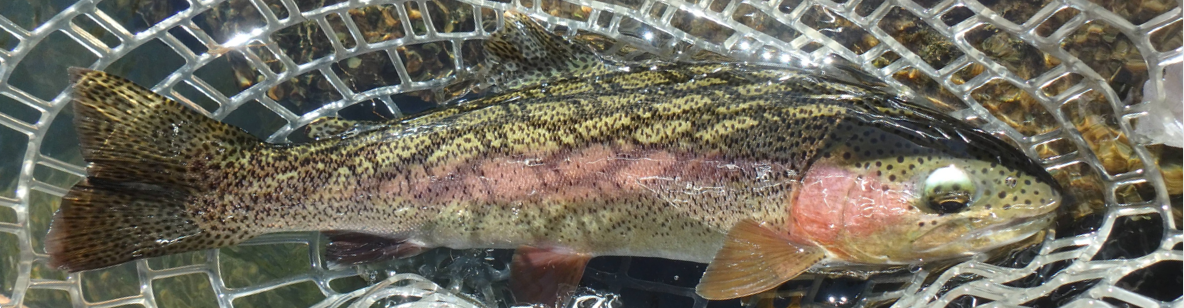
Although a time consuming hassle, I decided to make a conversion from dry dropper to a single cinnamon size 18 comparadun. As I went through this process, I glanced toward my target area, and the stream residents continued to sip duns from the surface. My heart raced as I cinched down the final knot, and I began to flick casts to the lower portion of the run. Needless to say, I was rewarded for making the changeover. I landed three gorgeous fish from this small area, including a fat seventeen inch rainbow and a hook jawed brown trout that measured eighteen inches. The brown was just a brute of a fish with wide shoulders and a large jaw, and I was amazed that it sipped my tiny size 18 comparadun.

Brook Trout Makes Trifecta

For the remainder of the afternoon I enjoyed similar success, although the three above the bridge were my only dry fly victims. The heavy cloud cover and overcast conditions persisted, and this prompted several waves of intense pale morning dun emergence. Every once in a while the sun would break through, and the dense presence of PMD’s would follow. Unfortunately I never observed additional rising fish, but it did not matter, as I returned to the dry/dropper approach, and the fish seemed to relish the salvation nymph. Sometimes it pays to fish subsurface during a heavy hatch, and this was one of those scenarios.

Mr. Stripe

I landed twelve additional trout between noon and my quitting time of 3:30. Many were twelve inch rainbows, but several more substantial striped fish were in the mix thus prompting me to snap photos. One fat bow in excess of fifteen inches with a wide scarlet band was particularly memorable. The most difficult aspect of fishing on June 23 was gaining access to the relatively scarce fish holding spots. It was impossible to wade along the edge of the river due to the high velocity current, so I repeatedly punched through the brush to the railroad bed and then moved upstream. It was very difficult to see the river through the brush, so periodically I parted the branches to reach the edge of the river where I could look upstream for attractive locales. Of course all this bushwhacking led to entanglements, sticks in the face, and net grabbing. Aside from landing twenty fish, one of my major accomplishments was avoiding breaking my rod or falling.

The Release

What a spectacular day on the Yampa River on June 23, 2016! The pale morning dun hatch endured from 11AM until 3PM, and the fish were hungry and willing to grab my offerings. Of the twenty landed fish, at least eight were in the thirteen to eighteen inch range. And all the fish were energized. I attribute the strong fights to the early season, cold water and lack of fishing pressure during the snow melt window. I returned to Denver on Thursday after my exceptional day of fishing, but I am already trying to schedule another visit before the river drops too much, and the tube traffic makes fishing during the day impossible.

Fish Landed: 20

Goodbye

Lowering to Freedom
Taylor River – 06/20/2016

Time: 10:30AM – 3:00PM

Location: Hog trough and then upstream from Lodgepole Campground area after lunch.

Taylor River 06/20/2016 Photo Album

Monday June 20, the first day of summer, was devoted to a full day of fishing. I was torn whether to fish in the popular public water below Taylor Park Reservoir, or whether to drive to the canyon water downstream near the Lodgepole Campground. Fighting crowds and catching one lunker in the hog trough is not my idea of fun, but the short section below the dam was above Lottis Creek and therefore offered lower flows.

Selecting Flies for the Hog Trough

I decided to compromise and try both. After breakfast was completed, and we packed our camping gear, Jane and I drove the short three miles required to reach the area below the dam. I pulled on my waders at the campsite, so all I needed to do was assemble my rod, and I was ready to fish. Jane lingered for a bit and took some photos, before she jumped on her bike and pedaled back to the South Lottis Creek trailhead to take a hike. I elected to walk downstream to a short section that contained a beautiful run that fanned out into a long pool. I was perfectly located between a fisherman in the slow deep pool just below the bridge and another pair of fishermen near the downstream border with the private section.

A Happy Fisherman

I began fishing with a strike indicator and a weighted Arkansas rubber legs nymph and a tiny black zebra midge. It is golden stonefly time on many Colorado waters, so I hoped that the Taylor was one of them, thus the stonefly nymph. Midges are always present on rivers and streams in the morning. After ten minutes of drifting the nymph combination along the deep center current seam, I failed to arouse the interest of any trout, and I was certain that fish were present, so I made a change. I clipped off the rubber legs and replaced it with an emerald caddis pupa, and then I swapped the zebra midge for a beadhead hares ear. Because I removed the weighted stonefly nymph, I crimped a split shot to my line above the caddis pupa for added weight.

The Big Picture

These flies also failed to interest the residents of the lower hog trough so I moved to the very top of the deep run. At this point there was a short deep pocket created by a huge submerged boulder that was positioned six feet below the beginning of the run. I flipped the nymphs into this deep hole, and on the fifth drift, the indicator paused, and I hooked and landed a small seven inch rainbow trout that grabbed the beadhead hares ear nymph. My skunking was eliminated, but this was not a trout that gave the hog trough its reputation.

Best Fish of the Day Came from the Hog Trough

The next section of water was populated by numerous large boulders, many submerged, but a large quantity exposed. It was impossible to wade into this rushing mass of whitewater, so I decided to work the edge. One-fourth of the distance along the left bank from the start of the frothy section, I found myself downstream from a narrow deep slot between the bank and a large rock that jutted into the river. I hid behind the rock and lobbed the nymphs above the boulder, and as they passed by the current break, the indicator dipped. Once again I executed a swift lift of my rod tip, and instantly it began to throb with the weight of a very angry and energized rainbow trout. The rambunctious fish eventually looped my line around a small branch just below me, but I was fortunate enough to wade a few steps and scooped the prize catch before it could break off the hares ear. The rainbow was thirteen inches in length and very chunky, and it proved to be my best fish of the day.

I continued fishing the left bank and managed one more deeply colored eleven inch brown trout on the hares ear before I reached the bridge pool. It was 11:45AM, and I was hungry, so I concluded it was a perfect opportunity to migrate downstream to the area above Lodgepole for the afternoon.

After lunch on a nice flat rock overlooking the Taylor River, I hiked along the shoulder of the road until I was below the wide pocket water area near the car. I cut down to the river and fished some nice shallow shelf pools next to a raging whitewater chute. I anticipated that the afternoon fishing would consist of fishing shallower areas, so I converted to a dry/dropper approach with a yellow fat Albert as the leading fly, and I trailed the emerald caddis pupa and hares ear.

Clear River and Green Surroundings Equals Beauty

I spent the remainder of my afternoon prospecting the relatively shallow pockets and runs with the dry/dropper. Early on I replaced the caddis pupa with a salvation nymph, and along with the hares ear and fat Albert, these flies were featured for the bulk of the afternoon. I landed seven additional fish, but I also suffered numerous foul hooked incidents. I suspect I was getting refusals to the fat Albert, and I hooked fish on the trailing flies, when I executed a hook set. I was also disappointed with the size of the brown trout that responded to my flies, as the largest was probably in the eleven inch range. The sun was bright and the air temperature rose into the eighties, and it was delightful to wade in the cool water while I felt the warmth of the sun on my upper body, but the fish apparently did not favor the warm conditions.

At 2:30 I decided to make a change, and I removed the dry/dropper flies and replaced them with a gray size 14 stimulator. A few caddis were present, so perhaps the stimulator would arouse interest while also being fairly visible in the tumbling currents. The thought was good, but it did not pay dividends. I abandoned the stimulator strategy and returned to the dry/dropper approach with a size 8 Chernobyl ant, beadhead hares ear and beadhead bright green caddis pupa. Almost instantly a twelve inch brown trout rose at the tail of a run and nipped the Chernobyl, but the connection was only temporary.

Deep Color on This Taylor River Brown Trout

That was the last interest in the foam indicator fly, but then I achieved some success with the bright green caddis pupa with several more brief hook ups and a small landed fish. By 3 o’clock I moved within forty yards of another fisherman, and Jane was relaxing in the shade near the car, so I decided to end my day. Ten fish is a reasonable fish count for four hours of fishing, but the size of the fish was disappointing. In retrospect, I should have deployed the Chernobyl ant and bright green caddis sooner, and I should have been more selective about casting locations and sought deeper bank side pockets and slots. Fishing in a river on June 20 is always a treat, and I remain pleased with my Fathers’ Day fishing outing.

Fish Landed: 10

Taylor River – 06/19/2016

Time: 6:00PM – 7:00PM

Location: .5 mile downstream from the confluence with Lottis Creek.

06/19/2016 Taylor River Photo Album

I love camping on Fathers’ Day, but I do not relish the difficulty in obtaining a campsite for the popular outdoor weekend in Colorado. Since Jane and I are retired, we devised a strategy to counter the weekend crowds and still fulfill my desire to camp and fish on June 19. I continued to monitor the flows on Colorado rivers, and I was attracted to the Taylor River below Taylor Park Reservoir which registered 325 cfs. I recalled fishing this gorgeous tailwater near the end of July and early August at 400 cfs, so I was certain that the flows documented on the DWR web site were manageable.

Huge Creature

Jane and I initiated our plan by packing the car with most of our camping, hiking, biking and fishing gear on Saturday, and we departed Denver by 9:30 on Sunday morning. We banked on the weekend campers departing on Sunday to return to their workplaces by Monday morning, and we were mostly accurate in our assessment. Since half of Sunday was spent driving, and I desired a full day of fishing, we headed directly to Crested Butte for some mountain biking. A highlight of our journey was sighting a large bull moose browsing in the willows four miles below the summit of Cottonwood Pass. I continue to be amazed by the size of these majestic creatures. The ability to hold their heads up while supporting massive antlers is also an admirable feat, and I am always surprised by the dark brown almost black color of their coats.

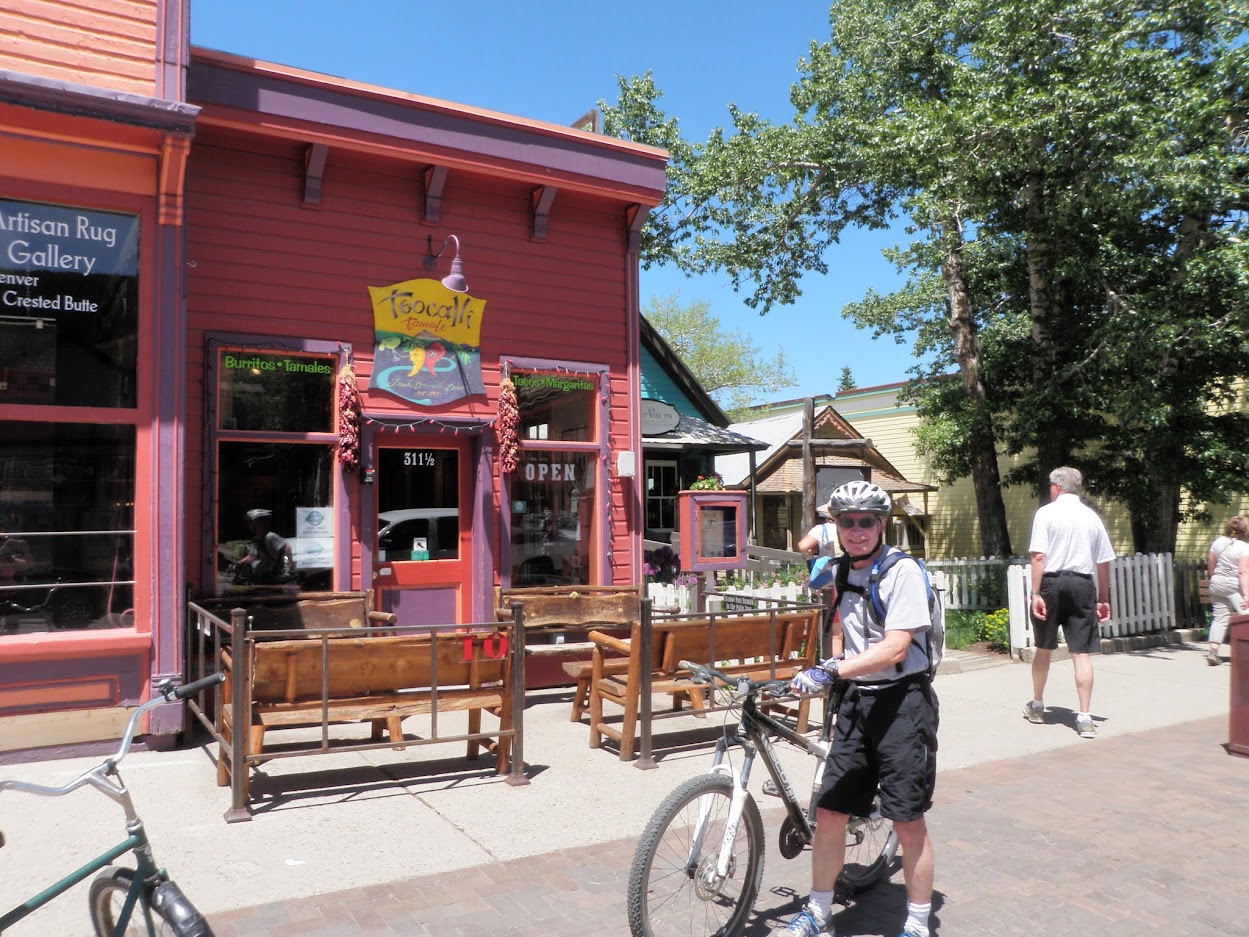
Dave’s Favorite, Teocalli Tamale

Upon our arrival in the town of Crested Butte we drove down Elk Avenue, parked and marched directly to Teocalli Tamale, where we each devoured two examples of the namesake menu item. An elk sighting and Teocalli tamales had my Fathers’ Day off to an auspicious start. After lunch we parked at the end of Elk Avenue and lowered our mountain bikes to the pavement to begin our ride. The Lower Loop trail was even more fun than we remembered from our visit just before Labor Day weekend in 2015. The trail consisted of paved road, dirt road and single track, but the difficultly level was easy to moderate, and that suited us sixty year olds perfectly.

Jane Reflects

After completing our bike ride we reloaded the bicycles on the Santa Fe and negotiated Jack’s Cabin Cutoff and returned to Lottis Creek Campground, where we snagged a nice campsite in the Union Park loop. Once the Big Agnes tent was assembled, we relaxed in our camp rockers and quaffed beers while munching snacks. After an hour or so of relaxation, Jane began to gather the essentials for a stir fry chicken meal, and at this point she discovered that she mistakenly packed frozen chicken drumsticks instead of the thawed boneless breasts she purchased for easy dicing. She was not sure the chicken would thaw in time for dinner, so I suggested we improvise with fresh caught trout and vegetable stir fry. Jane agreed that I should dedicate an hour and a half to fishing, but she also planned to pursue thawing the chicken as a safety net.

Happy Hour Arrived

I accepted the challenge, and Jane and I drove .5 mile to the first section of public water below Lottis Creek. By now the river was in shadows, so I wore my regular glasses and assembled my Sage four weight and began my quest for dinner. I tucked a plastic shopping bag in the bib of my waders in case I was successful. At this point I realized that the 325 cfs flow that attracted me to the Taylor River was a bit deceiving, as I failed to account for the additional 100 cfs being dumped into the river by Lottis Creek.

I began my search for wild trout with a strike indicator, split shot, slumpbuster and beadhead hares ear, although deploying both a weighted conehead slumpbuster and split shot was probably overkill. I worked some attractive deep pockets along the bank for fifteen minutes without success, and since the allotted window of time was shrinking, I decided to make a change. I retained the slumpbuster and swapped the beadhead hares ear for an emerald caddis pupa. I observed several caddis in the air and hoped that the emerald color of the caddis pupa would stand out and attract attention.

The ploy worked somewhat as I quickly landed a six inch rainbow that chased the pupa, as I stripped it in an attempt to activate the slumpbuster. Unfortunately a six inch fish only represented two bites for each of us, so I released it and resumed my casting with greater urgency. Another fifteen minutes transpired, when I approached a very large run and shelf pool. On the fifth drift through this deep area the indicator dipped, and I set the hook and played a chunky twelve inch rainbow into my net. Hurrah! I would not need to return to the campsite empty handed, although one twelve inch trout shared among two people was still a minimal quantity of food.

I returned my focus to the river and fished intensely for another half hour, but I was unable to repeat the magic. At 6:55 I reeled up my line and returned to the Union Park loop, where I found Jane seated in her camp rocker. She was pleased to see my prize catch, but she was also relieved that she pursued the backup plan by thawing and slicing the frozen drumsticks. I cleaned the pretty rainbow trout, and we shared it as an appetizer before devouring the tasty chicken stir fry that Jane expertly prepared. Fathers’ Day was a success for this Dad, although I did miss my wonderful children, Amy and Dan.

Fish Landed: 2


Urad Lake – 06/17/2016

Time: 10:30AM – 3:00PM

Location: Urad Wildlife Area near the inlet to the lake

Urad Lake 06/17/2016 Photo Album

During the last three off seasons I made two significant pledges that only reached fulfillment to a minor degree. First I committed to fish streamers more frequently, but my time allotted to this fishing approach fell short of my expectations. Secondly, I routinely expressed a desire to visit more lakes during the snow melt season in the Rocky Mountains. Last year I fished at Parvin Lake and Dumont Lake, and the year before I visited Palmer Reservoir. One or two lake outings does not constitute completion of my pledge. On Friday June 17 I took a major step toward realizing these two fly fishing goals.

I am a big fan of Instagram, and I follow a user who goes by the tag @flyhunter333. I noticed that he recently posted photos of trout caught in an alpine lake environment, so I exchanged comments with him, and he invited me to call him at his outdoor shop in Idaho Springs for ideas on lake fishing. I accepted his offer and called him on Thursday, and one of the options he suggested was Urad Lake. I decided to give it a try.

The forecast for Denver was a high in the low 90’s, so I looked forward to cooler temperatures at high elevation. Unfortunately Friday at Urad Lake was colder than I bargained for. Snow remained along the ridges next to the lake, and the water was frigid. By the afternoon my feet turned into frozen stumps, and I could no longer tolerate the cooling effect from evaporation of my soaked sun gloves, so I removed them. Large dark clouds constantly rolled in front of the sun, and the wind gusted at times so hard that it was impossible to cast. At noon before eating lunch I pulled out my raincoat and zipped the collar as high as it would go. An hour or so later I pulled my redneck gaiter over my head and wore it like a hat to cover my ears.

The four mile drive on a coarse dirt road to Urad Lake was passable, but it did not offer calendar quality scenery, as it traveled by mine tailings and settling ponds. But after two steep switchbacks, I arrived at a small gravel parking area below a gate. As I prepared to fish, two vehicles arrived, and a solo fisherman emerged from a pickup truck, while the other truck contained a large family with numerous young children.

Reaching the lake required a 100 yard hike on the dirt road beyond the gate, and the first half was a steep breath depleting climb. The single fisherman stopped ahead of me to chat with an angler returning to the parking lot, and this allowed me to catch up. I greeted him and quickly learned that he fished at Urad previously, so I invited myself to tag along since he knew the path to the water.

Eight people were fishing along the east bank, and a couple was situated on the opposite side of the inlet. One final solitary fisherman was spin fishing along the west bank. My new friend’s name was Chris, and we decided to fish together on the east side of the first inlet. The feeder creek split and entered in two separate channels. Chris carried his waders and not yet assembled rod to the lake, so he found a private spot in the willows to prepare to fish. I meanwhile tied on a fat Albert with a light yellow floss body, and then added a beadhead hares ear. It was not long before I experienced two momentary hookups, and then I managed to land a ten inch rainbow trout that nipped the beadhead hares ear.

First Fish from Urad Lake

Chris joined me after a bit, and he asked my advice on flies. I told him what I was using, and he opted to try a yellow parachute stimulator trailing a size 16 beadhead hares ear. Between 10:30 and noon I landed three additional rainbow trout in the 9-11 inch range. One slurped the fat Albert on the surface, and the others snatched the hares ear nymph.

New Friend Chris Lands a Rainbow at Urad Lake

I was feeling quite chilled by noon, so I began to circle around the couple on the bank by the second inlet. I targeted a space between the campers and the single spin fisherman, so I stopped by the young pair to ask their permission to fish just beyond them. As I was chatting with the bearded gentleman, I heard some rapid barking and then felt a solid pinch on my left buttock. I did not pay much attention to the dog, but Hobbs made his presence known by biting me in the butt. The young man gained control of Hobbs and was very apologetic, but in that moment I was concerned that Hobbs bit through my waders. I asked his owner to check my waders, and he assured me there was no tear, so I felt better about the incident, but the sting of the clenched teeth on my rear continued to throb.

I put this encounter behind me, so to speak, and moved to an open area on the west side of the second inlet, and I removed my backpack and ate lunch while sitting on a small rock that was a component of a primitive fire ring. While I was eating, Chris arrived, and he chose a position on a small point that protruded into the lake between the inlet and a small bay on the southwest corner of Urad. Immediately Chris began to land fish after fish, as the resident trout smashed his stimulator and grabbed his hares ear. At one point he lost the trailing nymph, and I waded over to take a look at his fly box. He asked me which fly he should use to replace the hares ear, and I pointed to a similar nymph that possessed a bit of purple flash in the body.

Between lunch and 2PM I continued fishing the area on either side of Chris, and I landed three additional rainbows to take my fish count to seven. The hares ear that served me in the morning began to unravel, so I replaced it with an ultra zug bug, and this fly produced one of the rainbows. After a bit of a lull and in a period when the wind died back a bit, I spotted two rises fifteen feet in front of me. This caused me to remove the dry/dropper configuration, and I switched to a size 16 olive brown deer hair caddis. I was confident that this fly would dupe the riser, but it did not.

I gave up on the rising fish when the wind once again resumed its angry assault on the water, as it created three inch waves and tiny whitecaps. Chris’s catch rate subsided a bit, and he ceded his spot to me while he munched a snack bar. The small deer hair caddis was nearly impossible to track in the riffled surface with sun glare, so I copied Chris’s fly choices and tied on a yellow size 12 stimulator and then returned to the beadhead hares ear nymph as a dropper.

Dave Smiles After Landing His Best Rainbow Trout on the Day

I waded until I was thigh deep and made a long cast toward the eastern shore, and after what seemed like an eternity, a slurp appeared, and the stimulator disappeared. I reacted with a quick hook set, and felt a decent bend in my five weight Sage One. Eventually I played the fish to my net, and Chris photographed my best trout of the day, as it measured twelve inches. The third rainbow landed in the early afternoon window nabbed the subsurface hares ear nymph.

My catch rate slowed significantly by 2PM, and the adverse weather conditions peaked. Since the dry fly and dry/dropper approaches were not generating hot fishing, I decided to experiment with a streamer. I removed my floating line and replaced it with a sink tip that I carried in my backpack. To the end of the sinking tip leader I knotted a slumpbuster, and then I added the beadhead hares ear as a trailer about eight inches behind the slumpbuster. I began making long sling casts and retrieved the flies with short rapid strips. Initially my energy was wasted on fruitless casts and strips, but I was enjoying the change of pace.

Fortunately on the tenth cast I felt a bump, but the initiator of the strike backed off and did not follow up with another bite. On the very next cast, however, back to back bumps occurred, and I then felt the throb of a fish. The hooked fish proved to be a small rainbow trout, but I was nevertheless excited to generate some success on my slumpbuster. In the area next to the west inlet I succeeded in landing two more rainbows using the sinking line with one taking the hares ear and another falling for the slumpbuster. I was delighted to realize that the fish counter reached double digits, and my decision to fish in a lake during the peak of run off was vindicated.

A Pretty Meateater

I was now curious if the streamer tandem could produce fish in the area between the two inlet currents, so I circled around the Hobbs territory that now contained a tent, and stationed myself east of the western entry point of the creek. I began spraying casts in all directions between the entering flows, and the fish responded. I landed five additional trout with three attacking the slumpbuster and two grabbing the hares ear. I am not sure if it was the time of day or the weather conditions, but for some reason Chris and I began to land more brook trout. Of the five fish that I landed between the inlets, three were brookies and two were rainbows.

By 3PM heavy dark clouds amassed above us, and the sun appeared very infrequently. The wind gusted unrelentingly, and my feet were mere fence posts with all feeling absent from my toes. I decided to call it quits, and Chris agreed. It was inconceivable to me that Jane was sweltering in ninety degree heat in Denver, while I shivered at Urad Lake, but when I descended on interstate 70 to the Denver metro area, my dashboard thermometer displayed 91 degrees. Colorado is a strange place.

Friday was a success on three levels. I met a fishing friend named Chris, and I partially satisfied my pledge to fish lakes more frequently. My favorite accomplishment, however, was landing eight trout on a streamer/dropper combination. I now look forward to another outing to determine whether I can repeat my streamer fishing prowess. 2016 continues to be an exciting time for fly fishing.

Fish Landed: 15

South Platte River – 06/13/2016

Time: 9:30AM – 3:30PM

Location: Downstream from Eleven Mile Canyon.

South Platte River 06/13/2016 Photo Album

Upon my return from Pennsylvania and Vermont, I was too busy catching up to consider fishing. The second week of June usually offers few options, as the rivers and streams of Colorado are usually swollen with high muddy run off, and given the average snow pack of the past winter, I had no reason to believe 2016 would be any different. By Sunday, however, I made solid headway on my list of backlogged “to do’s”, so I decided to take a peek at the DWR streamflow data.

As I expected, most flowing water options were not in play, but I was surprised to see that the South Platte River near Lake George displayed flows in the seventies. Two other tailwaters that stood out as possibilities for a fishing trip were the Yampa River below Stagecoach Reservoir and the Taylor River, but these destinations required longer trips and possibly an overnight stay. I made plans to visit the South Platte River once again on Monday, June 13. This represented my fifth trip to the Park County river, and the previous four were quite successful.

Rocks and Pockets

I arrived at the river by 9AM and quickly assembled my Sage four weight rod. I took some time to review my fly box since I put a major dent in my fat Alberts in Pennsylvania. My boat box, which I transport in the car on every fishing trip, did not contain additional fat Alberts, so I filled some open slots with pool toys and Charlie boy hoppers. By 9:30 I was ready to attack the river, and I began with a tan pool toy as my top fly, and beneath that I dangled a salvation nymph and beadhead hares ear. In the first half hour I managed to land a small rainbow and slightly larger brown trout on the hares ear, but some huge dark clouds appeared on the western horizon, and they were accompanied by the distant rumble of thunder.

By 10AM some rain began to fall from the sky and the thunder was closer, so I quickly found a place to wade to shore and climbed a bank to the Santa Fe. Just as I arrived the clouds opened, and I removed my gear and climbed into the drivers’ seat, where I watched sheets of rain descend for ten minutes. Once the precipitation dwindled to a light sprinkle, I prepared to resume my quest for trout by exchanging the pool toy for a fat Albert with a green floss body. The fat Albert is a very buoyant fly, and I wanted a top fly that could support two size 16 beadhead nymphs. I also removed the salvation nymph and replaced it with an emerald caddis pupa. Believe it or not, I found a small size 16 natural caddis with a gray body inside the car while I was waiting out the rain, and I seemed to recall that an emerald pupa sometimes matures into an adult with a gray body.

Nice Fish Landed in the Morning

I returned to my point of exit prior to the storm and began working my way upstream Suddenly the sky turned blue and the sun reappeared, and fish began to attack my nymphs. By noon I registered ten fish landed including the two prior to the storm, and all but two hammered the hares ear while the others favored the emerald caddis pupa. I approached the river with the same fast paced wade and cast strategy that worked in previous South Platte visits. The fish were smaller on average, but several of the first ten were husky twelve inch specimens.

Deep Coloration on This Brown Trout

After lunch I once again resumed my upstream migration, and this period was the most interesting phase of my day. Again some clouds blocked the sun, and this low light triggered several types of mayflies to emerge. I noticed small blue winged olives as well as a few that could be imitated by size sixteen flies. I was also delighted to view a smattering of pale morning duns. Generally PMD’s appear in decent numbers in the Deckers section of the South Platte in the middle of June, so I was quite pleased to see these size sixteen mayflies in the Lake George area on June 13.

Indian Paintbrush

The PMD observance caused me to rethink my fly alignment, and I swapped the emerald caddis pupa for a juju emerger. I conjectured that this medium olive creation would cover the larger BWO and the pale morning duns. In fact, I did land a couple trout that snatched the juju on the swing, but the hares ear continued to outproduce the second subsurface option. As I continued moving, the number of pale morning duns began to exceed BWO’s, so I once again made a swap and added a hare nation in place of the juju emerger. The hare nation is intended to copy the nymph stage of pale morning duns, and it did chip in with a few takers, but clearly the hares ear was preferred.

As these mayflies preoccupied my thoughts, the sky once again grew extremely dark and the sounds of thunder echoed across the valley. The deep reverberations were louder than the morning percussion, so I did not delay and quickly made my way back to the car as sheets of rain began to descend. I decided to use this break in fishing to move the car upstream closer to where I expected to end my day, and by the time I parked and turned off the windshield wipers, it was nearly over. The second storm sounded worse than number one, but it was much briefer and delivered less of a wallop.

Tail Wagging Rainbow Trout

The remainder of the afternoon continued in a manner similar to the morning and early afternoon, as I prospected all the likely pockets and runs with the three fly assemblage. At some point the hare nation seemed to be unproductive, and the very small BWO’s were still present, so I exchanged for a soft hackle emerger. This move landed me a fish or two, but the consistently favored fly was the hares ear nymph. By 3:30 I covered most of the attractive water, and once again some dark clouds appeared, although the threat of another storm was not imminent. Nevertheless I was weary from a day of aggressive wading and constant casting, so I called it quits with the fish counter resting on thirty.

Head Shot

During the afternoon I spotted several golden stonefly adults fluttering over the water, and I was curious if the fish might react to a dry fly. Over the last twenty minutes I fished a size ten Letort hopper with a light yellow body to see if I could attract any interest from the fish, but apparently the presence of these large insects on the water is not frequent enough for the fish to be tuned in at this early stage of the season. It was worth a try for future reference.

In conclusion I enjoyed a thirty fish day near the middle of June. I must admit that the predominant size of the fish was 6-9 inches, but I estimate that at least ten were in the eleven to twelve inch range, and that is not disappointing. I assumed that I would be fishing stillwater and managed to salvage one more decent outing on flowing water. I am thankful for the opportunity.

Fish Landed: 30