Marvine Creek – 09/20/2018

Time: 10:00AM – 4:00PM

Location: .5 – 2.0 miles from the trailhead

Marvine Creek 09/20/2018 Photo Album

I first experienced Marvine Creek last September when the upper North Fork was closed due to a wildfire. My day on the small Flattops creek was favorable, and I decided to return on Thursday, September 20. After my prior year adventure I made a mental note to fish a .5 mile canyon stretch that was a mile from the trailhead. I now realize that I failed to review my blog post from last year; and, consequently, I bypassed the canyon section. Instead I cut down to the creek after a ten minute and .5 mile hike, and this delivered me to a section of the creek downstream from the area I targeted. I suspect that the water I covered during two hours of morning fly fishing was the most heavily pressured due to its proximity to the trailhead.

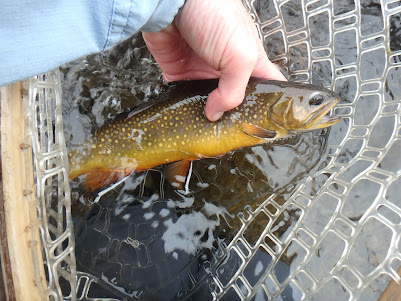
This Spot Yielded a Brook Trout

The air temperature was sixty when I began, and despite clear skies and sunshine, the high never surpassed seventy. Nevertheless I was comfortable in my fishing shirt and never resorted to an additional layer. I was surprised by the decent flows in spite of the winter drought, although I suspect that water levels were lower than September 2017.

Tough Wading

During the morning I simply continued fishing a size twelve Chernobyl ant, ultra zug bug, and salvation nymph; since my rod remained rigged from Wednesday. Between 10AM and noon I landed nine trout, and all were brookies except for one ten inch rainbow. Most of the fish snatched the salvation. After thirty minutes I exchanged the Chernobyl for a tan pool toy, as the foam ant was not attracting attention, and the small yellow indicator was difficult to follow in the shadows and glare. A few fish hammered the pool toy, but the surface fly eaters managed to escape, after they attacked the foam impostor.

Speckled Cutbow

Promising

After lunch and a lack of action in some quality sections, I decided to make an adjustment. I replaced the pool toy with a peacock ice dub hippy stomper. In addition I extended the length of the leader between the surface fly and the upper nymph, which was the ultra zug bug. The change paid off, and the fish count ballooned from nine to forty-two during the afternoon. Five netted fish, all brook trout, slurped the hippy stomper, and the remainder favored the nymphs. I estimated that 25% chomped the ultra zug bug and 75% grabbed the trailing salvation. The overwhelming majority of landed fish were brook trout in the six to nine inch range with an occasional ten or eleven inch orange bellied bruiser in the mix.

Orange Tinged Brookie

My focus remained at an elevated level throughout the afternoon with the possibility of an occasional cutbow, cutthroat, or rainbow. I landed five of these spectacular jewels in the twelve to fourteen inch range. These catches were welcome surprises, and the silver sided fighters offered significant resistance in the tight quarters of Marvine Creek. The rainbows tended to materialize in riffles of moderate depth; whereas, the brook trout frequented slower edge pockets and the tails of pools.

Easy There

Thursday was a very enjoyable day. The weather was perfect, the autumn trees were glowing, and the trout were hungry. That sums up perfection in my mind.

Fish Landed: 42


North Fork of the White River – 09/19/2018

Time: 1:00PM – 5:30PM

Location: Between Trappers Lake and the North Fork Campground

North Fork of the White River 09/19/2018 Photo Album

I departed Denver at 8:05AM on Wednesday morning, September 19, and arrived at my intended fishing destination along the North Fork of the White River by 12:30PM. As a result of my zeal to get on the stream, I hastily consumed my small lunch and assembled my Orvis Access four weight, and a short hike on a trail delivered me to a spot next to the tumbling North Fork by 1PM.

Difficult Wading Ahead

The temperature was around 64 degrees and the sky was overcast, and the cloud cover intensified as the day progressed. By 3PM I became quite chilled, so I pulled on my raincoat for the remainder of the afternoon. In spite of this extra layer I yearned for my fleece during several brief periods, when the sky darkened and the wind picked up.

Cutthroat Magic

I began my quest for trout with a gray stimulator, but after ten minutes and no action, I moved on to a tan pool toy and beadhead hares ear. This combination was also ignored, so I added a salvation nymph to create a three fly lineup. For the next hour I moved upstream, and the dry/dropper alignment began to connect. Interestingly I netted five trout during this time period, and four smacked the tan pool toy. Midway through the progression I exchanged the salvation for an ultra zug bug, and the iridescent peacock nymph produced a trout as well. In addition to the landed trout, I hooked three decent fish that managed to escape, and consistent with fishing lore, these were the largest.

Pumpkin Brook Trout

I covered a significant amount of stream real estate, and I learned that the deep slots and pockets were the most productive, and marginal water was largely barren. Among the first five catches were wild and colorful brook trout and cutthroats. I created a nasty entanglement near the end of this period, and the two front legs on the pool toy fell off in the process of unraveling the line. This circumstance prompted me to swap the two-legged hopper for a peacock body hippy stomper, and this move paid off handsomely.

Number six was a spectacular cutthroat that smashed the recently added hippy stomper; and the three fly combination of hippy stomper, ultra zug bug, and salvation nymph remained on my line from 3:00PM until 4:30PM, and they lifted the fish count from five to twenty. The catch rate accelerated with these three offerings, and during the late afternoon the nymphs took center stage, although the foam attractor continued to fool one out of every four fish.

Money

When I reached twenty, a few size sixteen mayflies made an appearance. They tumbled and fluttered on the surface in their efforts to combat the wind and become airborne. The hatch was very sparse, but I spotted four or five subtle rises in response to the emergence. I tossed the hippy stomper to a nice deep pocket, and an above average cutthroat refused the dry fly. I continued casting, and when the top fly was a few feet beyond the rejection point, I glimpsed a flash and splash. I responded with a hook set, felt momentary weight, and then the fish was gone along with three flies. What happened? I stripped the line in and discovered a curled end, and this typically indicates a poorly tied knot or abraded monofilament.

Deep Colors

I Love the Orange/Blue Halo Spots

Before this dose of disappointment I spotted a rise in the vicinity of the original refusal, and since I needed to re-rig, I decided to try a size sixteen cinnamon comparadun, in case the rise was a response to a sparse pale morning dun hatch. I flicked a cast across from my position and allowed the very visible comparadun to drift through the tail of the pocket. Nothing. I repeated the ploy two more times, and on the third pass a head appeared, and the dun disappeared in a swirl. I reacted with a swift hook set, and eventually guided a gorgeous cutthroat into my net. I removed the comparadun, and before I snapped a photo, I noticed something glittering in the fish’s cheek. I inspected more closely, and I discovered my ultra zug bug and salvation nymph embedded in my hungry catch! I caught the same fish that broke me off minutes earlier!

More Pockets to Pick

I continued with the comparadun, and it produced a small brook trout, but then I advanced to some faster water, and this created visibility problems, so I returned to the dry/dropper method. For the last half hour I tossed a size twelve Chernobyl ant combined with the ultra zug bug and salvation, and I boosted the fish count to twenty-five.

Wednesday provided a fun 4.5 hours of fishing with excellent results. Fall certainly arrived in the Flattops.

Fish Landed: 25


South Platte River – 09/06/2018

Time: 10:30AM – 3:00PM

Location: Eleven Mile Canyon within a mile of the dam

South Platte River 09/06/2018 Photo Album

If fishing success is measured by long hatches and copious quantities of ravenously feeding fish, then Thursday ranked high on the scale. On the other hand if success depends of feeling the weight of an abundant quantity of fish in one’s net, then September 6, 2018 was a disappointment. A three hour spinner fall and abundant pods of eagerly feeding trout caused me to place my outing on the South Platte River in the positive column. The variables were present for a banner day in Eleven Mile Canyon, but this fisherman could not deliver the desired flies or the necessary presentation.

Leaves Begin to Change

I met my friend, Steve, at 7:30 in Lone Tree, and we departed for the South Platte River in Eleven Mile Canyon. An uneventful drive enabled us to pull into a circular parking spot at the first bridge below the dam by 10AM, and we quickly donned our waders and rigged our rods. I anticipated some larger than average fish, so I opted for my Sage four weight, although I realized that the nine foot length would likely apply additional stress to my ailing elbow.

A Huge Mat of Aquatic Weeds

We crossed the dirt access road and met the river above the bridge. A long moderately deep run was next to our position, and this is one of Steve’s favorites, so I elected to retreat back to the bridge. The water just above the bridge was reasonably deep and flowed at a moderate pace, but a thick mat of long aquatic vegetation flourished across the entire width of the river. No fish revealed themselves, and it was impossible to spot targets among the long green waving growth.

I tied a Jake’s gulp beetle to my line and trailed a RS2, in case the trout were on the alert for trico nymphs, but after ten futile casts I moved on. I decided to explore the right bank and walked up the Spillway Campground access road, until I was across from and slightly above Steve. I began to flick the light two fly dry/dropper to gaps in the weed growth as well as the faster moving riffles at the top of the pool. The fish were ignoring my offerings, and while this scenario transpired, a few sporadic rises appeared along the current seam near Steve.

I surmised that perhaps the surface action was attributable to emerging tricos, so I snipped off the two flies and replaced them with a size 24 CDC blue winged olive. This was the closest thing I had to a trico dun. I executed some nice across and downstream drifts and managed to connect with two fish for a split second, but then the trout began to shun my tiny speck of a fly. Either they wised up to my fake, or they shifted to a new menu item.

I abandoned the area across from Steve and moved upstream along the right bank a short distance to a quality deep pool next to and below the main current, after it flowed around a sharp bend. Another angler was present just beyond the bend on the opposite side of the river, but I concluded there was plenty of space. I paused and observed, and I was very pleased to notice a quality rainbow in a deep depression next to the bank no more than eight feet from where I stood on some large jagged rocks. As I cautiously observed, the pink striped trout casually finned to the surface and sipped a tiny morsel of food on a fairly regular basis. I cast my CDC olive over the subtle riser several times, but it totally ignored the fluffy dry fly and focused on other specks of food.

This pattern of frustration continued for ten minutes, and then the river came alive with more sipping fish. Five trout in a short pool fifteen feet below me revealed their presence, as they engaged in the feeding ritual, and then after another ten minutes the deep pool above me revealed another pod of active surface sippers. A glance at my watch revealed that it was eleven o’clock, and the preponderance of sipping trout could only mean one thing…the trico spinner fall was in progress.

A few tricos fluttered by occasionally, and I determined that they were extremely small, so I opened my fly box and scanned my supply of trico spinners. The row of foam contained eight sunken trico imitations and six poly wing spinners constructed to fish in the surface film. I plucked a size 22 poly wing version from its slot and knotted it to my line, and I began to drop casts and drifts among the many feeders surrounding me. Initially I targeted the rainbow near the bank, but after a severe lack of interest, I shifted my focus to the risers downstream. Twenty minutes of unproductive casting forced me to shift my attention back to the area above my position, and an active pod of risers entertained me for another frustrating period of time.

The rainbow continued to feed nearby, and it was joined by a larger brown trout that moved from side to side and rhythmically floated to the surface to sip on a regular basis. My heart rate elevated at the thought of tangling with one of the two nearby prizes. I struggled to follow the minute trico spinner on the longer upstream and downstream casts, so I decided to focus my efforts on the close by feeders. The brown trout seemed wise to my fraud, but finally the rainbow threw caution to the wind and sucked in my trico! I raised the rod and set the hook, and this had an effect comparable to lighting a firecracker. The silver missile instantly streaked downstream, and before I could utter “rainbow trout”, my line went limp. I stripped in the leader to inspect the end, and I discovered that the spurting fish parted the line at a surgeon’s knot connection.

I dipped into the fly box and removed another size 22 trico spinner; however, this fly got snapped off while casting in my zeal to pepper the river with repeated drifts. I was depleting my supply of trico spinners, and the spinner fall showed no signs of abating. The young man that was initially around the corner had by now moved to a position within view, and he was generating more success than Steve or I.

I sorted through my remaining supply of spinners and found one that was probably a size 24, and I determined that it was my one and only of the smallest size. An angler that I follow on Instagram suggested that I tie some size 24’s with only a black thread body and a small tuft of CDC for a wing. He raved about the performance of this simple and quick to tie trico imitation in Eleven Mile Canyon, and now I rued my decision to delay my response to his recommendation.

Fat Stub

I renewed my vigorous casting regimen and directed my attention to the pod of active feeders fifteen feet above my rocky platform. I was rarely able to track the tiny poly winged speck, but finally I saw a rise in the area, where I surmised my fly to be. I quickly lifted the rod tip and felt a solid connection with a writhing form. Could this be real? It was, as I quickly stripped up slack and then battled my first fish, while I cautiously negotiated a few steps, until I was standing in the edge of the river. My net scooped the fish, and I was amazed to discover an eleven inch brown trout; however, this was the fattest eleven inch trout that I ever witnessed. The shape of this cold water fish was akin to a bluegill or sunfish! I was not complaining, however, as I finally tallied a landed fish after more than an hour of futile casting and several fly changes.

Another Fly Change

At some point in the midst of this frantic casting I pricked the back of the prize brown trout, that I described earlier in this report, so the two nearby targets presumably moved their chowing act to another part of the river. I refreshed my size 24 trico and renewed my quest for South Platte River trout. Again I directed my casts to the area upstream, and again after a substantial quantity of unproductive drifts, I saw a rise in the vicinity of where I estimated my fly to be. I swept the rod tip upward, and a wild rainbow trout leaped into the air. Once it crashed back in the river, an adrenaline rush caused repeated surges and spurts, but I concentrated on the fight and managed to slide it into my net. The silver sided river resident measured fourteen inches, and I snapped a few photos, before it bolted back into its natural environment.

Purple Stripe

Another period of futile casting followed my second catch and release, and I began to ponder the effectiveness of a sunken dropper. Some of the visible fish rarely rose, and I suspected that they were snatching sunken tidbits below the surface. I removed the trico spinner and replaced it with a Jake’s gulp beetle and a sunken spinner on a 2.5 foot dropper. I allocated ten minutes to this tactic, but both flies were ignored so I contemplated another change.

I liked the visibility of the beetle with the orange foam indicator, so I kept it in place and replaced the sunken trico with an unweighted version. The move proved somewhat effective, as two fish grabbed the trailer and caused the beetle to dart. Unfortunately I should have used a shorter tippet, because the lag from when I saw the beetle move, until I set the hook was excessive, and both fish escaped after a brief hook prick.

I persisted with the double dry for an extended time after my brief dose of success, but for some reason the fish grew wise to the ruse. The number of rising fish began to dwindle, as I returned to a single size 22 trico spinner, so I glanced at my watch, and I was dumbfounded to learn that it was 1:30PM. Was it possible that I fished to a trico spinner fall for 2.5 hours? Did time really fly by that fast? I decided to surrender to the by now jaded trout surrounding me, and I circled back down the road and crossed the bridge and joined Steve.

We both expressed hunger, so we returned to Steve’s Subaru and consumed our lunch. After lunch I asked Steve about the river downstream from the bridge, and he suggested that we check it out. We traveled along a well worn path and intersected with the river, where it was wide and smooth with a deep channel flowing along the opposite bank. Steve moved upstream to fish a deep run next to some large bank side boulders, and I directed my attention to the area across from where I was standing. I looked up and down the river, and after a bit I observed a single rise ten yards downstream. I moved along the shoreline a bit and began to fire casts to the area of the rogue rise.

Steve Moves Upstream

The fish did not respond, but I noticed a pair of rises farther upstream, so I migrated to a position across from the fresh evidence of feeding. I repeated the across stream casts, but again my efforts were thwarted by the failure of South Platte River fish to respond. My confidence sank to new depths, when I noted another rise downstream somewhat above the ring that initially caught my attention. I held very low expectations, but nonetheless I lofted a cast above the point of the rise and fed out line to allow a drag free downstream drift. Wham! A near miracle occurred, as a fish crushed the slowly drifting trico spinner. I quickly set the hook and felt two heavy throbs, and then the surprise responder to my cast slipped free. Needless to say I was quite disappointed to lose the unexpected feeder.

When Steve and I reached the run and riffles below the bridge, we adjourned to the car and drove downstream to the parking space on the north side of the twin tunnels. We slid down the steep bank, and Steve prospected the quality pool, while I explored the two channels that split around a narrow island just above Steve’s pool. I converted to a yellow fat Albert, beadhead hares ear, and RS2; but despite some focused fly fishing, I was unable to summon interest from the river residents. When I reached the quality riffles stretch above Steve and the deep pool, I swapped the RS2 for a salvation nymph, but the change was met with similar disinterest.

Some dark clouds rolled in from the southwest, and they were accompanied by some streaks of lightening and the sound of thunder. Given our lack of action and the threat of an electrical storm, we hooked our flies to the rod guides and scaled the steep bank and departed for Lone Tree and eventually Stapleton Denver.

Two and a half hours of intense feeding is a rare experience, and I was thankful to participate. I only managed to land two trout, both quality fish, but I can only blame myself for not having better imitations. Conditions were perfect for landing more and larger trout, and I failed to capitalize.

Fish Landed: 2
Boulder Creek – 09/05/2018

Time: 10:00AM – 2:00PM

Location: West of Boulder, CO

Boulder Creek 09/05/2018 Photo Album

I completed errands on Tuesday and attended my physical therapy appointment, and this positioned me for my first day of fly fishing in September 2018. September is generally my most productive month, and with my son Dan’s wedding scheduled for September 14, fishing days were not on the calendar during the forthcoming week.

I was reluctant to undertake a long trip, so I settled on Boulder Creek in the canyon west of Boulder, CO. I also considered the Big Thompson River and Clear Creek, but I was intrigued with the possibility of plopping terrestrials in a canyon setting. Flows were in the 30 CFS range, and I gauged this to be nearly ideal for early September.

A Good Place to Begin

I departed Denver by 8:45 and arrived at a pullout along Boulder Creek by 9:40AM. As I traveled along the creek, I was concerned with the cloudy state of the water, so I stopped four miles up the canyon for a closer look. My inspection confirmed a level of turbidity, but visibility was good to three feet, and given the small nature of the drainage, I concluded that conditions were acceptable. The clarity improved considerably as I traveled west, and after an hour of fishing, murkiness became a non-issue.

I walked downstream along the shoulder of Canyon Boulevard for .2 mile, and then I angled down a steep bank to the edge of the creek. I began my quest for trout n the canyon with a Jake’s gulp beetle, and the first two plops initiated successive temporary hookups. I was pleased with the quick response, but I was also disappointed with my inability to stay connected. My optimism surged as I dropped a few casts in the next plunge pool downstream, but my beginners’ luck would not repeat.

I was about to reverse my direction in order to progress upstream, but I gazed down the canyon, and I was drawn to a series of plunge pools farther east, so I scaled the bank and ambled along the highway for another .1 mile and then repeated my careful descent. Another ten minutes of beetle plopping failed to interest the trout, so I reevaluated and made a change. I exchanged the foam beetle for a hippy stomper with a peacock dubbed body, and beneath the attractor I added a size 14 beadhead hares ear on a thirty inch dropper.

Shimmering Orange Spots

The two fly dry/dropper combination served me quite well, and I built the fish count to fourteen over the next two hours, before I broke for lunch slightly before noon. Two out of every three fish nabbed the hares ear, but an ample quantity of eager brown trout also crushed the hippy stomper on the surface. I adopted the practice of applying floatant to the body as well as the antron wing, and gooping the wing improved the visibility of the fly noticeably. The process of prospecting and moving quickly up the canyon was very enjoyable, and the trout of Boulder Creek were very cooperative.

Sleek

During my entire day the sky was mostly cloudy with only a few brief periods, where the sun broke through. The temperature remained in the sixties, and I wore my raincoat for warmth throughout the four hours. Although rain seemed like an imminent possibility, I never felt a drop, until I was removing my waders at the end of the day.

Appealing Shelf Pools

After lunch I continued with the hippy stomper and hares ear and built the count to twenty, and at this point I decided to experiment with different combinations. First I cycled through a series of changes to the dropper fly, as I tested a salvation nymph and ultra zug bug. The salvation fooled one fish, but after a reasonable trial period I concluded that it under performed the hares ear.

The takes of a Jake’s gulp beetle at the outset of my day made an impression on me, so I reverted to the beetle, but it never induced as much as a look. I concluded that dry/dropper was the approach of choice on Wednesday, so I adopted a three fly dry/dropper configuration. This time I knotted a size 12 Chernobyl ant to my line and then added the beadhead hares ear and an amber body caddis pupa. The hares ear enabled me to increment the fish tally by two to twenty-two, and the Chernobyl provoked a number of refusals and temporary hook ups.

Cascading Creek

I approached a nice pool and observed a few sporadic rises, which I attributed to a blue winged olive hatch. I swapped the caddis pupa for a size 22 RS2, and continued my upstream quest for trout. I expected action on the droppers, but a small brown trout responded to the Chernboyl, and I was both pleased and surprised by this circumstance. A pair of brief taps by trout on the lift gave me hope that the RS2 was in demand, but the small nymph never yielded a trout.

As two o’clock drew nearer, the sky grew increasingly dark, and I spotted a couple caddis, as they dapped the surface of the creek. I intended to quit a 2PM, at which point I needed to remove my three flies, so it was not a huge commitment to take that action early in order to experiment with a size 16 gray deer hair caddis. The ploy paid off somewhat, as I landed a small brown trout on the caddis adult just before I called it a day.

As expected Wednesday’s action consisted almost entirely of small brown trout in the 6 – 10 inch range. The Chernobyl ant and salvation nymph accounted for two fish that made it to my net, and the remaining twenty-two favored the hippy stomper and beadhead hares ear in a ratio of two hares ears for every hippy stomper. Carefree casting to relatively small eager brown trout was what I hoped for, and the results lived up to expectations.

Fish Landed: 24

Frying Pan River – 08/29/2018

Time: 10:00AM – 3:30PM

Location: Below Reudi Reservoir

Frying Pan River 08/29/2018 Photo Album

A slow day that yielded small fish had me considering alternatives for Wednesday, August 29. I tentatively settled on the upper Frying Pan above Reudi Reservoir, as I dozed off in my comfortable sleeping bag. I reasoned that the feeder stream and smaller fish would at least provide a faster pace, and I presumed that I would have the area to myself during the middle of the week. Most fishermen treat the Frying Pan tailwater as their dream destination, and they ignore the small fish above Reudi.

As I finished packing my camping gear on Wednesday morning, however, I experienced a change of thinking. The freestone section of the Frying Pan would offer even less in the way of hatches than what I observed on Tuesday on the tailwater, and this circumstance might translate to difficult fishing in low water conditions for small fish. I also reasoned that I drove four hours from Denver to fly fish the fabled Frying Pan tailwater, and I probably needed to give it a second chance. Perhaps the slow fishing on Tuesday was attributable to a change in the weather, and an extra day of stability would usher in more consistent hatches. Since I camped at Little Maude at Reudi Reservoir, I was merely two miles from the sought after water just below the dam, and I knew from a trip in May, that a high density of larger than average trout called this area their home.

A Guide and Clients Took My Spot

I turned on to the dirt road that accesses the upper Frying Pan, and I continued along the north side of the river. It was immediately apparent that quite a few other fishermen had the same idea, as all the prime spots, that I envisioned as my starting point, were occupied with early risers. I was disappointed, but I continued downstream on the paved road to check out the premium locations between mile marker (MM) 11.5 and 13. The possibility of finding an open stretch away from competing anglers improved, however, quite a few vehicles occupied the many pullouts along the way.

Yummy Shelf Pool

After assessing the upper four miles, I executed a U-turn and settled into a nice wide pullout .3 miles above the downstream boundary with private water. The air temperature was in the low sixties, as I slipped on two pairs of socks and climbed into my waders. The thicker grip of the five weight had an impact on my tennis elbow condition on Tuesday, so I elected to use my Sage four weight on Wednesday. The Sage was longer than the Loomis five weight with a narrower grip, yet it possessed a stiffer backbone than my Orvis Access four weight in case I tangled with a larger than average trout. In spite of Tuesday’s disappointment I harbored some optimism for a second day on the Frying Pan River.

Looks Appealing

I walked down the road to the long pool where a fallen tree forms a semi-dam, but a guide and two clients claimed the side of the river opposite the road. I retreated back toward the car and slid down the bank just above a long fast chute, where the river splits around a long narrow cluster of tiny islands. I knotted a yellow fat Albert to my line, and then I added the ever-present beadhead hares ear nymph and a salvation nymph. I began casting to the nooks and crannies around the small islands, and within ten minutes I hooked and landed a ten inch brown trout that displayed deep coloration and vivid markings.

Cube Rock Pool

This approach became my mode of operation for the remaining time on the river. I experienced very little success in the large attractive pools, and most of the landed trout materialized from obscure lies along the bank or smaller midstream pockets. Two periods deviated from this approach, and I will describe them later. During the course of my dry/dropper prospecting I made several changes. During the morning I exchanged the hares ear for a size 14 prince nymph in an attempt to imitate the underwater stage of a green drake. The large nymph picked up a couple small fish, but it was not a highly sought after menu item. I also swapped the yellow fat Albert for a peacock body hippy stomper, and this conversion prompted me to abandon the prince nymph for an ultra zug bug. The salvation sacrificed its position on my line for a size 18 pheasant tail nymph in an effort to simulate the nymph stage of pale morning duns, but again the move proved ineffective. The ultra zug bug and hares ear nymph occupied my line for the longest time, and each accounted for a fair share of trout.

My What Spots

I progressed from my starting point to MM12, and then I reversed my direction and investigated the smaller left channel, where the river splits around a long slender island. On my way upstream I covered the south braid, so I was now interested in surveying the channel closer to the road. Typically this branch carries lower flows and provides more challenging fishing. On Wednesday I managed a refusal in the lower pool section, and then I netted a ten inch brown in the upper pocket section. I continued until I reached the abundant series of pockets scattered above the island, and I paused to observe. It was around 2PM, and I previously covered this area quite thoroughly on my dry/dropper search, so I was not optimistic regarding my prospects on the second pass.

Fifteen Inch Rainbow Made My Day

As I scanned the deep curled pocket directly above the point of the island and next to the roadside bank, I was shocked to see a fish, as it elevated to sip an unidentifiable object from the surface. I peered into the tail of the pocket, and I was sure that the feeding fish was a very nice rainbow trout. As this transpired, another sizable fish hovered a foot below the surface, and it too snatched a drifting bug along the current seam, where the river swirled around an exposed boulder at the upstream end of the curled pocket. My heart rate accelerated with this fresh sign of surface feeding by larger than average trout.

Now I needed to determine what these feeders were consuming. I paused and observed the air space above the river, and several medium size mayflies made an appearance. They were too small for a green drake but larger than a blue winged olive, although I spotted several baetis as well. I quickly removed a size 18 cinnamon comparadun from my fly box and dropped several nice drag free drifts over the rainbow at the tail of the small pool. No luck. The trout twitched its tail and rose a bit but then resumed its normal holding position. What should I try next? Normally I downsize, but my hunch in this instance was that the pale morning duns were larger than a size 18. I clipped off the size 18 PMD and replaced it with a size 16 cinnamon comparadun. I applied a generous quantity of floatant and preened the wing to a nice vertical position, and then I dropped a cast four feet above the target rainbow. I held my breath as the sighted fish slowly elevated and drifted under the fly, and then at the last minute it turned and ate!

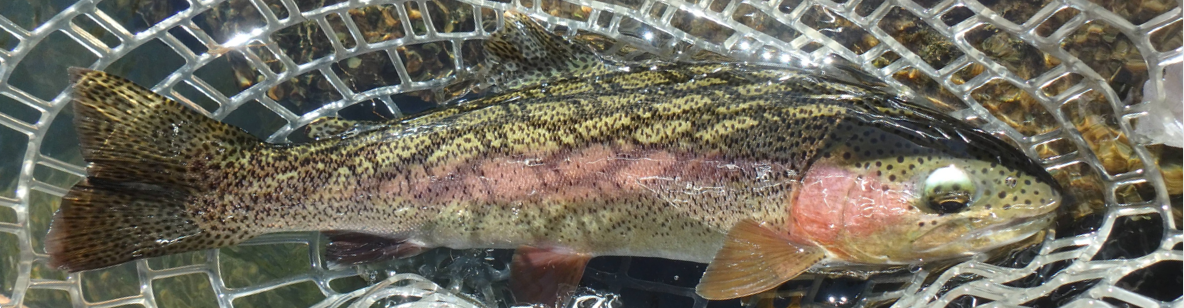
I was dumbfounded. I quickly lifted my rod and set the hook, and the rainbow went into intense escape mode. I held tight, eliminated slack and cautiously waited for the thrashing fish to tire. When I concluded that the battle was complete, I slid my net beneath a gorgeous fifteen inch rainbow. I removed the comparadun and snapped a photo, while the pink striped beauty rested in my net, and then I lifted and lowered it to the river, and it was gone in a flash. Was this the beginning of an intense hatch and reckless feeding binge by large Frying Pan trout?

In short the answer was no. I disturbed the active pocket, so the other fish in that vicinity stopped their feeding and retreated to safety. I scanned the other pockets in the area, but I was unable to detect surface rises. Perhaps the pool below the large cube rock on the south braid had come alive? I slowly waded along the edge of the river, but when I arrived at the pool, it was devoid of surface action. Next I carefully waded along the inside edge of the island to the bottom and then crossed to the north branch and once again moved upstream. Again I found no evidence of a hatch or actively feeding trout.

It was now 3PM, and I was reluctant to believe that the brief fifteen minute feeding episode in the pocket above the island was the extent of Wednesday’s hatch. I decided to check out the long pool near the private boundary that was occupied by a guide and two clients at the start of the day. I was pleased to discover that it was vacant, so I stood on the bank and observed. It took awhile, but eventually I noted several sporadic rises. I positioned myself at the tail and made several cross stream casts to no avail. I once again paused, and now I noticed more activity in the moderate riffle on the opposite side of the pool, so I crossed above the fallen tree and positioned myself to cast in the neighborhood of the rises.

Small Pool Produced

For the next half hour I cast pale morning dun imitations and green drakes to the quality shelf riffle and center run seam, but I was unable to generate a single hook up. I spotted two green drakes, as they recklessly tumbled on the surface in an effort to dry their wings to become airborne, and this prompted me to test a parachute and comparadun imitation, but each could do no better than provoke a refusal from a ten inch brown along the center current seam.

At 3:30PM even the sparse random surface activity dwindled to nothing, and modifying my configuration for dry/dropper was not appealing. I was weary and faced a long drive to Denver, so I hooked my fly in the rod guide and returned to the waiting Santa Fe.

I accumulated sixteen landed fish on Wednesday, but aside from the fifteen inch rainbow and one or two twelve inch brown trout, the rest were small browns in the six to ten inch range, and at least six of the small fish were heavily weighted toward 6-7 inches. The hatch was sparse and brief, and I was frankly disappointed with my two days on the Frying Pan River. The upper water near the dam was crawling with anglers, and even the lower portion of the upper four miles contained a fair amount of competition. Unlike most previous ventures to the Frying Pan, large fish were absent, and I never sighted fish other than the risers during the brief hatch. The flows were a constant 181 CFS and cold and crystal clear. The daytime highs were in the middle to upper seventies. The wind was an annoyance both days, but never a show stopper. I am at a loss to understand why the two days at the end of August 2018 were so lackluster. The Frying Pan River has always ranked as one of my favorites due to the consistent hatches of green drakes, pale morning duns and blue winged olives. Where were they during August 28 and 29?

Fish Landed: 16


Frying Pan River – 08/28/2018

Time: 12:00PM – 4:30PM

Location: Folkstead Spring

Frying Pan River 08/28/2018 Photo Album

There is no denying that I had high expectations, and I was disappointed with my first day of a two day fly fishing trip to the Frying Pan River. I am repeatedly attracted to the Pan because of the consistent hatches in an intimate tailwater environment. An explanation for my subpar day on August 28 is difficult to formulate. A drop in air temperature occurred on Monday night, and generally this results from a cold front or high pressure system. Historically I have not experienced many solid days of fly fishing the day after a front moves through an area, so perhaps Tuesday’s results were attributable to this weather situation.

The Frying Pan River

I left Denver at 7:30, and this enabled me to arrive at the wide parking area by Folkstead Spring by 11:30. By the time I climbed into my waders and rigged my Loomis five weight, I was ready to fish. Another angler arrived, as I was gearing up, and he asked which direction I was heading. I intended to go downstream a bit, but his presence caused me to start directly across from the spring.

I launched my day with a size 14 parachute green drake, as I hoped that the fish were accustomed to seeing the large olive mayflies. It did not work. I prospected for twenty minutes with nary a look, so I migrated to a tan pool toy with a beadhead hares ear, and a salvation nymph. This combination was also not effective, although I did manage to net a six inch brown trout to eliminate the possibility of a skunking.

As the start to my day was evolving, a different angler charged across the quality run thirty yards upstream, and he began working along the right bank. He appropriated my intended path! Some undisturbed quality water remained, before I overlapped with my nemesis, so I continued, but the lack of response to my dry/dropper offering caused me to revert to the parachute green drake. I noticed a sparse number of blue winged olives in the air, so I concluded that the water temperature elevated enough to generate increased mayfly and trout activity.

Nice Early Catch

Before tying a tiny blue winged olive fly to my line, I decided to go large. The strategy paid off, when a gorgeous rainbow inhaled the green drake in a long deep trough in the center of the river. The striped stream resident measured fourteen inches, and I was quite pleased with this fortuitous turn of events. Eventually I would discover that this was the highlight of my day.

I conjectured that perhaps I reached a turning point in my day, but despite some scattered refusals, the drake could not repeat its magnetic impact. I downsized to a size 18 light gray comparadun, when I observed some pale morning duns, but only a refusal or two resulted from this change. Next I stepped up to a size 16 comparadun, as the visible duns appeared larger than the size 18 on my line. Again I was thwarted.

Button Flowers

I now speculated that the trout were following through on blue winged olive emergers, so I switched to a pool toy, salvation nymph and RS2. It was a great idea, but it appealed to fishermen and not to fish. I also experimented with a 20 incher to imitate a green drake nymph during this phase, but this ploy was yet another disappointment.

Finally I progressed to a point where the river morphed into a fast water chute, and the only attractive locales were pockets along the right bank, and this was water that the upstream angler disturbed. I abandoned the spring area and walked downstream a considerable distance, and I reverted to the parachute drake. The green drake provoked a pair of refusals along a band of slow water next to the bank, so I once again forsake the dry and returned to a dry/dropper. The water ahead was fast and consisted of a large quantity of pockets and deep runs, and these conditions are more suited to the dry/dropper approach.

A Bit Larger. Salvation in Lip

During the 2-3:30PM time frame I cast a yellow fat Albert, hares ear nymph, and several versions of a pheasant tail nymph. I finally earned some consistency and built the fish count to ten. Unfortunately this included three more browns in the 6-7 inch range, but also a muscular thirteen incher joined the mix along with some wild browns in the 10-12 inch range.

Hops Blossoms

By 4PM I found myself across from the spring again, but the less than torrid catch rate subsided to inactive status. I jumped in the car and moved to mile marker 12, where I made a feeble effort to add to my fish count. It did not work, and I abandoned my efforts at 4:30 and secured a campsite at Little Maude.

Tuesday may have been my slowest outing ever during the July – October time frame on the Frying Pan River. I applied considerable effort to my approach during the afternoon to reach double digits, but the size was lacking. Consistent hatches of green drakes, pale morning duns, and blue winged olives are the hallmark of the Frying Pan River, but they were absent or meager compared to historical standards on Tuesday.

Fish Landed: 10


Clear Creek – 08/24/2018

Time: 10:30AM – 2:00PM

Location: Within one mile east of Tunnel 2

Clear Creek 08/24/2018 Photo Album

Jane and I had tickets for the Cardinals vs Rockies game on Friday evening, so my fishing options were limited to relatively close destinations. The closest choice was Clear Creek, so I made the short drive to the narrow canyon west of Golden, CO on Friday morning. Traffic was flowing reasonably by the time I left the house around 9:30AM, and I arrived at a very wide pullout on the south side of US 6 east of Tunnel 2 by 10:15.

Hot Sunny Day on Clear Creek

The high temperature for Denver was projected to reach ninety degrees on Friday, so I elected to wade wet, and this decision proved to be appropriate. I rigged my Orvis Access four weight for small stream fishing, and I ambled along the shoulder of the highway for .2 miles, until I found a reasonably safe spot to negotiate the steep rocky bank to the creek.

Jake’s gulp beetle historically yielded excellent results on Clear Creek, so a size 10 foam terrestrial became my first fly choice. I lobbed it to likely deep spots, and I observed a few looks, but the trout failed to open their mouths, before they dropped back to the stream bottom. Unwilling to deepen my frustration, I switched to a size 16 gray deer hair caddis, and this matched the small naturals that covered the streamside boulders.

Very Nice Brown Trout for Clear Creek

My move was immediately confirmed as a winner, when I tossed the caddis to a deep hole below a large exposed boulder situated along the bank. As I looked on, a decent brown trout slowly elevated to the surface and sipped the caddis impostor. Needless to say I was very pleased. I methodically worked my way upstream along the left bank and added another representative brown that was quite nice for Clear Creek but smaller than the first netted fish. A pair of smaller brown trout followed, but then a series of refusals ruined my state of fly fishing bliss.

The water type shifted to fast runs and deep pockets, and I speculated that perhaps the Jake’s gulp beetle might be more effective and surely more visible, so I made the switch. Initially the foam beetle accounted for fish number five, but then it lapsed into another ignored or rejected dry fly. At this point I paused for lunch in a rare shady location overlooking a gorgeous run and pool. The deep center run cut the pool in half and created two very attractive shelf pools on each side.

After lunch I extended the leader by eighteen inches, and I exchanged the Jake’s gulp beetle for the size 16 deer hair caddis that provided success during the morning. By now the sun was directly overhead, and its rays beat down on the river and anyone attempting to fly fish in the canyon. Apparently the fish were affected as well, because the same caddis that yielded confident takes in the first 1.5 hour now provoked tentative looks at best. I persisted, however, under the mistaken belief that the right spot along the bank would yield positive results in spite of the bright blue sky and soaring air temperatures.

First and Best on Deer Hair Caddis

After an hour of dry fly frustration I decided to try one last approach before I surrendered to the heat and exited the canyon. I tied a size 12 Chernobyl ant to my line and added a beadhead hares ear as a dropper. Initially I cast this combination to similar locations as those prospected with the dry flies, but after another lull in action, I began to focus on faster deep runs and frothy sections at the top of pockets and riffles. A small brown trout grabbed the hares ear, and my method was finally vindicated.

I moved along and experienced a couple momentary hook ups, but then the small yellow indicator on the Chernboyl began to twist around on the underside of the body. The top fly was not drifting topside up, so I replaced it with a size 14 chubby Chernobyl with a brown body. With the more buoyant surface fly I added a second dropper in the form of a size 16 yellow caddis pupa. I continued to target the faster aerated spots in the creek, and the deep nymph approach paid dividends, when two brown trout mashed the caddis pupa, as it began to swing at the end of the drift.

Smaller but Appreciated Brown Trout

Just before two o’clock the chubby paused in the middle of a current seam, and I responded with a quick hook set, but after feeling some weight for a split second, the line went limp. I stripped in the line and discovered that the hares ear and caddis pupa were missing, as apparently I tied a bad knot between the chubby and the upper nymph. I was within minutes of when I planned to quit, so rather than undertaking the task of tying two replacement flies to my line, I climbed the very steep rocky bank to the highway and paced back to the Santa Fe.

Late August is typically a slow time for fly fishing in Colorado on freestone streams, and the hot weather added to the challenge, so I was pleased to land eight trout in 3.5 hours of fly fishing on Friday. Hopefully I have more time next week, and that will enable some longer trips to tailwaters in Colorado.

Fish Landed: 8


South Boulder Creek – 08/22/2018

Time: 11:30AM – 3:30PM

Location: Below Gross Reservoir

South Boulder Creek 08/22/2018 Photo Album

Jane and I returned from Wyoming and Montana on Monday, and that was a bit earlier than planned. I caught up on some chores on Tuesday and cleared the calendar for a day of fishing on Wednesday. Since my outstanding visit on 08/09/2018 to South Boulder Creek, I was aching to return, in case the green drake activity intensified. Wednesday, August 22 would be that day.

I delayed my departure until 9:10AM in order to check on an issue at a store, when it opened at 9:00AM, and this enabled me to arrive at the kayak parking lot below Gross Reservoir by 10:30AM. Three other vehicles occupied the parking lot, and two fishermen were about to embark on the trail, as I threw on my waders and assembled my Orvis Access four weight. The air temperature was in the low 60’s, as I took my first step down the steep trail to the edge of South Boulder Creek. Flows were 117 CFS, and the water managers held the flows at this level for a week in a welcome and unusual display of cooperation with anglers.

Began in This Area

I hiked a decent distance below the dam, and I passed a cluster of three young fishermen in the first section above the pedestrian bridge. I never encountered the two gentlemen, who departed as I was preparing in the parking lot. By 11:30 I was positioned on the creek in a nice section characterized with an abundance of pockets and tumbling riffles. I pondered my choice of flies and decided to begin with a parachute green drake. If the large western mayflies were in attendance, I speculated that the trout might react to a large dry fly regardless of the time of day.

Deep Black Spots

It was a strong hunch, and it was on target. Between 11:30 and a lunch break at 12:15 I netted ten trout from South Boulder Creek. All of the beautiful wild fish chowed down on the size 14 parachute green drake, and I was in a state of euphoria. I sat on a large flat rock in the middle of the creek and consumed my sandwich, while I observed the water, and surprisingly I never saw a green drake in the surrounding air. The first seven trout were fooled by the green drake that duped two gorgeous rainbows on the North Fork of the Shoshone River in Wyoming, but then a feisty brown dragged my line over a sharp branch and snapped off the popular paradrake. The replacement was slightly larger, and it accounted for three additional creek dwellers, but refusals were part of the package with this fly.

After lunch rejections of the parachute green drake became more frequent, so I elected to switch to a size 14 comparadun with no ribbing. The smaller mayfly imitation was effective initially, but when I cast to a pool with smooth water, the trout once again inspected but did not eat my fly on a repetitive basis. I reverted to a parachute style; however, the new dry fly was smaller than the previous replacement for the lost fly.

Attractive Section Ahead

In the early afternoon time frame the catch rate slowed from the morning blitz; however, enough trout consumed the parachute green drake to maintain my interest. I cast the low riding parachute to appealing pockets and deep runs, and a steady supply of positive responses enabled the fish count to climb to twenty-two. During the 1-2PM period rainbows began to dominate my net, and I was pleased with this shift.

Another Aggressive Rainbow Trout

At three o’clock I began my return hike; however, along the way I paused at a productive section to spray a few casts. The trout in this area rejected the parachute green drake, so I decided to experiment during my lingering time on the creek. I clipped off the drake and replaced it with a size 12 Jake’s gulp beetle, and I began to plop it behind exposed rocks. The ploy paid off as two trout smacked the terrestrial within five minutes of making the conversion.

I spotted several fish in a nice pool along the bank, but they darted upward and snubbed the terrestrial, so I paused to make yet another change. Several rises commenced along the edge of a nice long run above my position, and a size eighteen mayfly floated upward. This observation persuaded me to knot a size 18 cinnamon comparadun to my line, and the low floating mayfly imitation prompted a slurp from a pretty ten inch rainbow. The comparadun did not appeal to other trout in the pool, so after ten minutes of futile casting, I called it a day and completed the hike back to the car.

Speckles and Stripes

Wednesday was a fun and productive day on South Boulder Creek. Twenty-five fish was a rewarding experience, and the ability to confidently cast a single green drake for three hours was highly appreciated. Hopefully the flows will remain in the current range for the foreseeable future, and this fly angler will certainly return for more green drake action. I already restocked my boat box with my remaining supply of size 14 parachute ties from the winter.

Fish Landed: 25


Boulder River – 08/19/2018

Time: 11:00AM – 1:30PM

Location: Two miles south of Falls Creek Campground

Boulder River 08/19/2018 Photo Album

Jane and I drove from Livingston, MT to the Boulder River south of Big Timber. Based on some research I determined that most of the public access was south of Natural Bridge State Park. I drove on a somewhat rough gravel road beyond the state park for another six miles, until I parked on a wide shoulder across from a Christian ranch. Jane and I agreed that I would fish from 11:00AM until 2:00PM, while she walked and read her book.

I assembled my Orvis Access four weight and walked downstream along the dirt road for thirty yards, until I found a reasonably safe place to angle down to the river. The Boulder River in this area consisted of a mass of large boulders with clear greenish tinged water swirling and cascading over and around the exposed rocks. Deep pockets and runs characterized the flowing water for most of the section I fished on Sunday. The air temperature was in the low sixties, when I began.

Brawling Boulder River

After significant success on Saturday on Mill Creek, I reverted to a yellow fat Albert, ultra zug bug, and salvation nymph. During the early going several trout refused the fat Albert, but after twenty minutes a twelve inch rainbow trout grabbed the salvation nymph, as it began to swing at the end of its drift. I continued with this approach for another hour and tallied three more rainbows to boost the fish count to four. Three rainbows nabbed the salvation, and one snatched a 20 incher from the drift.

First and Best Fish on the Boulder River

I was rather disappointed at this point with the slow catch rate and the small size of the fish. The river was gorgeous and suggested much better fishing, and the failure of the Boulder River to meet my expectations was inexplicable. I read prior to Sunday that the Boulder River was a nymphing and caddis river, so I embarked on the somewhat time consuming task of configuring my line with a strike indicator, split shot, an emerald caddis pupa, and a salvation nymph. I theorized that the split shot and two nymphs would allow me to get deeper in the boulder strewn river.

The ploy failed. I applied the new approach for twenty minutes, and then I implemented another 180 degree change, when I switched to a size 14 chubby Chernboyl. Within minutes a ten inch rainbow darted to the surface in a long deep trough, and it crushed the foam imitation. This initial success was followed by a series of refusals, so I once again elected to change. I replaced the chubby with a gray size twelve stimulator. The stimulator experiment continued until 1:30, before I declared it a failure.

Decent Rainbow

I pondered my next move and concluded that a return to dry/dropper was perhaps my best chance for additional success. I did not relish the knot tying exercise, and I was within thirty minutes of my agreed upon quitting time, so I ended my fly fishing early. The best part of Sunday was our one hour hike within Natural Bridge State Park on our return drive to Big Timber and ultimately Billings, MT.

Fish Landed: 5


Yellowstone River – 08/18/2018

Time: 3:00PM – 4:00PM

Location: Mill Creek Road Bridge

Yellowstone River 08/18/2018 Photo Album

On our way back to the cabin Steve and I decided to check out the crude boat launch area next to Mill Creek Road, where it crosses the Yellowstone River. The sky was black, and the wind gusted, and light rain began to fall, as we strolled down the potholed ramp. I wore my raincoat, and we began fishing on the north side of the bridge. The Chernobyl ant, hares ear, and ultra zug bug remained on my line from Mill Creek, and the configuration included a short two foot dropper.

I was skeptical that I could produce results along the edge of the huge Yellowstone River, and I suggested to Steve that I would be happy with a whitefish. I ignored the main river and focused on the fifteen feet next to the bank and methodically prospected the band of water along the shoreline, until I reached the bridge. My thorough coverage and attentive casting were not rewarded.

This Fat Albert Fooled a Yellowstone River Brown Trout

By now steady rain was in progress, and the Chernobyl was difficult to track in the dim light. I made a major change and removed the three flies and replaced them with a single yellow fat Albert. Despite the worsening weather and my lack of confidence, I persisted.

A Huge Surprise

A series of sequential shelf pools appeared above the bridge, with each roughly fifteen feet wide and fifteen yards long. The river cascaded gently over some barely visible rocks at the top of each pool and then slowed  in a deeper depression. I shot a pair of casts to the center of the first pool, and the fly’s drift was unimpeded on each pass. Cast number three; however, yielded a different result. A bulge materialized in the center of the pool, and the fat Albert disappeared in a swirl. In a state of disbelief I lifted the four weight and felt a solid connection. Initially I thought I hooked a whitefish due to the subdued color of the thrashing fish, but I quickly realized that the fat Albert would not fit in the small mouth of a whitefish. After several dives and rolls I guided a sixteen inch brown trout into my net. What a surprise!

Yellowstone Beast

I eagerly progressed upstream along the bank for another thirty yards hoping for more magic, but the prize brown trout proved to be the only interested inhabitant of the Yellowstone River in the vicinity of my fly on Saturday, August 18.

Fish Landed: 1