Brush Creek – 05/24/2014

Time: 2:00PM – 4:30PM

Location: Sylvan Lake Road to the beginning of the private water.

Fish Landed: 0

Brush Creek 05/24/2014 Photo Album

With snow melt still on the upswing on Colorado rivers and streams, would it be possible to catch fish in moving water, or should I be turning my attention to stillwater or travel to other locations such as Wisconsin or Pennsylvania where mountain snow melt is not a factor? My friend Dave Gaboury swears that it is possible to catch trout under the less than favorable conditions of high dirty water.

Beth and Dave live in Olathe, KS most of the time, but they also own a second home in Eagle, CO. They graciously invited Jane and I to join them and two other mutual friends for the Memorial Day Weekend. We quickly accepted, but I expected to mostly relax, eat, play games and undertake bike rides to get exercise. When I spoke to Dave G., however, he stressed that I should bring my fishing gear as we would do some fishing. I was skeptical, but he had done this before, and he was quite adamant that we would catch fish.

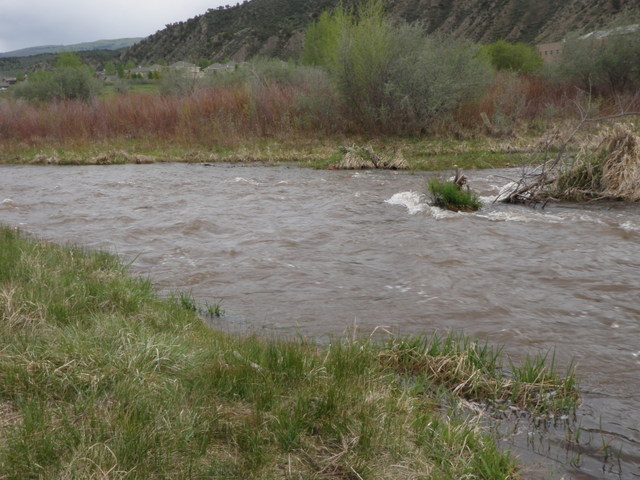
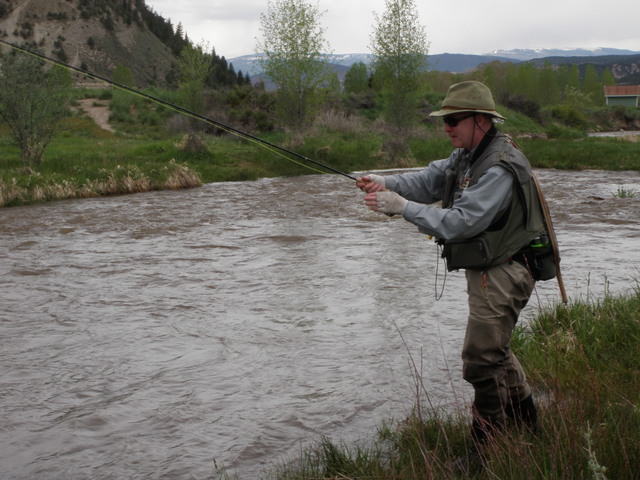
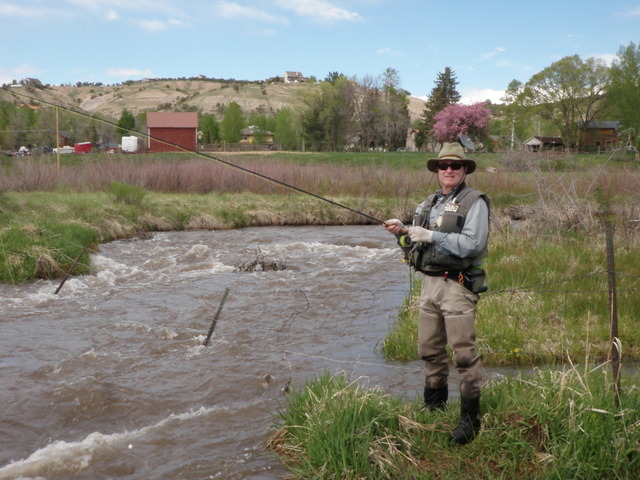
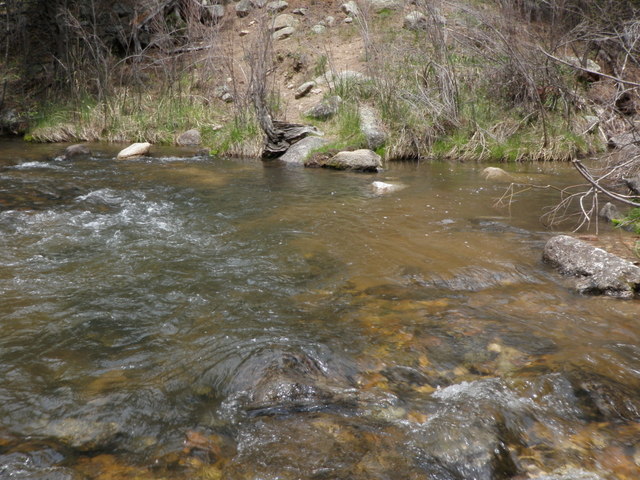
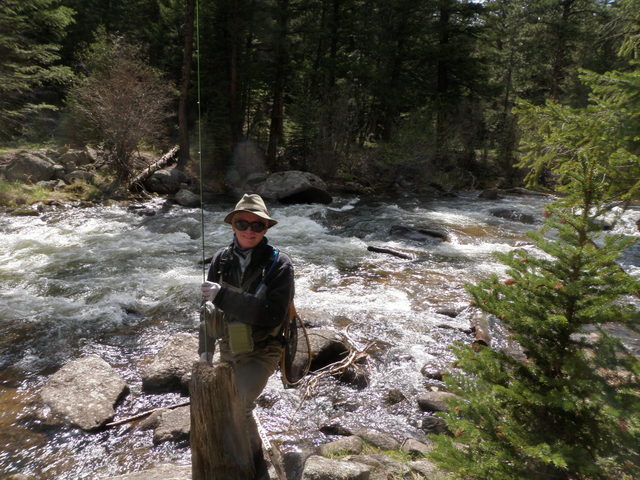
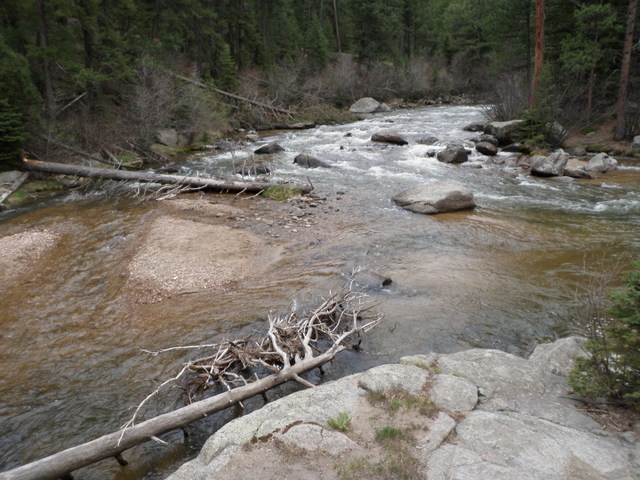
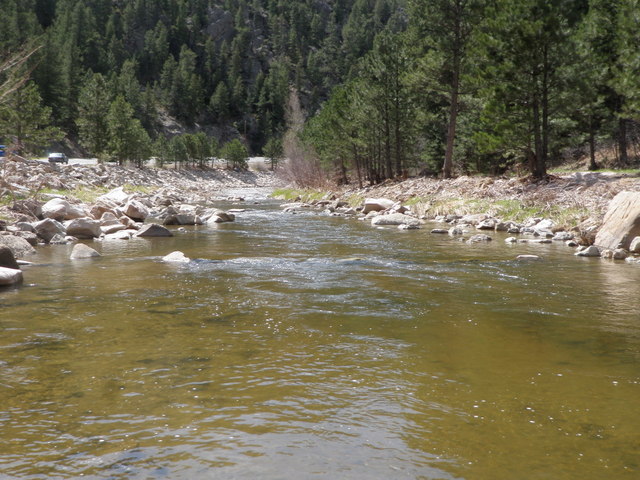
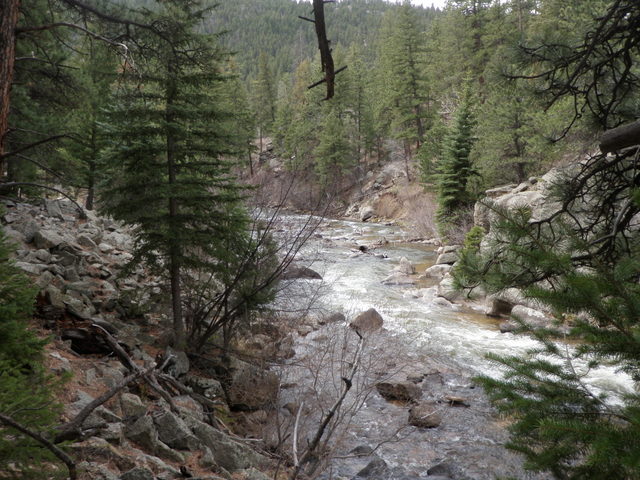
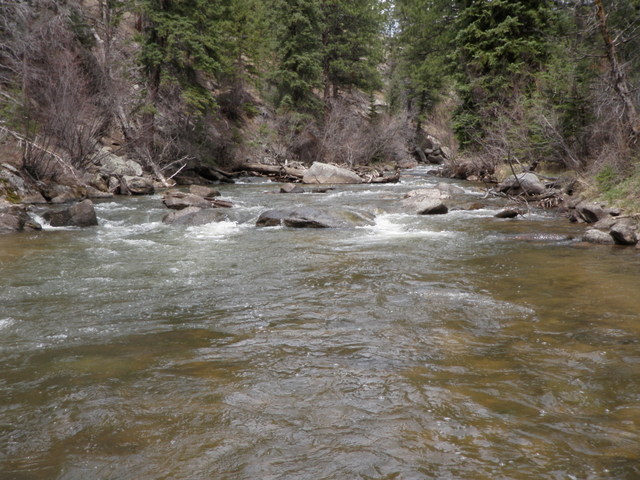
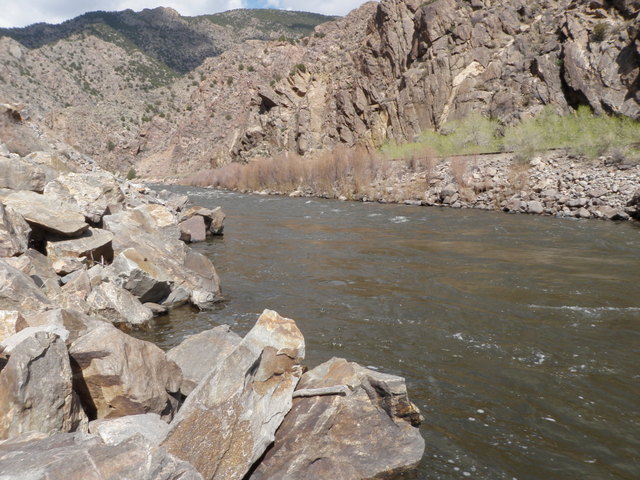
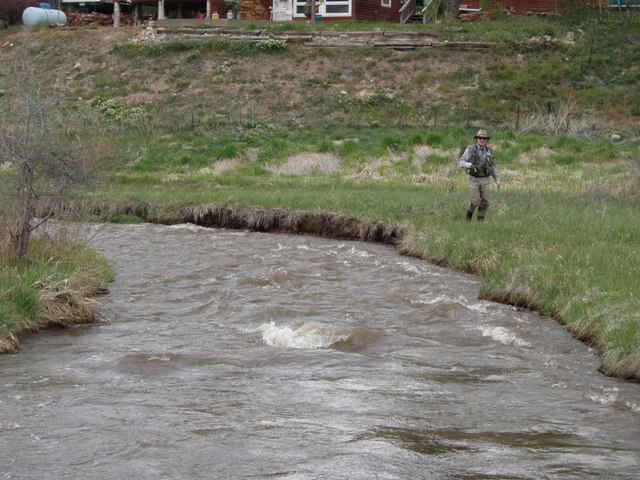
Jane and I departed Denver at 9:30AM on Saturday and arrived at Eagle, CO by noon. We made delicious sandwiches in the Gaboury kitchen, and then Dave G. asked if I was ready to fish. The sky was quite cloudy and overcast, but the clouds were high and didn’t suggest an immediate threat of rain. We put on our waders and configured our rods, and Jane drove us to our starting point where Brush Creek flows under Sylvan Lake Road at the northern end of Eagle Ranch. The creek was rushing rapidly toward the Eagle River and was the color of weak chocolate milk and came within 6-12 inches of the top of the bank in most places.

Dave G. Confident We Will Catch Fish

Dave G. Confident We Will Catch Fish

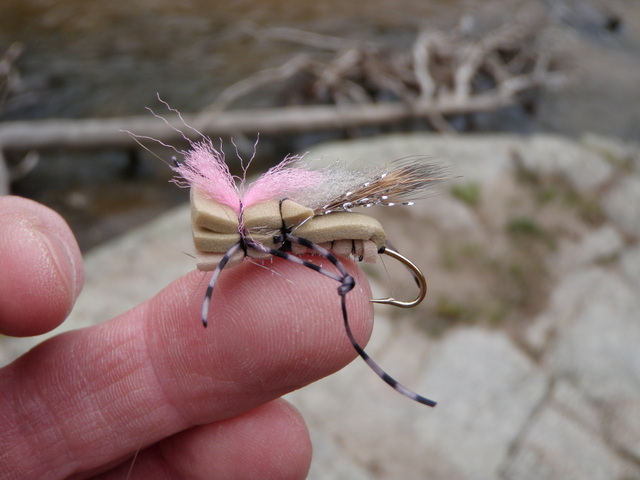
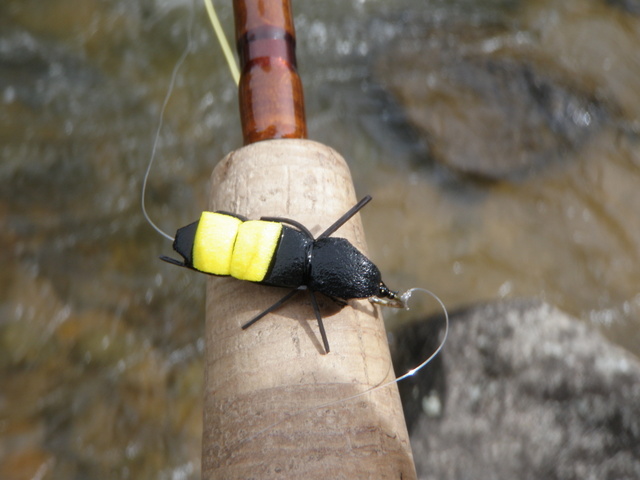
I was quite intimidated with these conditions, and I must admit that I had minimal confidence that either of us would hook, let alone land a fish. We began the ritual of playing hopscotch and fished our way along the right west bank. Every other time I fished Brush Creek, I could easily wade from one side to the other, but on Saturday we were locked to one side as it was too dangerous to cross. Dave G. suggested using two worm flies; an annelid style with red ribbing wrapped around the hook and bend and a classic red San Juan worm. I accepted his advice and tied one of each type of worm to my line beneath a thingamabobber and split shot.

Water Up to the Bank

Water Up to the Bank

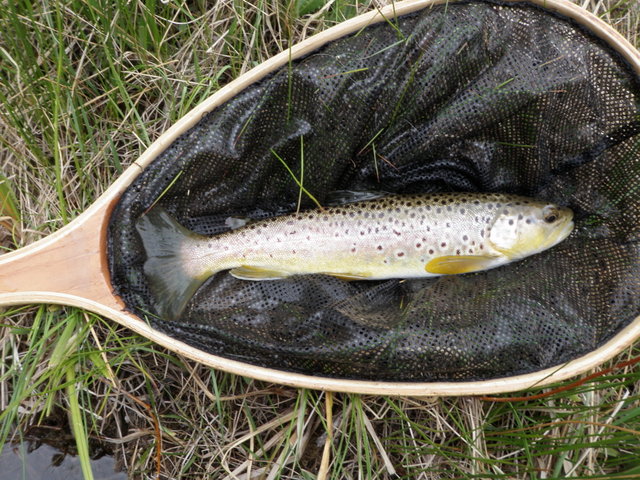
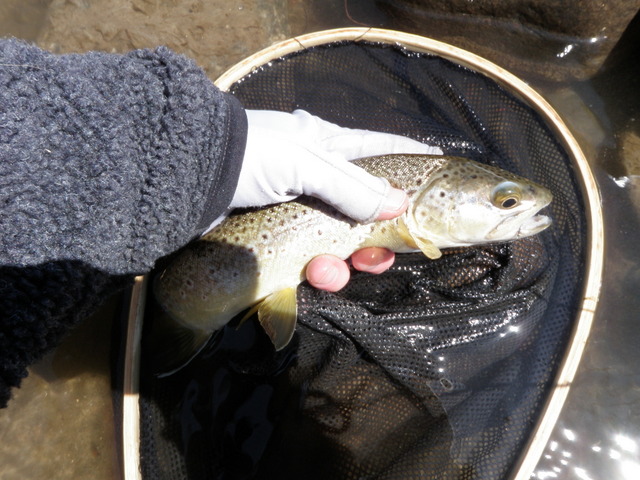
It didn’t take long before Dave G. miraculously landed a small brown, but I continued hopping by him, and I didn’t experience any success. In fact within the first half hour I got snagged to the bottom twice and broke off both flies and the split shot. Dave G. suggested that I use 4X tippet to prevent frequent break offs, but I only had 3X, so I tied that on to my leader using a surgeon’s knot. Unfortunately I only had two red San Juan worms in my arsenal, so once I broke off the second one, I changed to a chocolate brown worm. When I stripped it in, I noticed that there was very little contrast in the brown murky water.

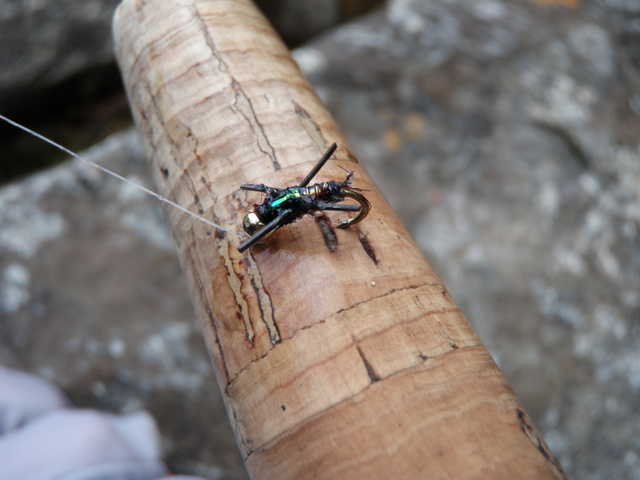
Meanwhile Dave G. continued to add to his fish count while my confidence slid to new depths. I decided I needed more contrast so I clipped off the brown San Juan worm and replaced it with a black woolly worm. This fly was at least 20 years old as I tied a few in Pennsylvania when I first began fly tying. Finally in a narrow relatively still area between the bank and the raging current I experienced a momentary hook up. I was attached to the fish long enough to lift its nose out of the water, but I could not determine which fly it took.

Another Drift

Another Drift

Because of the high water we were covering the stream quite rapidly as we continued to take turns in the fishable water, and there were large gaps in between. Finally I moved above Dave G. to a spot where he was confident I would catch a nice fish as he had hooked up with a brown in excess of 15 inches in this location previously. Much to my surprise as I lifted the line next to an exposed stick to make sure I wasn’t snagged, I felt some weight and set the hook. Immediately a nice fish began to thrash and fight to free itself. As the trout fought back and forth in the area between the heavy current and the bank, I enjoyed several views of it, and it surely was a fine brown in the fifteen inch range. Finally I felt I had tired it out enough to bring it to the bank in order to net, so I applied side pressure to keep its nose above the water and bring it across the current to where I was standing. Unfortunately the brown used its remaining energy to twist its head, and the hook came free. Not only did I fail to land a nice brown, but now I also didn’t know which fly enticed the finned foe.

Judging from the way the fish was fighting, I guessed that it was on the woolly worm. Since the woolly worm was an antique fly, I was concerned that the hook was too dull, so I clipped it off and replaced it with an orange and black woolly bugger. Unfortunately by now we were near our end point, the barbed wire fence that demarcated the beginning of the private water, so I only tested the orange and black woolly bugger for a short amount of time. When we reached the private water we both reeled up our lines and returned to the Gaboury house for snacks and cocktails.

End of Day Saturday at the Private Water

End of Day Saturday at the Private Water

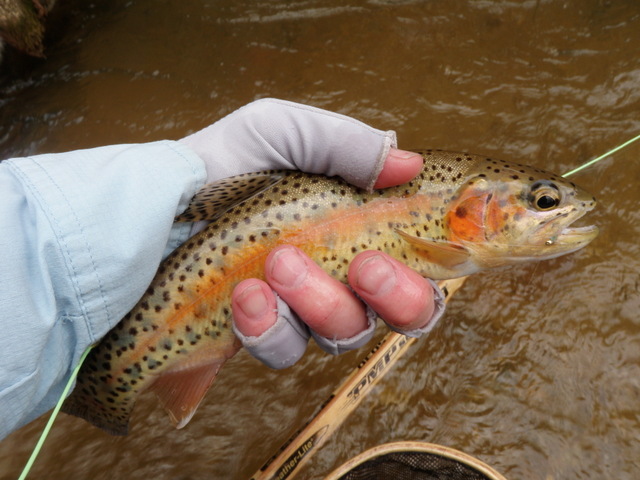
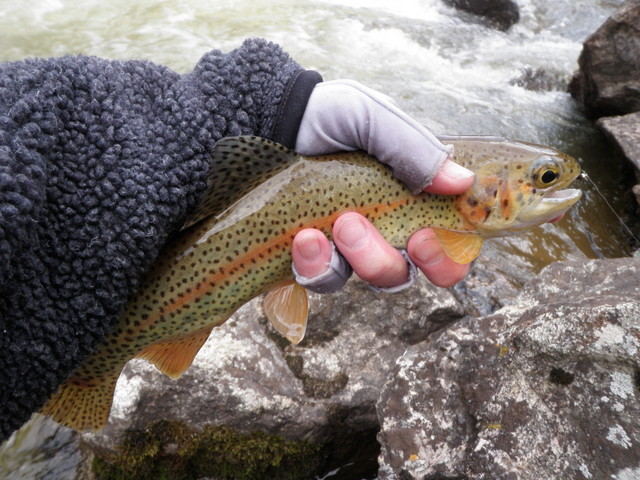
Dave G. did indeed prove that he could catch fish in the high muddy conditions characterized by runoff. I also managed to connect with two fish, but was not fortunate enough to bring them to my net. I did, however, now believe that it was possible to catch fish under adverse runoff conditions.

South Boulder Creek – 05/20/2014

Time: 11:00AM – 3:30PM

Location: One mile from the parking lot where there is a huge mass of large boulders extending from the path to the stream

Fish Landed: 4

South Boulder Creek 05/20/2014 Photo Album

With work commitments scheduled for Wednesday and Thursday, I knew that Tuesday was my best opportunity to enjoy a day of fishing. The high temperatures in Denver were forecast to be in the upper 70’s, so from a weather perspective as well, Tuesday was favorable for fishing.

Now the challenge revolved around finding a stream that was still in reasonable fishing condition, as I had not checked stream flows in a week. I went down the South Platte watershed list on the DWR website which is listed alphabetically. Bear Creek was at 132 cfs so I crossed it off. This is roughly six times ideal flows. Clear Creek swelled from 120 cfs to 251 cfs in the last couple days, so that was not an option. The South Platte River below Cheesman Reservoir jumped from 280 cfs to 400 cfs in a matter of a day. 400 is high, and I don’t like water that increased significantly within the last couple days as the fish haven’t had time to adjust. The South Platte River below Strontia Springs in Waterton Canyon was at 222 cfs, and from previous experience that is high for the narrow canyon stream bed, so that wasn’t a good destination. The Big Thompson skyrocketed from 130 cfs to 330 cfs in five days, so this was another show stopper.

I finally uncovered two options. South Boulder Creek below Gross Reservoir was listed at 132 cfs, and I fished it earlier in May at 148 cfs, so I knew this was manageable. The South Platte River near Lake George was presented at 75 cfs and actually this projected the best fishing conditions within a day drive of Denver. I had fished the South Platte on Friday and experienced a fine day, but I opted for South Boulder Creek due to its proximity.

At the Start

At the Start

I got off to a late start as I had to handle some chores for the workmen delivering sheet rock for the basement finish project, and consequently I pulled into the parking lot above South Boulder Creek at 10:15. By the time I pulled on my waders and prepared my gear for fishing and hiked down to the stream it was approaching 11AM. It was overcast and cool with the temperature in the low 50’s when I began. I had my 5 weight Loomis two piece rod and began with a tan pool toy and below that I added a beadhead hares ear nymph. These flies were not productive and after moving upstream for thirty yards, I swapped the hares ear for an emerald caddis pupa, and added a third fly in the form of a beadhead bright green caddis pupa.

These flies also proved to be out of favor with the South Boulder Creek trout, so after a reasonable test period, I clipped off the bright green caddis pupa and replaced it with a salvation nymph. This finally turned the tide, and I landed two small rainbows on the salvation nymph. By 12:30 I had two fish in my count, and I was feeling hungry and a bit chilled, so I paused for lunch. I removed the fleece that I tied around my waist under my waders and pulled it on, and then I sat next to the stream below a nice pool and ate my lunch while observing the water.

Nice Pool Did Not Yield Fish

Nice Pool Did Not Yield Fish

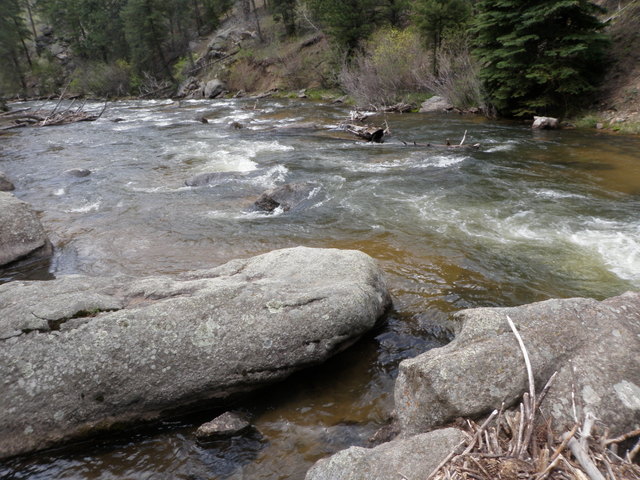
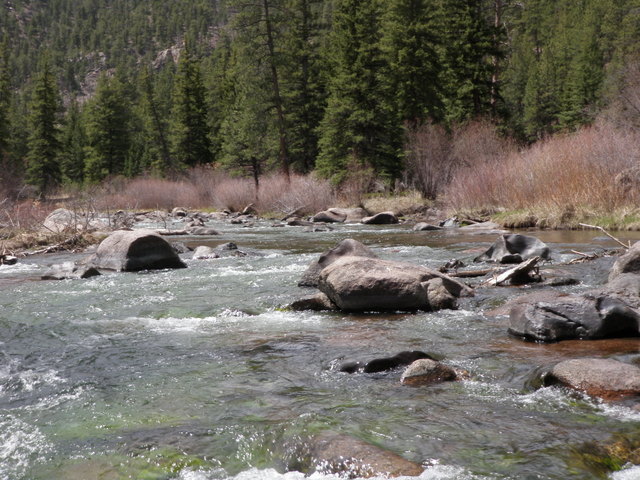
The water was high for the relatively small Boulder Creek stream bed, and there were minimal points where I could safely cross to the bank away from the path so I remained on the more accessible side. Most of the water I was able to fish was in the 5-10 feet of space bordering the bank where the high current velocity was broken by logs and large boulders. After lunch I decided to exchange the salvation nymph for a soft hackle emerger since I spotted one or two blue winged olive mayflies fluttering in the air above the water. I stuck with the pool toy, emerald caddis and soft hackle emerger for a fair amount of time and covered a decent amount of water. For some reason I began to experience fairly frequent refusals to the pool toy and disregard for the trailing subsurface patterns.

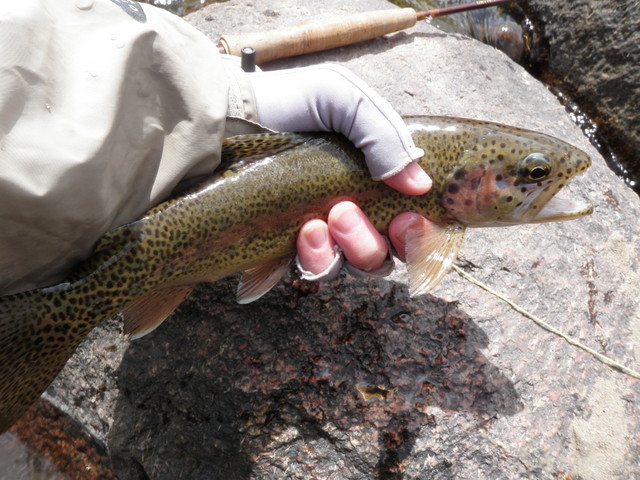
The normally productive edge water was not producing, so I began to experiment with fishing some of the deep slots and troughs where currents merged as I took a lesson from my success on Friday on the South Platte River. This actually worked, and I landed a very bright and colorful eleven inch rainbow that attacked the emerald caddis. At the tail of the drift as I gradually lifted my rod to make another cast, the rainbow grabbed the caddis.

Bright Rainbow with Emerald Caddis Pupa in Its Mouth

Bright Rainbow with Emerald Caddis Pupa in Its Mouth

The soft hackle emerger had now been on my line for a fair amount of time without generating any interest, so I decided that there was no significant BWO activity in spite of the overcast conditions. I concluded that I might as well offer something larger and with more flash, so I reverted to the salvation nymph as it had at least produced two fish earlier. I began to direct my casts to the deeper slots and troughs and executed swings and lifts at the end of the drift and managed two land a second brightly colored rainbow on the salvation nymph. In addition I felt the temporary weight of two other fish that reacted to the swing and lift approach, however, I was unsuccessful in bringing these fish to my net. The frequency of contact with fish did in fact improve and held my interest until close to 2:30PM.

Salvation Nymph Was the Top Producer

Salvation Nymph Was the Top Producer

Despite more action and changing my tactics to prioritize a different type of water and drift, I continued to notice refusals. Once a fish rose to inspect the pool toy but returned to its lie without taking the fly, it no longer responded to repeated drifts. I was bothered by this interest in surface food accompanied by a reluctance to eat the floating morsel, so I removed my three flies and experimented with some dry flies over the final hour. I tried a gray size 16 deer hair caddis and a green size 12 stimulator, but these didn’t even generate a refusal. It was worth a try, but I now reached the pedestrian bridge and decided to cross and cover the same water that I’d cast to on my two hour visit during an earlier evening in May.

A Second Bright Rainbow in the PM

A Second Bright Rainbow in the PM

I carefully walked along the path on the south bank of the creek and then dropped down the steep slope to the point where several currents merge in a deep run before the main current then deflects off a large vertical wall. I reverted to the dry/dropper technique and deployed the tan pool toy with a beadhead hares ear and then the salvation nymph. I thoroughly covered the attractive water characterized by merging currents and the deep trough, but nothing responded to my careful presentations. I was certain that this area would yield a fish, but I was wrong. I turned around and moved up along the south bank for another twenty yards, but again I was thwarted in my efforts to land  a fish.

Self Timer

Self Timer

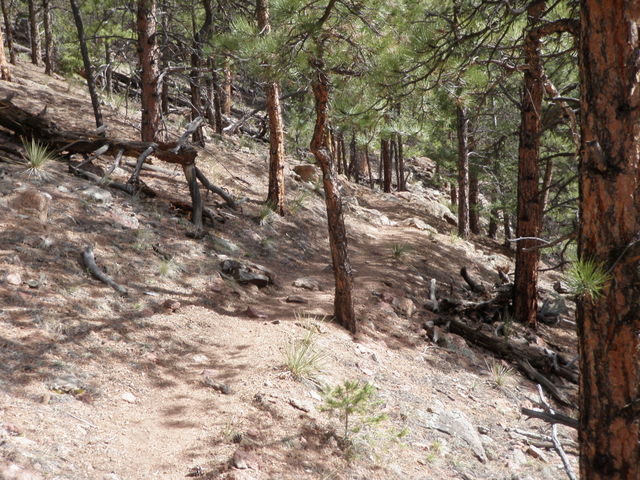
I was now growing frustrated with the lack of action, and it was approaching 3:30 so I decided to climb back up the steep bank to the path and explore the nice water on the south side above the pedestrian bridge. I angled back to the creek a short distance above the bridge and prospected twenty yards of decent water, but I’d lost confidence, and the fish weren’t doing anything to reverse my mental state. I decided to call it a day and made the return hike and ascent out of the canyon to the Santa Fe.

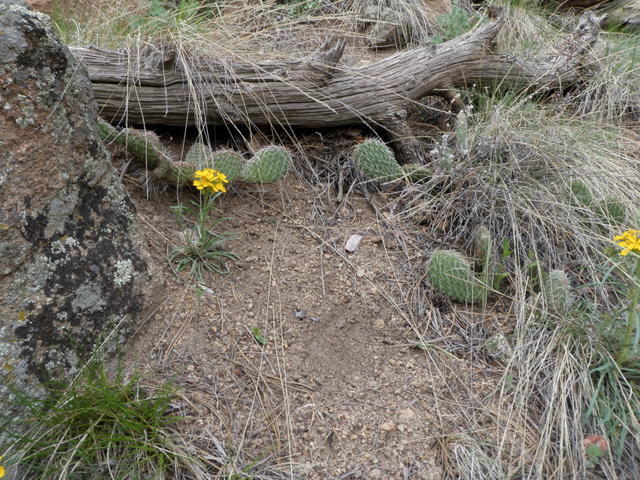
Wildflowers and Cactus

Wildflowers and Cactus

I enjoyed a beautiful day in a scenic canyon setting a little over an hour from home, and I managed to land four pretty fish. While the catch rate was beneath my usual rate, I was fishing in a stream on May 20, and that in and of itself was quite an accomplishment. My stream fishing days in Colorado appear to be numbered, and I will shortly turn my attention to stillwaters.

South Platte River – 05/16/2014

Time: 10:30AM – 4:00PM

Location: Wildcat Canyon

Fish Landed: 21

South Platte River 05/16/2014 Photo Album

The Mothers’ Day snowstorm came and went, but the air temperatures remained unseasonably cold Monday through Thursday. I was depressed and feeling sorry for myself, as I was certain that the cold winter weather caused me to miss my last chance to stream fish in Colorado before the snowmelt bloated all the rivers and streams. But just for fun, I decided to check the DWR site and review the stream flows during the middle of the week. Much to my surprise, the cold temperatures halted the snow melt, and a number of streams within a day trip of Denver were at near ideal flows. I was positioned at work to take a day off, so I made plans for a fishing excursion on Friday.

All spring I had been considering a trip to the South Platte River in the Wildcat Canyon area. I’ve fished this gorgeous stretch of water ten or so times, but always after mid-August and never in the spring before the flows climb to difficult levels. I checked the flows on the South Platte River near Lake George, and they were 85 cfs, so this concluded my deliberations. Because this destination involves a hike in excess of one hour, I prepared everything on Thursday evening so I could get off to an early start. I even made a pack in fishing list on my iPhone so that I could assure myself that I would not forget any critical item when I packed for the three mile hike away from the car. I also made a list of all the flies I thought I might need and went through my front pack and fly boxes and added flies where I determined that I might be in short supply.

Everything worked as planned, and I left my house in Denver at 6:25AM. Denver traffic slowed me a bit, but I arrived at the trailhead by 8:45AM and the dashboard thermometer registered 39 degrees. I decided to wear my waders and wading boots for the three mile hike to the river in order to lighten the load on my back, and the cold morning temperatures reinforced that decision. I wore my fleece over my Columbia long sleeved undershirt and fishing shirt, and this proved to be a mistake. Once I was on my way, the intense exertion caused me to perspire quite a bit under the fleece layer.

The Platte River Trail

The Platte River Trail

I stopped at my usual staging area at 10AM after a one hour hike and rigged my fly rod and took off the fleece layer. I stuffed my lunch and raincoat in my fishing backpack and returned to the Platte Trail and hiked for another 15 minutes downstream until I reached the spot where the river narrows into a whitewater chute. I entered just above this point and tied on a Chernobyl ant and beadhead hares ear and began prospecting all the likely locations where trout might rest and feed. I failed to land the first couple fish that I hooked but eventually landed three or four on the hares ear.

The sky was clear and the sun warmed things up considerably at this point, but I covered some attractive water without any results so I tied on another section of leader and added a salvation nymph below the hares ear nymph. This combination broke my slump, and I added a couple more trout that hammered the salvation nymph.

Clear and 85 CFS

Clear and 85 CFS

By noon some large gray clouds moved above the canyon and blocked the sun, and some strong breezes kicked up.  This development caused me to become quite chilled, and I thought it might rain, so I took time to remove my raincoat from my backpack and put it on over my clammy shirt. This helped for the time being, and now I was distracted by the appearance of some rises at the tail of a nice deep pool. Around this time I somehow created an enormous tangle, and in order to undo it, I removed both the subsurface flies. Before resuming, I decided to switch to a beadhead emerald caddis pupa and a small soft hackle emerger. I suspected the rises were in response to some early emerging blue winged olives, and my choice of the soft hackle emerger hopefully matched this food source. I’d also spotted a few random caddis on the water, so the emerald pupa hopefully covered this possibility.

Soft Hackle Emerger Spent Some Time on My Line

Soft Hackle Emerger Spent Some Time on My Line

These choices proved to be solid, and I landed four more fish primarily on the soft hackle emerger by 12:30PM. As this successful change in strategy was evolving, the sky grew darker and strong gusts of wind became a more frequent occurrence. My sun gloves had become saturated in the process of releasing fish, and now the cooling effect of evaporation was resulting in a dull ache and constant stiffness of my fingers. My feet were more like stumps as the feeling was draining from my toes, and the moist undershirt and fishing shirt were adding to my misery. I decided to return to my backpack and obtain another layer before proceeding.

A Pretty 12 Inch Rainbow

A Pretty 12 Inch Rainbow

When I arrived back at the staging area, I discovered two fishermen in the midst of resting, and they were eating their lunch. I chatted briefly with them, and dug into my backpack and pulled out my fleece and my New Zealand hat with ear flaps. Once these were secured on my body, I decided to eat my lunch before returning to my exit point. I sat by the stream and quickly consumed my snack while watching one of the fishermen enter the nearby pool and attempt to fool some sporadic risers with a dry fly. The young fisherman was unsuccessful in his endeavor, and I finished my lunch, so I bid them farewell and walked quickly down the path to my ending point prior to lunch.

I was much more comfortable when I entered the river, and the warm hat probably made the most difference. I continued prospecting the water with the Chernobyl ant, emerald caddis pupa and soft hackle emerger for the remainder of the afternoon and added another eleven fish to my total of ten before lunch. I spotted the occasional blue winged olive in the air, but the hatch was quite sparse. Fortunately this did not seem to hinder the fish from being on the lookout for the tasty tiny morsels that drifted in the water column as I landed most of my fish on the soft hackle emerger.

One of the Nicer Brown Trout

One of the Nicer Brown Trout

As I’ve stated previously in this blog, I relish this sort of fishing. I moved quickly up the river and popped three to five casts in all the likely pockets, runs and pools and picked up fish on a regular basis. It didn’t take long to discover that the most productive areas were deep troughs at the very tail of pools where two currents merged. If I allowed the flies to drift beyond the point where I normally would lift to cast again, a nice trout would often hammer the trailing soft hackle emerger. I tried lifting the flies when upstream or accelerating the drift via quick bad mends, but none of these techniques produced like the swing at the tail of a long pool.

Toward the end of the afternoon, I snapped the two subsurface flies off on a streamside willow on a backcast. I somehow was able to spot the two flies dangling in the air and retrieved them, but I used this as an opportunity to switch flies and converted to a dark olive deer hair caddis. The caddis brought a couple refusals and two or three momentary hook ups, but I was unable to land any fish with this surface fly. It was clearly close to what the fish were looking for, but perhaps off a bit in color or size.

By 4PM I was feeling quite weary from perhaps my longest extended period of constant wading and casting of the season to date, so I decided to call it quits. Despite the continuing colder than expected air temperatures and thick gray clouds, I shed all my layers down to my fishing shirt. I knew the exertion of hiking and climbing would elevate my body temperature, and I didn’t want to repeat the mistake of overdressing for the return hike. This strategy worked to some degree, but I was still quite perspired and exhausted when I reached the Santa Fe at 5:30.

Once again the remote stretch of the South Platte River yielded a fine productive day of fishing. I’ve had better days later in the season when my catch rate was higher, and the size of the fish were larger, but Friday was still a great experience particularly in the middle of May when I’m usually without good stream options. The allure of Wildcat Canyon is its remoteness and the solitude of having a gorgeous natural stretch of water essentially to myself. The fish aren’t large, but they are numerous and more opportunistic than the trout encountered in other highly pressured Colorado streams. If only the physical effort required for a day of fishing in this area weren’t so taxing, but this is probably the reason it remains wild and pristine and one of my favorite places.

South Boulder Creek – 05/06/2014

Time: 5:00PM – 7:00PM

Location: From below footbridge upstream

Fish Landed: 3

South Boulder Creek 05/06/2014 Photo Album

Tuesday proved to be a gorgeous day in Denver, and I was at a good pausing point at work, so I decided to leave early and make my first evening fishing venture of 2014. By the time I left work, returned home, packed my gear and drove to South Boulder Creek below Gross Reservoir; it was 5PM. Traffic was heavy on westbound I70 resulting in an extra fifteen minutes of drive time. In addition, as I drove west I noticed some dark gray clouds hovering over the front range. I chose to place a positive spin on the weather and told myself that some overcast skies and light rain would probably translate to improved fishing.

There were three or four additional cars in the parking lot, so I didn’t have the space to myself, and three young fishermen were stringing their rods and close to departing as I climbed into my waders and put together my rod. The threesome headed down the trail ten minutes before me, but when I made my descent down the steep trail to the stream, I came upon them quite quickly as they jumped in the water relatively close to the beginning of the open fishing water.

I hiked past them and continued a half mile or so until I reached the pedestrian bridge, and here I crossed to the southeast side of the creek. The flows were up quite a bit from my previous visit, and when I checked them beforehand on the DWR web site, they were 149 cfs. I knew from a previous trip that I could fish at 180 cfs, but I also realized that this was higher than ideal and would entail tossing a lot of casts along the bank and behind current breaks.

After crossing the bridge, I began hiking up the steep trail that is part of the Walker Ranch Loop, but I veered to the left and followed a fisherman path along the south bank until I reached a very large vertical rock wall. Here I clambered down to the edge of the stream and fed my line through the guides and tied on some flies. To begin, I attached a tan pool toy and below that an emerald caddis pupa and then added a soft hackle emerger. By now it was quite overcast, so I was covering the possibility that the gloomy weather might initiate a blue winged olive hatch or an evening caddis emergence. It was clear that some adverse weather was moving in, and the temperature dropped considerably so I removed my raincoat from my backpack and pulled it on beneath my wader straps mainly to serve as a windbreaker and add a layer of warmth.

A Tan Pool Toy to Start

A Tan Pool Toy to Start

Initially I made some downstream casts to some very juicy runs that deflected against the vertical rock wall and gradually covered the water until I rolled out a forty foot cast to a nice current seam where two currents merged. In an instant I saw the pool toy dive and set the hook, but my excitement transitioned to disappointment when I realized that the nice rainbow on the end of my line was foul hooked. After another ten minutes of searching I turned my attention in the opposite direction, and I began prospecting along the left bank and moved upstream covering the forty yards of water between my start point and the bridge. This period was characterized as frustrating as I pricked two or three fish along the way and witnessed several refusals of the pool toy. I was attracting the interest of fish, but I was unable to fulfill my goal of putting some weight in my net.

Starting Point on South Boulder Creek on Tuesday Evening

Starting Point on South Boulder Creek on Tuesday Evening

During this period I somehow broke off the soft hackle emerger, so I decided to replace it with a beadhead hares ear nymph. I wasn’t seeing any natural BWO’s in the air, and given the higher flows, I felt more confident having a larger fly that the fish could see. This seemed to help my plight and after making the change I hooked and landed a small rainbow that struck the emerald caddis pupa. I continued above the bridge and in the next nice stretch of water before a thunderous whitewater chute, I hooked and landed another rainbow on the emerald caddis. I would eventually discover that this fish was the nicest fish of the evening, and I snapped a photo while I held the catch above the stream.

Best Fish Took Emerald Caddis Pupa

Best Fish Took Emerald Caddis Pupa

It was right around this time that some rain began to fall, and I was quite pleased that I already had my rain jacket in place to keep me warm and protect me from the moisture. The next 45 minutes or so prior to quitting were spent working my way upstream along the left bank. It seemed like the quality of the water and my approach should have been producing more action, but unfortunately this was not the case. While I was fishing the water closer to the bridge, two of the young fishermen that left the parking lot ahead of me passed me on the path along the left bank.

I managed to land one more eight inch rainbow in the last 45 minutes, and this fish struck the hares ear as I gave it a lift next to a large submerged rock, but even repeating this technique that worked once didn’t seem to increase the interest of the fish in my offerings. By seven PM I was feeling quite chilled; mainly my feet that were constantly submerged in the ice cold flows from the bottom release dam, so I decided to begin my outbound hike. As I climbed up the bank to the path I noticed several wet imprints in the gravel, so I began to suspect that the young fishermen had gone ahead of me and covered the water that I was now exiting from. I’m not suggesting that they crowded my space, but it’s always difficult to be the second fisherman through water that was recently covered by others. Fish go on high alert and procure more secure positions. The basic need of safety supersedes the other primary need of food.

I completed the vigorous hike out of the canyon and packed my gear and made the drive back to my home where Jane and I grabbed a quick bite at Burger Works. It wasn’t an extremely productive outing, but it was enjoyable to get out on a weeknight. I had quite a few opportunities to catch more fish, and as always I was alone with my thoughts and challenged trying to solve the riddle of how to entice small trout to eat imitations that I created myself. There may not be many more opportunities before the full force of the heavy snow pack rushes down the streams of Colorado.


Big Thompson River – 05/02/2014

Time: 10:30AM – 4:00PM

Location: Began above RV park at bend on Route 34 (RV park has been washed away)

Fish Landed: 10

Big Thompson River 05/02/2014 Photo Album

Unusually heavy and steady rain during September 2013 brought flooding to most of the rivers and streams that drain from the front range to the South Platte River. This included several of my favorite destinations, the Big Thompson River and St. Vrain River. I read a report on the Big Thompson River which stated that the fish population was unaffected, and in fact electroshocking surveys suggested that the eight miles below Lake Estes contained more fish than were present prior to the flood. The St. Vrain suffered more devastation than the other front range streams, and I saw a report that the North Fork below Buttonrock Reservoir would not reopen for fishing until 2015.

The greatest obstacle to fishing the Big Thompson seemed to be damage to the highways that provide access to Estes Park and the river below the dam. When I checked the stream flows on Thursday night as I considered options for a day of fishing on Friday, I noticed that the Big Thompson was actually running low at 40 cfs. Flows on other streams in the Denver area were already edging up with snow melt entering the picture. Before committing to the Big Thompson, I decided to make a phone call to Kirk’s Fly Shop in Estes Park to get information on the roads between Denver and the river. The young man that answered the phone told me that waits were consistently one half hour on route 36 from Lyons to Estes Park. He recommended taking an alternative route out of Lyons that looped south and then along the eastern boundary of Rocky Mountain National Park. When I asked about route 34 from Loveland to Estes Park, he suggested this as another good option as the construction waits averaged 5-10 minutes compared to longer waits on 36.

I decided to gamble on the route through Loveland and called my friend Lonnie Maddox to let him know I would be passing near his home. Lonnie said that he and Debbie would be home in the late afternoon, so we made plans for a short visit on my return trip.

Big Thompson Was Low and Clear on Friday

Big Thompson Was Low and Clear on Friday

I got off to a reasonably early start at 8:45 and arrived at a pullout next to the river by 10:15 as I experienced a 10-15 minute wait at the entrance to the Big Thompson Canyon west of Loveland. As I drove west, I was a bit concerned because the river was chocolate covered over the first section from the canyon entrance to Drake, CO. Once I drove beyond Drake, however, the water clarity improved considerably until it became crystal clear where I stopped to begin my day. Low flows at 40 cfs and clear water suggested some skittish fish. The sky did have some high clouds off and on, so that helped a bit, but for the most part it was bright and sunny, and this added to the fishing difficulty. As always there were gusts of wind rolling down the canyon to make things more interesting.

Once I pulled on my waders and rigged my fly rod, I walked down the road twenty yards to the northern border of what used to be a RV park. The entire area that previously was filled with RV’s was now a sand beach with a few remaining platforms that were apparently solidly anchored during the flood. From the road next to my car I could see two or three fish in the clear pool below me, and I even spotted a rise or two. Because the water was so clear and low, I didn’t want to create too much surface disturbance, so I tied on a size 16 dark olive deer hair caddis and placed some long casts into the nice pool in front of me.

It wasn’t long before a brown trout smacked the caddis, and I landed my first fish of the day. Unfortunately as I cautiously moved closer to the deepest part of the pool, I could see quite a few fish in front of me, but they were showing no interest in my caddis. I turned my attention to a nice faster run that rushed by me ten feet to the right, and as my fly drifted along the inner current seam, a rainbow rose and slurped the caddis. It was a decent start to my day, but I could see a lot of remaining fish in the pool that were ignoring my offering. Perhaps they were tuned in to something subsurface such as an emerger or nymph.

Some attractive water beckoned above the pool that I dwelled in, and I didn’t want to jump to the dry/dropper method prematurely, so I moved on. I picked up the pace a bit and managed a third trout on the deer hair caddis before I looked at my watch and noticed it was noon and time to eat lunch. The car was quite close so I climbed the bank and grabbed my lunch and returned to the edge of the river to eat and observe. I didn’t really see any significant insect activity, so when I resumed I decided to try the dry/dropper method. The water that I was approaching was faster and appropriate for a nymphing method.

Pretty Big T Rainbow

Pretty Big T Rainbow

I snipped off the caddis and tied on a tan pool toy and dangled an emerald caddis pupa and below that a bright green caddis pupa. For the next two or three hours I worked this three fly combination through all the likely runs and pockets as I progressed upstream and landed another five fish including several pretty bright rainbow trout in the 12-13 inch range. I enjoy this type of fishing where I’m constantly moving and prospecting the likely holding spots. The large buoyant pool toy was a pleasure to use under these circumstances as it easily supported two beadhead flies and was readily visible in the swirling riffles and currents.

Emerald Caddis Pupa Produced Two Fish

Emerald Caddis Pupa Produced Two Fish

At 3PM I’d gone awhile without any action so I decided to make another switch. I noticed a few BWO’s fluttering about, so I downsized my top fly to a yellow size 12 stimulator and then I added a soft hackle emerger as a dropper. The soft hackle emerger is not as heavy as the larger nymphs and pupa, so I felt I could get away with the smaller top fly. I managed to land a trout on the yellow stimulator, but never had any success with the soft hackle emerger and eventually I clipped them both off and tried a Chernobyl ant with a salvation nymph. The salvation nymph proved to be a winner as I landed my tenth and last fish as I approached a forbidding barbed wire fence spanning the river with a sign that made it clear that no trespassing was allowed.

It was a beautiful spring day on the Big Thompson River, and I discovered that the trout do in fact remain despite the destructive forces of a flood. Fish apparently deal with natural disasters better than human beings. I drove back down the canyon with no construction stoppage on late Friday afternoon and then turned and drove a mile south from route 34 in Loveland and visited with Lonnie and Debbie for a half hour. Spring is finally arriving in Colorado.

South Boulder Creek – 04/25/2014

Time: 10:30AM – 3:30PM

Location: 1.5 miles down the path from the parking lot. Started fishing at the spot where a large vertical rock makes passage difficult.

Fish Landed: 9

South Boulder Creek 04/25/2014 Photo Album

Temperatures were projected to reach the low 70’s in Denver on Friday, April 25 so I decided to take a day off for fishing. I was frustrated by several difficult trips to the Arkansas River and had my eye on South Boulder Creek. I discovered this fishery several years ago on a train ride to Fraser, and it became my favorite spot for fishing close to the Denver metro area. I checked the flows, and they were running at 102 cfs, and I knew from previous trips that this is a good level.

I took my time on Friday morning to allow the air temperature to warm up, and after an hour of driving I pulled into the parking lot high above the canyon where the stream flows out of Gross Reservoir. I was the first car in the lot, but as I prepared to fish two more vehicles arrived, and two fishermen jumped out of each car. I decided to wear my fleece top and stuffed my raincoat in my backpack along with my lunch so I could hike quite a ways down the path and eat my lunch by the stream.

Just as I was ready to close the hatch and embark on my hike, a Denver Water truck pulled into the lot and a bearded man jumped out. He walked to the trash can and checked it, and then on the return trip to the truck he asked to check my license and that of the two gentlemen in the vehicle parked next to me. We each complied with his request, and then the other two fishermen at the far end of the lot volunteered their licenses for review as well. As I walked to the trailhead, the Denver Water employee called out and asked if I went to Bucknell. I replied yes, and then he told me he went to Penn State. After some additional conversation I learned that he was from Plymouth Meeting, and he did have a bit of a Philly accent.

South Boulder Creek on Friday

South Boulder Creek on Friday

High clouds remained in the sky for most of the morning and consequently the sun never broke through to warm the air temperature. As I walked briskly along the trail, I created enough body heat to remain comfortable, but once I arrived at my starting point, I was a bit chilled. I began fishing with a Chernobyl ant and then added a long tippet section of 5X and attached a beadhead hares ear. Finally I extended another 18 inch section from the bend of the hares ear and tied on a soft hackle emerger.

Chernobyl Ant on My Line

Chernobyl Ant on My Line

I began prospecting some attractive runs and pockets around large exposed rocks and in short order experienced a refusal to the Chernobyl ant. At least it was good to know that fish were present and looking toward the surface for a meal. I experienced a couple refusals to the Chernobyl, but continued working upstream and eventually landed a nice rainbow that gobbled the soft hackle emerger. I cast into a pocket and allowed the Chernobyl to be pulled back upstream by an eddy below an exposed rock, and the rainbow  grabbed the soft hackle emerger and pulled the Chernobyl under, although I actually saw the fish dart away from the rock and grab the subsurface fly.

Very Nice Rainbow Landed in the Morning

Very Nice Rainbow Landed in the Morning

The morning and in fact the remainder of the day continued pretty much in this fashion. I fished the Chernobyl ant, beadhead hares ear, and size 20 soft hackle emerger and landed nine fish. One gullible trout nailed the Chernobyl, and two fish snatched the beadhead hares ear in the afternoon. All the other fish that I landed favored the soft hackle emerger.

The sun never appeared in the morning, and because my sungloves were wet from handling fish, the evaporation caused my fingers to ache. This finally forced me to stop for lunch at noon, and I removed the sungloves and placed them in the zippered pocket of my waders. In addition to cold hands, my feet felt like stumps due to the icy flows coming from the bottom of the dam. The sun did come out during lunch and warmed me a bit before I resumed after lunch.

After lunch I found a spot where I could cross to the opposite bank, and I prospected up along the south side for quite awhile. I always favor the side of the stream away from the road or main path, and this did in fact seem to help in the afternoon. Also since I’m righthanded, the left bank was more natural for me to hook casts under overhanging branches and into soft pockets behind rocks and current breaks.

Attractive Stretch with Slower Current

Attractive Stretch with Slower Current

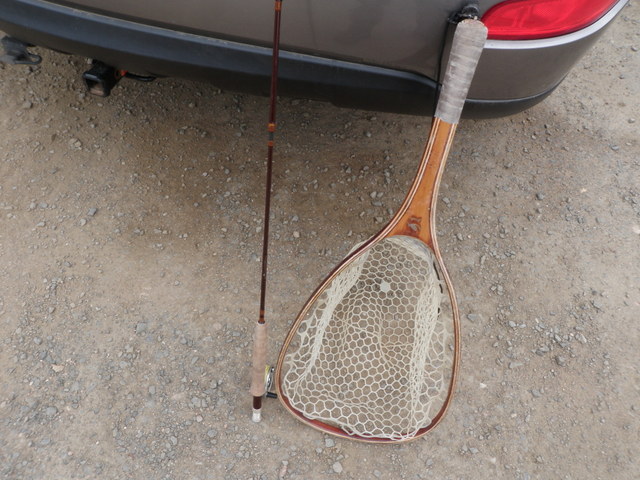
At around 2PM I was wading along the bank when I stepped on something that shifted under my weight. I looked down and spotted a net under my foot, so I reached in the creek with my hands and extracted it. Initially I thought it was fairly old and not desirable, but after swishing it in the water and removing old rotting leaves, I realized it had one of those plastic nets that doesn’t snag ones flies. It was a large net with a long handle, and it had a mayfly logo engraved at the top of the handle and the word Brodin above the mayfly. I decided to try and carry it back to the car with me, but I wasn’t ready to quit fishing so I stuffed it between the straps of my backpack and wedged it between my back and the backpack.

Major Find Was This Brodin Net

Major Find Was This Brodin Net

This lasted for a bit, but then it almost fell out, so I used the broken cord attached to the ring on the handle and tied it to my belt. This worked better but the net and handle were so long that the net dangled down to the water surface, and it hampered my wading for the last 1.5 hours. At approximately 2:30 I’d gone without any action for quite a while, so I decided to make a change and replaced the Chernobyl with a size 14 stimulator. I removed the hares ear and added a single dropper consisting of the beadhead soft hackle emerger.

The stimulator did arouse some interest, and I experienced two or three rises and momentary hook ups, so I think the fly attracted fish, but it wasn’t exactly what they were looking for. By 3:30 I’d gone quite a while without landing a fish, so I decided to find a rare crossing point and quit for the day.

It was a fun day on South Boulder Creek in a gorgeous location relatively close to Denver. The weather remained much cooler than I expected, but I managed to land nine fish and had four or five momentary hook ups and a couple foul hooked fish. With options quickly diminishing due to early snow melt, it was nice to enjoy some dry/dropper fishing on South Boulder Creek.

Vail – 04/18/2014

Vail 04/18/2014 Photo Album

Friday, April 18 at Vail was more about lunch and grilling than skiing. Jane and I were anticipating a warm sunny day during spring that would allow us to pack some brats and beverages and head to the top of Blue Sky Basin to do outdoor grilling. When we saw the five day weather forecast that projected highs in Denver in the upper 70’s for Friday, April 18, we initiated our plan.

Jane contacted our friends, the Gaiges and Youngs, and invited them to join us for a day of skiing at Vail including grilled bratwurst at Belle’s Camp at the top of Blue Sky Basin. In a short amount of time we learned that the Gaiges were in, and Fred would join as well although his wife Douggie had other plans. Karen Gaige volunteered to bring along food as well, and we were set.

On Friday morning Jane and I drove to Frisco and met the other three at the parking lot just off the second exit from interstate 70. We combined our food and ski gear and proceeded to the Lionshead lot at Vail. As we boarded the gondola at 9:30, the temperature at the base was already in the low 50’s. We all wore backpacks stashed with food for our lunch, and I attempted to include a bottle of Lefthand Milk Stout Nitro in my small day pack. Unfortunately for the first time all season a security person was inspecting packs and confiscated our one brew. Evidently they were scrambling for beverages for their Friday after work party.

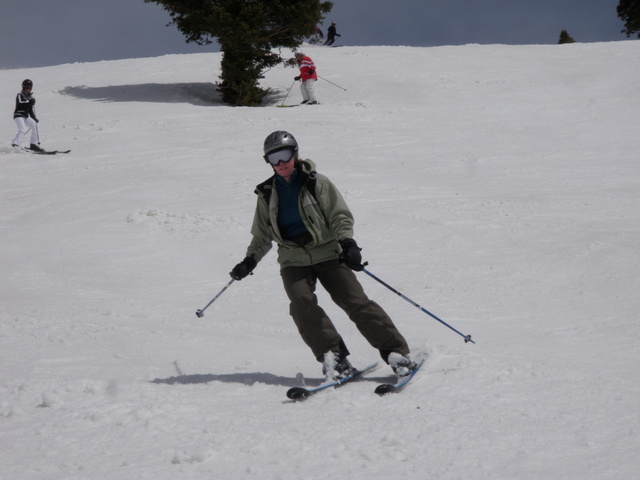
Jane Rocks China Bowl

Jane Rocks China Bowl

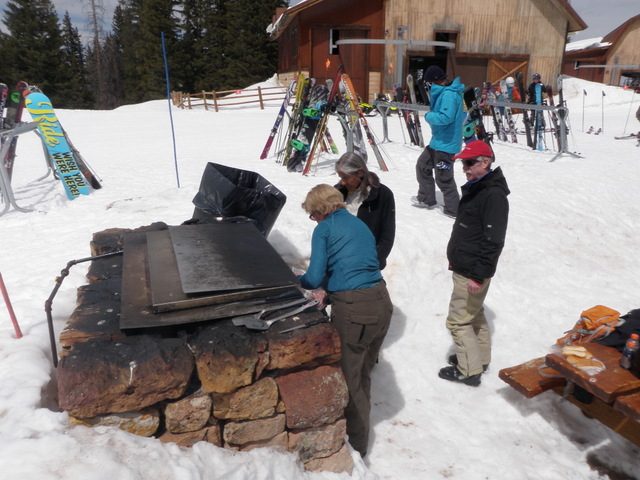
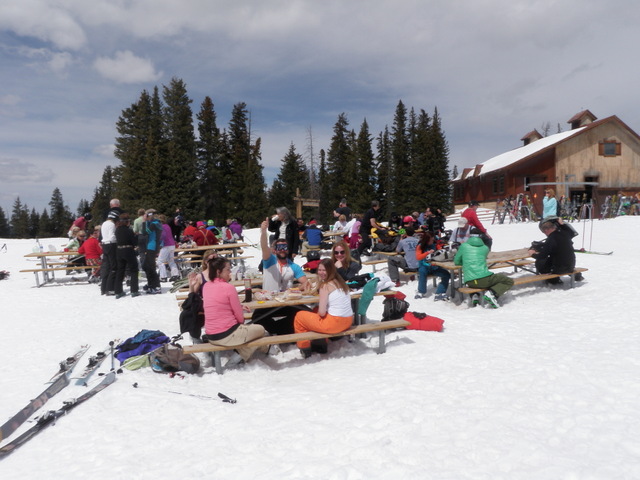
Our group of five spent the morning largely in the back bowls sticking mostly to groomed terrain to avoid the crusty conditions that existed before the snow softened. By 12:30 we managed to arrive at the cluster of picnic tables at the summit of Blue Sky Basin next to Belle’s Camp. Quite a crowd had already gathered, but we managed to snag one of the two remaining tables, and Karen and Jane extracted the package of bratwurst and secured some grilling space at the most western grill. Everyone was in a festive mood as they stripped down to T-shirts and soaked up the strong rays of the sun. We noticed bottles of alcohol everywhere and speculated that many skiers had large hidden pockets or knew the protocol for bribery.

Karen and Jane Find Space for Brats

Karen and Jane Find Space for Brats

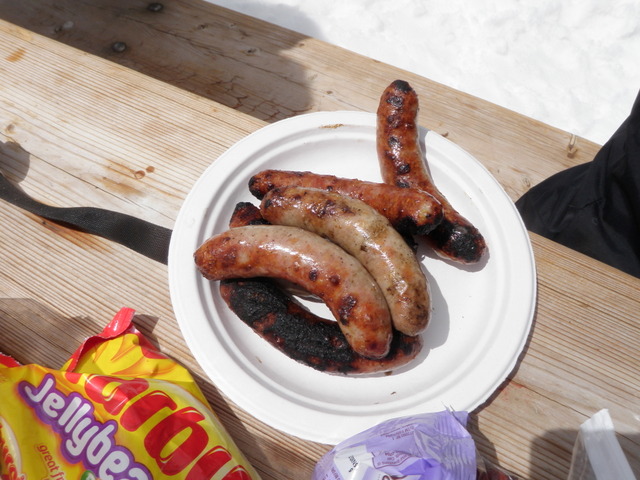
Jane tended the brats on the grill while I obtained some tap water from the Belle’s Camp snack shack; and Karen, Dave and Fred spread out the other tasty items on the picnic table. In addition to bratwurst there were clementines, carrots, apples, Easter candy and brownies. Once the brats were cooked and singed a tempting shade of brown, we stuffed ourselves and relaxed and soaked up the sun. This was definitely the highlight of the day.

Mmm. Brats Ready for Consumption

Mmm. Brats Ready for Consumption

We snapped quite a few photos to record our fun event and then cleaned up our table and prepared to ski for the remainder of the afternoon. The skiing was actually rather anticlimactic as we found soft sticky slushy snow everywhere. One could straighline steep expert slopes from top to bottom with no concern over loss of control due to the extreme sticky consistency of the snow. Catwalks and gradual slopes were another matter, as they delivered a fairly strenuous upper body workout required to pole through the slush. Every transfer from shade to sun was an adventure and provided a lesson in physics and the forces of momentum.

Spring Crowd Enjoys the Sun

Spring Crowd Enjoys the Sun

Despite the slow afternoon skiing, it was a great spring skiing day highlighted by a delicious lunch and capped by a stop at Prost in Frisco for some German beer and a soft pretzel. This may be the last ski post of the season, but then again A-Basin may remain open until the Fourth of July. Our group of five already discussed taking the Smokey Joe to the Beach at Arapahoe Basin. Stay tuned.

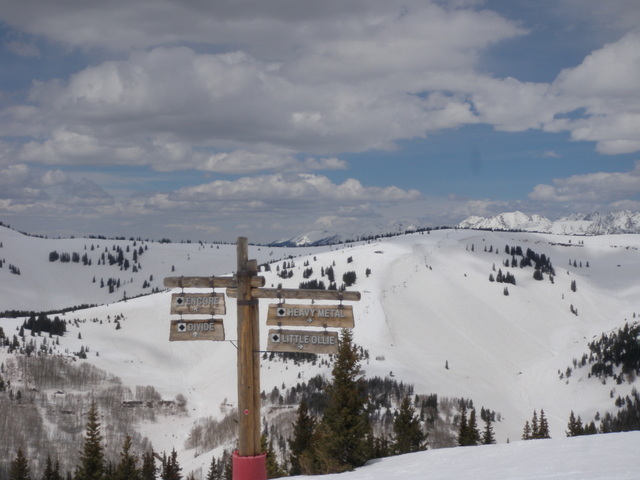
Blue Sky Runs Beckon after Lunch

Blue Sky Runs Beckon after Lunch

Arkansas River – 04/21/2014

Time: 10:00AM – 3:30PM

Location: Salt Lick, Spike Buck, and Parkdale access areas

Fish Landed: 3

Arkansas River 04/21/2014 Photo Album

Are my skills permanently eroding or am I in a slump or are external factors controlling my fly fishing results? I’ll choose to blame external factors such as weather and streamflows for now, but if the 2014 fishing outings continue down the current challenging path, I may need to reevaluate.

My friend Steve and I exchanged emails and settled on a trip to the Arkansas River on Monday, April 21. The weather was projected to be warmer on Tuesday and Wednesday, but we were concerned that the wind would be more adverse, so we decided to make the trip on Monday when high temperatures would peak in the sixties. I had my gear packed on Sunday night and was able to leave the house by 6:30 and arrived at Steve’s home in Lone Tree by 7:15. We were off early, and this paid dividends as it allowed us to park along U.S. 50 above Salt Lick access by 9:30. The air temperature hovered around 52 degrees as we prepared to fish, and I pulled on two layers thinking I would shed at least one when Steve and I met again at noon.

River High and Murky at Starting Point

River High and Murky at Starting Point

Steve walked back down the highway toward Salt Lick to begin his fishing, and I migrated west along the shoulder and then scrambled down a steep rocky bank to the river. The river flows were elevated for April with the DWR site reporting flows at Parkdale around 800 cfs. We anticipated this, but we did not expect the turbid water that appeared below us. There was visibility of around two feet along the edges of the river, so we assumed this would allow the fish to see our offerings if we presented our flies in the five to ten feet of water along the bank. Given the higher flows, we assumed this was actually the only water that the trout could hold in.

Working the water along the bank is exactly what I did over the next two hours as I worked my way up the river and scrambled over large boulders to fling my nymphs into all the likely protected pockets and slack water areas where I expected to engage hungry trout. I began with a weighted 20 incher and trailed a bright green go2 caddis, but these apparently didn’t appeal to the tastes of trout in this area of the Arkansas River. I worked through numerous fly changes including an emerald caddis pupa, prince nymph, San Juan worm and apricot egg. None of these turned the tide. As 11AM arrived and passed I decided to follow the advice of the Royal Gorge Anglers web page and moved to a RS2 in case the blue winged olive nymphs became active.

I also replaced the 20 incher with an iron sally as the top fly, and finally in the period between 11:30 and noon, I hooked and landed a nine inch brown on the iron sally. As I released the fish I realized that it was approaching noon, and I needed to hustle back up the bank and down the highway to meet Steve. Steve reported that he landed three small browns early on, but had not enjoyed any action since. We decided to move on and try new water, so Steve executed a U-turn, and we drove east to the Spike Buck access parking lot. Here we took our lunches down to the boat launch area and observed the water from some large rocks while we ate.

Intermittent clouds blocked the warming rays of the sun, and when this occurred gusts of wind swept up the river. Fortunately the wind was blowing out of the east and up the river so casting was not as difficult as my last trip to the Arkansas River. Halfway through consuming our lunches, we began to observe small mayflies skittering across the surface of the water in front of us. The small BWO’s didn’t remain on the surface more than a fraction of a second before they were swept up in the air by the wind. For fifteen minutes or so as we watched, there was actually a fairly dense emergence, but we did not spot any rising fish nor any fish hovering below the surface.

Second Fish Landed on Monday

Second Fish Landed on Monday

After lunch Steve decided to fish upstream a bit, and I walked downstream to the last point before the river crashed through a narrow chute. I decided to try one of my soft hackle emergers and went with a combination of the emerger on top and a RS2 as the bottom fly. I began to work my way up the river along the left bank and managed to land two additional brown trout in the twelve inch range. Both of these fish snatched the emerger on the lift or swing, so movement appeared to be key to attracting fish. This sounds like great action, but in reality this took place over an hour and a half, and I was convinced that I should be seeing and landing many more fish during this fairly strong BWO hatch.

Soft Hackle Emerger Fooled Two Brown Trout

Soft Hackle Emerger Fooled Two Brown Trout

In fact, I did not spot many fish over the course of the entire day, and this is highly unusual for the Arkansas River. Normally as I work my way upstream I startle numerous fish that dart from cover tight to the rocky bank, but none of this was occuring on Monday. Perhaps the murky water afforded the fish more cover than usual, and they felt safe spreading out to holding locations in the river behind current breaks, and I was largely excluding the middle of the river from my prospecting?

At 2PM Steve and I met up and decided to move once again, and this time we migrated east to Parkdale where we parked at the upstream edge of the access area. I grabbed my rod and walked down the exit road for quite a while and then battled through some stiff dead vegetation to the river. I never fished in this area before, so this was a bit of a scouting expedition. Unfortunately sometimes scouting trips enable one to dismiss certain water, and this was one of those occasions. The stretch of water below the boat launch was a 50-75 yard long featureless trough. I gave it a chance and began at the base and began casting my nymphs upstream within five to ten feet of the bank. I covered the entire stretch until I reached the riffle at the top, and during this one hour of exploration I didn’t see nor hook a single fish.

I exited the river at the boat ramp and walked back up the road and found Steve casting near the picnic tables near the car. We both decided that we were weary and not having any success and looking forward to snacks on the drive home more than continuing to fish.

Steve Calls It Quits

Steve Calls It Quits

I’m beginning to fear that the current conditions on the Arkansas River will continue right into snow melt, and I will miss productive pre-season outings before the river rages out of control in May. Since my trip to Wyoming I’ve experienced four fishing outings, and the highest fish count was three. Is this a slump, permanent erosion of skills, or convergence of adverse conditions? Too early to know, but I’ll keep plugging away.


South Platte River – 04/15/2014

Time: 11:00AM – 4:30PM

Location: Upper mile below dam and then downstream on north side of twin tunnels

Fish Landed: 3

South Platte River 04/15/2014 Photo Album

Three hours of blue wing olives hatching and abundant quantities of large trout would seem to portend a great day of fishing, and it was, but not without some hardship. At the beginning of the week I studied the weather forecast as I was hoping to fish on Thursday and ski on Friday. Monday was cold with leftover snow accumulations from Sunday night. Tuesday called for highs in Denver in the low 60’s. Wednesday was not an option due to commitments at work, and Thursday projected as another cold front with high temperatures spiking in the 40’s. Friday was the nicest day, but I’d already committed to spring skiing at Vail with friends.

I decided that Tuesday would be the day, but now I needed to determine a destination. I eliminated the Arkansas River quickly as it represented a long drive, and my results the previous week were disappointing. The Big Thompson was only flowing at 26 cfs so that sounded challenging, and a report on the St. Vrain River below Buttonrock stated that one of my favorite destinations would not be open until 2015 due to September flood damage. Flows on the South Platte River in Waterton Canyon were over 300 as well as the South Platte below Cheesman Dam. These are reasonable levels, but they increased from the low one hundreds in the last two days, and I haven’t had good results when water levels change dramatically.

The South Platte River below Eleven Mile Reservoir, however, was running in the high 80’s, and the high temperature was projected to be in the low 50’s, so this became my choice. I took my time getting ready as I knew it would take some time for the air temperature to get to tolerable levels in the mid-40’s. At 7:45 I was set with the car loaded with all the necessary items for a day on the river. I encountered heavy traffic on interstate 225 near the junction with I25, but again I wasn’t trying to arrive early, so I relaxed and listened to music from my iPod.

When I arrived at the entrance to Eleven Mile Canyon and paid my day use fee, the temperature was 39 degrees, so I drove very carefully and slowly to the dam to check out the water. The water appeared to be delightful, but shaded areas displayed a couple inches of snow and the wind was shaking the trees and willows along the stream. I didn’t encounter other fishermen until the last mile or two below the dam, and here I discovered quite a few, so I executed a U-turn in the parking lot and reversed my direction. I found a nice large gap between parked cars approximately a mile below the dam and pulled over and prepared to fish. I killed some more time by eating a granola bar and slowly applied sunscreen to my face and hands. I couldn’t delay any longer so I opened the door and absorbed a cold blast of wind.
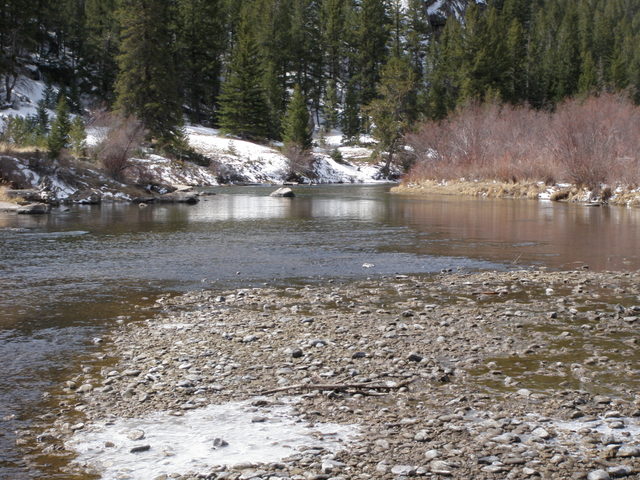
 

Starting Point in Eleven Mile Canyon

Starting Point in Eleven Mile Canyon

I didn’t spare any layers and pulled on my Adidas pullover, a heavy fleece cardigan, and my down vest and then pulled my waders over the top while wondering how the Michelin man manages any mobility. To top things off I donned my New Zealand brimmed hat with ear flaps and after stringing my Loomis 5 weight, I was on my way. I followed a worn path thirty yards downstream and cut over to the river. I didn’t notice any surface activity, so I waded downstream a bit further to the tailout of a long riffle and tied on a Chernobyl ant with a beadhead RS2 dropper and began working the soft water along the left bank. Already I was noticing the difficulty of casting into a stiff headwind, but it was early in the day, and I didn’t give it too much thought.

After covering some marginal water without any action or seeing any fish scattering from bank lies, I came upon a nice deeper pool and riffle behind some exposed rocks serving as a nice current break. I paused and observed the water and immediately I spotted two then three then at least five to ten nice fish holding in the pool and run. Unfortunately these fish were totally ignoring my Chernobyl and RS2, so I clipped off the nymph and replaced it with an apricot egg and then added a third fly, a size 20 soft hackle emerger.
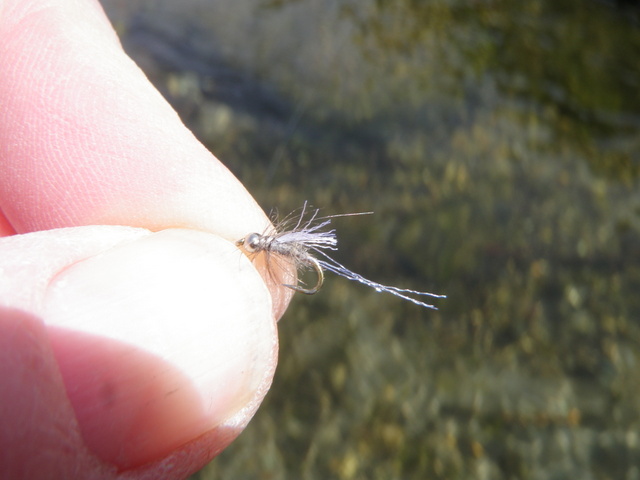
Soft Hackle Emerger Spent Some Time on My Line

Soft Hackle Emerger Spent Some Time on My Line

It was downright cold, and the wind continued to be a nuisance, but the sight of nice fish finning in the pool ahead of me allowed me to ignore the weather difficulties. As I prospected my three fly menu, I began to observe swarms of tiny midges buzzing along the surface of the river. The fish were also becoming more active, and my polarized lenses allowed me to see them moving subtly from side to side. This behavior usually indicates feeding on subsurface nymphs and larva in the drift, but they were having none of my soft hackle emerger.

As all this observation was going on, I now began to notice larger insects tumbling across the surface, and upon closer examination and during a lull in the wind, I spotted a blue wing olive mayfly riding by me on the surface current. This was followed with a few sporadic rises from two of the fish in front of me. I couldn’t understand why my soft hackle emerger wasn’t attracting interest since historically it worked in these same circumstances on other rivers. But the fish were active, and my flies weren’t effective, so I concluded a change was in order.

Off came the Chernobyl, the egg, and the soft hackle emerger; and they were replaced with a size 22 CDC BWO dry fly. I began overpowering forward casts in order to punch the tiny fly into the headwind, and as I did this, the frequency of trout breaking the surface picked up a bit. Unfortunately none of the trout were in a regular rhythmic feeding pattern, so it was difficult to choose which fish to focus on. I spotted a fish to my right and fifteen feet upstream that rose a couple times, so it became my target. This fish was moving around quite a bit subsurface, but occasionally it rose to the surface and gulped a mayfly from the surface film.
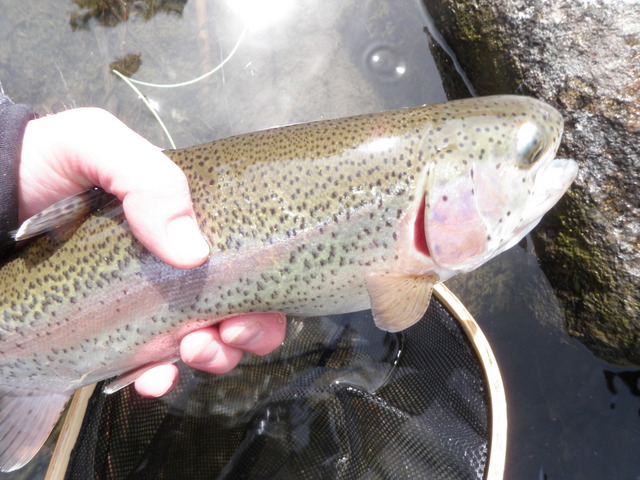
15" Rainbow Was First Fish Landed

15″ Rainbow Was First Fish Landed

I cast repeatedly and shifted my target  off and on, but eventually I returned to the fish described above and after perhaps half an hour and 50 casts, the fish tipped up and sucked in my imitation. I executed a solid hook set and played a strong rainbow trout, and after a few strong but futile runs, I was able to slide my net beneath the 15 inch pink sided warrior. I shuffled over to the bank and managed to grip the fish long enough just above the net to snap a photo. I’m being extremely conscious of not removing fish from the water more than a few seconds as I go forward. I approximated the rainbow’s length at 15 inches, and it exhibited a healthy girth for that length of fish.
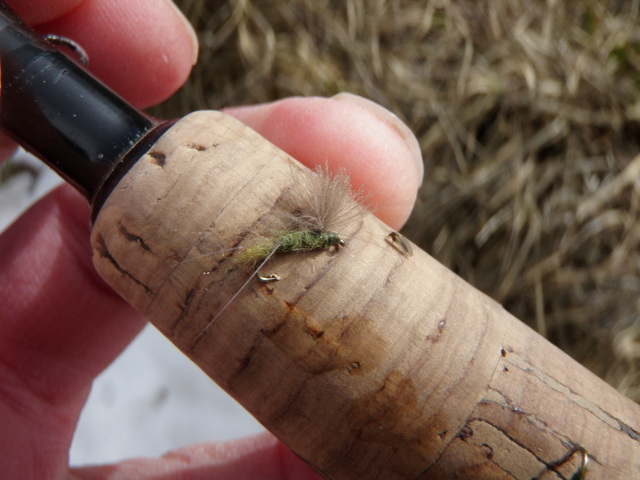
CDC BWO Fooled Two Rainbows

CDC BWO Fooled Two Rainbows

Fish continued to rise in this area after I rested it a bit, but I was anxious to move on, so I waded up along the right bank a bit. In previous circumstances such as this, I’ve had success getting above fish and drifting my dry fly downstream to their position, so I tried this for a bit, but on this windy day in April the technique was having no impact.

The next water above the current break was a wide riffle approximately three to four feet deep with a stronger main current running along the left bank. As I approached the water I could see at least seven or eight fish in the riffle. They appeared as dark fish shapes against the light sand bottom of the river. Careful observation also revealed that these fish were rising sporadically to the surface, but they were also moving about and taking something subsurface. I resumed my furious casting into the wind and began covering the locations where I spotted fish. This went on for another hour or so, and I did manage two or three momentary hook ups with my tiny fly. It seemed that I should be getting more attention from my fly given the increased amount of surface feeding from this pod of fish.

Another 15" Rainbow Sipped CDC BWO

Another 15″ Rainbow Sipped CDC BWO

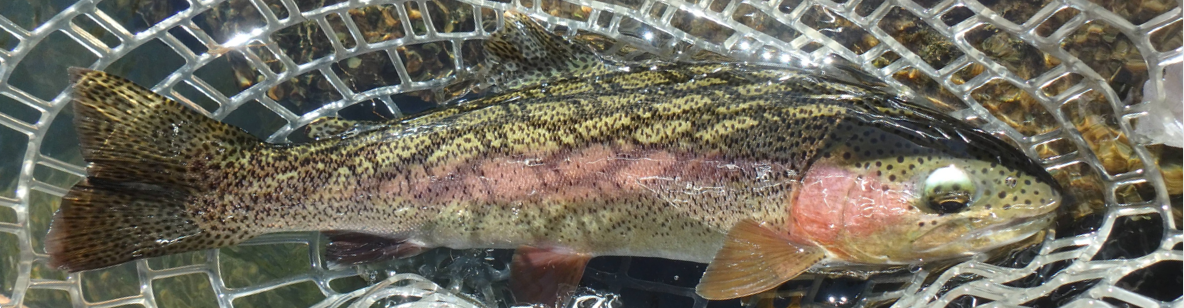
My theory is that the trout were accustomed to seeing the adult BWO’s tumbling across the surface due to the strong wind, and my artificial floated along without any sort of skittering or movement. Finally after an enormous amount of exaggerated casting into the wind and some frustrating momentary hook ups, I noticed a fish tip up near my fly, so I set the hook and felt the weight of another nice fish. When I eventually landed this beauty, my net revealed a silvery pink striped rainbow that was nearly the same size as my first fish. I carefully snapped another head shot and released this gem back into the river.

I was now verging on shivering uncontrollably, but as long as the hatch was continuing I was hesitant to return to the car to warm up and eat lunch, but there was no more deferring of this necessary reprieve in my fishing day. I returned to the car and quickly ate my minimal lunch and warmed my body and feet. Sheltered from the wind inside my SUV, I was amazed at how comfortable the day was.

Another car arrived while I was preparing to resume fishing, and it parked along the road forty yards further upstream, but I decided to return to my exit point and resume assuming I still had some space to work before conflicting with the new arrivals. When I arrived back at the river, I quickly passed some unattractive water until I approached some nice deep runs and riffles approximately twenty yards below the pullout with the forest green car that arrived as I was preparing to fish. Once again I could spot some nice fish in this area, but not nearly the concentration that I’d witnessed further downstream. The hatch had now waned to very sporadic tumbling mayflies, and there may have been one or two visible rises while I was watching.

I made some good casts and presentations to the areas where I observed rises, and I experienced one more momentary connection, but I was now bumping into the territory of the next group of fishermen, so I climbed up the bank and returned to the car. I broke for lunch at 1:30 and after this brief resumption of fishing, it was probably 2PM when I unlocked the car and threw my gear in the back. I decided to drive further downstream to the bottom of the special regulation area and fish there for the remainder of the afternoon.

I found a nice wide pullout a half mile or so beyond the twin tunnels and this was above a wide smooth pool where the river could spread out briefly after going through a more narrow canyon stretch. I descended to the top of the pool, and I was weary of casting tiny dry flies into the wind over very selective fish, so I decided to try the strike indicator nymphing technique. Also I was not seeing any mayflies on the surface anymore, but I did see quite a few extremely small cream colored midges swarming about. I elected to go to an indicator and split shot and beneath that I tied an orange scud and then a small size 22 RS2.
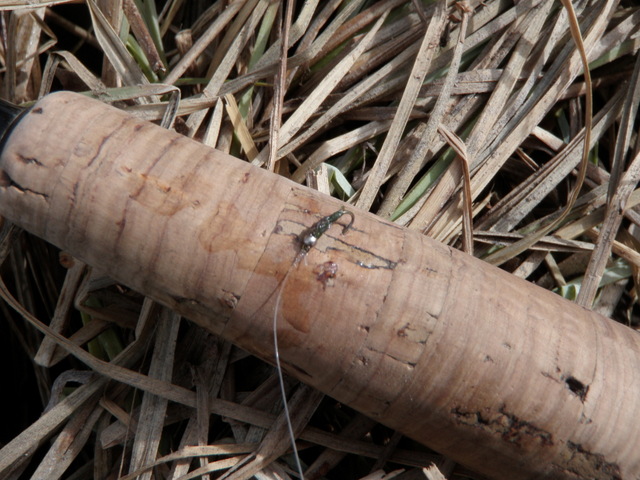
RS2 Took a Rainbow Late in Day

RS2 Took a Rainbow Late in Day

I worked some nice deep pockets along the left bank and did spot an occasional fish that ignored my offerings, but then I approached a nice long narrow deep pool. Before I cast, I could see five or six decent fish lined up across the river in some slower moving water at the top of the pool. I didn’t hold out much hope that my nymphs would fool these fish since the surface was rather smooth and my cast would surely create a noticeable surface disturbance. I made five or six half hearted casts above the visible fish, and tried to impart some movement and swing to my flies. Miraculously on the seventh or eighth drift I was shocked to see one of the lined up fish closer to the far side dash two or three feet to the side to snatch something, and it was approximately where my trailing fly was, so I set the hook and found myself attached to the fish.

What a thrill as I battled another rainbow and brought it to my net, and this fish measured around 13 inches. I’d already conceded to a two fish day, so this late surprise was a bonus. I was reinvigorated by this catch and continued working my way upstream with the nymph offerings, but unfortunately my new enthusiasm was not rewarded. By 4:30 I was once again chilled and the relentless wind forced me to climb the steep rocky bank to the road and return to the Santa Fe.

In spite of the low fish count of three, it was a very enjoyable outing. Being able to see large actively feeding fish always gets my juices flowing, and that’s what held my interest for most of Tuesday on the South Platte. I will certainly look for additional opportunities to visit Eleven Mile Canyon in the spring of 2014 before the water management folks open the gates and release large volumes of water from the dam.
Arapahoe Basin – 04/12/2014

Arapahoe Basin 04/12/2014 Photo Album

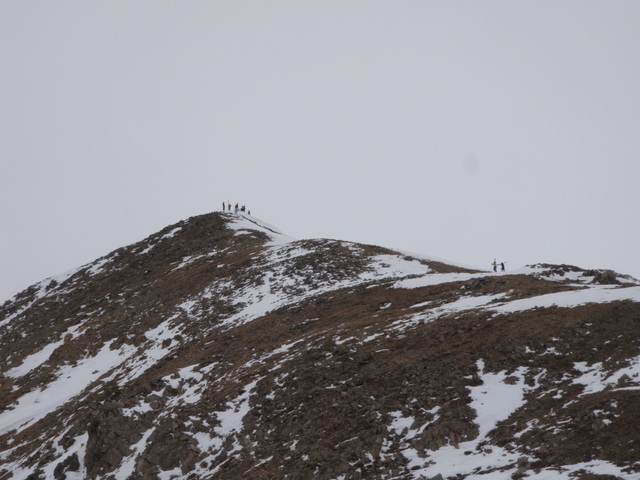
As mentioned in the previous post, Jane was unable to accompany John, Dan and I to Vail on Thursday, so we planned to make a compensatory trip to A-Basin on Saturday. A-Basin is a small high elevation ski area on the west side of Loveland Pass, and it represents a much shorter drive than the other areas available to us on our Epic Pass. We also agreed to take our time and arrive late and then limit ourselves to three hours of skiing.
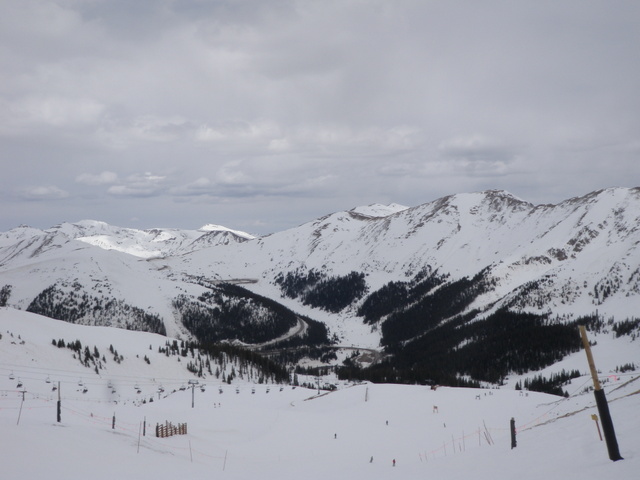
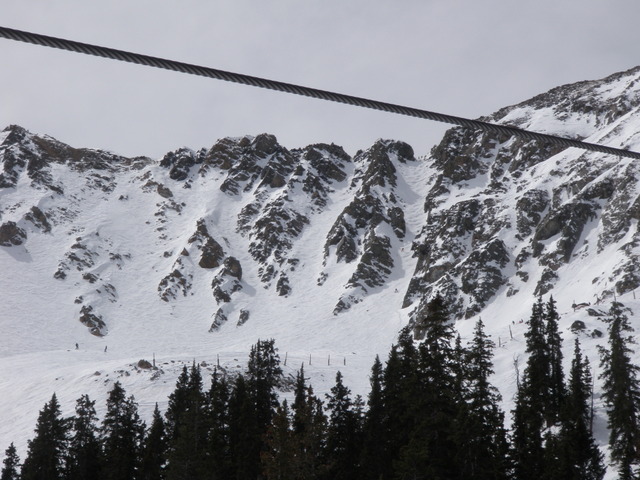
Skiers Appear as Tiny Ants on the First East Wall Chute

Skiers Appear as Tiny Ants on the First East Wall Chute

We held to these commitments and had a very enjoyable day at The Legend, the marketing term that Arapahoe Basin advertises. It was sunny with the air temperature in the high 30’s when we arrived and began skiing at approximately 10:30AM. We warmed up with a few runs on the front side and then climbed over the incline to Montezuma Bowl where we executed another three runs in the bowl. We finished our day with three or four runs on the front side and then packed our skis and returned to Denver.

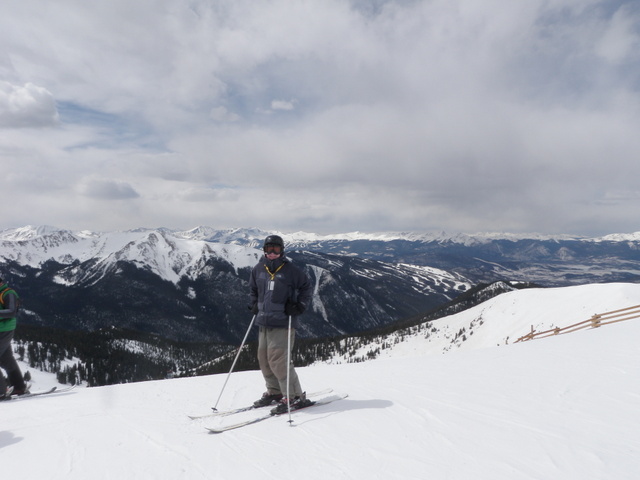
Dave at Top of Montezuma

Dave at Top of Montezuma

The bottom one-third of the mountain had soft spring snow, but above the Black Mountain Lodge we were dealing with winter snow conditions. It was fun to have the option to choose between winter or spring skiing on the same day at the same area.

Looking Northeast Toward Loveland Pass

Looking Northeast Toward Loveland Pass

Skiers Hike to the Top of East Wall

Skiers Hike to the Top of East Wall

My favorite aspects of the day were enjoying the companionship of my wife, sweeping down the wide open Montezuma Bowl on fast firm snow, and ending the day with three strong bump runs on the soft moguls populating Ramrod near the bottom of the mountain.

With colder weather and more snow forecast for today, I suspect there will be a few more skiing posts mixed in with fly fishing entries in April.