Emerald Caddis Pupa – 12/17/2014

Nice Fly

My relationship with the emerald caddis pupa began many years ago during several fishing trips to Pennsylvania, and you can read the background story at beadhead emerald caddis pupa – 01/01/2012. It continues to be a productive fly in my arsenal, and I always plan to have adequate quantities available.

Unlike the bright green caddis pupa which seems to peak in effectiveness around grannom hatch time periods, the emerald version is productive all season long. In fact, I’ve had success with this fly during late afternoon time periods when the water seems dead after a significant hatch. I attribute this to the emerald color. I’ve seen caddis adults bearing emerald tips on their abdomen, so I believe that the color is a significant triggering characteristic.

Six Completed Emerald Caddis Pupa

For 2015 I plan to have 30 emerald pupa in my beginning inventory, and this required me to produce an additional six. I experimented with two different dubbing materials for the collar behind the gold bead. One choice was hares mask fur, and I am quite pleased with the unruly buggy look of this modification. I’m hoping this appearance will convey the illusion of movement and emergence even more than the gray rabbit fur that I have traditionally applied. I have completed six new flies, and I’m ready to explore rivers and streams with emerald caddis pupa.

Great Scraggly Caddis Look

Bright Green Caddis Pupa – 12/16/2014

While still living in Pennsylvania early in my fly fishing career, my father and I rented a small cabin along the Beaverkill River in New York during the middle of May. During one day early in our week we encountered a dense grannom emergence, and I managed to catch some fish on a dark cahill wet fly, but I felt like a better imitation would have resulted in more fish landed.

When I returned to the cabin that evening, I pulled out my recently purchased Caddisflies by Gary Lafontaine and researched what patterns imitate grannom pupa. This was my introduction to the bright green emergent caddis pupa. I must have had fly tying materials with me, as I remember producing some caddis pupa as well as some egg laying adult patterns, and the next day I arrived at the river prepared. That following afternoon I was armed with the bright green caddis pupa, and I experienced one of the best days of fishing in the east prior to my relocation to Colorado. I recall two doubles where I had two fish on my line at the same time.

Great Proportions

After I moved to Colorado, I continued to knot a bright green caddis on my line whenever I spotted a fair amount of adults in the air or in the streamside vegetation. I discovered that the sparkle yarn pattern was just as productive in the west as it was in the east.

Historically I’ve experienced the most success with the bright green caddis on the Arkansas River in April and early May when the grannom hatch is at its peak. I fish the pupa on a tandem nymph rig with a split shot and impart various types of movement to the fly in the hours before emergence or egg laying, and this approach yielded a significant amount of success. Unfortunately due to unusually cold high murky water conditions during the spring of 2014, I never encountered the caddis pupa friendly conditions that I seek.

I did have some decent success on the Eagle River in early July during the post runoff time period. During one outing with my friend Todd I was landing quite a few nice fish over a short period of time so I gave him some to test. Todd quickly became a huge fan of the bright green caddis pupa.

Twelve Bright Green Caddis Pupa

I counted my stash of bright green caddis pupa and discovered that I had 28 carry overs in my bin, so I planned to tie an additonal twelve to bring my inventory level to 40. I’m happy to report that this goal has been reached, and I anxiously anticipate a more productive caddis season on the Arkansas River.

Hare Nation – 12/11/2014

In my 12/04/2014 post on the hare’s ear nymph I concocted a fly in my mind that I called a Hare Nation. I envisioned combining the best features of two of my most productive flies into one. I selected the hares mask dubbing for the abdomen and soft hackle legs from the hare’s ear nymph, and then borrowed the flash back black and flashabou from the salvation nymph along with the black peacock ice dub for the thorax.

A Completed Hares Ear

Very Nice Top View

I am happy to report that the hare nation is no longer a figment of my imagination. I tied one the other night. I like the look, but the final product strikes me as a close replica of a flashback pheasant tail nymph. That isn’t really all bad, as it may attract more fish during pale morning dun hatch periods.

Better Top View

What do you readers think? Should I tie more hare nations?

Ultra Zug Bug – 12/07/2014

My history with this fly goes back to the Scott Sanchez fly tying book I purchased at the Fly Fishing Show several years ago. In 2012 I was flipping through the book looking for new ideas, and I encountered Scott’s recipe and instructions for ultra zugs and decided to give it a try. I tied a few ultra zug bugs, and at the time I viewed them as simple replacements for a prince nymph. I dislike mounting the white goose biots as wings on the prince nymph, so the simplicity of the ultra zug appealed to me.

Until this year I rarely fished a prince nymph, and thus an ultra zug, except for the April and early May time frame when I’ve had decent success with the peacock bodied subsurface flies during the caddis hatches that occur frequently on Colorado streams. My theory is that the dark peacock body is a reasonable imitation of egg laying female caddis flies. Unfortunately the spring of 2014 featured abnormally high and cold conditions, and I did not fish during the heavy presence of caddis as I was accustomed to in previous years. For this reason my ultra zug bugs remained dormant in my fly box for most of the summer.

During my trip to the Flattops Wilderness in September after hiking two miles into the backcountry to fish the South Fork of the White River, I came to the realization that I was running out of my salvation nymphs. The salvation had advanced from an experimental fly to the new number one workhorse fly in my arsenal. With another month of prime fishing remaining in the 2014 season, I did not want to deplete my salvation supply, so I rummaged through my zippered fleece pouch and spotted several ultra zugs.These flies had an abundance of flash, a scraggly look, and the peacock color that trout relish. Could these be a replacement for the salvation for the remainder of the day?

15 Ultra Zug Bugs with Better Light Setting

I tied one on my line, and it instantly became the hot fly. I always avoid tying flies during fishing season, so I continued opting for the ultra zug over the salvation for the remainder of the season, and guess what I discovered? The ultra zug yielded fish on par with the hares ear and possibly matched the salvation nymph in productivity. Was this a fall phenomenon, or is the ultra zug an all season attractor similar to the hares ear and salvation?

In order to answer this question, I decided to tie another thirty this winter so that I have fifty as I enter the 2015 fishing season. Quantity will not be a deterrent to tying an ultra zug to my line, and I intend to test it throughout the season and not limit it to early and late season situations.

Ingredients for Ultra Zug Bug

The beauty of the ultra zug is its simplicity. Excluding the hook, bead and thread only three materials are required to construct this fish catching machine. I start with a brown tail made from pheasant feather fibers, and then I tie in a strand of crystal hair. Next I dub a tapered body of synthetic peacock, and then I rib the body with the crystal hair. Finally I spin small clumps of the peacock dubbing around the body just behind the bead, and then I whip finish. I can crank out two of these flies for every single hares ear or salvation nymph. The synthetic peacock dubbing creates quite a bit of sparkle and the crystal hair augments the flash even more than fine wire. Once I whip finish the fly, I pinch the dubbed collar with my right hand, and then I pull the excess fibers with my left and tear them away. This shrinks the dubbed hackle to the proper length and also strokes the fibers into a nice sheath around the body of the fly.

Ultra Zug Bug

I’m excited to give the ultra zug more time on my line. It is a great looking simple fly, and I’m betting the fish will give it a thumbs up.

Hare’s Ear Nymph – 12/04/2014

Once I moved to Colorado and learned the effectiveness of nymph fishing, I discovered that a hare’s ear nymph was a magnificent producer in all seasons and all times of the day. Adding a beadhead to the hare’s ear nymph simply enhanced the fish catching appeal of this traditional fly. For the last four years I entered each new fishing season with an inventory of at least 100 beadhead hare’s ear nymphs; a testament to my trust in this productive fly.

During 2014 I noticed a shift in my favorite nymph option as I began to knot a salvation nymph to my line more frequently than a hare’s ear, and in the late stages of the season I selected an ultra zug bug ahead of a beadhead hare’s ear. I can recall numerous occasions when I fished a beadhead hare’s ear and salvation nymph in tandem, and the fish seemed to demonstrate a distinct preference for the salvation. Perhaps the position of the fly had an impact on their relative effectiveness, and I generally placed the salvation on the point with the hares ear presented as the top fly. I have always believed that the point fly tantalizes fish because it exhibits more movement as it is only attached to a leader on one end. Nevertheless I gradually concluded that the salvation nymph was outproducing the hare’s ear, and consequently I developed a higher level of confidence in the new flashy kid in my box.

[pe2-image src=”http://lh5.ggpht.com/-TGDVUCAetqA/VHjTLXlvhKI/AAAAAAAAtOU/ig8hjtxSPWM/s144-c-o/PB270001.JPG” href=”https://picasaweb.google.com/108128655430094950653/11272014Thanksgiving#6086847088655565986″ caption=”A Clump of Hare’s Mask with Lots of Guard Hairs” type=”image” alt=”PB270001.JPG” ]

These evaluations are never very scientific, and I pondered why fish would shift from preferring one fly compared to another. Are trout going through some sort of evolutionary shift in appetite? This theory is highly unlikely. Did I shift the timing of my fishing to seasons or times of the day when fish seek a different food source? The Arkansas River has historically been a haven of hare’s ear gobbling brown trout, and I did not fish that river as frequently in the early season as in previous seasons. This may have been a factor. Could it simply be that much of the success stems from how much confidence a fisherman has in a given fly? Confidence yields time on the line, and time on the line results in more hours in the water in front of fish. In all likelihood all three flies are attractive to fish, and the relative success depends on how frequently I attach them to my line.

[pe2-image src=”http://lh3.ggpht.com/-RJ5KvK9doUI/VHjTM4PnDnI/AAAAAAAAtOs/8uPBoLqtvto/s144-c-o/PB270004.JPG” href=”https://picasaweb.google.com/108128655430094950653/11272014Thanksgiving#6086847114600975986″ caption=”A Completed Hares Ear” type=”image” alt=”PB270004.JPG” ]

This discussion of hare’s ear effectiveness begs the question; what does a hare’s ear nymph imitate? I believe that it is a general nymph imitation that effectively represents various mayfly nymphs. In addition, the soft hackle legs, tan-gray color, and buggy guard hairs also make it effective during periods when there is an abundance of subsurface caddis activity. A salvation nymph is more narrowly an imitation of mayfly nymphs, but the one advantage it possesses is more flash and tiny rubber appendages. Perhaps the additional flash attracts more fish particularly when paired with a beadhead hare’s ear on the same line. In an effort to test this theory, I tied a few new hare’s ear nymphs this winter with a strand of pearl flashabou in the middle of the wing case. I have not resorted to the following pattern yet, but the idea is floating in my mind. I may combine the best qualities of a hare’s ear and salvation and call it a hare’s nation. I envision the buggy hare’s mask dubbing for an abdomen, but then I would use the flashback black and flashabou for a top layer and wing case that covers the entire fly. For the thorax perhaps I would use black peacock ice dub and then finish the fly with soft hackle legs instead of the fine silli legs.

I counted my remaining stock of beadhead hare’s ear nymphs and discovered that I had 51 in inventory. Given the shift in preference from hare’s ear to salvation, I decided to tie 29 and bring my season opening total to 80 rather than the historic standard of 100. In addition I tied 15 for my friend in Kansas City.

[pe2-image src=”http://lh5.ggpht.com/-c1i96kYJR0s/VHpxZ9JrwMI/AAAAAAAAtQ4/2LyU3cb90bE/s144-c-o/15%252520Hares%252520Ear%252520Nymphs%252520for%252520Gift.JPG” href=”https://picasaweb.google.com/108128655430094950653/11272014Thanksgiving#6087302537070493890″ caption=”A Gift for Dave Gaboury” type=”image” alt=”15 Hares Ear Nymphs for Gift.JPG” ]

Will the salvation nymph continue to outshine the beadhead hare’s ear nymph in 2015? Will the ultra zug bug become my new hot fly? Can the beadhead hare’s ear rebound and return as the pre-eminent fly in my fly box? I look forward to spring so I can begin to determine the answers to these questions.

South Platte River – 11/29/2014

Time: 11:30AM – 2:30PM

Location: Cheesman Canyon

Fish Landed: 0

South Platte River 11/29/2014 Photo Album

I’ve never been a huge fan of winter fishing, but the mild weather of Thanksgiving weekend in Colorado induced me to overcome my reluctance. The high temperatures for Thursday through Saturday ranged from the mid-60’s to the mid-70’s, and Jane suggested that we take advantage of the weather and hike into Cheesman Canyon. I signed on to the late fall trek, and we arrived at the Wigwam parking lot at 11AM on Saturday morning. I put on my waders and wading boots and prepared my Sage four weight while Jane grabbed her lunch, stadium seat, and book. We were on our way on a pleasant .5 mile hike to the rim of Cheesman Canyon.

The temperature was in the low 60’s as we began, and when we began the descent to the river in the brilliant sunlight it felt more like 70. The flows in the South Platte tailwater were 125 cfs and crystal clear. As we traveled upstream on the red gravel trail, we passed quite a few fishermen. Our destination was Cows Crossing, but as we approached this ninety degree bend in the river, it was clear that the large rock that Jane loves to frequent was covered by shade. We shifted our destination and found another nice large flat boulder bathed in sunlight, and Jane made this our base camp.

[pe2-image src=”http://lh3.ggpht.com/-KsGKmuXowDo/VHp3ZTdHxlI/AAAAAAAAtV0/TNDxYK5oEHw/s144-c-o/PB290013.JPG” href=”https://picasaweb.google.com/108128655430094950653/11292014SouthPlatteRiver#6087309122947499602″ caption=”Jane’s Spot Along South Platte” type=”image” alt=”PB290013.JPG” ]

I began my quest for a late November fish by moving fifteen yards downstream from Jane, and I tied on a Chernobyl ant with a trailing ultra zug bug and orange scud. I stood on some large rounded boulders and began covering some very attractive water, but I saw no signs of fish. I began to doubt the effectiveness of the dry/dropper configuration in the cold flows of the South Platte River, but when I approached a nice current seam just below Jane’s position, I observed a pause in the foam attractor and set the hook. Much to my surprise I was attached to a tiny rainbow trout that measured four inches, so I quickly removed the ultra zug bug and allowed the small gem to return to the icy flows. I gave my camera to Jane before I began fishing, so she actually captured me netting the hungry little fish.

[pe2-image src=”http://lh6.ggpht.com/-gCVkVIYCTSU/VHp3cVSOO0I/AAAAAAAAtV4/HA50QBb3iKg/s144-c-o/PB290019.JPG” href=”https://picasaweb.google.com/108128655430094950653/11292014SouthPlatteRiver#6087309174978263874″ caption=”Landing a Tiny Rainbow Trout” type=”image” alt=”PB290019.JPG” ]

I moved on above Jane to the large bend at Cows Crossing and found a place where the river was shallow enough to cross, and I then continued fishing upstream along the opposite bank. I prospected some nice current seems, riffles over moderate depth and deep runs; but none of these typically productive stream structures produced any action. In fact I was surprised that I did not see any fish since the flows were low and clear.

[pe2-image src=”http://lh5.ggpht.com/-hQRAV9UWB_s/VHp3dal10_I/AAAAAAAAtVs/xt01U8gTMNk/s144-c-o/PB290021.JPG” href=”https://picasaweb.google.com/108128655430094950653/11292014SouthPlatteRiver#6087309193582597106″ caption=”Forward Cast” type=”image” alt=”PB290021.JPG” ]

At 12:30 I returned to Jane’s base camp and enjoyed my lunch in the company of my lovely wife. Jane noticed that the shade was rapidly advancing toward her rock perch, so she announced that she might move before I returned. I meanwhile decided to walk farther up the trail and around the next ninety degree turn that is called Rainbow Bend. I discovered that this area was quite popular with other fishermen and passed four fishermen working the slow moving deep pool just above the bend.

[pe2-image src=”http://lh6.ggpht.com/-q1hg-wlwAL0/VHp3e_uwttI/AAAAAAAAtTU/JmucK4Rmpdo/s144-c-o/PB290024.JPG” href=”https://picasaweb.google.com/108128655430094950653/11292014SouthPlatteRiver#6087309220731991762″ caption=”Two Fishermen in Clear Pool” type=”image” alt=”PB290024.JPG” ]

Eventually I moved above the last fisherman and approached a nice wide pool. I abandoned the dry/dropper approach and configured my line with a hot pink strike indicator, split shot, ultra zug bug and zebra midge. I noticed quite a few minuscule midges buzzing about above the river, and this observation caused me to experiment with the midge larva. I began drifting the nymph combination through the pool, along the juicy current seams and through the tail out, but none of this focused fishing attracted any fish. Meanwhile another fisherman that was originally below me circled around my position and then entered the river forty yards farther upstream.

[pe2-image src=”http://lh6.ggpht.com/-7c64xJrRm5c/VHp3iuHdCvI/AAAAAAAAtU8/f6r8uBia9zY/s144-c-o/PB290030.JPG” href=”https://picasaweb.google.com/108128655430094950653/11292014SouthPlatteRiver#6087309284723198706″ caption=”The Loop Is Forming” type=”image” alt=”PB290030.JPG” ]

Aside from the lack of action and absence of any signs of fish, the most frustrating aspect of this Saturday outing was the constant need to remove moss and scum from my flies. I estimate that scum removal was an every other cast event. After exhausting the prime pool that I optimistically claimed, I advanced upstream a bit, but after an hour of casting and moss removal, I began to think more about the snacks I packed for the return trip than the likelihood of landing a fish.

I clipped my flies to the rod guide and trudged back along the trail to our base camp. As Jane suggested, she was no longer there, so I hiked another .3 miles until I spotted her bright blue long sleeved shirt on the beach next to another juicy pool. She was now in the sun and sheltered from the wind by a huge boulder. Seeing no competing fishermen in the pool, I decided to make one more attempt to land a substantial trout from the South Platte River. Well, I have to admit that a nine inch fish would have exceeded my expectations at this point.

[pe2-image src=”http://lh4.ggpht.com/-zj8LhozatXo/VHp3g_2i2JI/AAAAAAAAtTs/vTSP98dw998/s144-c-o/PB290027.JPG” href=”https://picasaweb.google.com/108128655430094950653/11292014SouthPlatteRiver#6087309255124375698″ caption=”The Top of the Pool” type=”image” alt=”PB290027.JPG” ]

Alas, after another half hour of fruitless casting, I decided to call it quits, and I waded back to Jane’s resting place. I acknowledged that she probably had the right idea about Saturday November 29. It was a rare opportunity to enjoy a pleasant hike through gorgeous scenery and bask in the warmth of the late autumn sun. Catching a fish was really secondary.

Salvation Nymph – 11/15/2014

Salvation Nymph 11/15/2014 Photo Album

You can read my previous posts that chronicle how I was introduced to this fly. Suffice it to say, the salvation nymph has risen from a purchase at the fly shop along the Conejos River to the status of my most productive nymph in 2014. The shiny attractor nymph is typically the first nymph that I attach to my line when I approach a stream.

[pe2-image src=”http://lh6.ggpht.com/-WmUY1jWhDJE/VGeuiYAV29I/AAAAAAAArYs/XkNLMfD5wVQ/s144-c-o/PB130002.JPG” href=”https://picasaweb.google.com/108128655430094950653/11152014SalvationNymph#6082021727369812946″ caption=”Nice Sideview” type=”image” alt=”PB130002.JPG” ]

During 2013 I experienced some stellar days while tossing the salvation nymph in Colorado streams so I entered the year with 35 in inventory. Unfortunately this quantity did not meet my needs, and I nearly depleted my entire supply. In the last couple months of the season I began to substitute the ultra zug bug, another fly with an abundance of flash, but that is a future story. I found the salvation nymph to be particularly effective during the time periods when there were pale morning dun mayflies available to the trout. An outing on the Eagle River in early July stands out in my memory. For an hour in the early afternoon I spotted an occasional PMD mayfly in the air, but the fish ignored surface flies and aggressively chased my salvation nymph.

[pe2-image src=”http://lh4.ggpht.com/-Sj7IRJa0_WQ/VGeujBtU-qI/AAAAAAAArY4/LWC6Xo3-4eo/s144-c-o/PB130004.JPG” href=”https://picasaweb.google.com/108128655430094950653/11152014SalvationNymph#6082021738564352674″ caption=”Very Nice Top View” type=”image” alt=”PB130004.JPG” ]

I spotted one fish next to a submerged boulder, and as my nymph began to lift above the visible target, it aggressively moved a foot to inhale the artificial offering. I recall similar days on the White River in September and the Frying Pan River in late June. This nymph is not just a match the hatch phenomenon, however, as it produced many fish when used as a general attractor during time periods when pale morning duns were not a factor.

[pe2-image src=”http://lh3.ggpht.com/-iSbxE_sWHZw/VGeujyDMVdI/AAAAAAAArZE/tN_0oQps5Ig/s144-c-o/PB130005.JPG” href=”https://picasaweb.google.com/108128655430094950653/11152014SalvationNymph#6082021751540962770″ caption=”Ten Completed Salvation Nymphs” type=”image” alt=”PB130005.JPG” ]

Since I nearly ran out of salvation nymphs in 2014, I plan to begin 2015 with 50 brand new shiny prototypes in my fly fishing arsenal. For this reason I kicked off my production tying season by making salvation nymphs, and I’ve already completed twenty-one. I have supreme confidence in this fly. I’m also considering experimenting with some variations that will use different colors for the abdomen. A brown, amber or rust color is high on my list of experimental variations, as this color is an even closer imitation of  pale morning dun and sulfur nymphs. Stay tuned for more on the evolution of the salvation nymph.

Clear Creek – 11/09/2014

Time: 10:30AM – 2:00PM

Location: Large wide pullout on north side of route 6 and half a mile below where stream cuts to north side; 50 yards below bridge until just above the bridge

Fish Landed: 8

Clear Creek 11/09/2014 Photo Album

The water that one elects to fish is one of the keys to fly fishing, but I’m not talking about stream destination choice, although this is certainly another critical factor. Another critical decision revolves around the stretch of water that a fly fishermen chooses to fish, and I discovered how important this seemingly minor choice is to fishing success on Sunday November 9, 2014.

After skin surgery on my back (wear sunscreen) on Thursday, October 30 2014, I was not able to fish for at least a week. Until I experienced this incision, I did not realize how many movements bring the middle of one’s back into play, and casting a fly was certainly at the top of the list of aggravating actions. Unfortunately my recovery period coincided with a week of continuing mild fall weather in Colorado, and it was difficult to refrain from enjoying bonus fishing time.

Sunday was forecast to be the last of the mild weather before a blast of arctic air descended on the Front Range, and I felt that my back could withstand a couple hours of casting, so I committed to a late season trip. I did not want to make a long drive, so I evaluated nearby options. South Boulder Creek was flowing at a ridiculously low 13 cfs, so I ruled out my home water. The South Platte River was also trickling through Waterton Canyon at 34 cfs, and that represents quite low water and technical fishing. In addition this option necessitated a bike ride with a backpack, and I did not want to test the stitches on my back to that extent.

The next close option was Clear Creek, and the flows were fairly ideal at 50 cfs. Clear Creek Canyon is a mere 50 minute drive from my house, so I decided to make it my destination on Sunday. With the change from daylight savings time to standard time, I estimated that prime water and air temperatures would be in the 11AM to 2PM window. I packed my gear on Sunday morning and left the house by 9:30, and this enabled me to reach a wide dirt parking space on the north side of route six by 10:15, and I was in my waders and ready to fish by 10:30.

As I stood behind my car preparing to fish, another vehicle pulled into a pullout directly across from me, and a solo fishermen began a similar routine. When I initially arrived, I walked across the road and scanned the creek up and down for competing fishermen, and I was pleased to see no one else. After all my caution, my desire for stream space was being compromised unknowingly by the gentleman across from me. I considered moving on, but then decided to walk down the road .2 miles and fish back up to the Santa Fe, as I assumed the other fellow would cut directly down the bank.

[pe2-image src=”http://lh4.ggpht.com/-Tzn0eDFeIQE/VGAuURweETI/AAAAAAAAqvo/Lh4s8n7ehV0/s144-c-o/PB090040.JPG” href=”https://picasaweb.google.com/108128655430094950653/11092014ClearCreek#6079910422849130802″ caption=”Clear Creek at My Starting Point” type=”image” alt=”PB090040.JPG” ]

I executed my plan and walked by a large rock formation that separated the highway from the stream and then found a nice worn path that took me gradually down the bank to the edge of the river. Another fisherman was in a nice pool thirty yards below me, but he seemed to be rather stationary, so I waded into the creek and crossed to the south side away from the road. A gorgeous pool and deep run presented itself just above me, and a rush of anticipation surged through me as I tied on a Chernobyl ant and ultra zug bug.

I was certain that this attractive water would yield one if not two small trout, but certainties are rare in fishing. I covered the length of the pool and the deep run at the top, and I had nothing to show for my efforts. Perhaps it was the flies? I added a salvation nymph below the ultra zug bug and moved up along the bank, and ten yards above the lovely starting pool I saw a fish dart to the surface to grab the Chernobyl. A swift hook set allowed me to connect, and I quickly stripped a skinny eleven inch brown trout to my net. I was pleased to have a fish and even more impressed that it took a fly on the surface. Did this fish lose weight in the spawning process?

[pe2-image src=”http://lh5.ggpht.com/-OrtX4k8CDEY/VGAuU8MZCCI/AAAAAAAAqv0/Rts5UQWfNbw/s144-c-o/PB090041.JPG” href=”https://picasaweb.google.com/108128655430094950653/11092014ClearCreek#6079910434240530466″ caption=”First Catch Was This Skinny Brown Trout” type=”image” alt=”PB090041.JPG” ]

I was pretty excited as I moved on after this minor success, and I focused my propecting casts on the water that bordered the bank and rocks on my side of the river. Despite some solid casting and drifts, my fish count remained at one as I worked my way upstream on the south channel that flowed around a long narrow island. After an hour of fishing I approached the tip of the island, and here I noticed the tip of a fly rod moving back and forth. When I moved closer, I found a heretofore hidden fisherman just above the island, and he appeared to be younger than the person who arrived and parked across from me.

[pe2-image src=”http://lh3.ggpht.com/-rT9DlngH2To/VGAuVa61XXI/AAAAAAAAqv8/wzm2fKORciE/s144-c-o/PB090042.JPG” href=”https://picasaweb.google.com/108128655430094950653/11092014ClearCreek#6079910442488388978″ caption=”Liked the Chernobyl Ant” type=”image” alt=”PB090042.JPG” ]

I crossed the island and the small north braid and climbed the steep bank to circle around this temporary block to my progress, and when I crested the steep bank and looked upstream I could see the owner of the green Subaru that was parked across from me. At this point I realized that I had probably fished through water that the lower fisherman covered not more than thirty minutes beforehand.

With two fishermen now blocking my path I threw my gear in the car and slowly drove west to just beyond the bridge that crosses Clear Creek where it shifts from the south side of the highway to the north. Cars filled the parking spaces on both sides of the road just beyond the bridge, but I did not see fishermen in the stream. A second pullout on the south side of the paved two lane had an open space, so I made a U-turn and snagged the spot. In a matter of minutes I had my backpack and front pack in place, and I walked along the shoulder to the bridge where I jumped the guard rail and found a nice path that followed the creek along the south side.

[pe2-image src=”http://lh4.ggpht.com/-bj1_wo9xgNM/VGAuWjz5KDI/AAAAAAAAqwI/-OC_GRpoTCg/s144-c-o/PB090044.JPG” href=”https://picasaweb.google.com/108128655430094950653/11092014ClearCreek#6079910462055065650″ caption=”Nice Spot” type=”image” alt=”PB090044.JPG” ]

I hiked along this path for fifty yards and then angled down a short steep bank to the edge of the water and resumed my prospecting. The remainder of my time on Clear Creek was quite enjoyable as I methodically worked my way upstream and cast the Chernobyl and trailing nymphs in all the likely pools and pockets. The creek in this area was faster due to the tighter canyon walls, and this probably explains why I no longer needed to share the water. Fortunately I developed a preference for pocket water, and the stretch of water below the bridge suited me perfectly.

[pe2-image src=”http://lh5.ggpht.com/-lSBfVTmoP7I/VGAuV6JFAPI/AAAAAAAAqwE/_y3rtIzoQrs/s144-c-o/PB090043.JPG” href=”https://picasaweb.google.com/108128655430094950653/11092014ClearCreek#6079910450869633266″ caption=”Another Decent Brown for Clear Creek” type=”image” alt=”PB090043.JPG” ]

I landed seven additional brown trout in the remaining two hours as I fished to the bridge and slightly above. The weather was quite pleasant for early November with partial clouds and sunshine ruling the sky, and the high temperature reached the upper sixties. By 2PM I reached a churning white water cascade, and this forced me to once again scale the steep bank. I knew the shadows would shortly cover the stream and the temperature would plummet, so I decided to honor my commitment to quit at 2 and returned to Stapleton to watch the Broncos vs. Raiders NFL game.

I continue to be amazed by the amount of pressure that Clear Creek receives in the canyon between Golden and Idaho Springs, but I suppose fishermen head there for the same reasons that I do; proximity to Denver. The fish are small, but they still help to satisfy the avid fisherman’s need to feel the intoxicating tug on the end of a long rod. I enjoyed some bonus fishing on Sunday November 9, and I am thankful for that.

Arkansas River – 10/26/2014

Time: 10:30AM – 4:00PM

Location: Chafee – Fremont County line and upstream

Fish Landed: 13

Arkansas River 10/26/2014 Photo Album

Catching one trout on a streamer on the Colorado River and then quitting left me questioning whether I could repeat this success. I constantly see photos on Instagram of large fish with ugly streamers suspended from their jaws. Did I simply need to commit more stream hours to this method of fishing to enjoy more success catching bigger fish?

Jane and I hoped to take advantage of another unseasonably warm fall day on Sunday October 26, but when I began checking stream flows and fishing reports, I discovered that the local options were limited. I was hoping to visit a larger river that offered good conditions for streamer fishing, but the South Platte drainage was running low, and the stream reports indicated that the fishing was fairly technical. I fished South Boulder Creek on Friday, and I hoped for a different location on Sunday. Reports on the Williams Fork and Big Thompson were fair, but both indicated that crowded conditions were the rule particularly on the weekend.

The most attractive option was the Arkansas River as it represented a larger river, and that meant streamer fishing was a viable option. In fact the reports from the fly shops in the area suggested that streamers should be in a fly fisherman’s arsenal as the brown trout were becoming territorial. Unfortunately Jane is not a big fan of accompanying me to the Arkansas River as most of the best fishing locations are right next to a busy highway. For this reason I decided to make a solo trip, and Jane stayed at home to enjoy the weather doing local activities. I did not want to pass up a day of mild temperatures particularly since I was scheduled for skin surgery on my back on Thursday October 30.

[pe2-image src=”http://lh5.ggpht.com/-vA6fByH74yk/VE3CiG9jH4I/AAAAAAAAoJM/yp1eHYWyJ80/s144-c-o/PA260058.JPG” href=”https://picasaweb.google.com/108128655430094950653/10262014ArkansasRiver#6074725363632775042″ caption=”Mt. Princeton” type=”image” alt=”PA260058.JPG” ]


I jumped off to a nice early start and arrived at the Fremont – Chafee county line by 10AM. The temperature was in the low 60’s as I prepared to fish, so I pulled on my raincoat for warmth. The sky was pure blue with no visible clouds, and this condition would remain for the entire day. Because of the larger river and my desire to keep streamer fishing as an option, I elected to use my Scott six weight rod. I dropped my extra spool of sinking line in my backpack so I could make a switch in support of streamer fishing at some point during the day. I did not anticipate surface fishing, so I decided to rig my line with the thingamabobber and level line technique that Taylor Edrington of Royal Gorge Anglers taught me. It is easier to set up this system while at the car, so this delayed the start of my fishing a bit.

Finally I was ready, so I crossed the wide river at the tail of the long pool below the county line and then began walking upstream on the north bank. I normally head downstream, but for variety I decided to explore the water upstream from the parking spot. After skipping the bottom third of the pool which consisted of slow moving deep water, I stopped and entered the edge of the river. As my initial offerings I tied on a weighted 20 incher and then below that I knotted on an ultra zug bug. The area where I entered was characterized by a long slow moving slough off to the side of the main current. The side pool was twenty yards long and averaged twenty feet wide, and I began lofting casts directly upstream to cover the entire width from the bank to the current seam.

I failed to interest any fish in the first couple series of casts, but then as I dangled my flies behind me while wading upstream three or four steps, I felt a tug. I reacted with a soft hook set and felt the weight of a fish. The twelve inch brown put up a spirited battle before I netted it with my new Hobbs Creek net with a rubber bag. I decided to photograph the fish that christened my new net and discovered that the rubber bag material provides a nice contrast for photos.

[pe2-image src=”http://lh6.ggpht.com/-ivUj1u1CR1c/VE3CjqYeSKI/AAAAAAAAoJg/xGfL3pbgTVU/s144-c-o/PA260060.JPG” href=”https://picasaweb.google.com/108128655430094950653/10262014ArkansasRiver#6074725390320814242″ caption=”The New Net Is Christened” type=”image” alt=”PA260060.JPG” ]


Next I moved halfway up the long side pool and lobbed a cast toward the top and, wham, the indicator dove. Again I reacted with a swift hook set, and a hot fish streaked down the river, but I soon discovered that it was foul hooked by the 20 incher. I release the chunky thirteen inch brown and tossed another cast to the top of the pool and once again the indicator dove. This time a smaller brown leaped above the water, but it became free in an instant after the launch. When I reeled up my line I discovered that the entire five foot section of level monofilament broke away from the thingamabobber. Apparently I tied a bad knot, but I was puzzled by how I was able to land the previous fish, particularly the foul hooked brown that generated quite a bit of tension on my line. Perhaps the foul hooked fish somehow nicked the leader near the knot during the fight to escape.

[pe2-image src=”http://lh3.ggpht.com/-UAovLfTneus/VE3C5dkIsVI/AAAAAAAAoKI/eAt2KaLtmYg/s144-c-o/PA260067.JPG” href=”https://picasaweb.google.com/108128655430094950653/10262014ArkansasRiver#6074725764837192018″ caption=”Nice Water Ahead” type=”image” alt=”PA260067.JPG” ]


The early fishing was amazingly hot so I quickly moved on and fished the tandem of nymphs in all the likely runs and pockets along the north bank of the river. In total I landed five fish before breaking for lunch at 12:30, and in addition I experienced several long distance releases and the foul hooked fish mentioned earlier. It was a strong two hours of action. Shortly after moving above the long slow moving stretch, I reached another juicy spot. As I lifted my flies to recast at the tail of the riffle of moderate depth, I felt weight and accelerated my lift into a hook set. This action caused the weight to charge upstream for safety and a solid battle ensued. Eventually I slid my new net beneath a hefty fifteen inch brown trout, and this proved to be my best fish of the day.

[pe2-image src=”http://lh6.ggpht.com/-MsFfnHngsKg/VE3C3q9mHZI/AAAAAAAAoJw/Ne-QZDkP1jw/s144-c-o/PA260064.JPG” href=”https://picasaweb.google.com/108128655430094950653/10262014ArkansasRiver#6074725734073900434″ caption=”Best Fish of the Day” type=”image” alt=”PA260064.JPG” ]


The afternoon pretty much followed the morning in terms of fishing method, but the pace of fish catching slowed quite a bit. The fish averaged twelve inches in length, and all were brown trout. The negative factor that affected the afternoon fishing was the strong wind that gusted down the canyon. If I ever had thoughts of fishing with a dry/dropper, the wind reminded me that it was a bad idea. Even with my stiff six weight I had great difficulty punching casts upstream despite the benefit of the extra weight provided by the strike indicator and split shot. In many cases the wind still managed to push the flies back toward me, and this probably affected my catch rate more than I realized particularly in places that lacked depth. In order to generate the line speed necessary to penetrate the wind I overpowered the forward stroke and accelerated my rod tip down toward the water. This worked to some degree, but it created quite a disturbance where the flies splashed through the surface of the river.

[pe2-image src=”http://lh5.ggpht.com/-hrbE_TXE3T8/VE3C4dICheI/AAAAAAAAoJ4/N-VhyhDZGQM/s144-c-o/PA260065.JPG” href=”https://picasaweb.google.com/108128655430094950653/10262014ArkansasRiver#6074725747539477986″ caption=”Another Fine Catch” type=”image” alt=”PA260065.JPG” ]


As I was wading upstream, I noticed three or four fish that bolted from the bank cover, so I tried to make casts very close the stream side rocks and vegetation particularly where the river offered depth next to cover, and this strategy paid off with several nice fish. By 2:15 I was not catching fish on the 20 incher, so I swapped it for a beadhead hares ear. I remembered the hares ear generating quite a bit of success on previous late October trips to the Arkansas River, but it was not the right fly for 2014 and yielded no fish.

[pe2-image src=”http://lh6.ggpht.com/-oQfOErWgysk/VE3C5_zNIrI/AAAAAAAAoKQ/fnnBLiJkmIw/s144-c-o/PA260068.JPG” href=”https://picasaweb.google.com/108128655430094950653/10262014ArkansasRiver#6074725774027203250″ caption=”Ultra Zug Bug Was Top Producer” type=”image” alt=”PA260068.JPG” ]


As 2:45 arrived my fish count stood at twelve, and all the brown trout fell for the ultra zug bug except for two that favored the 20 incher in the early phase of my outing. The ultra zug bug continues to amaze me with its effectiveness and has become a major weapon in my arsenal. And best of all it is easy to tie!

During the mid-afternoon time period I approached the water across from the next wide pullout as one drives west toward Salida. This fifty yard stretch of river appeared to be absolutely delicious with a series of wide riffles and deep runs behind large protruding boulders and flowing over rocky bottoms of moderate depth. Much to my surprise however it did not produce as I anticipated, and I landed two of the twelve in this area. During previous visits to this area it produced fish after fish, and despite low productivity on Sunday, I pledged to revisit it when I return in the spring if the flows allow me to cross.

[pe2-image src=”http://lh5.ggpht.com/-RHWkV_WgT7I/VE3C61V4zPI/AAAAAAAAoKg/1LcCeHqeq2M/s144-c-o/PA260070.JPG” href=”https://picasaweb.google.com/108128655430094950653/10262014ArkansasRiver#6074725788399750386″ caption=”Another Stretch of Attractive Water” type=”image” alt=”PA260070.JPG” ]


At 3PM I sat down on a rock and removed my spool of floating line and replaced it with a sinking tip. I added a couple of sculpzillas to my fleece pouch at the outset of the day, so I removed an olive one and tied it to my line. I began working upstream making mostly short casts across to the current seam and then allowing the undulating olive marabou glob to swing back across toward my position. I twitched and stripped the line constantly as I worked the fly across and below me. I also experimented with upstream casts to deep pools, and during these drifts I jigged the streamer up and down as it tumbled back toward me.

Despite my creative movements, the fish were having none of it until I reached a fairly shallow nondescript stretch of water. I’m not even sure why I did it, but I flicked a backhand cast fifteen feet above where I was standing so that the ugly sculpin landed six inches out from the bank.I was shocked to see a twelve inch brown trout materialize from two feet of water, and it instantly chowed down on the olive marabou mass. I could not believe my eyes, but I set the hook and played the feisty fish to my new net. I snapped a head shot as proof that I caught another fish on a streamer and then released it to the cold clear river.

[pe2-image src=”http://lh3.ggpht.com/-qoimy4ZsEKY/VE3C7fH0aII/AAAAAAAAoKk/hifEFYDXTjQ/s144-c-o/PA260071.JPG” href=”https://picasaweb.google.com/108128655430094950653/10262014ArkansasRiver#6074725799615031426″ caption=”My Last Fish Was a Meat Eater” type=”image” alt=”PA260071.JPG” ]


Similar to my experience on the Colorado River, my streamer success did not last long. On the third cast after releasing the fish, the sculpzilla became wedged on something in front of a large rock. The water at this point was fairly deep and fast, but I managed to wade close and discovered a large jumble of sticks anchored in front of the rock. I attempted to use my wading boot to break up the stick jam and free the fly, but somehow in this process I broke off the sculpzilla.

By now it was 3:45 and the shadows were extending over 75% of the river, and the fishing was slow so I decided to begin the long hike back to the crossing at the tail of the long pool. It was a decent day for late October with thirteen fish landed. I broke in my new net, reintroduced myself to the thingamabobber/level line nymphing technique, and managed to land another fish on a streamer. Not bad.
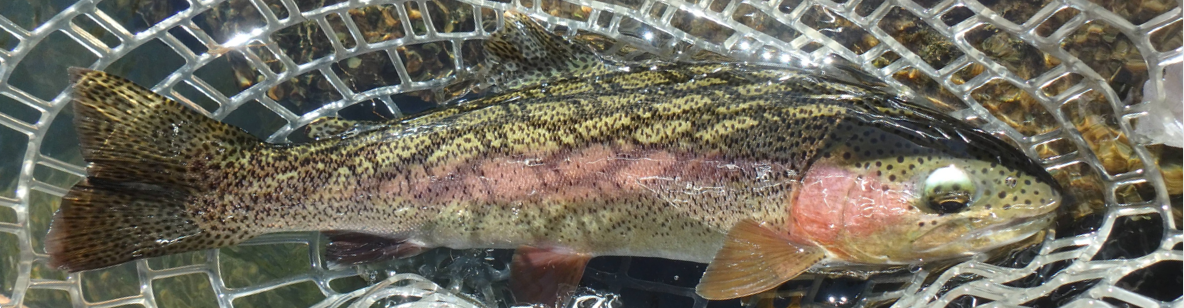
Clear Creek – 10/25/2014

Time: 1:15PM – 3:15PM

Location: The first point after tunnel 1 where the stream crosses to the north side of the highway when driving west through Clear Creek canyon.

Fish Landed: 13

Clear Creek 10/25/2014 Photo Album

The original plan for the last weekend in October was to hike and fish with Jane on Friday, work on chores around the house on Saturday, and then hike and fish again on Sunday. Fortunately, the major task of repairing a broken shelf in the garage did not take as long as anticipated, and the high temperature in Denver was once again expected to be in the low 80’s, so I made a last minute decision to visit Clear Creek. I could not forego fishing on such a beautiful day in late October.

Normally a trip to Clear Creek is a blatant number boosting gambit, but on my last visit during the summer I discovered the small fish in Clear Creek canyon were quite selective thus requiring more focus than I normally associate with this small stream. I was apprehensive that the same situation would evolve on Saturday, particularly given the late October date and the scarcity of aquatic insects. As usual most of the pullouts were occupied with numerous cars as I slowly cruised west on route six looking for the ideal spot to wet a line in the early afternoon. The canyon is narrow at most places, so I was mainly looking for a stretch of water that would be in sunlight for a few hours.

Finally a few miles after passing through tunnel number one I reached a place where the creek crossed beneath the highway and ran for a half mile along the north side of the road, and this stretch was bathed in sunlight. I executed a U-turn and parked in a pullout that already contained two cars. I assumed that the fishermen from these cars were in the water directly across from the pullout, and I planned to walk east on the shoulder and then fish back upstream to the car. When I was ready with my Loomis five weight, I followed my plan and walked along the narrow shoulder to a point where I could descend the steep rocky bank without excessive risk of injury.

[pe2-image src=”http://lh6.ggpht.com/-UGILuD67vvM/VE3AuieKxFI/AAAAAAAAoIo/H00OVIbZyxc/s144-c-o/PA250054.JPG” href=”https://picasaweb.google.com/108128655430094950653/10252014ClearCreek#6074723378152522834″ caption=”Near the Beginning of My Fishing Outing on Clear Creek” type=”image” alt=”PA250054.JPG” ]

When I reached the edge of the water, I decided to begin with a dark olive size 16 deer hair caddis since this fly performed well on Friday afternoon. The canyon walls at my starting point were fairly steep on both sides, and this topography forced the water through a fairly narrow channel. Despite the high velocity in the middle of the stream, quite a few nice pockets presented themselves for me to prospect. I began popping quick casts into these areas. This type of fishing yielded short drifts, but I landed two small brown trout in a short amount of time.

I continued the strategy of making a few quick casts in all the likely spots as I moved at a fairly rapid pace upstream. During the first half hour I managed two more browns in addition to the two in the initial set of pockets, but then I noticed two or three fish in succession that rose up to inspect the caddis but then settled back near the bottom. The caddis was also requiring more frequent trips to my dry shake canister in addition to developing a rejection complex, so I elected to replace it with a size 12 stimulator with a gray body. The large bushy dry fly could support a beadhead dropper, so I added a short 18 inch section of tippet and tied on a salvation nymph.

[pe2-image src=”http://lh6.ggpht.com/-tOmsTir3MYc/VE3AvFgU3rI/AAAAAAAAoIw/DJmH-8qkHmo/s144-c-o/PA250055.JPG” href=”https://picasaweb.google.com/108128655430094950653/10252014ClearCreek#6074723387556814514″ caption=”A Very Sweet Pool Ahead” type=”image” alt=”PA250055.JPG” ]

With the change of flies I decided to cover the water that yielded refusals from two fish, and each fish stopped the stimulator in its tracks by gobbling the trailing salvation nymph. It was pretty clear that the brown trout in Clear Creek preferred a salvation nymph over an olive caddis. These flies remained on my line for most of the afternoon, and I added six more fish that inhaled the salvation. Several of these fish proved to be the best fish of the day in terms of size, as they stretched the tape measure to ten inches.

[pe2-image src=”http://lh3.ggpht.com/-1iygY2Uz5sY/VE3AvjcPyGI/AAAAAAAAoI4/8nuixbOfd44/s144-c-o/PA250056.JPG” href=”https://picasaweb.google.com/108128655430094950653/10252014ClearCreek#6074723395592767586″ caption=”A Small Brown Liked My Salvation Nymph” type=”image” alt=”PA250056.JPG” ]

By 2:45 the shadows covered most of the stream, and the stimulator with the white wing was sinking more frequently. I was curious to know if adding a second nymph to get my flies deeper would attract more attention, but I required a larger top fly to support the added weight of two beadhead nymphs, so I tied a gray pool toy to my line as the surface fly and then added an ultra zug bug below the salvation nymph. I fished these flies through some water covered in shadows and managed to add a brown that smacked the pool toy to the fish count .

[pe2-image src=”http://lh4.ggpht.com/-IHDm29XZ8YE/VE3AwMXm36I/AAAAAAAAoI8/oFOVvEnr7mg/s144-c-o/PA250057.JPG” href=”https://picasaweb.google.com/108128655430094950653/10252014ClearCreek#6074723406579163042″ caption=”Another Salvation Nymph Fan” type=”image” alt=”PA250057.JPG” ]

I was approaching an area where sunlight remained on the water as the canyon opened up a bit, but when I looked up three fishermen came into view. Since my path was blocked by this trio, I circled around them and reentered the stream and fished some attractive water with no positive results. Just as I was about to merge back into the shadows another fisherman appeared, so I decided to quit and scaled the high rocky bank to the highway.

It was admittedly a numbers padding outing as I landed thirteen small brown trout in two hours of fishing. The fish were quite small with the largest measuring ten inches, but it was still an enjoyable afternoon in gorgeous weather in late October.