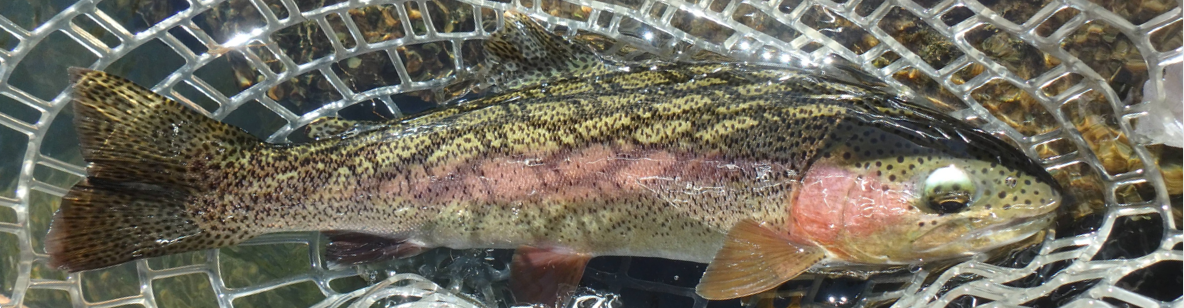
Conejos River – 07/21/2015

Time: 3:00PM – 6:00PM

Location: Below CO 105 bridge; walked downstream past Lake Fork to huge nice pool and then fished back up to within .2 mile of the car.

Fish Landed: 9

Conejos River 07/21/2015 Photo Album
Conejos in Spanish means rabbit. The white rabbit in Alice and Wonderland leads Alice down the hole to Wonderland, so could this be the rabbit that the Spanish named the Conejos River after? The chronology does not work, but the Conejos River Valley was certainly a wonderland for me during the past week. Perfect weather, nearly ideal flows, multiple hatches, camping next to the river, and lots of fish made this a trip to remember. Oh, and I did spot several very large rabbits thumping about the campground, so I suppose these are the rabbits that engendered the name for the river in south central Colorado.

I visited the Conejos River in 2011 on the dates in July that coincide with this 2015 trip, and I enjoyed some wonderful fishing on the upper Conejos below Platoro Reservoir. The Conejos River Angler pointed me to this water and sold me perfect flies to match the aquatic insects that I encountered. It was this magic that I hoped to recapture with my trip on Tuesday July 21, 2015. I got off to a nice early start, and after 5.5 hours of driving to the southern border above New Mexico, I arrived at Lake Fork Campground. The last 18 miles of the trip consisted of a rough dirt road with a speed limit of 25 MPH. CDOT can save the speed limit signs for another location, because it is nearly impossible to drive faster without damaging one’s vehicle.

Upon my arrival I quickly placed some of my belongings at camp site number 7 and paid for two nights. I actually planned to stay for three, but I hedged my bets until I evaluated the quality of the fishing. There were eighteen camp sites and approximately seven were occupied, so I had my choice from quite a few locations. I chose seven since it was spacious, had a nice surface on which to place my tent, and it bordered on the Conejos River.

I was anxious to sample the fishing, so I delayed assembling the tent until I returned in the evening. I jumped back in the car and drove a mile back down CO 250 to the CO 105 turn off, and after making a right turn crossed a new one lane bridge and parked in the crude grass and stone area on the other side of the river. I was nearly ready to fish when another vehicle arrived, and three anglers emerged attired in waders. After a brief chat I learned that the single man was from Albuquerque, NM and the other couple was from Maryland. They fished the Meadows area upstream in the morning with outstanding success, and they now planned to continue their good fortunes in the river at the 105 bridge. The gentleman from Albuquerque suggested that it was easier to hike downstream along the river on the side next to the road, but I stubbornly planned to emulate my 2011 visit with a twenty minute hike along the west side.

Conejos River Flowing Strong at 150 CFS

I followed my plan exactly and hiked across the meadow grass for twenty minutes and then dropped down to the edge of the river. When I pushed aside the willows and stepped into the water, I realized I was at the same beautiful pool where I attempted to begin fishing on my first visit on July 21, 2011. Unlike that experience when the pool was occupied by another fisherman, it was totally vacant and available for me to prospect. I tied on a parachute green drake since I read that this large mayfly was hatching. From past experience I know that fish tune into green drakes all day long during the emergence period. Unfortunately on this day they were not interested in my parachute style fly, so I clipped it off and experimented with a size 14 elk hair caddis with a medium olive body. Again this was ignored, but the pool looked too juicy to not harbor fish, so I opted to switch techniques and converted to deep nymphing.

I configured my line with a strike indicator and knotted on a 20 incher as my top fly and a salvation nymph as the bottom attractor. The 20 incher covered the possible presence of stoneflies or the nymph form of a green drake, and since it was weighted, it also sank the flies to the bottom. The salvation nymph was a bet on the presence of the nymph stage of pale morning duns. These were great ideas, but neither excited the fish, so I swapped the salvation for an emerald caddis pupa. I noticed some splashy rises, and several fish actually cleared the water in their attempt to inhale something from the air. This always surprises me, since it seems leaping from the water exceeds the caloric value of any food captured with this maneuver.

None of the nymph offerings enticed any fish, so I decided to revert to dry flies. I continued to believe that caddis were causing the late afternoon erratic rises, so I responded with a size twelve olive stimulator. I decided that I was wasting my time in the huge deep pool and began moving up the river at a regular pace, and I prospected the stimulator in likely pockets, riffles and runs as I carefully waded against the strong current. When I later checked the streamflows for July 21, I discovered they were running at a stiff 150 cfs pace. This new tactic quickly produced four eleven to twelve inch brown trout, so my faith in the Conejos River gradually returned.

Typical Small Pockets That Produced

Unfortunately after the initial flurry of success, the stimulator ceased to produce, so I elected to reprise the dry/dropper technique that served me well in 2011. I tied a Chernobyl ant to my line and then added a salvation nymph and ultra zug bug. My initial introduction to the salvation nymph occurred in 2011, when I purchased a half dozen from the Conejos River Angler, and they were extremely productive during that trip. Since then the salvation nymph has become a mainstay in my fly box.

A Nice Brown on the First Day

The three fly dry/dropper combination was an effective choice, as I landed five more brown trout over the remainder of the afternoon as I worked my way upstream at a steady pace to a point .2 miles below the 105 bridge. The majority of the brown trout consumed the ultra zug bug, but one snatched the salvation and another decent brown trout slurped the Chernobyl ant from the surface right along the bank. This was the best fish of the afternoon as it measured thirteen inches and exhibited a chunky profile.

Best Fish of Tuesday Slurped a Chernobyl Ant

I was pleased to land nine fish in three hours of fishing in the late afternoon. 3PM – 6PM is typically slow, since it unfolds after any emergence activity in the Rocky Mountains. Also the flows of 150 cfs were a bit high, and this yielded fewer prime holding locations and made wading a challenge. On the positive side, it was cool for most of the afternoon with partial sun. Offsetting this was a constant wind, and this made accurate casting an ongoing battle.

I returned to my new campsite and assembled my tent and ate dinner. That evening two campers mentioned fishing in the Meadows area, so I became concerned that I was missing the best fishing by gravitating to the section of river below the 105 bridge. I decided to stick with my plan for Wednesday. If the fishing was sub par, and hatches did not materialize, I could join the crowd in the Meadows on Thursday.
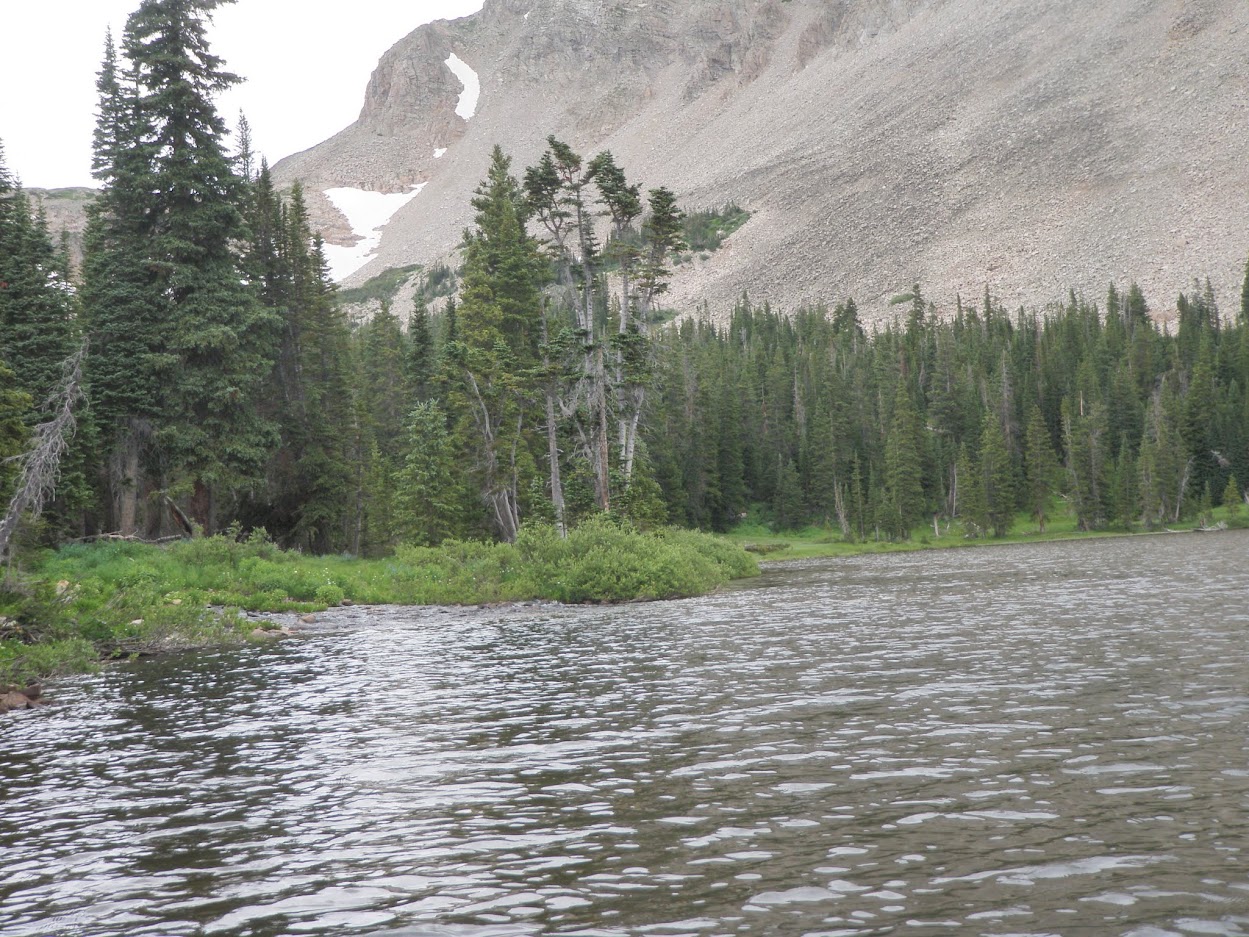
Mitchell Lake – 07/20/2015

Time: 1:00PM – 3:00PM

Location: Southwest shore.

Fish Landed: 0

Mitchell Lake 07/20/2015 Photo Album

It was Amy’s final day in Colorado before returning to Oregon, so we planned a hike for Monday July 20. We departed Denver after I returned from a physical therapy session and arrived at Mitchell Lake by 11:45AM. We were convinced that the crowds would be minimized on a Monday, but this was not the case. No parking spaces were free at the Mitchell Lake trailhead, as we circled the lot several times. Our only option was to return to the day use parking lot, and this step would add another uninteresting mile along a paved roadway. I decided to park in the emergency vehicle parking space while the girls applied sunscreen and pulled on their hiking boots. They planned to hike three miles to Blue Lakes while my destination was Mitchell Lake for some fishing, and that was only a mile up the trail. Amy and Jane would find me at Mitchell Lake on their return hike after I made the extended hike from the day use parking lot.

But wait, two returning hikers appeared near our car in the emergency spot, and Jane asked if they were leaving. They replied in the affirmative, so Jane followed them to their car. Once Amy was ready, I backed out of the emergency space and circled to the parking space of the departing hikers. The cooperative holders of the parking space agreed to “lollygag” until we appeared, and then they backed out and ceded the valuable space to us. Whew, what a start to our hike.

I was now able to stuff my backpack with all the essentials for fishing in Mitchell Lake, and then we charged up the trail. We departed the parking lot at noon and arrived at the shore of Mitchell Lake by 12:40PM. We very quickly discovered that Mitchell Lake fostered a healthy mosquito population, so we lathered up with repellent and ate our lunches. After lunch Amy and Jane began their trek to Blue Lakes, and I walked west along the shoreline to a point thirty yards below the inlet. While we ate lunch I observed quite a few rises on the smooth surface of the lake, so I was somewhat optimistic that I could land a fish or two from this high elevation body of water.

The Inlet of Mitchell Lake

Unfortunately by the time I pulled on my waders and configured my line with an elk hair caddis, the wind picked up and created a strong riffle on the surface. I attempted to overcome this adversity by spraying thirty foot casts in all directions as I worked my way slowly along the shoreline to the inlet. This approach seemed quite futile with my tiny fly dancing in the waves in this comparatively large body of water. What were the chances of placing a cast over a fish that happened to be looking toward the surface?

Dainty White Wildflowers Where the Stream Spills Into the Lake

I changed the elk hair caddis for a royal stimulator with a white wing for better visibility, but the dense cloud cover and wind made the situation quite daunting. I decided to move back toward where I began, as there was an open area that enabled long back casts without interference. I took a break from casting, and after five to ten minutes, the wind subsided, and some small rings appeared on the lake. This was my signal to resume fishing, so I sent out forty and fifty foot casts that taxed my distance shooting capability. This cycle repeated itself for the remainder of my time at Mitchell Lake with only a couple humiliating refusals compensating for my patience and effort. I did add a second dry fly, a Charlie Craven spant, at one point, but this also failed to snag a fish.

Pretty High Country Scene

At three o’clock I heard Jane’s voice so I clipped my fly to my rod guide and gathered my backpack to begin the return hike. By 3PM it became quite overcast and the wind whipped across the lake, so I was quite chilled even though the girls were comfortable in their shorts. We made it to the parking lot just as a light shower descended, so I quickly removed my boots and waders and prepared for the return drive.

I spent time with my daughter and wife and visited a beautiful setting, so I cannot be upset over the lack of fish. The high country scenery was a visual delight, and that in and of itself justified the trip.

Frying Pan River – 07/17/2015

Time: 12:15PM – 4:00PM

Location: The segment below the spring; mile marker 10.5.

Fish Landed: 15

Frying Pan River 07/17/2015 Photo Album

The Weller method of washing camp dishes is often held up for ridicule by the younger members of our family. The steps involved are heating water in a coffee pot until boiling and then dumping into a white plastic dish bin containing liquid dish washing detergent. Once the dishes are scrubbed with a washcloth, the soapy water is dumped, and the dish bin is rinsed with fresh water. This water is then used to refresh surrounding shrubs before more clean water is added to the dish bin. The soapy dishes, pots and utensils are then rinsed by swishing in the dish bin. The final step is to dry the dishes and return them to their proper place in the plastic car-camping storage bins. The rinse water is then returned to the soil near the campsite.

Camp Dish Washing Keys

Why am I explaining this detailed process to my readers in a fishing blog? On Thursday evening my daughter, Amy, volunteered to execute the dish washing steps as outlined above. Unfortunately she neglected to remove a spoon from the bin before dumping the soapy water. She was extra diligent about disposing of soapy water away from the campsite and elected to toss it over a sharp bank at which point she heard the ringing sound of a metal spoon landing ten feet below. It was almost dark at this point, so she resigned herself to be a camping litterbug.

Friday morning however brought fresh light to the situation, and feeling bad about her inadvertent trashing of the environment, Amy resolved to retrieve the $.50 utensil. Five feet to the left of the spoon a large log angled from the lip of the bank to a point beyond the spoon. Amy used the knobs and broken branches from the large tree trunk to secure her position as she carefully picked her way down the steep eroding bank. Once she was across from the spoon, she carefully slid across some loose dirt and snatched the prize spoon and thus cleansed the environment at Bogan Flats Campground. A few more sidesteps brought her back to the tree, and then it was not long before she pulled herself back to the brim of the embankment with the sought after spoon firmly gripped in her hand. My daughter is an amazing person.

Since we were unable to stay at Bogan Flats on Friday night , we strategically packed the Santa Fe with all our camping, biking and fishing gear. We were careful to place the biking and fishing items near the one accessible door, as we required these components for the planned day’s activities. Fitting everything in the Santa Fe while maintaining access was a significant accomplishment.

Feeling quite proud of this feat, we departed the campground and drove to the spring between mile marker 10 and 11 along the Frying Pan River. This trip took roughly an hour, and we arrived at the large pullout by noon. I quickly prepared to fish, while Jane and Amy readied their bikes for a ride on the road that follows the Frying Pan River to Basalt. The sky was a rich blue, and I expected to enjoy a beautiful sunny day on my favorite Colorado river.

I intended to hike down the road to the downstream border with private land, but two fishermen were already in that vicinity, so I was forced to cut in farther upstream than I desired. I also wanted to cross to the other side, but the shallow wide area was close to the downstream fishermen, so I resigned myself to working up along the roadside. I began with a Chernobyl ant trailing a salvation nymph, and in a short amount of time I landed a small eight inch brown on the salvation.

I continued prospecting the pockets and hooked a nice brown trout that raced downstream and eventually shed the hook, and I surmised that his fish may have been foul hooked. Next I hooked a large rainbow in a deep slot towards the middle of the river, and this fish fought valiantly before also escaping my hook. Some dark clouds began to gather in the southwestern sky, and they were accompanied by the sound of thunder.

Held Over the Net

I moved up along the left bank to an area where a thicket of shrubs and branches extended over the water. I carefully tossed the Chernobyl ant fifteen feet directly above me, and it drifted back within six inches of the branches. When it nearly arrived at my feet, I spotted a subtle flash in the glare on the surface and immediately reacted with a hook set. What a surprise to be attached to an eighteen inch rainbow with vivid color and distinct spots!

Tight Spot on the Frying Pan

After releasing the prize rainbow, the sky grew darker, and it became increasingly difficult to follow the yellow spot on the Chernobyl, so I decided to use this time to return to the car and eat lunch. I fished from 12:15 to 12:45, so it was actually lunch time, and it made sense to eat during the less than optimal weather conditions. Initially I was planning to sit by the river to eat, but large raindrops appeared, so I retreated to the Santa Fe and ate there while sheets of rain descended for fifteen minutes. I gave some thought to driving down the road to check on the girls, but they took raincoats along, and I was hopeful that they avoided the storm cell.

Another Decent Brown

The thunderstorm scared off the competing fishermen below me, so after lunch I hiked downstream along the shoulder to the spot just above a small island where it was shallow enough to cross to the opposite shore. I executed my initial plan and worked upstream on the south side of the river for the remainder of the afternoon and landed an additional thirteen fish. One change I enacted was switching the Chernobyl ant for a tan pool toy when I reached the stretch of water above the spring. The Chernobyl was not producing, and I wanted a more buoyant fly that could suspend two beadhead nymphs. This adjustment of course allowed me to add a beadhead hares ear as a second dropper with the salvation.

This Pocket Yielded a Fish

I kept expecting a pale morning dun hatch to develop, but I never spotted more than a handful of mayflies, and as a corollary to this circumstance, no rising fish. By 3:45 I reached a point where the strong current ran tight to the south bank, and in order to skip this stretch, I was forced to fight through the trees and wade tight to the overhanging branches. I hoped to end by four o’clock in anticipation of the long trip back to Denver, so I reversed direction and waded back downstream along the edge and crossed just above the spring. Jane and Amy were just returning from their bike ride and an afternoon spent exploring Basalt.

One More View of Best Brown of the Day

The post-rainstorm action consisted almost entirely of brown trout in the 7-11 inch range, although I did land a chunky thirteen inch variety and two twelve inch fish. Roughly half of these fish nabbed the salvation nymph, and the other half grabbed the hares ear. The best results came from the mid-section of slots and pools just as the speed of the drifting dry/dropper began to accelerate.

Pretty Flowers in the River

Friday was a sub-par day compared to most of my time on the Frying Pan River, but the timing was between the spring hatches and the dense summer emergences. I’m not sure where the big browns and rainbows were hiding, but I did manage to land one big boy. I cannot wait to return later in the summer when the green drakes, pale morning duns and blue winged olives are emerging and cause the big fish to abandon their fear.

Crystal River – 07/16/2015

Time: 4:00PM – 7:00PM

Location: Bogan Flats Campground upstream to the group camping area and then from the downstream border of the campground back upstream for 50 yards.

Fish Landed: 12

Crystal River 07/16/2015 Photo Album

Our daughter, Amy, was visiting for ten days during her summer break from the physical therapy program at Pacific University in Hillsboro, OR. Jane and I considered several options for a camping trip during her stay and finally settled on the Crystal River valley. Jane and Amy had never visited this area, and we were intrigued by the towns of Marble and Redstone, and there were numerous interesting hikes and bike rides nearby. In addition the Crystal River was the common thread, and I experienced one reasonably successful day fishing in Marble and upstream from the Bogan Flats Campground several years ago.

Jane and I attempted to make reservations using the USFS web page, but we quickly discovered that all the sites that allowed reservations were locked up for Friday night, July 17. However, it appeared that there were numerous first come/first serve campsites at Bogan Flats. Based on this assessment, we decided to make the trip on Wednesday and secure a walk up site for three nights.

On Wednesday morning we filled the Santa Fe from floor to roof with camping gear and departed for the Crystal Valley. The addition of a third camper challenged our ability to squeeze everything into the back of the car, but we managed to do it with no significant omissions. After a four hour drive with a stop for lunch in Glenwood Springs, we arrived at Bogan Flats by 3:30PM and made a quick circle of the campground. Very quickly we discovered that all the sites were contained in the reservation system, and this meant all were reserved for Friday night. We were now faced with the decision of whether to drive to another campsite, or change our plans to stay at Bogan Flats for two nights rather than three. We chose the latter as we concluded that we could pack everything up in a manner that enabled biking and fishing on Friday and then return to Denver.

Before leaving Denver I did a quick check of the stream flows on the Crystal River, and I was quite unnerved to see a huge spike in flows Wednesday night. Prior to the peak, the river flows subsided to 430 cfs, but on Wednesday night the graph depicted a dramatic blip to 700 cfs. Causing me more concern was our stop at the USFS White River ranger station in Carbondale where the man on duty confirmed that the area received heavy rain, and he also informed us that the Crystal muddies quickly as it passes through soft red soil on its way to the Roaring Fork River.

Fortunately as we drove on Colorado 133 for 25 miles along the Crystal River on our way to Bogan Flats, I noticed that the river was nearly crystal clear albeit with relatively high flows, although a level that appeared to allow edge fishing.

On the Road to Marble

After we settled on campsite number four and paid our fee for two nights, we assembled the tent and canopy; and with some time to kill before dinner, we chose to take a brief bike ride. I suggested that we ride toward Marble a bit, as I selfishly wished to check out the river access, but once we got started, we fell into a rhythm and continued into the town. The ride lasted for an hour, and we endured several significant hills but enjoyed seeing numerous marble remnants and sculpture along the way. The town of Marble was rather small with a firehouse and many small vacation homes.

Marble Sculpture

On Thursday I suggested that we undertake a bike ride on the Rio Grande Trail in the morning, and then in the afternoon I planned to fish from the campground while the girls could use the car to travel to a trailhead where they could either bike or hike. Amy and Jane chose a segment of the Rio Grande Trail that went from Woody Creek to the terminus in Aspen at Neale Street. We executed the plan with the only stumble being our inability to find the Woody Creek parking lot. Instead we found Jaffe Park, and while this served our purpose, it also necessitated a steep .5 climb to the trail at the outset of the twenty mile ride. Much of the course followed the upper Roaring Fork River, and the clear although somewhat high flows beckoned me to abandon the Crystal River to fish this larger river with reputedly bigger fish. The Rio Grande Trail skirted Aspen, and it was rarely obvious that we were traveling through a resort town with extensive million dollar residences within a stone’s throw of our path.

Rafting the Roaring Fork River

Upon our return to Bogan Flats, I quickly prepared and devoured my lunch and then set out on my Crystal River fishing adventure. It was almost 4PM by the time I donned my waders and assembled my Sage four weight rod. The sky was mostly sunny with occasional clouds providing a white blemish on the background of blue. I found a worn path that cut away from the entrance to the campground and quickly hiked toward the river. The location where the Crystal River flowed past our campsite featured a high steep bank, so I was looking for a place along the trail where I could descend to the river without undue risk.

Running High but Clear

It was not long before I found my opportunity, and I bushwhacked my way through the forest until I found myself along the edge of the river. As I stood next to the river, I confirmed that it was high and clear. Next I prepared to fish, and I spotted a yellow stonefly cruising up from the river, so I elected to begin with a yellow sally adult, but after a reasonable test in several promising pockets with no results, I decided that I needed something larger to attract attention with the higher flows. I adjusted my approach to dry/dropper and featured a Chernobyl ant connected via a 5X tippet to a beadhead hares ear nymph.

This combination at least prompted a few refusals to the Chernobyl ant, but I still could not land a Crystal River fish, so I swapped the Chernobyl for a yellow Letort hopper. Perhaps golden stoneflies were present along with their smaller yellow sally cousins. Again I could not entice any interest, so I exchanged the hares ear for a salvation nymph and continued prospecting likely holding spots. Finally the salvation nymph delivered a small rainbow trout, but I consumed roughly thirty minutes with intense casting and wading to achieve this result.

Typical Small Crystal River Rainbow Trout

At this point I concluded that the dry/dropper approach was not conducive for the high cold late run off conditions present on the Crystal River, so I resigned myself to going deep with weight. I rigged my line with an indicator, split shot, iron sally nymph and salvation nymph and began dredging the bottom of the river. This actually paid dividends as I landed seven additional fish until I decided to move on at 6PM. The trout chose evenly between the iron sally and salvation nymph, and six of the netted fish were rainbow trout with one lone brook trout in the mix. The brook trout was actually quite nice by western standards and measured around nine inches. All the rainbows were quite small and fit in the 6-9 inch range. Unfortunately the best fish between four and six PM was a thirteen inch whitefish, which I did not count.

Surprised by a Brook Trout

When I reached the group camping area, the river narrowed and flowed tight to a high bank. I did not wish to undertake the challenge of circling around this obstacle, so I took advantage of the group campground road and walked back to the paved road and then returned to Bogan Flats. The Santa Fe was not parked at our campsite, so I decided to march the length of the campground to investigate the water at the lower end. The river split around a tiny island, so I waded across the smaller channel to the point of the island and worked some pockets with my nymphs. The indicator dipped, and I set the hook only to feel significant weight bowing my rod. Could this be a bigger fish to end my day on the Crystal? Imagine my disappointment when I stripped in a twelve inch whitefish that was attracted to the iron sally.

I was now disappointed with nymph fishing, so I decided to at least have some casting fun. Earlier I witnessed two trout that rose to inspect my neon red strike indicator, so I tied a royal wulff to my line. I’ve had success with this ploy as a response to indicator rises during many previous outings. Much to my surprise, this strategy worked nicely as I landed four additional trout while I worked my way methodically up along the right bank. Two of the landed fish were rainbows and two were browns. I made sure to photograph the brown trout in the waning light to prove that I achieved a Crystal River grand slam; rainbow trout, brown trout, brook trout and whitefish in three hours of fishing.

A Brown Trout Completes the Trifecta

At one point I was intently focused on casting and watching my fly, and I hooked and landed a small brown. As I released the fish, I heard a voice from high on the bank above me congratulating me on my success. I turned around and gazed upon a woman and a dog, and she seemed keenly interested in my every move. She told me that she was enchanted by the rhythm of my casting and fish catching movements.

I ended my day with an avid spectator and dry fly success, and I managed to reach double digits with twelve fish landed in three hours. I suppose it was a decent outing, but I yearned for greater size and the addictive tug of a tougher fish on my rod. Perhaps tomorrow the Frying Pan could quell my desires for better fish.


Eagle River – 07/10/2015

Time: 10:00AM – 4:00PM

Location: Downstream end of Eagle lease; Horn Ranch open space above the route 6 bridge.

Fish Landed: 7

Eagle River 07/10/2015 Photo Album

All a fisherman seeks is opportunity. On Friday July 10 I would have numerous opportunities on the Eagle River.

The sun was bright and the sky was a deep blue as Dave G. and I departed from the Gaboury house in Eagle Ranch at 9AM on Friday morning. Despite the sunny sky, the air temperature was cool and in the sixties, although the warming effect of the sun would quickly have an impact. We decided to investigate the Eagle lease above Eagle, CO first before moving farther upstream. The section of water we were interested in fishing was quite turbid on Thursday as a result of the day of rain of Wednesday, but we were hopeful that the lack of precipitation on Thursday allowed sufficient clearing to enable edge fishing.

Entrance to the Eagle Lease

When we crossed the river at the first bridge after the circle at Eagle, we stopped and checked the water clarity. The river remained a milky olive color and flowed at 1,000 cfs, but we banked on enough edge visibility for the fish to see our flies. We both agreed that it was sufficiently clear to allow a trial run, so we continued on to the western most access point to the Eagle lease. Dave G. called Todd to inform him of our decision, and within ten minutes we were all geared up and prepared to fish. We each used the metal ladder to climb over the barbed wire fence and then crossed the meadow until we reached the river at its western most edge. Dave G. elected to fish the bottom of a nice side pocket that began as a narrow deep run and then fanned out into a small pool.

Hares Ear in the Lip

I meanwhile moved to the deep narrow top section and began with a Charlie boy hopper, beadhead hares ear, and salvation nymph. Dave G. hooked up very quickly, and then I saw a pause in the hopper and set the hook and found myself attached to a spunky streaking thirteen inch rainbow trout. I skillfully played the energetic fish to my net and snapped a quick photo before I released it back into the olive stained river. Next I dropped some casts into the small pocket above the triangle pool, and once again I was pleased to see a dip in the hopper. I reacted with a solid hook set and battled a second mirror image thirteen inch rainbow to my net. The cloudy state of the water did not seem to be affecting our fishing success, so I was quite optimistic about our prospects on the Eagle lease.

The three of us worked our way up along the left bank of the river over the remainder of the morning. Unfortunately the good fortune of my first thirty minutes did not repeat over the remaining 1.5 hours. I did manage three solid opportunities; there is that word again, but I was unable to convert any of them. The first missed chance came when I cast my flies to the mid-section of a long narrow deep channel next to the willows. As the Charlie boy drifted back toward, me a huge pink sided mouth appeared, so I set the hook. The owner of the large mouth reacted immediately and bolted to the heavy nearby white water. All I could do was allow the fish to streak down the river. I attempted to follow it for a couple steps, but the round slippery Eagle River boulders made this quite a challenge. After ripping out line at an alarming rate, the fish accelerated even more and snapped off my two subsurface flies. I surmise that the rise was actually a refusal, and my hook set resulted in a large angry foul hooked rainbow trout.

The other two opportunities of the morning were matching experiences. In both cases the hopper paused during the drift, and this caused me to react with a hook set. The fish on the other end of the line demonstrated some aerial acrobatic skills, and I maintained tension and fought the fish for a couple minutes when somehow the rainbows managed to slide free of the hook. Both fish were probably in the thirteen to fourteen inch range, and both amounted to lost opportunities. Adding insult to the situations, in both cases the pent up energy of the arced rod released when the fish escaped resulting in a massive snarl of my tippet and three flies with the expected curse words in response.

As noon approached I realized that I had fished the prime edge water that yielded quite a few nice fish in 2014, and I could see Todd and Dave G. wading along the edge of the river 100 yards ahead. In addition some dark clouds were rapidly rolling toward me from the southwest and the wind kicked up to the sound of thunder claps. I decided to hustle and skipped the remaining water which my fellow fishermen waded through. Just as I came within twenty yards of the retreating Todd and Dave G., some waves of rain blew sideways and instantly soaked the back of my arms. I quickly caught up and turned up a path and followed the other two fishermen to the car, where we quickly shed our gear and took our seats sheltered from the brief rain shower.

We used the brief period of rain to drive upriver to a new spot called Horn Ranch. Apparently the Eagle County conservation fund along with some other grants secured a nice stretch of land between the route 6 bridge downstream from Milk Creek and the I70 bridge crossing. This was new water to us, so we parked in the dirt lot before a railroad crossing and finished our lunches and then progressed through some tall weeds to the edge of the river. Just as we left our cars, the rain subsided, and the sun reappeared, and it became quite warm and muggy. The water in this area was still below Milk Creek and therefore the clarity remained compromised.

Dave G., Todd and I spread out along the left, north bank and worked our way upstream between 1 and 2:30PM. Early on in this period I hooked a fourteen inch rainbow on the ultra zug bug. I was still fishing with the dry/dropper combination of the Charlie boy hopper, beadhead hares ear, and ultra zug bug. The rainbow was a tough foe and put up quite a bit of resistance before I brought it to my net.

The Horn Ranch section in this lower area was actually not my type of water, as it was a large wide smooth deep pool with few current breaks to signal likely fish holding locations. Because of the lack of visible structure, I began to doubt the efficiency of casting a dry/dropper and, therefore, after a lull in action following the rainbow landing, I converted to a nymphing set up. This consisted of an indicator, split shot, beadhead hares ear and bright green caddis pupa. I noticed a handful of surface rises to caddis while fishing the dry/dropper and actually debated employing a single caddis dry, so the caddis pupa was an attempt to take the middle ground.

After finally setting up my nymph rig, I made a cast to a deep trough just below a subtle current seam and immediately snagged bottom. I waded as close as I could, but I realized the snag point was too deep and too fast to risk further rescue efforts, so I snapped off my entire system. The only thing that remained was the strike indicator and tapered leader. This unfortunate incident resulted in quite a bit of wasted time extending the leader, crimping split shot and knotting on new flies. Eventually I resumed fishing, but I quickly grew bored with the uninteresting water and lack of action, so Dave G. and I found a path and met Todd and returned to the parking lot.

Dave G. suggested that we move upstream to the spot where an old concrete bridge spanned the river, so Todd and I agreed with his suggestion. We all walked out to the middle of the bridge and surveyed the new water. As I gazed downstream I salivated over the edge water along the east bank (road side), so I chose that as my territory for the remainder of the afternoon. Todd and Dave G. meanwhile liked the look of the west bank, as Milk Creek entered and created some side channels and structure.

I walked down the shoulder of route 6 until I was above a large drainage pipe, and then I carefully descended a steep bank to the river. A guide and client were below me on the same side of the river, but the intervening distance was at least 100 yards. The water ahead of me was much more to my liking with numerous large rocks forming current breaks and large side pockets and runs where the river either fed against the bank or reflected back toward the middle.

A Fat Caddis Slurper in the Afternoon

I prospected with the nymphs that remained on my line from the western end of Horn Ranch, but it was not long before I began to observe quite a few caddis dapping on the surface. The trout also seemed to become keenly aware of this new food source, and sporadic rises dimpled the surface upstream and across from my position. I quickly removed the nymph paraphernalia, and tied a size 16 deer hair caddis to my line. This paid quick dividends as I picked up a feisty and plump rainbow, but then I hooked a nice fish in the tail. This fish streaked downstream, and it took quite a while to tire it to the point that I could hydroplane it upstream across the surface to my net for a gentle release.

Once I was back in action, refusals became the standard, so I clipped off the gray caddis and replaced it with an olive brown version. Again this satisfied the trout for a bit as I hooked and landed a twelve inch brown and then a thirteen inch rainbow. Just when I felt I had the puzzle solved, I moved up along the bank a bit to fish to some steady risers, and the olive brown deer hair caddis fell out of favor. What did I have left in my bag of tricks? I scanned my velcro Simms fly box and spotted a muggly caddis. Charlie Craven designed this fly to look raggedy from the start, so I decided to give it a try. The fly has snowshoe rabbit foot hair as an underwing to aid buoyancy, but no hackle, and thus rides deep in the surface film.

Caddis in the Corner

The muggly proved to be a smart choice, and I landed another very solid chunky rainbow in the fourteen inch range. All the rainbows were robust fighters that made electric runs and performed aerial maneuvers in their attempts to escape. I attributed their energy to the fact that the river had just subsided to fishable levels, and therefore the fish had not yet been caught and released in the 2015 season. I also blame my high percentage of lost fish to the early season spunky nature of the fish.

I released fish number seven and looked upstream and once again observed some gulping rises just below an exposed rock where the current curled around it and toward the bank. I lofted a fairly long cast to this area and allowed the muggly to flutter down to the nook of the tiny eddy. Dave G. and Todd had just appeared on the concrete bridge above me, but I kept my focus on the recently delivered fly. Wham! A nice fish smashed the muggly caddis and the fight was on. Clearly this fish was hooked in the lip as it instantly made a strong upstream dash. I allowed my line to spin rapidly off the reel until the fish paused in its flight. I gained back some additional line, but then the silver bullet decided to make a second strong dash. The line screeched from my reel a second time, but inexplicably the rainbow reached some turbulent water upstream and made a sudden side move and snapped off the muggly. I rued another lost opportunity, and this one occurred with my friends as spectators on the bridge above.

I was now just below the bridge, and several fish rose sporadically in the squiggly current seam below the bridge supports. Todd and Dave G. saw them and attempted to direct my casts. I followed their guidance as best as I could, but after fifteen minutes of unproductive casting, I decided to yield to the fish and quit for the day. I did manage one very brief hook up during this time, but again the fish never made it to my net.

I landed seven very nice fish on Friday with all being rainbows except for one brown. The four nice fish that slurped my caddis imitations in the afternoon really salvaged my day, as it was great fun to spend 1.5 hours casting to an array of rising fish. Unfortunately I should have easily recorded a double digit fish count, as I lost nearly as many fish as I landed. I cannot complain about the number of opportunities, but I do need to improve my ability to capitalize.

Eagle River – 07/09/2015

Time: 10:00AM – 3:30PM

Location: The Preserve in Edwards

Fish Landed: 11

Eagle River 07/09/2015 Photo Album

Having fished the Yampa River on three separate trips over the last two weeks of June and through the Fourth of July, I was ready to explore some new flowing water. The next most likely candidate was the Eagle River, a freestone river with its headwaters near Vail, CO. The DWR site indicated that the cubic feet per second were dropping nicely into the 700 – 1000 range. During the early summer of 2014 I experienced some very exciting fishing on the Eagle as the run off subsided yet remained high compared to normal summer levels.

My friend Dave Gaboury called and invited me to join him and Todd Grubin for a day on the Eagle on July 10. I accepted the invitation, but one day was not enough to satisfy my yearning for edge fishing. I made plans to pack my camping gear, drive to the Eagle on Wednesday morning and spend Wednesday and Thursday fishing while I used my campsite as my base of operations. On Friday I planned to join Todd and Dave G. for a day and then return to Denver Friday evening.

Unfortunately when I checked my weather app it showed rain all day Wednesday and throughout the night. I do not mind fishing in the rain, but sleeping in a tent in steady rain or thunderstorm conditions is not one of my favorite activities. I modified my plan to include only one night of camping, Thursday night, and then I called Todd to ask if he was interested in joining me on Thursday. Apparently when Dave G. called Todd to make final arrangements for Friday, Todd informed Dave of my intent to fish on Thursday, so Dave G. called me and graciously invited me to sleep at his Eagle Ranch house on Thursday.

The plan was in place, and I made the early morning drive to The Preserve in Edwards on Thursday where I met Dave G. and Todd. I actually made great time and pulled into the parking lot 30 minutes before our prearranged meeting time of 9:30. Over the past year Todd gained access to the private water below The Preserve, and he requested and received approval to fish there with two friends on July 9 . We left the parking lot and headed directly to the private water. Todd and Dave G. hiked farther down the river behind a gravel quarry, while I began my quest for run off trout in the braids that flowed around two small narrow islands. As we hiked through the tall grass to the river we stirred up dense clouds of hungry mosquitoes, so my first act before fishing was to douse my neck, hands and ears with insect repellent.

The area had indeed received quite a bit of rain on Wednesday which caused the flows to spike from the 750 cfs level back to the 900’s. This made fishing a bit challenging, but I flashed back to fishing at 900 cfs in 2014, and this gave me confidence that I could enjoy some success on Thursday July 9. The sky was overcast most of the day, but no additional rain fell on us.

Side Channel Fished in the Morning

To begin my quest for Eagle River trout I tied on a tan pool toy, beadhead hares ear and salvation nymph. Because of the high flows, I was tempted to configure a nymphing rig, but the small side channel ahead of me swayed the decision to dry/dropper. For the next two hours I worked the three fly combination through the seams where the side channels joined the main river as well as through the two side braids. I landed three brown trout in the twelve inch range in addition to one small six inch cutthroat trout. This probably represented the first cutthroat that I ever landed from the Eagle River. Two of the landed fish took the hares ear, and the other two snatched the salvation nymph.

Nice Early Brown Trout

Just before lunch I moved above the second island and began to work some very attractive side pockets along the bank. The pool toy was serving simply as an indicator, and I thought I saw a solitary golden stonefly, so I tried a yellow Letort hopper as a stonefly imitation. The dubbed body hopper does not support two beadheads very well, so I kept the salvation and removed the hares ear. This change did not pay off, as the Letort hopper simply provoked refusals and distracted the trout from any interest in the salvation.

After a 45 minute lunch we returned to The Preserve water, and I resumed fishing near my lunchtime quitting point. It was not long before I began to observe caddis tumbling and skating on the surface of the river, and this prompted some sporadic rises. I reacted to these observations by clipping off the hopper and salvation, and I knotted a solitary size 16 olive brown deer hair caddis to my line. This drew interest in the form of refusals, so I made another switch to a slightly larger olive brown caddis with a wing that extended beyond the body of the fly. This fly generated a decent momentary hook up, but then it also was ignored by the surface feeding trout.

Nose Included on This Shot

By now the hatch intensified, and many small caddis skittered across the surface, and I was frustrated that I was missing out on some fine dry fly action. Perhaps the body color was too dark? I replaced the olive brown caddis with a size 16 light gray deer hair caddis, and this produced the success I was afraid I would miss. Over the remainder of the afternoon I worked my way upstream along the right bank and cast the light gray caddis and landed an additional seven fish. Most the of the fish resulted from spotting rises, but some also reacted to prospecting casts to likely fish holding spots. I was disappointed with the size of the afternoon catch, as I landed one nice thirteen inch fighter, and a twelve inch brown, and the remainder were in the six to seven inch range. I suppose catching fish is better than not catching fish, but I would have liked more size.

Edge Water Fished at the Preserve

The caddis hatch waned by 3PM, so I experimented with a Charlie boy hopper with a bright green caddis pupa and light yellow caddis pupa. This combination did not produce, so I switched the bright green caddis for a beadhead hares ear, and this also failed to interest the resident trout. The wading was very arduous in the afternoon, as I was forced to carefully wade against some stiff current or exit the river and battle through thick brush and tree limbs. When I was catching fish, the trade off was beneficial, but now with the lack of results, I decided to return to the car at 3:15 ahead of our agreed upon 3:30 quitting time.

I am forced to admit that Thursday was a disappointment for me. Perhaps my expectations were too high, and eleven fish landed is certainly a worthwhile accomplishment. The positive experiences on the Yampa River may have spoiled me, and certainly the size of the Eagle River fish paled by comparison to the Yampa trout. Also my positive experience during the receding flows of 2014 provided another unfavorable comparison point to Thursday July 9. At least I had Friday to look forward to before returning to Denver.

Elk River – 07/05/2015

Time: 11:00AM – 2:00PM

Location: Christina public water upper end

Fish Landed: 5

Elk River 07/05/2015 Photo Album

Sunday July 5 was overcast with light rain off and on and temperatures in the low to mid-60’s in the Yampa Valley. This weather was quite a change from Friday when the hot sun made it nearly impossible to cool the Supple’s south facing condominium. Once again Steve and I evaluated fishing options. We fished the tailwater on Friday, so we were anxious for a change, and the crowds on the Sunday of the Fourth of July weekend would probably be formidable. I considered the east end of the Yampa before it enters downtown Steamboat Springs, but Steve was convinced the tubers would not be deterred by the cool damp weather. That left our remaining option, the Elk River, and we agreed to give this tributary of the Yampa a chance.

I drove to the Christina public access stretch, and we parked by a large green sign that enumerated the rules of the leased water. The sign stated that we were within 200 yards of the northern border with private property,. so Steve and I decided to walk downstream a bit to a large bridge. A sign warned that the bridge was private, so Steve and I found a rugged path down a short but steep bank to the edge of the river. The flows at Milner, near the junction with the Yampa, were 580 compared with 750 on Wednesday July 1 when I last fished the Elk River. This represented a significant drop, however, the water remained fairly high and fast compared to the norm. Unlike my visit earlier in the week I was able to wade much farther from the shoreline in my pursuit of likely trout holding spots.

I began fishing with a thingamabobber, split shot, a salvation nymph and a size 18 gray nymph to imitate pale morning duns. We visited the Straightline Fly Shop on Lincoln Avenue on the Fourth of July, and the young salesman showed me some flies that represented the nymph stage of the PMD, and they were all size 18 and mostly gray. I thought I was outwitting the trout, but this was not the case as I failed to attract a hook up of any sort. I pondered the situation and concluded that the small nymph was not flashy enough in the higher flows, so I replaced it with a beadhead hares ear. This finally yielded a six inch rainbow from a current seam in a non-descript area.

Shadowy Figure in My Net

I worked my way upstream to a wide deep run that Steve abandoned, and here I discovered that I could carefully cross at the tail out. I waded slowly and carefully and reached the west bank where I could effectively drift my nymphs through a deep run. This proved to be the winning spot for our Elk River venture, as I fought and landed three nice thirteen inch rainbows from the area. It required many drifts, but eventually the fish spotted my nymphs. The salvation proved to be the most desirable of my two flies to the finned creatures that I was attempting to fool.

A Fine Elk River Rainbow Trout

After I exhausted the attractive area I crossed back to the road side of the river and waded above Steve to a narrow deep slot next to the bank. A narrow evergreen leaned at a forty-five degree angle over the top of the run, and I frustrated myself by losing two sets of salvation/hares ear nymphs to the nuisance tree. Steve was not having any success, and I was frustrated by the careless casting that resulted in a loss of flies, so we hacked our way through some dense brush and reached the car.

Steve Changes Flies at a Nice Pool on the Elk River

We left the large parking area and drove to the downstream area where we parked and scrambled down another bank to the edge of the river. I succeeded in finding the gentle pool where I ended on Wednesday with a brook trout, and I invited Steve to give it a try. I meanwhile went downstream a bit and worked some pockets surrounding exposed rocks with my nymphs. I experienced no success, so I decided to at least have some casting fun, and switched to a yellow sally dry fly. The highly visible little stonefly attracted a six inch rainbow which I landed, but then the rain picked up so I met Steve, and we returned to the car and called it a day.

I managed five fish in three hours, and I was frankly disappointed with the quality of fishing on the Elk River which presents many stretches of wide shallow riffles. As the flows drop it seems that fewer fish holding locations exist. The Yampa Valley provided some excellent late June stream fishing, but now other rivers are falling to attractive levels, so I plan to take a break and move on.


Yampa River – 07/03/2015

Time: 2:30PM – 5:00PM

Location: Stagecoach tailwater

Fish Landed: 7

Yampa River 07/03/2015 Photo Album

Our friends, Steve and Judy Supple, invited us to spend the Fourth of July with them at their condominium in Steamboat Springs, so we quickly accepted and found ourselves in that fine western town by 11AM on July 3. We took a walk to the ski area to check out an art fair, and then returned to the condo for lunch. Steve was anxious to do some fishing, so we discussed the options and settled on the tailwater at Stagecoach. I knew the odds were in favor of a crowd since Friday was a holiday for most of the United States, but counterbalancing that factor were the warm temperatures in the upper 80’s and the fact that we would reach the water in the mid-afternoon. The flows were running at 84 cfs, and that is quite favorable compared to other streams in Colorado at the time of the July 4th weekend.

The other option was the Yampa River within Steamboat Springs, but the high temperatures assured a never ending stream of tubes and flotation devices, so we agreed it really was not a valid choice. I drove to the Stagecoach State Park parking lot below the dam, and seven cars greeted our arrival. I was disappointed, but Steve accurately commented that it was not that bad for the Fourth of July weekend, and there were actually some decent gaps visible as we looked down at the stream. If only the state of Colorado could somehow extend the public access for another .5 mile.

The Water Available to Steve and Me

As one would expect, many of the fishermen were stacked at the upper end of the public segment starting with our favorite wide riffle pool, and then more anglers occupied the next two downstream pools. Steve and I stepped in between the bend below the parking lot and a long pool occupied by two fishermen. I tied on a size 16 cinnamon comparadun and began to cast to a short shelf pool where some slow water slid off from the main current. In this comparatively obscure spot a deeply colored fifteen inch rainbow rose and slurped my comparadun, and I was quite pleased to begin my July 3 outing in such an auspicious manner.

Nice Early Rainbow

I tossed another cast a foot from the bank and witnessed a refusal, and then dropped a cast at the top of the short pool and registered a momentary hook up with a rainbow that was visible as it leaped above the water and tossed aside my fly. I could not have asked for a faster start to my day.

The cinnamon comparadun was on fire, as I landed an eleven inch rainbow in the next short pool, and then I turned my attention to some twin side pools on the opposite bank. This led to a second momentary hook up on a decent fish, but that was the extent of the action from the stair step short side pockets in this area. I’m sure most fishermen skip these areas, so I was quite pleased to have such heated action under hot sunny skies and relatively crowded conditions.

Next I moved to the very bottom of a long deep pool where two fishermen occupied the top third. The pool was probably thirty yards long, so I felt that it was proper etiquette for me to cast to the bottom third, and they seemed to be paying no attention to the area I was targeting. I spotted a few rises along the bank but spent way too much time here with no results. Making the situation even more challenging was a muskrat that worked busily along the bank gathering grass and sticks. The bank risers ceased their feeding as the muskrat frolicked and performed aquatic movements eight feet in front of me.

Five Fishermen in View

Finally after wasting half an hour in this area I met up with Steve, and we decided to hike up the road to the area above the riffle pool. As we grew closer we realized that even the next area above the riffle pool was occupied so we settled for some faster pocket water more typical of a high gradient mountain stream. I stood on a rock high above the river and looked down on many large rocks and numerous pockets and runs. Steve took a pair of moderate sized upper pools, and I carefully waded toward the center of a lower section so I could reach some narrow slots and pockets on the opposite half of the river.

I began executing mostly drifts that were across and downstream from my position, but the fish were showing no interest in my cinnamon comparadun, so I switched to the scraggly sulfur from my formative years of fly tying. This fly also lost its magic, so I defaulted to a size 16 gray comparadun which exhibited a nice full upright deer hair wing. This fly drew immediate interest, although I was disappointed to witness two momentary hook ups with rainbows of decent weight on downstream drifts. Downstream presentations are tricky as they require a bit of hesitation before setting the hook, and I have a very quick trigger when I see a fish react to my fly.

Just Outstanding Color

I shifted my focus back to a narrow pocket across from me where I spotted a fish on an earlier drift. I dropped a very accurate cast right along the short current seam by a large exposed rock, and a deeply colored fourteen inch rainbow gulped the comparadun. Unlike the two escapees that occupied my line for a brief period, this feisty fish found a brief home in my net.

I attempted some downstream presentations to some swirly water in front of a large boulder where I experienced one of the momentary hook ups, and I finally enticed a rise from an eleven inch brook trout. Eleven inches is a nice size for a brook trout in a western stream, and I could not recall ever catching a brookie in the Yampa tailwater previously.

A Rare Brook Trout from Stagecoach

By now I exhausted my limited holding locations, so I climbed the bank and investigated the remaining stretch of water to the outflow from the dam. It was quite fast and could be described as a white water chute, so I reversed my direction and circled back to Steve. The sweet series of upper pools remained occupied, but Steve claimed the bottom of a long deep area. Steve told me he observed a pair of rises along some rocks on the far bank, but he was unable to attract any surface bites, and he invited me to take some shots at the difficult stream dwellers.

I made some decent across and downstream drifts a foot or two away from the bank with no results, so I decided to gamble and shot a longer cast that landed on top of the largest rock. I twitched it so it fell off the rock and into the water and instantly a fifteen inch rainbow pounced, after which I worked the thrashing trout across the current and guided it into my net. I was quite proud of this success under some fairly challenging conditions.

Once again I moved downstream to the area with three cascading side pockets on both sides of the river. As a first step I addressed the first pocket directly below me. I checked my cast high and piled some slack, and the pale morning dun slowly drifted toward the tail of the short side slack water. I watched intently as a beautiful rainbow slowly drifted up from the bottom and sipped my fly. What a visual! Unfortunately after a brief tussle the ‘bow managed to shed the hook, and I was back in stalk mode.

The lower two pockets on my side did not yield any interested trout, so I turned my attention to the mirror images along the opposite bank. Using the slack cast technique with a downstream drift, I managed another connection that lasted for five seconds, but then I repeated the scenario in the lower pocket and played a nice rainbow to within five feet of my net at which point it flopped free.

After completing the six side pocket episode, I made some downstream drifts along the center current line and hooked and landed an eleven inch rainbow. I wandered upstream a bit to the top of the big pool with a long back eddy since the occupying fishermen departed. Steve preceded me, and he suggested that I take a crack at the location where he spotted some risers. I accepted his suggestion and fluttered some casts to the eddy line, but I did not generate any interest, and I perceived that the fish shifted to a new food source.

It was now close to 5PM, so Steve and I agreed to call it a day, and we returned to the car. We were both curious about a second stretch of public water a couple miles north of the tailwater called Sarvis Creek, so we decided to return to Steamboat Springs via the dirt road that passes that access point. The Sarvis Creek public water did indeed look very interesting, but there were many cars along the road and in the parking lot, so we posited that it may have been almost as crowded as the tailwater. We discovered the main impediment to future trips to this intriguing water was the extremely rough dirt road that we suffered through on our return trip.

Once again I enjoyed a fun visit to the Yampa River at Stagecoach Reservoir. I was unable to cast to the prime pools, but I managed to work around this hurdle to land seven nice rainbows, and I am embarrassed to admit that I probably could have landed another six fish that escaped before reaching my net. After two successive outstanding visits to Stagecoach, I was probably due to be humbled, and Friday certainly served that purpose.


Yampa River – 07/01/2015

Time: 2:30PM – 5:00PM

Location: Tailwater below Stagecoach Reservoir

Fish Landed: 13

Yampa River 07/01/2015 Photo Album

I returned to Steamboat Springs and found an 8 hour angled parking spot not far below the pedestrian bridge that crosses to Howelsen Hill ski jump. Here I ate my lunch on the rocks while observing river traffic. Since it remained overcast, I was hopeful that this would deter the tubers, and the river traffic definitely seemed lighter than on the previous Tuesday, but I probably counted 15 tubers in the thirty minutes while I ate. They also seemed to gravitate toward the north bank, which was the stretch I wanted to fish.

I experienced an exciting couple of hours at Stagecoach on Tuesday, so I decided to cast my lot with that waterway again. Perhaps the PMD hatch from 3-5PM would repeat? By the time I ate my lunch and made the drive to the tailwater, it was 2:30 when I entered the water. There was only one other car in the lot, and by this point in the afternoon the sun had burned off the clouds. There were some darker clouds to the southwest which prompted me to wear my raincoat, but this proved to be overkill, and I was quite warm for most of my time on the river.

I began at a long smooth pool and made some casts with the dry/dropper combination that remained on my line from the Elk River, but this proved to be futile. As happened on Tuesday I began to witness some sporadic rises, so I exited and went around the wooden fences that were created to promote re-vegetation, and then I cut back to the river at the next spot which proved to be at the top of the long pool where I began.

I walked downstream along the edge a bit and then spotted a rise farther downstream. I observed a few PMD’s floating on the surface and making erratic actions to take flight, so I clipped off the dry/dropper accoutrements and tied on a size 16 light gray comparadun. I tried a downstream drift to the riser along the bank, but could not tempt a take, so I refocused on the area across from me. There I could see a gorgeous rainbow trout hovering a foot below the surface. This fish was moving aggressively and snatching emergers, but it also occasionally sipped food from the film. I worked this fish for quite some time and generated a couple looks, but it was too smart for me.

I abandoned the rainbow and made some downstream drifts along the seam, and registered tallies on the Stagecoach scoreboard with two 13 inch rainbows. At least I now knew that the light gray comparadun could fool these fish. I thought I viewed an occasional rise in the deep V slot behind the large rainbow, and sure enough when I made a cast and allowed it to drift over that area, a very fine rainbow in the fifteen inch range sucked it in. The term cast was a bit of an overstatement for what I did, as I simply reached my long rod over the water so that only leader extended beyond the tip, and allowed the fly to drift with the erratic current until the rainbow tipped up and took the fly.

Beautiful Color

Back Eddy Pool

I photographed and released this beauty, but the rainbow at the head of the slot continued to have nothing to do with my comparadun, and I did not see additional rises, so I moved to the next long pool. This pool is characterized by a strong center current with a ten foot wide shelf pool that featured a long back eddy. I positioned myself across from the back flow at the midpoint and allowed the comparadun to float back upstream along some foam bubbles. Smack! A sixteen inch rainbow slurped the fraud with confidence. I carefully dried the fly and flicked it to the upstream current and after a five foot drift from where I hooked the previous fish, another 16 inch rainbow inhaled it. This fish pretty much allowed me to pull it in, and as I released it, I noticed it had several black splotches on the side. I’d caught the same fish that I fooled on Tuesday.

Better View

I was now at twelve fish on the day, and the wide shallow riffle where I ended my fishing on Tuesday still beckoned. As I walked up the path toward my next destination, two women stood on the road. One held binoculars, and the other had a camera, and these accessories were aimed at the opposite bank. I followed the direction of their aim, and observed a deer grazing. I patiently waited until they finished their photography, and then I moved to the worn spot between two large trees to fish the wide riffle.

Riffle Pool Ahead

As had been the case on Tuesday, I could see fish, and many were quite large fish, and they were spread out in the thirty yard by twenty yard riffle. I flicked the light gray comparadun no more that eight feet above my position and drifted it over a large rainbow and then a second rainbow almost as big as the one above it. Both fish elevated to look at my fly but then snubbed it by returning to the bottom. Hmm, now what?

Old Sulfur Productive

The ratty twenty year old sulfur that produced on Tuesday beckoned me, so I tied it to my line, but on Wednesday this fly was no longer favored. I clipped it off and replaced it with another slightly less poorly tied full hackle sulfur, and flipped this imitation upstream and over twenty feet. As this fly danced down on the riffles a large rainbow could not resist it and gobbled it in. What fun. I dried the fly and lobbed it toward the middle of the riffle and a second rainbow in the 15-18 inch range inhaled it. What made this fly so popular?

That is a good question, because all of a sudden it was rudely rejected by large and small fish in front of me. Did the stage of emergence suddenly change so that a fully hackled fly did not imitate what the fish were seeing? I gave it no more thought and switched to a size 16 cinnamon comparadun. It was clear that the fish stopped liking the gray comparadun and then rejected the sulfur, so I had to try something new. The cinnamon comparadun was ignored by the savvy characters within ten feet of me, but eventually another typical fifteen inch rainbow could not let it pass by. It seemed that once the fly got water logged and then dried out with white dry shake, it became a more desirable morsel. Does the residual white powder somehow modify the color to look more like a natural?

Gill Color Is Amazing

The cinnamon comparadun proved to be the most desirable PMD imitation that I offered the Stagecoach trout. Over the remaining hour I landed an additional seven fish from the giant riffle area. Certainly the comparadun was politely ignored or rejected numerous times, but there were enough that viewed it as a tasty snack to motivate me to repeat the cycle of catch, net, release, refresh fly and recast. The last fish was a twelve inch baby, but all the others were in excess of thirteen inches and mostly in the fifteen to sixteen inch range.

I could have stayed and continued catching fish, but I reached twenty for the day and glanced at my watch and discovered it was approaching five o’clock. I had a 3.5 hour trip ahead of me, so I reeled up my line and hooked the comparadun to my guide and marched back to the car. I’m in love with the Stagecoach tailwater of the Yampa River. Twenty one large fish in 4.5 hours of fishing will do that to you.


Elk River – 07/01/2015

Time: 9:30AM – 1:00PM

Location: Christina Lease downstream end and then upstream

Fish Landed: 7

Elk River 07/01/2015 Photo Album

The fishing on the Yampa River within the town of Steamboat Springs on Tuesday was not enjoyable enough to offset the annoyance of the heavy traffic of flotation devices, so I decided to gamble a bit and try new water. When Jane and I camped at Steamboat Lake, we drove along the Elk River for much of its length, and at the time it was flowing at 1,200 cfs. The Elk River streambed is smaller than the Yampa, yet the flows were 25% greater. While I was in cell range in Steamboat Springs on Tuesday, I checked the department of water resources web site, and the velocity had dropped to the 750cfs range. This is still quite high, but I hoped that edge fishing might be a hot ticket so I made the trip.

Other than the headwaters in the national forest along Seedhouse Road, there is only one 1.2 mile section of public access on the lower Elk called the Christina lease. I arrived at a pullout at the downstream edge of this area after 9AM on Wednesday morning and prepared to fish with my Sage five weight rod. As I looked down at the water, I could see that it was indeed high but also very clear. Unlike Tuesday the weather was cool as the sky was quite overcast, and it would remain this way for most of my time on the Elk.

Once I was ready I walked along the shoulder for a short distance to check out the water and to find a reasonably safe path down the very steep bank. A dangerous fall before I even wet a line was not in my plan. After some searching I discovered an angled path and very cautiously side stepped my way down to the edge of the river. Since I was hoping for robust edge action, I tied on a buoyant Charlie boy hopper and trailed a beadhead hares ear and ultra zug bug. This was virgin water for me, and I did not remember the recommended flies from the online fishing reports.

Nice Deep Pool Along the Edge

Despite my optimism I covered quite a bit of water in the first half hour with only a small six inch rainbow to show for my efforts. The hungry rainbow inhaled the hares ear, but I was hoping for more size and quantity. The river was somewhat intimidating due to the high fast flows and my lack of familiarity with the river. In addition I was in the shadow of the high eastern bank, and this made it difficult to judge water depth as I moved upstream. As an added hindrance dense thick bushes hugged the shoreline, and this did not facilitate walking, so I was forced to carefully negotiate around branches and trees that swept over the river. I was quite fearful of being knocked off my feet at these spots by the swift run off currents.

After an hour or so of unproductive dry/dropper fishing, I decided to try deep nymphing. I added a split shot, thingamabobber, pine squirrel leech (no bead), and juju emerger. I spotted a few PMD’s floating up from the surface thus the choice of a juju emerger. On nearly the first cast the indicator paused, and I set the hook and saw a large brown trout thrash near the surface. What a shock! I played it for five to ten seconds, and then it made a sudden twist, and the fly came free. Needless to say I was quite disappointed.

Best Rainbow from the Elk River

I moved on, but the pine squirrel leech did not appear to be producing, so I removed it and added a salvation nymph but kept the juju emerger, since I thought the escaped brown was fooled by it. The salvation/juju combination improved my fortunes, and I landed six more fish until I quit at 1PM. It was not especially hot fishing, but at least it was steady enough to keep me interested. Among these fish were a feisty thirteen inch rainbow and a very nice thirteen inch brown. The brown had vivid spots and deep gold coloring and was quite thick. As expected by this description, it put up a tenacious battle with much head shaking and deep diving. The brown trout took the juju emerger.

Another Angle

Not long after the first hefty brown, I also hooked another that appeared to exceed fifteen inches. This bruiser came from a nondescript relatively shallow rocky chute right along the edge. I fought this fish longer, but as I was finally guiding it to within 10 feet of my net, it worked free, and the pent up energy in my rod caused the flies to catapult into an evergreen tree high above me on the bank. Somehow I stretched as far as I could and managed to break off the tip of the evergreen branch to recover the fly.

Another lost opportunity was a rainbow that also appeared to be in the fifteen inch range. This fish actually took one of the flies from a slick behind a large boulder farther out away from the bank. I fought this fish for awhile, but it managed to break free on the third or fourth hot dash toward the middle of the river. In the case of all the lost fish, the fly did not break, but worked loose during the heat of the battle.

At 12:30 I approached a point where the river split around a small island. The right or eastern channel created a lovely pool where the current spilled around a curve toward the bottom tip of the island. I tried the nymphs, but this water screamed for a dry/dropper approach, so I made the conversion with a Charlie boy on top and the salvation and juju emerger on the bottom. I sprayed casts along the main current seam and spotted one refusal, as a rainbow finned toward the hopper but then turned back. A secondary current ran toward the island above the main one that I prospected, so I launched a long cast to the slow area above the tongue of the current. A swirl to the hopper surprised me, so I set the hook and stripped in an eight inch brook trout and took a photo. While not much size, this gave me a trout trifecta on the Elk River…one brown, one brook, and five rainbows.

A Brook Trout Completes the Trifecta

After releasing the brook trout, I noticed a worn path on the other side of the river, so I found a safe crossing point and climbed to the road and then walked down the shoulder to the car. The Elk River fishing was steady, and I missed some decent opportunities for better fish, but I was quite weary from all the climbing and scrambling required to negotiate the bank with the high flows. I never found a great rhythm and was not clear on what type of water produced the better fish. There did not seem to be any commonality to the productive areas. I decided to return to Steamboat Springs to check out the Yampa in town and assess the tube traffic while I ate lunch. I was keeping my options open for the afternoon.