Brush Creek – 08/12/2015

Time: 10:00AM – 2:00PM

Location: E. Fork from where road crosses below yurts and then lower Brush Creek from above private water to above Sylvan Lake Road bridge

Fish Landed: 5

Brush Creek 08/12/2015 Photo Album

I was floating on a cloud of euphoria after two fun days of fishing on the Elk River in British Columbia. After one day of recovery on Monday, Jane and I drove to Eagle, CO to visit our friends the Gabourys at Eagle Ranch. Since we arrived around noon on Tuesday, and Dave Gaboury was tied up with an issue related to a company where he serves on the board of directors, I decided to skip fishing. Jane and I did a nice bike ride around Eagle Ranch that included a return on the cinder bike path that borders Brush Creek. I used this as an opportunity to scout the stream, and immediately I was struck by how low the water was compared to my previous visit in July.

Dave G. and I discussed fishing options on Wednesday morning. I reported tough fishing on July 30 and 31 on the Eagle River, and when Todd Grubin joined us for dinner on Thursday night, he confirmed that the last two weeks were slow. I suggested the East Fork of Brush Creek within Sylvan Lake State Park, and Dave G. quickly agreed. On Wednesday morning we packed our lunches, and I drove to a parking area along the East Fork just below the yurts that can be rented within the state park. Dave G. extended his tenkara rod, and I assembled my Orvis Access four weight. In addition I wore my Simms neoprene wading boots and prepared to wade wet for the first time.

Jake’s Gulp Beetle

The air temperature was cool and in the low 60’s as we began on the west side of the road and began working our way upstream. In fact initially I was concerned that I would need to return to the car to pull on my waders, as both legs felt numb from the frigid high elevation water. Fortunately as we began to fish, my thoughts turned away from cold legs and focused more on what flies might tempt these high elevation trout to rise. Dave G. elected to cast a renegade dry fly first, and I opted for Jake’s gulp beetle. It worked well over the weekend on the Elk River, so why would it not shine on this small creek with tall grass and vegetation on both sides. Surely beetles inhabited these plants, and the wind certainly deposited numerous quantities in the tumbling stream.

Dave G. connected first, and as I looked on, he landed several fish and experienced an equal number of refusals. Once he was done harassing the small fish in the first attractive pool, he ceded the upstream position to me. I flicked the beetle to a nice deep run, but there was no reaction. We continued playing hopscotch in this manner, and Dave G. continued to see more reaction to his fly than mine, so I switched to a size 12 peacock stimulator. After quite a bit of upstream wading, the stimulator finally duped a small brown trout, and I was on the scoreboard. Dave G. meanwhile was dissatisfied with the number of refusals created by his renegade, so he tied on a royal wulff.

Brush Creek Brown with Peacock Stimulator

The Brown Came from Area Below Stump

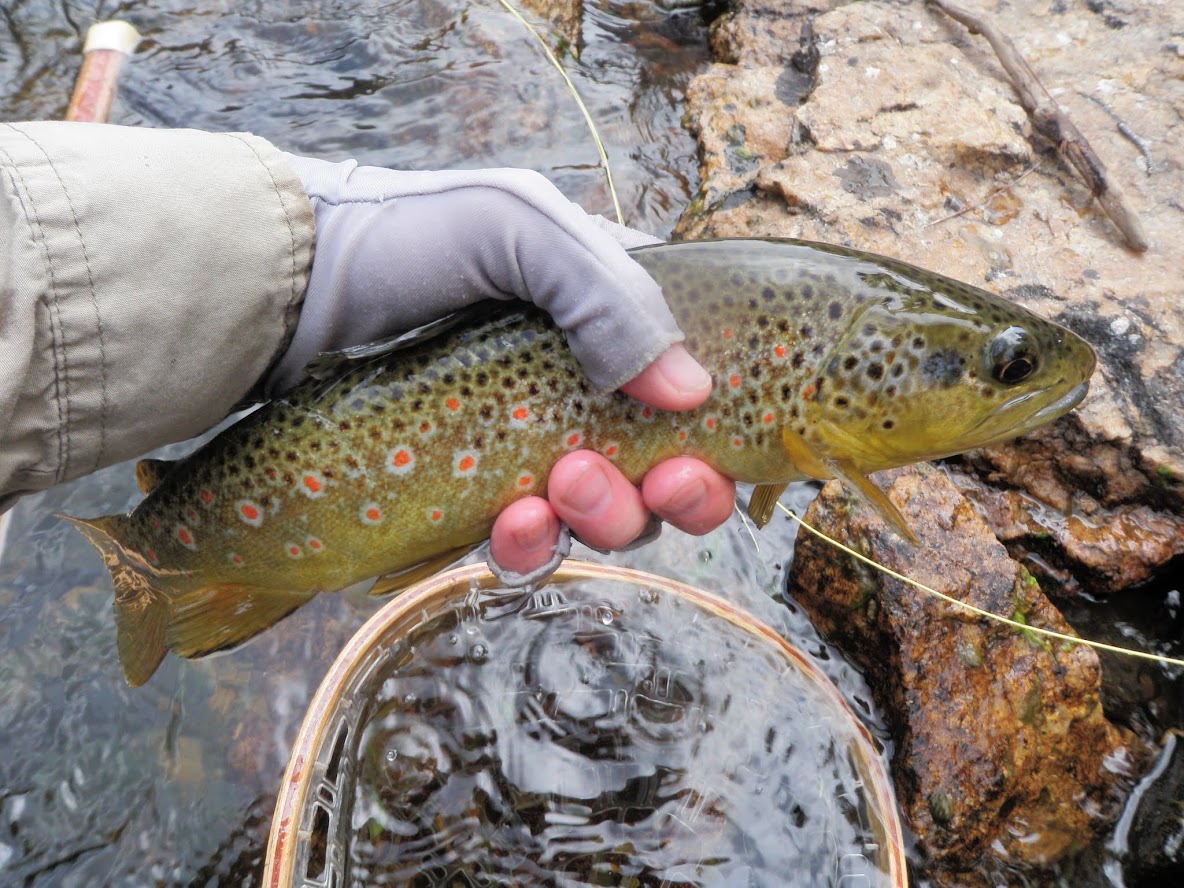
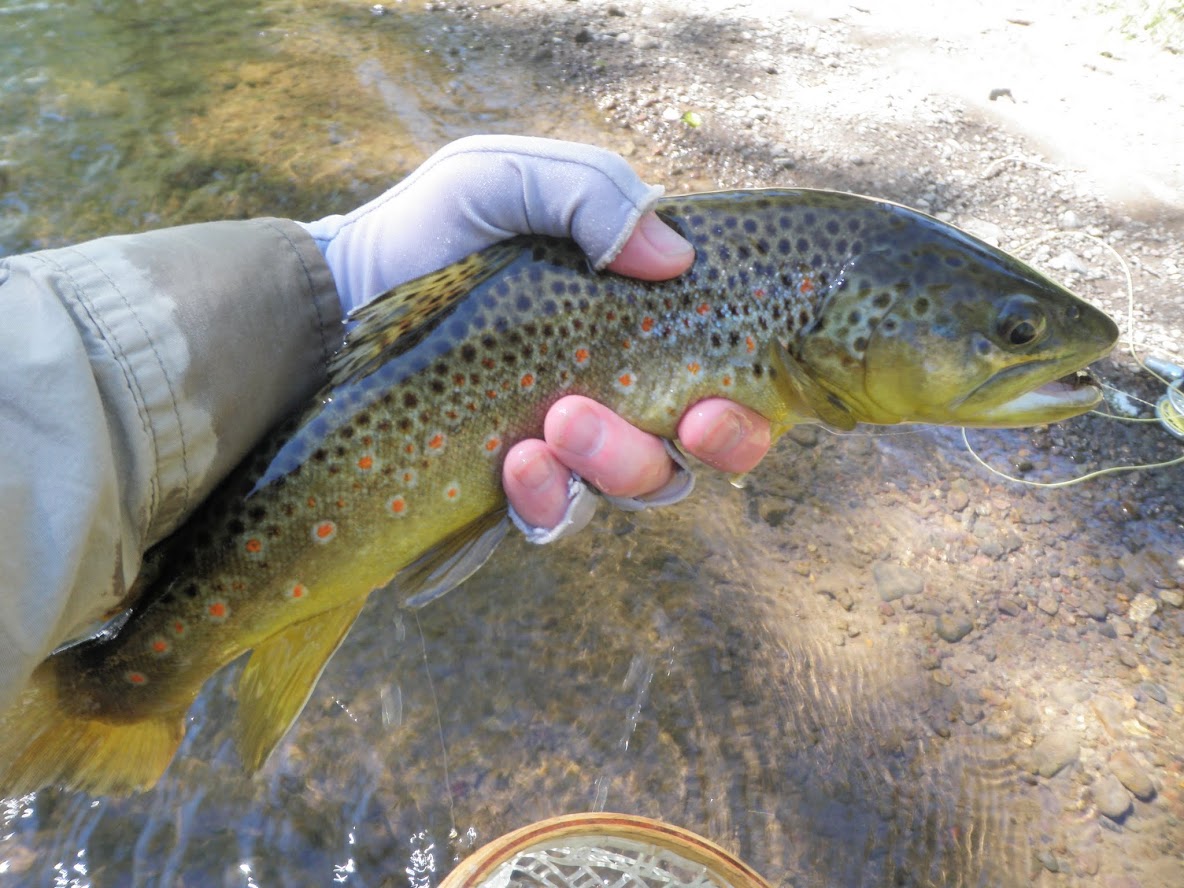
After the stimulator registered one landed fish, it ceased to produce takes or even refusals, so I finally surrendered to adding a nymph dropper. I swapped the stimulator for a Chernobyl ant and then added a two foot tippet and a beadhead hares ear nymph. This improved my fortunes, and in a short deep run below some overhanging branches, the Chernobyl paused, and I made a quick hook set. I was shocked to see a substantial fish attached to the other end of my line, and when I eventually landed the feisty fighter, I discovered a thirteen inch brown trout in my net. A thirteen inch fish in the tiny East Fork is quite a catch, so I celebrated my good luck and moved on.

Giant for E. Fork Brush Creek

It did not take long before I saw another pause in the ant and set the hook, and this time I found an eight inch brook trout. The brook trout was so pretty that I could not resist taking a photo despite its relatively diminutive size. Dave G. seemed to be passing me at shorter intervals by now, and he was voicing displeasure over the lack of action. I pressed ahead, but I knew that his frustration level would likely put an end to the East Fork adventure shortly. Just before noon I landed a small six inch brookie in a smooth shallow pool behind a large rock, and then I caught up to Dave G., and we decided to move downstream to Brush Creek in Eagle Ranch. Although I landed four fish in two hours, the action was admittedly rather slow, and I was amenable to making a change.

Pretty Brook Trout

We thrashed through some thick bushes until we reached the dirt road, and then we walked back to the Santa Fe and tossed our gear in the back. A brief fifteen minute drive brought us to the bridge on Sylvan Lake Road where I parked, and we grabbed our rods and tromped across a grassy field to the upstream border between the private water and the public Eagle Ranch section. Here we once again began playing the game of hopscotch as we worked our way upstream. The creek in Eagle Ranch was relatively low, although probably normal for the middle of August. The low clear conditions dictated much caution as one approached and cast to the deeper runs and pools.

Dave G. immediately began to experience success on his dropper, however, I was unable to unlock the secret code to catching these Eagle Ranch brown trout. I stuck to the Chernobyl ant and hares ear for awhile, but after a half hour with no success I switched back to Jake’s gulp beetle. This was rudely ignored, so I reverted to the Chernobyl ant with a hares ear and again the combination failed to excite fish. I swapped the hares ear for an ultra zug bug and then a salvation nymph, and none of these combinations put any weight on the end of my rod. Eventually I returned to the hares ear and picked up a six inch brown.

Dave G. began like a ball of fire, but after his initial success, he also found the fishing quite challenging. After two hours of difficult fly fishing on Brush Creek, we surrendered to the wild fish and called it a day. Wednesday on Brush Creek was disappointing, but the weather was pleasant and the scenery was outstanding. The August doldrums have officially arrived, and I now plan to seek out high elevation creeks and tailwaters to offset the impact of high temperatures and low flows.

Elk River, BC – 08/09/2015

Time: 12:00PM – 5:00PM

Location: Olsen Pit – Hosmer

Fish Landed: 6

Elk River, BC 08/09/2015 Photo Album

Big fish eat little fish. At least that is the conventional wisdom in fly fishing circles. For the last year or two, I made ongoing efforts to improve my streamer fishing game since big fish eat little fish, and streamers attempt to imitate little fish. If I could consistently recognize opportunities to deploy streamers, then I could probably catch more large fish. Unfortunately I struggle with technique, but on Sunday I would spend a significant amount of time stripping a large bait fish imitation.

Flies Designed by Jake Chutz in Elk River Guiding Fly Bins

Adam Trina is the president and CEO of Montana Fly Company, and he arrived in Fernie, BC on Sunday morning to join us for another day of fishing on the beautiful crystal clear Elk River. Jake and I checked out of our hotel and found an open breakfast spot called Smitty’s, and then we drove a short distance to the Elk River Guiding Shop where we met Adam. After Adam purchased his Canada fishing license, we were off to Olsen Pit to launch Jake’s craft for another day of floating. The plan for Sunday was to drift a different stretch of the Elk River from Olsen Pit to Hosmer. Hosmer was our take out on Saturday, so this segment of the river was the next section upstream of the water we covered the previous day.

Drifting Some Crystal Clear Riffles

Unlike Saturday the sky was quite overcast, and the temperature was much cooler. I wore my new neoprene booties in case we decided to park the drift boat and wade fish, as I was anxious to give my new purchase a test. Once Jake launched the river boat, I climbed in the front and remained in the bow for the entire afternoon. The front position is the most desired as the occupant gets first shot at drifting flies over new water. Jake and Adam were skilled oarsmen, so they alternated between fishing and manning the paddles. Apparently the convention among fly fishing rowers was to  switch positions each time the one fishing has success.

The upstream section of the Elk was similar to Saturday with alternating small bends, riffles and deep pools; although it seemed to me that we encountered more deep pools filled with rich azure color. Since Adam did not fish on Saturday, we gave him first choice on type of fishing, and he quickly selected streamers. Adam and I quickly grabbed our six weight streamer rods and began attacking the banks with sparkle minnows. Adam brought along prototypes of larger sparkles that were weighted much heavier than the versions that Jake and I tossed on Saturday.

One of My Meat Eaters from Sunday

I found myself quickly immersed in the active game of stripping streamers. I am the type of person who likes to follow direction and rules, but I quickly learned that other than some basic principles, there is a huge amount of improvisation in streamer presentation. Some of the underlying tenets are: allow the rod to load by pausing on the back cast, cast toward the bank, point the rod tip at the fly, never set the hook, and just keep stripping. I followed these basics, but then applied my creativity by varying the speed of retrieval and the jerkiness of my strip. Another option is whether to make a large mend when the streamer hits the water or a series of quick mends to create erratic movement. Speaking of erratic movement, wiggling the tip of the rod and making quick side to side shakes are quite acceptable. Anything that creates movement and the illusion of wounded bait is fair game.

This is what I practiced for the first three hours of the afternoon, and I am proud to report that I landed four trout on the sparkle minnow. One of the fish eaters was a bull trout that fell off my line just as I lifted the fish to bring it to the net, while the other three were quite handsome west slope cutthroats in the fourteen to sixteen inch size range. Remember the opening sentence? Here was proof that the conventional wisdom is true. I probably failed to capitalize on an equal number of opportunities. Early in my real world lesson, I found myself reacting to bumps with hook sets. Unfortunately this intuitive hook set that works well in the dry fly and nymphing world simply pulls the artificial bait out of the trout’s mouth. Once I learned to ignore the bump and continue stripping, my ratio of conversion to landed fish improved.

PB-J’s Were Eaten Here in the Boat

After three hours of chucking the heavily weighted sparkle minnow with a six weight catapulting device, I felt quite a bit of wear and tear on my right shoulder and arm, so I asked Jake if I could switch to my five weight with a gulp beetle. This move delivered two additional cutthroats in the twelve to thirteen inch range, but the beetle did not seem to pique the interest of fish on Sunday in the same manner that it performed on Saturday.

Adam Shows Off Double

By five o’clock we reached the take out ramp at Hosmer and called it a day. Obviously my fish count suffered in comparison to Saturday, but I feel that the weather and section of the river had more to do with that result than the choice of fishing with streamers. Three of the streamer chomping fish were fourteen to sixteen inch bruisers, and that is something to appreciate. Best of all I committed to streamers for an extended time period and experienced a modicum of success. The true value of Sunday August 9 with Jake and Adam was advancement of my streamer technique along with confidence that this method of fishing can deliver superior results. I’m actually anxious to toss some bait fish imitations in the waters of Colorado.

Pretty Bend of the Elk River


Elk River, BC – 08/08/2015

Time: 10:00AM – 6:30PM

Location: Hosmer to Fernie

Fish Landed: 20

Elk River, BC 08/09/2015 Photo Album

Jake Chutz is the sales manager for Montana Fly Company, and Adam Trina is the president and CEO. They invited me to visit them in Columbia Falls, MT, and the invitation included a trip to Fernie, BC in Canada for some fishing on the Elk River. I never met either of these gentlemen in person, yet I felt that I knew them quite well from the many phone conversations.

Jake’s MFC Hopper Box

Jake picked me up at Adam’s house in Columbia Falls, MT where I was staying on Friday evening, and we made the two hour trip to Fernie, BC with his drift boat in tow. It was a scenic drive as we spotted numerous deer along the way and passed many picturesque lakes. By the time we crossed the border into Canada, darkness descended, and this made it impossible to view my surroundings in southern British Columbia. I was pleasantly surprised by the extra hour or more of daylight in the western and northern portion of the mountain time zone.

Saturday morning after breakfast at the Park Place Inn, Jake and I crossed the main highway to the Elk River Guiding Shop, and here we purchased eight day fishing licenses and access permits for two days on the Elk River. I also splurged on a pair of neoprene wading booties for wet wading during the summer, although I did not wear them on Saturday. Jake arranged for a shuttle service to transport his truck and trailer to the take out in Fernie, and we moved on to the Independent Market to pick up lunch supplies and sunscreen. With these chores out of the way we proceeded north along the Elk River until we found the turn off for the Hosmer boat launch. Jake commented on the low level of the river as we crossed a bridge, but I had no point of comparison, and the crystal clear flows looked quite inviting for a fly fisherman.

Steady

Since Jake informed me that we would likely be in the boat most of the day, and the forecasted high was eighty degrees, I changed into my shorts and Chacos. Jake rigged up a six and five weight as well as my Sage One five weight. The five weights were configured for dry fly fishing, and the six weight was threaded with a streamer set up. Once we were ready, Jake launched and paddled the drift boat down a narrow channel to the main river just below a bridge. He jumped out of the boat and pulled it across some shallow water so we could prospect a bridge pylon and a long dead tree branch that extended downstream. The water look magnificent, but I was unable to interest any trout in my size 10 Jake’s gulp beetle.

The weather was fantastic with a high around eighty as predicted and minimal cloud cover. In Colorado these clear conditions can presage challenging fishing, but that was not the case on the Elk River. Since we arrived after dark, I did not have the opportunity to see the landscape, but on Saturday morning I was dazzled by the jagged rocky topped hills that bordered the river on all sides. The Fernie, BC area reminded me very much of the Grand Tetons near Jackson, WY.

Jake Displays One of Dave’s Nicer Fish

The first hour of fishing was quite slow, and I was unable to bring any fish to the large net in the boat, but the second hour proved to be more productive. My first fish was a small cutthroat, and this fish proved to be the smallest of the day. All the remaining catches were in the 12 – 15 inch range with several fish topping out around sixteen or seventeen inches. The gulp beetle was the workhorse fly over the course of our eight mile drift, although Jake changed my line from a size 10 beetle with a purple body to a size 12 with a red body for the midday period. The cutthroats seemed to favor purple and red with equal enthusiasm.

More Gorgeous Scenery

It took some time to identify the productive water types, but eventually we solved the riddle and focused on deep slow pockets and slack water along the bank. A drag free drift was required, but successful presentations were nearly always rewarded with stubborn hard fighting west slope cutthroats. For short casts to small pockets I executed high stick maneuvers where the fly line never touched the water and only the beetle gently drifted along the surface. In places where there was fast current between the boat and the slow shelf water next to the shore, Jake taught me to perform a reach cast which positioned the line upstream of the fly to avoid drag without a mend. It was great fun drifting from one side of the river to the other, as I popped quick cast to small pockets and enjoyed longer drag free drifts in other bank side locations. Solid drifts consistently yielded regular bites from the pretty speckled residents of the Elk River.

A Rarity…Dave Wading Wet

The other water type that yielded cutthroat trout was riffles of moderate depth over a green bottom where the river dropped into a pool. These areas seemed to be more productive in the morning, as the action in the drop offs tapered in the afternoon.

The Drift Boat Anchored

When I reached twelve fish landed on my mental scorecard, Jake suggested that we give streamers a test. We stopped in a gorgeous deep hole where the main current angled at ninety degrees toward the west bank. I wet waded and landed a twelve inch cutthroat while Jake stripped the sparkle minnow through the aqua depths until he connected on a small bull trout. When we resumed our drift, Jake continued demonstrating the streamer basics and yanked a fine cutthroat from a root ball. The hungry fish darted from beneath the root wad and gulped the fraudulent minnow that gave the appearance of a struggling dead bait fish.

Great Shot of a Nice Fish and Jake’s Gulper Beetle

With his fine demonstration complete, Jake handed the six weight rod to me, and I began to practice what I observed. Jake preached confidence in my ability to induce a take, and after twenty minutes I did in fact succeed. I cast repeatedly toward the bank and manipulated the minnow with short jerky pulls on the line. Suddenly I felt a small tug, and I was not sure whether it was fish or bottom, so I resumed the retrieve, and immediately I felt the heavy weight of a struggling fish. I gave the rod a quick jerk to set the hook after the fish was on the line, and then I fought a hard fighting seventeen inch cutthroat to the net. This meat eater proved to be the best fish on Saturday, and I was thrilled to experience some success with a streamer.

Jake Plays a Nice Cutthroat

After some additional streamer tossing with no success we reverted to the gulp beetle, and this move enabled me to build my fish count to twenty. As we approached the take out point we stopped a few times so Jake could explore some side channels, and he demonstrated exceptional casting and line management capabilities that yielded numerous fine cutthroats in our large net.

Very Nice Beetle Consumer

Toward the end of our drift I tried a small foam hopper as I searched for improved visibility, but the high floating terrestrial yielded only a few refusals. Jake meanwhile returned to the workhorse beetle and added a few more nice fish to his count for the day. I was surprised to learn that the Elk River fish favored beetles over hoppers, but the riparian vegetation was trees and bushes rather than grass. Grass is the preferred habitat for grasshoppers.

It was a spectacular day on the Elk River, and I enjoyed my first fish caught north of the border. The weather was perfect, the scenery was a sensory delight and a twenty fish day is something to treasure, especially when the trout are thirteen to seventeen inches long, and they are delicately spotted cutthroats with a brilliant orange slash below the jaw. Was it my best outing in 2015? I rank it slightly above the Conejos River on July 22 due to the unique appeal of catching west slope cutthroat. Another factor elevating my day on the Elk was the excellent rowing and instruction by Jake Chutz. Hopefully I can build on these skills during my future fishing adventures.


Cache la Poudre River – 08/03/2015

Time: 9:00AM – 11:00AM; 12:00PM – 3:00PM

Location: First bridge after beginning of Pingree Park special regulation water and then upstream for a mile.

Fish Landed: 13

Cache la Poudre River 08/03/2015 Photo Album

Jane and I drove to the Kelly Flats Campground along the Cache la Poudre River on Sunday where we tested our new Big Agnes Big House tent. We are scheduled to make a long camping and sightseeing trip to Crater Lake in Oregon to visit with our daughter Amy in August, so we decided to practice assembling and taking down our new purchase. We completed a 2.2 mile hike on Sunday afternoon, and then we relaxed and enjoyed happy hour and dinner at our prime campsite along the Poudre River.

On Monday morning I ate a quick breakfast of cherries and breakfast bars, as I hoped to get an early start with warm temperatures in the forecast. Jane, being the wonderful wife that she is, dropped me off so she could keep the car and begin packing all our camping gear for the return trip. We drove west along highway 14 until we reached the special regulation water at Pingree Park, and then we continued another mile until we crossed a bridge, and this is where I began my efforts to catch and land some Cache la Poudre trout.

The Brawling Cache la Poudre

I was pleased to note that the sky was quite overcast, and the air was cool as I descended the bank to begin fishing. These were ideal fishing conditions, so I hoped I could capitalize. I noticed a dozen or more caddis with a dark gray/brown body on the tablecloth on Sunday night as we played cards by the bright propane lantern, so I decided to begin my day with a size twelve peacock stimulator. This was larger than the caddis at the campsite, but the body color was a close match.

A Nice Brown Trout Near the Start

Initially I experienced two momentary hook ups and two refusals, but then I landed four fish in the first hour. One was a fourteen inch brown that slurped the stimulator confidently in a tiny pocket right along the edge of the river. My fishing guide book pointed out that the upper limit for Poudre fish is fourteen inches, so I was quite ecstatic with this catch.

Peacock Stimulator Did the Trick

The second hour was rather tough as I endured forty-five minutes without any action. I eventually came to realize that my success on Monday came from a distinct type of water, and I wasted quite a bit of time during this unproductive forty-five minutes in non-productive water. The characteristics of the water that produced the most fish was along the edge and at least three feet deep, and the pace of the current had to slow down quite a bit. Water that did not produce was riffles and current seams along faster runs; places that generally produce for me on other rivers. Other non-productive areas were deep pools such as the places that other fishermen flock to. These did not produce for me at all on August 3, but it was difficult to skip over them because they looked so attractive.

A Different Look

Between 10:45 and 11:00 I decided to change to a dry/dropper, and this proved to be a great move. I tied on a Chernobyl ant with a pink indicator and then added a beadhead ultra zug bug and beadhead hares ear nymph. This combination worked quite well as I landed three browns before lunch in some nice pockets along a steep bank with moderate depth. All three fish snatched the ultra zug bug from the drift, and several reacted to my lift.

I returned to the campground at 11AM and ate lunch and helped Jane take down the canopy, load the car and put the bicycles on the rack. At 12PM we checked out of the campground, and Jane dropped me off a half mile above the bridge where I stopped fishing at 11AM. I began working upstream with the dry/dropper combination and landed two more small browns, but the action was very slow, and I covered a considerable amount of water between catches. I began to wonder if the fish in the first hour took the peacock stimulator mistaking it for a green drake? I decided to try one of the bushy green drakes that worked on the Conejos in case the fish were still accustomed to seeing these large mayflies. The bushy green drake actually has the characteristics of a large stimulator, so I attached an ultra zug bug as a dropper.

An Afternoon Prize

I approached a spot that appeared to offer the requisite depth and desirable stream characteristics, but some branches stretched out over the water. I fired a sidearm cast up under the branches, and as the green drake drifted just below the branch I saw a slurp. A hook set yielded a nice 12 inch brown, and then I moved a bit closer and fired another sidearm cast up under the leaves but a bit farther, and a smaller brown attacked the ultra zug bug almost as soon as it hit the surface.

Success Under the Branches

I thought I was on to something, but that was the end of the green drake/ultra zug bug production. Between 1:30 and 2:30 I began to see a handful of pale morning duns in the air. By this time the sun burned off the clouds, and the air temperature increased dramatically. While I was next to a deep pool, I decided to go deep with nymphs. I attached a thingamabobber, split shot, hare nation nymph, and pheasant tail. The hare nation is a new fly I invented over the winter that combines features of a salvation nymph and hares ear nymph, and I hoped that this fly would imitate the nymph stage of a pale morning dun.

In a series of nice deep pockets of moderate depth along the bank, I hooked and landed three brown trout on the hare nation. The fish aggressively attacked the nymph almost as soon as it hit the water, so perhaps the hare nation was mistaken for a pale morning dun nymph as I theorized. Again I thought I had solved the riddle of the Cache la Poudre, but the nymphs ceased producing.

A Huge Eddy and Pool

Over the last half hour, I returned to a green drake dry, but this time I experimented with a size 12 comparadun style that I tied myself. This fly looked quite juicy as it danced on the current, but I was more enthralled by it than the fish. I quit at 2:35 to make sure I was at the pullout when Jane arrived, and she arrived promptly so we could begin our return trip to Denver.

It was a productive day on the gorgeous Cache la Poudre River west of Ft. Collins, CO. The river carries higher than normal flows for early August, so this probably bodes well for late August and September fishing. Unfortunately I did not experience the easy number boosting fishing that I hoped for, but thirteen fish including a fourteen inch brown that approaches the maximum for the Poudre is a solid outing. The miles of access to this gorgeous clear free flowing river will bring me back at some future date.


Eagle River – 07/31/2015

Time: 8:30AM – 2:30PM

Location: Edwards rest area and then section between Minturn and interstate 70

Fish Landed: 9

Eagle River 07/31/2015 Photo Album

My most significant accomplishment on July 30 at the Timbers at Bachelor Gulch had nothing to do with fishing, but more on that later. I spent Thursday morning fishing with Jeff Weekley, and this taught me two things. First, I realized that the best fishing was in the morning with the bright sun and warm air temperatures making fly fishing in the afternoon a difficult proposition. I enjoyed my time with Jeff, but I did not want to push him too hard to move often given the extremely slippery wading conditions on the Eagle River. The Thursday experience did whet my appetite for some aggressive wading and dry/dropper fishing in the abundant pocket water near the Edwards rest area.

With these thoughts spinning in my head, I woke up early and quickly munched an english muffin and yogurt. The valet quickly brought my car to the covered entrance to the condominium complex, and I drove the short distance to the Edwards rest area where I prepared to fish. For Friday I decided to explore the pocket water between the Riverwalk shops and the rest area, so I followed the fisherman path and then walked downstream along the bank as far as I could until I reached the very fast whitewater chute that blocked the progress of Jeff and me on Thursday.

I began with a Chernobyl ant with a pink foam inidcator and added a beadhead ultra zug bug and salvation nymph, and interestingly these flies would serve me over the course of my entire day on the Eagle River near the rest area. Despite my early start and the cool air temperatures, the first hour was very slow, and I did not land a single fish. Although the fishing was lacking, I did burn quite a few calories as I slipped and slid over the round slimy rocks that characterize the Eagle River stream bed. I moved back and forth between the left bank and the edge of the heavy current in the middle of the river and prospected all the deep attractive pockets in between.

Pocket Water as Far as the Eye Can See

Finally after an hour of fishing, a twelve inch brown grabbed the salvation nymph as it tumbled next to a large exposed rock. This gave me some hope, so I continued in this manner and landed three additional trout until I encountered a wide shallow section of the river above the rest area. All the fish landed in the rest area pocket water were brown trout in the twelve inch range, and all but one took the salvation nymph. The other one inhaled the ultra zug bug. This segment of my outing between 8:30 and 10:30 represented a lot of difficult wading over much stream real estate for a fairly minimal return.

A Decent Brown from the Eagle River Early Friday Morning

I could see fishermen in the prime run between the rest area and the pedestrian bridge, so I exited and climbed the bank to the path and circled high above the river and then crossed the pedestrian bridge. I returned to the river on the opposite side and decided to fish the right bank upstream from the bridge. This is my favorite stretch of Eagle River water, although Todd Grubin told me it is private. I decided to fish it anyway and plead ignorance should I be confronted, as I rarely see anyone on the condo side of the river high above a steep bank.

This section of the Eagle is perfect brown trout water. It consists of a series of deep pockets and runs between the heavy main current and the bank. The dry/dropper method is devised for this water, as the approach matches the moderate depth. On Friday the right side produced three additional fish under some very challenging conditions. I began fishing at 10:30, and the sun was strong, and the air temperature was rising quickly. There was no evidence of a hatch of any sort. Despite these adverse conditions, I landed a feisty twelve inch brown from the area just above the pedestrian bridge.

Same Chunky Fighter from the Side

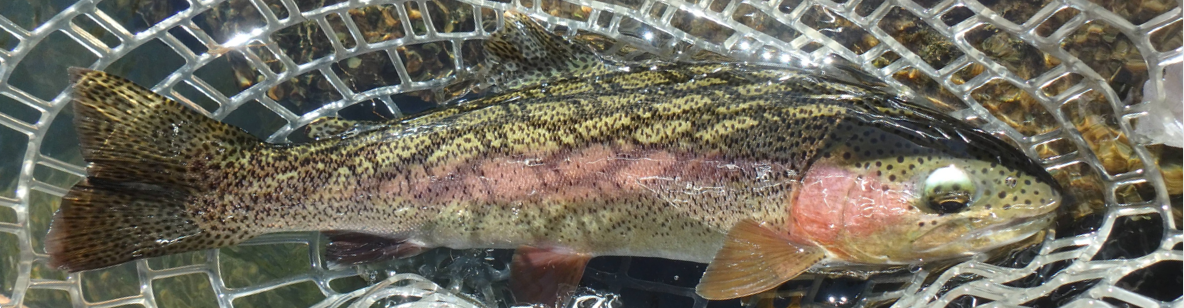
After I released the brown trout, I cast to a fairly shallow riffle close to the bank, and the indicator paused for a split second. I reacted to this subtle shift in drift and set the hook and landed a very healthy 15 inch brown. Ten yards farther upstream as the flies drifted tight to the edge of the current seam, the indicator once again dipped, and I executed a swift lift with my rod tip and discovered a beautiful 16 inch rainbow attached to my line. I enjoyed the battle with this beauty and eventually brought it to my net and rejoiced in the two large fish that I managed to land under very trying conditions.

Great Shoulders on This Pretty Fish

By 12:30 it was quite warm, and I had fished the entire right bank from the pedestrian bridge to the ninety degree bend, so I exited and walked back to the car via Riverwalk and the Edwards bridge. It was 12:45, and I wanted to fish a bit longer, so I drove east and exited at the Minturn ramp. A short drive south brought a bridge into view, so I turned left, crossed and then turned right and drove on the rough dirt road until I was a decent distance beyond a camper. I cut straight down to the river, and began prospecting with the same flies that I used at the Edwards rest area, but there were no signs of fish until I landed a small brown on the salvation nymph as it drifted tight to a large side boulder along the bank.

The Eagle River Below Minturn

The river here was narrower than the main branch, but it was similar to the Edwards section in terms of many exposed boulders, deep runs and pockets. It seemed there should be more fish than I was encountering, so I clipped off the dry/dropper components and tied on a size 14 olive stimulator. This generated some refusals, so I downsized to a size 16 gray caddis. In a short amount of time after the change, I landed a ten inch brown on the caddis, This caused me to believe that I unlocked the secret, but then the fish began refusing the small caddis imitation.

Small Brown from the Minturn Section

I continued on and covered quite a bit of the stream, and I did manage several momentary hook ups at the very lip of pockets. I saw a few PMD’s rising up from the surface and wondered if the fish were refusing the light gray caddis because they recognized the light gray body, but were then turned off by the swept back wing. I went to a light gray comparadun to test my theory. In a nice deep trough next to the bank, I spotted a swirl in the glare and set the hook and felt the weight of a decent fish, but it only lasted for seconds, and the fish was gone. The comparadun stopped producing, so I experimented with a large peacock body stimulator, but that only elicited a refusal or two.

By 2:45 I was weary and frustrated by how picky the small fish were, so I returned to the Timbers at Bachelor Gulch condo. Nine fish on a hot day was actually respectable, and this included two beauties of fifteen inches or greater.

But what about my most significant accomplishment on Thursday? I often saw runners gliding along at high altitude, and I held these folks in very high regard. It is difficult to run at the elevation of Denver, let alone 8,000 feet above sea level as is the case in Vail or Avon. Even more impressive is running uphill at altitude against a severe grade. When I returned from fishing with Jeff on Thursday, the other guests at the condo were golfing, and I felt like I needed to exercise. I decided to run to the tennis courts and back, but I soon discovered that it was only a half mile with the return being a severe uphill that followed several sharp switchbacks. After I finished the one mile loop, I turned left and followed the paved road that skirts the Bachelor Gulch developed area and continued on an uninterrupted climb for another mile. At age sixty-four I accomplished what I marveled at other young runners doing; I ran a continuous uphill at altitude in eighty degree temperatures. Now that is something to celebrate.

Eagle River – 07/30/2015

Time: 10:00AM – 1:00PM

Location: Edwards rest area; downstream of bridge and then back above to the high bank

Fish Landed: 6

Eagle River 07/30/2015 Photo Album

The life style change was a shock to my system. After spending four days and three nights camping in the wilderness next to the Conejos River, I returned to Denver, and then on Wednesday Jane and I journeyed to Beaver Creek. Our sister and brother-in-law invited us to visit them at their luxurious condo at the Timbers at Bachelor Gulch, and we were grateful to join them. Bell hops, valet parking, maids, and chocolates on the pillows contrast to the extreme with pit toilets, no showers, sleeping in a tent and soup for dinner every night.

Joining our in-laws were the Weekley’s, Gail and Jeff, also from Atlanta, Ga. Jeff was the only member of the group who expressed an interest in fly fishing, so he and I made plans for a morning outing on July 30. The Eagle River flows within a few miles of the Timbers resort, so I targeted that stream as our destination. The reports of the fly shops indicated that the flows dropped to the 300 cfs level, and I know from past experience that fishing on the Eagle can be quite challenging after the run off ends and water levels normalize. Compounding my concern was the weather report which called for clear skies, bright sunshine, and high temperatures in the mid to upper 80’s.

Jeff and I left the condo on Thursday morning by 9AM, and our first stop was the Vail Valley Anglers at Riverwalk in Edwards, CO. Jeff purchased a fishing license and rented waders and boots for our morning on the river. When I asked the salesperson behind the counter about the fishing, he informed me that dry/dropper was working best in the morning and evening. He showed me some attractor dry flies such as chubby Chernobyls, but I declined to purchase since I have quite a few close facsimiles that I tie myself. Next he opened the fly case and pointed to some small flashy nymphs that were probably size 18 or 20. I thanked him for the suggestions, but decided that I had enough options that were close to his choices.

Next Jeff and I drove to the parking area at the Edwards rest stop and prepared to fish. I elected to use my Sage four weight, and I set Jeff up with my Loomis five weight two piece rod. We hiked through the trees to the bridge below the rest area, and then we found a path to the river. Here some trees and bushes blocked our path, so we carefully waded along the edge of the river until we were just above a very tiny island. The river here had some attractive deep pockets, and I wanted to introduce Jeff to fishing this type of water even though navigating the round slimy boulders was quite challenging.

Initially I tied a chubby Chernobyl to Jeff’s line along with a beadhead hares ear nymph, and I demonstrated how to make short upstream casts and then allow the large attractor to drift back while raising the rod and keeping the fly line off the water. He was fairly proficient at this style of fishing immediately, and we observed a fish that repeatedly swam toward the surface to inspect the chubby, but it would not commit to eating. Eventually we decided we were wasting our time with this picky eater, so we moved upstream to the next juicy slot. Because he was receiving refusals to the chubby Chernobyl, I swapped it for a conventional Chernobyl ant.

While Jeff was prospecting with the dry/dropper technique, I began rigging the Sage four weight for myself. I decided to fish dry/dropper with two nymphs, so I knotted a tan Charlie boy hopper to my line and then added a beadhead ultra zug bug and salvation nymph. In the middle of this preparation Jeff called out that he hooked a fish, but before I could even glance toward him, the fish escaped and popped off the Chernobyl and hares ear. Jeff asserted that the fish felt quite heavy as it began to charge downstream, and I was happy that he at least felt the tug of a significant Colorado trout.

Another Shot of the Rainbow

I tied another Chernobyl ant to his line and added an ultra zug bug as his dropper, and he resumed prospecting in a very enticing wide deep slot across from his position. I delayed fishing myself, as I watched him make some nice accurate casts to the top of the deep trough. Suddenly on the fifth drift, as the flies began to sweep at the end of the slot, Jeff felt a tug and set the hook. The battle began, and Jeff expertly allowed the valiant fighter to run a bit, and then stripped up some line. The tussle lasted for a few minutes with several runs and counter moves, but eventually Jeff tipped the head of a thirteen inch rainbow above the surface, and I slid the net beneath it. Jeff and I were quite excited that he landed his first fish of the day, and it was a very nice hard fighting rainbow trout.

Reaching Across Currents

We exchanged fist bumps, and I moved above Jeff to some three star pockets (Jeff’s spot was five star) along the left bank. I began my typical short upstream casts while keeping my line off the water, and fairly quickly I landed a small brown and a chunky twelve inch brown on the ultra zug bug. Jeff seemed to be enjoying himself in the water below me, so I quickly moved up to the long deep run and tailout below the Edwards bridge. As I began to fan out some longer casts to the wide tail area, I spotted a pair of rises in the riffles just below the bridge where the light transitioned from shadows to sunshine. I took a few steps closer, and lofted several casts to the vicinity of the rising fish, and on the third drift saw the hopper disappear. A swift hook set resulted in a streaking fish, but I halted its downstream progress and managed to steer it to the side and above me. It was not long before I netted a spunky twelve inch rainbow.

Rainbow from Below the Bridge

I paused and waited for Jeff to catch up. He liked the appearance of the long run and pool, so I allowed him to continue to cover that water while I moved under the bridge to the head of the run on the east side. The seam along the faster current looked ridiculously delicious, but I was unable to attract any residents to my flies. I moved farther along the left bank and dropped a few casts in some marginal small pockets before I reached a deep pocket below some large exposed boulders. This spot was also a five start trout lair, as it was ten feet long and eight feet wide with a huge foam layer covering nearly forty percent of the surface. This was a perfect place for a trout to hide and pick off delicious snacks as they drifted by.

I lobbed a cast above the foam and as it drifted along the edge, the hopper paused, and I set the hook and landed a nine inch rainbow. Upon the release of the rainbow, I tossed another cast to the same area, and once again I set the hook, and this time I landed a small brown trout. Despite the small stature of this fish, it had a huge hump behind its head, so I named it the hunchback of Edwards. One of the nine inch fish snatched the ultra zug bug, and the other nabbed the salvation nymph. I saved the top half of the pool for Jeff, and went back to lead him to it. He appeared beyond the concrete bridge support, and I enticed him to the pool with comments about the certainty of landing a big fish. Unfortunately despite some accurate and repeated casts to the top of the pocket, he did not succeed in landing a fish let alone a lunker.

A Nice Brown Trout Landed by Dave

We exhausted our forward progress along the left side of the river, as we encountered some white water that rushed against a vertical fifteen foot high bank. We retreated to the area just above the bridge and then hiked back to the car. From here we followed the fisherman path back to the river and then hiked east until we reached a run that opened up into a huge long pool. This is probably the prime water on the section of the Eagle River near the Edwards rest area. Another fisherman had waded into the tail of the pool, so I asked if he minded if we fished the top section, and he replied that he was fine with that.

Jeff took the area at the very head of the run, and I began fishing in the midsection. I sprayed twenty casts throughout the run, but the water appeared to be devoid of fish. As this was transpiring, however, I observed some tiny mayflies slowly fluttering up from the surface of the river. The birds also seemed to notice the beginning of a sparse hatch, as they began to swoop back and forth across the river. No surface rises were apparent, so I wondered if perhaps the fish were locked on the subsurface version of the small mayfly that was present. I clipped off the salvation nymph and replaced it with a size 20 Craven soft hackle emerger, and despite my efforts to impart movement as well as fish it dead drift, the fish were not interested.

I could tell Jeff was losing interest, so I quickly made one last attempt to catch a fish from the gorgeous run and pool in front of us. I clipped off the dry/dropper flies, and reconfigured my line with a strike indicator, split shot, salvation nymph and RS2. I covered the middle section of the run with drifts, and after five minutes of effort, I managed to hook and land a nine inch brown that grabbed the salvation nymph as I began to lift and make another cast. I accomplished my goal of landing a fish from the prime run, so we called it quits.

Jeff landed the best fish of the day and hooked another fish that appeared to be of decent size. I managed to land six trout, two rainbows and four browns, although the size was inferior to most of my previous experiences on the Eagle River. I spent quite a bit of time setting up Jeff and pointing him to likely areas, so six fish in three hours was actually respectable. Thursday was more about introducing Jeff to the Eagle River, and I obtained almost as much of a thrill as him when he landed the nice rainbow trout.


Boulder Creek – 07/27/2015

Time: 11:30AM – 3:00PM

Location: Seven miles up Boulder Canyon from the end of the bike path. 1.5 miles above Boulder Falls.

Fish Landed: 17

Boulder Creek 07/27/2015 Photo Album

By Monday morning my arm and shoulder were recovered from four straight days of fishing in the previous week. I was anxious to hit the streams again before the summer doldrums set in, but since I had a haircut appointment at 9AM, the destination needed to be reasonably close to Denver. I considered Bear Creek, Clear Creek, and South Boulder Creek; but I eventually chose Boulder Creek since the flows seemed lower and closer to ideal than the others. In addition I had a first hand look at the creek as we traveled along it on Sunday on our way to and from Rainbow Lakes.

On Monday I departed Denver by 10AM and drove up Boulder Canyon seven miles beyond the end of the bike path, and this also happened to be 1.5 miles above Boulder Falls. The gradient was quite steep, but I saw quite a few nice plunge pools from the car window. Also after seeing the number of fishermen in the small stream on Sunday, I assumed that the high gradient water was not as pressured, as most fishermen do not like fast steep water. As if to question the sanity of my water choice, there was a 10% grade sign along the highway.

This Sign Was Next to My Starting Point

I began with a medium olive stimulator and landed one small brown trout, but I was also frustrated by five or more refusals. While my impatience with being rejected built, I saw one yellow sally, so I tried a size 16 imitation, but that generated a couple refusals and then ceased to attract any interest at all. Perhaps I was over analyzing, so I tied on a solitary Chernobyl ant. This was a breakthrough, and I landed three small browns that craved the ant, but I probably had as many or more refusals to the large attractor terrestrial as I had hooked fish.

Typical High Gradient Section Fished

Just before lunch at 12:30, I began to see occasional PMD’s in the air. No fish were rising, but I thought perhaps nymphs were active subsurface, so I added a salvation nymph dropper to the Chernobyl. Almost as soon as I did this, a small brown crushed the salvation as soon as it entered the water. I broke for lunch at 12:30 and resumed fishing by 12:45 and managed to land two more browns on the salvation nymph. The salvation seemed to work best in riffled runs where the fish were forced to make a quick opportunistic grab.

A Very Pretty Native Brown Trout

In the slower moving deep pockets, the trout obtained a better look and refused the foam top fly.    After 30 minutes of mostly refusals, I spotted a small splashy rise along the far bank. This fish was having nothing to do with my flies, so I made a radical change and went to a size 16 light gray comparadun. I was leery of using this small hard to see fly in the fast swirly currents of the steep gradient creek, but it paid dividends. I concentrated on water with some depth where I could get a decent drag free drift, and the fish responded. I moved at a quick pace, or as fast as rock climbing would allow, and made only a few casts to likely spots.

A Light Gray Comparadun Fooled This Fish

Between 1:30 and 3:00PM I registered ten more brown trout to end at seventeen on the day. The largest fish were in the nine inch range, so nothing to brag about, but I enjoyed the mental stimulation of trying to figure out what fly and what water type would produce fish. It is always challenging to solve this puzzle on brand new water.

Plunge Pools

Arkansas River – 07/24/2015

Time: 12:00PM – 4:00PM

Location: First pullout west of Fremont – Chafee County line and upstream

Fish Landed: 9

Arkansas River 07/24/2015 Photo Album

Friday was get away day, and I was not thrilled to leave behind the wonderful Conejos River and the productive fishing that it provided on Tuesday through Thursday. But life moves on, so I woke up early on Friday morning and took all the necessary steps to break camp by 7:30. I was fortunate that the clear dry air of the upper Conejos did not produce any dew on the tent, so I was able to quickly stuff it in the sack without any concerns about moisture during storage.

My plan included a stop over on the Arkansas River to break up the return trip. When I checked the flows prior to departing for the Conejos River on Monday, the river remained at 1,000 CFS, so I hoped to experience some hot action from edge fishing before the fish spread out. Google maps indicated that the drive from Lake Fork Campground to Salida was 3.5 hours, and this proved to be very accurate. I stopped at ArkAnglers on route 50 to replace my nipper retractor that  broke on Tuesday, and while there I purchase several attractor flies for dry/dropper fishing and asked the salesperson about local stream conditions. He informed me that the flows remained at 1,000 CFS, but the river was clear until the Vallie Bridge area. I planned to fish below Salida and above Vallie Bridge, so this news did not impact me.

Armed with some new flies and stream information, I departed for the pullout at the Fremont – Chafee line, but a car with Ohio plates was parked there. I jumped out of my car to scout the river, and a single fisherman was upstream, so I executed a U-turn and drove to the next pullout when traveling west. It was overcast and cool with temperatures in the low 70’s as I donned my waders and boots. Since the Arkansas River is much larger than the Conejos, and flows were high at 1,000 CFS, I chose my Sage One five weight rod.

Near My Starting Point. Water Swamped the Willows.

I descended the steep path and then fought my way through the willows to the edge of the river. Indeed I quickly discovered the flows were high with water deluging the streamside willows a bit. I walked upstream until I reached a slower riffle of moderate depth and rigged my line with a Chernobyl ant, salvation nymph, and iron sally. The salesperson at ArkAnglers told me iron sallies were working well. On the second or third cast I landed a small brown on the salvation and then a second small brown near the top of the riffle. I was actually startled to experience such sudden success as I tossed one more cast in the middle of the riffles. In an instant the Chernobyl disappeared, and I landed a quite nice brown on the iron sally.

Best Fish of the Day Was This Brown Trout

What a start! I moved upstream and fished all the likely spots along the bank and picked up two more browns before I decided to stop for lunch. A second brown of around 12 inches grabbed the iron sally and the other brown took the salvation. It was around 1PM when I stopped for lunch, and the sun burned off the clouds, and it actually became quite warm. Before lunch I noticed several refusals to the Chernobyl, and it seemed to be distracting fish from the nymphs somewhat, so I decided to try a yellow Letort hopper. I observed the occasional golden stonefly, so I thought that perhaps the yellow body hopper with a slim profile would imitate an adult golden. It is difficult to support two relatively heavy nymphs such as the salvation and iron sally with the dubbed body Letort hopper, so I added only the salvation as a dropper.

On the first two casts I experienced refusals to the hopper, and on the second one I foul hooked the fish with the trailing salvation. The fish shot downstream, and after a few seconds the flies became disengaged and shot back above me and landed in a tree branch. I could see the hopper and salvation dangling from a dead limb, and then I bungled the situation even more when I wrapped the tapered leader around another dead tree branch separate from the first.

I put down my rod so as not to endanger it and climbed through some dense streamside willows until I reached the larger branch that held the tapered leader just below the tip of the rod. I rocked the branch a couple times and suddenly it broke free from the stump, and I was able to unwrap the first snag. Unfortunately the two flies continued to dangle high above me. I was not about to give up. My wading staff was too short to reach the hopper, but the branch I just broke down was quite long. I picked it up and used it like a jousting pole to hit the small dead branch holding the two flies, and succeeded in breaking it off on the first attempt. I picked up the small twig and unraveled the two flies, and in a short amount of time I was back in business.

I moved up a bit and cast to the middle of a short run, and as the hopper drifted back toward me I saw a swirl and set the hook. I thought the fish took the top fly, but when I managed to land it, I noticed the salvation nymph was embedded in the lip. The Letort hopper appeared to be attracting attention, but it was not exactly what the fish expected. I clipped it off and tried a yellow stimulator size 12 2XL, that I purchased at ArkAnglers as a golden stonefly imitation. This did not even generate refusals.

Maybe they were looking for yellow sallies? I tried one, but it was soundly ignored. Next I tried a solitary size 16 gray deer hair caddis. This actually generated a rise on a prospecting cast, and I added another fish to my count. By now I reached seven fish, and it was 2PM, and the sun was high in the sky, and the air temperature reached its peak. The conditions became quite challenging. The Chernobyl ant produced most effectively for me in the early going as a top fly because although it was refused, at least the fish also tuned in to the nymphs. I decided to return to my original threesome for the tough afternoon conditions.

Iron Sally in Upper Lip

I picked up my pace and did not dwell at any particular spot for long. I was particularly focused on depth along the bank, and I covered a lot of stream real estate. I landed two fish in the last two hours, and one was a decent brown of around thirteen inches that hammered the iron sally. Despite being debarbed the hook point  got stuck in the tough cartilage that forms the lip, and I had a difficult time removing the fly. Some dark clouds appeared in the western sky as 4PM approached. I was quite weary from four days of camping and fishing and the action was quite sparse, so I decided to call it quits.

I ended the day with nine fish, and a few were in the 12 -13 inch range, but it was by no means the hot edge fishing that I anticipated. Although the flows remain at 1,000 CFS, it seems the fishing has slowed a bit particularly in the middle of the afternoon when the sun is bright and the air temperatures peak. If I return to the Arkansas River, I will schedule my fishing time for the morning and evening, and do something else from 2-5PM.

Conejos River – 07/23/2015

Time: 9:15AM – 6:00PM; 30 minute lunch due to returning to the car for a camera battery issue and then 30 minutes to walk back to the car and then drive to the campground. Fifteen minutes of fishing at the campground at the end of the day.

Location: Pullout between Lake Fork Campground and the Meadows area and then upstream to the eastern/southern edge of the Meadows; 15 minutes at the campground.

Fish Landed: 24

Conejos River 07/23/2015 Photo Album

What could I do for an encore after a spectacular day of fishing on the upper Conejos River on Wednesday, July 22? First I needed to decide what segment of the river to fish on Thursday. But even before this decision, I needed to manage some fundamental camping basics. I only paid for Tuesday and Wednesday night as I hedged my stay until I determined the quality of the fishing. Wednesday’s results certainly made that decision easy, so I returned to the pay station and wrote a check for another night.

After two days in relatively warm weather, my ice supply dwindled, and it was clear that I needed to replenish in order to remain until Friday morning. I did not relish another rough 36 mile round trip to the store at the CO 250 turn off. When I was researching the campgrounds in the area on Google maps, I thought I noticed a small town near the reservoir six miles up the road. Surely there must be a source of ice in Platoro? I noticed that the campers across from me had large heavy duty spinning rods that are typically used in lakes. I suspected that they fished in Platoro Reservoir, and this probably meant that they knew if ice was available in the small town of the same name. I mentioned all this to another camper from Texas that I became acquainted with, and he inquired of my neighbors as he passed by on his return from the pump. They replied that yes, ice was for sale at the store next to the Gold Nugget Cafe in Platoro, and they in fact just bought some there themselves. My camping friend relayed this welcome information to me, and I made plans to drive to Platoro so I could be there when the store opened at 8AM.

This worked out nicely because it enabled me to scout out the river between the campground and Platoro. There was a short stretch above the public access that I fished on Wednesday evening, and then the river made a ninety degree turn and flowed through a deep valley with high banks on both sides. This segment was probably .3 mile long and when combined with the water between the public access parking lot and the large bend, it probably extended to half a mile. I also discovered that in previous trips I never went beyond the eastern end of the Meadows section, and the water near the top of the Meadows was much more interesting with many bends and deep pools.

When I returned to the camp site after replenishing my ice supply, I considered three options. My initial plan was to drive south on CO 250 beyond the camper trailer that I encountered on Wednesday. I could park in a pullout or along the road and cut across the grass bluff and drop down to the river and fish new water back up to my Wednesday entry point. Number two would be to begin at the first public access above the Lake Fork Campground and then fish the .5 miles around the bend until I reached the Meadows where my exit would be relatively easy. A third possibility was finding some nice water in the Meadows.

I knew other fishermen loved the Meadows, and I did not wish to compete for space, so I rejected that option first. I was not certain how much open water remained below the camper trailer, and I was getting farther downstream and away from the green drake hatch, so I decided to choose the water between the campground and the Meadows. Perhaps the hatches in this area were similar to the Meadows, but the high banks and difficult access would ward off other fishermen. The key to this decision however was fishing my way through the entire canyon area, because otherwise I would be required to climb the long steep bank between the river and road.

Soft Spot Behind the Rock Was Productive

I drove to the public access parking lot and found a dry spot to park where I could pull on my waders and boots without dealing with the abundance of mud. I rigged my Sage four weight and anxiously walked to the edge of the river and began fishing my way upstream. The bushy green drake performed in outstanding fashion on Wednesday, so why not present it again on Thursday? I did, and then I mimicked Wednesday even further by knotting a salvation nymph to a three foot dropper below the green drake.

Early Morning Brown from the Conejos

What a great strategy! I covered the water from the parking lot to the ninety degree bend between 9:15 and 11:00 and landed fourteen wild brown trout. Unlike Wednesday when the green drake dominated, the salvation nymph produced ten fish, while the green drake fooled four. Quite a few of the fish were once again chunky browns in the twelve to fourteen inch size range. I crossed to the opposite bank as soon as I could, as I am a proponent of fishing areas that are harder for the average fisherman to reach, and this strategy appeared to pay off in a major way. I was feeling pretty smug about my choice of water as I sat down on the bank away from the road at a very inviting area just above the large bend in the river. I tallied fourteen fish landed with the prospect of hatches and seldom fished canyon water ahead of me, and I stopped for lunch at 11AM since I wanted to avoid the Wednesday situation where the hatch commenced at 11:30 as I began to eat. This meant I had five or six more hours of fishing in front of me.

Nearly 15″ Beast Took the Green Drake

Before eating lunch I decided to snap a photo of the attractive water across from me. Unfortunately as I did this, I received a battery dead warning. This happened on previous occasions, but usually it had something to do with the replacement battery not being seated properly in the compartment. I removed it and reinserted it several times, but each time I tried to test the camera by taking a photo, the battery low icon flashed across the screen. Perhaps the battery was actually low. I decided to cross the river and hike back to the car to procure my second battery. On the return trip I drove the car to a wide shoulder pullout just below the bend so that I would be closer to my exit point at the end of the day, but the entire round trip probably used up thirty minutes of prime fishing time.

My Favoite Spot on July 23 on the Conejos

Finally I ate my lunch and resumed fishing in the wide area just west of the bend. The water looked spectacular with two nice pools side by side. I approached the nearest one first, and immediately I could see several fish at the tail. I attempted to lure the fish to my green drake and salvation nymph, and with my polarized sunglasses, I did observe some looks but no takes. I cast to these reluctant eaters for quite a while and then decided to concede victory and moved across to the larger pool closer to the dirt road that was by now quite a distance above the river. As I carefully waded across the river I noticed a few golden stoneflies, fewer green drakes, and some pale morning duns. The density of all these insects was far less than what I viewed on Wednesday.

Nevertheless the green drake was not working, so I switched to a yellow Letort hopper in an effort to emulate the golden stoneflies first. The change did not elicit a response, so I countered with a parachute green drake. This fly performed quite well in the early stages of the hatch the previous day, but other than a momentary hook up, it did not live up to expectations on Thursday. As these fly changes were taking place, a fish began to rise steadily in the swirly water where the current spilled into the pool at an angle. I gently drifted the parachute drake over the area of the rises, but it went unmolested. Why not follow Wednesday’s routine and convert to a cinnamon comparadun? That is what I did, and on the fifth cast to the water where the fish was feeding, the comparadun disappeared. I executed a swift hook set and the fight was on. This fish churned and raced and put up a stiffer battle than my large rainbow on Wednesday, but eventually I coaxed a seventeen inch chunky rainbow into my net. What a thrill! For two days in a row I switched to a cinnamon comparadun and then landed a fat seventeen inch rainbow trout, and in both instances it would be the best fish of the day and the only rainbow.

A Fine Fish

The hefty rainbow was number sixteen on my scoreboard, and I continued moving deeper into the canyon with the cinnamon PMD and increased the fish count to twenty by 1PM. My thoughts were optimistic, as I had a large chunk of remaining time and barely touched the seldom fished pockets and deep runs in the canyon area. I did not know the water was lightly pressured for sure, but it certainly seemed likely.

The only certainty in fly fishing is change. As soon as a fisherman thinks he has things figured out, he discovers that he does not. I fished the remainder of the afternoon from 1 to 4PM through the highly anticipated canyon water and landed only two additional fish. The hatches on Thursday were extremely brief, and I was forced to experiment with a series of fly changes. A lime green trude spent time on the line and resulted in a small brown trout. Next a yellow Letort hopper plopped upstream for some period of time, and this did generate a nice twelve inch brown trout that aggressively smashed the large terrestrial tight to the bank above a four foot deep trough. But that was it. The major differences between Wednesday and Thursday were that the hatches began later in the day, it was overcast and windy rather than sunny and warm, and the hatch lasted only a fraction of the time that it persisted on Wednesday. On Wednesday quite a few pale morning dun stragglers continued to emerge through the early afternoon, but the wind blew any similar late emergers off the water early on Thursday.

Last Minute Tail Wag Created a Blur

The afternoon was a large amount of hard work for a minimal return. When I returned to the car, I decided to revisit the wide area that delivered the large rainbow, but this move only resulted in a six inch brown that crushed a size 16 light gray caddis. As I drove back toward the campground, I stopped at the public access parking lot where I began the day, and I prospected for a bit with the caddis and enticed another six inch brown to mash my fly.

When I returned to the campground I attempted one more last ditch effort to resurrect the day to something close to Wednesday by casting a yellow Letort hopper and beadhead hares ear to the juicy hole directly behind my campsite, but alas there was no sign of trout. The water looked so attractive that I took the time to rig for deep nymphing, but that move was also futile.

Normally a twenty-four fish day is something to celebrate, but I was spoiled by the best to date outing on Wednesday. The lack of action for three hours in the afternoon also left a bad taste in my mouth as it is human nature to remember recent events and discount earlier success. Did I make a mistake by not selecting one of the other segments of the Conejos River? This question will never be answered, but in hindsight, I experienced three superb productive days of fishing in a remote wild environment in the Conejos Valley, and that is something to be happy about.


Conejos River – 07/22/2015

Time: 9:30AM – 6:00PM

Location: 35 minute hike downstream from the CO 105 bridge and then back up to the starting point on Tuesday (large pool). From 5-6PM fished at the first public access upstream from the Lake Fork Campground.

Fish Landed: 35

Conejos River 07/22/2015 Photo Album

You cannot turn back the clock. This expression refers to a person’s inability to recreate a positive historical experience in the present. I believe this condition relates to nostalgia and the human brain’s propensity to minimize negatives and exaggerate positives. On Wednesday July 22 I was attempting to turn back the clock. On July 21 and 22 2011 during my introduction to the section of the Conejos River below Platoro Reservoir, I experienced some outstanding fishing. I discovered some new flies, and they produced great results during some strong green drake and pale morning dun hatches, and I also landed some large fish by prospecting during the time periods when a dense emergence was not in process.

The conditions were aligned to repeat the 2011 success. I camped at Lake Fork Campground along the upper Conejos River and within a mile of my starting point in 2011. All the reports indicated that pale morning duns and green drakes were emerging on the upper river. The flows were nearly ideal as they fell from 150 CFS on Tuesday to 115 CFS on Wednesday. The sparse population of fishermen were gravitating to the water upstream in the Meadows. The sky was blue and the air temperature was cool. Camping near the CO 105 bridge allowed me to get an early start and thus hike a significant distance from the parking lot. I came prepared with a large number of salvation nymphs and an array of green drakes covering different styles and sizes. Could I recreate the magic? Read on.

There were some concerns. Three fishermen referenced the Meadows area and the great success they experienced during a dense green drake hatch. Perhaps there were no competing fishermen in the area I was targeting because the hatches progressed upstream to the Meadows? Was I feeling smug in getting away from other anglers only to discover that they were in the know, and I outsmarted myself?

Dinosaur Backbone

When I woke up on Wednesday morning, it was a great day with sunny skies and cool temperatures. In fact the high for the day in the high elevation reaches of the Conejos probably never exceeded the high 70’s. According to my plan I arrived at the rough parking lot across the 105 bridge by 9AM and then hiked downstream along the western side of the river for 35 minutes. This brought me to a place where thick trees extended down a steep bank to the river, so rather than attempting to fight through the forest, I dropped down along a gully. Interestingly after all the effort to get away from human beings, I spotted a camper trailer parked across from my entry point. I was undeterred however because it was on the opposite side of the river, and the swift flows made it difficult to cross.

Another Chunky Green Drake Eater

In my ongoing effort to recreate the magic of 2011 I extracted a bushy size 12 green drake dry fly from my front pack and knotted it to my line. I am sure this fly has a different name, but it consists of a lot of deer hair and even more dense hackle. The wings,unlike conventional mayfly ties, are swept back in a fashion similar to a caddis or stonefly. This fly was very productive in 2011, and I operate under the theory that during green drake emergence time frames, trout react to green drake sightings 24/7. Since the fly was quite buoyant due to the heavy hackling, I attached a salvation nymph on a three foot dropper. The salvation was also extremely productive in 2011, and I theorized that it imitated the nymph stage of pale morning duns should they be active prior to an early afternoon hatch.

The Water Between the Bank and the Whitewater Was Money in the Bank

I was quite pleased to learn that these flies were great choices. I methodically worked my way upstream and prospected the two fly combination in all the likely locations, and the brown trout of the Conejos were quite responsive. I landed twelve fine brown trout between 9:30AM and 11:30AM when I paused for lunch. Most of the fish were chunky head shaking browns in the 12-13 inch range with a couple fourteen inch fish in the mix. The bushy green drake produced most of the fish, but I also landed four on the salvation, so it was worth the hassle of fishing with a dropper. So far so good. The flies were producing and the fish were where I expected them to be.
Looks Like the Green Drake in the Mouth of this Well Fed Conejos Brown

Just as I removed my front pack and backpack and sat down to eat, chaos developed. First I observed a few golden stoneflies gliding up from the river, and then some size 16 mayflies appeared. I assume these were pale morning duns, as they sputtered and tumbled in their efforts to become airborne. Lastly some green drakes appeared, but these were much smaller that what I remembered from 2011. Clearly my bushy version would probably not fool these fish if they were focused on the size 14 natural version in front of me. I ignored my mother’s advice to chew my food slowly and quickly gulped my lunch to avoid missing out on the multiple hatches that commenced in front of me. Directly across from my lunch position was a deep wide run, and a fish began to rise with moderate frequency at the top of the run.

Same Fish with the Parachute Green Drake Visible

As I suspected, when I resumed casting, I covered the attractive run with the bushy green drake, and it was ignored, so I searched my stash of green drakes and chose a size 14 parachute version. This fly has a white tipped wing post and presents a narrower silhouette on the water, and in my opinion it represented a much closer imitation of the naturals in front of me. I was pleased to discover that the trout agreed for awhile. The parachute green drake was on fire, and I landed six additional brown trout to push my fish count to eighteen. Several of the takers were fourteen inch brutes that confidently inhaled the fraudulent green drake imitation.

A Gorgeous Deep Buttery Gold

I was in a euphoric state when I arrived at a sweet spot where the main current deflected off a high vertical rock wall and created a long eddy. From my position below the bottom of the turning point of the current, I could spot at least five nice fish. Three fish were in the nook of the eddy before the water turned and flowed back along the wall. Apparently there was a soft spot below the surface where fish could hold and snatch food from the churning froth. I tried to fool these fish first with my parachute drake, but it was soundly ignored. I was seeing quite a few yellow sallies, but very few green drakes, so I tied on one of the small yellow bodied stoneflies from my front pack. Apparently this was not on the menu either. What could the fish be eating? Some pale morning duns continued to flutter up from the surface, so I switched for a third time to a size 16 cinnamon comparadun.

Eight Feet Above the Root Ball Facing Downstream

This fly was also shunned by the trout in the nook, but I turned my attention to two long torpedoes up and across from me that faced into the reversing current as it flowed along the base of the rock wall. These were very nice fish. Could I even dare to assume that I could bring one to my fly? And even if I managed to hook one, it would be quite a challenge to maneuver it through the heavy current between me and their location.

I fluttered a cast downstream of the two targeted fish so that quite a bit of slack landed, and then the comparadun slowly drifted toward the holding position of the fish. In a matter of fact move, one of the fish slid under my fly and sipped it in! Now I was faced with fighting this large fish across the heavy intervening current, and somehow I managed to do it. I slid my net beneath a gorgeous seventeen inch rainbow trout and marveled at the beauty of its vivid pink stripe and distinct spots. This would be my only rainbow of the day, but what a thrill it was.

A Great Shot of the Hefty Rainbow Longer Than the Net Opening

I continued prospecting with the cinnamon comparadun and moved my fish count from 18 to 30. What a productive imitation! I was skeptical that I could prospect with such a tiny fly, but the fish were having no trouble seeing it even in riffled water. When I lofted a cast to a likely spot that held a trout, the response was typically a confident sip. I snapped off one fly on a hooked fish, and I bent the hook on a second one, as I needed to use my hemostat to leverage it from an awkward position in the fish’s mouth. Eventually I lost the bent fly when a brown trout swallowed it deep, and I cut the line rather than try to remove it and injure the fish.

Eventually I landed a small brown on the pale morning dun to reach thirty, and I decided to experiment with something different. The PMD hatch had waned by this point, and I was encountering fewer willing takers. I was in the middle section of a huge long deep pool where the main current flowed along the base of some large rocks on the east bank. The comparadun failed to interest any trout in this juicy stretch of the river, so I converted to a yellow Letort hopper. I gambled that the hopper with a narrow profile might imitate one of the golden stoneflies that I observed throughout the afternoon, or perhaps natural hoppers were present as a result of the intermittent blasts of wind.

Just a Pretty Fish

I flicked the hopper to the top of the pool and allowed it to drift slowly along the inside edge of the current seam and suddenly a thirteen inch brown trout savagely attacked the fraud. I was shocked at this immediate reversal in fortunes resulting from a change in flies. Then as if to emphasize my fly change, a second brown trout inhaled the hopper in roughly the same location as the first one. I was re-energized as I departed the deep pool and resumed my upstream migration with the Letort hopper, however the hot terrestrial imitation lost its allure, and I began registering refusals. For some reason the fish in the shallower locations were better able to distinguish my fly from natural facsimiles.

Two Browns Mashed the Hopper in This Location

Once again I considered my options and decided to downsize to a lime green trude, as this fly more closely approximated the size of the golden stoneflies, although the color had too much green and not enough light orange. The feedback from the fish confirmed that the lime green trude was not to their liking, so I changed again to a muggly yellow sally. This fly is intended to imitate the smaller yellow sally stonefly, but I did not observe as many of these compared to the larger golden stoneflies. This fly was also soundly ignored by the denizens of the Conejos River.

At 4PM I reached the attractive deep pool where I began my Conejos River fishing adventure on Tuesday, so I elected to return to the car rather than repeat the section already covered. It was still early, and my campsite was set up, so I stayed in my waders and drove north along CO 250 beyond the Lake Fork Campground. I thought I remembered water in between the campground and the Meadows area, and I wanted to check it out as a possible destination for Thursday.

Sure enough a couple miles beyond the campground I encountered a nice public parking area and pulled in to inspect the water. It was similar to the segment that I fished downstream of the bridge on Wednesday with lots of exposed rocks and pockets with a medium steep gradient. I decided to give it a try and removed the yellow sally and reverted to the yellow Letort hopper, but this time I added a salvation nymph on a three foot dropper.

Big Spots

I worked my way upstream for fifteen minutes, and then I was pleased to land a thirteen inch brown that slammed the hopper. After releasing the brown trout, I made a few more casts and observed a swirl to the hopper in some difficult lighting conditions. Unfortunately I set the hook to an apparent refusal and created a foul hooked situation. The angry fish streaked downstream, and before I could leverage it back to my net, it broke off the salvation nymph. Once again I seem to be losing salvation nymphs at a rapid rate, so in an effort to conserve them for the remainder of the summer, I replaced it with a beadhead hares ear nymph. This proved to be a good choice, and I landed two additional ten inch browns before 6PM.

I began to think more about a cold beer than fooling more fish, so I reeled up my flies and hooked them to the rod guide and called it a day. And what a day it was! I landed thirty-five trout, all browns except for one large rainbow. Many of the brown trout were in the twelve to fourteen inch range, and these are nice sized wild fish for a relatively small high elevation river. I experienced four basic phases during the day. First there was the green drake/salvation prospecting period which covered the bulk of the morning hours. Next I enjoyed success with my slender profile parachute green drake. The most productive stage resulted from replicating the pale morning dun hatch with a size 16 cinnamon comparadun. A brief final chapter closed out the day with the yellow Letort hopper drawing interest.

Top Producers on July 22

Most of my success occurred on the west side of the river away from the road. The best spots were deep pockets and slots next to the bank. This is not surprising, as brown trout love the protection offered by bank structure and gravitate to water of moderate depth where they value safety but can still see food items that drift by. Surprisingly another productive water type was long wide relatively shallow riffle stretches on my side of the river. I encountered these areas during the hatch period, so perhaps the fish spread out when a high density of food sources caused them to sacrifice some security for calories.

Largest Brown Came from This Unlikely Shallow Riffle Area

One of my best brown trout on the day came from such a shallow water area. A large dead branch reached over the thirty foot wide shallow riffle, so I was forced to hook a cast around the branch so the parachute green drake landed ten feet above. I was dumbfounded to witness a fourteen inch brown as it snatched the green drake as it bobbed down the riffles to a point just beneath the dead branch. It is hard to top the satisfaction received when I dupe a relatively large trout to take my fly in a relatively obscure place.

Did I recapture the magic of 2011? Can a fly fisherman turn back the clock? I’m forced to admit that I may have not only repeated the magic of the Conejos River, but I may have created a new higher standard. Now I asked myself the question, what could I do for an encore on Thursday? I returned to the campground to celebrate with an Odell Ninety Shilling Ale, and I evaluated my options for Thursday July 23.