South Platte River – 04/11/2017

Time: 10:30AM – 3:00PM

Location: Elevenmile Canyon

South Platte River 04/11/2017 Photo Album

Everything was set. The flows were nearly ideal at 80 cfs, and the high temperature was projected to reach the low fifties. I contacted my new friend @rockymtnangler, and he agreed to join me for a day in Eleven Mile Canyon on the South Platte River. The fly shop web sites indicated that we could expect midge hatches in the morning and blue winged olives in the afternoon.

Since @rockymtnangler (also known as Trevor) is the proud owner of a rod vault, he performed the driving duties, and I assembled my Sage four weight and slid it into one of his empty rod vault tubes, when he arrived to pick me up at 7:30AM. We departed Stapleton, and after negotiating some relatively heavy rush hour traffic in Denver, we arrived at the special regulation water of the South Platte River in Eleven Mile Canyon by 10AM.

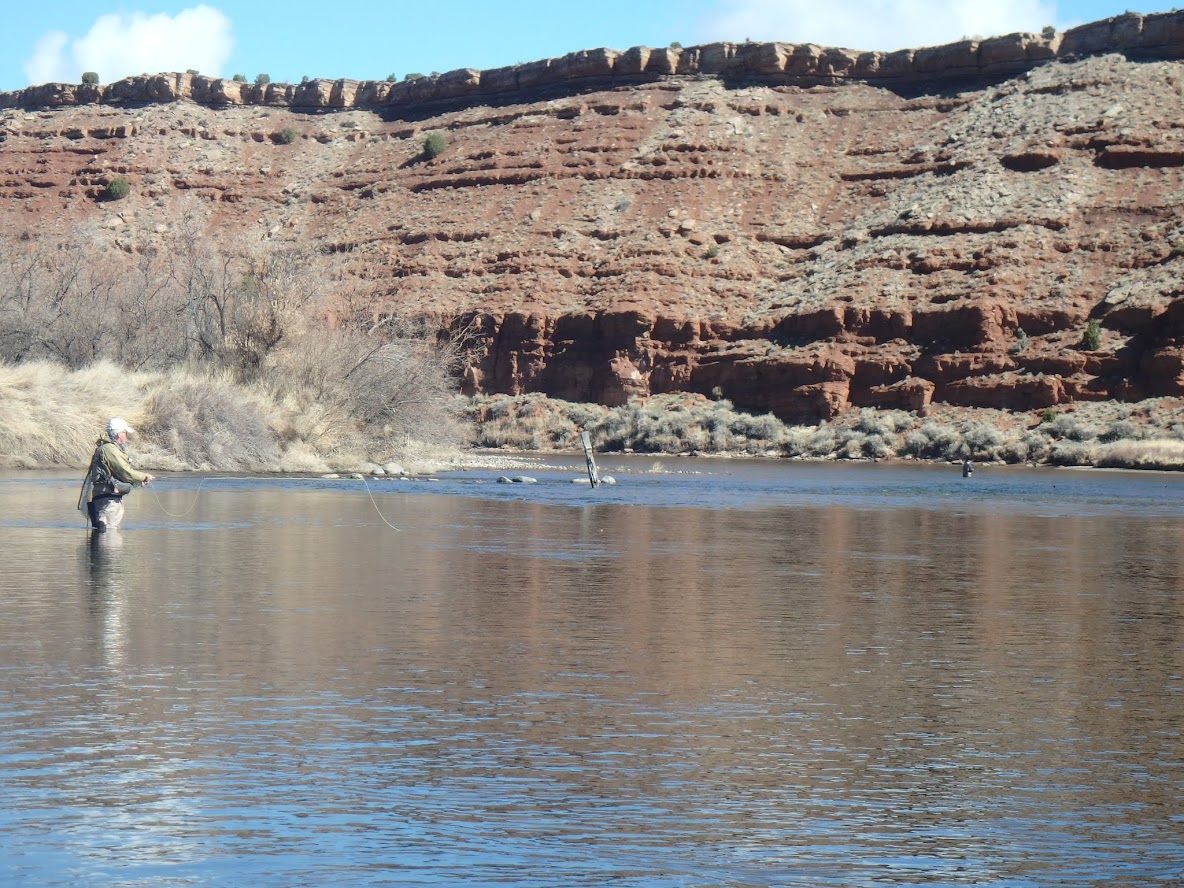
I reaped the benefit of the rod vault when we arrived, and after I climbed into my waders, I was prepared to attack the beautiful crystal clear flows below the dirt road where we parked. Trevor and I carefully negotiated a steep path down a rocky bank next to Trevor’s car, and we found ourselves on the water ready to fish by 10:30. I walked downstream a bit to a nice pool, while Trevor took a position next to a gorgeous deep pool directly below the car.

End of the Drift

In the first 1.5 hours Trevor and I each landed two decent trout. My first fish was a thirteen inch brown trout that snatched the beadhead hares ear in a riffle of moderate depth above a deep slow moving pool. Trevor netted a fine rainbow concurrent with my initial brown, and we celebrated our “double”. After photographing and releasing the brown, I carefully angled across the river and prospected a couple marginal pockets with the fat Albert trailing a beadhead hares ear and mercury black beauty. I exchanged a RS2 for the black beauty after an unproductive half hour trial period.

Very Nice Beginning

The second pocket was noteworthy for its mediocre appearance, but I tossed a couple casts to the top, and on the third drift I was shocked when a pulsing weight bent my rod tip, as I lifted to continue my upstream progress. The cause of my vibrating rod was a welcome twelve inch brown trout that displayed the tiny black beauty in the corner of its mouth.

Looking for Rises

I continued my progress to the opposite bank and moved to a position opposite Trevor in the gorgeous riffle, run and pool, where he initially staked out a spot. I was certain that the riffles of moderate depth at the top of the run would deliver a fish before lunch, but my expectations were misplaced. Trevor moved downstream toward the slower moving tail of the pool, and he reported a series of sporadic rises in the smooth deep area where the center current fanned out into a pool. I offered some drifts from my side of the river, but the pod of fish in the deepest section disregarded my flies. I observed quite a few nice fish below me, so I clipped off the three fly set up and converted to a single size 22 CDC BWO. In the remaining time before I climbed to the car to obtain my lunch, I managed to generate a few frustrating refusals, but mostly futile casts.

While I was stuffing my backpack with my lunch as well as Trevor’s, I heard him shout from the edge of the river below. I quickly pulled on my light down coat, as I was chilled while standing waist deep in the cold tailwater, and then I slowly slid down the angled gravel path and joined Trevor. Trevor was quite excited and announced that the hatch advanced in intensity, and the length of the pool was littered with rising fish. I decided to delay lunch and quickly crossed at the tail of the pool and claimed a position on the western bank. Trevor informed me that five or six fish were rising in the moderate riffles in front of me, but the glare of the sun made following my tiny size 22 CDC BWO very difficult. I shifted my focus to trout rising along the center current seam, but once again the tiny mayfly imitation was mostly ignored, with a couple refusals in the mix to heighten my frustration.

Dave Is Pleased

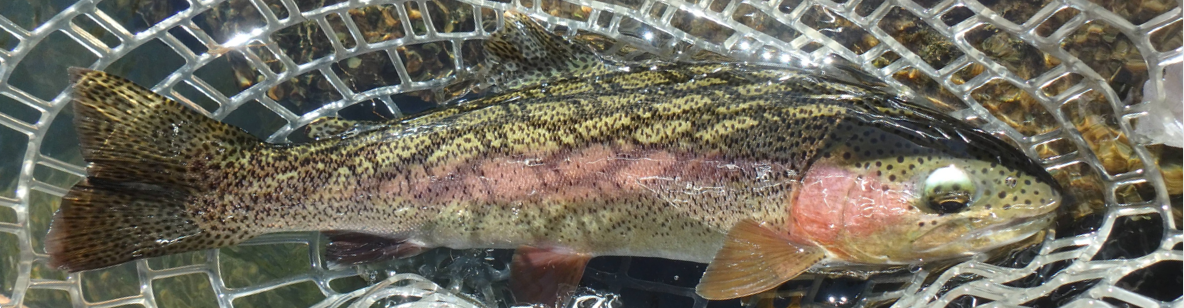
I queried Trevor, and he reported that the baetis where quite large and probably a size 16 or 18. This information prompted me to swap the size 22 for a size 18 with a fairly tall and bulky CDC wing. This move paid off, and I began to connect with South Platte River trout. Between 12:30 and 3:00 I landed ten additional trout, with three showing off the buttery yellow color that distinguishes a brown trout. Rainbow trout were the prevalent species, as seven striped beauties spent time in my net. All the afternoon fish sipped the size 18 CDC BWO, as the baetis adults emerged in waves over the 2.5 hour period. The heaviest emergence periods seemed to coincide with long periods of cloud cover. As the hatch intensified, the regularity of the rises increased, and my confidence surged. If I focused on a steady riser and made accurate downstream drifts, I could bank on a sipping rise, and in many cases I was rewarded. The rainbows measured in the twelve to fourteen inch range, and they did not slide into my net without a spirited tussle.

One of My Better Brown Trout

Trevor meanwhile was enjoying similar luck on his side of the river, as he tossed an assortment of size 16 and 18 flies such as a parachute adams and a CDC and deer hair comparadun. By 2PM we endured an extended lull, so I migrated downstream to the smaller pool, where I initiated my fishing day in the morning. I paused on the west bank and observed the entry riffle and deep pool for three minutes. As expected I spotted a nice active fish, as it hovered just below the surface and revealed sipping rises from time to time. I waded across a shallow intervening run and positioned myself five yards upstream of the sighted fish, and twenty-five feet across.

Gorgeous Colors

I stripped out a decent amount of line, and I fired a cast, so that it fluttered down ten feet above my targeted stream dweller. I was able to see my small fly on the surface, and I patiently waited, as the current carried the small mayfly downstream. When the small lint-like speck bobbed a few inches above the targeted fish, it slid six inches to the side and sipped the fraud. I could barely contain my excitement, as I gently lifted my rod tip and found myself connected to a spirited streaking rainbow trout. The annoyed feeder streaked back and forth a few times and gathered up my slack fly line. I shifted from stripping to playing the trout off the reel, and the watery foe made one more streaking dash that stripped additional line from the reel. After the last rush upstream I gained the upper hand and guided the colorful male into my net. Trevor waded into a position upstream of where I kneeled to release my prize, and he snapped some timely photos. Trevor was impressed with the hooked jaw of the vanquished rainbow in my net.

The Release

Eventually the lower pool remained quiet, so we returned to our previous positions in the large pool that occupied our efforts for most of the afternoon. Another wave of dense BWO emergence erupted during the last thirty minutes, and I managed to land number ten from the moderate riffle section at the top. This segment of the pool thwarted me for most of the day, but it finally delivered, when I executed downstream casts from the shallow riffles directly above.

Mauled CDC BWO Accounted for Ten Trout on Tuesday

Trevor suggested that we quit at 2:40, so we could leave with the memories of our last outstanding fish landed, but the pool was alive with rising fish. I waded downstream a bit and managed to land two more thirteen inch rainbow trout on downstream drifts along the edge of the center current seam. At three o’clock we decided to quit in order to get a jump on the long return drive; however, the pool remained alive with regular risers.

What a day! It has been quite awhile since I experienced a day, when I landed double digit trout on a dry fly. The duration of the blue winged olive hatch was impressive. I fought off the urge to switch to a dry/dropper approach with an RS2 and soft hackle emerger, and I was pleased with the results. Fishing a single dry fly to spotted rises is really the essence of fly fishing, and that approach defined my success on April 11. Trevor registered an equally enjoyable day on his maiden visit to Eleven Mile Canyon, and he repeatedly expressed his desire to return. He characterized Tuesday as his best ever day of stream fishing. Spring fly fishing in Colorado is heating up, and I am excited by that prospect.

Fish Landed: 12

Arkansas River – 04/07/2017

Time: 11:00AM – 3:00PM

Location: Pinnacle Rock

Arkansas River 04/07/2017 Photo Album

Friday was a success on many fronts, but I harbor some concerns about the health of the Arkansas River in lower Bighorn Sheep Canyon. Despite the reports on the Royal Gorge Angler web site touting the heavy presence of the blue winged olive life cycle, I failed to witness a single BWO in any stage of its life cycle while fishing for four hours in the vicinity of Pinnacle Rock. I was acutely aware however of dense piles of gray mucky sludge along much of the river bank. The Hayden Pass fire in 2016 impacted the ecosystem south of Coaldale, and subsequent storms washed ash and sludge into the Arkansas River. I am not an expert on stream biology and the impact of wildfires, but I want to believe that the absence of BWO’s is attributable to weather or water temperatures, and not to the Hayden Pass wildfire.

With high temperatures projected to reach the upper sixties in Canon City, Jane decided to join me for a trip to the eastern section of Bighorn Sheep Canyon above Royal Gorge on the Arkansas River. We departed Denver by 8AM and arrived at the Pinnacle Rock access area by 10:40. I chose Pinnacle Rock since I knew it contained bathrooms, and I speculated it would offer a nice haven for Jane, while I fished in the nearby river. Pinnacle Rock is located .5 mile below a section of the Arkansas River that I hold in high regard, where the flow splits into four or five channels. These separate braids transform a large intimidating river into smaller medium sized creeks, and this makes reading the water a much more manageable undertaking.

Trough Next to the Sticks Was the Source of Two Brown Trout

I quickly pulled on my waders and assembled my Sage One five weight rod and ambled across the parking lot to the downstream border, where I found a nice wide path that led to the river. I paused to assess the structure, and then I configured my line with a strike indicator, split shot, Arkansas rubberlegs, and a beadhead hares ear. A narrow deep trough existed within a few feet of the bank upstream from my position, so I lobbed the nymphs toward the midsection and allowed the indicator to slowly drift, until it was in front of me. I repeated this cycle several more times, and on the fifth drift as I lifted the nymphs to make another cast, I felt a sharp tug and accelerated my movement into a hook set. My reaction provoked a sudden response from a finned creature, and a spirited battle ensued, before I gently lifted a fourteen inch brown trout over the lip of my net. What a surprise to land what would turn out to be the largest fish of the day within the first five minutes.

First and Best Fish of the Day

Nearly as amazing was the next sequence of events. After I photographed and released the energetic brown trout, I moved up along the bank a bit, and tossed a cast to the top of the run just behind an exposed rock. The flies barely hit the water when the indicator raced upstream toward two o’clock, and again I executed a sharp sweep of my rod tip to the right. I entered a tussle with a wild brown trout, and this version ended up in my net as well. I estimated the length to be thirteen inches, as I carefully removed the Arkansas rubberleg and nudged it back into the ice cold current.

I wish I could announce to my readers that the first fifteen minutes of fishing were representative of the remainder of my day, but that was not the case. In the next 3.5 hours I added six additional trout to the fish count. Four were decent fish in the twelve to thirteen inch size range, and the other two measured seven to nine inches long. I worked extremely hard for these prizes, as one might conclude from the slow catch rate. The first two fish described earlier represented my only catches in the morning, and at noon I climbed the bank and joined Jane at a picnic table near the car. The spot was protected from the wind and benefited from the direct rays of the sun, and I thoroughly enjoyed the brief time with my lovely wife, while I basked in the warmth.

Near Our Lunch Spot

After lunch I prospected the water around a tiny island just above our parking space, but the exploratory session proved fruitless. I returned to the picnic area and persuaded Jane to drive me to the large bend in US 50, where I planned to access my beloved multi-braid section of the river, while Jane returned to the comfort of the Pinnacle Rock picnic area. I crossed the highway and hiked a short distance along the shoulder, before I dropped down a steep bank. By now I lost faith in the Arkansas rubberlegs, so I clipped it off and realigned my offerings with a beadhead hares ear on top followed by an emerald caddis pupa and then a soft hackle emerger. I was hedging against the likelihood that caddis or blue winged olives might be present in the drift.

Surprise Rainbow Trout Was a Beauty

I covered a nice stretch of moderate riffles next to the highway with no results, so I questioned whether I needed a larger fly to attract attention in the somewhat cloudy water. I removed the hares ear nymph and replaced it with a size 12 20 incher, and the lineup of the 20 incher, emerald caddis, and soft hackle emerger remained on my line for the remainder of the afternoon. Before abandoning the segment across from my drop off point, I tossed the three flies upstream and tight to the bank. As the nymphs tumbled toward a deep chute, I felt a tug and reacted with a lift. Instantly a silver pink-sided torpedo rocketed across the river and then dashed downstream in the riffles below me. I allowed line to spin from my reel, until the fish paused, and then I gradually regained line and lifted the head of a thirteen inch rainbow trout out of the water and into my net. This fan of the 20 incher would be my only rainbow on the day, but it was a hard fighting foe, and I was pleased to guide it into my net.

I decided to move to the north channel, as it represents my favorite section of the braided area. I carefully crossed the two intervening branches, and then I drifted my nymphs through some nice moderate riffles in the channel just above the confluence with the north braid. This slight detour in my route yielded a twelve inch brown trout that crushed the emerald caddis pupa, as it began to swing at the end of the drift.

My Favorite Branch

Finally I reached the point where the north channel dumped its volume into the main river, and during the remainder of the afternoon I methodically worked my way upstream to a point forty yards below where the flow split off from the main stem. I prospected with the three nymph system and added four additional trout to my fish tally. Two of the fish were on the small side, but the other two were very decent brown trout that rewarded me for my persistence.

Not Bad

For the most part moderate current and moderate depth seemed to describe the productive trout yielding destinations on Friday. Normally I edge fish the deep pockets of the Arkansas River and land numerous brown trout that relish the cover provided by the large protective rocks, but on this occasion that type of structure was not productive.

Return to Home

Readers of this blog may note that I often stumble on to a fly that is preferred above all others by the trout, but that was not the case on April 7. I landed one brown on a beadhead hares ear, one on an Arkansas rubberlegs, one on a soft hackle emerger, two on the emerald caddis pupa, and three fish that clobbered the 20 incher. The fish definitely seemed to validate my tactic of using the 20 incher to attract attention.

Overall it was a decent day. The weather was perfect and the flows were reasonable although a bit murky, but edge visibility was quite good. I managed to land eight trout during four hours of fishing, and this represents an average catch rate, however, six of the eight were in the twelve to fourteen inch size range, and that was noteworthy. I enjoyed the companionship of my wife, Jane, during the drive to and from the river, and we stopped at the Smiling Toad in Colorado Springs for a craft beverage on the way home. Spring is upon us, and I look forward to more fishing adventures.

Fish Landed: 8

South Boulder Creek – 04/06/2017

Time: 10:30AM – 2:30PM

Location: Below Gross Reservoir

South Boulder Creek – 04/06/2017 Photo Album

I previously discussed the importance keeping expectations low when embarking on a fishing trip, but on Thursday April 6 I was a victim of not adhering to my own advice. I enjoyed a spectacular day on South Boulder Creek on March 22 when flows were 21 CFS, so imagine my reaction, when I checked the DWR web site and noted that the current volume remained at a slightly below ideal 30 CFS. Of course the weather forecast suggested that the high temperature in the canyon would likely peak in the low fifties, but with the proper attire I knew that it would be tolerable. When I compiled all the factors; tolerable weather, flows slightly above my previous visit, and a fabulous day on March 22; how could I not anticipate another fine day on South Boulder Creek?

I arrived at the upper parking lot below Gross Reservoir by 9AM, and after completing the task of climbing into my waders I assembled my Loomis five weight and set out on the trail that descends the steep hill to the stream. My car was the sole occupant of the parking lot, and I was pleased to know that I owned the entire length of stream miles below Gross Reservoir. The temperature was forty-one degrees when I departed, but I knew I would quickly generate excessive body heat, so I wrapped my light down parka around my waist under my waders. In a concession to the cool temperatures I topped my head with my New Zealand hat displaying ear flaps.

Lots of Snow on the Path Along South Boulder Creek

I was shocked to discover the amount of accumulated snow along the creek, which I estimated to be twelve inches, and this made hiking in the untracked snow extra challenging. Given the lack of competing fishermen and the difficulty of tromping through the deep heavy snow, I stopped after a forty minute hike and began my quest for trout in a gorgeous wide pool. I tied a yellow fat Albert to my line and then added a beadhead hares ear and a size 18 salad spinner. I persisted with this configuration, until I stopped for lunch at 11:45, and I landed five small trout. The first two were brown trout, and the next three included two rainbows and one brown. Two of my early catches nipped the salad spinner, and the other three grabbed the beadhead hares ear.

Beautiful Pool Was My Starting Point on Thursday April 6

Just before lunch I snapped off the hares ear and an ultra zug bug that replaced the unraveling salad spinner. Unbeknownst to me a large arching evergreen branch moved into the line of my backcast and grabbed my flies, so I used this misfortune as an opportunity to pause for lunch and then to make a change. I switched to a gray stimulator and trailed a RS2 and then a soft hackle emerger. A very attractive pool was next to my lunch spot, and I spotted five or six decent fish cruising the deep run and slow moving shelf pool. The two fish in the slow water slowly cruised about the pool and generated subtle sipping rises from time to time.

I attempted to dupe several trout in the tail of the run with a gray size 14 stimulator that trailed a beadhead hares ear and beadhead RS2, but the visible fish showed no signs of interest. I made futile casts to the taunting fish for quite a while but observed no reaction, so I shifted my attention to the two brown trout in the shallow slow shelf pool. After a couple unproductive casts, I decided to adjust, and I clipped off the two nymphs and added a size 20 CDC BWO behind the stimulator. I made some long casts to the top of the pool and allowed the tandem dry fly offering to drift twenty-five feet, so that both flies passed over the target trout. Nothing. What could they be eating?

Finally in a fit of frustration I shot a cast to the very top of the pool, and as the flies slowly floated a few feet, a small brown tipped up and sucked in the CDC BWO. I quickly executed a lift and felt weight on my rod, but then the tension released, and I accepted the fate of a long distance release.

Between lunch and 2:30 I accelerated my pace and covered a huge amount of water. For the most part I prospected with  a size 12 olive stimulator with a beadhead hares ear dropper and a mercury black beauty. The black beauty accounted for one additional fish, and the hares ear was favored by two to bring my count for the day to eight.

Best Fish

On Thursday I landed four brown trout and four rainbows, and the largest fish to find my net was a nine inch brown trout. In short it was a frustrating day. In three or four extremely enticing deep runs and pools I observed an abundance of fish including many that surely surpassed the size of my nine inch brown. Unfortunately these fish shunned my offerings. I suspect I dwelled too long on pods of unresponsive fish, but other approaches were not providing action, so it was hard to abandon a concentration of visible fish.

30 CFS is relatively low, and the fish demonstrated an above average wariness. The melting snow along the creek probably kept the water temperature below the normal feeding range, and other than some midges, I did not observe any significant source of food. Eight fish in three hours is respectable, but the size was below average, and I covered a large amount of stream mileage to achieve mediocre results. Perhaps a warming trend will increase the metabolism of the South Boulder Creek trout, before I visit the nearby stream again.

Fish Landed: 8

Light Gray Comparadun – 04/04/2017

Light Gray Comparadun 04/04/2017 Photo Album

Success with the light gray comparadun predates the cinnamon version. Check out my 12/27/2015 post for more information regarding my infatuation with this fly and my migration to the cinnamon comparadun. Despite a recent shift toward the cinnamon variety, I continue to encounter situations where the light gray no hackle dry fly is preferred by Rocky Mountain trout. Scenarios that dictate light gray also seem to coincide with a requirement for the larger size 16.

Love the Background Texture

My inventory of gray comparaduns revealed that I was quite well stocked in size 16, and seventeen size 18’s remained in my fly bins. In order to round off the size 18 count, I tied three additional no hackles. I remain optimistic that I will encounter more pale morning dun hatch matching situations in 2017, and I feel adequately prepared with multiple body colors and sizes.

Cinnamon Comparadun – 04/04/2017

Cinnamon Comparadun 04/04/2017 Photo Album

My post of 12/23/2015 summarizes my history with this fly, and another summer of experience solidified it as a necessary component of my fly fishing arsenal. For some reason I did not encounter as many pale morning dun hatches as was the case in previous years, but a day on the Yampa River on June 23 justified my devotion to size 18 cinnamon comparaduns.

Delicate

When I counted my carry over supply of cinnamon pale morning dun imitations, I discovered that I retained an adequate supply of size 18’s; however, I only possessed three of the size 16 variety. Size 18 seems to be the prevalent size on the streams that I frequent, but I decided to produce an additional seven in the larger size to avoid getting caught short in case I meet a brood of larger mayflies.


Boulder Creek – 03/30/2017

Time: 2:30PM – 4:30PM

Location: City of Boulder

Boulder Creek 03/30/2017 Photo Album

After three days in Wyoming, I anxiously looked forward to some rest and relaxation upon my return to Denver, CO. However, when I reviewed the weather forecast, I noticed that a winter storm was expected to enter the state on Friday and continue into Saturday with colder and seasonal temperatures following. I could not resist the temptation to take advantage of a beautiful spring day on Thursday with temperatures spiking in the low sixties, so I made a spur of the moment decision and packed the car for a quick trip to Boulder Creek in Boulder, CO.

Jane decided to accompany, so she could complete her walk on the nice trail along the creek, and we managed to depart by 1:30 after a brief lunch. After making the drive and assembling my Orvis four weight, I completed a short hike on the Boulder Creek trail until I was at least .5 mile below my parking space. The temperature was indeed 64 degrees, but a huge gray cloud moved over Boulder and blocked the sun for much of my time on the water. It created one of those illusions, where the gray sky and slight breeze made it seem colder than the actual air temperature. The creek meanwhile was extremely low and flowing at approximately 10 CFS. I correctly surmised that the shallow water and extreme clarity would translate to challenging fishing conditions.

Where I Began

In deference to my accurate assessment I began my fishing venture with a size 12 olive stimulator and trailed a beadhead hares ear nymph. During the first hour I moved upstream cautiously, observed several rare riseforms in slow smooth pools, and scattered several fish. The day was evolving much differently than my previous visit on March 18. Deploying a light stimulator as my top fly was a departure from my standard operating procedure, which dictated a foam attractor, but even this light offering seemed to be spooking the fish in the clear pond-like pools. Actually the splashy entry of the trailing beadhead was most likely the offending culprit, so I made an adjustment and tied a small size 16 gray adult caddis to my line. I was certain that this unobtrusive earth toned fly would turn the tide, but it was ignored by the picky stream residents.

The caddis was difficult to follow in the glare created by the partial sun, and I reached a nice deep run that carved a path along some large bank side boulders, so I replaced the single fly with a size 10 Jake’s gulp beetle and once again trailed the beadhead hares ear. Nothing. I added the dropper because I was casting to a short section where the current velocity masked the splashy entry of the nymph, but when I moved to the next pool, I made the mistake of retaining the invasive hares ear.

Finally I arrived at a very sweet pool with a nice deep angled run at the top that flowed against the south bank of the stream. I paused to observe, and I was rewarded with a view of two or three rises on the left side of the deep center current. I was not certain what the object of affection was for these surface feeding fish, but I guessed that a sparse blue winged olive hatch was in progress. The significant clue was the overcast sky, as BWO’s seem to prefer low light to make their grand entrance into the adult stage of life. Sure enough as I gazed at the pool, I spotted two tiny mayflies, as they slowly fluttered up from the water surface.

I was reluctant to convert to a single CDC blue winged olive given the riffled surface and frustrating glare, so I compromised by knotting a size 14 gray stimulator to my line, and then I added a size 18 beadhead soft hackle emerger to imitate the active blue winged olive nymphs. The move partially worked. On two consecutive early casts I spotted rings near the vicinity of my stimulator, so I set the hook and momentarily connected with a pair of fish. But the Boulder Creek trout were simply teasing me, as the fish escaped after a brief tussle. I suspected that the trout were refusing my large top fly and ignoring the trailing emerger which was intended to match their food source, but I persisted with a few more casts, and finally a drift right down the heart of the main current rewarded me. I quickly fought the eleven inch brown trout and determined that it struck the stimulator, before it bounced free, just as I raised its head to the rim of my net.

Surely the two long distance releases and the thrashing of a hooked fish must have locked the jaws of any remaining inhabitants, but I noted another stray rise, so I lofted another cast to the top of the riffles. Again a rise occurred where I estimated my fly to be, so I reacted with a hook set. Needless to say I was quite disappointed, when I learned that the brown trout in my net was foul hooked by the soft hackle emerger. This was confirmation that the first two fish likely exhibited the same last minute rejection resulting in being foul hooked by the trailer.

The fifteen minute mayfly emergence ended, and I concluded that I disturbed the hot spot beyond repair, so I continued on my path upstream. During the remaining hour I covered quite a bit of water, but I mostly repeated the experience of the first hour. I limited my casting to deep faster water and skipped the smooth pools, but even this fishing selectivity failed to yield another fish. Toward the end a pair of ducks paddled ahead of me, and each time I drew close they flapped their wings and moved upstream to the next pool. This repeated disturbance was certainly not helping my cause given the challenging low water conditions.

Nice Angled Pool

I reeled up my line at 4:30 and made a brief hike back to the car, where I found Jane huddled in the passenger seat. She agreed with my assessment that the gray sky made it seem colder than 64 degrees. After I pulled off my waders and tucked my rod in the case, we drove to the Celestial Seasonings tea room, where we stocked up on mountain chai, which has become extremely scarce in the Denver supermarkets. Next we searched the maps app for local brew pubs, and we settled on Upslope, as it was merely 2.7 miles away from Celestial Seasonings. I ordered an ozo coffee brown ale for Jane and a citra pale ale for myself, and we quaffed our brews inside in front of a huge wall diagram that depicted the evolution of various beer types.

One trout landed in two hours of fishing was certainly a slow catch rate, however, I enjoyed the experience and the challenge of overcoming the difficult conditions. The mountain chai and Upslope pale ale were a nice conclusion to a fun afternoon.

Fish Landed: 1

North Platte River – 03/29/2017

Time: 9:00AM – 12:00PM

Location: Alcova Afterbay

North Platte River 03/29/2017 Photo Album

Steve and I relaxed and took our time on Wednesday morning after our extended brush with adverse weather on Tuesday. The forecast projected snow over night, but the full extent of frozen water was the thin layer of ice on Steve’s windshield. After a quick breakfast at the Hampton Inn, we checked out and drove thirty miles to the Alcova afterbay, where we ended our fishing adventure on Tuesday. The last hour on Tuesday was the highlight of our day, so it did not take much to persuade us to return for some wade fishing prior to returning to Denver, CO.

The sky was once again blue, and the temperature hovered around forty degrees, when we climbed into our waders at the crude boat launch at the afterbay. Both Steve and I kept our rods in a rigged state, since they were fitted with Greg’s two egg set up. On Tuesday Greg pointed toward a large post protruding from the river forty yards above our parking spot as a place we should check out, so that was our eventual target destination. Initially however an attractive deep run near the boat launch beckoned us, so we waded into the river and covered the current seam before we migrated to the post area.

I used my steelhead approach, as I fanned casts close and then progressively farther out until I covered a section of attractive water. If fish did not materialize, I took three steps downstream and repeated the exercise. I duplicated this cycle five or six times with no positive results, and then I moved close to the space of a fisherman who arrived after Steve and I. This was my clue to change locations, so I circled above Steve and descended a steep bank, until I was directly across from the thick protruding post.

A nice deep trough curled between me and the post, so I lobbed some casts to the top and allowed the eggs to tumble through the deep area, but again I was shutout in my attempt to log a fish on the tally sheet. I contemplated a move, and I waded out below the post and then upriver, until I was across from a nice deep riffle. I was now casting toward the north, and I avoided the annoying sun glare that affected me when casting from the bank. I made five or six nice drifts through the moderately deep riffles, and on the seventh pass, just as the eggs began to lift at the end, I felt a jolt and instantly set the hook. Imagine my state of shock, when I witnessed a large silver missile, as it shrugged and charged about in the water surrounding me. I was quite pleased to be using a six weight rod and a 2X tippet.

Gorgeous Rainbow from the Afterbay on Wednesday

After a brief but spirited battle I lifted the head of the rainbow trout and nudged it into my under sized net. The fish was longer than the opening of my net and created a significant sag. I estimated my catch to be an eighteen inch rainbow, but more impressively it was well fed and exhibited a large girth. I captured a few photos and then smiled as the aquatic beast swam off to resume its life in the Alcova afterbay.

By now Steve moved up to the tail of a long slow moving pool above the riffles in front of me. He was casting from the bank, so I progressed directly upstream until I was above his position, and I cast back toward the bank. I covered the slow deep water in a manner similar to the faster run at the start of my day. I fanned casts of increasing length, and then after I covered a section, I moved up the river three or four steps and repeated. I made one full cycle of casts and added some steps, and then once again as the eggs reached the end of their drift and began to lift ever so slightly, I felt a hard grab and instinctively reacted with a hook set. Again I was thrilled feel the throb of a live stream resident on the end of my line, and the new combatant fought nearly as valiantly as its larger cousin.

Unable to Grip Around the Large Body

Eventually I lifted the rainbow into my net, and I obtained a good look at my prize. This trout was around fourteen inches long, but it displayed the shape of a bluegill. The huge wide body behind the head prevented me from wrapping my hand to gain a grip. I was amazed at the steep upward and downward taper of the body, as it moved away from the small head.

By now the sun was higher in the sky, and the temperature crept upward, and Wednesday evolved into a very nice day. Steve continued prospecting the tail of the deep pool, while I waded back downstream and circled around the post, and then I hiked along the north bank toward the bridge and dam upstream. I prospected some marginal areas, but I was not able to spot any fish, so after some unproductive exploration, I returned and stood on the high bank above Steve. I sighted quite a few large trout across and below him, but they were hovering over some light colored round gravel openings in the river bed, so I assumed they were spawning and not interested in Steve’s offerings.

Steve Focused

Steve landed one nineteen inch rainbow, while I was exploring upstream, and then he hooked and played another beauty that escaped, before he maneuvered it within a rod’s length of his net. He endured a lengthy period with no response to his flies, so he was ready to try something different. We decided to walk back down river to a position across from the bottom tip of the gravel island. When we arrived, we discovered one of the two fishermen that were below me initially. She was waded into the river waist deep, so we debated moving to the deep run below her, but the river dropped off rapidly in that area, and we were not certain we could fish it effectively.

Pretty View

I glanced at my watch and noted it was nearly noon, so we decided to call it a day and returned to the Subaru. We quickly removed our waders and restored our rods to their rod cases and began the four hour return drive to Denver. Although two fish in three hours did not represent scintillating action, I was quite pleased to land two very nice rainbow trout while wade fishing. Our wade fishing experience on Monday resulted in a shutout, so two large hard fighting rainbow trout on Wednesday was a pleasant surprise.

Fish Landed: 2

North Platte Wednesday: 2013, 2014, 2015

North Platte River – 03/28/2017

Time: 9:00AM – 5:00PM

Location: From Red Butte Ranch to the western edge of Casper; the Alcova Afterbay.

North Platte River 03/28/2017 Photo Album

As usual Steve and I awoke on Tuesday morning in a state of anxious anticipation. The river float with guide Greg was the apex of our North Platte trip, and we were on the verge of completing another day of drifting over thousands of hungry rainbow trout per stream mile. Two pieces of negative news, however, clouded our optimism. The first was the weather forecast described in my previous post. Casper weather projected to be a high of 41 degrees with a 90% chance of rain over the entire day and then converting to snow in the evening. We also learned that the much anticipated flush took place earlier than usual and ended a week ago. Despite these discouraging factors we pinned our hopes on the vast experience and knowledge of our guide Greg. He did not disappoint us in any of our previous float adventures (2013, 2014, and 2015) with Wyoming Fly Fishing.

After a continental breakfast at the Hampton Inn Steve and I completed the twenty minute drive to the small shop operated by Wyoming Fly Fishing. We met Greg and paid our fee for the day trip, while Greg assembled our rods and configured our lines with the traditional egg and worm arrangement. Steve’s line displayed two eggs, while mine was adorned with a butterscotch egg and a purple leech. We jumped in Greg’s truck, and he proceeded west to the Red Butte Ranch (where he lives), and we launched from there.

Gray Grey Reef

In a bow to meteorological accuracy, the sky was an imposing slate gray, and low hanging clouds shrouded the mountain range to the south. The dashboard thermometer registered 39 degrees and small water droplets pelted the windshield on a fairly frequent basis. I wore a warm UnderArmour layer, a fishing shirt, a fleece cardigan, a heavy down parka, and my raincoat. I felt like the Michelin man stuffed in a rain shell. My head gear of choice was the New Zealand hat with ear flaps, and I capped off my aversion to cold with my down ski mittens filled with hand warmers. Sadly even with this massive compilation of fleece, down and warmth generating technology, I suffered through various stages of near hypothermia. The worst factor over the course of the day was the famous Wyoming wind, which howled up the river and into our faces for nearly the entire eight hours.

Cold

Avoiding the Wind

We launched and our fishing approach followed a consistent formula over the course of the day. I began in the bow of the boat, and then Steve and I switched positions after lunch. The water was somewhat colored, and this enabled us to cast a fairly short distance from the boat; rarely more than fifteen to twenty feet. The rules were simple. Both fishermen were required to cast to the same side of the boat, Greg directed our casts, and we set at the slightest sign of pause or dip in the indicator. 90% of the time the set was initiated by the flies snagging into aquatic vegetation or rocks, but often enough to maintain focus, the hook set resulted in a throbbing angry fish.

During the morning I landed two rainbow trout, while Steve demonstrated his boat fishing prowess by netting 8-10 fish. Greg exchanged the leech for a second neon green egg part way through the morning, but the change did not seem to improve my fortunes. I also registered a couple foul hooked fish and three or four momentary connections. During the morning I suffered through several periods of exceptional chill, when the wind gusted in my face and shivers emanated from all levels of my spine. At noon Greg pulled the drift boat into a small nook at the top of an island, where we benefited from the shelter of a high bank while we gobbled our lunch.

My Fishing Mates

Between 12:30 and 4PM we covered the remaining portion of the river, and I added two more rainbows to my straggling fish count. The thirty fish days of 2013 and 2014 were distant memories, and all I could contemplate was a hot shower and delicious dinner. Steve meanwhile fared better than me in the afternoon, as he moved the fish count to twelve, but even this elevated level of action was insufficient to take his mind of the ridiculous Wyoming wind chill. Greg did his best to find high banks that could shelter us from the fierce wind, but the river only offered a few of these natural wind breaks.

As we approached 4 o’clock, Greg kicked in the outboard motor and made fast work of the remaining slow moving unending pools. He then suggested that we move to the afterbay, and after loading the boat on the trailer, he drove us both to the Wyoming Fly Fishing headquarters. We jumped in Steve’s car and followed Greg to the end of the lane at Red Butte Ranch, where we parked the car and rejoined Greg in his truck. From there we drove another ten miles to the Alcova afterbay, and Greg launched the Adipose drift boat at a crude boat ramp. Initially Steve and I were fearful that Greg planned to drift from the Grey Reef launch back to Red Butte, a float of easily two hours, but then we realized what he was up to. The thought of another two hours in the icy cold weather was enough to crush our spirits.

Number 5 Was This Beauty

Ultimately the last hour at Alcova was the best of the day. We embarked on the repetitive practice of drifting seventy-five yards on either side of a long narrow island across from the boat launch. 75% of the passes were on the side closest to the crude parking area, and the remainder were in the slow shallow channel on the south side. During this time I experienced another foul hooked fish and several long distance releases, but more importantly I landed two impressive rainbows that perhaps represented the largest fish of any of my visits to the North Platte. The first was a fat seventeen inch rainbow that displayed bright spawning colors, and my last fish of the day was a trophy to remember. The red-sided slab was in the twenty-two inch range, but the weight was even more impressive, as Greg estimated 4-5 pounds. Clearly this fish was not counting its calories.

22″ Beast at the End of the Day

The time at Alcova salvaged an otherwise disappointing day for me, although Steve reached double digits and registered a respectable outing. For some reason the weather also improved during the last hour, and this only served to enhance my positive experience. Six fish in eight hours of fishing is certainly a sub-par catch rate, however, it is hard to overlook a twenty-two inch lunker to cap off a bitterly cold and windy adventure. Needless to say a hot shower was a welcome conclusion to a frigid day on a Wyoming river.

Fish Landed: 6

North Platte River – 03/27/2017

Time: 1:00PM – 4:00PM

Location: Grey Reef

North Platte River 03/27/2017 Photo Album

We skipped 2016, but my friend Steve and I made a trip to the Grey Reef stretch of the North Platte River in each of the previous three years. In 2013 and 2014 we took advantage of a deal offered by Wyoming Fly Fishing at the Fly Fishing Show in Denver. We enjoyed a one day guided float trip on the North Platte for a reduced price, if we scheduled the trip before the end of March. We gambled on tolerable weather and completed both trips on days when the high temperature climbed into the fifties. During the first two years our visit to Grey Reef coincided with the annual flush, when the reservoir managers released a huge slug of water for three or four hours each morning. The surge of water cleansed the gravel and rocks on the riverbed to enhance the spawning habitat for the rainbow trout. In addition the rush of high water dislodged worms and eggs from the sediment and bank, and this created a natural buffet for the resident trout. Our numbers during both years reflected the impact of the flush, as we each landed in excess of thirty fish.

During 2015 we were unable to schedule a trip for the end of March, so we made an appearance around the middle of April. Compared to any normal standard of fishing, we experienced superlative success, but our fish counts dwindled from 30 to the 15-20 range, and we attributed this circumstance to the absence of the flush.

For 2017 we once again exploited the show discount and booked our float for March 28. When we made this commitment, we hoped that it would once again coincide with the cleansing phenomenon referred to as the flush. Every early season North Platte River trip followed a similar calendar. We drove to Casper, WY on Monday morning, checked into our lodging, and then fished the Grey Reef tailwater on Monday afternoon. Tuesday was the highlight of our adventure, as we drifted the river below the dam with our guide Greg. On Wednesday morning we wade fished various segments of the North Platte River in the area, and typically we called it quits and made the return drive during the afternoon.

Grey Reef from Parking Lot Side

2017 would not be an exception to our historical practice. Steve picked me up at 7AM on Monday morning, and we made the four hour trek to Casper, where we checked into the Hampton Inn. After a small lunch we continued west, until we pulled into the parking lot next to the Grey Reef tailwater between the dam and boat launch. Monday was a pleasant day with the temperature in the fifties and a clear blue sky, although the weather gods threw a bit of adversity our way with the ever present Wyoming wind. Quite a few fishermen were already casting on both sides of the river, but we found some space between the parking lot and the boat launch and began our quest for explosive North Platte rainbow trout.

Pine Squirrel Leech

I began my search for a red striped bullet with an apricot otter egg and a pine squirrel leech, but after a reasonable test, I remained without a fish. I exchanged the leech for a red San Juan worm, and this move failed to improve my fortunes. Steve experienced similar luck, so we decided to change our scenery, and we hiked across the dam to the opposite side of the river. I staked out some very inviting runs on the other side of the narrow island below the dam, but once again my egg and worm offering was totally ignored.

Apricot Egg

After another half hour elapsed I exchanged the San Juan worm for a vanilla woolly bugger, but again the change was ignored. In a final act of desperation I removed both flies and knotted a sparkle minnow to my line below a split shot. The shiny synthetic bait imitation looked amazing to me, but the fish in the river had other thoughts. I manipulated the minnow with a variety of retrieves, but the river trout population was absent as far as I was concerned.

South Bank on the Opposite Side of the Narrow Island

By 4PM we ran out of real estate on the south side of the river, so Steve and I returned to the north bank next to the parking lot. We dabbled a bit in the runs above the boat launch, but by now we were both bored with the lack of action, so we called it quits and returned to the car and ultimately to our hotel room.

Monday was an inauspicious start to our North Platte River trip, but we were confident that our guide Greg would know the secret to attracting the wild rainbows to our offerings on Tuesday. Our main concern became the foreboding weather forecast that stared back at me from my weather app. Tuesday’s high was projected to be forty-one degrees with a 90% chance of rain or snow over the entire day. My priorities shifted from fish count to survival, as I rolled into bed on Monday night.

Fish Landed: 0

Clear Creek – 03/23/2017

Time: 11:00AM – 2:30PM

Location: Idaho Springs

Clear Creek 03/23/2017 Photo Album

I am beginning to understand that early spring fishing on freestone drainages such as Clear Creek is vastly different from tailwaters such as South Boulder Creek and the North Fork of the St. Vrain. Even on small streams a dam holds back ice cold snow melt and moderates the stream temperatures below, thus creating an artificially more conducive environment for fishing for cold water residents.

After a spectacular day on South Boulder Creek on Wednesday, I scrolled through a series of photos of decent trout posted by flyhunter333 on Instagram. Flyhunter333 indicated that he enjoyed excellent results fishing in Clear Creek within the town of Idaho Springs. I was reluctant to make a trip to Clear Creek after my last visit yielded only a couple fish. On that visit I tossed my flies among small icebergs and carefully negotiated around ice shelves, as I waded upstream. I concluded that the narrow canyon and freestone nature of the stream made it a poor early spring choice. Flyhunter’s evidence of success, however, convinced me to give it another try.

Fish Number One

I arrived in Idaho Springs at 10:45, and after I assembled my Loomis four weight, I was on the water by 11AM. I began my quest for Clear Creek trout with a yellow fat Albert and trailed a beadhead hares ear nymph. Early in my outing I covered some very attractive deep pockets and runs, but I was unable to interest any resident fish in my offerings. I observed a couple refusals to the fat Albert, and I considered this a bad sign. Eventually a small rainbow latched on to the trailing hares ear, and shortly thereafter a small brown trout darted to the surface and mauled the fat Albert. The brown created a huge snarl, when it twisted the trailing nymph around its body, so I relaxed on a rock and unraveled the monofilament mess.

What a Snarl

I was dissatisfied with the slow amount of action, so I added a salad spinner as a third fly on a dropper tied to the eye of the hares ear. This move seemed to increase the interest of the trout, but unproductive drifts were replaced by several momentary connections to the small size 20 salad spinner. The wind became a significant factor, but I persisted and moved the fish counter to five, before I climbed the bank and sat at a picnic table in the park to consume my small lunch. Two of fish three through five snatched the hares ear from the drift, and another small brown crushed the fat Albert.

Downstream Look

After lunch I approached a very attractive riffle of moderate depth, and I was able to spot at least three relatively large trout by Clear Creek standards. I flicked a cast with the three fly arrangement above a visible trout, but it totally ignored the fake food, as it tumbled by. I could not resist the temptation to focus on these fish, since my success utilizing the prospecting method was not paying huge dividends. I snipped off the flies and tied an olive stimulator to my line and then reconnected the beadhead hares ear. Certainly this deadly combination would create interest. On the first cast a small brown trout surfaced and refused the size 14 stimulator, and on subsequent drifts the visible fish paid no attention to my intruding offerings.

I eventually surrendered to the sighted fish, and continued my upstream progression. The stimulator was not attracting interest, so I exchanged it for a size 10 Chernobyl ant, and I added a small baetis nymph with a green glass bead below the hares ear. Again I was frustrated to note two refusals to the Chenobyl. During this time frame I made another inconsequential change, as I swapped the glass bead baetis for an ultra zug bug.

I was now above a bridge, and the creek was narrowing, and I concluded there was limited decent water before I would be forced to reverse my direction. The sky began to display large gray clouds, and the wind morphed from a nuisance to a significant negative factor. I pondered my situation, and I decided to experiment with an indicator nymph configuration. The rainbow trout seemed to be hugging the bottom, and I hoped to gain a deeper drift with the split shot added to the beadheads. The indicator set up also offered no distracting surface fly to induce refusals and fisherman frustration. I selected a beadhead hares ear and an emerald caddis pupa as my deep nymph offerings.

Another Feisty Rainbow Trout

The move paid off, as I landed two additional rainbow trout, as I worked my way back downstream. I was very selective and cast only to deep slow moving water next to the faster current. In addition to the two landed fish, I connected briefly with another pair, and one of these felt a bit heavier than the previous fish on my line. The emerald caddis pupa produced one of the two fish landed on the indicator set up. Based on my final forty-five minutes of fishing, I concluded that fishing deep with a nymphing rig was a better approach on an icy cold freestone stream such as Clear Creek. Seven small fish in 2.5 hours did not measure up to Wednesday on South Boulder Creek, but I achieved a moderate amount of success, discovered that an indicator nymphing approach was preferred, and explored a new section of the creek. Most importantly I was fishing on a stream on March 23.

Fish Landed: 7