South Platte River – 05/05/2017

Time: 11:30AM – 3:30PM

Location: Eleven Mile Canyon

South Platte River 05/05/2017 Photo Album

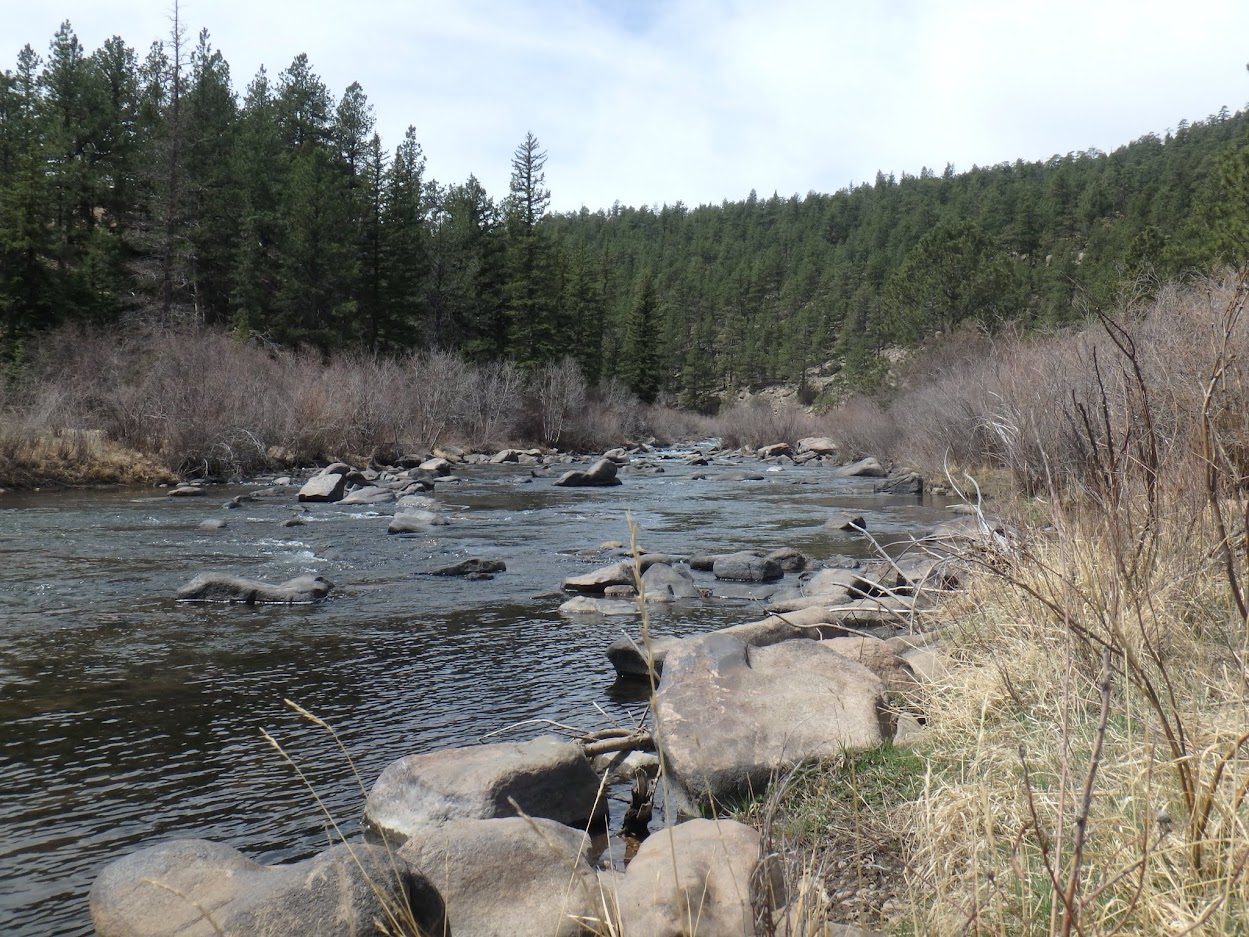
The flows on the South Platte River in Eleven Mile Canyon hovered in the 75 cfs range, and I was eager to make another trip to one of my favorite Colorado fishing destinations. The weather forecast anticipated high temperatures in the upper seventies in Denver, and this translated to a pleasant day in Eleven Mile Canyon. Jane’s calendar was open, so she agreed to join me on the two plus hour drive. The only negative was a gradually expanding sore throat that was draining my energy.

Another Fishermen Below Me

We arrived at a parking space along the river at 11AM, and I quickly prepared for a day of fishing with my Sage four weight rod. I chose to begin my fishing adventure in the downstream portion of the canyon, since it was readily apparent that Friday was a popular day on the South Platte River for Colorado fly fishermen. In other words many pullouts were already occupied, and that condition would only worsen, as one proceeded toward the special regulation water and the dam. For several years now I harbored a contrarian belief that labeling a section of water special regulation actually attracts more crowds and improves the fishing in the water open to bait fishermen by reducing the pressure in the water open to all types of fishing. On Friday I planned to test my theory.

Friday in Eleven Mile Canyon did in fact prove to be a very pleasant day with temperatures climbing into the upper sixties. In addition the river tumbled along at 75 cfs, and it was extremely clear. The price for these nearly ideal conditions, of course, was the hordes of fishermen who were lured to the South Platte. While I busied myself preparing to fish, Jane embarked on a short hike to investigate the area upstream. Later in the afternoon she completed a bike ride to the dam and back, and she confirmed that heavy crowds were present in the special regulation section.

A Nice Start to My Day

I began my quest for trout with a yellow fat Albert, beadhead hares ear, and salvation nymph, and initially I covered some relatively shallow runs and riffles near the car. I spooked three of four fish before I climbed back up on the bank and circled around a slow moving pool. When I approached the river once again, I paused and observed quite a few fish in the pool, and I made some drifts with the dry/dropper combination to no avail.

Better Lighting

Next I moved to the top of the pool, where faster water spilled over some rocks and then curled around an exposed boulder. Here I could see additional medium sized trout holding in the deep trough below the drop off. My flies were being ignored, and I spotted a solitary rise, so I removed the salvation and replaced it with a RS2. This did the trick, and I landed a twelve inch brown trout just below the exposed boulder, and then in the faster water that sluiced between some rocks at the head of the pool, the fat Albert dipped, and I connected with a fine thirteen inch rainbow and managed to guide it into my net. This beauty also inhaled the RS2.

Focused

Jane returned from her hike at 12:15, so I returned to the car and grabbed my lunch bag, and then we sat on the grassy bank and munched our snacks. During lunch I spotted three fairly regular risers across from my perch on the grass, so after I retrieved my rod, I removed the dry/dropper set up and tied a size 20 CDC BWO to my line. I positioned myself downstream from the area of the three risers, and focused my attention on the lower fish first. This foray into dry fly fishing was futile, so I shifted my attention to the fish that rose fairly regularly next to an eddy along the far bank. This required some fairly long casts, but on the third effort, a bulge appeared on my fly, and I set the hook only to despair, when the tiny fly released after a momentary hook up.

I retreated to the bank along the road, and then I walked to the tail of the pool and crossed to the opposite bank. I planned to get above the sippers in the pool, so I could employ the downstream drift technique that served me well on a previous trip to Eleven Mile Canyon. The best I could accomplish with this ploy was a refusal by a trout right next to the bank on a twenty-five foot downstream drift. I finally surrendered to the educated fish in the slow pool, and I crossed again at the tail and advanced along the road to the point where I exited for lunch.

Vivid Spots

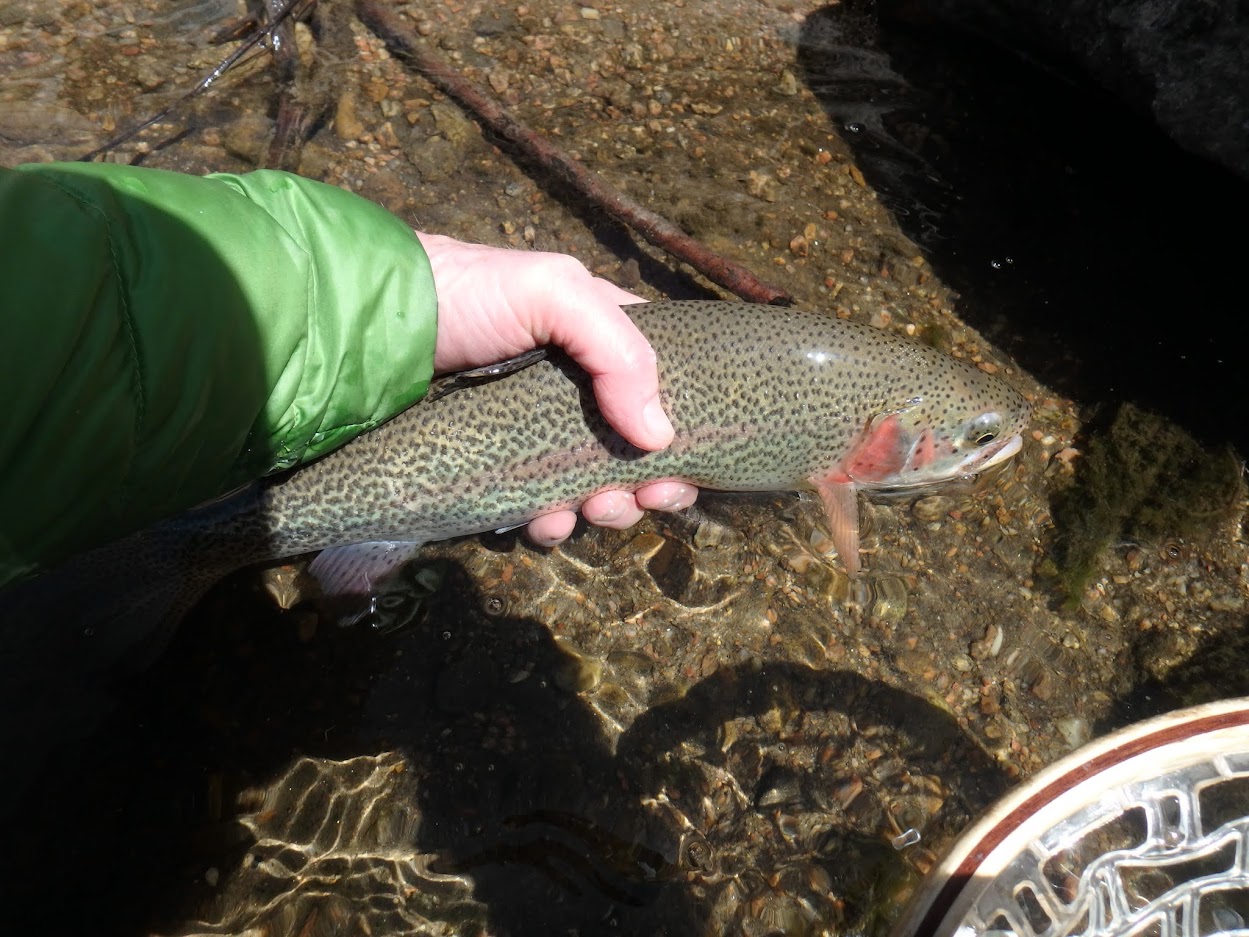
For the remainder of the afternoon I reverted to the three fly dry/dropper approach featuring the yellow fat Albert, beadhead hares ear nymph, and RS2. Toward the end of the day I exchanged the RS2 for a beadhead soft hackle emerger. The sky was mostly blue and sunny, but occasionally some large clouds blocked the sun’s warm rays, and this seemed to provoke a very sparse BWO emergence. I covered quite a bit of water in the afternoon, and I managed to add three additional brown trout to my fish count. Two browns were very nice wild fish in the thirteen inch range, and the last fish was a feisty ten incher. The nicest brown on the day snatched the hares ear as it tumbled through some riffles of moderate depth. In addition to the landed fish, I experienced temporary connections with three fish, but I snapped off two flies on one, and the others managed to shake free before I could bring them close to my net.

By three o’clock I lost my confidence and interest. Jane moved the car to a picnic area upstream from where we began, and I reached that point. I walked beyond the long smooth pool above the parking lot and prospected some faster moving glides and runs for another twenty minutes, and then I returned to the car and found Jane in her chair and ready to make the return trip.

So Pretty

I was feeling a bit under the weather, and that affected my energy level and consequently my approach. I dwelled too long in the smooth pool across from our lunch position, and this period resulted in zero catches. On the plus side it was a perfect spring day, the surroundings were gorgeous, the leaves were budding out on the trees, and I shared the canyon environment with my lovely wife. The five fish I landed were all energetic wild fish, and I was outdoors in Colorado. Life could not be much better.

Fish Landed: 5


Boulder Creek – 05/04/2017

Time: 10:30AM – 3:00PM

Location: Boulder Canyon

Boulder Creek 05/04/2017 Photo Album

After a couple days of cool weather and appointments I was anxious to return to my beloved pastime of fly fishing. The weather forecast for Thursday was promising, so I prepared for a trip to Boulder Creek in the canyon west of Boulder, CO. Originally I hoped to visit the Big Thompson River, but a review of flows on the DWR web site indicated an increase and some erratic movement on the chart, so I decided to avoid for a few days until things settled down.

I arrived at a pullout along Boulder Creek at 10AM on Thursday morning, and the weather forecast proved to be accurate, as the temperature climbed into the sixties and the sky was deep blue during my entire stay. The flows were at 52 cfs as advertised on the web site, and clarity was superb. Favorable conditions awaited my entry into Boulder Creek on May 4.

The Lane Next to the Foam Catches My Attention

I began my day with a size 8 Chernobyl ant, emerald caddis pupa and beadhead hares ear, as this combination performed well for me on the North Fork of the St. Vrain Creek on Monday. During the early going the nymphs were ignored, and the Chernobyl ant attracted mostly refusals with the exception of one small brown, that smashed the over sized foam ant imitation.

A Great Start

After a half hour of refusals and one landed fish, I experimented with a gray stimulator in an effort to downsize, but the change failed to elicit any reaction from the Boulder Creek trout. I pondered my next move and considered the fact that the fish were rising to the large Chernobyl but not eating. I deduced that they were looking for a smaller terrestrial, so I switched to a size 12 Jake’s gulp beetle.

A Fan of Nymphs

Voila! This produced, and I landed two additional small trout that gulped the beetle with confidence, before I stopped to eat lunch. After lunch another beetle chomper incremented the fish count by one, and then I spotted occasional blue winged olives hovering above the stream. This observation prodded me to switch back to a dry/dropper arrangement with  a smaller size 10 Chernobyl ant, beadhead hares ear, and RS2.

The fish counter moved from four to ten over the remainder of the afternoon, with one fish taking the RS2, and one nabbing the hares ear. Surprisingly the remainder of the afternoon catch crushed the Chernobyl. Several brown trout feeders in the early afternoon moved at least a foot downstream to catch up to the drifting foam terrestrial. I recognized this as a sure sign of an effective fly.

The Beetle Fooled the Brook Trout

At 2:30 I was frustrated by the increasing rate of refusals to the foam ant, so I reverted to Jake’s gulp beetle and ended the day with an eight inch brook trout. I probably should have switched to the beetle earlier, but it is always easy to look back. On Thursday I landed eleven fish, and all were browns except for the final brook trout, The largest fish was only ten inches, but it was a gorgeous spring day with the leaves beginning to break out on the trees in Boulder Canyon.

Fish Landed: 11

North Fork of the St. Vrain River – 05/01/2017

Time: 12:00PM – 4:00PM

Location: Below Buttonrock Reservoir

North Fork of the St. Vrain River 05/01/2017 Photo Album

The forecast of variable weather for Monday, May 1 convinced me that I needed to avoid the streams and catch up on other chores, while I awaited a warming trend on Thursday. As I watched a show on Sunday evening, I was surprised to receive a text message from my new fishing pal Doran. Doran inquired regarding my plans for fishing on Monday. This prompted me to check the weather and the flows on the local front range streams. A late spring snowstorm on Friday and Saturday caused me to be concerned over the impact of low level snow melt particularly in the foothills.

Much to my amazement the DWR graph for Bear Creek at Morrison showed a minor spike on Saturday, and then flows returned to 25 CFS. In addition the high temperature in Morrison was forecast to reach 62 degrees. Next I checked the North Fork of the St. Vrain and the Big Thompson. Both registered nearly ideal flows in the 50-55 range, and the trend was steady for the last five days. The high temperature for Estes Park, unfortunately was expected to reach only 45 degrees, but Lyons projected a high of 60. I texted back to Doran and informed him that I was interested in fishing Bear Creek or the North Fork of the St. Vrain, and after several additional exchanges, we settled on Bear Creek. I felt more confident about Bear Creek, since we visited the same stream a week prior.

Before I could finish gathering my fishing essentials for the morning; however, Doran delivered the news that he received an email reminder of a doctor’s appointment on Monday morning at 10:30. We could not concoct a plan to work around this obstacle to our fishing trip, so we reluctantly agreed to check in again in the future. I made a lunch and gathered most of my fishing gear before Doran canceled, so I decided to forge ahead with a day of fishing on my own.

Yummy Deep Run

On Monday morning I rechecked the flows on the St. Vrain, and they remained steady at 52 CFS, so I elected to make the trip to that destination. I viewed it as a scouting expedition to assess conditions for a possible future joint trip with Doran. I departed Denver by 10AM, and this enabled me to reach the parking lot below Buttonrock by 11:15, and after gearing up and assembling my Orvis Access four weight I was on the gravel road by 11:30. The temperature was in the mid fifties, and the sky was mostly clear with some large puffy white clouds, and the one concern was intermittent wind. After recent days on the South Platte River and Arkansas River battling ridiculous wind, this caused me some misgivings, but I trusted the accuracy of the weather reports and began my walk.

After a twenty minute hike at a brisk pace I reached a point where the creek passed under the road, and I chose this as my starting point. The stream was in a Goldilocks state, not too high and not too low, and clarity was excellent with just a small tinge of color. I moved to the south edge of the creek and tied a yellow fat Albert to my line and then added a beadhead hares ear and a salvation nymph. This was my first experience with a salvation nymph in 2017, and I wanted to test the effectiveness of the flashy subsurface offering.

I fished for forty-five minutes and managed to land one small brown trout that snatched the hares ear, but I was frustrated by several refusals to the fat Albert as well as three or four temporary connections. In a short amount of time I was faced with six opportunities and converted only one. I took solace in the fact that my flies were drawing considerable attention.

Happy to Be in Colorado

By 12:45 I could sense the hunger building in my stomach, so I sat down on a large rock and chowed down on my usual sandwich, yogurt cup and carrots. The setting was spectacular with a large vertical rock wall bordering the southern side of the creek just above me. After lunch I pulled my raincoat over my light down coat as a windbreak and continued my upstream progression. The salvation nymph was not producing, so I decided to exchange it for a RS2 in case baetis were active. The fat Albert continued to generate refusals, and this was distracting the fish from the subsurface offerings, so I decided to adjust my approach.

Glistening Brown Trout

I removed the dry/dropper arrangement and tied a solo yellow size 14 stimulator to my line. I prospected some very attractive locations with this fly, but it was totally ignored. Maybe a smaller terrestrial was the answer. I clipped off the stimulator and replaced it with a size 12 Jake’s gulp beetle. I might as well have been fishing with a pine cone. Again the fish informed me that they were not interested. I considered going deep with a strike indicator and split shot, but most of the water type was not appropriate for this approach. I finally decided to revert to the dry/dropper, but to utilize a different top fly. For this job I selected a size 8 Chernobyl ant, and below it I knotted the workhorse beadhead hares ear nymph and an emerald caddis pupa. Before I made this switch, the fish count rested on four; however, all the fish landed were small brown trout in the six to seven inch range.

Surprise Rainbow Mauled a Chernobyl Ant

The Chernobyl dry/dropper combination seemed to improve my fortunes. Over the remaining two hours I incremented the fish count from four to thirteen, and the mid afternoon catch included a couple trout that stretched the tape measure to eleven inches. Number ten was an eleven inch rainbow trout, and two aggressive stream residents pounced on the huge Chernobyl ant. The emerald caddis also accounted for two fish, and the remainder were attracted to the reliable hares ear nymph.

Hares Ear Produced

The sky clouded up during the last hour, but I never saw any evidence of a baetis hatch. The thick cloud cover dropped the air temperature, and by 4PM I reached the point where the road split, so I reeled up my flies and hooked them to the rod guide. A thirty minute hike returned me to the parking lot, and I quickly removed my waders and prepared for the return drive. The fish were small, but I enjoyed a fun afternoon on the North Fork of the St. Vrain in nearly ideal water conditions and tolerable weather. I did not plan to fish on Monday, so I viewed the day as bonus fishing in 2017.

Fish Landed: 13


Arkansas River – 04/25/2017

Time: 10:30AM – 2:30PM

Location: Fremont/Chafee County Line

Arkansas River 04/26/2017 Photo Album

A day of fishing is better than a day at work, but not all fishing days are created equal. The Arkansas River humbled me on Tuesday April 25. I surrendered in my annual search for the caddis hatch, and I am increasingly convinced that the caddis hatch is a myth manufactured by the fly shops in Canon City and Salida. Despite my recent repudiation of the relentless search for the dense caddis hatch, I recognize that the Arkansas River is a quality fishery, and it offers the opportunity to land some fish that are on average larger than many of the closer front range streams. In addition a fine blue winged olive hatch continues to provide solid action for anglers who make the visit, and for these reasons I decided to make the long drive to the Salida area.

The flows near Salida were in the 400 cfs range according to the DWR chart, and the fly shop reports indicated solid clarity. In all likelihood run off conditions will commence in a couple weeks, so I intended to prospect the water one last time. Most of my fly fishing equipment remained in the car from my Monday venture, and this enabled me to depart my house in Denver by 6:45. I knew the high temperature was expected to peak at 56 degrees in Salida, so I anticipated cool weather, but I did not plan to drive through snow and light slush during my time in South Park. I arrived at the pullout near the Chafee/Fremont County boundary at 10AM, and I pulled on my heavy Under Armour undershirt to combat the cool temperature. Unfortunately the four letter word of fly fishing announced its presence, and I battled stiff gusts of headwind during my entire time on the water.

Since it was a weekday, I assumed that the number of fishermen would be down compared to the weekend, but an Instagram contact warned me that crowds might be an issue. Unfortunately he was correct. The East Salida Campground was full, and quite a few of the roadside pullouts were occupied, as I traveled east to my planned destination. Two vehicles were present in my favorite parking area when I arrived, and one gentleman was in the process of preparing to fish. I walked to the edge of the bank and surveyed the river, and I did not see anyone, so I concluded that I could execute my normal crossing to the north bank and avoid the other fishermen.

This turned out to be a faulty assumption. After I pulled on my waders and put together my Sage One five weight, I descended the bank and crossed the wide river at the tail of a large pool. Crossing such a large river even at 400 cfs remains a scary proposition, but I took my time and assured myself that each step formed a solid base for the next shuffle. My heart was pounding when I reached the opposite shoreline, and then I elevated it some more, as I climbed the steep slope to the railroad bed. I was now in my own world as I strode down the rail bed and stepped on alternating ties. I was high above the river and unable to see the near side below me, until I approached the location where the river splits around a small island.

Here I paused to glance downstream, and I was shocked to see two fishermen above the island and two below, and as I shifted my gaze farther east, four additional anglers came into focus. What was going on? How did all these fishermen cross to my side of the river? All my favorite spots were occupied, so I reversed my direction and hiked back along the top of the rim, until I was a good distance above the most upstream fisherman. I carefully descended the rocky bank and found a position next to a nice deep run. I decided it was too early for blue winged olives, so I tied a 20 incher to my line and then added an emerald caddis pupa. I flicked the strike indicator upstream with a backhand cast, and on the fifth drift I noticed a dip and lifted my rod tip. I was pleasantly surprised to feel the throb of a fighting fish, and after a short battle I netted a chunky thirteen inch brown trout with the 20 incher in its mouth.

First and Only Fish on Tuesday

What an auspicious beginning to my day on the river! I could endure the wind and competing fishermen, if additional similar outcomes were in my future. Unfortunately that was not going to be the case. During the morning I played hopscotch with two other fishermen, and as one of them passed me, he paused to chat. After exchanging information about our success or lack thereof, he asked how I crossed the river. I told him and pointed to my crossing point. He seemed surprised, so I inquired regarding how he arrived at his current position on the north side of the river. He informed me that his group parked at the Stockyard Bridge and hiked three miles along the railroad tracks with the intention of fishing back to the bridge. It was just my luck to choose the day of the hiking/fishing club excursion to fish on the north side of the Arkansas River.

Upstream from My Lunch Spot

I fished intensely for the next three hours and forty-five minutes and failed to land any additional fish. I churned through an iron sally, RS2, and BWO soft hackle emerger; but none of the flies created interest among the Arkansas River trout. The wind continued its maddening rush down the canyon, and I was quite pleased to be wearing my light down coat and my hat with ear flaps. After lunch I managed to create some space from the large group, but the fishing did not improve. For the last hour I remembered the quote, “Insanity is continuing to do the same thing while expecting different results”, so I removed the nymphing system and converted to a dry/dropper arrangement. While these flies were occupying my line, I temporarily hooked up on one fish, and witnessed an exciting refusal from a rainbow trout in front of a large submerged boulder.

During the last thirty minutes I abandoned the multiple fly arrangement and rested my hopes on a size 14 gray stimulator. This fly generated two refusals, and then I hooked a fish for a moment only to see it escape. I reeled up my line to inspect and discovered a pig tail indicative of a poorly tied knot. I replaced the lost stimulator with a medium olive version, and I managed another refusal before I shrugged and hooked my fly to the rod guide at 2:30.

A tailwind pushed me back to my crossing point, and once I reached the car, I changed into my street clothes and said goodbye to the wind, the waves of fishermen and the lock-jawed fish. It was a tough day on the Arkansas River, and I am not sure I will return until after run off. I suspect my next fly fishing adventure will seek out a tailwater that is sheltered from the wind. If anyone knows such a place, let me know.

Fish Landed: 1

Bear Creek – 04/24/2017

Time: 10:00AM – 2:00PM

Location: Cold Spring Gulch to Corwina Park and O’Fallon Park

Bear Creek 04/24/2017 Photo Album

I suspect it has been four or five years since I last visited Bear Creek. While undergoing physical therapy for my sprained MCL, I met a young physical therapy aid named Hayley. In the course of conversation I learned that she and her boyfriend Doran love fly fishing, and on my last visit she obtained my mobile number, so she could share it with Doran. Several days later I received a text message from the aforementioned Doran, and we agreed to meet on a local stream. Doran suggested Cold Spring Gulch on Bear Creek as our meeting place between 9 and 9:30 on Monday morning, and our text message exchange became a bona fide plan.

As I drove west on CO 74, I noticed a sign for Cold Spring Gulch, but a parking area was not obvious, so I continued on to Corwina Park, where I immediately texted Doran to let him know my whereabouts. Doran arrived at Corwina Park by 9:30 on Monday, and after I strung my Orvis Access four weight, we were on our way. The temperature was in the upper 50’s when we began, and the flows were a bit low at 20 CFS but very clear for late April.

We hiked downstream along the shoulder of CO 74 to the bend where Cold Spring Gulch entered Bear Creek, and then we descended a steep bank and crossed the creek below a cyclone fence with several very visible no trespassing signs. Doran occupied a gorgeous long deep pool, and I continued downstream to a point where a large rock wall jutted into the creek. I began with a yellow fat Albert and trailed a single beadhead hares ear, and I covered quite a bit of nice water before I returned to Doran, who was in the process of moving upstream beyond the private water. During this early period I landed one nine inch brown trout that grabbed the hares ear in a relatively shallow riffle.

An Early Catch on Bear Creek

The paths along the creek were well worn, so I suspected that the obvious prime spots were pressured over the weekend. Bear Creek in this area is public water and open to fishing with bait, lures and flies. When I reached the private property sign, I exited and used the main trail to circle around the fenced water until I crossed a bridge. After crossing the bridge I turned on to a fisherman path that led upstream from the bridge pool. Thirty yards above the bridge I found Doran, and we compared notes from our fishing so far.

Promising Water Ahead

Doran decided to try the dry/dropper method using a large foam top fly, and I presented him with one of my yellow fat Alberts. Over the remainder of the morning we alternated nice deep runs and riffles, and I picked up two more brown trout in the process. Doran also experienced some success, and he became a loyal fan of the fat Albert.

At noon we advanced to a point above the parking lot at Corwina Park, and we could see a fisherman ahead of us, so we exited and returned to our cars. I grabbed my lunch and snacked at a picnic table in the park, and then we drove farther west to O’Fallon Park. I wanted to introduce Doran to a new area. We crossed the bridge and parked in the parking lot on the other side of the creek, and then we hiked on the gravel path until we were above another fisherman and just below the bend run next to a streamside restaurant.

Yum. A Fat Albert Snack.

Doran positioned himself next to the deep run, and he experienced a refusal as his flies drifted next to some large exposed rocks. When he moved up to the prime section, I began casting to the area of the rise. I tossed the fat Albert to a narrow space where a side current curled back to the main flow, and I was shocked when a fish bolted to the surface and crushed the fat Albert. I was certain that the brown trout was the fish that snubbed Doran’s cast earlier, and I landed the greedy little guy and snapped a photo.

Doran Shows His Catch

Meanwhile Doran ran his dry/dropper between the faster current and a foam patch, and he observed a pause and landed a decent brown that snatched the beadhead hares ear. We were both thrilled with his success. We continued upstream until we reached the next bridge, and then we called it a day and returned to the parking lot.

I landed two additional average size Bear Creek browns during this time, and they both grabbed the hares ear. On Monday four of my netted fish favored the hares ear, one smashed the fat Albert, and one nipped a salad spinner. Doran was pleased with his results, and he vowed to tie hares ear nymphs and fat Alberts when he returned to his apartment. I could not have asked for higher praise from a fishing friend.

Fish Landed: 6

South Platte River – 04/19/2017

Time: 10:00AM – 3:30PM

Location: Eleven Mile Canyon

South Platte River 04/19/2017 Photo Album

Of course four letter words are common among fly fishermen particularly after losing a monster fish or after breaking off three flies on an overhanging tree branch. But another word that is relatively benign in common usage takes on the characteristics of the established four letter words in the broader English vernacular when applied to fly fishing. That word is wind, and wind was the overriding theme for our fly fishing adventure on Wednesday, April 19.

My friend Steve and I set out from Lone Tree at 7:30 on Wednesday morning with visions of a repeat of our successful trip the previous Thursday, when we fished from 12:30 until 4:00 to ravenously hungry trout on the South Platte River in Eleven Mile Canyon. High clouds blocked the sun and created conditions conducive to a sustained baetis hatch on that date, and Steve and I took advantage of the feeding frenzy.

We arrived at the parking lot at the first bridge below the dam at 9:30, and we were in our waders and on the river fishing by ten o’clock. After I lathered up with sunscreen, I attempted to open the driver’s side door, but the gale force wind made me lower my shoulder and push with exceptional force to combat the gusts. This was an ominous harbinger of what was in our future. After I pulled on my waders, I assembled my Sage four weight rod, and I wandered across the dirt road along with Steve to inspect the wide but relatively shallow pool that entertained us for most of the afternoon on April 13.

The area upstream from the bridge was empty, so Steve took his position next to the prime water fifteen yards above the bridge, and I migrated a bit farther upstream to a nice deep run that passed along some large rocks on the opposite bank. It was too early for dry flies, so I rigged with a strike indicator, split shot, beadhead hares ear, and RS2; and I executed a large number of drifts through the very attractive deep run. After half an hour of this futile activity my only accomplishment was to remove a decent amount of moss from the river rocks, as it accumulated on my bottom dredging nymphs.

I turned the corner and discovered a quartet of fishermen spread over the next forty yards, so I reversed my direction and crossed the road and surveyed the river below the bridge. Since I was rigged with a nymphing configuration, I decided to probe the nice deep runs immediately below the four culverts that carried the river beneath the bridge, but once again my efforts to land a fish were stymied. I saw fish hovering and moving from side to side in a manner that normally indicates feeding, so I concluded that they were grabbing small nymphs or emergers from the drift. I cycled through a soft hackle emerger and salad spinner with no impact on my lagging fish count. Pat Dorsey indicated on an Instagram post that he was having luck with stoneflies, so I replaced the salad spinner with a size 12 peacock stonefly imitation, and finally I witnessed a deep dive in my indicator. I set the hook and immediately felt the power of a fat streaking fish, but eventually I fell back into a demoralized state, when I netted the beautiful sixteen inch rainbow trout and discovered that it was hooked in one of the fins.

It was now 11AM, and my confidence reached a new low, as I pondered my next move. I decided to cross the bridge and fish the opposite side and then explore the stretch of water downstream to the next bend. The area was strangely vacant, so it was a good opportunity to take advantage. Just below the fast moving runs and riffle below the bridge there was a large round depression with a light sand bottom, and these conditions made it easy to spot five large trout, as they held in the current and intercepted subsurface food morsels. I executed some dead drifts and swings through the deep hole, but the fish maintained their feeding rhythm with no apparent recognition of my offerings. My frustration mounted, as I shifted my attention downstream to a nice long section of relatively smooth slow moving water of moderate depth.

The clock ticked toward 11:30, and I noticed several sporadic rises twelve to eighteen inches out from the high bank on the other side of the river. At least now I saw some targets to pursue, and this renewed my focus after halfheartedly lobbing nymphs for the first 1.5 hours. I removed the nymphing paraphernalia and tied a size 18 CDC BWO to my line. During this entire morning period the wind continued to gust in an unrelenting manner, and as I evaluated the challenge ahead of me, it once again announced its strong presence. In order to tempt the bank feeders I needed to launch a relatively long cast across the current to within a foot of the bank, and then allow the tiny barely visible fly to drift downstream without drag, until it passed over the uppermost feeder. While doing this I needed to combat the strong wind that was rushing directly downstream.

For the next fifteen minutes I endeavored to conquer the difficult challenge, but I must report that I was not equal to the task. Reach casts and mends were thwarted by the blasts of chilly air. I may have completed one or two decent drifts over the sporadic feeders, but they were not fooled by my efforts. In a fit of frustration and despair I reeled up my line and returned to the car at 11:45. Along the way I checked in with Steve, and he reported landing three nice fish, two on a RS2 and one on a prince nymph. He was not ready for lunch, so I returned to the car and sought shelter from the ever present wind.  At least I now knew that catching South Platte fish on a blustery day was possible.

After lunch I pulled my raincoat over my light down coat to serve as a windbreaker. I considered resuming my position on the opposite side of the river from Steve similar to the previous Thursday afternoon, but when I stood on the bridge, I learned that a pair of fishermen were below Steve and another was pinching him from above. I surrendered the idea of fishing above the bridge and circled back to the car to consider other options. I remembered the bank feeders and decided to approach them from the high bank on the same side of the river as the parking lot. I made a short walk on a worn trail and then slid down a dirt path to the water. The bank feeders were no longer active, but as I gazed upstream I spotted a nice feeding fish in shallow water next to the point of an exposed rock anchored to the bank. As I watched the trout, it casually rose and sipped tiny morsels as they drifted overhead.

I was fearful that I would line the fish if I cast directly over it, so I sprayed some casts to other visible fish farther out in the river, but they were hovering beneath the surface and focused on emergers or nymphs in the underwater drift. As this was transpiring, Steve relinquished his pool to the upstream invaders, and he returned to the car to grab a quick lunch. I returned to the parking area to unlock the Santa Fe.  After lunch Steve pulled on a raincoat as a windbreaker, and then he crossed the bridge and approached the river from the opposite side. I was now upstream of the regular sipper, so I decided to attempt some downstream drifts. I persisted at this approach for twenty minutes, but the wily feeder avoided my fraud and continued to sip naturals in a carefree manner. This entire episode served to heighten my frustration, and I finally turned my attention to other large fish present in the area below the bridge. The distinct possibility of a skunking flooded my thoughts.
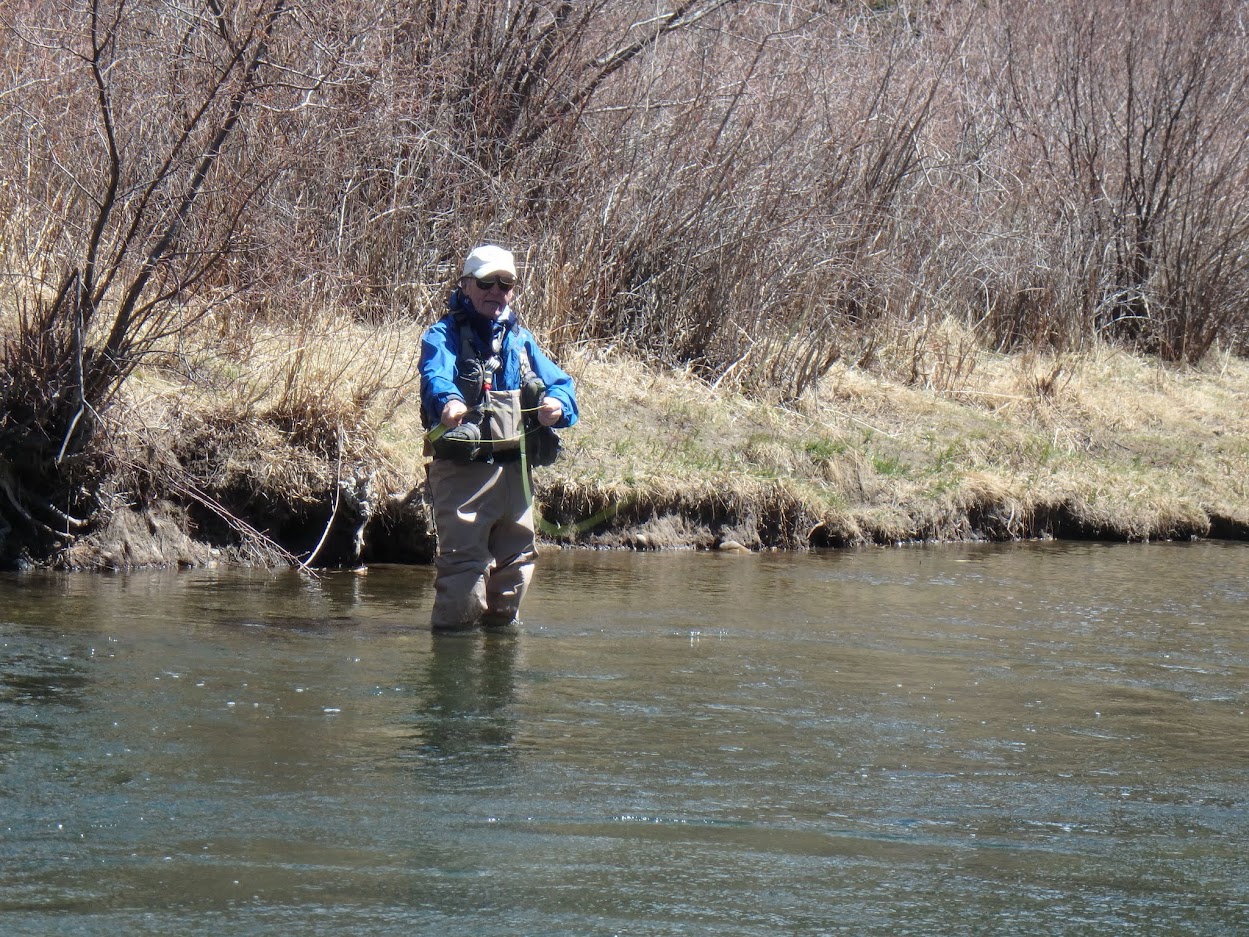
A Roll Cast to Avoid the Brush

As I pivoted toward the center of the river, I once again spied the large trout hovering over the large round sand bottom depression. Perhaps they were more open to a surface fly now that the baetis emergence appeared to be in a more advanced state. I cast across and above these fish numerous times and attempted to offset wind drag with exaggerated mends and upstream reaches, but I never observed the slightest evidence that the fish looked at my surface fly. I checked off another blunted strategy and turned my attention once again to the twenty foot section of run and riffle directly below the bridge.

Number One in the Net

As I paused to consider my approach, a brown trout rose and created a popping sound in the slow shelf pool no more that five feet above me. I watched it return to its feeding position, and then I dropped a cast upstream. The fly drifted no more than six inches, and the targeted brown trout bolted to the surface and inhaled the size 20 CDC BWO. What a thrill to suddenly tempt a trout with my dry fly! I lifted the rod tip and felt a deep bend, as I was connected to a healthy fourteen inch brown. I registered my first fish of the day and unleashed some trash talk to the scoffing wind, as it taunted me to overcome its adversity again.
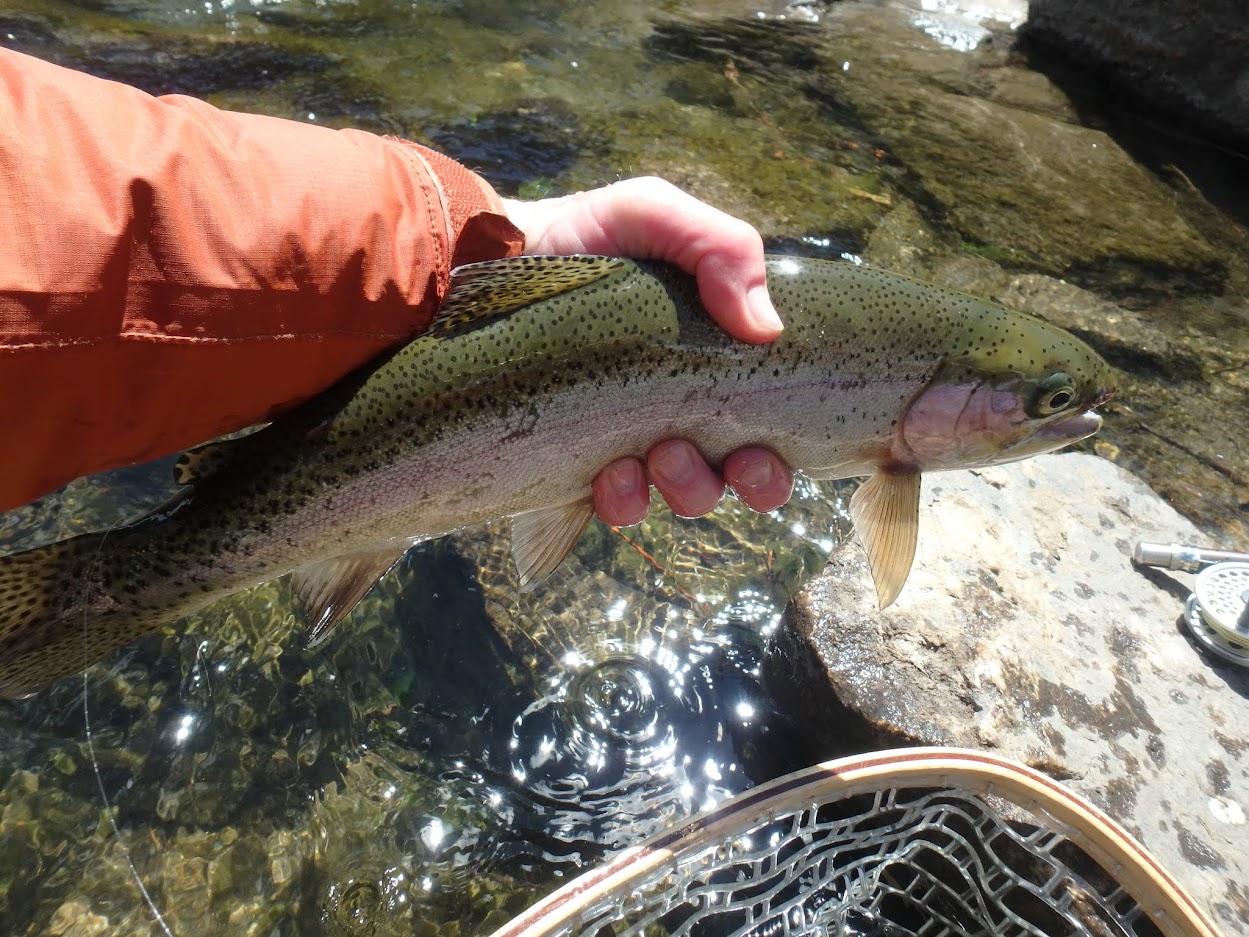
Just a Beauty

After releasing the prize first catch, I paused and once again surveyed the run. I thought I saw a dark shadow along the fast current seam fifteen feet above me, so I overpowered some forward casts to combat the head wind, and on the third such effort, the fly landed and was immediately engulfed by a fish. Was this a dream? This fish launched from the river and revealed itself to be a corpulent rainbow trout, and it executed the characteristic rapid runs and streaks that one would expect from the rainbow species. I expertly played the agile fish from my reel and allowed it to strip line several times, until I was able to lift its nose over the lip of my net. The fat sixteen inch rainbow was the best fish of the day, and I was very pleased.

Once again I released the fish and returned my attention to the the bridge riffle. I remembered spooking a fish from the shallow water next to the bank on April 13, so I scanned that area. Sure enough there was a decent rainbow facing downtream, but it seemed to be in a comatose state and not an active feeder. The shallow area bordered a small tight eddy, and a slight movement caught my attention. I focused my eyes on the swirling water, and as I stared another fish materialized. In fact as I peered attentively at the eddy, a second brown emerged from the green and brown rocky stream bed. Both were brown trout, and each darted to the surface and snatched food as I looked on. The riseform on the surface was extremely subtle and easily overlooked if not for the subsurface movement.
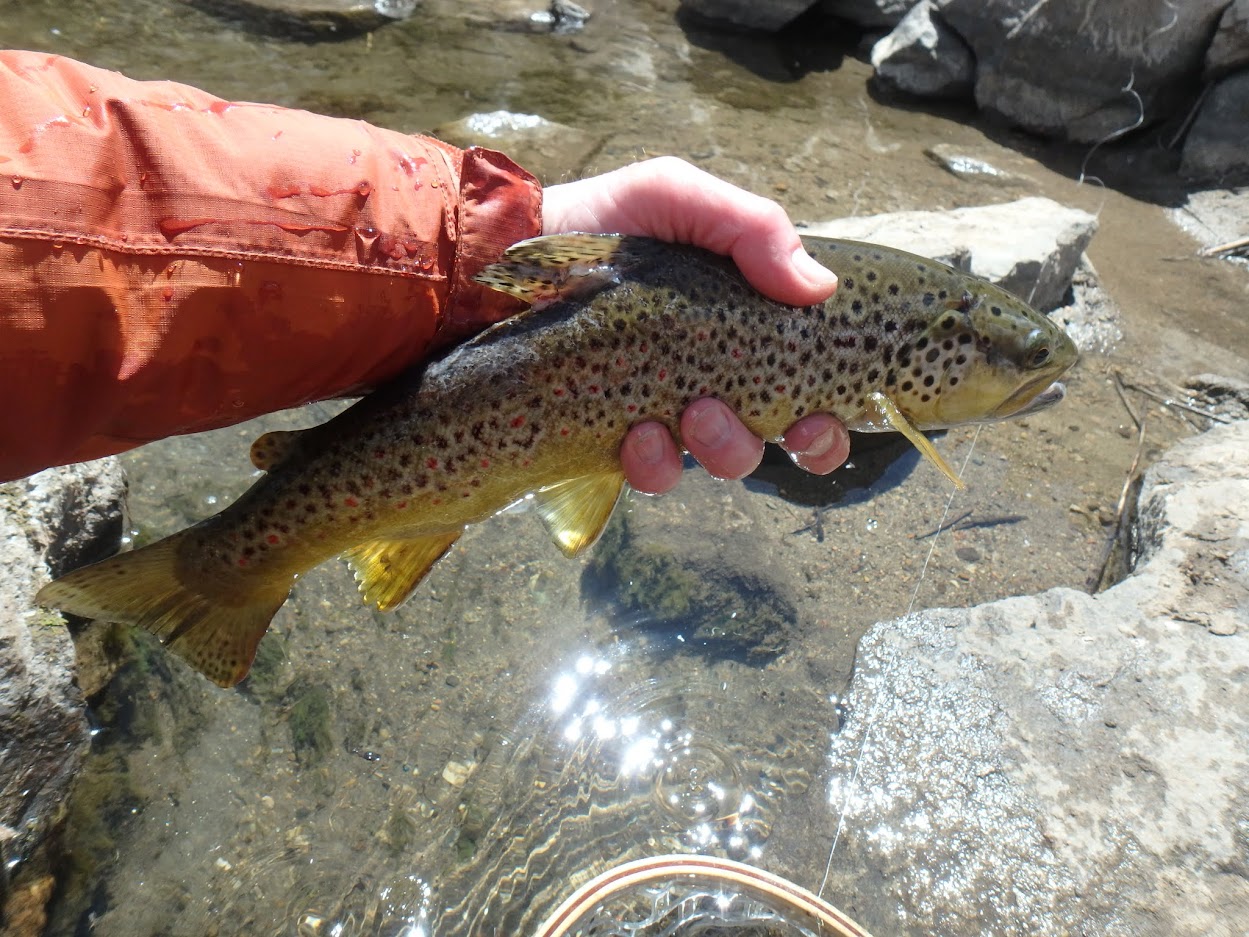
Number Three

I was now prepared, so I began dropping short casts to the eddy. The swirl and sucking action prevented me from following my fly for more than a few seconds, but on the fifth cast I noticed that the larger of the two fish elevated and shifted slightly to the left, so I lifted my rod in case my fly was the object of the brown trout’s affection. It was. My rod tip throbbed, and the brown slab thrashed, and then after a minute or two of battling I elevated the fish and slid my net beneath its broad body. What a thrill to catch a third above average size trout on the South Platte River in spite of the wind tunnel that surrounded me!

Unfortunately the remainder of the day was not very rewarding. The fishermen above the bridge abandoned our sweet spot, so we returned to our favorite haunt from the previous week. I resumed my position on the opposite side of the river next to the lane that leads to the campground. I repeated my strategy from April 13 with dapping downstream casts at the top of the riffles and long downstream drifts with stack mends through the midsection and lower area. None of my ploys produced. Steve had some sporadic success with an emerger dropper, so I converted to a dry/dropper set up with a fat Albert and RS2 and soft hackle emerger, but this tactic met with zero success. Unlike April 13 I never observed steady risers, but only sporadic random surface feeding, and this probably explains my inability to repeat success with downstream dry fly drifts. The wind was sweeping the tiny BWO’s from the surface before fish could react, so they compensated by nabbing rising emergers below the surface.

By 3:30 we were both chilled to the bone and beaten down by the nagging windstorm. Our arms dangled limply from our sides after forcing repeated casts into the unrelenting headwind. We agreed to quit so we could begin the long return trip. It was a tough day on the South Platte River in Eleven Mile Canyon, but I managed to land three gorgeous trout in the fourteen to sixteen inch range. Although the fish count was low, I remain quite proud of my ability to overcome the adversity of the four letter word, wind. I landed three quality fish, and for that I am very thankful.

Fish Landed: 3
South Boulder Creek – 04/18/2017

Time: 12:30PM – 3:30PM

Location: Below Gross Reservoir

South Boulder Creek 04/18/2017 Photo Album

Although I fished all day on Monday and made plans for another full day on Wednesday, I could not resist a short local trip in light of the gorgeous spring weather. I checked the flows on the front range streams, and South Boulder Creek stood out as a nearby option with flows at 43 CFS. This level represented an increase from 35 CFS, but I did not view that increment to be a negative. In fact the low early season flows made fishing somewhat challenging during my last visit to the small tailwater below Gross Reservoir.

The air temperature was sixty degrees, when I pulled into the kayak parking lot, and by the time I ascended the steep trail at 3:30PM, the mercury increased to the upper sixties. Since it was noon when I arrived, I chomped my lunch in the car before I prepared to fish. Two vehicles arrived before me, and another joined the parking lot while I assembled my Orvis Access four weight.  I slid into my waders and then descended the steep trail to the creek and then hiked for twenty-five minutes, until I was a half mile below the pedestrian bridge that is part of the Walker Loop. The stream in this section tumbles through high canyon walls comprised of large jumbles of boulders. Normally I hike past this area, but I decided to give it a try on Tuesday, since my late start was not suited for a long hike.

After I scrambled down a boulder field, I tied a size 14 gray stimulator to my line, and I began to prospect upstream through some inviting deep pools. After fifteen minutes of unproductive casting, I experienced a refusal at the lip of a gorgeous deep pool. I was pleased to note a response to my single dry fly, but the snub was not what I hoped for. I decided to downsize, and I added a size 16 gray deer hair caddis on a dropper twelve inches behind the stimulator. The smaller trailing fly also generated a refusal, and I eventually tipped my hat to the discerning trout and moved on.

A long lull commenced where I failed to generate even a look or refusal, so I eventually converted to a dry/dropper approach. I knotted a size 10 Chernobyl ant to my 5X tippet, and then I added a beadhead hares ear. Another lengthy period of inaction ensued, until I finally hooked and landed a small rainbow trout that barely extended beyond my six inch minimum requirement. I was not very proud of my catch, but at least it preventing a skunking.

Just a Jewel

As the lack of action unfolded; I spotted some small midges, an occasional small mayfly, and some diminutive stoneflies. Given the presence of small insects I decided to react by adding a size 20 salad spinner below the beadhead hares ear. This change proved to be the salvation of my day on Tuesday, as the salad spinner accounted for three additional trout, before I retired at 3 o’clock. The second was a very pretty ten inch rainbow with perfect black speckles. The third was another tiny rainbow with an array of vivid colors, and the last netted fish was the prize of the day.

Pretty Speckles

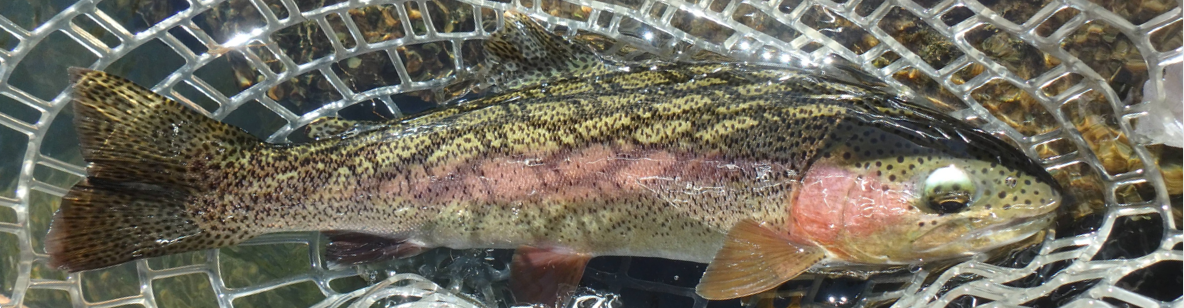
I was twenty yards below the pedestrian bridge, and I tossed my flies to the top of a current seam adjoining a nice long run. Just as the Chernobyl approached a log at the downstream border of the pool, I raised the rod tip to avoid entanglement, and this action prompted a feisty rainbow to attack the salad spinner. I slid the thirteen inch jewel into my net and marveled at the wide scarlet stripe that adorned both sides of the fish. This fish vindicated my three hour visit to South Boulder creek, and I was elated by the late surprise.

I continued upstream beyond the bridge a bit, but I was tired and weary of climbing over rocks with minimal reward for my efforts. I reeled up my flies and hooked them to the bottom guide and made the long trek back to the parking lot. Four fish in three hours was a bit sub par, but I only invested a one hour drive, and I enjoyed a beautiful spring afternoon, so it was a positive experience. The brightly colored rainbow was icing on the cake.

Fish Landed: 4

South Platte River – 04/17/2017

Time: 10:00AM – 4:00PM

Location: Eleven Mile Canyon

South Platte River 04/17/2017 Photo Album

It was a beautiful day with the high temperature in the sixties and overcast skies for much of the day, although gusts of wind were a significant negative. The flows were up a bit at 90 cfs compared to my two previous trips to the South Platte, but the river remained nearly perfect for late April. I departed Denver at 7AM, and this enabled me to reach a parking space along the South Platte River by 9:30, and I was in the river fishing by 10AM.

My Starting Point Along the Dirt Road

I walked down the road and entered at a point that was farther downstream than I ever previously fished in this segment of the Eleven Mile Canyon area. I began fishing with a yellow fat Albert and trailed a beadhead hares ear nymph and an ultra zug bug, but I switched out the ultra zug bug for a mercury black beauty after twenty minutes with no action. In the early going I experienced a refusal to the yellow fat Albert and two momentary hookups, and I suspected the temporary connections were a function of the tiny size 22 midge larva.

Zoomed a Bit Closer

Between 10:00 and 11:30 I covered a significant amount of water and managed to land five trout, four browns and one rainbow. All the morning fish were in the twelve inch size range, and I was pleased with the steady action. Halfway through the morning I swapped the mercury black beauty for a salad spinner, and the move paid off, when a brown and rainbow snatched the small midge imitation in a deep narrow slot, just before I returned to the car for lunch.

More Rocks Equals More Pockets

After lunch I endured thirty minutes without any action, and I spotted a couple blue winged olives, so I removed the salad spinner and replaced it with a soft hackle emerger. Unfortunately the BWO emerger was not what the fish desired, so I reverted to the salad spinner, and that change rewarded me with some great action, as the fish count increased from five to eleven. I estimate that five of the eleven landed fish consumed the salad spinner, and the others crushed the beadhead hares ear nymph.

Macro

One again I endured a lull, as I moved through several attractive pockets, so I snipped off the salad spinner and replaced it with a beadhead pheasant tail. The size 18 pheasant tail produced one nice brown trout from a deep seam, but for some reason the fat Albert suddenly became a more desired commodity. During the afternoon time frame four trout crushed the fat Albert, and all seemed to materialize from slow moving slack water along the bank. The hares ear continued to provide steady production, and between 2:30 and 4 the sky clouded up, and I noticed a few more small BWO’s in the air. During this overcast period I exchanged the pheasant tail for a size 22 RS2, and three brown trout attacked the small baetis nymph imitation, as it began to lift and swing at the end of long drifts.

Yummy Deep Run Ahead

By 4PM I was quite weary, so I decided to call it a day. I landed twenty-three trout in 5.5 hours of fishing. The largest trout measured twelve inches, and only two of my catches were rainbows. Despite the relatively small size of the South Platte trout, I enjoyed the day, as I covered a large amount of stream mileage, and I moved quickly from pocket to pocket. The hares ear was my most productive fly; but the fat Albert, salad spinner and RS2 also earned their time on my line. After a couple hours on the river I learned that the most productive locations were long pockets and runs through moderate riffles. The fish seemed to relish places, where they could spread out in water with moderate depth and moderate current velocity. Large deep holes and slow moving pools did not produce, and I learned to skip over these sections of the river.

Fish Landed: 23

Clear Creek – 04/14/2017

Time: 12:00PM – 2:00PM

Location: Upstream of Tunnel 3 in Clear Creek Canyon

Clear Creek 04/14/2017 Photo Album

Friday was a testament to my belief that 80% of fishing success derives from choosing promising destinations. I normally review the stream flows and fly shop fishing reports before I settle on a location, and I followed that path on Friday. After two days on the South Platte River in Eleven Mile Canyon on Tuesday and Thursday, I constrained my choices to local options. South Boulder Creek, the North Fork of the St. Vrain, and the Big Thompson represented strong choices, but I favored Clear Creek, since it required the shortest drive. For this reason I overlooked the spike in flows from 40 to 55 cfs within the past twenty-four hours. I focused on the absolute value of 55, as that is a fairly ideal level, and I made the mistake of discounting the recent change.

I arrived at the pullout along US 6 by 11:45AM, and after a quick bite to eat I eased into my waders and rigged my Orvis Access four weight rod. The creek was relatively murky, but I was encouraged by the decent visibility along the bank, where rocks and gravel on the stream bed were easily discernible. The air temperature on the other hand was quite pleasant, as the reading hovered near the seventy degree mark.

I began my quest for Clear Creek trout with a size 8 Chernobyl ant and a beadhead hares ear nymph, and I embarked on my usual process of prospecting the deep pockets and runs along the right bank. For the next hour I covered quite a bit of the creek with only a refusal to the Chernobyl and then another snub to a size 12 olive stimulator. In fact these were the only fish I observed during the first hour, and this is quite unusual, since I normally spot small brown trout tucked among the rocks along the edge of the stream.

I Managed a Temporary Hookup in the Foam

I considered quitting, but I decided to give the day one more solid effort, so I swapped the stimulator for a yellow fat Albert and retained the beadhead hares ear and then added an ultra zug bug. This lineup provided more depth in case my nymph was riding over the fish in the water column. The change did not seem to impact my fly fishing fortunes, until finally a small brown trout emerged from the tinted flow and nipped the size 8 fat Albert. I responded with a soft hook set and just as I lifted the nine inch brown from the water, it flipped and slid off the hook. This action accounted for my only catch on the day, and I never enjoyed the satisfaction of seeing it nestled in my net.

Typical Water

The sudden attention given to the fat Albert allowed my optimism to surge, and I refocused my efforts for the remaining thirty minutes, but once again I fell into casting practice mode. At two o’clock I advanced to a state of total boredom and decided to cut my losses and return home. I theorized that the spike in flows resulted from the warm temperatures and a surge in run off, and the fish did not have an opportunity to adjust to the new conditions. After two days of spectacular dry fly fishing on the South Platte River I was too stubborn to resort to fishing nymphs in Clear Creek with a strike indicator, and I chose to save my valuable fishing time for a destination more conducive to my preferred approach.

Fish Landed: 1

South Platte River – 04/13/2017

Time: 10:30AM – 3:30PM

Location: Eleven Mile Canyon

South Platte River 04/13/2017 Photo Album

Based on my many years of fly fishing, I can attest to the fact that history rarely repeats itself, but Thursday was mostly an exception to that rule. I made plans to return to the South Platte River in Eleven Mile Canyon on April 13 with my North Platte River fishing companion Steve. We met at 8AM at his home in Lone Tree, and after a two hour and fifteen minute drive to the tailwater below Eleven Mile Dam, we arrived at a small parking lot next to the river.

One major deviation from my experience on Tuesday aside from a different fishing buddy, was our location, since we drove the length of the canyon, until we were two hundred yards below the dam. As was the case on Tuesday the flows remained at 80 CFS; however, the sky was clear blue for the entire day, and the high temperature peaked in the upper sixties.

Starting Point Below the Bridge

I assembled my Sage four weight and then ambled to the bank just downstream of the bridge, while Steve chose to explore the river on the upstream side. I hesitate to call the structure a bridge, since it was an earthen embankment with four large culverts carrying the cold volume of water under the road. The upper river where we fished on Thursday was wider and shallower than the stretch that Trevor and I covered on Tuesday. Before I chose my approach, I paused and observed the deep run and pool in front of me. Immediately I spotted five or six fish in the two depressions downstream from the riffle and run, where the river poured through the pipes.

The low clear water dictated that I avoid a strike indicator and split shot, and I also concluded that the plunk of my revered size 8 fat Albert would create too much disturbance. I pulled a size 12 olive stimulator from my fly box and knotted it to my line along with a size 20 soft hackle emerger and a mercury black beauty. I sprayed casts over the depression near my position and then covered another one directly across, but the large trout continued to hug the stream bed, as they were unimpressed with my three fly offering. I exchanged the black beauty for a size 20 RS2, but that failed to reverse my fortunes.

After twenty minutes of futile casting I advanced to the nice deep runs just below the bridge. The water was faster in this area, and I could observe some decent fish hovering in the depths next to the heavier current. I executed an abundant quantity of drifts over the elusive trout before me, but once again the fish treated my flies like inert flotsam. How could I interest these fish in my offerings? I conjectured that my flies were not getting deep enough given the position of the trout on the stream bottom, so I swapped the RS2 for a heavier beadhead hares ear nymph. My minor attempt at change was also soundly rejected. During this entire episode I witnessed only one or two surface rises, and I concluded that any potential baetis hatch was not yet in progress. I was puzzled however by the lack of interest in my blue winged olive nymph imitations, since they generally provide some action in the hours before an emergence.

I glanced at my watch and noted it was 11:30, so I decided to check out Steve’s results on the west side of the bridge. He reported that he landed one nice brown trout on a blue winged olive emerger. The water on the upstream side of the bridge was slower, and a series of quasi rock dams created some deeper troughs in the middle. Steve was positioned below the widest concentration of rock structures, and once again I could see an abundance of nice fish spread throughout the area. As I observed and chatted with Steve, several active fish slowly rose to the surface and sipped a tiny morsel of food from the film. Several fishermen were above Steve, and we were unwilling to abandon his location, so we decided to eat lunch in shifts. I took the first time slot and returned to the car and ate my lunch quickly, while I sat next to the river where I fished during the morning.

Another Fisherman in Some Nice Water Above Us

When I returned, I noticed another fishermen between Steve and the bridge, so I claimed the position vacated by Steve, and he retreated to the car to grab a quick bite. During Steve’s absence I removed the three fly dry/dropper arrangement and tied a size 18 CDC blue winged olive to my line. Based on my experience on Tuesday I tied five new size 18’s and three new 20’s in anticipation of the Thursday return to Eleven Mile Canyon, and one of the 18’s found a home on my line. I began making reach casts across the current lanes, and then allowed the flies to drift downstream. These drifts floated my fly over numerous prospects, but the only response was a pair of refusals by a small brown trout eight feet below me.

Steve returned quickly, and I allowed him to reclaim his spot. I actually preferred fishing from the opposite side, where I could employ long downstream drifts similar to my approach on Tuesday, so I announced my intention to Steve and then crossed the bridge and walked along the dirt road that led to a campground. The northwest side of the river would become my home for the remaining 2.5 hours of fishing on April 13. From my vantage point at the top of the riffles I could see an abundant quantity of sizable fish spread throughout the deep riffles, the downstream pool, and the smooth flats next to the bank.

In the Water

Pleased With This Catch

The hatch intensified a bit by 12:30, but it never achieved the intensity of Tuesday, nor did it last as long. The clear blue sky, warmer temperatures and intermittent wind probably explain the inferior baetis hatch, but there was enough mayfly activity to interest the residents of the South Platte River. The fly fishing was more challenging than Tuesday, but I managed to land ten fish over the course of the afternoon. All the netted fish responded to my newly tied CDC BWO, as seven sipped the size 18, and the last three fell for the size 20. More impressive than the number of fish was the size and variety. My net felt the weight of two trout in the fifteen inch range with most of the remainder occupying the 12 – 14 inch slot. I was quite pleased to land two absolutely magnificent cutthroat trout that displayed a deep copper-gold body color and vivid fine spots. A fourteen inch cutbow exhibited the stripe of a rainbow and the prototypical slash of a cutthroat. Three rainbows were among my fish count, and four brown trout rounded out the day. One of the rainbows and a cutthroat stretched the measuring tape to fifteen inches.

Amazing Colors

All my landed fish responded to a downstream presentation. I stood at the very top of the riffles above the cluster of large rocks, and I made casts directly downstream. I checked my cast high and allowed a substantial amount of slack fly line to pile in the current, and then I executed stack mends and wiggled my rod tip to allow a long drift. I recall several cases where a fish bulged and inhaled my fly fifty to seventy feet below me. Needless to say the surge of excitement that resulted from landing sizable fish on dry flies presented with long downstream drifts was exhilarating.

Stretched Out

Meanwhile nearly all of Steve’s success resulted from upstream casts to the faster water with a three fly set up that included two dries and an emerger. All of Steve’s landed fish crushed the emerger, and this made me puzzle over this circumstance. Perhaps the fish in the fast runs and riffles were keyed on emergers, while the fish in the slower areas spread out and sipped duns? I vowed to test this theory in a future visit.

A Better Grip

In summary it was another banner dry fly day on the South Platte River. I landed ten gorgeous cold water fish, and all sipped a CDC BWO that was presented on a downstream drift. The day was not total perfection, as I experienced a large number of surface refusals and underwater snubs, and my arm ached from the huge quantity of casts, but the superior size and variety of fish made the trip worthwhile. Prime time in Colorado is commencing.

Fish Landed: 10