Road Trip to Arizona Day 2 – 03/16/2016

Road Trip to Arizona Day 2 03/16/2016 Photo Album

Wednesday was devoted to spending time with our son, Dan. Jane and I awoke early and took advantage of the breakfast provided at the Holiday Inn Express in Montrose. Dan’s flight was due to arrive at 11:30, so we had some time to kill. Initially I identified some short drives and hikes in the surrounding hills, and we were about to embark on one of these trips to nearby vistas. The guide book that I picked up in the hotel lobby suggested these destinations for viewing the gorgeous sunsets that are apparently prevalent in the area.

Before we left the parking lot, however, I glanced at the map and spotted a nearby park that bordered the Umcompahgre River. The area was named Baldridge Park, and Jane and I both agreed that we preferred hiking nearby. Of course I leaped at the opportunity to scout a river for possible future fly fishing trips.

Inviting Fishing Water

We hiked the trail that followed the river for a half hour and then returned to the Santa Fe. The park was very nice with soccer fields, baseball fields, picnic areas, a roller blade rink, and exercise stations. There was even a water park with man-made stream improvement structures to create interest for kayakers. The same structural features probably enhanced the fish habitat, but I did not spot any fish during my cursory survey of the stream. A light dusting of snow from the previous evening left its mark, and several shaded spots along the trail retained patches of remnant snow cover. On our return trip we passed some ponds, and a small cluster of large birds hovered along the edge of the water. Eventually we heard the telltale squawk of sand hill cranes. The crane call reminds me of a hoarse turkey gobble, and it also prods me to recollect our camping trip among the sand hill cranes at Steamboat Lake last June.

After our Baldridge Park hike we continued our journey and found the nearby Montrose Airport. Unlike large urban airports, this one was small and provided free close by parking. When we entered the foyer, we discovered that we were at the gates, baggage claim and restaurant; as the small building made everything conveniently located near the entrance. The main generator of air traffic through Montrose is apparently Telluride Ski Area, as a fleet of shuttle vans were stationed just outside the entrance.

The Box Canyon at the End of Colorado Avenue

Eventually Dan appeared off to the side of the baggage claim area, and we quickly collected his luggage and departed for lunch. Dan consulted his phone and chose a small Mediterranean bistro along Main Street and slightly south of Townsend Avenue. We enjoyed some gyros, and then returned to the car for the 1.5 hour trip to Telluride. We were not sure whether Dan’s lodging for the week was in the town or on the other side of the ridge at the ski area base, but we decided to explore town a bit as our first stop. We found a parking space along Aspen Street and then strolled along Colorado Avenue; the main thoroughfare in the old mining town. As we were doing this, we checked out restaurants for dinner possibilities.

On the return along Colorado Avenue we gazed down a side street and spotted the loading station for the gondola, so we approached and noticed a sign that stated that the ride was free. It was not dinner time, so we leaped at the opportunity to enjoy a free gondola ride. The aerial transportation car carried us high above the town and over the next ridge until we eventually off loaded at a large developed base complex that included bars and restaurants and condominiums. We paused here for some photos and then reloaded for the return trip. Quite a few skiers were also gathered for the ride back to Telluride, as the clock advanced to 4PM.

Birthday Boy Having Fun

Once we reached the gondola base, we resumed our walk, but this time we followed Pacific Avenue which was closer to the boundary with the ski area. Dan had the address of the lodging, and by now we determined that it was in Telluride and not at the ski area base. After a fifteen minute stroll we approached the sought after address, and once Dan placed a call to his friend Adam, voices and faces appeared on the second floor balcony. We turned the corner and found the entrance and climbed the stairs to the destination condo unit. Five of Dan’s friends were already present, and Adam offered beers while we received a tour of the unit. The number of skiers exceeded the capacity of the condo unit we were in, so Adam led us up the street to a second accommodation that he rented for the same period of time. This unit had a better picture window view of the mountain, so we remained here and drank our beers while chatting for thirty minutes.

Once we finished our beers, our appetites took control, so we bid our farewells and returned to east Colorado Avenue to a Mexican restaurant that we flagged on our initial walk. The restaurant was named La Cocina De Luz, and it proved to be a delectable find. We inhaled the chips and salsa and then consumed our favorite entrees before declining dessert, since we stretched our bellies to their limit. I ordered my favorite Mexican dish, tamales, and I was not disappointed.

After dinner we dropped Dan off at his condominium, and then Jane and I proceeded on a two hour drive to Cortez, CO, where we found the Hampton Inn and the room that we reserved for the night. A half day with Dan was a great bonus to our nine day road trip to Arizona.

Road Trip to Arizona Day One – 03/15/2016

Road Trip to Arizona Day One 03/15/2016 Photo Album

Jane and I were anxious to undertake a road trip to Arizona in the spring of 2016. In 2011 Jane presented me with a spring training trip as a birthday gift, but at the time she was employed by a bank in Denver and unable to get off work, so my son Dan accompanied me on a long weekend escape to Phoenix where we attended two spring training games involving the Colorado Rockies. The Sunday game took place at Salt River Fields at Talking Stick, and Dan and I obtained a look at the brand new complex that was shared by the Rockies and Diamondbacks located just north of Scottsdale. The weekend was a blast, and Jane was jealous of our getaway.

I was feeling sufficiently recovered from my January 27 surgery, so we made the last minute decision to embark on a mid-March road trip to the sunny climes of Arizona. As it turned out, our son Dan scheduled a ski trip to Colorado from March 16 – March 20. He planned to fly into Montrose, CO and then travel south to Telluride. Interestingly his airfare was less expensive to fly to Montrose compared with Denver DIA. Dan’s ski equipment was stashed at our house in Denver, so Jane and I decided to time our trip so that we could transport Dan’s gear, shuttle him from Montrose to Telluride, and spend some time with him before continuing on to Arizona.

Jane made reservations at the Holiday Inn Express for Tuesday night March 15, and we made the five hour drive across Colorado. The weather was cooperative, so we decided to stop and explore the Black Canyon of the Gunnison National Park along the way. The side trip to the national park was only five miles off the main route, and we arrived at the first pullout along the South Rim in the late afternoon. Despite the recent mild March weather, a thin layer of snow remained and covered the canyon walls.

Visitors Check Out the Canyon

After a brief peek over the canyon rim, we proceeded to the parking lot outside the visitor center, but here we were disappointed to discover that the center closed at 4PM, and it was 4:10 when we arrived. Despite this minor setback, we were resilient travelers, so we parked and hiked down a short trail to another overlook. Some of the trail was snow packed, so we exercised considerable caution with each step. This visitor center overlook was far superior to the first stop, and when we moved to the small platform at the point of the canyon rim, we peered deep into the chasm. Here we saw the clear turbulent flows of the Gunnison River as it rushed and tumbled along the rocky canyon floor. I am convinced that this section of the river receives light fishing pressure due to its remote and deep location. This of course conjured images of large uneducated trout willing to rise and slurp large attractor patterns. Perhaps some day I will explore the river downstream from the East Portal, but on Tuesday I could only dream.

Best View of the River

Jane and I snapped a series of photos of the amazing natural wonder and then returned to the car. The remainder of South Rim Road was closed for the winter, so we retraced our path to highway 50 and continued a short distance to Montrose, where we found the Holiday Inn Express and checked in for the night. For some reason there was a mix up with the online reservation that required correction, but after a few minutes of confusion, we possessed our keys and found our room.

Dinner on March 15

On Tuesday evening we found the Horsefly Brewing Company and chose it as our dinner option. The restaurant was a small casual eatery, and we enjoyed some tasty fare along with a craft brew before retiring for the evening. Tuesday was a great start to our nine day road trip to the southwest.

Arkansas River – 03/13/2016

Time: 12:00PM – 4:00PM

Location: Five points and then up the river.

Fish Landed: 9

Arkansas River 03/13/2016 Photo Album

Double digit fish count is always my goal. I did not achieve this objective on Sunday, March 13; however, I came close and had my best outing of 2016. In addition I endured my longest amount of time casting for the new season, and I climbed over numerous large rocks, and these were notable achievements in my recovery from surgery.

Sunday’s forecast anticipated high temperatures around 67 degrees near Canon City, so Jane agreed to accompany me on the long drive to the lower end of Big Horn Sheep Canyon. We pulled into a river access parking space at Five Points at 11:45, so I immediately downed my sandwich and snacks and prepared to fish. Fortunately I placed the Colorado State Parks pass on my windshield before we left, so I did not need to worry about DOW agents citing me for illegal parking.

The Arkansas River Near Five Points


The one negative to Sunday was the periodic gusts of wind that howled down the canyon, but I have grown to expect this adversity. The wind made dry fly or dry/dropper fishing a poor option, so I assembled my thingamabobber nymphing rig. I connected my fly line to the thingamabobber with a six inch section of 0X leader and followed that step by knotting a five foot section of level 5X to the eye of the thingamabobber as well. Next I added an eighteen inch section of 5X with a surgeon’s knot and tied an Arkansas rubber legs to the tippet. The large nymph was weighted, and I expected it to serve in lieu of a split shot. Finally I added a beadhead hares ear to the terminal end of my leader, and I was set to begin my quest for Arkansas River trout.

I fished for forty-five minutes with this combination, and although I experienced two split second hook ups, I did not add to my fish count, and I began to lose confidence in my approach. I snipped off the Arkansas rubber leg, moved the hares ear to the top position, crimped a split shot to my line above the surgeon’s knot, and then knotted a RS2 to the end of the 5X. Finally with this arrangement in place, I landed a small six inch brown trout, and I celebrated despite its diminutive size.

As I moved above the Five Points access area, I encountered an island below a large bend, and I chose to explore the left braid which carried two thirds of the river volume. The most attractive portion of this segment of the river is the sharp bend where the current deflects off a large vertical rock and creates a nice deep run and shelf. I anticipated at least one fish from this juicy area, and I began to thoroughly cover the likely fish holding locations. First I probed the narrow slack water between the bank and the faster current, but this failed to yield a tug. Next I cast along the current seam next to the deep pool, but this was also futile. Finally I lobbed the nymphs to the center of the slow moving pool, and suddenly the thingamabobber took a dip. I quickly set the hook, but I was confused to discover my line flying back toward my position, while the thingamabobber drifted sideways toward the faster current. I looked on in amazement as the float and nymphs bobbed down the river while my line dangled before me. I sadly realized that the knot connecting the 0X leader to the thingamabobber unraveled, and I lost my entire system including strike indicator, split shot, five feet of tippet, and two flies. Needless to say I was a frustrated angry fisherman.

Lots of Pocket Water

I waded to the island and found a place to sit down on the soft slanted sand, and here I began the time consuming task of recreating the entire nymph configuration. Of course as I embarked on this task, I began to observe small blue winged olives as they took flight over the riffles in front of me. This always happens when I am struggling with a tangle or fly change and serves to increase the anxiety associated with not having ones fly on the water. Since I was starting over, I opted to try an emerald caddis pupa as the top fly, but I found another RS2 for my bottom offering.

Best Trout of the Year So Far

Now I was set to attack the river. The intensity of the wind increased, but I spotted more BWO’s in the air above the river, and I was certain that I had the proper set up and flies to achieve afternoon success. I waded up the river to a point above the island and prospected some nice pockets, and my confidence was affirmed when I landed a nice twelve inch brown trout that inhaled the beadhead hares ear. Perhaps I was on the right track. Next I worked my way across to the bank along the road, and here I began exploring some deep slots next to some large boulders. Unfortunately on one of the drifts, the flies wedged beneath a large exposed boulder. I attempted to wade into position to extract them, but the current was fast and dangerous, and I avoided reaching my arm into the icy water not wishing to get my shirt and Under Armour sleeve wet. Just as I broke off both flies, I heard a voice high above next to the road, and it was Jane admonishing me for wading into a fast deep segment of the river.

This Brown Trout Liked the Beadhead Hares Ear

I quickly added more tippet to my leader, and this time I reverted to a beadhead hares ear as my top fly with another RS2 occupying the bottom position. As Jane remained above me, I cast to a nice short riffle of moderate depth, and here the indicator paused. I reacted quickly and hooked and landed another 10-12 inch brown while my wife watched from the edge of the canyon above. It is always fun to catch a fish while a spectator is watching.

Decent

The remainder of the afternoon was a blast as I worked my way up the river along the left bank and landed six more brown trout. Two of the netted fish snatched the RS2, but the others grabbed the hares ear. I alternated between dead drifting the nymphs and imparting motion, but the most effective presentation was lifting or swinging the nymphs at the tail of the drift. The one constant through the last two hours of fishing was the relentless wind, and several times I stopped to brace myself by holding my flies and turning my back.

Nice Water Near End Point

At 3:50 I carefully climbed the steep rocky bank and hiked back along the shoulder of route 50 and found Jane reading at a picnic table. I requested ten minutes to try my flies in a nice deep slot that I covered close to the start of my day, and she graciously honored my request. I walked back to the river on a path and then waded the edge until I found the location that I was targeting. I covered the lower half and then the upper half of the slot quite thoroughly with lots of motion, but fish number ten eluded my best efforts. Finally I returned to the car and prepared for the drive home.

Sunday was my best day of 2016 in terms of fish count and size of fish. I fished for four hours and did not aggravate the healing parts of my body. In fact, from a physical perspective, it was the best I felt during my post-operative existence. The wind was a nuisance, but otherwise it was a sunny warm day with active fish. I remain a happy fisherman.

Fish Landed: 9

North Fork of St. Vrain Creek – 03/11/2016

Time: 11:30AM – 3:30PM

Location: Below Buttonrock Reservoir from below where the dirt road Y’s to the right and then upstream .75 mile.

Fish Landed: 7

North Fork of St. Vrain Creek 03/11/2016 Photo Album

What is your favorite comeback story? Kurt Warner going from a grocery store clerk to a Super Bowl champion with the St. Louis Rams? The 1993 Buffalo Bills coming back from a 32 point deficit in a playoff game against the Houston Oilers? Ulysses S. Grant drank too much, suffered from depression and quit the army; only to return as the victorious general of the North and  a two term president of the United States. I could go on. When I read these stories, I realize that my fly fishing comeback from surgery is a minor occurrence on the world stage, but it means a lot to me, and I chose Friday March 11 to make another trip to a nearby Colorado stream.

Many fishermen are so focused on casting and fly selection that they fail to observe subtle clues that can lead to success. Friday was a day when I was proud of my ability to capitalize on a minor event that could have easily been overlooked.

Looking Downstream after a Half Hour of Fishing

Once again I reviewed the stream flows of the local front range streams, and very little change occurred since my last scrutiny of the DWR web site. I decided to make another short drive to the North Fork of the St. Vrain, since I landed a few fish on my previous outing, and the weather was forecast to be more favorable with high temperatures hitting seventy degrees in Denver. I left the house at 9:45 and arrived at the parking area below Longmont Reservoir at 11AM. By the time I assembled my gear and hiked the dirt road along the stream until I reached my exit point from the previous Friday, it was 11:30.

I scrambled down the rocks and tied a size eight Chernboyl ant to my line along with a beadhead hares ear nymph and salvation nymph. The two nymphs were the last flies on my line on March 4, and they produced all my fish, so I decided to continue with proven fish attractors. This seemed like a sound strategy, but unfortunately it resulted in only one small brown trout after an hour of intense casting and quite a bit of stream coverage. I was feeling quite hungry and preparing for lunch, when I approached a small eddy on the left braid of the stream across from the port-o-let where the road splits. As my Chernobyl drifted along the current seam, I noticed a decent fish, as it quickly finned to the surface, but it then backed off and returned to a holding spot in the slack water near the tail of the eddy.

Same Fish, Different Lighting

Since I was not setting the world on fire, and I planned to change flies shortly, I clipped off the Chernobyl and replaced it with Jake’s gulp beetle. I kept the hares ear but removed the salvation, and with these two flies in place, I resumed casting to the small eddy. On the third cast I spotted the fish, as it moved to the side a bit, and this suggested the possibility that it inhaled my trailing hares ear nymph. I executed a smooth hook set, and sure enough I connected with a slender eleven inch brown trout. I was quite pleased to record this fish after making a correction in my approach, and close observation played a key role in this success story.

The Eddy on the Far Side of the Current Yielded a Fish

After releasing the brown trout, I climbed on to a long narrow gravel bar that separated the two channels of the stream. I was anxious to cross to the bank next to the road, as I spotted several large boulders that could serve as nice resting places for lunch. But before I could take another step, a fish rose in a relatively shallow riffle in front of me. I paused and focused on the water in an attempt to spot a morsel of food on the water surface, but nothing was obvious. As I was ready to wade across the roadside braid below the riffle, the fish rose once again near the previous location. This show of early March surface feeding was enough to force a change in plans, and I began to toss my foam beetle with a trailing hares ear above the spot of the two rises. I had no idea what the fish was eating, but perhaps a large tasty terrestrial would create an opportunistic slurp. That would be a storybook ending, but unfortunately the fish stopped feeding, and I resumed my journey to the opposite bank where I ate lunch.

Nice Macro of the Stonefly

After lunch I observed the run where the fish caught my attention, but no sign of feeding reappeared. Something else however caught my attention. A small insect fluttered on the surface film in the slack water between shore and the main current. I stretched my seining material across my net and attempted to scoop the struggling insect, but I only succeeded in creating a wave that pushed the specimen away and out of sight. I was sorely disappointed with this lack of insect collection skill, but as I was reprimanding my clumsy approach, another buzzing surface bound sample appeared. This time I moved my net below the target and then softly lifted it until I scooped the prize on to the white mesh seining material. I quickly hunched over my net and discovered a tiny stonefly with the characteristic veined wings folded on top of each other over the abdomen. The color was light gray, and I estimated the size was roughly an eighteen.

Soft Hackle Emerger Yielded Four Brown Trout

Instantly I began to dredge my memory banks trying to recall whether I had a fly that might imitate this hard earned sample. I had a few size eighteen black stoneflies with charcoal colored wings and a dark olive brown body. These might work, but I was reluctant to prospect with such a tiny fly especially since I only noticed one or two in the air in addition to the two that were struggling in the surface film at my lunch spot. As I pondered what to do, I concluded that a soft hackle emerger possessed almost the exact same shade of gray as the stonefly that I observed in my net. In addition these were size 20, and I was certain that this wet fly could represent one of the light gray stoneflies if it were crippled or stillborn or damaged in some fashion.

Fat Albert Served as a Strike Indicator

I elected to switch the beetle for a fat Albert on top, retained the hares ear as the middle fly, and knotted a beadhead soft hackle emerger to my line as the bottom fly. I resumed my upstream progression and quickly covered all the likely fish holding locations. This strategy rewarded my keen observation with five additional brown trout brought to my net, and four snatched the soft hackle emerger, while one smacked the hares ear. The fish grabbed the soft hackle on the dead drift, not on the swing, so this suggested that they were taking it for some form of the small stonefly. When fish eat the soft hackle on the swing or during movement, it usually means that blue winged olive nymphs are active in the subsurface aquatic environment.

Deep Olive Color on This Brown Is Amazing

By 3:30 I approached some shallow riffle water, and I spied another fisherman above me. I was concerned that I was about to cover water that had just been waded through, so I reeled up my flies and secured them to the rod guide. I decided to hike back toward the car and perhaps pause and fish some of the deep pools in a steep canyon stretch above Longmont Reservoir and below the first large bend. When I arrived at this location, I carefully inched my way down a precipitous boulder field and thoroughly worked three or four promising pools, but either fish were not present, or I was not presenting them with a desirable meal. At any rate after fifteen minutes of fruitless exploration, I abandoned my efforts and returned to the car and made the return trip.

Fly in Upper Lip of This Feisty Brown

Pausing to observe the rising fish and then collecting a stream sample triggered me to tie a light gray soft hackle emerger to my line. I landed five fish after this modification in my approach. Would another fly have worked just as well? Perhaps, but I firmly believe that my soft hackle emerger was a close match in color and size, and this increased my catch rate over the last two hours of the day. My fly fishing comeback is well on its way.

Fish Landed: 7


North Fork St. Vrain Creek – 03/04/2016

North Fork St. Vrain Creek 03/04/2016 Photo Album

I launched my season with two and half hours of fishing on Monday February 29, and it was fun to enjoy the outdoors and prove that I could fish four weeks removed from my late January surgery. However catching zero fish continued to gnaw at my thoughts. Friday was forecast to be a day with high temperatures in the low 60’s, so I decided to take advantage of the mild early March weather to once again pursue my first trout of 2016.

I scanned the flows in the local front range streams, and I was surprised to discover that South Boulder Creek was trickling from Gross Reservoir at 12.5 CFS, and the Big Thompson was in a similar state at 13 CFS. Clear Creek was running higher, but I was not anxious to fish in the deep shadows, and previous experience taught me that a freestone like Clear Creek does not fish well when carrying ice cold low level run off. Bear Creek was flowing at 20 CFS, and that is actually fairly nice for the tiny creek that tumbles through the narrow canyon west of Morrison, CO. I checked one more stream, and that was the North Fork of the St. Vrain Creek below Buttonrock Reservoir. The DWR graph displayed 25 CFS, and for a streambed smaller than South Boulder Creek and the Big Thompson, this was encouraging.

During the flood of September 2013, the St. Vrain and its tributaries likely absorbed more damage than any of the other South Platte tributaries along the Colorado front range. In fact the section below Buttonrock Reservoir was closed entirely for the 2014 season and only reopened in July 2015. Significant amounts of bridge building and road construction were required to regain access to the stretch below the dam. Prior to the flood this fork of the St. Vrain was one of my favorite destinations, as I could make the drive in 1.25 hours. I also experienced some very successful days fishing the North Fork, so the idea of returning on Friday was intriguing. I searched for fishing reports and information about the impact of the flood on fish density, but I was not very successful in gleaning any information beyond confirmation that the area was reopened.

I decided to take the plunge and packed up my gear and made the short drive to the parking lot below the gate at the dirt road that leads to Buttonrock Reservoir. The temperature was in the mid-50’s as I assembled my Orvis four weight rod and prepared to fish. The negative factor was the occasional gusting wind, but I have become accustomed to this frequent accessory to early season fishing. Once I was ready to begin my hike, I checked my watch and noticed it was 11:45, so I decided to eat lunch in the comfort of the car rather than lugging it up the path in my backpack.

Looking Upstream from Start

After lunch I hiked for twenty minutes until I reached the section where the stream runs along the southwest side of the gravel road, and here I found a moderately sloping path down to the creek. The stream bed was devoid of any form of vegetation similar to the Big Thompson, as the flood apparently scoured all trees and bushes in its relentless rush to the Mississippi River. The flows were actually quite satisfactory, and the water above me suggested numerous nice pools, pockets and deep runs. I was cautiously optimistic that I could break through and add a fish or two to my fish counter.

2013 Flood Scoured Vegetation

I began fishing with a size 10 chernobyl ant, ultra zug bug and RS2. I chose the dry/dropper approach as I felt I could cover the depths with this arrangement with flows at  a relatively low 25 CFS. There was no need to dredge the bottom with a split shot or two, and the heavier approach would tend to scatter fish when the flies entered the water. Unfortunately I began to doubt my choice as I worked my way upstream for 45 minutes with only a four inch brown as a reward for my focused fishing. The brown was below my cut off for counting fish, so I remained frustrated in my efforts to register a landed trout in the new season.

After this initial period of unsuccessful angling, I resolved to change my approach. I replaced the chernobyl ant with a fat Albert tied with a yellow floss body. This was a new fly I recently produced to provide more options for a large buoyant top fly in the dry/dropper system. Below the fat Albert I tied a beadhead hares ear, but I doubled the length of the tippet so that I could get deeper drifts. Finally I tied the ultra zug bug to the end of my line as the third fly, and I began to toss these morsels to all the likely fish holding spots in front of me. The total length of line below the fat Albert was now in excess of three feet, and this quickly paid dividends.

First Fish of 2016

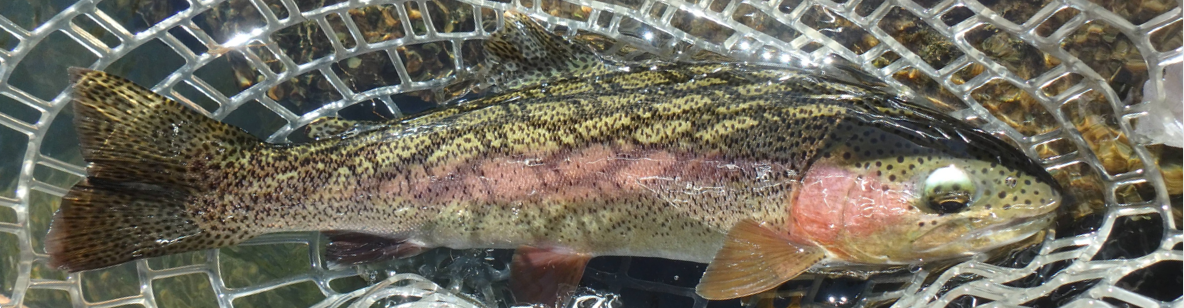
As the top fly slowly drifted toward the tail of a nice deep run, the fat Albert exhibited a subtle pause, and I reacted with a hook set. I was pleased to see a nine inch brown trout battling valiantly to free itself, but I maintained constant pressure and slipped my net beneath my first trout of 2016. Although on the small side, this fish was highly valued, and I marveled at its color and beauty, as I snapped a couple quick photos and removed the beadhead hares ear before releasing it back to its natural environment.

Numero Uno

For the next hour I continued my upstream migration and landed four additional brown trout. After the first fish, I swapped the ultra zug bug for a salvation nymph, and this workhorse fly yielded two of the small browns, and two others snatched the hares ear as it tumbled through deep runs and pockets. For one hour I felt like I was getting back in the groove, and this was especially gratifying in light of my recovery from surgery.

Pretty St. Vrain Brown

Between 2:30 and 3:00 the action slowed, and some gray clouds blocked the sun. My hands morphed into red stiff claws, and I ceased to have fun, so I reeled up my flies and made the return hike. Five fish in 2.5 hours of fishing is a reasonable day, and I recorded my first fish of the new season. I rediscovered one of my favorite stretches of local water, and although the fish were small, I saw enough to merit a return. I also proved to myself that I can resume fishing, and my physical status should only improve as time heals my body.

Fish Landed: 5

Chubby Chernobyl – 03/02/2016

Chubby Chernobyl 03/02/2016 Photo Album

Prior to my fishing trip to Argentina I purchased a box of flies from Royal Gorge Anglers. I provided Taylor Edrington with a budget and asked him to fill the box with an optimal selection that fell within my dollar range. The fly box that he shipped to me contained some dragon fly imitations along with an assortment of streamers and large foam attractor flies. Several of the foam attractors were very large single layer Chernobyls with long dangling rubber legs and huge polypropylene white wings protruding from the back of the fly. Taylor informed me that these were chubby Chernobyls.

My guide did not select them for fishing in Argentina more than once or twice, so I returned to Colorado with several large foam beasts to chuck on western streams and rivers. I used them a few times over the next couple years, but for the most part they earned tenure on my line during periods of frustration caused by poor lighting conditions. When sun glare or shadows made it nearly impossible to see my hopper pattern or Chernobyl ant, the chubby Chernobyl made an appearance on my line as the surface fly that typically supported a pair of beadhead nymphs. Of all my flies, the chubby Chernobyl is the most visible.

Antron Wing and Beige Antron Body

My young fishing friend, Danny Ryan, holds the chubby Chernobyl in high regard, and during a trip to the South Platte River in October he deployed one on his Tenkara rod for nearly our entire time on the water. Danny enjoyed a fabulous day of fishing, and the chubby Chernobyl was part of the formula. This opened my eyes to the possibilities of the popular fly, so I decided to produce a batch as my next large foam attractor.

I Like the Ice Dub Look

Chubby Chernobyl Materials

I watched several videos on YouTube and eventually chose the one produced by Intheriffle, as it was very clear and seemed to simplify the steps more than the others. Using this educational tool, I produced ten size six chubby chernobyls. The YouTube tier used tan ice dub for the body, but I did not possess that material, so I substituted beige antron yarn for the first four. They turned out nice, but I am fearful that the antron yarn will absorb water, and they do not seem to produce the psychedelic pop that ice dub yields.

Nice Side View

Climbing Over the Bump

After making the first four, I made a trip to Charlie’s Fly Box and purchased a bag of tan ice dub, and I manufactured two chubbys that utilized this material for bodies. These really stand out, and I suspect they may be superior fish attractors. Next I combined some silver ice dub strands with some light gray poly dubbing and mixed my own custom ice dub. This clump was applied to two chubby Chernobyls with gray bodies, and then finally I experimented with black versions with a peacock body and yellow poly wings. I am anxious to test these in situations when I would normally toss a conventional black Chernboyl ant. I like the large size and visibility for supporting beadhead droppers, as this is my preferred method of fly fishing.

A Parade of Ten Chubbys

Charlie Boy Hopper – 03/02/2016

Charlie Boy Hopper 03/02/2016 Photo Album

Having restored my supply of pool toy hoppers, I turned my attention to another large foam grasshopper pattern, the Charlie boy hopper. I began tying these in 2011 in an attempt to discover a visible yet buoyant replacement for my reliable Letort hoppers. My initial batch was poorly tied, and consequently I did not develop confidence in Charlie boy hoppers. They occupied space in my fly storage bin and did not see much use until late in the 2014 season. I depleted my pool toy supply to a dangerously low level, and quite a bit of hopper season remained, so I substituted one of my largely forgotten Charlie boys. In my mind I was simply using it as a strike indicator.

A Charlie Boy Fresh Off the Vice

All of a sudden I had a hot fly on my hands, and this motivated me to tie up more for 2015. During the past summer and fall I tested the Charlie boy more frequently, and I can report that it is an effective fish catcher primarily in the August and September time frame. In addition it is extremely buoyant, very visible, and can support two beadhead nymphs in a dry/dropper setup.

Since all my foam materials were arranged on my fly tying countertop, I decided to knock out some new Charlie boys for 2016. They are not difficult to tie, but I dislike working with superglue, and the quick dry adhesive is a critical component of the Charlie boy. My plastic container of Zap-a-Gap was over a year old, and when I attempted to apply it to the first work in process, I was dismayed to discover that it did not adhere. Fortunately I bought Jane a small vial of superglue as a stocking stuffer for Christmas, so I searched for and found it. I suppose I should feel guilty about giving myself a gift, but it remains available for Jane to use should she have a need. At any rate I discovered that the new brand applied easier to the foam, and this greatly improved my attitude about tying Charlie boy hoppers.

A Clump of New Charlie Boys

Once a tier gets over the superglue paranoia, the fly is actually an easy, straightforward tie with fewer materials and far fewer steps than a pool toy. A hook, thread, two pieces of foam, rubber legs and deer hair are all that is required to make a fairly realistic fly that floats well and contains the key triggering characteristics of a grasshopper struggling to escape from the current of a stream. 3/0 thread is recommended to allow increased pressure when snugging down the deer hair wing.

Zoomed In on the Leaders

Over the last two seasons I concluded that the Charlie boy and pool toy perform best in the late summer and early autumn season. This makes perfect sense, since this is when the large land bound natural hoppers are most prevalent, and the dense population of adults increases the likelihood of an errant flight path that results in a water landing. I have concluded that the yellow Letort hopper produces fish in the early season, as it is most likely taken for a golden stonefly. The Charlie boy and pool toy are not strong imitations of a stonefly even if they were tied with yellow bodies.

One Charlie Boy, Three Looks

As a result of my new affinity for the Charlie boy, I churned out ten new size ten versions and stashed them in my boat box. I made all of them with tan foam since I have not met with success using any other color. I have a few leftover yellow and green models from my earlier efforts should the need arise. Bring on the hopper season and dry/dropper fishing.

South Platte River – 02/29/2016

Time: 12:00PM – 3:00PM

Location: Downstream from Deckers

Fish Landed: 0

South Platte River 02/29/2016 Photo Album

Monday February 29 was more than the first fishing outing of the year, as I took my first step toward a comeback from surgery on January 27. How appropriate that this significant stride occurred  on leap day, although I must admit that I did not execute a leap, but instead completed a slow shuffle into the ice cold flows of the South Platte River near Deckers, CO.

Although some residual abdominal soreness remained along with some other expected hardships associated with my type of surgery, I felt reasonably strong, and I could no longer deny the strong urge I felt to enjoy the unseasonably warm February weather. Would my arm still remember how to make the familiar casting stroke, and more importantly would the upper abdominal soreness come into play as I picked up line and generated a backcast? There was only one way to find out.

The temperature in Denver was forecast to reach the low 60’s on leap day, and this translated to the mid-fifties for Deckers, so Jane and I decided to make the trip. We arrived at the large bend pullout below Deckers by 11:30, and by the time I climbed into my waders and new wading boots and assembled my rod it was 11:45. The wind was gusting in a fierce unrelenting manner, so I decided to consume my lunch before I faced this adversity.

After lunch I walked along the road until I was just above a bridge, and here I slowly slid below a large boulder that served as a temporary windbreak. I strung my rod and before I could carefully shuffle into the river, Jane appeared along the road at the start of her one hour walk. I quickly shouted to her, and she approached on a short path and snapped a few photos of the momentous occasion. It was my first day of fishing in 2016, my first outing since surgery, and surely the first time I ever fished on a leap day.

Back in the Water after Surgery

I began my quest for the first trout of the new season with a flesh San Juan worm and a RS2. I quickly discovered that my greatest risk was a slip or stumble, as this would clearly aggravate my still tender upper abdominal muscles. For this reason I moved slowly, and my progress was interspersed with several long rest periods. The caution due to abdominal soreness is true, but the rest periods were provoked by two ridiculous tangles that forced me to snip off both my flies in order to straighten the entire mess.

After twenty minutes of casting practice, the indicator zipped upstream, and I set the hook and felt my line connected to a fish. Unfortunately this only lasted for a second or two, and then my best shot at a fish on leap day evaporated. I moved on and enjoyed being outdoors while I focused on executing dead drifts. In case the fish were reacting to emerging blue winged olives I alternated by imparting movement to the flies, but none of these techniques provoked any action.

Fine Looking Segment

At one point I spotted a fish chasing the worm at the tail of a run, so I exchanged the flesh colored imitation for a slumpbuster and retained the RS2 as a trailer from the eye of the streamer. This combination was likewise ineffective, although I once again observed a trout following the slumpbuster, but I could not entice a take.

Slumpbuster on My Line

Onward I moved until I circled the large bend where the Santa Fe was parked, and then I approached an island across from the Deckers parking lot. I worked up the right side to no avail and encountered a pair of fishermen at the attractive deep run near the top of the island. This forced me to retreat to the downstream tip, and then I worked a marginal run along the left braid. None of this resulted in a fish or even the image of a spotted fish, so I climbed to the road and strode back along the shoulder to Jane’s sheltered retreat near a bench.

RS2 Was Tested

I decided to repeat covering the stretch where I observed two follows. Unfortunately early in this pursuit I snapped off both my flies (an ultra zug bug and RS2), and rather than recommit to nymphs and an indicator, I decided to toss one of my new chubby chernobyls. I clipped off the flies and removed the strike indicator and split shot and replaced everything with a beige chubby and size 20 soft hackle emerger, as I stuck with the blue winged olive theme. Alas none of these strategies caused the fish to show interest. I swapped the soft hackle emerger for a salvation nymph and beadhead hares ear, but these were likewise ignored, so I called it a day and joined Jane back at the car where she sought refuge from the relentless gusts of wind.

I avoided injury and took my first fly fishing step toward recovery, so despite getting skunked, I counted leap day as a success.

Pool Toy Hopper – 02/28/2016

Pool Toy Hopper 02/28/2016 Photo Album

Three prior posts on this blog thoroughly documented my introduction to the pool toy hopper as well as the evolution of my experience with this fly. If the reader clicks on the link in the previous sentence, he or she will encounter two additional links to access previous posts.

A New Pool Toy

Yikes Up Close

Not much has changed with this fly. It remains a large visible buoyant terrestrial that I select when I wish to fish a dry/dropper arrangement. I particularly appreciate its buoyancy when I elect to fish two trailing nymphs as it continues to bob along on the surface despite the weighty attachments. Occasionally a fish will fall for the large hopper imitation, but most of the time the pool toy hopper serves as a sophisticated strike indicator.

Fish View

One locale where I experienced decent success with the pool toy is on the North Fork of the White River as well as the South Fork of the same drainage. This September pool toy success story seemed to repeat itself on each of my trips to the Flattops. Also it seems that large foam hopper patterns reach their peak effectiveness in August and September, and this probably makes sense since this is when the majority of large juicy grasshoppers get blown into the rivers and streams.

Twelve Tan Pool Toys

I often choose a pool toy earlier in the season when fish refuse my Chernobyl ant pattern. I get easily frustrated when fish rise to my top fly and reject it, and this circumstance usually coincides with trout totally ignoring my trailing nymph droppers. In this situation I am more interested in a buoyant indicator that will not attract attention, and the pool toy serves this purpose.

Four Views

Unlike previous winter tying sessions, I settled on a standard combination for my pool toy hoppers in 2016. I made ten with tan and medium olive foam, and I settled on olive barred sexilegs from Montana Fly Company for the legs. I did vary from my established pattern to produce two versions with a pink top foam layer. These should be extra visible under difficult lighting situations.

Chernobyl Ant – 02/24/2016

A Size 8 Chernobyl Ant

Chernobyl Ant 02/24/2016 Photo Album

If I created a hall of fame filled with the most productive flies, the Chernobyl ant would hold an honored position at the top of the list. I documented much of my history with this fly on previous posts, and the reader is encouraged to click on the below links to learn why I revere this foam terrestrial/attractor.

Chernobyl Ant – 02/01/2011

Chernobyl Ant – 02/13/2014

Chernobyl Ant – 01/06/2015

Underside

When I performed an inventory of my Chernobyl ants a few weeks ago, I discovered 23 size 10 versions in my bins and boat box. I was satisfied that this quantity was sufficient for the upcoming season; however, I counted only two large size eight imitations. During 2015 I often utilized two beadhead droppers from my Chernobyl ants, and the size 10’s tended to ride very low in the surface film as a result of the weight of two flies. I decided to go big for the new season, and I tied fifteen new size eight foam ants. These larger flies should be much more visible, and they will probably do a superior job of floating a double nymph dry/dropper configuration.

Creeping Down

I learned during the late summer and fall season that trout began refusing the Chernboyl ant. For some reason the fish seemed to get more discriminating in their choice of surface terrestrials as the season progressed. In response to these snubbings, I experimented with substituting a Jake’s gulp beetle, and I was pleased to discover that the smaller terrestrial was quite effective. The Chernobyl allows me to spot fish and also to determine that they are looking to the surface for their food supply. The more realistic and smaller Jake’s beetle enables me to close the deal when fish are more selective.

Ten New Size 8 Chernoyl Ants

The only significant change to my Chernobyl ant tying approach is the usage of a Tiemco 5262 or equivalent hook. The heavier weight of this hook serves as a keel for the large foam ant, and this causes the fly to land right side up nearly all the time. I learned this trick from Jake Chutz, the designer of Jake’s gulp beetle. I tied all of the new size eight Chernobyl ants on the heavier 5262 hook.