Big Thompson River – 08/03/2016

Time: 10:30AM – 3:30PM

Location: Upstream from the border with the RV park that was destroyed in the September 2013 flood

Big Thompson River 08/03/2016 Photo Album

After three consecutive days of outstanding fishing, I was due for a reality check, and today August 3 served that purpose. Hopefully today’s results are not a sign that I need to select tailwaters and high elevation headwaters over lower valley rivers and streams at this early juncture in August. The high temperature reached 98 degrees in Denver, so I suspect heat is the main explanation for my slow day on the Big Thompson River. The DWR web site displayed flows of 103 cfs, and this is actually relatively high for early August, so I cannot blame the challenging fishing on the amount of water.

103 CFS

I arrived at a pullout along US 34 approximately six miles below Olympus Dam at 10AM, and by the time I assembled and rigged my Orvis Access four weight and gathered my fly fishing essentials, it was 10:30. I began fishing with a size 14 gray deer hair caddis, and three fish in the wide relatively smooth starting pool found it to their liking. The moderate flows enabled me to cross at the wide starting point, and I love the idea of fishing along the bank that is away from the road, so I adopted this approach. As I slowly moved up the river prospecting with the small caddis, I upped my fish count to four, but then the fish began to ignore my offering.

The type of water may have had something to do with this, since it transitioned into faster runs and pockets. In an effort to make my fly more visible to me and the fish, I swapped the size 16 caddis for a size 14 stimulator with a gray body. This change did not tempt the stream residents, so I defaulted to one of my favorite lineups. I tied a size 10 Chernobyl ant to my line and dangled a 20 incher and salvation nymph below it. By 11:45 as I climbed the rocky bank to return to the car for lunch, I added one more small fish to my tally, after it struck the salvation nymph, as I lifted to make another cast.

I walked back to the Santa Fe and executed a U-turn and parked high above my lunchtime exit point. I sat on a large rock with a great vantage point, while I munched my sandwich, but I failed to spot any insects or fish. It is very unusual not to see fish in the deep pools of the Big Thompson River.

After lunch I continued from my quitting point, and within minutes I was perched at the tail of a long deep run that transformed into a wide pool. The entire area was 25 yards long and the pool covered the entire width of the river. I made some long angled casts to cover the lane along the opposite bank, and I noticed a refusal to the Chernobyl, and the brief glimpse suggested a decent fish. In the midsection of the pool, another fish flashed to the top fly. What could these fish be looking for?

It was a bit late in the season for green drakes, but I recalled encountering them in the Big Thompson in prior years, so I decided to test one. I knotted a Harrop deer hair green drake to my line, and it also generated a look but no take. Next I switched to a size 14 parachute green drake, and the large low floating mayfly created interest from three fish that elevated to inspect and then turned away. I had one more style to try, so I tied a size 14 comparadun to my line, but this was totally ignored. Since the parachute style prompted the most action, I reverted to it. I made a forty-five degree cast up and across, and as the parachute drifted across from me, a decent brown trout rushed to the surface and nipped the fly. I felt weight for a split second, and then the fish was gone. After this weak endorsement of my offering I wasted an excessive quantity of additional futile casts, before I finally conceded defeat and moved on.

The next section of water consisted of large pockets and deep runs. The green drake induced a couple more refusals along the edge, so I gave in to my instincts and returned to the dry/dropper approach. Unlike earlier I selected a tan pool toy as my top fly and added a beadhead hares ear and salvation nymph.

The Fly Is Almost Larger Than the Fish’s Mouth

It was now early afternoon, and the intense rays of the sun were shining directly on the Big Thompson River. It was quite warm and bright, and I regretted not selecting wet wading for this unusually warm summer day in the mountains. Over the two and a half hours between 1:00 and 3:30, I worked my way upstream and covered a significant amount of water. I limited my casts to three or four and then moved on. I also attempted to focus more on the banks, although the level of the river and the large population of rainbows should have supported fish in the attractive pockets and pools in other places.

A Legacy Fly Accounted for Two Fish

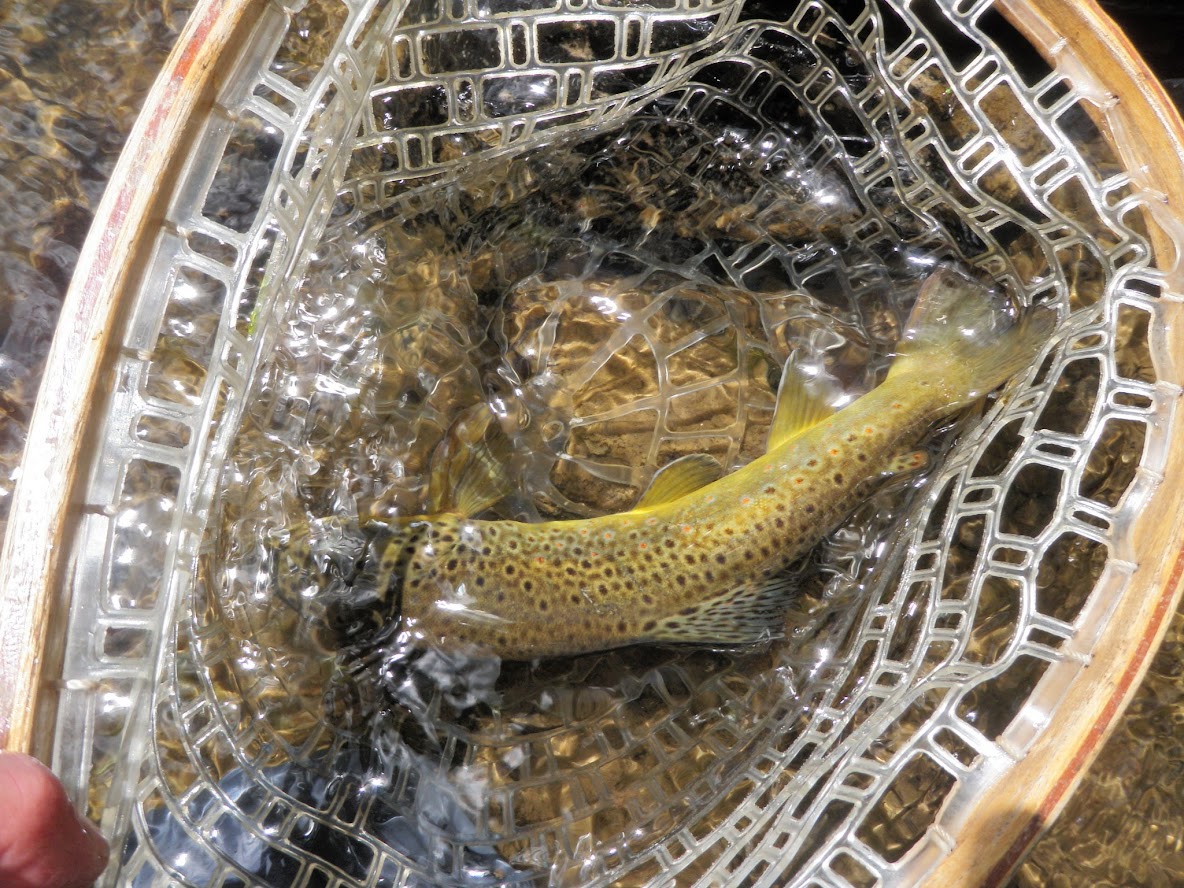
I feel fortunate to report that I increased my fish count to eleven before I quit for the day. Three fish grabbed the salvation nymph, and one aggressive bank dwelling brown smashed the pool toy. Part way through this period of slow action, I decided to experiment with some old flies that I carry in my fleece pouch and rarely tie on my line. I grabbed a long narrow gray wet fly with a copper rib and replaced the hares ear. Miraculously this fly accounted for two small rainbows that snatched it, as it drifted through a run of moderate depth. This was probably the most significant positive for my day on the Big Thompson River on August 3.

Fish Landed: 11


Trout Creek – 08/02/2016

Time: 10:30AM – 3:30PM

Location: Downstream from Trout Creek crossing

Trout Creek 08/02/2016 Photo Album

On October 5, 2015 Jane and I explored the lake and Trout Creek area ten miles north of Vail, CO. We enjoyed a wonderful fall hike at high elevation, and afterward I sampled some fly fishing in heretofore unexplored Trout Creek. I landed seven fish in 1.5 hours, and I was impressed enough by the potential to pledge a return trip. Tuesday August 2 I honored my 2015 pledge.

Unlike my previous visit I planned to spend an entire day on the small headwater river, and I also hoped to hike along the Trout Creek trail for an hour. I estimated this would place me three miles from the trailhead and beyond most of the fishing pressure closer to the Trout Creek Crossing bridge. It normally takes two hours to drive to Vail and another forty-five minutes to negotiate the relatively rough Red Sandstone Road that leads to the Trout Creek Crossing trailhead. Add on an hour of hiking and fifteen minutes of preparation time, and the cumulative elapsed time required to be on the water fishing projected to four hours.

In order to reduce the morning drive Jane and I reserved a campsite at Gore Creek Campground just east of Vail, CO for Monday evening. Our site, number 13, was very nice, as our tent was positioned along the upper reaches of Gore Creek. On Tuesday morning we consumed a light breakfast and efficiently packed up the camping gear and departed the campground by 8:15. An hour later we pulled into the crude parking lot at Trout Creek Crossing, and after gathering all the essentials for a day of remote fishing, we were on the trail by 9:30. True to my plan we hiked for an hour, and this enabled us to reach a meadow section of Trout Creek. At this point Jane changed direction and returned to the parking lot, while I cut down a gradual hill and then followed the edge of some tall grass to the bottom section of the meadows.

The Meadows Was Challenging

I did not have access to stream flows for the upper Trout Creek, but I estimated the volume was roughly double that of October 5, and perhaps in the 40-50 cfs range. The weather was perfect, as the temperature on the dashboard was 57 degrees when we embarked on the trail, and the high reached the low seventies. High clouds blocked the sun for much of the afternoon, and a very light sprinkle commenced at 3PM, but the rain was never heavy enough to cause me to pull out my raincoat.

A Brown Trout from the Meadows Area

Between 10:30 and 11:30 I methodically prospected the slow moving meadows area. Numerous fish showed their positions sporadically, but I suspect many of these rises emanated from very small fish. Nonetheless I landed a nice eleven inch brown trout and a similar sized cutbow in the first fifteen minutes, and I was quite pleased with this beginning of my adventure. My catch rate diminished during the remainder of my reconnaissance of the meadow area, but I did add three more fish to the count including a twelve inch brown and another eleven inch rainbow. The last fish of the meadow harvest was a small cutbow. A size 12 light yellow stimulator was the attraction for all these trout. In addition to five landed fish, the meadows section frustrated me with four times as many refusals as takes and several long distance releases, but I was satisfied with my initial hour in the remote area of the Eagles Nest Wilderness.

Early Cutbow

At 11:30 I reached the end of the meadow section and entered a narrow canyon that was characterized mainly by pockets and plunge pools. The remainder of my day was spent in this environment, and my main concern was how I would exit the steep sided valley and find the Trout Creek Trail to return to the car. Fortunately the fly fishing action was intense enough to take my mind off of this concern for most of the day. In the lower canyon stretch above the meadow I continued my cautious upstream migration by adding three more small trout to the fish count ledger, but then I stalled at eight. I set a personal goal to reach double digits by lunch, but the fish were no longer slurping the stimulator, so I decided to adopt the dependable dry/dropper approach.

Tough Wading

I tied a size 10 Chernobyl ant to my line, and a foot behind it I added a beadhead hares ear, and then a size 18 beadhead pheasant tail. The pheasant tail was responsible for the next three fish including an eleven inch brown trout, before I paused for a streamside lunch at 12:30.

Showing Off the Slash

Shortly after resuming my upstream progression after lunch, I grew dissatisfied with the catch rate, and I swapped the pheasant tail for a salvation nymph. This move paid off handsomely, and I moved the fish counter from eleven to twenty-five by 2:30. This was my favorite period of fishing. I carefully moved over the rocks and tossed upstream casts to the deep pockets and plunge pools. In many places I could see the trout in the center of the pocket or the tail. My catch rate was obviously solid, but I also observed numerous subsurface looks, refusals, and temporary hook ups. Roughly half the fish smashed the Chernobyl, but quite a few of these connections evolved into long distance releases. I was not excessively upset by the LDR’s, as the majority of them were associated with small fish. Most of the other landed fish favored the salvation, but the hares ear produced enough action to justify remaining on my line.

Perfect!

For me the unique aspect of my afternoon on Trout Creek was the number of beautiful cutthroats and cutbows that found a home in my net. None of these fish exceeded twelve inches, but they were absolute jewels, as they displayed fine spots over a lemony cream background in sharp contrast to the vivid orange slashes beneath their mouth. These species of fish in the backcountry environment were a nice contrast to the more typical brown trout and rainbow trout, that I catch in the lower reaches of Colorado rivers and streams.

Rock Ledge Wall Ahead

The scenery was also spectacular, as I passed through numerous canyons with high vertical red rock walls adjacent to the small tumbling stream. Fortunately in all these situations, one side of the stream offered me terrain that allowed relatively easy passage.

One of the Better Brown Trout on the Day

At 2:30 the beadhead hares ear nymph unraveled, and I spotted one solitary green drake, so I decided to test a parachute style. Perhaps the trout were accustomed to seeing more of these meaty mayflies? The large mayfly did induce a refusal and temporary hook up, but then it ceased to be a factor, so I changed back to the Chernobyl but with only a salvation dropper. This combination enabled me to add four more fish to the count, but then I suffered through a longer than normal stretch with only refusals and temporary hook ups with tiny fish. I reached a place where the slope on the left side of the valley was gradual enough to allow an exit, so I resigned myself to a twenty-nine fish day.

Fireweed

But perhaps the yellow stimulator still retained some magic? I tied one to my line and moved upstream a bit beyond my exit point, and in one attractive short but deep run along a submerged log, a ten inch brown could not resist the bushy attractor. I released number thirty from my net and retreated a short distance to a place where I circumvented the raspberry bushes and climbed the short but fairly steep hill until I intersected with the well worn Trout Creek Trail. I was elated to discover the path without much searching. Forty-five minutes later I was back at the parking lot, where I found Jane relaxing in her chair beneath the camping canopy.

This Ended Up Being My Exit Point

My Trout Creek adventure was a success, and I am already planning more forays into the Eagles Nest Wilderness. The fish were small with my largest probably a thirteen inch brown trout, but I had the place to myself, and I was lost in my own thoughts in a remote corner of Colorado for five hours. Cutbows and cutthroats were a nice deviation from my familiar catches, and this only added to the allure of the backcountry. The beauty and remote location created a unique fly fishing outing, as I began my August 2016 fly fishing adventures.

Fish Landed: 30

Boulder Creek – 07/29/2016

Time: 10:30AM – 2:30PM

Location: Near 8% grade sign and zip line crossing for rock climbers

Boulder Creek 07/29/2016 Photo Album

We returned from Reudi Reservoir on Thursday, and Jane and I stopped to complete the Eagle Lake hike along the way. Glenwood Canyon was closed from 9:00AM until 3:30PM on Thursday for rock slide work, so Jane and I decided to negotiate the Eagle-Thomasville Road. I read several books that warned not to drive this rough dirt road after rain, since it is essentially impassable when wet. Fortunately we did not encounter any significant rainfall, and we completed the taxing drive. The section from Thomasville to the trailhead to Eagle Lake contained numerous deep ruts created by the heavy logging trucks during mud season. Successfully traveling this area depended on balancing the vehicle tires on the high ground in order to avoid sinking into the deep tire tracks.

The eight mile drive from Eagle Lake over Crooked Creek Pass and ending at Sylvan Lake was new terrain to us. The difficulty in this area was extremely rocky sections that forced us to travel at maximum speeds of 5MPH, as driving faster would have risked the loss of fillings from our teeth. Another hindrance to progress was a two mile section where the road surface consisted of an inch thick layer of red dust. It was obvious that rain could convert the roadbed into a slick red clay slip and slide in a small amount of time.

I relaxed on Thursday evening and decided to squeeze in another day of fishing on Friday. After reviewing the stream flow data for the nearby Front Range drainages, I selected Boulder Creek west of the city of Boulder as my destination. The DWR data displayed stream flows at 80 cfs, and I knew from trips in early spring that this level was close to ideal. I drove up Canyon Avenue for eight to ten miles, until I reached the area where the gradient is quite steep. I selected this segment with the assumption that most fishermen gravitate to the tame water closer to Boulder, and with flows in the ideal range, I did not mind undertaking some stream side bouldering. I expected to have a fun day catching 6-10 inch brown trout on dry flies. This expectation pretty much held true except for one significant deviation.

Sweet Spot Held Four Trout

A Large Boulder Creek Brown Trout

I departed Denver at 9:20, and by the time I rigged my Loomis five weight and climbed into my waders and approached the edge of the creek, it was 10:30. I considered wet wading, but the temperature was 70 degrees, and some big gray clouds in the western sky indicated that rain was a possibility. I decided to begin my day with a size 14 gray stimulator, and it was a good choice. In the first two attractive pools, the stimulator was ignored, but then it began to draw the attention of the small stream residents. I popped the heavily hackled attractor in all the likely spots where trout might lie in wait for food, and I was fortunate to land eight fish by the time I broke for lunch just below the Santa Fe at 11:40. This may sound like spectacular fishing, and it was quite good, but the number of refusals outnumbered the takes, so there was that element of frustration. I did not build the satisfying level of confidence that accompanies consistent takes without rejection.

Pretty View from Lunch Spot

After lunch I decided to experiment with some changes in an attempt to lower the refusal count. First I tied a Jake’s gulp beetle to my line and added a size 18 beadhead pheasant tail as a dropper. I was hoping that a pale morning dun hatch might materialize, thus the pheasant tail. The gambit was unsuccessful, but the beetle drew a few looks, so I concluded that the fish were looking toward the surface for their meals. In response to this supposition, I clipped off the dry/dropper and reverted to a single dry fly; however, this time I knotted a size 14 light yellow stimulator to my line. This fly served me well on the Conejos River and Elk Creek, so I guessed that it might be popular with Boulder Creek trout.

Scenic Stretch

The supposition was partially correct as I landed two more fish to build the fish count to ten. I was satisfied that I reached my goal for the day, so I once again made a change. The dry/dropper method on the upper Frying Pan River on Wednesday was dynamite. Could the same be true on Boulder Creek, or would the fish refuse the large top fly and ignore the subsurface offerings? I tied a tan pool toy hopper to my line and then connected a beadhead hares ear and salvation nymph. This was the very same lineup that produced prodigious quantities of trout on the upper Frying Pan.

It worked. I continued migrating up the narrow steep gradient stream while popping the dry/dropper combination in all the likely plunge pools and deep eddies, and this process incremented the fish counter by six. Number sixteen was the largest fish of the day at thirteen inches, but it squirmed free as I was in the process of posing it for a photograph. The home of this fish was a very deep hole behind a large bank side boulder. The current swirled around the point of the rock and then eddied back to the nexus of the pool where a large foam patch covered a large segment of the surface. The pool toy darted back toward the foam, and this clued me to set the hook in order to land the thirteen inch wild brown.

Surprise Catch

I was frustrated by my inability to maintain a grip on the elusive brown for a photo, so I decided to continue probing the deep eddy. I backhanded a couple casts to the foam, and on the third effort, as the pool toy danced to the vortex, a large figure elevated and grabbed one of the trailing nymphs. I could not believe my eyes, but I had the presence of mind to lift my rod and made a solid hook set. Immediately the oversized brown recognized that the food in its mouth was a hook, and it began to dive, thrash, roll and spurt; but I maintained solid pressure and after a few minutes, I guided it to the edge of the bank below me. My net barely contained the huge flopping catch, and I could barely contain my glee. I have caught larger brown trout, but an eighteen inch fish from a small stream that rarely produces fish over a foot long was quite an achievement. Surprises like this are what make fly fishing my favored pastime.

Magnificent

The Lair of the Boulder Creek Lunker

After carefully releasing the behemoth to fight another day, I moved on. It was 2 o’clock, and I hoped to reach twenty fish and depart no later than 3PM, since Jane and I made plans to meet some friends for happy hour at Union Station at 5:30. I began casting at a nice pool a bit upstream from the productive eddy, when movement caught my attention. I glanced up and noticed a young man fidgeting with a clamp, and I realized that I was fishing directly below a short zip line that transported rock climbers over Boulder Creek. The young rock climber secured a large hook to his belt, and then he used a hand over hand technique to slide upside down above the creek and me, until he reached the side next to the road.

I resumed my quest for trout and landed three more by 2:20 when I approached a section characterized by whitewater chutes and waterfalls. This obstacle was enough to convince me to call it quits, so I climbed the steep bank and hiked along the shoulder until I reached the car. Several new arrivals parked behind me, and they were readying their gear to begin their day of rock climbing.

Friday was another wonderful day of fly fishing in July. The weather was perfect, the brown trout were hungry, and I managed to pull a small stream lunker into my net. July has been a spectacular month.

Fish Landed: 20

Upper Frying Pan River – 07/27/2016

Time: 10:00AM – 5:30PM

Location: Above Reudi Reservoir between Meredith and Thomasville

Upper Frying Pan River 07/27/2016 Photo Album

On day two of our fly fishing trip to the Frying Pan River, John Price and I decided to avoid the crowds and fish the upper Frying Pan River above Reudi Reservoir. We agreed to spend the morning there, but if we were dissatisfied with the action, we could return to the tailwater in the afternoon. The upper Pan is a freestone stream and not a tailwater like its cousin below Reudi Reservoir. On Wednesday July 27 the flows were 130 cfs compared to 250 cfs on the tailwater. The presence of large and deep Reudi Lake makes the two segments of the river fish like two separate streams.

Unlike Tuesday the sky was blue and the sun was bright all day, and consequently the high temperature reached the low eighties. Since John fished the upper Pan more than me, I allowed him to lead, although the water we chose to fish was essentially the same that I fished several times in the past. We began below a concrete bridge just before Thomasville, and we each landed one trout, although we quickly encountered a stretch of very fast whitewater and changed locations.

Same Fish, Different View

Although the flows were clear and very comfortable for fishing, they remained higher than normal mid-summer levels. I was able to cross at wide points, but I exercised a high degree of caution due to the swift current. John did not carry a wading staff, so in all locations that we fished, I accepted the task of crossing, so we could fish somewhat in parallel. I began my day with a gray stimulator, but this did not generate any interest. Next I shifted to a tan pool toy, with a beadhead hares ear and salvation nymph. These flies remained on my line for the entire time I fished on Wednesday, and the reader will discover why by continuing to follow this post. The first fish landed early in the day was a small brown trout that consumed the salvation nymph near the bank in a narrow band of slow water.

When we abandoned the first spot, we returned to John’s truck and reversed our course a short distance and pulled into an angled two track dirt lane. The water here was wider, and wading and fishing were much more manageable. I crossed at a very wide shallow area and then went downstream a moderate distance. In order to avoid disturbing some appealing bank side pockets, I exited the river and made difficult progress through bushes on a steep loose bank. It paid off to some degree, as I landed three small fish in a nice pocket of moderate depth next to the bank, as I fished my way back up to the crossing point. Another fish that felt a bit larger rose and slammed the pool toy next to a protruding rock in this same pocket, but it quickly shrugged free of the hook.

Delicious Pool

When I caught up to John, the fish count was at seven, as three more small fish found my net, as I worked the pockets between our two positions. John was entrenched at the tail of a gorgeous deep pool, and he had already landed six fish on a dry fly. He beckoned me to join him, and I accepted his offer. I was grateful for John’s generosity in relinquishing the  productive pool, as I landed three additional fish from the bottom portion on the salvation nymph bringing my count to ten. These three fish were some of the best on the day and measured in the 11-12 inch range.

I backed out of the pool and continued progressing up the left side and added seven more fish before lunch, but these required more work in the form of repetitive casts through especially attractive deep pockets and runs. At around 1PM we returned to the truck and drove another .5 mile downstream, where we parked in a pullout across from a lot with several sheds and a for sale sign. We took our lunches to the edge of the river, but the mosquitoes were ridiculous, so John and I lathered up with more repellent.

Pool Toy Chomper

At this location I angled across the shallow tail of some riffles and then walked through a pasture for thirty yards, before I cut back to the north bank of the river. In this case the extra effort was hardly worth it, as the thirty yard section was marginal and required difficult wading. I may have landed one fish in this entire escapade.

I caught up to John, and fortunately for me the water on my side was higher quality than along the bank next to the road. Between 2 and 4 I moved the fish counter from 17 to 40. It was ridiculous fast paced fishing, although the fish were all in the 7-12 inch range and primarily rainbows. I established a nice rhythm and began popping casts to every possible fish holding lie. I am not sure if there were a lot of PMD nymphs subsurface, but the fish absolutely pounced on the salvation. 75% of the landed fish in this time period snared the salvation, and the remainder nabbed the hares ear.

Brilliant Spots and Color

The fish were small, but the action was fabulous. Every spot that looked like it might hold a fish, did. In many instances a fish snatched the nymph as soon as it touched the water. I am always amazed by this phenomenon. By four o’clock we reached another section of very fast water, and it was quite warm and the action slowed slightly, so we agreed to tentatively call it a day.

A Fine Brown Trout after Difficult Cast

As we drove back to the reservoir, however, we spotted a sketchy lane consisting of two bare tire tracks, so we could not resist exploring. John guided the truck over some large protruding boulders, and we parked and assembled our rods and followed a shaky seldom used path to the river. We found ourselves above the bridge just above the inlet to Reudi. The water here was wide and relatively shallow with lots of pockets of moderate depth. We spread out a bit, and I worked up the left bank and added three fish to the counter. I probably hooked and lost an equal number, and the salvation and hares ear continued to be productive.

Pocket Water Everywhere

What a fun day on the upper Frying Pan River! We saw one other fisherman during our entire outing, and he was below the bridge just above Reudi, and he did not appear until the last half hour before we quit. We had the Frying Pan River to ourselves, and when can you say that? The fish were small, but they aggressively attacked my nymphs. I love the scenario where a fish emerges from nearly every likely holding spot, even relatively short shallow pockets in the middle of the river. That was the case on Wednesday, and I reveled in the action. I only regret not switching back to dry flies in the afternoon to determine if the fish were selective to subsurface offerings. July 2016 continues to impress.

Fish Landed: 43


Frying Pan River – 07/26/2016

Time: 10:00AM – 5:30PM

Location: Four spots along the Frying Pan River between MM3 and MM10.5

Frying Pan River 07/26/2016 Photo Album

Jane met Brenda Price through tennis, and they became steadfast hiking and golf buddies. By coincidence Brenda’s husband, John, is a fly fisherman; so we made plans for a joint camping/hiking/fishing trip to the area around Reudi Reservoir. Jane and I arrived on Monday July 25 and set up camp, while Brenda and John stationed their Casita in the campsite across the road at Little Maud Campground.

On Tuesday morning John and I set out for a day of fly fishing adventure. The Taylor Creek reports suggested that green drakes were present in the lower one-third of the Frying Pan River, so we began our quest for trout there. Supposedly pale morning duns were emerging throughout the river corridor, so with this knowledge, we agreed to begin on the lower river and work our way upstream and thus avoid the crowding that inevitably frustrates a fisherman on the upper four miles below the dam.

Our starting point was mile marker 3, and I crossed the river at the tail of a run, and then I began fishing up along the right bank until a point just above a huge eddy where a small side channel entered the main river. The weather was actually overcast and cool in the morning, but I did not feel the need to wear an extra layer over my fishing shirt. From a flow perspective the river was near ideal levels at 250cfs. This enabled comfortable wading, but the water was high enough, so that fish were not abnormally skittish.

John Price Fishes a Deep Pool on Tuesday Morning

As I rigged with a size 8 Chernobyl ant, 20 incher (green drake nymph proxy), and zebra midge; John began fishing along the roadside bank. After fifteen minutes with no sign of fish, although the water quality on my side of the river was marginal at best, I abandoned the tiny zebra midge and switched to a salvation nymph. Finally in a slightly more attractive short pocket along the bank I landed a twelve inch brown trout that slurped the large foam indicator fly.

Nice Run

In the unusual wide eddy where a small side channel reentered the main flow, I foul hooked a small rainbow trout. The water above the eddy was unfavorable for fishing, as the fast current rushed tight to the bank, and John continued to prospect the juicy shelf pools farther downstream, so I cross the river at a shallow riffle to reach the bank next to the road. Here a narrow five foot wide ribbon of slow moving water existed between the fast current and the bank, and I began to cast my three fly dry/dropper. I was excited to land four fish from this nondescript section of the fabled Frying Pan including a fifteen inch brown that smashed the Chernobyl ant. The other three fish grabbed the hares ear and salvation, as they trailed the lead fly.

Best Fish of the Day

At the top of the narrow ribbon I encountered another section of fast whitewater next to the bank, so I retreated to John, and we decided to moved to another location. We jumped in John’s Chevy truck and migrated upstream to the massive pool at MM4.5. Much to our amazement it was unoccupied, so after gulping my lunch, I crossed at the tail and moved to a wide deep run and riffle that angled toward the opposite bank. The dry/dropper was ignored, and John reported some looks to his green drake, so I made the switch to a parachute green drake size 12. On the first cast the large paradrake elicited a splashy refusal, but that was the extent of the action. I cycled through some different variations of the drake including a Harrop deer hair drake and a size 14 comparadun, but the changes were fruitless.

John shifted positions and once again announced some refusals, so I returned to a parachute version, albeit a size 14. Finally at the top of the riffle on the right side of some strong current, a  fourteen inch brown trout sucked in the green drake. I speculated that this was the beginning of a more significant emergence, but this turned out to be wishful thinking. I sprayed numerous drifts over the delightful run and riffle, but to no avail, so I reverted back to the dry/dropper approach with the Chernobyl, 20 incher and salvation nymph. The change allowed me to land a small brown to reach a fish count of seven, as the fish grabbed the salvation when it began to swing at the end of the drift in some swirly water.

John and I finally abandoned the giant pool and moved up the right side of the river to two short faster pockets that contained some depth. Although these areas appeared promising, neither of use landed fish, but as I returned downstream, I observed two decent fish in the shallow water at the end of the return current in an eddy. Just prior to this I spotted two crumpled pale morning duns along the edge of the river, so I suspected that the pair were hovering just below the surface, as they looked for PMD’s. I tied one of my size 18 cinnamon comparaduns to John’s line, and he landed one of the spotted fish. It turned out to be a fourteen inch brown trout.

Success

After John departed I attempted to fool the large rainbow, but it was resolute in ignoring my fly. I gave the big fish a salute, and John and I crossed at the tail and once again moved to a new location. This time we only drove .3 mile to the huge pool in front of an island at the Seven Castles area. We languished here for an hour, but our efforts were largely thwarted. I did manage to land a small rainbow trout that mistook my cinnamon comparadun for a natural fly, but this event was apparently an aberration. Despite fairly frequent although sporadic rises in the area, I was unable to repeat my early success. I was certain that a size 18 black ant would be the answer, but that fly was likewise treated like inedible flotsam. John reported similar frustration in the smooth flat pool farther upstream, so we once again pulled up stakes and moved.

We debated quitting since it was nearly four o’clock, but we decided to stop at the spring for one last ditch effort. By now some thick clouds appeared in the west, so we agreed to fish until the rain chased us from the stream. We hiked downstream on the shoulder of the road, until we were just below a small narrow island. John jumped in at the top, and immediately witnessed a green drake refusal, while I moved below the downstream point of the island. I thoroughly prospected the attractive pockets below the island and along the south side with no response from fish, and then I bumped into John in some sweet deep riffles near the middle of the river.

Afternoon Landing

As I observed, two fish refused the green drake, and then another gulped it with utter confidence. I congratulated John and then reconsidered my approach and made a change. You guessed correctly. I abandoned the dry/dropper trio and tied a size 14 parachute green drake to my line. To give John space I moved to the pockets along the road and added six additional brown trout to my fish count before we retired at 5:30. The fish were in the 8-12 inch range, but they were aggressive toward my green drake, and they chomped it with confidence. In fact they cut the parachute hackle on the first imitation, and I was forced to tie on a new version for the last two fish. During this time period I spotted my first and only natural green drake of the day.

MM 10.5

In summary I landed fourteen fish including a fifteen and fourteen inch brown trout. On average however the fish were smaller than my historical experience on the Frying Pan River. It was fun to find a new fishing buddy, and we were pleased to avoid competition from guides and other aggressive Frying Pan fly fishermen. We returned to the campground weary and hungry, as Jane and Brenda rolled out appetizers and delicious tamales. July 2016 continues to be a fabulous fly fishing month.

Fish Landed: 14

Conejos River – 07/20/2016

Time: 9:00AM – 4:30PM; 7:00PM – 8:00PM

Location: 1.5 miles downstream from CO 105 bridge and then back up to bridge; nice pool next to the Lake Fork Campground

Conejos River 07/20/2016 Photo Album

I could not let the Conejos River beat me. I pondered my options for Wednesday on Tuesday night. I considered exploring the Conejos River above Platoro Reservoir, since it would be unaffected by water releases from the dam, but I was unfamiliar with this water and did not have a detailed map. Another option was to cut my losses and leave a day early and identify another decent fishing destination on Thursday or Friday closer to home. Of course the final alternative was to spend another day on the Conejos River. I chose the latter with a caveat. If the fishing was slow, I would quit at 2PM and return to the campsite and pack up and return to Denver.

Spending another day on the Conejos seemed like the correct choice for several reasons. First of all I drove nearly six hours to be there, so I really needed to give it another chance. My main motivation, however, was the observance of a few green drakes and a decent pale morning dun hatch on Monday around noon. Perhaps this was the leading edge of a more intense emergence, and it would be ashamed to abandon the Conejos just as it blossomed into prime productivity. July 20 was the start date of my two previous successful trips to the Conejos River.

On Wednesday morning I drove down CO 250 to the last place where the short grass and low bushes defined the landscape between the road and the river. Had I traveled farther, reaching the river necessitated battling through trees and dense shrubs. Once again I elected my Sage four weight, and after I slid into my waders and pulled on my packs, I hiked across the dry grass and angled down a bank to the river. I decided to experiment with some different approaches on Wednesday, and I kicked the day off by stripping a streamer. I clamped my reel containing a sinking tip line to the rod and knotted a slumpbuster to the short stiff tapered leader. My original plan envisioned working streamers for an hour, but after thirty minutes of fruitless manipulation of the small bait fish imitation with nary a follow, I made an adjustment. In fairness to the streamer advocates, the quality of the water at the outset of my day was not highly conducive to that methodology.

I removed the sinking tip line and restored the floating line that I stuffed in my backpack before departing from the car. I was now prepared to utilize a different method from the dry/dropper approach that I stubbornly embraced on Monday.

Wednesday was another sunny day in the morning, but dense clouds blocked the sun’s rays off and on during the afternoon. The flows seemed comparable to Monday, so my prayers for reductions from the water managers went unanswered. In fact, upon my return to Denver, I checked the graph, and flows remained consistently at 180cfs until they dropped to 130cfs on the day I departed. Typical. I reasoned that the fish were hugging the bottom as a result of the high flows and cold bottom releases, so I elected to utilize the strike indicator deep nymphing approach to fly fishing.

Keeping Them Wet

Between 9:30 and 11:30 I deployed a nymph approach, and the lineup featured a 20 incher and salvation nymph. The 20 incher was an attempt to imitate the nymph stage of a green drake, and the salvation nymph was the same for pale morning duns. In the first hour after switching to nymphs I landed two brown trout. The first landed fish was a very nice energized fourteen inch brown trout, and it snagged the 20 incher from the drift. The second twelve inch brown trout snatched the salvation nymph. So far so good. I was pleased that my adjustment delivered a pair of nice fish, and both my fly choices were recognized as prevalent food.

Nice Shelf Pool Yielded a Fish on a Green Drake Spinner


At 10:30 I approached a beautiful long deep shelf pool on the side of the river away from the road. Earlier I managed to cross the stiff flows at the wide shallow top of an island, and I remained on that side for the entire day. The left bank was simply more comfortable to fish by a right handed caster, and there were very few locations where I could risk another safe crossing. I surveyed the long attractive pool, and as I looked on, I spotted a flurry of rises. It was not obvious what was prompting the activity, so in between casts of the nymph set up, I focused on the water in front of me. On the third such inspection, I noticed a green drake spinner, and there was no mistaking the size and spent wings of the large western mayfly species.

Green Drake Spinner Eater

I impatiently removed the nymph paraphernalia, and tied on a cornuta spinner, as it was a similar shape and color. As I expected, it was ignored, as it was two sizes too small to copy the green drake that floated by. I searched my fly box once again, but there were no large spinners to pick from. What should I do? In the past I have had some success using a comparadun to imitate a spinner since it rides low in the film and has a fan shaped deer hair wing that protrudes from both sides of the body similar to a spinner wing. I dug out a size 14 green drake comparadun with no ribbing and applied floatant and smashed down the wing.

I was ready for another attempt at one of the earlier risers. I tossed the makeshift spinner above the spot were I observed a rise, and sure enough a nice thirteen inch brown materialized from the river bottom and confidently consumed my fly! Moments like this when a fly fisherman observes, reacts, adjusts and improvises are extremely gratifying. I lifted my rod and set the hook, and a brief battle ensued before I landed a chunky thirteen inch brown trout.

Coming off this success I quickly cast above one of the other risers, but this fish refused my comparadun, and then just as suddenly as the spinner fall commenced, it ended. The brevity of the spinner fall perhaps indicated that the density of green drake emergence in this area of the Conejos remained light. I was not eager to return to the deep nymph system, and I remembered that in July 2015 I prospected with a size 12 Harrop deer hair green drake with a salvation nymph dropper with a high degree of success. Why not try it again in this prime pool?

I found one of the Harrop  drakes in my fly canister and attached it along with a salvation nymph. I cast across to a nice deep run along the roadside bank, and much to my amazement a weighty brown flashed to the surface and inhaled it. I played the fish for a bit, and then I was sorely disappointed when the drake slipped out of the mouth of my foe, and the trailing salvation foul hooked the brown trout in the body. Despite losing a nice fish, I was now excited that perhaps the Harrop drake and salvation nymph would reprise the 2015 success.

It did not. I continued prospecting the throwback combination and experienced a couple momentary hookups to the salvation, but then interest faded as I reached the top of the pool. I glanced at my watch and noticed it was 11:30, so I returned to the bottom to eat lunch early, as I expected a green drake and pale morning dun hatch to commence in thirty minutes.

Lunch Break

After lunch I saw no hatch, so I decided to revert to the deep nymphing approach. I was intrigued with the idea of working my the 20 incher and salvation through the deep shelf pool in case the trout were tuned into subsurface activity prior to a hatch. The strategy worked somewhat, as I landed a small brown on the 20 incher in the shelf pool, and then netted number five at the bottom lip of a short but deep narrow slot along the bank. This thirteen inch brown trout also inhaled the 20 incher. At one point during this deep nymphing phase I foul hooked a fish that stripped out fifty feet of line before it eventually came free without breaking off the flies. I breathed a sigh of relief as I escaped this near miss disaster, and I moved on and added a small brown to reach a fish count of six.

Yikes, Very Healthy

In the early afternoon as I waited for the mayfly hatch, my progress was rapid, because I skipped vast quantities of river real estate that were not conducive to fish holding away from the high velocity flows. In the midst of this period I encountered another juicy spot where two currents merged and created a deep trough. If ever there was deep nymphing water, this was it. I made five or six drifts with no response, but then on the next pass, the indicator dipped, and I was connected to a hot fish. The angry missile streaked to deep fast water, and within seconds it broke off both nymphs. The fish may have been foul hooked, but I will never know for certain.

I continued to anticipate green drakes and pale morning duns, but they were not cooperating. A type of aquatic insect that was appearing in greater quantities was stoneflies. I recognized small yellow Sallies, large golden stoneflies, and a version that was in between those two in size. I captured the medium version while eating lunch, and it approximated a size 14 stimulator with a light yellow body that exhibited tinges of green. I was not ready to abandon nymphing, but I filed this information in my brain for future reference.

Zoomed In Even More

When I replaced the broken off flies, I retained the salvation but exchanged the 20 incher for an iron sally. I resumed nymhing, but the temperature was peaking, and fish were not responding, and I was beginning to weigh the option of packing up and returning to Denver on Wednesday evening. It was at this low point that I approached a section characterized by wide shallow riffles. This water type was not conducive to deep nymphing, but was one of the few areas at high flows that screamed for a dry fly approach. My success level was non-existent, and I saw numerous large yellow Sallies, so why not try a size 14 light yellow stimulator? This fly was popular with the Elk Creek brown trout, so perhaps the main stem Conejos cousins loved them as well?
Yellow Stimulator Streak Begins

I had the foresight to restock my fly box with size 14 light yellow stimulators at the campsite, so I pinched one and knotted it to my line. I launched a long upstream cast, and as the visible fly danced through the riffles, a thirteen inch brown confidently slurped it in. My first thought was that I should have tried it earlier, but I was nonetheless elated with this dry fly success. Over the remainder of the afternoon I landed eight more brown trout by prospecting the small stimulator. Yes there were some refusals, but the move to the heavily hackled stimulator enabled me to salvage the day and find a consistent producer on the Conejos River in the absence of significant green drake and PMD activity. My decision to remain for one more day on the main river was vindicated.

Big Head with Stonefly Cases in the Background

The final eight fish included several in the thirteen to fourteen inch range, so the stimulator was not just a dink magnet. Of course I experienced some long distance releases as well, and several of these were substantial fish. I covered 1.5 miles of river, as the trick was to skip around vast sections of pure rapids and focus only on spots that were obvious fish holding lairs. The best places to cast a fly were relatively shallow riffles of moderate velocity and deep slower moving bank side pockets. One particularly productive wide shallow riffle yielded three twelve inch browns, and a memorable series of narrow pockets along the bank produced two very nice browns. A third brown at the top of this area swirled and refused the stimulator, but this visual elevated my heart rate for a brief moment, as it was probably the best of the three fish.

Pretty Section of the Conejos

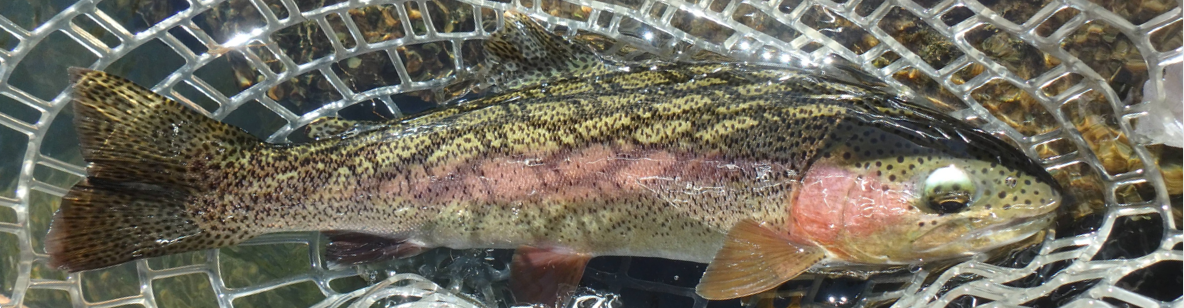
I fished for seven hours and covered significant stream miles, so the Conejos made me earn my success. If I landed a higher percentage of my hook ups, I could have easily attained a fish count of twenty. The river was reluctant to reveal its fish, and the fish were reluctant to find my net. In my opinion Conejos River brown trout are pound for pound some of the hardest fighters, that I encountered in my many years of fly fishing. Landing fifteen healthy battling Conejos River brown trout in high flows without the benefit of a green drake or pale morning dun hatch was a significant achievement.

After dinner at the campground on Wednesday evening I strolled down the road to the river and checked out the nice hole behind my campsite in 2015. As I looked on, some fish rose, so I quickly returned to site number six to collect my gear and prepared to fish. A cluster of spinners bobbed over the dirt road in the campground, so I should have recognized this as a sign of what was ahead.

Home of Elusive 16″ Brown

The wide pool was situated behind a large exposed midstream boulder with strong deep currents forming the outside border on both sides. One of those strong currents was between my position and the pool, and this made countering drag quite challenging. Initially I prospected a size 14 gray caddis in the bottom half of the pool since the rising fish were in pause mode. The fish did not respond to the caddis, so I paused to  observe and noticed a large mass of bobbing spinners above the pool. After a brief period, the rises resumed, although they were in the upper half of the pool this time. I concluded that some of the mating spinners hit the water, so I opened my fly box and spotted a size 16 rusty spinner and tied it to my line.

As I mentioned, it was extremely difficult to obtain a drag free drift as the strong current in front of me grabbed the fly line instantly. Also several tall trees were behind me, and this forced me to be very cautious of my backcasts. I managed to elicit two refusals to the rusty spinner, and it was not clear if the rejection stemmed from a poorly matched fly or drag. Eventually I would discover that it was probably the former.

Periodically the cloud of spinners vanished, and in each case the rises disappeared. Clearly there was a relationship between spinners and feeding fish. During one of the lulls a sixteen inch brown trout launched two feet above the water near the top of the pool in the area where the merging currents made it nearly impossible to create a drag free presentation. I could only observe the spinners from a distance, but they seemed to exhibit pink or light maroon bodies from a distance. Unfortunately none of these were present in my fly box. But wait a minute, what about the comparadun ruse that performed earlier on Wednesday for the green drake spinner?

Size 16 Cinnamon Comparadun with Mashed Down Wing Served As Effective Spinner Substitute

I quickly found a size 16 cinnamon comparadun and tied it to my line after mashing down the wing. Success! Two browns slurped the comparadun with the best measuring twelve inches. And what about the large brown in the heart of the swirling currents? The big boy was very discrete and cautious in its rises. As I cast to other risers, I continued to revisit the beast, and finally my heart leaped when a big head emerged and engulfed my mashed wing comparadun. As soon as my hook set pierced its lip, the brown leaped out of the water in the same manner as I witnessed earlier. Since I saw the beast twice, I knew I could not force it to my net, so I allowed it to spin line from my reel, and it charged to the far side of the large boulder at the top center of the pool. I anticipated this as trouble, so I pressured it a bit and felt pulsing thus confirming that I was still attached. The brown seemed to be sulking under the rock, so I stripped a bit of line to coax it away from the structure, but in the next instant my line went limp and the comparadun was missing in action. What an ending to a challenging yet successful day on the Conejos River.

Campground Pool Brown

Fish Landed: 17
 

Conejos River – 07/19/2016

Time: 4:30PM – 5:30PM

Location: The bend where the river moves through a canyon below The Meadows.

I stayed in my waders and kept my rod strung, when I returned to the car from Elk Creek. When I reached the turn off from CO 250 to the campground, I continued on to an area a little over a mile above the Lake Fork Campground. It was too early to eat dinner, so I decided to check out the flows on the Conejos and enjoy some overtime fishing.

The fat Albert, hares ear and salvation remained on my line, and I cast the threesome along the edges, but the only thing caught was gobs of green moss. After fifteen minutes of prospecting some tight pockets along the edge, I approached a nice pool and saw two separate rises. This prompted me to snip off the dry/dropper lineup, and I opted for a size 16 gray deer hair caddis. I was certain this would fool the carelessly rising trout, but it was ignored. Next I returned to the size twelve light yellow stimulator. Could it continue the magic? Nah, it was shunned as well.

I decided to move on, and I discovered a small side channel the size of the Lake Fork. It was located behind me, so I popped the stimulator in a deep glide, and a small brown trout smacked it. It was barely six inches, but I was pleased to count it. That was the extent of my brief sampling of the Conejos River on Tuesday.

Fish Landed: 1


Elk Creek – 07/19/2016

Time: 10:00AM – 3:00PM

Location: .3 mile above Elk Creek Campground to .5 mile above ATV bridge

Elk Creek 07/19/2016 Photo Album

The biggest story on Tuesday was ice. I checked the cooler on Tuesday morning, and all that remained was a small pile of cubes that might be sufficient to make two mixed drinks. I was not excited about the prospect of fishing the upper Conejos River again with flows continuing to rush by the campground at 180 cfs. What other options existed within the vicinity of Lake Fork Campground?

Twenty years ago Jane, Amy, Dan and I camped at Elk Creek Campground, while we devoted a day to riding the Cumbre and Toltec Scenic Railroad. During this trip I fished in Elk Creek several times and experienced reasonable success. I read several glowing articles in the fly fishing magazines subsequent to that trip, and each time I made the trek to the Conejos, I considered spending a day on Elk Creek. Given the difficult conditions on the Conejos River, I concluded that Tuesday July 19 was the perfect opportunity to fulfill my desire to return to Elk Creek. Elk Creek is a significant freestone tributary to the Conejos and not subject to releases from a dam, and I viewed this as a major positive.

Unfortunately Elk Creek merges with the Conejos River near the junction of CO 17 and CO 250. This meant that I needed to repeat the eighteen mile drive on the rough dirt road, and if I desired to return to the campground on Tuesday evening, I was required to endure 36 miles of washboard misery. And what about the ice? In 2015 I drove north on CO 250  for six miles to the small summer resort town of Platoro, and I was able to purchase ice at a general store. I did not relish driving in the opposite direction from where I planned to fish, but then I remembered a small store and restaurant at the intersection of CO 17 and 250. I could buy ice there, and afterward only a one mile trip was necessary to reach the Elk Creek Campground and the trail that follows Elk Creek.

I was sold on the plan and fortunately began my drive before 8AM. I suffered the bumps and vibrations of the eighteen mile creep at 25 MPH, but when I reached the store, I was shocked to learn that it was out of business. Now what? I was in dire need of ice, and I remembered the Fox Creek Store located ten miles east on CO 17. I tried to recall its status from when I traveled past it on Sunday, but I could not recall this detail. Lacking options I continued east, and I was again sorely disappointed to discover another closed store. Apparently the general store business in the Conejos Valley is not thriving.

Just before reaching the boarded up Fox Creek Store, I noticed a billboard advertising phone, restaurant and lodging at the Conejos River Ranch. Another objective of my visit to civilization was to call Jane to let her know I was alive and well. Certainly a ranch advertising a phone, lodging and food would also have an ice supply. I made a quick turnaround and followed a dirt lane for .3 mile until I entered the Conejos River Ranch parking lot. Several burros were milling about in a fenced in corral on the right, and a sign pointed to the office on the left. I followed the sign for the office and entered a small tidy restaurant where several customers enjoyed their breakfast.

The waitress announced that she would be with me in a moment. After a few minutes she moved behind the counter and asked how she might help. I asked if she had ice, and she apologized and informed me that she was out. I then asked where the closest source of ice was, and she groaned and delivered the unwelcome news that Antonito was the nearest place to buy ice. Antonito is the small town where the Cumbre & Toltec Scenic Railroad begins, and it was another eleven miles away. I uttered some words of disappointment and then asked if I might pay her to use the land line to check in with my wife. Feeling sorry for my ice dilemma, she offered me the cordless phone on the counter, and graciously added that there was no need to pay. I immediately dialed Jane’s mobile number, but she did not answer, so I left a brief voice mail that informed her that I was alive and well.

As I left the restaurant I silently cursed my misfortune, and then bid the donkeys goodbye and drove back over the dirt lane to CO 17 and maximized the posted speed limit until I was at the grocery store in Antonito, where I purchased a ten pound bag of ice. With this duty behind me, I sped the twenty-one miles back to Elk Creek Campground where I prepared to fish. The ice trip cost me an hour, and by the time I rigged my Orvis Access four weight and pulled on my waders, it was 10 o’clock. I parked by the bridge that crossed Elk Creek and led to the campground, and when ready I began hiking along the east side of the creek.

In order to avoid the water that is inevitably hammered by the campers I hiked for .3 mile before I began to fish. I tied a size ten Chernobyl ant to my line and then added the ever present hares ear and salvation. I covered a fair amount of decent water in the first hour, but I was not rewarded with a single fish. The Conejos was in my dog house, and it produced two fish in the first half hour on Monday. During the first hour I exchanged the Chernobyl for a Charlie boy hopper, and this move produced two refusals, but the fish counter remained locked on zero.

I paused to analyze the situation. Clearly the fish were looking to the surface for food as evidenced by the refusals to the Charlie boy. A few medium sized stoneflies were in the air, so I removed the dry/dropper lineup and tied on a size 14 light yellow stimulator. If fish responded to this fly on the Lake Fork, how could they resist it on another Conejos tributary? The change proved to be a stroke of genius, as I landed twenty additional trout between 11AM and 2PM.

The very first fish was amazing. I approached a delicious pool with a strong current splitting it in half. I dropped the stimulator along the right side of the current seam near the tail out of the run, and guess what happened? A twenty inch rainbow trout materialized from the depths and sipped in the stonefly. What a visual thrill! I allowed the large fish to strip out line, and then I regained some ground by pulling line back to my feet as I maintained tension. The rainbow executed several subsequent bursts, but then it tired, and I maneuvered the brute toward my net. As I lifted the fish’s head toward the net, it twisted and came free. I counted it as a landed fish, but I must admit that I was sorely disappointed to miss the chance to collect a photo.

This Little Ribbon Yielded Two Gorgeous Browns

A Nice Elk Creek Catch

In a state of jubilation and minor sadness I moved to the next attractive area where a deep ribbon of slower moving water existed between the swift center current and a large exposed boulder. A thirteen inch brown trout confidently sucked in the stimulator just beyond the boulder, and then a fourteen inch brown trout slurped the hackled stonefly imitation in front of the boulder. At this point I pinched myself, as I was convinced that my day would consist of oversized trout for the relatively small Elk Creek.

How About This for a Small Stream Beast?

I quickly learned that was not the case, but over the course of my time on Elk Creek I did land a deeply colored fifteen inch brown, and three others in the twelve inch range. All but one of the first twenty fish landed chomped one of three light yellow stimulators. The two size fourteens in my fly box performed the best, but the collar hackle on both was cut by the teeth of the aggressive fish. This forced me to deploy the size twelve, and it produced as well, but at a slower pace. After the second size fourteen unraveled I tried a size 12 and 14 light yellow stimulator with a tinge of orange, and this yielded one small fish.

Typical Stretch

By two o’clock it became quite warm, and the surface action disappeared, so I reverted to the dry/dropper approach for the last hour. My three fly lineup consisted of a yellow fat Albert, an iron sally and a salvation nymph. The abundance of stoneflies caused me to test the iron sally, as it is supposedly the nymph form of a yellow Sally. The three flies produced three additional fish including the deeply colored fifteen inch specimen that gulped the iron Sally. Unfortunately this beauty escaped while I was in the process of posing it.

At 3PM I called it quits, as I was not sure how I would return to the car. Initially I climbed a steep ridge in an effort to intersect with a horse trail, but then I was forced to execute a dicey descent on loose gravel on a steep dirt slope. Once at the bottom I found a horse path, and it was clear sailing from there to the campground.

What a day! I landed twenty-three fish on Elk Creek, and the yellow stimulators took the guess work out of fly selection. The icing on the cake was the size of the fish including the twenty inch rainbow and five or six brown trout in the twelve to fifteen inch range. Somehow the bumpy drive back to Lake Fork Campground on CO 250 seemed much more tolerable on Tuesday afternoon.

Fish Landed: 23


Lake Fork of the Conejos River – 07/18/2016

Time: 2:30PM – 4:00PM

Location: Lake Fork confluence with the main Conejos River to a short distance beyond the large pipe under CO 105.

Lake Fork of the Conejos River 07/18/2016 Photo Album

As a diversion from the fruitless casting on the Conejos, I lobbed a few casts to the small Lake Fork, and I was surprised to witness two momentary hook ups and three refusals. As one might expect, this caught my attention after the hopeless prospecting that I endured on the main river. I decided to devote the remainder of my July 18 fishing time to the tiny Lake Fork.

Small Stream Salvaged Day

Given the refusals and temporary hook ups, I experimented with smaller fare beginning with Jake’s gulp beetle with the salvation dropper, but this duo was ignored. The contrast between five interactions with trout to no interest was stark. I concluded that the fish were attracted to the yellow body color of the pool toy, but the imitation was too large, and thus they turned away or simply bumped the pool toy. I responded with a size twelve light yellow stimulator with palmered grizzly hackle over the body, and this finally yielded a twelve inch brown trout that did not escape. I was impressed that such a small stream held a twelve inch brown trout, so I decided to explore farther.

Just Pretty

Although the stimulator finally delivered a netted fish, it also provoked some refusals and momentary hook ups, so it was not a perfect fly choice. After this mixed success, I hooked another fish, and it broke off perhaps due to an abrasion in my tippet. I used this fly change as an excuse to downsize to a size 14 yellow stimulator, and what a fortuitous change it proved to be. I landed five additional Lake Fork brown trout as I worked my way from the Conejos to  the large corrugated pipe that shunted the creek under CO 105. Of course I experienced additional momentary hookups and refusals, but I had a blast finally connecting with fish, and I enjoyed constant action. The creek was so small that it was almost a waste to make more than one or two casts in each likely fish holding spot, as the motion and line quickly telegraphed my presence.

A Beast for the Lake Fork

I reached the pipe with the fish counter stuck on nine, and a momentary hookup on the juicy deep area on the right side of the midstream boulder thwarted my effort to achieve double digits. I paused, and before moving on, I lobbed a cast to the blind side of the large round exposed rock, and wham! Number ten was a nice eleven inch brown, and I coaxed it into my net. I continued beyond CO 105 on the upside of the pipe and landed one more brown trout, and then the sky darkened, and I heard distant thunder. A string of refusals temporarily destroyed my confidence in the yellow stimulator, and at 4PM the wind gusted, and sheets of rain descended from the dark sky. I paused and dug out my raincoat and hustled back to the Santa Fe for relief from the weather.

A Fish Surprised Me on the Far Side of the Boulder

The Lake Fork salvaged my day, but I was now uncertain where to fish during the remainder of my time in the Conejos River valley. I paid to camp at the Lake Fork Campground through Thursday, so I was reluctant to cut my losses to seek greener pastures.

Fish Landed: 7

Conejos River – 07/18/2016

Time: 9:00AM – 2:30PM

Location: Thirty minute hike downstream from CO 105 bridge and then back to the confluence with the Lake Fork.

Conejos River 07/18/2016 Photo Album

My anticipation for a day of fly fishing could not have been any more intense than it was when I emerged from my tent on Monday morning July 18. Arriving at the rough parking area across the CO 105 bridge at 8:00AM was ample proof of my eager anticipation of a day on the Conejos River. Were my expectations met?

I assembled my Sage four weight and began hiking at 8:15 and reached the edge of the river above an island by 8:45. I tied a yellow pool toy to my line as a visible top fly, since shadows stretched over the eastern half of the river. Below the pool toy I attached a beadhead hares ear and salvation nymph; my favored lineup of fish candy. I was ready to cast by 9AM, and I worked my way upstream and prospected viable fish holding areas until 11:30, when I found a nice place on the bank to eat lunch. During this period I landed two fish; one was a twelve inch brown that grabbed the salvation, and the second was a smaller brown trout that favored the hares ear nymph. Both fish arrived in my net in the first half hour, and thus the 10 to 11:30 time period was a long unproductive grind.

Deeply Colored Early Monday Brown

During the 1.5 hour fish catching famine I cycled through a medley of flies. First there was the size 12 Harrop deer hair green drake. This fly was a favorite in the pre-hatch morning time period in 2015, but in a year’s time it developed a disease, because the trout stayed away. A year ago I fished the Harrop in combination with a salvation nymph, so I tried that duo again on Monday, but the fish were having none of it. Maybe stoneflies were at the top of the menu? A yellow/orange stimulator was ignored. I now knew that the spruce moths had a cream body. so I knotted a cream size 14 stimulator to my line and prepared for the voracious attack. It never happened.

I decided to return to the dry/dropper technique, except I substituted a size 8 Chernobyl ant for the pool toy. This adjustment had no impact on my non-existent catch rate. I encountered a nice section of the river that consisted of shallow flats, and I spotted a fish that surfaced twice to eat. This situation was not conducive to the cumbersome dry/dropper arrangement, so I chose a size 16 gray caddis adult and a size 16 olive brown deer hair caddis, and neither excited the rising fish, or any fish in the prime location. Suddenly a flurry of yellow sallies exploded from the riffles so I tied a size 14 yellow stimulator to my line and then a size 16 yellow sally. These efforts were unappreciated by the Conejos River trout.

Despite an early start and unlimited optimism, I fished from 9:00 until 11:30, and my fish count stalled at two. Concern began to overtake my positive attitude, but I clung to the expectation that green drakes and pale morning duns would explode from the river in another half hour. At 11:30 I sat on a rock across from a prime fish holding location and consumed my sandwich, carrots and yogurt cup.

Nice Eddy Across from Where I Ate Lunch

Across from me the main current deflected off a high vertical rock wall just above a large angled deadfall. These dynamics created an attractive eddy, and during lunch I noticed four green drakes and a fairly heavy pale morning dun emergence. Surely these circumstances would create the perfect storm, and the river would come alive with rising fish. Unfortunately after lunch I discovered that these conditions were not the perfect storm for the Conejos River, and as I moved upstream to equally attractive honey holes, the trout continued to hunker down and avoid surface feeding.

As far as fly selection, with the expectation of a green drake emergence and after noticing four over lunch, I returned to the Harrop deer hair green drake, but once again the fish were unimpressed. Next I resorted to a size 16 light gray comparadun, also known as the money fly. This fly is typically a killer during pale morning dun hatches, and quite a few PMD’a were visible in the lunch hole. The comparadun generated a pair of refusals, and that was the extent of its effectiveness. In the morning I was suspicious that the flows were elevated from Sunday’s ideal levels, and now I was certain of this eventuality. I did not have access to the internet, so I could only judge by how tight the velocity was to the bank, and by the reduced number of spots that enabled trout to hold out of the fast current. The brief hatch, the lack of rising fish, the wading difficulty and the infrequent locations that I could fish all confirmed my suspicions. When I returned to Denver on Thursday and checked the stream flow graph, I discovered that flows elevated from 115 on Sunday to 180 cfs on Monday. I never experienced positive fishing results shortly after a significant increase in stream flows, and Monday continued the trend.

The pale morning comparadun was too difficult to follow in the high flows, so I decided to once again test the dry/dropper style with a yellow Letort hopper trailing a salvation nymph. Surely the light yellow hopper was a close imitation of the stoneflies hovering in the air, and certainly pale morning duns were present in the drift given the number of adults in the air. My theory was somewhat confirmed as I landed two thirteen inch brown trout between noon and two on the salvation nymph. Both of these fish snatched the nymph as it drifted along the seam in smooth slicks behind exposed midstream boulders.

Much Appreciated Trout on Monday

The Letort hopper was ineffective, so I went the foam route with a tan pool toy, and this improved the buoyancy but did not impact fish feeding behavior. In addition for brief periods I auditioned an ultra zug bug and bright green caddis pupa along side the salvation nymph. Besides landing two fish, I devoted a lot of time to knot tying practice. By 2:30 I was totally bored with the inactivity and cursing the water managers for ruining my day and potentially impacting my trip by ramping up the flow rate. It was around this time that I intersected with the Lake Fork, a small tributary of the Conejos.

The elevated flows and lack of surface activity certainly lowered my expectations for my long anticipated trip to the Conejos. I consciously arranged to visit the area several days earlier, since it seemed that the main body of green drakes had already migrated to The Meadows area in 2015. I was sorely disappointed and uncertain how to best utilize my two precious remaining days in south central Colorado. Four fish in 5.5 hours is simply tough fishing, and I dreaded enduring two more full days of sub-par catch rates.

Fish Landed: 4