Yellow Stimulators – 02/21/2017

Yellow Stimulators 02/21/2017 Photo Album

Stimulators have become one of my favorite searching patterns over the past several seasons. Prior to last year I tied quite a few in an assortment of body colors; yellow, olive, peacock, black, tan and red. The heavily hackled attractors in size 16 and 14 performed admirably on the various Colorado streams, but the color that clearly distinguished itself as a necessity in my fly box was the light yellow version.

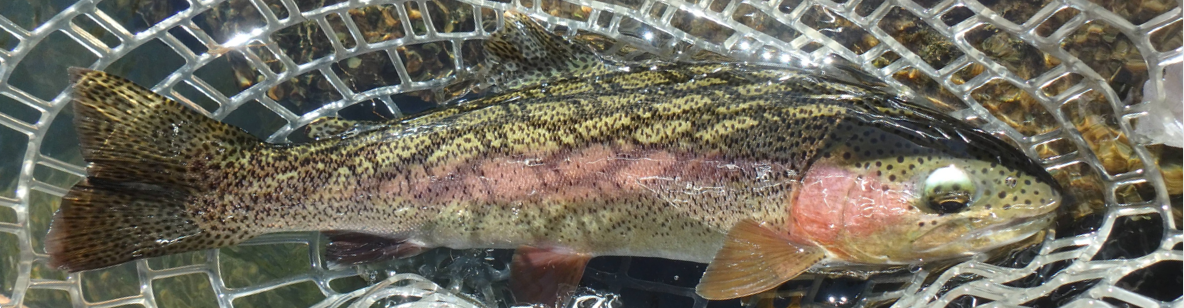
Very Nice

My devotion to the yellow stimulator began on the Lake Fork of the Conejos River on July 18, 2016. I experienced a day of frustration on the main stem of the Conejos, and in an act of despair, I diverged on to the tiny Lake Fork tributary. Initially I was surprised by an abundance of refusals to a pool toy with a yellow body. I was encouraged by the sudden attention, but it took me a fly change or two to solve the riddle. I eventually opted for a size 16 stimulator with a light yellow body, and the fish rewarded me for my persistence. During my time on the main Conejos I observed quite a few yellow Sallies and small golden stoneflies, so the effectiveness of the small yellow stimulator was not entirely unexpected.

Not wishing to suffer another day of frustration on the Conejos River on July 19 prompted me to drive to Elk Creek, a tributary seventeen miles downstream from the Lake Fork. Guess what I discovered? Amid a fairly steady emergence of yellow sallies and golden stoneflies the size 14 yellow stimulator accounted for twenty trout, and quite a few were above average size for the small tributary.

10 Size 16 Yellow Stimulators

On July 20 I accepted the challenge of the Conejos River once again despite high flows and memories of a day of futility on July 18. The sought after pale morning dun and green drake hatches never materialized, but guess what salvaged my day? A fairly heavy afternoon emergence of yellow Sallies and two sizes of golden stoneflies prompted me to once again resort to a size 14 yellow stimulator, and it proved to be a winning choice. The yellow attractor contributed eight fish to my count, and enabled me to enjoy a respectable day on the difficult main stem of the Conejos.
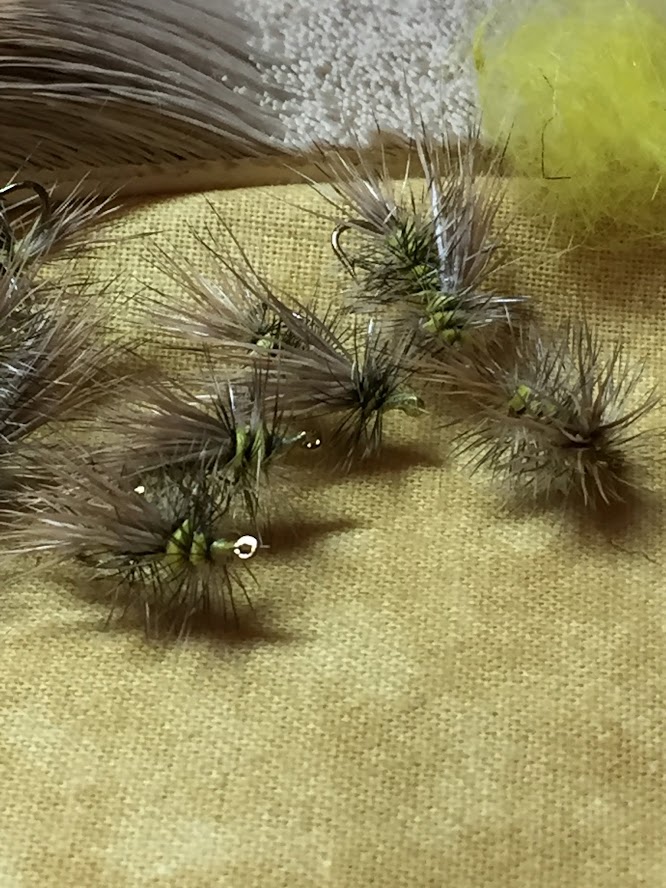
Zoomed in for a Closer Inspection

When I reviewed my posts from July 2016, I entered a reminder on my fly tying to do list to produce an adequate quantity of new yellow stimulators, and in early February this became a reality. I refreshed my memory of the tying steps with an excellent YouTube video, and then I sat down at my tying bench and produced twenty yellow stimulators. Half were made on size 16 hooks and the other half were attached to a size 14. Golden stoneflies and yellow Sallies cannot come soon enough.


Clear Creek – 02/20/2017

Time: 11:30AM – 2:00PM

Location: Mayhem Gulch area and then downstream from trail construction

Clear Creek 02/20/2017 Photo Album

Faced with high temperatures in the mid-60’s in Denver, CO, and basking in the accomplishment of landing my first fish of the year on February 17 in Clear Creek Canyon, I decided to venture forth on another February fishing trip. Of course being saddled with an injured knee that prevents me from skiing was another factor edging me toward the stream rather than the slopes.

Starting Point

Jane accompanied me on another quick visit to Clear Creek, and we arrived at the parking lot at Mayhem Gulch at 10:45. Jane decided to hike the Centennial Cone Trail, while I prepared to explore Clear Creek upstream from the Peak to Plains Trail bridge. The temperature was 48 degrees as I prepared to fish, and occasional strong gusts of wind swept down the canyon, so I elected to wear my Adidas pullover in addition to my fleece layer for the morning session.

First Fish on Presidents’ Day

The creek was clear and flowing nicely at around 25 CFS, as I rigged my line with a three fly offering that featured a yellow fat Albert as the surface indicator and a size 14 copper john followed by a beadhead hares ear nymph. The section of water that I covered in the morning was mostly in the sun, but it was wide and relatively shallow with only a few deep slower moving areas that offered decent prospects for fish. After fifteen minutes of futile casting and searching, I approached a nice slower moving shelf pool, and I lobbed my flies to the edge of the faster current. As the fat Albert drifted into the side pool, I observed a flash and set the hook. I felt a momentary connection, but then the fish was gone, and I was disappointed to miss my first hook up. Fish do not usually feed again after feeling the penetration of a hook, but this trout must have been exceptionally hungry, as it snatched the tumbling copper john on the very next drift. I maintained a taut line and quickly scooped an eight inch rainbow into my net. It was great to experience success early on my Monday fly fishing outing.

Quite an Ice Shelf

I continued upstream and carefully maneuvered over a large ice shelf until I reached water that was more suitable to edge fishing. Unfortunately the improved stream structure did not improve my luck, and I climbed the rocky bank to access the highway at 11:50. I returned to the car and grabbed my lunch, and after two bites of my sandwich Jane arrived and joined me. We situated ourselves on the eastern side of the Santa Fe and used it as a relatively effective wind screen.

Yummy Pool

Jane indicated she was open to moving to another location, so after lunch we drove a mile east of the construction zone and parked just below a series of yellow arrow signs at a sharp bend in the road. I hiked west along the shoulder of the busy highway, until I reached a manageable path that enabled me to descend the steep bank, and I resumed my upstream migration with the three fly dry/dropper system. The wind factor became a significant nuisance, as strong gusts played havoc with my casts, but I managed to persist. I added four more trout to my count between 12:30 and 2:00, and one chomped the copper john, while the other three consumed the hares ear.

Finally a Brown Trout

Surprisingly four of my landed fish on February 20 were rainbow trout and one was a brown trout. Historically I catch 80-90% brown trout from Clear Creek, so the preponderance of rainbows was baffling. The last fish of the day was also the best, as a twelve inch rainbow snatched the hares ear, as it began to swing away from the far bank on an across and downstream drift.

Distinct Spots

I was quite pleased with five fish during 2.5 hours of fishing on Presidents’ Day 2017, although the fish were admittedly on the small side. The experience was not entirely a pleasure ride, however, as I battled the relentless gusts of wind. Fortunately I tethered my hat to my head with a retaining strap, because it was blasted from my noggin at least three times. I also struggled with two wind aided tangles, and unraveling monofilament between gusts of rushing air was not enjoyable. The forecast for Tuesday predicts even warmer temperatures, but also stronger wind velocity. Should I plan another trip?

Fish Landed: 5

Last and Best Fish of the Day

Clear Creek – 02/16/2017

Time: 12:30PM – 2:30PM

Location: Below first bridge after Tunnel 1

Clear Creek 02/16/2017 Photo Album

As I departed the parking lot near Waterton Canyon, I yearned to see a trout nestled in my net on a gorgeous spring-like day in February. My return route took me to the junction of  I70 and C470 near Golden, and that placed me only a few miles east of Clear Creek Canyon. I left my rod in a fully rigged status, so I decided to head west and inspect the conditions on Clear Creek.

After turning left on US 6 I drove west through the narrow canyon for approximately three miles, until I reached the first bridge crossing over the creek. The pullout was completely vacant, so I pulled over and gazed down at the flowing water along the highway. The stream bed was mostly ice free with only a few sections with small ice shelves, so I decided to test the waters for an hour or two. I climbed back into my waders and wading boots and grabbed my Sage One five weight, and then I crossed the highway and hiked downstream below the bridge for five minutes before I carefully maneuvered over a rock jumble to the edge of the stream.

In the Shadows

I initiated my renewed quest for trout number one with a pine squirrel leech and salad spinner, but after a few futile probes of deep runs and pockets, I exchanged the tiny clear thingamabobber for a bright orange version. This improved the visibility, but the fish did not cooperate with a tug, so I once again paused to revise my approach. I removed all the deep nymph paraphernalia, and changed to a dry/dropper setup. A yellow fat Albert was attached as the surface indicator fly, and beneath it I added a beadhead ultra zug bug, and I retained the salad spinner.

This configuration endured for at least 45 minutes, but again I was stymied in my efforts to land the first trout of the year. As I slowly moved along the narrow stream and probed likely locations, I thought I observed a pair of refusals to the fat Albert, and this prompted me to exchange it for a size 8 Chernobyl ant with brown and black barred legs. If fish were refusing the fat Albert, perhaps the more subtle low riding ant would induce them to eat? Unfortunately as I advanced, I continued to experience only arm exercise with no signs of fish. I was in the shadows in the early afternoon, and the dim light and low riding Chernboyl made following my flies challenging.

The lack of action caused me to lose confidence in the ultra zug bug and salad spinner, so I responded by swapping a beadhead hares ear for the salad spinner. The hares ear is one of my most reliable flies year after year, so why not give it some time on my line? At 1:30PM I approached a nice shelf pool on my side of the creek, so I lobbed a couple casts to some deep water between the point of an exposed rock and some faster water. Just as the Chernobyl drifted into the slow moving shelf pocket behind the rock, I detected a pause and reacted with an abrupt hook set. The tip of the rod throbbed as I connected with a fish, and I quickly recognized a brown trout, as it swirled and deployed ineffective escape maneuvers. I maintained tension and gradually guided the eleven inch brown trout to my net, and then I snapped a couple photos and a brief video, as I released the valiant fighter into the ice cold winter flows. I was not surprised to learn that the hungry brown trout gulped the trusted hares ear nymph.

First Fish of 2017

When I resumed fishing, my left hand grew stiff and began to ache as the moisture quickly evaporated in the dry mountain atmosphere. I realized that I was approaching the bridge, and only a few more attractive spaces remained, so I braced myself against the chill and fished on. Surely additional trout were in feeding mode as a result of the unseasonably warm temperatures. Alas this was not the case, and I reeled up my line at 2PM and called it quits. I managed to land one trout on February 16, but that was enough to activate my dormant fervor for fly fishing. Let the fish counter begin.

Fish Landed: 1

First Crocus of 2017 As Well


South Platte River – 02/16/2017

Time: 9:30AM – 11:30AM

Location: Waterton Canyon

South Platte River 02/16/2017 Photo Album

My friend Danny Ryan convinced me to get out of the house and fish. The high temperature in Denver was forecast to spike in the mid-seventies, and I needed to focus my mind on something other than the injury I sustained while skiing at Breckenridge on February 6. I slapped an elastic knee brace on my left knee and packed the new Santa Fe and departed for southwest Denver and Waterton Canyon.

In anticipation of my second fishing outing of 2017 I spent Wednesday afternoon transferring my flies from my old streamer wallet to a new one, that I received as a Christmas gift. I pruned quite a few ancient flies from my collection and vastly improved the organization of my streamer and nymph container. I should probably devote an afternoon to this every year prior to fishing early in the season.

Done. New Streamer Wallet Populated.

When I arrived in the parking lot near the lower end of Waterton Canyon, the temperature was hovering around fifty degrees, so I wore my light REI down jacket. This proved to be a mistake. My first order of business was to find Danny, so I embarked on a crude path along the southeast side of the river, but after fifteen minutes of whacking through brush, he was no where to be found. I reversed my direction and crossed the road at the bridge, and then I continued on a twisting fisherman path for another twenty minutes. I passed two older fishermen near the bridge, and then I wandered a long distance without meeting another person. Where could he be? I noticed his truck was parked in the lot when I arrived, so he had to be in the vicinity.

Once again I reversed my direction and increased my pace until I returned to the bridge. By now the air temperature warmed into the upper fifties, and the extensive hiking kindled my body temperature to an overheated range. I checked the parking lot, and Danny’s truck was still in place, so I reconsidered my search options. I concluded that he must have waded downstream, so I crossed the bridge and then followed a faint path to an area where the river widened quite a bit. Two spin fishermen occupied the bank in this area, but there was no sign of Danny.

Between the Bridge and Lake

I reversed my course one final time, and as I approached the bridge, I spotted a fisherman who resembled Danny in stature. Sure enough it was him, so I shouted, and he returned a greeting. Once we connected, we progressed upstream toward the bridge and then beyond. Much to our amazement the popular deep run above the bridge was vacant, so we paused to prospect our nymph rigs in the clear deep run and pool. I spotted some movement toward the upper end of the pool, so I dropped my pine squirrel leech and salad spinner in the entry riffle. On the second drift near the heart of the pool, the small clear thingamabobber paused, and I executed a sudden hook set. For a split second I felt weight and observed the flash of a rainbow trout, but then the elusive prize escaped, and I was left to continue my pursuit of the first fish of 2017.

Attractive Hole

After some additional half-hearted casts to the pool, Danny and I abandoned the prime location and migrated farther upstream. In short order we encountered another nice deep run, so we paused and made some additional prospecting drifts, but this area was not productive. Again we reeled up our lines and continued our upstream progress to an area with an abundance of brush and fallen logs next to a deep narrow pool. Four fishermen were above us, and we did not spot any fish near our approach, so we began to circle around the other fishermen on a nice defined trail. After five minutes of walking, however, Danny decided that he needed to call it quits in order to return to work by a reasonable time.

We turned around and hiked back to the parking lot, where we said our goodbyes and promised to meet again in the near future. I enjoyed my time outdoors in the mild February weather, but the fishing was extremely slow. The low water translated to very few deep holding spots, and the fish seemed to be in scarce supply. At least I experienced my first connection of the new year.

Fish Landed: 0

CDC Blue Winged Olive – 02/15/2017

CDC Blue Winged Olive 02/15/2017 Photo Album

There is no more essential fly required to sustain success throughout the season than a small blue winged olive imitation. These abundant mayflies hatch nearly year round, if one includes freestone and tailwater fisheries on one’s itinerary. Over the last ten years I settled on a CDC-wing BWO imitation, and it served me well. The CDC BWO is a tiny comparadun, however, I substitute medium dun CDC fibers for deer hair to form a wing. I tie exclusively size 22 and 24 flies, and deer hair contains too much bulk for these diminutive replicas of the baetis mayflies that populate Colorado streams. A slender profile is necessary to convince selective blue winged olive feeders to mistake my flies for naturals.

Another One

A critical feature of the CDC BWO is the delicate split tails. I use dun microfibbets and strive to create two tail fibers that split at forty-five degree angles from each side of the hook shank. Historically I struggled to acheive this goal while maintaining the tail fibers on an even plain. Last year I searched online and found a brief instructional piece that solved my problem. When I attach the thread, I make a small bump at the rear of the hook shank, and then allow a three inch tag end of the thread to dangle. I tie two microfibbets to the top of the shank and make thread wraps back until I am 1/8 inch from the thread bump. Next I pull the tag end of the thread upward and split the tails and then pull forward and down until the near fiber approximates the position I desire. I switch hands and hold the tag thread with my right hand while I lock it down with a couple thread wraps with the bobbin in my left hand. I once again switch hands, and I continue wrapping thread back toward the bump with my right hand as I preen the fiber on the far side into the correct angle and position. I find that this technique yields nearly perfect split tails every time.

Nice Close Up of the Feather


I counted nineteen size 24 olives in my combined fly bins, so I manufactured six additional imitations to bring my total to 25. Next I inventoried my size 22 supply and discovered 34, so I made an additional six to bring my total to 40. If I am lucky, these flies will see action in the not too distant future, as blue winged olive hatches often commence in the middle of March.

Dun Microfibbets and CDC


Chernobyl Ant – 02/12/2017

Chernobyl Ant 02/12/2017 Photo Album

When I counted my supply of black Chernobyl ants the other day, I discovered that I possessed 28 size 8 or 10 flies, and twelve size 6 versions. This quantity is actually fairly close to my desired beginning inventory, so I merely produced two additional size 8’s and three more size 6’s. The high number of remaining Chernobyl’s is indicative of my tendency to migrate away from the popular black foam attractor toward the fat Albert in the spring and summer season and toward Jake’s gulp beetle in the fall.

Size 6 Top View

During the previous season I discovered that the size 8 and 10 ants did not easily support two beadhead nymphs, so I tied fifteen size 6 versions. This solved the problem of a sinking top fly, but the fish seemed to avoid the larger foam ant, and consequently I opted more frequently for a large buoyant fat Albert. The fat Albert did a superior job of supporting two size 14 beadhead nymphs, but it also surprised me with its fish attracting capability.

Late in the season even the smaller Chernobyls generated refusals. I concluded that the fish were drawn toward terrestrials on the surface, but they were discouraged from gulping due to the abnormally large size. I adjusted to this circumstance by choosing a size 10 or 12 Jake’s gulp beetle, and the fish awarded this move with a solid thumbs up.

Foam, Chenille and Rubber Legs Do the Job

In summary the fat Albert and Jake’s gulp beetle appropriated fishing time from the Chernobyl ant. Despite this turn of events, I continue to value the Chernboyl ant as a key weapon in my fly fishing arsenal. During my long history with this fly I refined it to the point where I am satisfied with its durability and performance. One critical modification was attaching the foam on the downside of the bend, and then folding it over the top to prevent spinning around the shank. Last year I began utilizing heavier hooks such as a Tiemco 5262 or equivalent. The extra weight served as a keel that enabled the fly to land in the desired position most of the time. Long legs seemed to contribute to the foam ant landing upside down, so I now limit the rubber leg extension to one body segment in length. The pinching effect of the thread tended to pull the legs in, so that they extended in a tight parallel manner at ninety degrees from the body. I disliked this look, so I began making narrowly spaced thread wraps around the body to attach the leg material. Given this history of refinement I do not expect to abandon the Chernboyl ant anytime soon.

Three Size 6 and Two Size 8

Pool Toy Hopper – 02/11/2017

Pool Toy Hopper 02/11/2017 Photo Album

Evidence that I made a more significant commitment to the pool toy hopper is documented by the seven decommissioned foam imitations in my refurbishment canister. During 2017 I knotted this buoyant and visible terrestrial imitation to my line quite frequently, and as expected, it accounted for a considerable number of fish. I continue to believe, however, that a simple yellow Letort hopper would outperform a pool toy or Charlie Boy hopper, if I dedicated an equal amount of playing time to the grasshopper imitation created in Pennsylvania. Unfortunately the Letort hopper does not possess the buoyancy that I crave in my dry/dropper configurations, so I cling to the pool toy and Charlie boy hoppers as my surface fly during summer sessions. The pool toy seems to attract more fish than the Charlie boy, and I dislike dealing with the super glue that is fundamental to Charlie boy construction.

I Like This One

During 2017 I stumbled across a competing foam attractor that stole line time from the pool toy. The fat Albert proved to be a superior indicator fly that was effective in supporting two size 14 beadhead nymphs. In addition it duped quite a few Colorado trout as either a golden stonefly or grasshopper fraud. It even fooled a wily Pennsylvania brown trout on Penns Creek that presumably mistook it for an eastern golden stonefly. I shifted my loyalties from the fat Albert to the pool toy during the prime summer months in Colorado, but then I reverted to the fat Albert in the fall season, and it did not disappoint.

Despite my newfound love affair with the fat Albert, I decided to hedge my bets, and I increased my pool toy supply by fifteen for the coming season. I counted twenty carry overs from the previous seasons, so this puts my inventory at thirty-five, and this is assuredly the greatest quantity of pool toys to occupy my fly bins.

Associated Materials

The retired flies in my canister served as my starting point. The bodies of these handicapped flies were intact; however, all were missing legs to varying degrees. I managed to attach my thread at the midpoint to attach replacement hind legs, or in other cases I tied down the thread near the eye and added front appendages. This process also tightened the foam to the hook shank and increased the stability of the flies.

Seven Refurbished Pool Toys

After I refurbished the seven misfits, I moved on to constructing new pool toys. I tied the freshly minted foam hoppers on size 8 hooks, and I generated three with tan bodies, four with light yellow and one with a tan ice dub body. I am anxious to give the ice dub version a test. Hopper season cannot come soon enough.

Eight New Pool Toys Ready for Action

Iron Sally – 02/09/2017

Iron Sally 02/09/2017 Photo Album

You can check out my introduction to the iron sally on my posts of 01/20/2013 and 02/04/2014. This is a fly that I should probably knot on my line more frequently. It is intended to imitate the nymph stage of a yellow sally stonefly; however, it also works as a subsurface imitation of golden stoneflies. The iron sally nymph takes longer to tie than most of the nymphs that I stock in my fly box, and this historically translated to fewer flies in my beginning inventory. Because I detest tying flies during the season, when I prefer to be on a stream, I too often shy away from the iron sally in an effort to preserve my quantity on hand. Preserve for what?

Nice Shine

On 06/28/2017 I experienced my best day of fishing in 2016 on the Yampa River, and the iron sally was the star player. During the afternoon I spotted several yellow sallies, so I featured the iron sally as a dropper beneath a fat Albert foam top fly, and the Yampa River residents went crazy. Not only did the iron sally produce quantities of fish, but the size of the landed trout was abnormally large. The memory of this day induced me to get serious in 2017, and I whipped out fifteen new sparkling imitations to go with the thirteen carryovers from last year.

Iron Sally Jewels

I will begin the 2017 season with twenty-eight, and I expect this larger quantity to buffer me against the higher demands of more time on my fishing line. A few days in my future that approach 06/28/2017 will make me a very happy fly fisherman.

15 Iron Sallies Completed

Mercury Black Beauty – 02/03/2017

Mercury Black Beauty 02/03/2017 Photo Album

Historically I relied almost entirely on a size 20 zebra midge for my subsurface midge larva imitation, and it served me reasonably well. I should probably resort to subsurface midge flies more frequently. On the infrequent occasions when I knotted them to my line, they generally surprised me with their productivity.

During a trip to the South Platte River in 2015, my friend Danny Ryan impressed me with a midge larva/emerger imitation, that he designed and created, and as a result I produced some of them for 2016 and then replenished my supply for 2017. Danny asked me to low key his fly, so I will honor that commitment, and avoid further details in this post.

Nice Zoom

When I attended the Fly Fishing Show in Denver in January, I watched Pat Dorsey tie flies, and his main focus was midge imitations. He swore that the tiny midge facsimiles were tremendous producers all year round, but particularly in the winter when midges represent the main source of nutrients for trout. I was especially attracted to the mercury black beauty, and as a consequence I took a seat at my fly tying bench and generated an initial supply for 2017. I made ten size 18’s and ten size 20’s. I added a flashback strip of pearl flashabou to all the 18’s and half the 20’s.

20 Completed

I tried the size 18 flashback mercury black beauty on my initial fishing trip to the South Platte River on January 30, but it failed to interest the local trout. I have not given up on the new fly, however, since the cold icy conditions did not lend themselves to a fair trial.

Vail – 02/01/2017

Vail 02/01/2017 Photo Album

Normally I limit my posts to fly fishing trips and extended vacations and road trips that differentiate my life from my daily routine. My day of skiing at Vail yesterday was so outstanding, that I felt the need to document it while fresh in my memory.

Jane and I took advantage of ideal winter temperatures; and we invited our friends, Dave and Karen Gaige and Fred and Douggie Young, to join us. As predicted the sky was bright blue, and the sun was brilliant during our five hour visit to Vail Ski Resort. The high temperature hovered around freezing, and these weather factors produced nearly ideal conditions for an enjoyable day of skiing in the Colorado high country.

The Turn for Little Ollie

After lunch our group of six ventured into Blue Sky Basin, and on the first descent of Little Ollie, Fred observed an inviting situation that demanded further exploration. A large bowl was positioned beneath the Skyline lift, and a huge cornice adorned the western rim. This natural snow formation builds throughout the season, and the wind blows snow across the lip and deposits it on the concave eastern side. As we skied by, Fred observed areas with a smooth collection of wind blown snow, and he suggested that we should explore it on our next run.

I reluctantly agreed, and we carefully skirted the edge of the cornice on our next loop. Sure enough as we slowly descended, we noticed a section that was as smooth as an untouched sand dune, so we decided to approach. The snow curled over the steep wall and created a C-shaped configuration. My heart pounded and jumped in my throat, as I gazed at the near vertical pitch of the snow wall that extended for ten feet below the cornice. Fred was undeterred, as he guided his skis to the edge, and then he took the plunge. He traversed a bit and then executed a sharp turn and zig zagged his way down the slope until he came to a stop 25 yards below.

I filmed a portion of his run with my camera, and as I was restoring it to my parka pocket, a group of four skiers approached from above. They watched Fred do his thing, and I heard the likely leader of the group comment that, “he did not sink in”. I was not anxious to wait for the four new arrivals to blemish the bowl, so I hurriedly approached the precipice and elevated my courage. In a flash I slid over the edge and followed Fred’s lead by traversing just below the lip for five feet, and then I twisted my lower body and launched a sharp jump turn. I will never forget the next vision. A wave of sparkling ice crystals initiated by my traverse tumbled in front of me, and I glided through it and reversed my course with another adrenaline fueled turn to the left. What a rush! My heart was pounding and endorphins flooded my brain, as I connected three or four additional turns until I came to a stop in front of Fred.

I Skied This

It was a two minute skiing sequence that I will never forget, and I have to admit that I was a bit energized by the group of four spectators perched on the rim of the bowl above me. In addition to the primal need to survive, I did not wish to embarrass myself in full view of the other skiers. Other memorable runs took place during February 1 at Vail, but the Lover’s Leap episode will never fade.