Category Archives: South Platte River

South Platte River – 05/16/2014

Time: 10:30AM – 4:00PM

Location: Wildcat Canyon

Fish Landed: 21

South Platte River 05/16/2014 Photo Album

The Mothers’ Day snowstorm came and went, but the air temperatures remained unseasonably cold Monday through Thursday. I was depressed and feeling sorry for myself, as I was certain that the cold winter weather caused me to miss my last chance to stream fish in Colorado before the snowmelt bloated all the rivers and streams. But just for fun, I decided to check the DWR site and review the stream flows during the middle of the week. Much to my surprise, the cold temperatures halted the snow melt, and a number of streams within a day trip of Denver were at near ideal flows. I was positioned at work to take a day off, so I made plans for a fishing excursion on Friday.

All spring I had been considering a trip to the South Platte River in the Wildcat Canyon area. I’ve fished this gorgeous stretch of water ten or so times, but always after mid-August and never in the spring before the flows climb to difficult levels. I checked the flows on the South Platte River near Lake George, and they were 85 cfs, so this concluded my deliberations. Because this destination involves a hike in excess of one hour, I prepared everything on Thursday evening so I could get off to an early start. I even made a pack in fishing list on my iPhone so that I could assure myself that I would not forget any critical item when I packed for the three mile hike away from the car. I also made a list of all the flies I thought I might need and went through my front pack and fly boxes and added flies where I determined that I might be in short supply.

Everything worked as planned, and I left my house in Denver at 6:25AM. Denver traffic slowed me a bit, but I arrived at the trailhead by 8:45AM and the dashboard thermometer registered 39 degrees. I decided to wear my waders and wading boots for the three mile hike to the river in order to lighten the load on my back, and the cold morning temperatures reinforced that decision. I wore my fleece over my Columbia long sleeved undershirt and fishing shirt, and this proved to be a mistake. Once I was on my way, the intense exertion caused me to perspire quite a bit under the fleece layer.

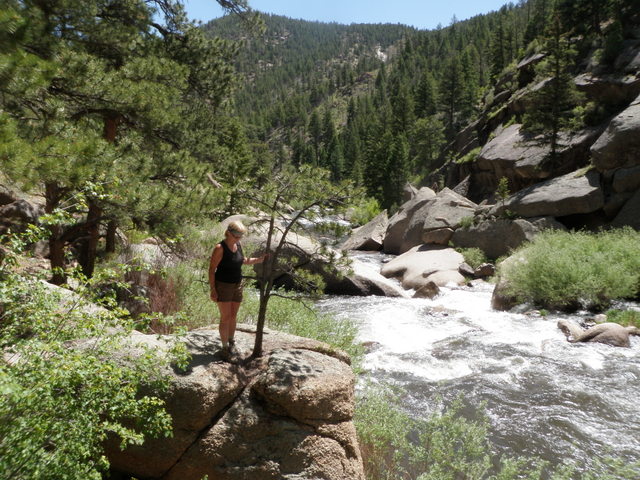
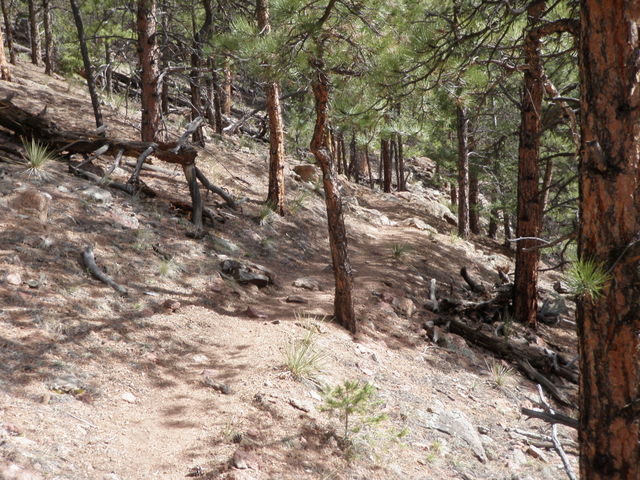
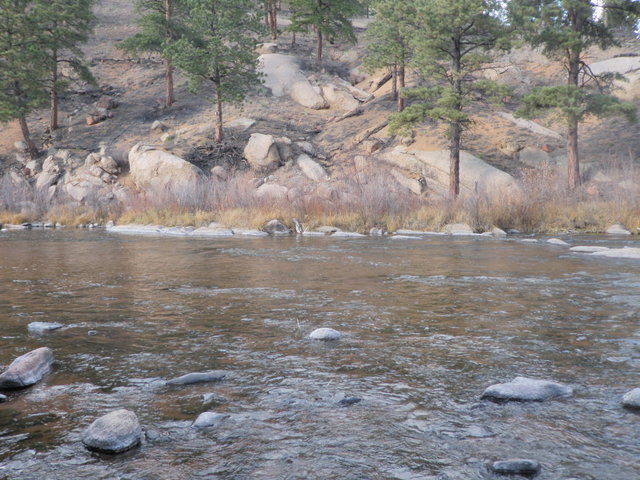
The Platte River Trail

The Platte River Trail

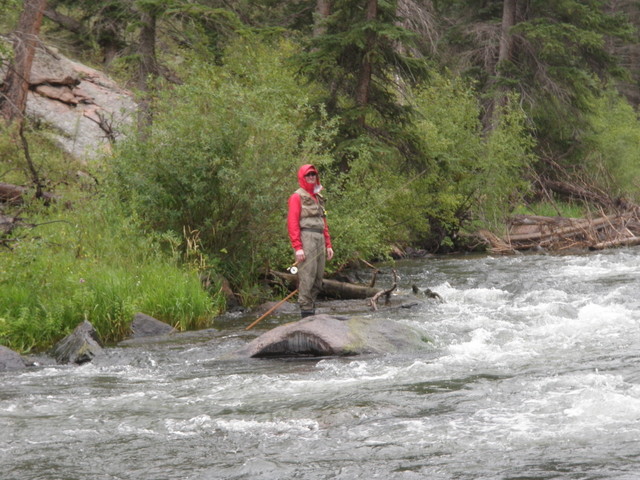
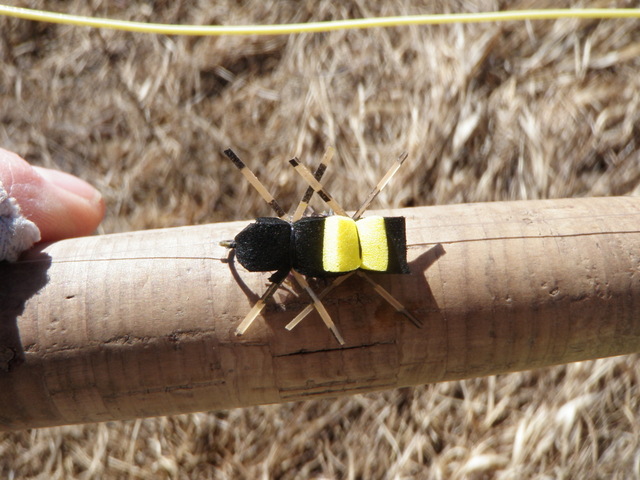
I stopped at my usual staging area at 10AM after a one hour hike and rigged my fly rod and took off the fleece layer. I stuffed my lunch and raincoat in my fishing backpack and returned to the Platte Trail and hiked for another 15 minutes downstream until I reached the spot where the river narrows into a whitewater chute. I entered just above this point and tied on a Chernobyl ant and beadhead hares ear and began prospecting all the likely locations where trout might rest and feed. I failed to land the first couple fish that I hooked but eventually landed three or four on the hares ear.

The sky was clear and the sun warmed things up considerably at this point, but I covered some attractive water without any results so I tied on another section of leader and added a salvation nymph below the hares ear nymph. This combination broke my slump, and I added a couple more trout that hammered the salvation nymph.

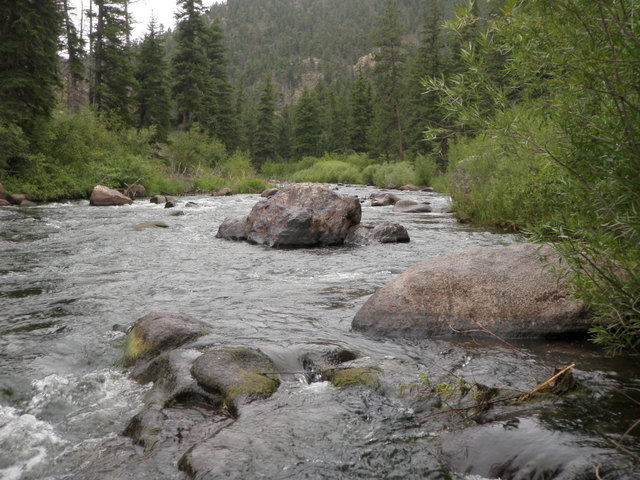
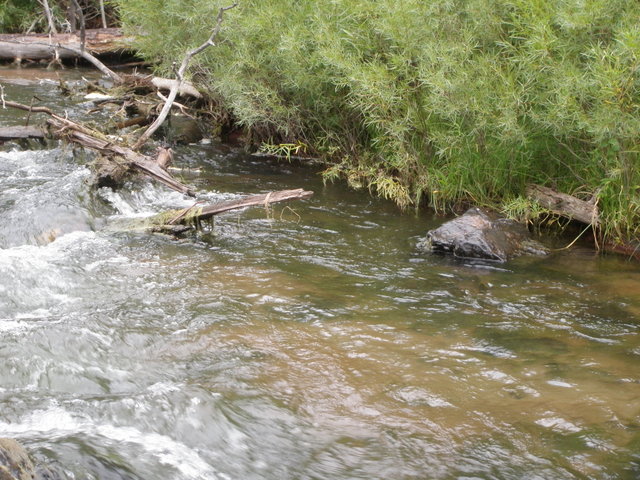
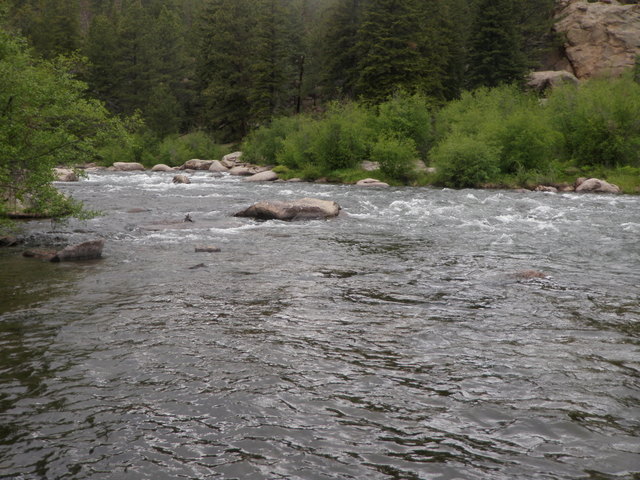
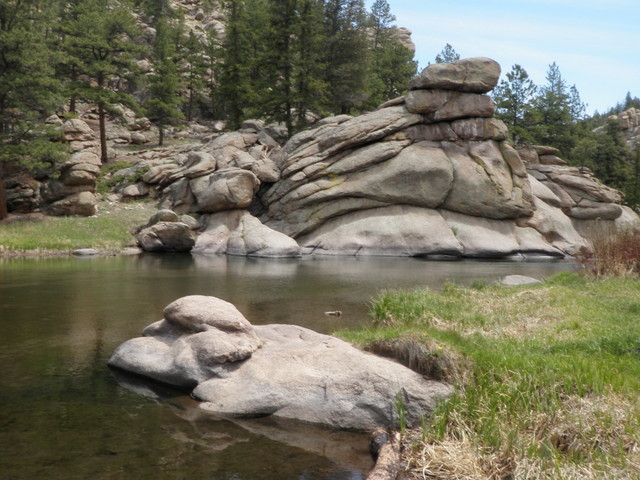
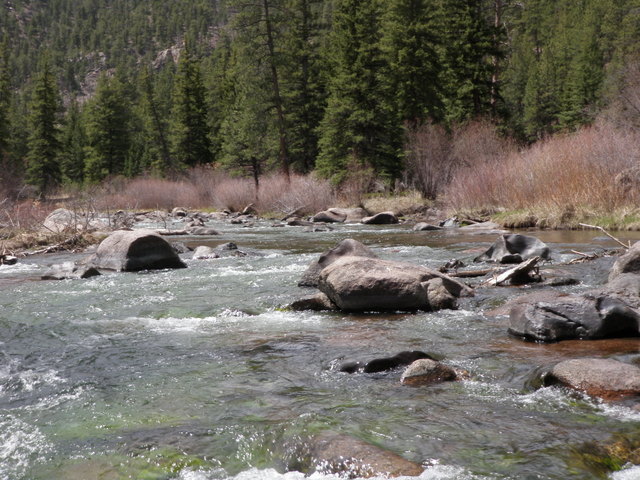
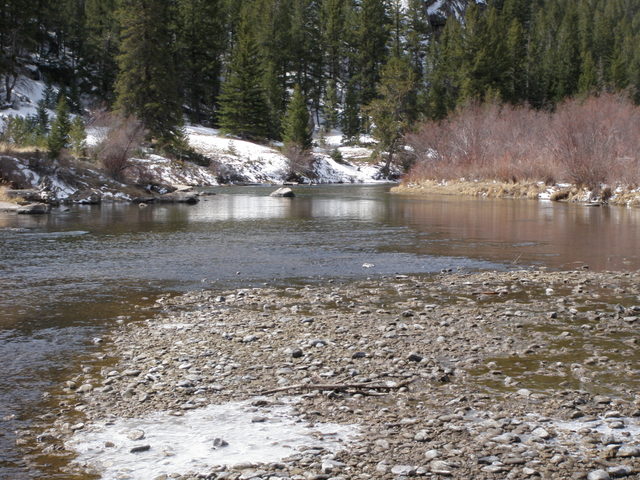
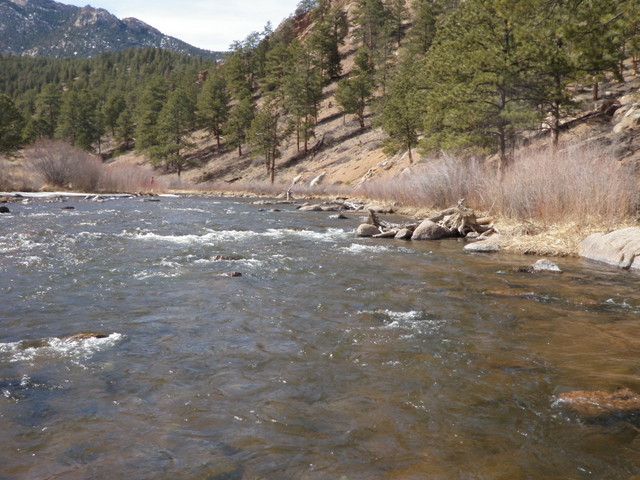
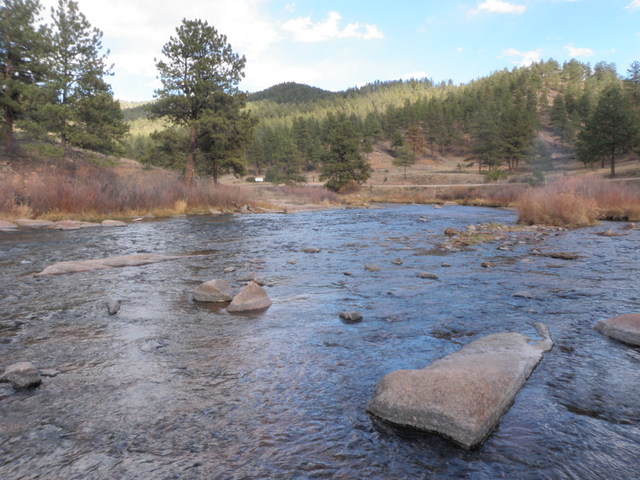
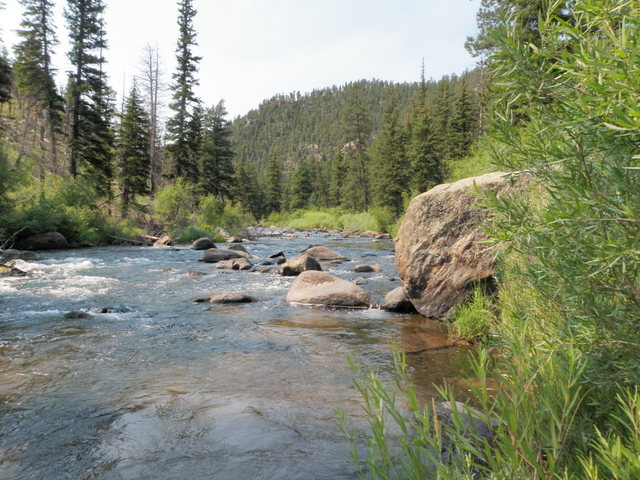
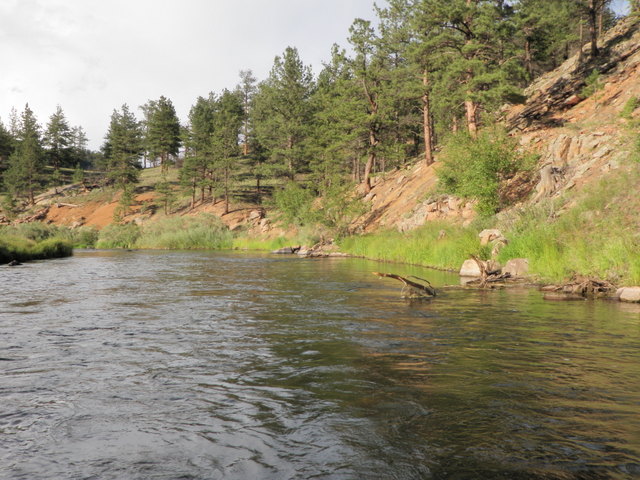
Clear and 85 CFS

Clear and 85 CFS

By noon some large gray clouds moved above the canyon and blocked the sun, and some strong breezes kicked up.  This development caused me to become quite chilled, and I thought it might rain, so I took time to remove my raincoat from my backpack and put it on over my clammy shirt. This helped for the time being, and now I was distracted by the appearance of some rises at the tail of a nice deep pool. Around this time I somehow created an enormous tangle, and in order to undo it, I removed both the subsurface flies. Before resuming, I decided to switch to a beadhead emerald caddis pupa and a small soft hackle emerger. I suspected the rises were in response to some early emerging blue winged olives, and my choice of the soft hackle emerger hopefully matched this food source. I’d also spotted a few random caddis on the water, so the emerald pupa hopefully covered this possibility.

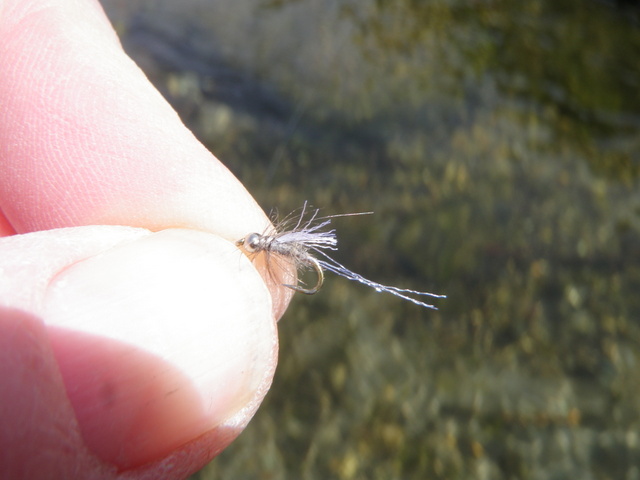
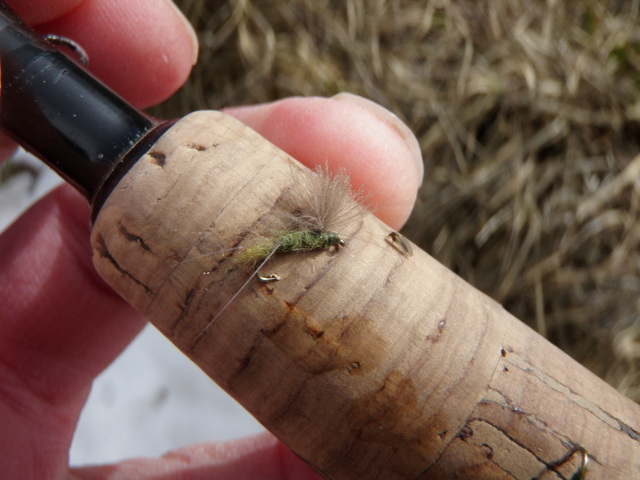
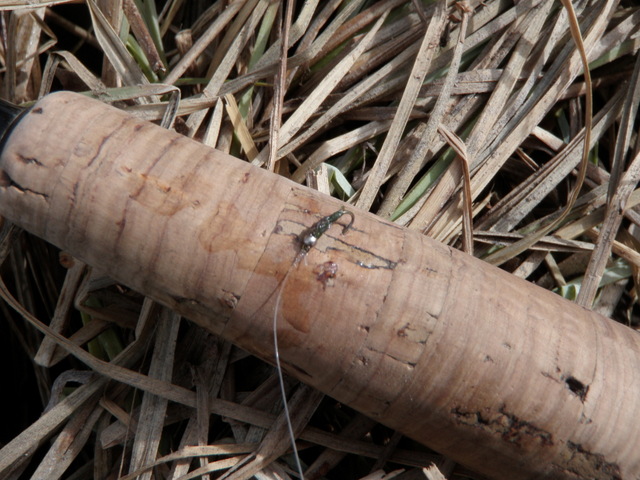
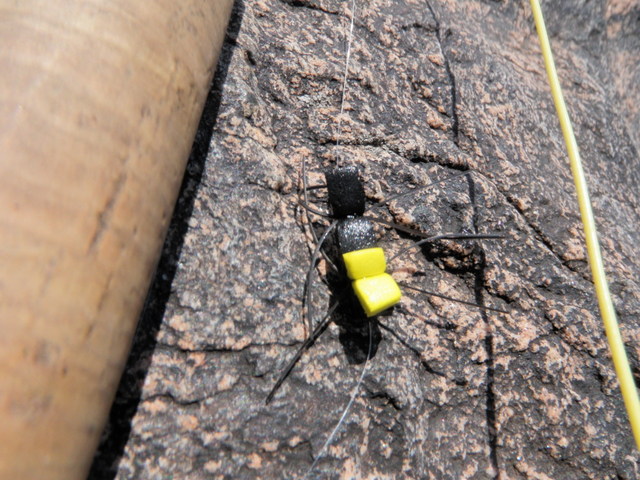
Soft Hackle Emerger Spent Some Time on My Line

Soft Hackle Emerger Spent Some Time on My Line

These choices proved to be solid, and I landed four more fish primarily on the soft hackle emerger by 12:30PM. As this successful change in strategy was evolving, the sky grew darker and strong gusts of wind became a more frequent occurrence. My sun gloves had become saturated in the process of releasing fish, and now the cooling effect of evaporation was resulting in a dull ache and constant stiffness of my fingers. My feet were more like stumps as the feeling was draining from my toes, and the moist undershirt and fishing shirt were adding to my misery. I decided to return to my backpack and obtain another layer before proceeding.

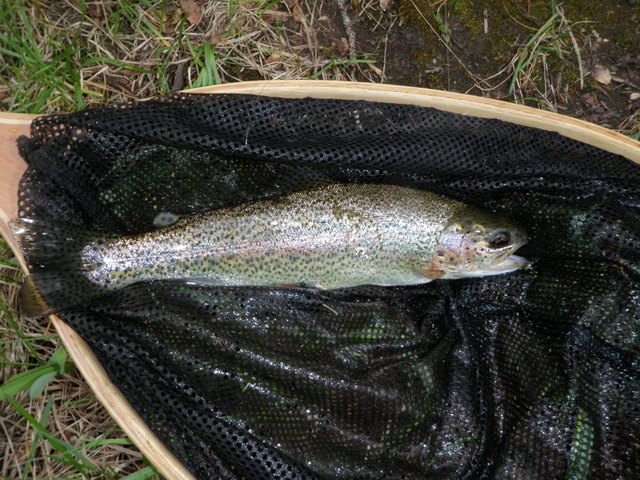
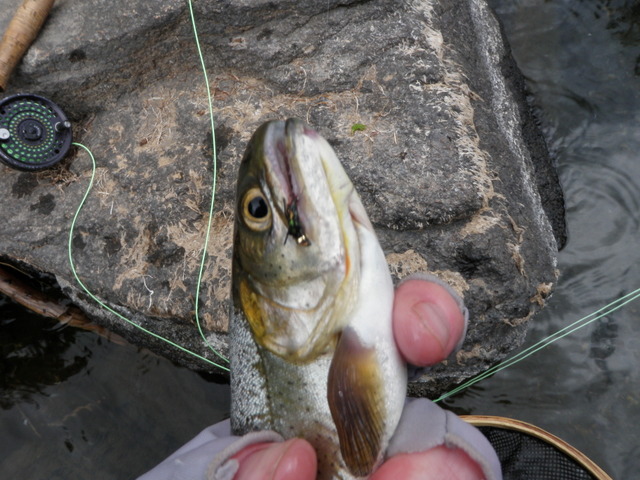
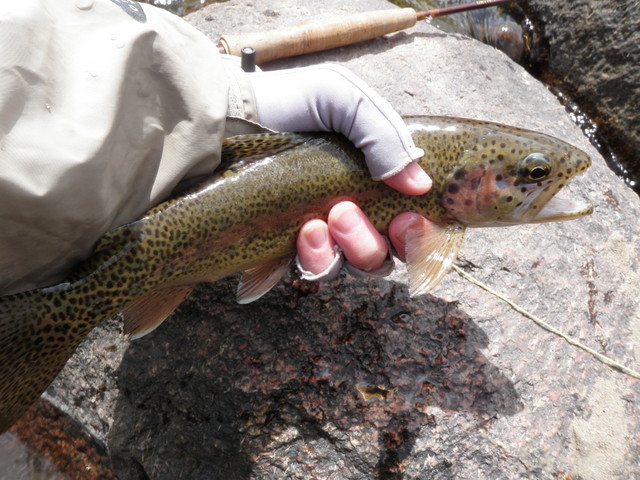
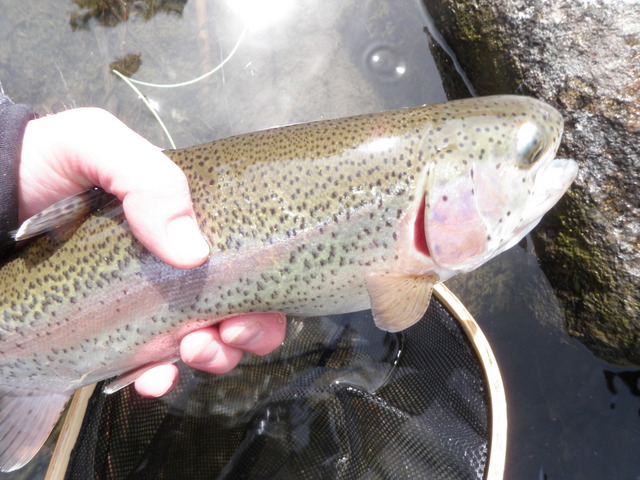
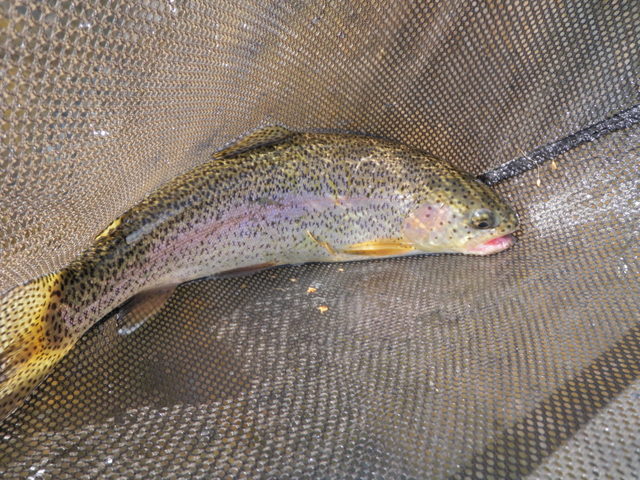
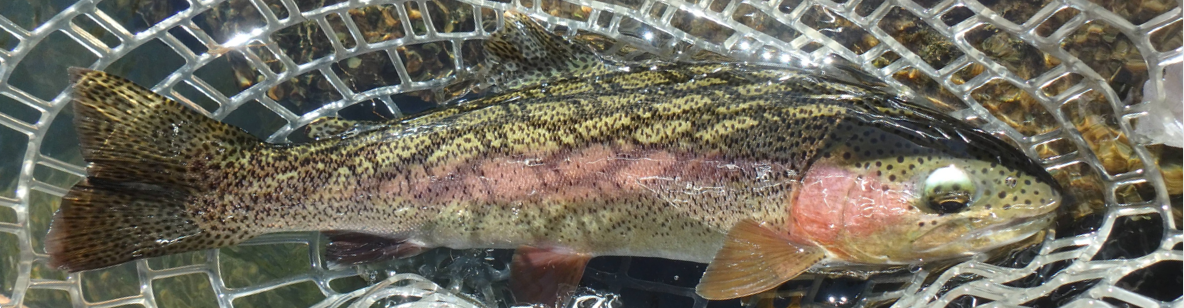
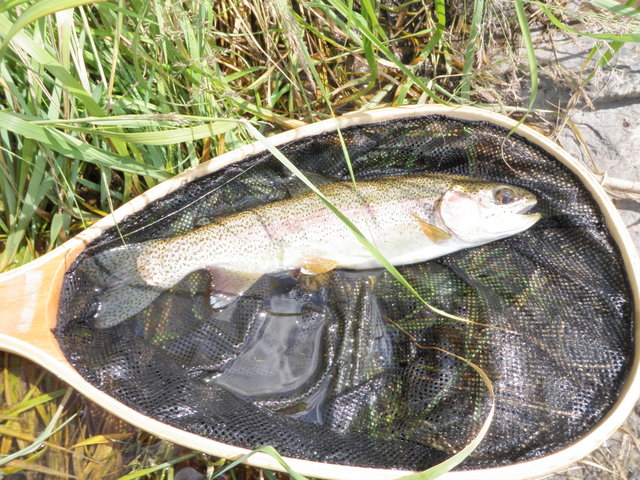
A Pretty 12 Inch Rainbow

A Pretty 12 Inch Rainbow

When I arrived back at the staging area, I discovered two fishermen in the midst of resting, and they were eating their lunch. I chatted briefly with them, and dug into my backpack and pulled out my fleece and my New Zealand hat with ear flaps. Once these were secured on my body, I decided to eat my lunch before returning to my exit point. I sat by the stream and quickly consumed my snack while watching one of the fishermen enter the nearby pool and attempt to fool some sporadic risers with a dry fly. The young fisherman was unsuccessful in his endeavor, and I finished my lunch, so I bid them farewell and walked quickly down the path to my ending point prior to lunch.

I was much more comfortable when I entered the river, and the warm hat probably made the most difference. I continued prospecting the water with the Chernobyl ant, emerald caddis pupa and soft hackle emerger for the remainder of the afternoon and added another eleven fish to my total of ten before lunch. I spotted the occasional blue winged olive in the air, but the hatch was quite sparse. Fortunately this did not seem to hinder the fish from being on the lookout for the tasty tiny morsels that drifted in the water column as I landed most of my fish on the soft hackle emerger.

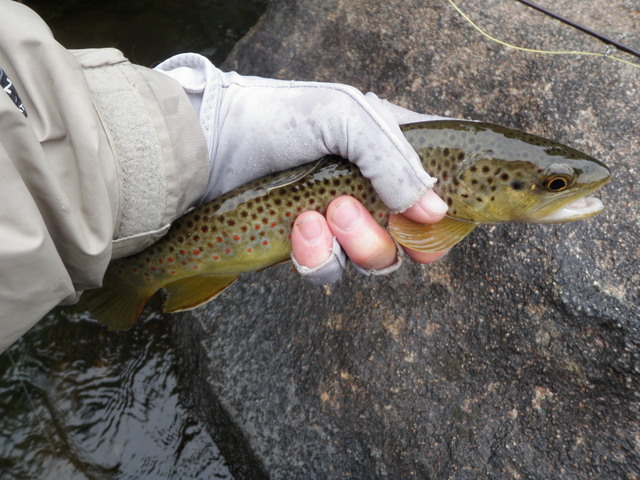
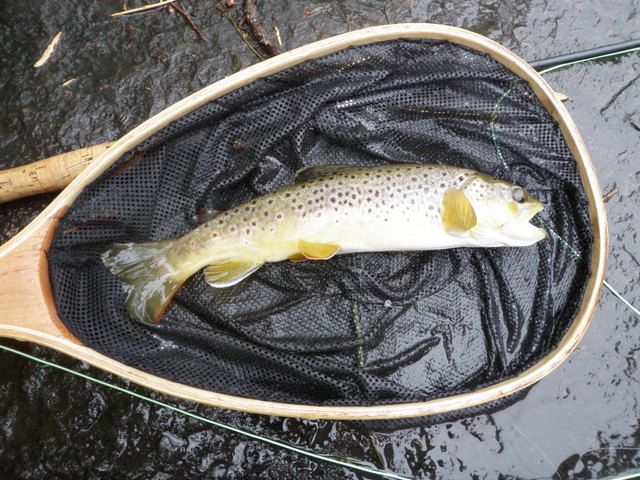
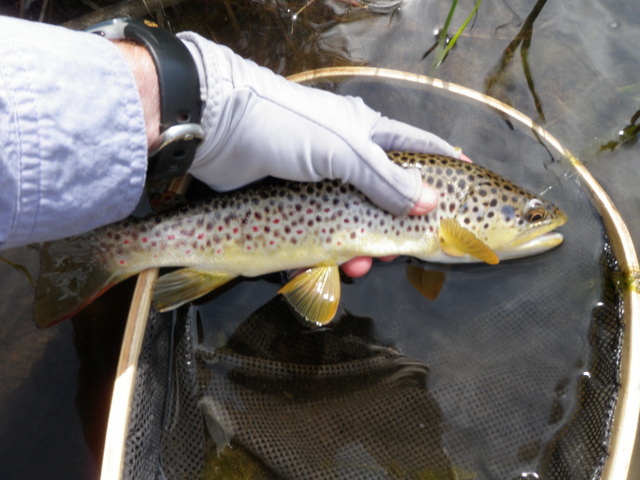
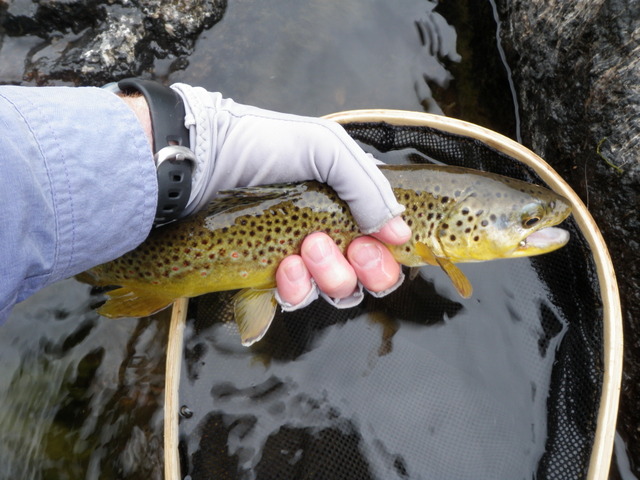
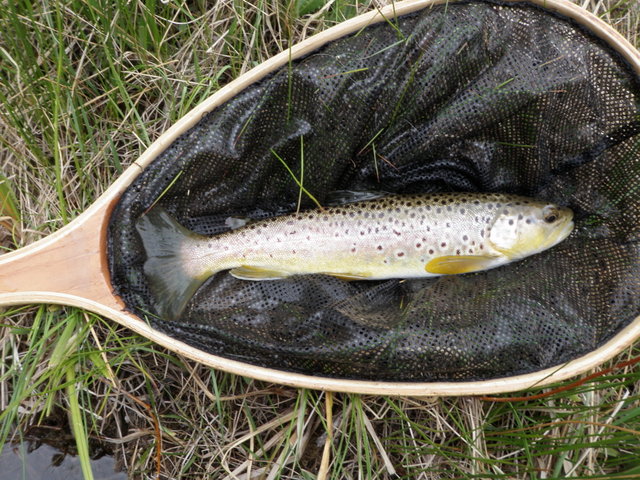
One of the Nicer Brown Trout

One of the Nicer Brown Trout

As I’ve stated previously in this blog, I relish this sort of fishing. I moved quickly up the river and popped three to five casts in all the likely pockets, runs and pools and picked up fish on a regular basis. It didn’t take long to discover that the most productive areas were deep troughs at the very tail of pools where two currents merged. If I allowed the flies to drift beyond the point where I normally would lift to cast again, a nice trout would often hammer the trailing soft hackle emerger. I tried lifting the flies when upstream or accelerating the drift via quick bad mends, but none of these techniques produced like the swing at the tail of a long pool.

Toward the end of the afternoon, I snapped the two subsurface flies off on a streamside willow on a backcast. I somehow was able to spot the two flies dangling in the air and retrieved them, but I used this as an opportunity to switch flies and converted to a dark olive deer hair caddis. The caddis brought a couple refusals and two or three momentary hook ups, but I was unable to land any fish with this surface fly. It was clearly close to what the fish were looking for, but perhaps off a bit in color or size.

By 4PM I was feeling quite weary from perhaps my longest extended period of constant wading and casting of the season to date, so I decided to call it quits. Despite the continuing colder than expected air temperatures and thick gray clouds, I shed all my layers down to my fishing shirt. I knew the exertion of hiking and climbing would elevate my body temperature, and I didn’t want to repeat the mistake of overdressing for the return hike. This strategy worked to some degree, but I was still quite perspired and exhausted when I reached the Santa Fe at 5:30.

Once again the remote stretch of the South Platte River yielded a fine productive day of fishing. I’ve had better days later in the season when my catch rate was higher, and the size of the fish were larger, but Friday was still a great experience particularly in the middle of May when I’m usually without good stream options. The allure of Wildcat Canyon is its remoteness and the solitude of having a gorgeous natural stretch of water essentially to myself. The fish aren’t large, but they are numerous and more opportunistic than the trout encountered in other highly pressured Colorado streams. If only the physical effort required for a day of fishing in this area weren’t so taxing, but this is probably the reason it remains wild and pristine and one of my favorite places.

South Platte River – 04/15/2014

Time: 11:00AM – 4:30PM

Location: Upper mile below dam and then downstream on north side of twin tunnels

Fish Landed: 3

South Platte River 04/15/2014 Photo Album

Three hours of blue wing olives hatching and abundant quantities of large trout would seem to portend a great day of fishing, and it was, but not without some hardship. At the beginning of the week I studied the weather forecast as I was hoping to fish on Thursday and ski on Friday. Monday was cold with leftover snow accumulations from Sunday night. Tuesday called for highs in Denver in the low 60’s. Wednesday was not an option due to commitments at work, and Thursday projected as another cold front with high temperatures spiking in the 40’s. Friday was the nicest day, but I’d already committed to spring skiing at Vail with friends.

I decided that Tuesday would be the day, but now I needed to determine a destination. I eliminated the Arkansas River quickly as it represented a long drive, and my results the previous week were disappointing. The Big Thompson was only flowing at 26 cfs so that sounded challenging, and a report on the St. Vrain River below Buttonrock stated that one of my favorite destinations would not be open until 2015 due to September flood damage. Flows on the South Platte River in Waterton Canyon were over 300 as well as the South Platte below Cheesman Dam. These are reasonable levels, but they increased from the low one hundreds in the last two days, and I haven’t had good results when water levels change dramatically.

The South Platte River below Eleven Mile Reservoir, however, was running in the high 80’s, and the high temperature was projected to be in the low 50’s, so this became my choice. I took my time getting ready as I knew it would take some time for the air temperature to get to tolerable levels in the mid-40’s. At 7:45 I was set with the car loaded with all the necessary items for a day on the river. I encountered heavy traffic on interstate 225 near the junction with I25, but again I wasn’t trying to arrive early, so I relaxed and listened to music from my iPod.

When I arrived at the entrance to Eleven Mile Canyon and paid my day use fee, the temperature was 39 degrees, so I drove very carefully and slowly to the dam to check out the water. The water appeared to be delightful, but shaded areas displayed a couple inches of snow and the wind was shaking the trees and willows along the stream. I didn’t encounter other fishermen until the last mile or two below the dam, and here I discovered quite a few, so I executed a U-turn in the parking lot and reversed my direction. I found a nice large gap between parked cars approximately a mile below the dam and pulled over and prepared to fish. I killed some more time by eating a granola bar and slowly applied sunscreen to my face and hands. I couldn’t delay any longer so I opened the door and absorbed a cold blast of wind.


Starting Point in Eleven Mile Canyon

Starting Point in Eleven Mile Canyon

I didn’t spare any layers and pulled on my Adidas pullover, a heavy fleece cardigan, and my down vest and then pulled my waders over the top while wondering how the Michelin man manages any mobility. To top things off I donned my New Zealand brimmed hat with ear flaps and after stringing my Loomis 5 weight, I was on my way. I followed a worn path thirty yards downstream and cut over to the river. I didn’t notice any surface activity, so I waded downstream a bit further to the tailout of a long riffle and tied on a Chernobyl ant with a beadhead RS2 dropper and began working the soft water along the left bank. Already I was noticing the difficulty of casting into a stiff headwind, but it was early in the day, and I didn’t give it too much thought.

After covering some marginal water without any action or seeing any fish scattering from bank lies, I came upon a nice deeper pool and riffle behind some exposed rocks serving as a nice current break. I paused and observed the water and immediately I spotted two then three then at least five to ten nice fish holding in the pool and run. Unfortunately these fish were totally ignoring my Chernobyl and RS2, so I clipped off the nymph and replaced it with an apricot egg and then added a third fly, a size 20 soft hackle emerger.

Soft Hackle Emerger Spent Some Time on My Line

Soft Hackle Emerger Spent Some Time on My Line

It was downright cold, and the wind continued to be a nuisance, but the sight of nice fish finning in the pool ahead of me allowed me to ignore the weather difficulties. As I prospected my three fly menu, I began to observe swarms of tiny midges buzzing along the surface of the river. The fish were also becoming more active, and my polarized lenses allowed me to see them moving subtly from side to side. This behavior usually indicates feeding on subsurface nymphs and larva in the drift, but they were having none of my soft hackle emerger.

As all this observation was going on, I now began to notice larger insects tumbling across the surface, and upon closer examination and during a lull in the wind, I spotted a blue wing olive mayfly riding by me on the surface current. This was followed with a few sporadic rises from two of the fish in front of me. I couldn’t understand why my soft hackle emerger wasn’t attracting interest since historically it worked in these same circumstances on other rivers. But the fish were active, and my flies weren’t effective, so I concluded a change was in order.

Off came the Chernobyl, the egg, and the soft hackle emerger; and they were replaced with a size 22 CDC BWO dry fly. I began overpowering forward casts in order to punch the tiny fly into the headwind, and as I did this, the frequency of trout breaking the surface picked up a bit. Unfortunately none of the trout were in a regular rhythmic feeding pattern, so it was difficult to choose which fish to focus on. I spotted a fish to my right and fifteen feet upstream that rose a couple times, so it became my target. This fish was moving around quite a bit subsurface, but occasionally it rose to the surface and gulped a mayfly from the surface film.

15" Rainbow Was First Fish Landed

15″ Rainbow Was First Fish Landed

I cast repeatedly and shifted my target  off and on, but eventually I returned to the fish described above and after perhaps half an hour and 50 casts, the fish tipped up and sucked in my imitation. I executed a solid hook set and played a strong rainbow trout, and after a few strong but futile runs, I was able to slide my net beneath the 15 inch pink sided warrior. I shuffled over to the bank and managed to grip the fish long enough just above the net to snap a photo. I’m being extremely conscious of not removing fish from the water more than a few seconds as I go forward. I approximated the rainbow’s length at 15 inches, and it exhibited a healthy girth for that length of fish.

CDC BWO Fooled Two Rainbows

CDC BWO Fooled Two Rainbows

Fish continued to rise in this area after I rested it a bit, but I was anxious to move on, so I waded up along the right bank a bit. In previous circumstances such as this, I’ve had success getting above fish and drifting my dry fly downstream to their position, so I tried this for a bit, but on this windy day in April the technique was having no impact.

The next water above the current break was a wide riffle approximately three to four feet deep with a stronger main current running along the left bank. As I approached the water I could see at least seven or eight fish in the riffle. They appeared as dark fish shapes against the light sand bottom of the river. Careful observation also revealed that these fish were rising sporadically to the surface, but they were also moving about and taking something subsurface. I resumed my furious casting into the wind and began covering the locations where I spotted fish. This went on for another hour or so, and I did manage two or three momentary hook ups with my tiny fly. It seemed that I should be getting more attention from my fly given the increased amount of surface feeding from this pod of fish.

Another 15" Rainbow Sipped CDC BWO

Another 15″ Rainbow Sipped CDC BWO

My theory is that the trout were accustomed to seeing the adult BWO’s tumbling across the surface due to the strong wind, and my artificial floated along without any sort of skittering or movement. Finally after an enormous amount of exaggerated casting into the wind and some frustrating momentary hook ups, I noticed a fish tip up near my fly, so I set the hook and felt the weight of another nice fish. When I eventually landed this beauty, my net revealed a silvery pink striped rainbow that was nearly the same size as my first fish. I carefully snapped another head shot and released this gem back into the river.

I was now verging on shivering uncontrollably, but as long as the hatch was continuing I was hesitant to return to the car to warm up and eat lunch, but there was no more deferring of this necessary reprieve in my fishing day. I returned to the car and quickly ate my minimal lunch and warmed my body and feet. Sheltered from the wind inside my SUV, I was amazed at how comfortable the day was.

Another car arrived while I was preparing to resume fishing, and it parked along the road forty yards further upstream, but I decided to return to my exit point and resume assuming I still had some space to work before conflicting with the new arrivals. When I arrived back at the river, I quickly passed some unattractive water until I approached some nice deep runs and riffles approximately twenty yards below the pullout with the forest green car that arrived as I was preparing to fish. Once again I could spot some nice fish in this area, but not nearly the concentration that I’d witnessed further downstream. The hatch had now waned to very sporadic tumbling mayflies, and there may have been one or two visible rises while I was watching.

I made some good casts and presentations to the areas where I observed rises, and I experienced one more momentary connection, but I was now bumping into the territory of the next group of fishermen, so I climbed up the bank and returned to the car. I broke for lunch at 1:30 and after this brief resumption of fishing, it was probably 2PM when I unlocked the car and threw my gear in the back. I decided to drive further downstream to the bottom of the special regulation area and fish there for the remainder of the afternoon.

I found a nice wide pullout a half mile or so beyond the twin tunnels and this was above a wide smooth pool where the river could spread out briefly after going through a more narrow canyon stretch. I descended to the top of the pool, and I was weary of casting tiny dry flies into the wind over very selective fish, so I decided to try the strike indicator nymphing technique. Also I was not seeing any mayflies on the surface anymore, but I did see quite a few extremely small cream colored midges swarming about. I elected to go to an indicator and split shot and beneath that I tied an orange scud and then a small size 22 RS2.

RS2 Took a Rainbow Late in Day

RS2 Took a Rainbow Late in Day

I worked some nice deep pockets along the left bank and did spot an occasional fish that ignored my offerings, but then I approached a nice long narrow deep pool. Before I cast, I could see five or six decent fish lined up across the river in some slower moving water at the top of the pool. I didn’t hold out much hope that my nymphs would fool these fish since the surface was rather smooth and my cast would surely create a noticeable surface disturbance. I made five or six half hearted casts above the visible fish, and tried to impart some movement and swing to my flies. Miraculously on the seventh or eighth drift I was shocked to see one of the lined up fish closer to the far side dash two or three feet to the side to snatch something, and it was approximately where my trailing fly was, so I set the hook and found myself attached to the fish.

What a thrill as I battled another rainbow and brought it to my net, and this fish measured around 13 inches. I’d already conceded to a two fish day, so this late surprise was a bonus. I was reinvigorated by this catch and continued working my way upstream with the nymph offerings, but unfortunately my new enthusiasm was not rewarded. By 4:30 I was once again chilled and the relentless wind forced me to climb the steep rocky bank to the road and return to the Santa Fe.

In spite of the low fish count of three, it was a very enjoyable outing. Being able to see large actively feeding fish always gets my juices flowing, and that’s what held my interest for most of Tuesday on the South Platte. I will certainly look for additional opportunities to visit Eleven Mile Canyon in the spring of 2014 before the water management folks open the gates and release large volumes of water from the dam.

South Platte River – 02/16/2014

Time: 11:30AM – 2:30PM

Location: Near Nighthawk and then in special regulation water below Oxbow Ranch

Fish Landed: 0

South Platte River 02/16/2014 Photo Album

What do you get when you combine a sixty degree day along the Front Range of Colorado with Sunday of Presidents’ Weekend and the South Platte River? You get a crowded stream with three or four cars in very pullout. That’s what I discovered today. Apparently a lot of fishermen had the same idea to find a cure for cabin fever.

I did some minor organization to make sure I restored all my gear after jumbling it a bit for my trip to Argentina, and then I packed a lunch and took off by around 10:30AM. I arrived at the first pullout after turning right at the bottom of Nighthawk hill and geared up for my first fishing outing of 2014. It felt rather warm but a stiff breeze kicked up periodically so I pulled my fleece over my fishing shirt and then rigged my Orvis four piece four weight rod and crossed the road to the river. It was probably around sixty degrees when I began; quite nice for the middle of February. There were three or four fishermen upstream and around the first bend and several fishermen at the next pool downstream, but I found some nice space across from the parking lot.
New Chernobyl Ant Tested

New Chernobyl Ant Tested

I elected to begin with one of the new fold-over Chernobyls that I tied recently and below that I added a salvation nymph. By the time I added tippet to my leader and tied on the two flies and began fishing it was around 11:30. I covered the water upstream for around forty yards, but didn’t see any fish. The next fisherman above me was blocking my path, but fortunately he grew weary of his position and exited by noon so I crossed to the north bank and began working the runs and pockets near the shore. The water was off color a tinge so I decided to insert a San Juan worm below the Chernobyl ant and then added the salvation nymph a foot or so below the worm.

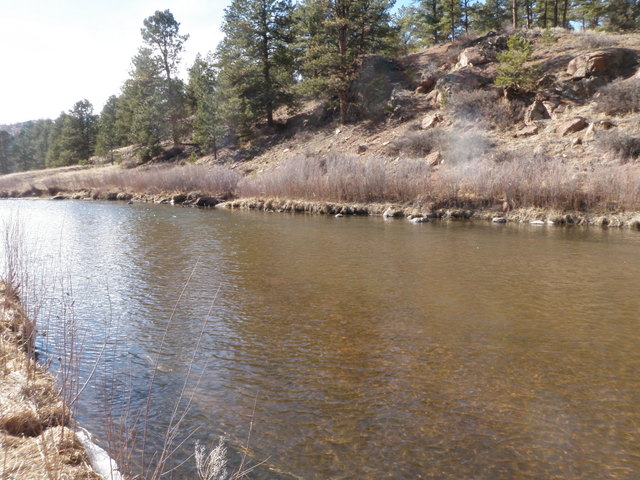
South Platte River Near Nighthawk

South Platte River Near Nighthawk

I was now drifting my three flies in some nice runs and pockets with a water depth of three to four feet. The stretch I was approaching is one of my favorites and generally delivers a fish or two so I increased my focus. Sure enough as the Chernobyl drifted on the outside of a nice current seam, the foam fly paused and I set the hook and saw a twelve inch brown trout as I lifted it toward the surface. Alas, this would be my only opportunity for a fish on this early season venture, but the brown somehow shook free, and I was left with a limp line.

I moved upstream another 15 feet or so to an attractive area where I always spot a brown trout tight to an angled log, and sure enough I thought I spotted a fish next to the log and in front of a large submerged rock. I made four or five drifts over this spot, but on the next cast I misfired a bit too far and wrapped the nymph and worm around a willow branch. I needed to disturb the sweet run to retrieve my flies and sure enough a nice brown of 13 to 14 inches darted from the rocks as I waded through.

I continued a bit but quickly bumped into another fisherman deliberately nymphing the deep ledge rock hole so I waded back toward the road and returned to the car. There were a lot of fishermen in the area so I decided to move to the catch and release area five or six miles upstream. I loaded my gear in the RAV and surveyed the river for approximately eight miles until I passed Trumbull. There were three or four cars, if not more, in every pullout so I passed them up and made a U-turn and began retracing my path back toward Nighthawk. Part way between the bridge downstream from Oxbow Ranch and Scraggy View I noticed a large pullout on the left that only had one pick up truck, so I pulled in and prepared to resume fishing.

South Platte in Catch and Release Area

South Platte in Catch and Release Area

By 1:30PM the wind had become a serious issue. The water next to the parking lot was a wide shallow unattractive area with no cover for fish, so I waded upstream a bit to a place where I’d seen rising fish on previous visits, although the structure of the stream was only moderately improved. I tossed the Chernobyl plus San Juan worm plus salvation nymph for a bit but nothing was happening so I swapped the salvation nymph for a zebra midge as I noticed quite a few midges buzzing about in the air. I continued working my way upstream for another forty yards through some nice runs of moderate depth, but once again my flies were not attracting any interest. The gusting wind became unrelenting and the sun glare made it difficult to follow my fly, so at 2:30 I reeled up my flies and clipped them to the rod guide and called it a day. I was actually feeling quite chilled as I no longer wore my fleece, so this contributed to my decision to surrender on Sunday, February 16.
It was fun to get on the river in February, and my fold-over Chernobyl seems to be solid, although it still hasn’t faced the cycle of catching and releasing a fish. The crowds and wind however were more than I bargained for. I made a mental note to only fish the South Platte River during weekdays in the future.

South Platte River – 11/03/2013

Time: 11:30AM – 4:00PM

Location: Area around Nighthawk and then between Osprey Campground and Scraggy View

Fish Landed: 2

South Platte River 11/03/2013 Photo Album

November is typically a tough month for fly fishing, although occasional fair weather can offer some decent action. Highs for Denver were projected to be in the upper 60’s on Sunday November 3, and I knew there weren’t many more opportunities remaining in 2013, so I planned a fishing trip. Jane picked up a nasty cold early in the week, and I woke up on Sunday suspecting that the bug had somehow transferred to my body, but once I experienced the sunshine and warm temperatures, I couldn’t resist making a fishing trip.

I considered Clear Creek Canyon, Waterton Canyon, and the South Platte River below Deckers. The flows below Strontia Springs in Waterton Canyon were only 40 cfs, and that is extremely low and suggests very tough fishing so I removed that option from my list. The South Platte River below Cheesman Canyon was flowing at 110 cfs and that is on the low side but not impossible. I’d been to Clear Creek Canyon on Thursday, and I knew the narrow canyon walls would block the sun so it could be chilly even with Denver air temperatures in the upper 60’s. The South Platte River below Deckers on the other hand is a wide open stretch of water that soaks up a lot of sunshine. The South Platte was my choice for Sunday.

I left the house at 10AM and by 11:15 arrived at the large parking lot across from the river just downstream from the junction of Nighthawk road and the road that goes along the South Platte River. I quickly pulled on my waders and put together my Loomis five weight and entered the water directly across from where I parked. Another fisherman was in the pool thirty yards below me so I began working my way upstream. I began with a Chernobyl ant, beadhead hares ear and beadhead RS2. The reports I read suggested that BWO’s and tricos were still hatching so I expected to have action on the RS2.

After a few prospecting casts I spotted a nice brown positioned to my left and eight feet upstream. I began casting above the fish and allowed my three flies to drift over the fish and on the third pass I noticed the fish make a slight move so I set the hook. Instantaneously the fish rocketed upstream and began stripping line from my reel so I allowed the handle to spin and waited to gain some control. After a 25 foot sprint directly upstream the fish made a quick turn and instantly my line was limp. I reeled up my line and discovered that the hares ear and RS2 had broken off. I’m not sure if I had the fish hooked in the mouth or foul hooked but any fish that can streak that fast is usually foul hooked.

Beginning and Ending Point

Beginning and Ending Point

I took a deep breath and tied another hares ear and RS2 below my Chernobyl and moved on along the left bank and around a bend in the river. I was covering deep attractive areas in the middle of the river quickly as I felt most of the fish would be along the bank. After turning the bend I waded across some shallow riffles and approached some attractive runs and pockets along the north bank. The lower deep runs did not yield any action so I moved up 25 feet to a spot where the river runs along a large rock and log and then creates a small pocket before spilling over some large rocks. Here I spotted a refusal to the Chernobyl, and then I observed the same fish rising two or three times to something tiny on the surface. It was about the time when trico spinners might hit the water, but I decided to try a CDC BWO first, and this tiny fly did in fact arouse another refusal. Unfortunately I tried to place a subsequent cast tight to the log and then allowed it to drift deep into the pocket and snagged a submerged branch. In my effort to save the fly I disturbed the tiny pocket and put down the fish so I decided to return to the car and take my lunch break. It was 12:15 as I crossed the river again and then walked back along the bank to the road and back to the Santa Fe.

Another SUV had arrived and parked next to me and a couple were fishing in the area where I began in the morning. As I ate my lunch, the fisherman who was below me when I began walked by and I didn’t pay much attention to this circumstance. After lunch I put on my frontpack and backpack and returned to the spot where I’d exited for lunch, and I was anxiously anticipating working upstream through some additional juicy pockets and runs along the north bank. Unfortunately I discovered that the fisherman who walked by the car while I ate lunch was now positioned across from a deep run no more than 15 yards above where I wanted to fish. I didn’t feel it was proper etiquette to resume fishing where I’d quit as I would have been crowding the upstream fisherman, so I returned to the car and drove up along the river to another spot.

The spot I chose was either a campground or picnic ground and it was the next parking area after Osprey Campground. Another SUV was already parked here and two fishermen were preparing to fish, so I hastily grabbed my gear and walked down the road 100 yards or so and entered the river a short distance below the road. I began prospecting my way upstream along the left bank next to the road and after covering thirty yards, I lifted the flies to recast and felt weight so I set the hook and a twelve inch brown launched itself out of the river. I played the strong fighter for 15 seconds and it swam under a branch that was lodged in front of a large exposed boulder. I didn’t see the branch from my downstream vantage point so I didn’t attempt to prevent the escape move. Unfortunately it worked for the brown trout, and when I waded closer and unhooked the Chernobyl I discovered that two more flies were missing along with the fish.

I screamed and uttered some choice words and tied on another pair of nymphs and then worked upstream further. The wind really kicked up at this point and I was having great difficulty punching casts upstream. I covered quite a bit of real estate and came to a shallow smooth stretch of water and I could spot two fish hugging the bottom in the clear two foot deep water. I decided to clip off the three fly set up and tie on a CDC BWO again, but by the time I did this, the lower fish disappeared. I did spot a subtle rise along the subsurface weed bed further upstream so I shot some casts to that vicinity, but these casts proved fruitless and I never saw another rise. I was pretty frustrated at this point with the loss of two fish, the lack of action, the wind and the nondescript smooth shallow water that was ahead of me so I climbed the gradual bank and returned to the car. On top of all this frustration I now noticed that a campground host had come by and put a fee envelope on my windshield.

I now noticed that I parked in a fee area and there was a tube in the parking area to deposit payment. The host had filled in my envelope for me and I quickly discovered that I owed $6 for a day use fee. I checked my wallet and of course I only had twenties plus four ones. I was about to put the four ones in the envelope when I noticed there was a space to enter my senior pass number. Whether it was proper or not, I assumed that the senior pass entitled me to a 50% discount, so I entered my senior pass number and deposited three ones in the envelope.

I now decided to drive further upstream, but after covering a couple miles and noticing that all the pullouts had one or two vehicles and numerous fishermen, I did a U-turn and drove back toward the Nighthawk Road junction. I was still in my waders so I needed to find a parking spot to remove them, so I pulled into the lot directly across from Nighthawk Road. There were no vehicles in the parking lot so I decided to return to my exit point for lunch and resume fishing upstream. I still had the CDC BWO on my line so I made some downstream casts to the exact spot where I’d experienced refusals just before lunch, but in the late afternoon the BWO didn’t even generate a look. With the wind and sun glare it was very difficult to see the tiny fly so I reverted to the three fly setup; Chernobyl ant, beadhead hares ear and RS2.

I cast the three fly combo across and let it drift through the small pocket at the end of the run and on the third or fourth pass a fish grabbed the trailing RS2. This fish put up a strong fight and I played it cautiously as I didn’t want to lose another prize catch. Eventually I was able to lift the nose of a nice 13 inch rainbow above the surface and slid my net beneath the first catch of the day.

Pretty 13 Inch Rainbow Took RS2

Pretty 13 Inch Rainbow Took RS2

Some additional nice water remained along the bank for another forty feet before the ledge rock next to a deep run that generally holds several fish. I carefully covered this water and in another short deep pocket the Chernobyl dipped and I set the hook and fought and landed another mirror image rainbow. My day was suddenly looking up and I was anticipating continuing my progress upstream and along the north and then west bank. But as this was going on two fishermen appeared and entered the river directly across from the ledge rock! I fished out the pockets but when I was within 15 yards I waded back across the river and circled around and above the pair of young fishermen.

Deep Run Along Rocks Popular

Deep Run Along Rocks Popular

When I came back to the river I was above a 90 degree bend and now the sun was quite low in the western sky and shining directly into my eyes. I crossed to the opposite bank so the sun was at my back, but this created a difficult glare and it was hard to read the water depth. I made a few futile casts to no avail and then crossed back toward the parking lot and walked up the path along the river quite a distance. The water in this area was wide and shallow and largely unattractive to me so after hiking 200 yards or so and making a few half hearted casts in the right channel next to an island, I reeled up my line and decided to call it a day.

I was quite pleased to avoid a skunking and land two decent rainbows late in the day. It was still a gorgeous day for early November and I’ll relish any late season action as a bonus for 2013.

South Platte River – 08/14/2013

Time: 10:00AM – 4:00PM

Location: Above cascade to place where I stashed my backpack

Fish Landed: 40

South Platte River 08/14/2013 Photo Album

The thing about the Wildcat Canyon area of the South Platte is the effort it requires to reach this beautiful stretch of water. I’ve made this excursion quite a few times and it always takes at least an hour to hike the three mile Platte River Trail to reach the public stretch of the river. Perhaps my backpack is not the correct size or maybe I haven’t fit it properly, but I’m always extremely exhausted after these ventures. The weight of the pack causes me much neck and shoulder soreness, and of course a full day of fishing with repeated casting and wading and climbing over rocks and through streamside vegetation only adds to the fatigue.

I was now situated close to the trailhead at Round Mountain so I could avoid the two hour drive and begin my hike earlier than previous occasions. I woke up at 6:30AM, ate breakfast, prepared a lunch and stuffed my backpack with all the essentials for a day of fishing three miles from my vehicle. This required some serious planning and thought as I first went through my mental checklist and then reviewed the list in my iPhone. Finally I was convinced that I had all the essentials and I proceeded to drive the ten minutes required to the trailhead. Here I hooked my fishing backpack containing my Camelbak water bladder over my backpack and began the trek into the canyon.

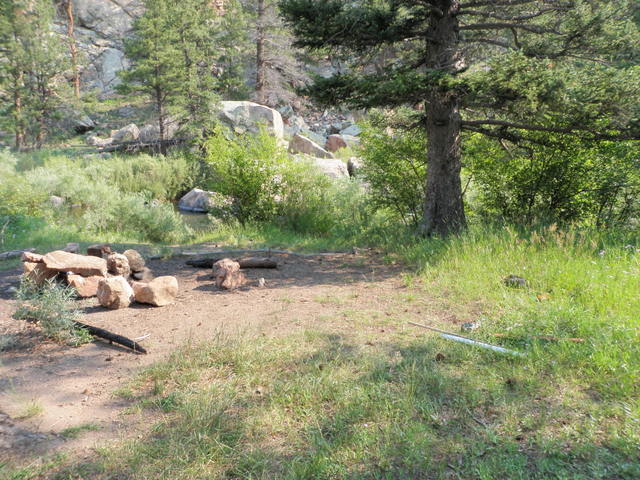
The air temperature was 47 on the dashboard when I began, but rather quickly the radiant energy of the bright sun warmed me and the air to the seventies. I wore my running shoes and shorts and made steady progress along the nice trail that passes through tall ponderosa pines. By 9:30 I approached the open area with a stone fire pit next to one of the nicest holes on the river, and here I put on my waders and rigged my Orvis 4 piece, 4 weight rod and stashed my backpack behind a tree.

Staging Area in Wildcat Canyon

Staging Area in Wildcat Canyon

As is usually my custom I continued to hike along the trail for another half mile or so to a point just above where the river cascades through a narrow gap in the large rock walls. It was a bright sunny day and the flows were roughly 132 cfs. I had great success in 2012 in mid August when the flows were 167 cfs and in the fall at 80 cfs, so I was pretty certain this level would be close to ideal. My car was the only one parked in the lot at the trailhead, and I saw no other human beings on my morning hike. It was 10AM when I began fishing and I had the entire canyon to myself!

Nice Flow Level on South Platte River

Nice Flow Level on South Platte River

I began fishing with a Chernobyl ant and beadhead hares ear. I reviewed my blog post from the August outing in 2012, and learned that this combination did the heavy lifting at that time, so I hoped to repeat my success. This strategy worked well as I landed 17 fish between 10AM and noon. Quite a few fish were rising and smashing the Chernobyl and the other difference was the number of rainbows landing in my net compared to brown trout. Over the course of the day I estimate that 70% of my catch was rainbows and 30% browns. This was quite different from a year ago.

Productive Fly...Chernobyl Ant

Productive Fly…Chernobyl Ant

I quit for lunch at noon and hiked back to the place where I stashed my backpack. Along the way I passed a young couple with two girls on a pleasant hike, but clearly not embarking on a fishing outing. After lunch I returned to my lunchtime exit point and continued up along the left bank of the stream using the same combination of flies and continued to land fish at a steady rate.

During this time I approached a nice long pool below some large protruding rocks. The current break created smooth water that was ten feet wide and 25 feet long with a deep current seam on the far side away from me. I hooked two very nice rainbows along the current seam, one at the tail and one in the mid-section. These fish fought hard and eventually slid down beyond the large protruding boulder at the base of the run, and in both cases my fly popped free as the fish thrashed next to the rock. I was quite disappointed with these lost fish, but how could I remain in grief with the great scenery and a catch rate approaching eight fish per hour?

Another memorable moment was fish number 24. I flipped a short cast above the lip of a pool and almost instantly the Chernobyl paused and dipped and I set the hook and discovered I was attached to a fine battling trout. I played it up and then down for a few minutes and prayed it wouldn’t attempt the same manuever as the previous large rainbows. This time, however, I held on and finally netted a beautiful 15 inch cutbow that featured the pink stripe of a rainbow, but also displayed the orange slash of a cutthroat and the fine black speckles on the sides similar to a cutthroat trout.

At 2PM the action slowed relative to what I was experiencing earlier and I spotted some tiny mayflies in the air so I swapped the beadhead hares ear for a RS2. This didn’t improve things, so I inserted a salvation nymph and attached the RS2 below the salvation, and this combination produced the last ten fish of the day with most hooked on the salvation nymph.

Rainbow from South Platte

Rainbow from South Platte

On the day I probably landed 10 of the 40 fish on the Chernobyl ant, and as I commented earlier, I was surprised that roughly 70% were rainbows and 30% browns. Perhaps the higher ratio of rainbows resulted from lower flows which enabled me to fish more midstream pools, and not focus as much on the banks and edge. It seemed that the browns came from the rocky banks and generally they opted for the more natural trailing nymphs. The rainbows on the other hand liked deeper water and larger pools and there tended to be multiple rainbows in the same place; whereas, the browns were solitary and more territorial. The rainbows also seemed more apt to go for attractors; flies that don’t really imitate a specfic insect such as Chernobyl ants and salvation nymphs.

All in all it was a great day. Several periods of clouds moved by in the afternoon but it never rained nor was there ever a hatch that resulted in surface feeding. The size of the fish was decent, although not as impressive as the preponderance of browns landed in August 2012. The larger fish during this visit tended to be rainbows. It would be interesting to return and focus on the banks to see if this would change the ratio to predominantly browns. Of course this would necessitate another two hours of hiking with an ill fitting backpack, and I can’t consider that until more time has elapsed. Time causes me to forget the discomfort and exhaustion, but remember the fishing. The one hour exit hike was even more taxing than the entrance, but I survived and drove on to Lakeview Campground near Twin Lakes on the way to Independence Pass where I rested and prepared for Thursday on the Frying Pan River.

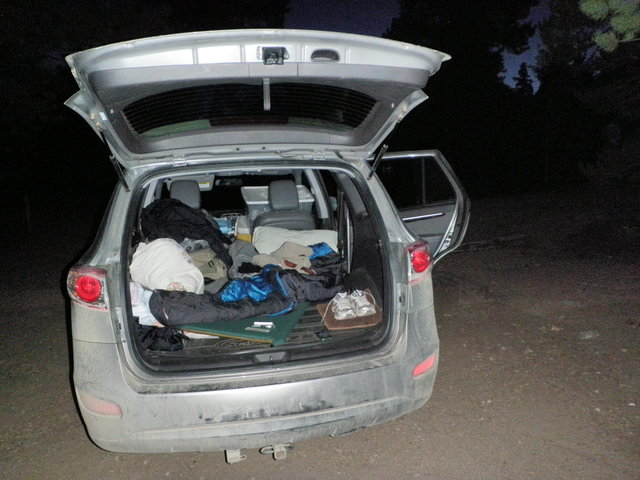
Sleeping Accommodations Wednesday Evening

Sleeping Accommodations Wednesday Evening

South Platte River – 08/13/2013

Time: 4:00PM – 6:30PM

Location: .5 mile below Happy Meadows Campground

Fish Landed: 8

South Platte River 08/13/2013 Photo Album

Flash floods are a real danger in Colorado, and Jane told me about a severe occurence several weeks ago in the narrow canyon along route 24 west of Manitou Springs. Apparently a local thunderstorm dumped a deluge of rain in a short amount of time and this resulted in a flash flood that caused one death and swept numerous vehicles downstream in a muddy torrent.

I left work in the morning on Tuesday and packed the Santa Fe for a three night and three day fishing/camping trip that I expected to result in a day on the South Platte River and two days on the Frying Pan River. Everything was packed, and I was on my way by around 1PM. I was quite excited to have nearly a week to explore some of my favorite waters in Colorado as I made my way south on interstate 25 through Colorado Springs and then west on route 24 toward Manitou Springs. Yes, I was traveling through the same area devastated by a flash flood several weeks ago, and in fact as I began driving up the narrow twisty stretch I saw a large flashing highway sign announcing a flash flood watch. I looked west and sure enough the sky was darkening, but I made a quick assessment that the clouds were fairly distant, and I could travel through the canyon stretch before any rain might commence.

This turned out to be an accurate decision as I reached Woodland Park west of the canyon stretch as rain began to hit the windshield. Along the way, however, I saw the result of the previous flash flood with side roads converted to deep gulleys and massive piles of red sediment along the roadway in several areas where the CDOT crews had removed it from the highway.

By 3PM I’d reached my planned destination of Happy Meadows Campground, a small campground situated right along the South Platte River a mile or two away from the Platte River Trailhead that I planned to depart from on Wednesday morning. Unfortunately I was faced with another setback as the small campground was completely full. What was I to do now? I had checked alternatives prior to departing Denver and remembered another national forest campground further west along US 24 as well as nice campground that we’d used as a family called Spruce Grove. I turned into a pullout and removed my Colorado map from the glove box and checked the distances. Clearly Round Mountain was the closest and only five miles or so west of the turn off I had taken from route 24.

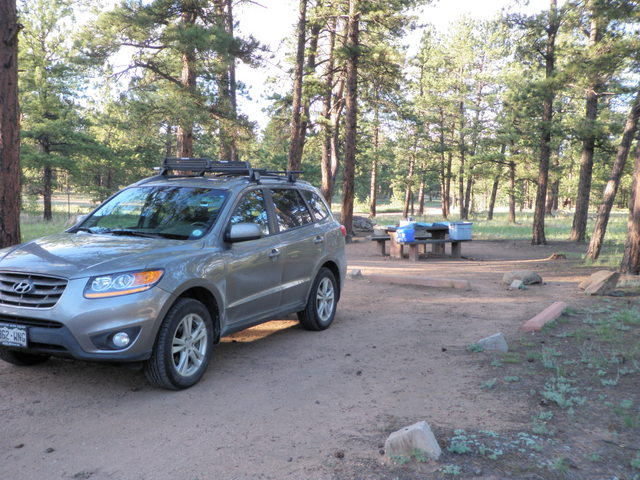
I reversed my direction and returned to the highway and sure enough a five to ten minute drive led to Round Mountain. I circled the campground and there were 16 sites with only three occupied so I snagged number 16 and unloaded my water container, tablecloth, and camp stove and paid my fee for one night. It was 3:30PM by now, and I decided I could whet my appetite for fishing by returning to the South Platte near Happy Meadows and test the waters for a few hours. I always drove by this water on my way to the Platte Trail and wondered what the quality of the fishing was like.

Round Mountain Campground

Round Mountain Campground

I passed Happy Meadows and drove slowly along the dirt road while glancing to the right to review the water. I was looking for some faster stretches with rocks and pockets as other fishermen tend to avoid this type of stream structure, and with the hot August temperatures, fish are attracted to these well oxygenated areas. Roughly half a mile beyond the campground I found just this type of water and parked in a large pullout and prepared to fish.

By 4PM I was on the water with my Loomis 5 weight rod featuring a Chernobyl ant and beadhead hares ear, and I crossed to the bank away from the road and began working my way upstream. Nothing showed in the first fifteen minutes or so, but then I added a small RS2 after spotting several tiny mayflies. In a short amount of time I landed three small trout, two browns and one rainbow. The rainbow took the RS2 on a lift, and the two browns grabbed the hares ear on the dead drift.

After this initial success I somehow broke off both nymphs even though I couldn’t recall any significant snag and I replaced them with a salvation nymph. This ended up producing quite well over the remaining hour or so of fishing as I supplemented my count by five to reach eight on the evening. The fish seemed to like movement with most hammering the nymph on the lift or on a twitch or during a poor mend.

South Platte River Near Happy Meadows Campground

South Platte River Near Happy Meadows Campground

I had difficulty seeing my flies in the first hour as I was on the east side of the river looking into the sun glare from the western sky, so I crossed back to the west side and this helped quite a bit until the shadows covered the river. In the last half hour I fished a stretch below where I parked the car, and it was more typical South Platte River water with long runs, fine gravel bars, and no large rocks or pocket water.During this time I had a pair of refusals to the Chernobyl so I switched to a light gray caddis, but this also generated rejection. At 6:30 I decided to call it quits and return to the campsite to made dinner before it got dark. I’d experienced a nice introduction to fishing in the South Platte River, and I was optimistic that I’d have a decent day on Wednesday.

South Platte River – 04/04/2013

Time: 11:00AM – 3:00PM

Location: Whale Rock below Nighthawk and then the area just below where the Nighthawk road meets the South Platte

Fish Landed: 3

South Platte River 04/04/2013 Photo Album

With Thursday expected to be a nicer day than Wednesday, and being in wait mode at work until the office manager announced that the numbers were ready for February, I decided to undertake another fishing venture. I looked at the flows on the streams closer to Denver and settled on the South Platte River below Deckers. The flows out of Cheesman Reservoir were 97 cfs and they increased to 117 in the village of Trumbull. This is fairly low, but I’ve seen flows around 50, so I figured it wouldn’t be ridiculously low. I can reach the lower stretch of the South Platte in 1.5 hours so this played into my thouight process as well.

I took care of several chores and departed the house by 9:30 and traffic in Denver was light so I arrived at my destination and was in the water fishing by 11AM. I chose to park at the lot by Whale Rock a couple miles downstream from Nighthawk. The temperature was in the low 50’s when I began fishing so I wore one layer of fleece, and I was quite comfortable. Another fisherman was upstream in the area where the river divided around a small island and I wanted to fish the pool and eddy at the bend so rather than begin further downstream where the river shoots through some large boulders, I elected to begin at the bend pool.

I rigged with a strike indicator on my tapered leader and added a split shot then a beadhead RS2 and a zebra midge. I began at the lower end of the bend pool and began working my way up with casts directed to the seam between the current and the smooth pool on the opposite side. When I reached the midpoint of the seam, my indicator paused and I set the hook and felt the throbbing of a decent fish. The brown trout fought defiantly which surprised me as I expected a small 9-12 inch brown. When I finally netted and photographed my catch is stretched out to around 13 inches. I was quite pleased with this early outcome. When I cast to the very top of the seam I noticed another pause and hooked and landed another brown in the 11-12 inch range. I was feeling pretty confident as I’d now landed two fish in the first half hour.

Decent First Fish on South Platte River

Decent First Fish on South Platte River

I wasn’t able to coax anymore trout from the bend pool, so I decided to fish up stream a bit along the high bank where the main current ran. I was working the narrow slot between the current and bank but to no avail. Meanwhile the fisherman above me did in fact appear and began fishing the top of the run that I was headed toward. He must have seen me as he retreated fairly quickly, but I decided to return to the area below the bend to water that was totally undisturbed.

I hiked down a narrow path for 50 yards or so and moved into the river where it divided into a small side channel. I began working my way upstream covering a lot of water quickly. The depth was only three to four feet and extremely clear so I made long uptream casts on my side and three quarters casts toward the far side. Nothing was showing interest and in fact I was seeing only one or two small trout bolting for cover as I waded slowly upstream.

Finally I got to a nice deep run with a slower moving pocket on the inside. I was sure this would yield some action, but again I was disappointed. I spotted some nervous water next to the opposite bank, so I quartered a cast up and across. Sure enough as the flies began to swing away from the bank, a brown hammered one of the flies. I set the hook and the fish immediately cleared the water but the hook came flying back. I moved up a bit and in similar fashion the indicator stopped in a deeper trough and I set the hook so that a rainbow launched out of the water. Once again the excitement dissolved as the fly came flying back free of any grip on the fish.

When I reached the bend I decided to adjourn to the car to eat my lunch as it was close to noon. After lunch I walked up the road to the rocky area near the huge boulders. I fished this area thoroughly and carefully, but again no interest was shown if there were in fact fish present. A deep run above the large boulders and below the next parking lot provided another disppointment. I passed an elderly gentleman stooped over the river as he seined the water with his net and moved to another favorite stretch where the river flows next to the dirt road and over a very rocky streambed. I passed the lower portion as it typically fishes better with dry flies or dry/dropper rigs and moved up to the nice long deep run that feeds the rocky pool stretch.

Low and Clear

Low and Clear

I ran the nymphs through this attractive area quite thoroughly but once again I was surprised to see no evidence of fish. I was now losing confidence in my ability to land anymore fish under the bright blue sky with the relatively shallow flows and extremely clear water. I rounded the next bend and waded to two or three nice deeper areas where I’d enjoyed past success, but nothing was showing. Another fisherman was now above me in some riffles, so I walked back to the rocky area and clipped off my nymph apparatus and tied on a olive body caddis with a RS2 dropper. Surely this would entice some small browns from the rocky pool area. I methodically covered the bottom end and did notice two decent browns bolt under a large boulder next to the bank due to my wading upstream.

As I approached the best part of the pool, the elderly fisherman who had been seining the water appeared above me. He was at the very top of the pool and began making downstream casts. He kept a distance of around 20 yards, but he clearly was disturbing the top portion of the stretch that I had my eyes on. I fished out a nice pool/run 25 foot stretch where I’d landed fish previously and then climbed the bank and returned to the car.

I planned to fish for another hour so I decided to drive back to the area where the road from Sprucewood joined the road along the river. I parked where there used to be a pay phone and made some half hearted casts to some deep water behind protruding boulders, but again this proved fruitless. After the bend there was some nice water with rocky pockets next to the bank and I’d caught nice fish there in previous visits when I lived in Castle Rock. I crossed over and decided to at least try out one of my newly tied pool toys to see how they cast and float. I attached a tan body pool toy to my line and below the bend added a beadhead hares ear.

I began working upstream prospecting the likely pockets and seams along the northwest bank. I wasn’t catching fish but I was falling in love with the rythmn of casting and following the highly visible hopper imitation. It floated quite well although occasionally the poly indicator material became saturated so I gave it a quick dip in my dry shake. Next I moved up ten yards and reached an exceptionally juicy area where the river flowed along an angled log that protruded from the bank. Between me there was 15 feet of nice water with moderate depth with numerous submerged rocks on the river bottom. As I looked at the water, I spotted two trout nestled in a depression at the very tail of the pool by the point of the log. I began to drift my hopper and nymph over them and on perhaps the seventh drift, one of the fish actually moved from its position as my flies drifted overhead.

Since I wasn’t having much luck moving and prospecting I decided to focus on these fish and I clipped off the hares ear and replaced with a beadhead RS2. Again I thought I saw one of the fish wiggle its tail and move slightly when the nymph drifted by, but there was no take. I cast this combination for perhaps ten drifts and then reeled up and again switched the point fly. This time I tried a beadhead soft hackle emerger, and once again I began flicking casts above the position of the two fish. On the third of fourth drift I allowed the pool toy to drift further downstream than normal and as I lifted my rod to pick up the flies and recast, one of the browns angled up and grabbed the soft hackle emerger. After all this work I’d finally landed another 11 inch brown.

Fish Taken Above Rock Cluster

Fish Taken Above Rock Cluster

I released the small brown and worked upstream a bit further to a point where the main current runs along a long slate rock ledge. Dave Gaboury and I used to catch quite a few fish from this area and we called in Dave’s Run. At the very tail I spotted a couple fish dimpling the surface in a fairly regular pattern. I thought about transitioning to a CDC BWO, but thought perhaps I could drift the pool toy and soft hackle emerger and lift the trailing fly to elicit a strike. Mistake. The large indicator fly appartently spooked the feeding trout and the game was over. I belatedly clipped off the dry/dropper set up and tied on a CDC olive and then rested the water for five minutes or so, but the hunt was over and the fish discontinued their feeding.

It was now 3PM and I was quite tired and the fishing remained quite challenging so I elected to return to the car and ultimately to Denver. It was a gorgeous spring day to be outside, but very difficult conditions for fishing in the South Platte River.

South Platte River – 10/17/2012

Time: 12:00PM – 4:00PM

Location: Wildcat Canyon

Fish Landed: 3

South Platte River 10/17/2012 Photo Album

Normally these fishing reports are about catching fish, but my experience on October 17 was more about overcoming difficult obstacles to experience a day of fishing. Dan called on Sunday and asked if I was interested in going fishing if he took a day off. He indicated that Tuesday and Wednesday were his best options, but he preferred Wednesday so we made tentative plans. I suggested hiking into Wildcat Canyon to fish the South Platte River as we enjoyed some decent fishing in 2010 and 2011 during October on this stream.

As Wednesday approached I frequently checked the streamflows and weather, and the flows of 124 were reasonable and actually favorable since they were higher than our trip in September when the fish were a bit skittish, but lower than my trip in August when it was difficult to cross the river. Unfortunately I couldn’t say the same thing about the weather as highs were forecast to be mid-50’s and lows around freezing. I fished the Arkansas River the previous Friday with a high of 57 and steady rain, so I felt these temperatures were tolerable. We hoped to eliminate the two plus hour drive on Wednesday morning by camping at Happy Meadows Campground near the trailhead on Tuesday night, so I was a bit concerned about the low temperature.

Dan arrived at my house by 7PM on Tuesday and we made the drive and watched the thermometer drop as we traveled south through Colorado Springs and then west over Ute Pass. By the time we reached the campground the air temperature was 45 degrees and there was one other camper at Happy Meadows. Dan and I put up the tent but didn’t stake out the rain fly as there was minimal chance of rain. Dan had his down sleeping bag as well as a second sleeping bag and a small quilt. I had my down sleeping bag and two thick quilts. We put one quilt on the floor of the tent, then placed our pads on top of that, and then our sleeping bags, and then in my case a thick blue quilt was used as a top layer.

Happy Meadows Campsite

We climbed into our cozy quarters by 10:30 and within a half hour I felt a mist hitting my face. Much to our surprise it rained briefly and I had neglected to zip the rain fly. Once I zipped it down, I no longer felt moisture, but I fell asleep to the sound of the light pitter patter of rain hitting the tent. The factor we had not anticipated was the strong wind that blasted the tent all night long. Since the rain fly was not staked to the ground it continually slapped against the side of the tent, and several times I awoke as the tent itself was pushed relentlessly down against my face from the force of the wind. I placed my flip flops on the ground outside my tent door in case I needed to get up during the night, and when I looked for them in the morning, only one was where I left it and the other was forty feet away near the pay station.

Dan found some ice on the tent so apparently the temperature had dropped below freezing, although I was quite comfortable in our cozy tent from a temperature perspective. As we threw all our layers back in the car and prepared a light breakfast using Dan’s backpacking stove the wind continued to howl and I checked the temperature at 9:30 and it was 42 degrees. Evindently a cold front had blown in during the night, and the high of 55 degrees was looking optimistic.

After breakfast we stuffed our backpacks and I put on my waders and wading boots and we drove a mile or two to the trailhead. Fortunately I removed all my top layers except for my long sleeved undershirt and fishing shirt for the three mile hike as we generated quite a bit of body heat. When we reached the river it was flowing higher than September but clear and we were encouraged and hoping for another decent late fall day of fishing. I was a bit concerned about the wind and I’ve never done well the day after a cold front arrives, but we planned to overcome these concerns.

Dan Assembles His Rod

We deposited our packs at the campsite that we used in September and assembled our rods and then hiked further down the path to a point where the canyon narrows and the velocity of the water increases. Here we cut over to the river and while Dan tied on his flies, I began casting along the bank closest to the path. I covered twenty yards of water while Dan knotted on a Charlie Boy hopper and beadhead hares ear. After twenty yards we reached a spot where the river became wider and Dan could wade to the far bank. I began fishing with a gray parachute hopper trailing a beadhead hares ear, but it didn’t take long for me to realize that the fishing was going to be difficult compared to my previous trips in 2012. I was casting to water that yielded nice brown trout during my earlier visits, but during the first half hour these drifts were producing nothing but arm exercise. The same was true of Dan’s casts along the far side of the river.

Dan Ready to Begin Fishing

As I moved upstream I reached a point where a small side channel of water merged with the main river. As I gazed at the junction I spotted several fish moving in the shallow water with their upper fins out of the water. It became pretty clear what was going on; three or four browns were in spawning mode. This probably explained the absence of browns from the lies that had produced fish in August and September.

I continued upstream and after 45 minutes or so my hopper dipped at the tail of a run in front of a large submerged rock and I set the hook and played an eleven inch rainbow in to my net. In short order I landed a second rainbow that was a bit larger on the beadhead hares ear. Meanwhile Dan finally connected on a brown along the opposite bank. The wind continued to blast down the valley and our hands began to ache after releasing fish due to the cooling effect of evaporation. At 1:15 I suggested that we take a break, return to our base camp, eat our lunches and warm our hands.

Casting in Nice Pool Before Lunch

After lunch I decided to change my approach and rigged my line in the manner demonstrated by Taylor Edrington of Royal Gorge Anglers. This involved a thingamabobber, and four foot section of 3X, a split shot, a twenty incher as my top fly, and  a beadhead hares ear as my point fly. Dan continued fishing with the hopper/dropper combination that he used in the morning. We hiked back down the path to the area where we had finished as there was a long pool that I wanted to run the nymphs through. Unfortunately the change in method didn’t really improve my fortunes to any great degree. Over the remaining two hours of fishing I worked the nymphs through some juicy deep runs and pools and landed one more rainbow. After a half hour or so I noticed some tiny mayflies floating on the surface and fluttering up into the air, so I swapped the hares ear for a beadhead Craven soft hackle emerger.

I should point out that I had four or five momentary hook ups in the afternoon that I did not land. I’m guessing these fish were taking the soft hackle emerger, but for some reason I wasn’t doing very well with setting the size 22 hook in a manner that allowed me to net the fish. Dan meanwhile landed a nice brown trout in excess of 12 inches on a beadhead pheasant tail at around 3PM. He converted from the Charlie Boy hopper to a Chernobyl ant and trailed the beadhead pheasant tail and soft hackle emerger. I was impressed with his willingness to fish three flies in the cold windy environment. Just before we quit for the day he landed a small brown.

Nicest Fish of the Day

By 4PM the shadows covered most of the water and the air temperature was plummeting, and combined with the consistently annoying wind created quite a bit of fishing hardship, so we decided to pack things up for the day. We stuffed our packs with our gear and made the three mile return hike in an hour. Once we stowed everything in the car, we fired up the heater and turned on the heated seats and pulled out the snacks. We stopped at Front Range BBQ in Old Colorado City on the outskirts of Colorado Springs for a warm enjoyable dinner.

The fishing was difficult on October 17, but we took pride in camping during sub-freezing temperatures and overcoming the wind and cold to catch a few fish. Wildcat Canyon was as always a beautiful place to be with no other human beings to interfere with our enjoyment of the gorgeous Colorado outdoor environment.

South Platte River – 09/09/2012

Time: 11:00AM – 3:00PM

Location: Wildcat Canyon 50 yards below campsite to area next to thick willows

Fish Landed: Dave 15; Dan 20

South Platte River 09/09/2012 Photo Album

The temperature dipped quite low on Saturday night, but Dan and I slept late in our warm down sleeping bags until the sun rose above the eastern mountain. I got up at 7:45, and didn’t really need my down parka, although I wore it since I packed it in. Dan slept until 10AM, and after he awoke we lowered the bear bag and prepared our breakfast consisting of two packets of instant oatmeal.

Our Home for a Night

We once again climbed into our waders and grabbed our rods and walked down the path to the spot where we exited the river Saturday evening. Sunday was another bright sunny day with the high temperature exceeding Saturday’s high. Once again Dan took the far side and I remained on the side of the river next to the path. We both returned to the parachute hopper and beadhead hares ear, and on Sunday Dan was attached to a fish almost immediately. As we worked up the stream in parallel Dan continued to be a fish magnet while I couldn’t even muster a refusal. After an hour of fishing I’d failed to land a fish as we approached the deep attractive pool next to our campsite. Meanwhile Dan had landed around five trout with several being quite chunky 12 and 13 inch specimen.

One of the Better Fish of the Weekend

Sweet Pool Next to Our Campsite

As I cast from below into the sweet camp pool, I didn’t attract any interest; but when I got to the top across from where the riffle deflected off the large rock I began casting across and allowing the center current to take my flies downstream along the current seam. Using this technique I landed four or five trout on the beadhead hares ear. Dan was behind me on the opposite side, and when he reached the pool he climbed up on top of the huge boulders and looked down on the eddy along the far bank. He said he could spot 4-6 fish lingering in the eddy, and he picked off two or three before moving on. Unfortunately he hooked a rock and broke off both his flies and had to reconnect his hopper and nymph.

Dan’s Favorite Perch

I continued working upstream and began catching fish at a more regular pace moving from four to thirteen between noon and 2PM. The downstream approach served me well in the deeper runs where I could get above the target area without spooking fish, but I also managed to land some with upstream casts. I was proud to see that Dan’s catch rate continued at a high rate and by the time I caught my thirteenth fish he had already achieved 16. Unlike the previous day, his fly was constantly in the water, and he was spending less time untangling and knotting. His long 25-30 foot casts were serving him well in the 82 cfs flows over skittish fish.

Before we started fishing we mutually decided to quit at 2PM and estimated we’d be on the trail by 3PM and back at the car by 4PM. At 2 we reached a spot where the river split around a narrow island with the channel on Dan’s side being smaller than the main channel ahead of me. I remember that Dan was at 17 at this point, and I was stuck on 13. Dan decided to explore the smaller channel while I continued through the main channel which consisted of a heavy dose of pocket water. I was seeing a lot of small mayflies again so I gambled that a switch to nymphing with a RS2 would allow me to gain on my son. I was pretty certain he’d stay with the hopper/hares ear.

I picked up two more trout in the pocket section on the nymphs with quite a few foul hooked fish and long distance releases. When Dan emerged at the top of the island and we compared notes, I discovered that he stayed with the parachute hopper and hares ear as I expected. Fortunately for him (and not good for me in the fish count competition) the fish continued to hammer his hares ear and hopper and he landed an additional three nice trout to reach 20. I failed to gain ground and in fact slid and ended with 15. But 15 is still a nice total for four hours of fishing in a beautiful setting on a bright sunny and warm afternoon in September. In fact I’m pretty proud of Dan’s emergence as a fly fisherman with his first twenty fish day. I expect there will be many more.

We returned to camp and filled our packs and began the return hike at 4PM. Once again it took an hour to negotiate the trail so that we arrived at the Santa Fe by 5PM and returned to Denver in time to see the second half of the Steelers vs Broncos Sunday night game. It was a great weekend of backpacking, fishing and spending time with my son.

South Platte River – 09/08/2012

Time: 1:30PM – 6:00PM

Location: Wildcat Canyon from just above cascade and narrow canyon to 50 yards below our base camp

Fish Landed: Dave 18; Dan 8

South Platte River 09/08/2012 Photo Album

In 2008 and 2009 Dan and I backpacked into Wildcat Canyon in September of each year and had a great time. A three mile hike is required, and as a novice aging backpacker this is about right for me. After this relatively mild exertion, a beautiful world is pretty much exclusively available to the camper with the cold South Platte River in close proximity. The river valley is fairly wide for most of the stretch available for camping with nice flat areas and the large ponderosa pines are spread out with soft pine needles covering much of the ground. Several well used camp sites are obvious with crude rock fire pits already constructed.

I hiked in to this area in late August and experienced a fabulous day of fishing and of course when Dan heard this tale, he wanted to make the trip again. The only problem was when? Initially Dan was scheduled to go on another weekend camping trip with another couple, but that fell through at the last minute, so we jumped on the opportunity to do Wildcat Canyon on September 8 and 9. Dan met me at our house at 7:30 on Saturday morning and we transferred all his gear to my car and rechecked our lists of necessities. We were on our way by 8AM and stopped in Woodland Park for some last minute food items. Once again we were on our way and reached the trailhead by around 11:30. It took us a bit of time to finalize our packs and attach fishing gear to the outside of our backpacks, and we were probably on the trail by noon. Because my wading boots and waders consume much space in my pack, I elected to hike the three miles in my waders. It turned out to be warm but tolerable.

Once we hit the river we continued on the trail to the place where a fire ring and a log bench are right next to a beautiful pool on the river. We’ve used this on previous trips to stash our gear and set up for fishing. We ate our lunches and then prepared our rods and hiked down the path to a point just above the falls where the canyon narrows between some vertical rock walls. Dan waded to the far side of the river and I took the near bank and we began fishing at around 1:30PM. The flows were 82 cfs, and that was 50% of the level when I fished earlier in August. Because it was a bright sunny day and we were beginning at 1:30 in the afternoon and the flows were down, I didn’t expect much from the river.

I began with a parachute hopper with a hares ear body and a beadhead hares ear nymph and was immediately surprised with a decent brown on the first cast. Just as on my previous trip the brown attacked the nymph late in the drift. Dan was still tying on his flies as I landed another brown on the fourth cast and then a rainbow and another brown. Within the first half hour I had landed five trout, and I was beginning to think this would be a repeat of my earlier stellar trip. Meanwhile Dan finally got his flies in place and began landing fish quickly as well. By the time I landed number five he was at three or four.

Dan About to Release Nice Catch

Unfortunately after the first half hour the catch rate dropped off significantly. I began seeing some tiny mayflies lifting off the surface of the water, and as this happened the fishing went from ridiculously easy to requiring more casts and covering more water. By three o’clock I’d landed nine trout with a few in the thirteen inch range, but on average they were smaller than my earlier trip. After a half hour of seeing the small mayflies I added a RS2 below the beadhead hares ear as a third fly. The RS2 didn’t really produce any fish, but it did increase the number tangles I had to undo.

Following His Drift

Meanwhile Dan picked up a few more trout and several appeared to be decent sized browns. Unfortunately there were a series of downed dead evergreen trees covering half the width of the stream on his side of the river. Dan could spot fish behind the natural structure, but he was also casting a bit long and creating his own messy tangles. Dan’s knot tying proficiency is not as advanced as mine, and extricating himself from tangles consumed a higher percentage of fishing time.

I totally lost track of the time and it seemed to be getting dark early as the shadows extended across the river. The sun fell behind the mountains by around 4PM and the combination of the shadows and my sunglasses made me think it was approaching darkness. As the fishing slowed at 3:30 in the afternoon I noticed more and more small mayflies slowly fluttering up from the water so I decided to try deep nymphing with a strike indicator. My past experience has taught me that this method of fishing is more effective when fish are tuned into active nymphs than dead drifting a nymph below a large attractor indicator fly.

I crimped a split shot on my line above the last knot, added a strike indicator, used a clinch knot to attach a beadhead hares ear, and then knotted an RS2 below the BHHE as my point fly. This proved to be a strategic plus as I began catching fish on the nymphs. Initially I landed two or three fish in an attractive deep run, and I was concerned that my fishing method would only be effective in this type of water. But I also began catching fish in riffles of moderate depth and even in some fairly shallow areas along the edge. Perhaps half the landed fish snatched the hares ear and the other half grabbed the RS2. I also experienced quite a few long distance releases and several foul hooked fish. I’m always amazed when I make an upstream cast with a split shot to shallow water and I lift the flies almost immediately after entry to make sure the split shot isn’t hung up and a fish grabs the nymph on the lift.

A Pretty Rainbow Landed by Dave

After an hour or so of me catching fish, Dan asked me to rig him up with nymphs. We met in the middle of the river and I set up his indicator and split shot and tied on a hares ear and RS2 from his fly box. Dan picked up two or three fish after going to nymphs, but he definitely favors fishing dries or dry/dropper over nymphing.

Filtering Process Begins

Setting Up Tent Is Next

By 6 o’clock I thought it was time for bed and the fishing had slowed and I was quite weary after the strenuous hike in the heat so we decided to exit the river and return to the base camp. Dan only transported a water bottle quantity of water from the car, so he immediately filtered some water and filled his camelback. Next he set up the camp stove and started the beans and rice which required 30 minutes of cook time. While dinner cooked we set up Dan’s luxurious two person tent that features foyers on each side and a dangling storage caddy below the ceiling. After our tasty dinner we made a campfire and stayed warm until curling up in our sleeping bags at 9:30. I fell asleep dreaming of the 18 fish I’d landed, with nine coming after my switch to indicator nymph fishing.

And Finally a Blazing Fire