Category Archives: South Platte River

South Platte River – 11/03/2015

Time: 11:00AM – 2:30PM

Location: Waterton Canyon near Rattlesnake picnic area.

Fish Landed: 3

South Platte River 11/03/2015 Photo Album

November 3 and the high temperature in Denver was 75 degrees. What should one do when such a fortunate break in the weather presents itself to a Denver resident? Well of course if one is an avid fly fisherman, one must visit a local stream.

After three consecutive visits to Clear Creek, I was ready for a change. At least five years passed since I last visited the South Platte River in Waterton Canyon, so I decided to make a trip to this historically productive location. During 2007 I fished the catch and release water below Strontia Springs Dam in late fall several times and experienced decent results including some fairly dense blue winged olive hatches. The stream strayed from my favorites in recent years due to a host of reasons. First it was closed for nearly a year while repairs were made to the dam. After that closure I read reports that the number of fish diminished, and fishermen were disappointed with results despite DOW assurances that the fish density remained the same.

More recently it seemed that the flows were either too high or too low, and I regularly found alternatives that seemed more promising. For the last two months when flows were constantly in the ideal range, the area was closed due to bear activity. Finally Jane read in the newspaper that Denver Water was reopening Waterton Canyon on Friday October 30. With this welcome news we decided to undertake a bike ride, and I packed my fishing gear.

Because of the time change to standard time, I set a goal to be on the water fishing by 11AM, and Jane and I managed to adhere to this intention. As forecast, the weather was gorgeous with the only negative being intermittent wind, although I did not complain as I was fishing in a long sleeved shirt in November. It took me 45 minutes on my mountain bike to reach the Rattlesnake picnic pavilion .75 mile above the diversion dam, and I established this as my base camp. A Denver Water employee later informed Jane that this was the center of the bear activity! I removed my backpack and climbed into my waders and then assembled my Sage four weight.

Downstream View

I decided to walk down the road to the bridge that was nearby, but I quickly discovered another fisherman in the huge deep pool next to a picnic table above the bridge. I considered fishing downstream of the bridge, but when I peered over the guard rail, I noted that the water was covered in shadows, so I reversed my direction and headed for the nice long run and pool nearly across from the picnic area. I found a marginal path that led to the edge of the river and tied a tan Charlie boy hopper, beadhead hares ear, and ultra zug bug to my line.

Most of the water in this area was also covered in shadows except for a five foot band above me along the left bank. Unfortunately the water in sunlight was even more difficult to fish than the shaded portion because of the wicked glare. I began to prospect the bottom part of the pool, but I observed no signs of fish until I reached the top third. Despite the sharp glare on the water, I tossed a cast directly upstream and allowed the flies to drift through an attractive shelf pool. I decided to lift my rod to determine where the hopper was, and suddenly I felt weight and movement. I did a perfunctory hook set, and as I stripped in my line, I noticed a foul hooked brown trout thrashing on the end of the line.

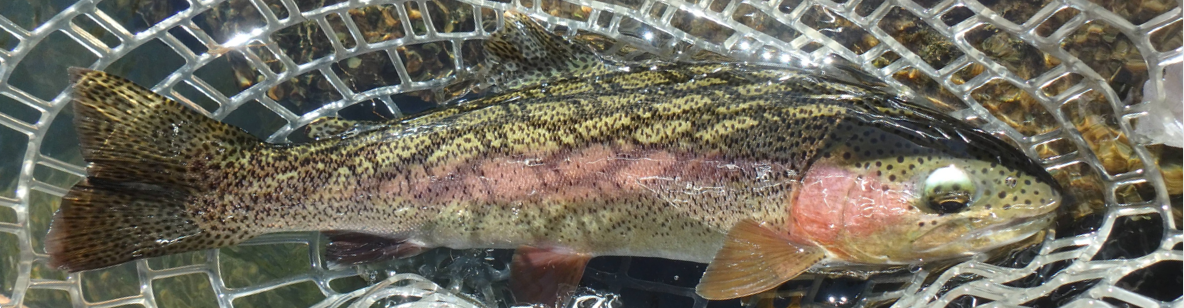
Beautiful Rainbow Was First Fish

I was disappointed by this turn of events, but I was at least reassured to learn that trout did in fact continue to inhabit Waterton Canyon. Next I began to prospect a narrow but long slot that ran down the center of the run. A large boulder served as a current break, and then a thin slower moving ribbon of water extended down stream for 25 feet to just above another large submerged rock. I made five drifts with no result, but on the sixth a large dark shadowy figure emerged from the deep swirly area at the tail. As I watched, the fish moved slightly to its right, and I surmised that it snatched one of the nymphs, so I executed a swift lift of the rod. Suddenly the fish felt the sting of a hook, and it began to thrash and exert pressure on my line. I held tight, and within a minute I applied side pressure and guided a fourteen inch rainbow into my net. Needless to say, I was shocked by this turn of events, yet quite thankful as well.

I released the rainbow and moved upstream a bit, but the water was wide and shallow and quite marginal. I was slipping and slogging along the bank to reach a stretch of deep water that ran along a vertical rock wall, when Jane passed by on her bike. I shouted that I would be up to Rattlesnake for lunch, but she apparently did not hear me and continued on to the dam. Since I now had more time before I planned to break for lunch, I waded back to shore and then carefully worked my way downstream to a location where the river narrowed and created another deep run and several juicy pockets. I skipped around this spot when I climbed the bank and walked up the road, but now I had time to inspect it.

Unfortunately I was approaching from above, and the many shrubs and willows did not allow me to stay back from the low clear river that was running at 72 cfs. I gave it my best effort and focused on some deep runs on the opposite side, but my flies were ignored. By now I estimated that Jane might be at the picnic pavilion, so I found somewhat of an opening in the willows and climbed the steep bank. Sure enough Jane was seated at the table, and I joined her to eat my light lunch.

After lunch Jane decided to take a walk to the dam, and I accompanied her up the road until I reached the path that delivered me to the wide shallow area that was my farthest advance prior to lunch. I splashed upstream until I was across from the deep run that rushed along the tall vertical rock wall, but again the fish were not tuned into the three flies that I presented to them. I was about to advance upstream again, but as I turned and surveyed the river, I noticed another fisherman blocking my path. This was the same person who occupied the emerald pool above the bridge when I first started to fish.

I reversed my direction and climbed back to the road, and then I hiked back downstream toward the bridge. I paused at the deep emerald jewel pool and covered the attractive runs at the top with no success, and then I moved along the bank and fished some nice pockets between the pool and the bridge. I continued to see no signs of fish in the after lunch time period.

Since my upstream migration was blocked by another fisherman, my only option was to continue downstream below the bridge. This area was now engulfed in shadows as the sun was low in the southwest sky and blocked by some high hills on the western side of the canyon. I walked down the road for .3 miles until I found a place where I could safely negotiate the steep bank. The water in this area was quite attractive with a series of cascading deep runs and short pools, so I began tossing the dry/dropper combination to the likely fish holding spots. By now my Charlie boy hopper was quite saturated, and after three or four foot drifts, it sank. I decided to switch it for a more buoyant top fly and chose a chubby Chernobyl with an orange body. From below this fly actually looked like an adult stonefly. I was not interested in catching fish with my top fly; I simply wanted something that was very visible and that suspended the two beadhead nymphs effectively.

Decent Afternoon Brown Trout

The chubby Chernobyl did its job, as I landed two brown trout in the last hour of fishing. Both fish snapped up the hares ear nymph, as it drifted along several feet below the surface. After I released the second fish, I was faced with the prospect of fishing the last .2 mile to the bridge where the river executed a bend away from the road. There was no obvious path before the bridge, so I elected to call it a day. My original plan called for quitting at 2PM, which was really 3PM by daylight savings time, so I reeled up my flies and hooked the ultra zug bug to my rod guide. I climbed the steep bank and returned to the base camp via the road, and there I discovered Jane seated at the table and reading her Kindle.

Jane at the Rattlesnake Pavilion

We packed everything up and rolled down the road on our bikes at a fast pace while enjoying the gradual downhill. We did pause halfway back to the parking lot when we encountered a cluster of male bighorn sheep. The sheep put on quite a show for the gathering of photographers, walkers and bikers as the rams sniffed each other and then backed off and butted their horns. In one amazing display of toughness, two rams suddenly backed up and then cracked their horns forcefully. I was stunned by the loud crack that this encounter generated.

Major Head Butt

It was a slow day on the South Platte River, but I had a great time nonetheless. The weather was delightful, the scenery was spectacular, and the wildlife was very entertaining. Outdoor time in November is priceless, and Jane and I appreciated our day.


South Platte River – 10/25/2015

Time: 11:00AM – 4:00PM

Location: South Platte River

Fish Landed: 13

South Platte River 10/25/2015 Photo Album

It is getting late in the 2015 season, and my opportunities to fish are dwindling. When my friend, Danny, texted me on Saturday to ask what I was up to on Sunday, I leaped at the opportunity to register another fishing day. The weather forecast projected highs in the mid-60’s in Denver and sunny, so this influenced my decision to fish in a positive direction.

I picked up Danny at his new apartment in South Denver at 7AM, and we were off to the South Platte River. By the time we drove to our target destination and hiked the trail, we were positioned to begin fishing by 11AM. The temperature at the trailhead before we departed was 33 degrees, but the warming effects of a vigorous hike enabled me to shed my fleece layer after fifteen minutes. When we arrived at our base camp, I slipped back into my fleece, but this was adequate for my entire day on the river as the temperature probably warmed to the upper fifties.

Danny Reaches the Tenkara

Danny and I agreed to work along both sides of the river in parallel, so I elected the southeast side as it was away from the trail. I tied a tan Charlie boy hopper to my line, and then I added a salvation nymph, and on the third cast I hooked and landed a small brown trout. Danny meanwhile opted for a yellow Charlie boy hopper that supported an egg fly and a small midge larva that he designed. Danny chose to pack in his Tenkara rod, as it collapsed to the size of a very small wand to tote along the trail. I watched with interest as he cast the eleven foot long rod with a single fixed line that probably extended to fifteen feet. The Tenkara method proved to be very effective for Danny, as he could use the length of the rod to flick long casts to all the likely fish holding locations in the river. The extra reach and lack of fly line allowed nice drag free drifts, and with the flows at 73 cfs, being able to stay back and execute long distance casts was a significant advantage.

Ready to Cast

Dave Shows Off an Early Brown Trout

Meanwhile I progressed up the river casting my Sage four weight loaded with a traditional fly line and tapered leader, and I landed seven fish by 12:30 when I perched on a large midstream boulder and devoured my lunch. Seven fish in a hour and a half on October 25 was commendable, and I was quite pleased with my accomplishment, although Danny and his Tenkara wonder stick were playing havoc with the trout of the South Platte River to a much greater extent.

Same Fish, Different View

After lunch the action slowed, but I was pleased to land an additional six fish in the remaining time. The sun was directly above us with no cloud cover, so perhaps this explained the lull in action from 1 until 2:30. Danny and I continued to pick up fish, but the pace was much slower than our earlier experience. We also encountered another fisherman who was fifty yards above us, so this may have had an impact as well. The fly fishing gentleman appeared to carry two fly rods, as he moved quickly and paused only at places that were prime spots. Danny and I both conjectured that his upstream wading and movement produced a negative effect on our fishing success, but there was no way to prove this theory.

By 2:30 he was no longer visible, and we suspected that he either departed or moved a far distance above us. At any rate, the fishing improved in the later afternoon hours. In fact Danny was on fire, and although he did not count his fish, we were both certain that he exceeded twenty fish landed on the day.

I persisted with the Charlie boy and salvation nymph for most of the day, and nearly all my fish chomped the salvation. What a productive fly this attractor nymph has evolved into during 2015! I also experimented with a third fly in the afternoon and cycled through a soft hackle emerger, ultra zug bug, hares ear, and emerald caddis pupa. The ultra zug bug and hares ear delivered one fish each to my net, and the the other flies simply served as decorations on my line.

By 3:30 I reached the huge deep pool that bordered our base camp. I performed a feat of rock climbing in order to circumvent the huge vertical boulders that blocked my upstream migration, and once I was positioned above them, I began to lob short casts to the narrow shelf pool in front of me. This area did not yield any fish, so I decided to waste a couple casts in a short pocket no more than five feet long that was just above the shelf pool. On the first cast a fish rose and smacked the hopper, but I was only able to maintain contact for a split second. I was certain at this point that the only fish in this small area had been pricked, and that I was wasting my time to cast again, but I flicked another cast to the pocket nonetheless.

Held in the Water

The hopper paused, and I instinctively lifted my rod and set the hook on a feisty and chunky brown trout. I carefully maintained pressure on the fighter and guided it to my net and discovered a thirteen inch beauty. This was my largest fish of the day, and a very fine brown trout by South Platte River standards.

Nice Width on This Beauty

I was checking my flies and preparing to resume my quest for trout, when I heard Danny shout from his position at the midsection of the large pool on the base camp side of the river. I pivoted to observe, and saw him using his hand over hand retrieval method to guide a large fish to his net. He motioned me, and I could not hear what he was shouting, but I guessed he hoped I could join him to photograph his prize. I complied and carefully waded across the river and snapped a couple shots of Danny and the fourteen inch wide body rainbow trout. This proved to be the catch of the day, and Danny was quite pleased with his Tenkara prowess.

Fisherman and Fish

My nice brown trout was the eleventh catch of the day, and once my photographic duties were complete, I waded back to the southeast side of the river and resumed my progress. I managed to hook and land another small brown before I approached a nice deep pool with a foam current line seven feet out from the bank. I paused to observe and noticed several splashy rises along the foam. I ran my dry/dropper combination along the entire current line, but the fish were apparently tuned into something different, as they ignored my offering.

Base Camp Pool

I gave up on the area and moved upstream, but the shadows now extended across the river, and following my flies became quite a challenge. I had not seen Danny since the photo session, so I exited the river and hiked back down the path and spotted him in the same large base camp pool. Now that I was reassured that he was nearby, I retraced my steps on the path and entered the river across from the foam line pool. Since the dry/dropper was no longer delivering fish at a reasonable pace, I decided to experiment with a caddis dry fly. I tied an olive-brown deer hair caddis to my tippet and moved closer to the foam. Once I was satisfied with my stance, I fluttered some casts to the current seam and allowed the caddis to float toward the spot where I saw rises earlier. I could not see the caddis, but I clearly observed the three splashy refusals that were associated with my first three drifts.

I rested the area and flicked the caddis farther upstream and along the bank, but then I returned some casts to the area of rejection and elicited one more swat. I was not done yet, however, and I executed one more downstream drift, and on this pass I could clearly follow my fly. Just as it reached the nadir of the current seam, the fish rose and sipped my fly, and this provoked a swift hook set on my part. Alas, I felt weight for only a split second and then it was gone. Although I was frustrated by my inability to land this fish, I was at least pleased that I managed a take.

Smaller Left Channel

Danny was now across from me, and we were near the downstream point of a long narrow island that divided the river into two channels. The sun was still covering the left braid, and I could see a smooth pool near the bottom of the island. I asked Danny if I could work up the left channel, since I felt it was more conducive to my delicate single caddis adult approach. Unfortunately the caddis did not interest the fish despite the fact that I stayed back a good distance and executed some nice long distance casts. I abandoned the shallow smooth pool and moved upstream to a spot where I noticed two or three very subtle rises. The only food source I could see were tiny midges that hovered in sparse clouds over the river, so I decided to try a parachute hopper with a zebra midge dropper.

This tandem offering actually yielded a tiny rainbow trout that was below my six inch minimum, but that was the extent of my success. I quickly migrated upstream and stumbled on one additional spot where the water depth suggested that a fish might be present. Sure enough I flicked a very short cast to the small pocket, and a ten inch brown trout emerged and crushed the parachute hopper. This was my last success on the day, and with the temperature dropping and the shadows lengthening, I quickly waded to the top of the island and then crossed the river to the path and returned to Danny.

I suggested that we should begin our return hike, but Danny asked if he could work some very attractive runs between us. I looked on as Danny expertly maneuvered the Tenkara and landed a couple more brown trout. By now it was nearly 4:30, so Danny finally relented and climbed out of the river and spooled his long line, and then we began a vigorous hike back to the car.

It was a fun day on the South Platte River. I landed double digit trout late in October, and I was able to fish a dry/dropper combination most of the day. Best of all I enjoyed the companionship of my friend, and I introduced him to a new location, and he experienced one of his best days of the year. Hopefully I will register a few more decent days of fishing in 2015 before the winter storms force me to the fly tying bench.

South Platte River – 10/08/2015

Time: 11:30AM – 4:00PM

Location: South Platte River

Fish Landed: 51

South Platte River 10/08/2015 Photo Album

Sometimes all the elements combine to yield a nearly perfect day of fishing, and Thursday October 8 was one of those days. About the only ingredient missing from our trip to the South Platte River was large fish, but given the abundance of superb factors, I can accept this omission. During my last trek to this section of the South Platte, I lost my rod tip, and Jane and I spent an additional couple hours backtracking until we finally located it. I was hoping for redemption, and Thursday qualifies as double restitution.

Jane Sets Up Base Camp

Jane and I departed our house in Denver by 7:15, and unfortunately we were unable to avoid some heavy rush hour traffic in the tech center area of south Denver. Despite this momentary inconvenience we were able to arrive at the trailhead by 9:50, and we began our hike at 10:05. An hour and fifteen minute walk at a steady pace delivered us at our customary base camp location, and after Jane spread out her blanket, we continued along the path to my entry point. I began above my usual starting point since I hoped to fish upstream beyond the base camp; something I usually fall short of.

Looking Good at 103 CFS

The flows were 103 cfs, and this level is nearly ideal. The moderate current allowed me to move freely about the river, however, the water was deep enough so that the fish were not overly skittish. The air temperature was in the upper forties when I began fishing, and it probably never peaked above sixty-five. I was comfortable during my entire time on the river under the bright sun and clear blue skies except for one brief period when some large clouds rolled in and blocked the sun’s rays.

I hoped to fish upstream along the left bank since it is away from the path, and I embrace the theory that the fish opposite a path or road are less pressured. Unfortunately the shadows and difficult light during the late morning period caused me to fish the right bank and the center of the river until I broke for lunch at 12:30. I began with a Charlie Boy hopper and hares ear nymph on 2.5 foot dropper, and almost instantly had a ten inch brown trout in my net. This fish tied me with the 2014 cumulative fish count, and shortly thereafter I hooked another comparable brown to surpass last year.

An Early Success Story

During the late morning and early afternoon time frame, I worked my way upstream and landed thirteen brown trout before exiting and returning to base camp for lunch. What an auspicious start to a gorgeous fall day! After lunch Jane walked down the path with me to my exit point before lunch, and she watched me and took photos as I resumed my quest for fish. Of course while she watched, I struggled to land even a small fish, so I added another one foot section of tippet to the hares ear, and tied on a second nymph…a beadhead salvation nymph.

Some Fat on This Brown

Boom. This addition was instantly successful, and as Jane looked on, I landed a couple small browns. She commented that I made it look too easy. The remainder of the afternoon was pure joy, as I advanced up the river beyond the base camp and landed another thirty-eight trout. The salvation nymph was the main producer during the early afternoon, but the hares ear came on strong in the late time period. At 1PM I began to notice blue winged olives, and this coincided with an incident when I lost the salvation in the process of photographing and releasing a fish. Consequently I used replacing the salvation as an opportunity to test a blue winged olive soft hackle emerger.

After a brief test I concluded that the soft hackle emerger did not perform on par with the salvation, and I returned the attractor nymph to its previous position at the tip of my three fly arrangement. The slow deep pools were not producing, so I stopped wasting time in that type of water and moved directly to the head of each pool where deep runs and riffles entered. These locations along with pocket water yielded nearly all of my fish on Thursday. Many of the fish were hooked during the lift at the end of the drift as well as during the swing, when I cast from the side and allowed the flies to drift across and then below me.

Same Rainbow Held Above the Net Briefly

The most memorable fish was a thirteen inch rainbow. I dropped a cast into a narrow frothy slot at the very top of a deep trough in the middle of the river. Suddenly a mouth appeared below the hopper, and I reacted with a solid hook set. Quickly I discovered a rainbow attached to my line, as it streaked up and down the river and put up a noble fight. Eventually it tired, and I scooped the irate silver football with my net. This was the only fish of the day that slurped the hopper imitation, even though the Charlie boy was in place as my top indicator fly all day long.

Huge Black Spots on This Brown Trout

In summary many of the fish landed were in the six to nine inch range with ten or so extending to ten and eleven inches. In addition I landed three that measured a foot or more in length. Admittedly these were relatively small trout, but I thrived on the fast paced nonstop action that accompanies landing a large quantity of fish in four and a half hours. As to species I landed only three rainbows, and the remainder were brown trout. I do not have an explanation of why certain species seem to predominate at different times of the year.

Obviously I desired more size, but it was a blast moving quickly upstream and popping casts to all the likely spots and more often than not connecting with a wild fish. I was in a beautiful remote location under blue skies and sunshine with pleasant temperatures. My lovely wife accompanied me, and no other human beings were nearby to disrupt our outdoor adventure. The wild trout were plentiful and willing to eat flies that I created myself. It seemed that every nook of water that might yield a fish, did in fact produce. Sure I would have liked a few larger fish, but this degree of success on October 8 is something I am thankful for.

A Glow Over the South Platte

South Platte River – 08/28/2015

Time: 12:30PM – 5:30PM

Location: South Platte River

Fish Landed: 26

South Platte River 08/28/2015 Photo Album

All is well that ends well. The real hero of this story is my lovely wife, Jane, who converted a potential day of frustration into one of the better outings of the season.

The story begins with my trip to the Elk River in British Columbia. While there Jake Chutz of Montana Fly Company convinced me to purchase some Simms neoprene wading booties for wet wading during hot summer days. I tried them out on the East Fork of Brush Creek, but I was not totally sold on the concept because my bare legs were exposed to thistles and thorns, and I needed to reapply sunscreen often to compensate for getting in and out of the water repeatedly. In order to overcome these negatives, I purchased a pair of quick dry pants that can be converted to shorts. I anticipated that using the pants in combination with the wading booties would make wet wading an enjoyable method of fishing Colorado streams.

One of my favorite areas to fish is the South Platte River, where I am required to hike for three miles from the trailhead to the river. As I was anxious to experiment with my new wet wading set up, I felt that this would be a perfect test. On previous trips I lugged my waders, wading boots, rod, reel, and fishing pack in a regular backpack. The three mile hike with a heavy load put significant stress on my neck, shoulders and back; and after a day of fishing, the three mile return was quite taxing. For this reason I only made the trek one or two times a year, as I needed a month or two for the tiresome aspect of the experience to fade from my memory.

Sun and Mist

With my new fishing apparel purchases, I could hike to the river in my wading boots and quick dry pants, and the only equipment I would need to carry on my back would be my normal fishing backpack which contained water and a raincoat. I decided to evaluate my new hike-in summer fishing approach on Friday August 28, and my wife, Jane, decided to accompany me.

The trailhead for this South Platte venture is two hours and fifteen minutes from our home in Denver, and the hike generally adds another one hour and fifteen minutes. In order to allow myself to begin fishing by mid-morning, I like to camp near the river the night before. Jane and I adhered to this plan by making the drive on Thursday, and we stopped for dinner along the way and then set up our tent before dark.

A Rocky Section with More Mist

The flows in the section of the river that I wished to fish were 157 CFS. This is a bit high, but I fished the area at 180 CFS several years ago with excellent results, so I was actually optimistic that the fishing would be good. Also above normal flows are a welcome change from the normal low clear difficult conditions present on most Colorado streams in late August. Everything seemed to be falling in place for a fun fishing trip to the South Platte River.

On Friday morning after eating breakfast and packing our camping gear, we arrived at the trailhead by 9AM. I was already attired in my quick dry pants, so after I pulled on my wading booties and boots and completed all my normal preparations for a day of fishing, we began our hike. I assembled my Sage four weight four piece rod, but I did not string the line because I do not normally do that until I arrive at the stream so I can observe the water before deciding on what flies to use. We hiked for a couple miles with Jane setting the pace, and I became annoyed with constantly getting my rod entangled in low overhead branches. Also I tended to gain on Jane and came close to tapping her with the rod several times, so I decided to reverse the position of my rod and began holding it with the tip facing backwards.

We arrived at the river by 10AM and established a base camp, and then Jane walked down the path with me for another .5 mile to the point where I planned to enter the river. I gave my camera to Jane so she could record my maiden entry into the cold river with my wet wading uniform. I stopped at the edge of the river while Jane looked on and began to string my rod with the fly line. When I reached the tip section, my jaw dropped, and my facial expression made an abrupt shift from anxious anticipation to deep gloom. A tip section was no longer present on my rod! My first concern was the cost of buying another tip section for my rod, but rather quickly this shifted to the anger and frustration that results from the sudden shattering of all plans for a day of fishing on one of my favorite remote stretches of Colorado water.

We had camped in order to be on the water early, so I could maximize my fishing time to compensate for the arduous hike. I purchased the wading booties and quick dry pants to test, and now that was in jeopardy as well. What could I do besides cry? As usual Jane was the voice of reason. She suggested that we retrace our steps back to the base camp and carefully look for the rod tip along the way. If we did not find it by the time we arrived at the base camp, we would need to hike back along the entry trail and look for it along the way. The worst case scenario resulted in our return to the car to pick up my spare tip, and then we could return to the river to fish. We were retired and had all day, so if I needed to fish later to make up for lost time in the morning, that would be the answer.

I meanwhile was in the depths of despair. I was mourning the loss of my rod tip and convinced that my carefully planned day of fishing was ruined as well. We began the process laid out by Jane, but the rod tip did not appear along the trail between my planned fishing entry point and the base camp. When we arrived at the base, I shed all my fishing gear except my wading staff which now morphed into a walking stick. We commenced a slow walk along the trail we had just covered. Before we reached the point where the trail veers away from the river, we encountered a couple on their way in from the trailhead. We asked if they noticed any rod tips, but they both replied no, but they really were not looking for one. Of course my first thought was that they probably stepped on it and crushed it.

We continued up the steep ascent away from the river. Jane suggested that I could move ahead at a faster pace while she moved at a slower methodical rate, but I was concerned that she might find it and have no way to communicate this information to me, so we stayed together. We covered roughly one and half miles from the base camp when Jane suddenly cried, “There it is!” I was in disbelief, but I turned and looked back, and she held the fragile fly rod tip in her hand. Even more amazing was the fact that I walked past the very rock where she found the rod tip, and I never saw it. The decision to not separate was now looking quite fortuitous. Jane handed me the rod section and suggested that I could now return at a faster pace, since she knew how anxious I was to fish.

The Found Rod Tip

I hustled back along the trail to our base camp and decided to eat my lunch since it was now approaching noon. Just as I finished lunch, Jane arrived and agreed to once again walk to the entry point and take a photo. We repeated the entire process, and this time we followed it through to completion. I entered the river with all four sections of my rod in place, and then I knotted a Chernobyl ant, beadhead hares ear and salvation nymph to my line. I thanked Jane for finding my rod tip and accompanying me on this adventure, and I turned my attention to fishing. I lost a couple hours, but at least I was now in a position to salvage some fun from a day that I prematurely wrote off.

Dave’s First Attempt at Wet Wading with Quick Dry Pants

I worked my way upstream methodically casting the dry/dropper trio for thirty minutes, but no fish responded. I was beginning to seethe with frustration since I suffered through many trials and tribulations to get to this point, and now the fish were not cooperating. But once again I was being overly pessimistic, and finally a ten inch brown trout grabbed the salvation nymph at the tail of a deep pocket. I was on the board, and the remainder of the day would raise my spirits and justify the long hike and search. The river was too high to safely cross to the opposite bank, so I continued working along the west side. This necessitated many backhand casts which created wear and tear on seldom used shoulder and back muscles. In addition I was not as accurate, and more nasty snarls resulted from backhand casts and three flies.

Nice Pocket Water Section

Despite these hassles I persisted, and between 1:00PM and 3:30PM I landed sixteen trout on the three fly system that I began with. All the landed fish were brown trout, and quite a few were in the twelve to thirteen inch range, and they displayed vivid spots over a silvery gold background. This was the fishing that I worked so hard for. I love moving quickly and popping three to five casts to likely areas, and the fish were rewarding me frequently by snatching the trailing salvation or hares ear.

Nice Vivid Spots on This Wild Brown

By 3:30 I reached a nice long pool, but the deep areas were not delivering fish on Friday, so I climbed to the path and circled around to the faster run that fed the pool. As I was doing this I ran into Jane, who was cautiously walking toward me to confirm my well being and progress. I could see the large rock across from the base camp, so I told her I planned to fish to that point, and then I would quit, and we would commence the long return hike.

One of the Better Brown Trout

When I re-entered the river I spotted quite a few tiny blue winged olives floating up from the surface, so I removed the salvation nymph and replaced it with a RS2. For the next two hours I worked upstream to the base camp pool and landed ten more fish. Unlike the early afternoon, two rainbows landed in my net, and these were probably my best fish on the day. Both the rainbows sipped the RS2, but the hares ear continued to outproduce the smaller nymph. During this time I also experienced two awful tangles, and quite a few long distance releases. I attribute the higher rate of momentary hook ups to the tiny size 20 hook contained in the RS2.

The Second Rainbow

At 5:30PM I reached the base camp and prepared for the return trip. We departed by 6PM and reached the Santa Fe by 7:15PM. The wet wading experiment worked out well, as I felt comfortable for the entire afternoon except for a few occasions when some large clouds blocked the sun, and some wind kicked up. Overall however it worked well and cut down greatly on the weight on my back and the associated neck and shoulder strain. We stopped at a brew pub on the way home and enjoyed craft brews and a delicious late dinner. Even this did not begin to repay Jane for salvaging my fishing day on August 28. Perhaps the best gift for Jane was the absence of whining and complaining that would have occurred should I have lost the rod tip and missed a day of fishing. Jane is one of a kind, and I cannot thank her enough. All is well that ends well.


South Platte River – 05/26/2015

Time: 10:00AM – 3:30PM

Location: Cheesman Canyon from Jamboree Pool upstream

Fish Landed: 3

South Platte River 05/26/2015 Photo Album

While Jane and I were enjoying gorgeous spring weather in the Carolinas; rain, snow and cold continued to be the norm in Colorado. I did not even bother to check stream flows or fishing reports for the first six days after we returned, but then I received a text message from my new fishing pal, Danny Ryan. Danny informed me that the South Platte River in Cheesman Canyon was reputedly fishing very well with San Juan worms, scuds, eggs and leeches. These are the typical high performing flies when flows increase dramatically, and that was the case in Cheesman Canyon.

I checked the stream flows and discovered they were at 1,160 cfs. Another fishing report stated that the above normal rain filled Cheesman Dam, and water was spilling over the top. Despite these leading indicators of difficult fishing, I agreed to a trip with Danny on Tuesday, May 26. We managed an early start and arrived at the Gill Trailhead parking lot by 9AM. As we drove along the South Platte River between Nighthawk and Deckers, I was disheartened to see very high flows and brown murky water conditions. Above the town of Deckers and Horse Creek, the water color improved to pea green.

The small stream that flows from the parking lot into the South Platte near the Wigwam Club was swollen to twenty times its normal size, and it also was carrying a significant amount of silt. Danny and I set off on our thirty minute hike to the canyon, and as we crested the rim, we gazed down upon the river below. Clearly the flows were high, but the clarity of the river was much improved over what we observed near Deckers above Horse Creek, We were both encouraged by this revelation, but I remained somewhat concerned about our ability to land some fish from the abundance of water.

Normally a Placid Pool

We continued hiking along the river for quite a distance until we arrived at the pool that spreads out below some huge boulders that are positioned in the middle of the river. On this day of flows in excess of 1,000 cfs, the pool was more akin to a deep run with a large shelf eddy on our side of the river. I began my fishing experiment with a conehead pine squirrel leech and a bright pink San Juan worm and began to drift these morsels through the deep slow moving eddies and sloughs created by current breaks.

Looking Across

I endured thirty minutes of fruitless casting until I reached the eddy above the huge boulder described above. Here I actually cast downstream and allowed the subsurface offerings to drift back toward me in a large eddy, and on the fifth such pass, the indicator dipped and I set the hook. It did not take me long to strip a small nine inch rainbow in to my net. It wasn’t a very exciting catch, but I at least eliminated the possibility of a skunking.

We moved on along the north bank of the river and played leap frog between ourselves as well as with another personable fishermen who joined the fray in our area. We skipped the water between Cow Crossing and re-entered at Rainbow Bend. When I rejoined Danny, I discovered that he had some fantastic success as he landed two large rainbows near our starting point on one of his red San Juan worms.

With this news I replaced the pink worm with a red version, but eventually I broke off both the leech and worm on an underwater snag despite using 3X and 4X tippet sections. By 11:45 I was feeling quite hungry, so I found a nice rock to rest on while I ate my lunch. Danny continued to cast relentlessly as I watched him from my perch.

Danny Makes Some Drifts

After lunch I decided to change things up a bit, and I knotted a Cathy’s super bugger to the top position, and then below that I tied on a red San Juan worm. I picked up the pace and began moving more frequently until we encountered the gentlemen that unofficially became part of our leap frogging progression. We exchanged information, and he revealed that he landed a nice brown trout on a green scud. I did not have many light olive or green scuds in my fleece pocket, but I did have five orange scuds, and many years ago these performed quite well during the high water of May. I decided to give one a try. In addition I swapped the woolly bugger for an egg sucking leech with a hot orange bead head.

A 17-18 Inch Ranbow

This move proved to be quite fortuitous, and in short order I hooked a medium sized rainbow at the tail of a long deep run next to the bank. Unfortunately the feisty fish managed to elude my hook after a brief battle. I took a few steps up along the bank and fished the middle portion, and once again a fish tugged my thingamabobber below the surface. A swift hook set ensued, and once again I found myself connected to a fish; however this time it proved to be a large combatant. The fish thrashed near the surface and revealed itself to be a large rainbow, and after several powerful runs, I applied side pressure and maneuvered it to a spot along the bank where Danny swooped his long handled net beneath. This fine pink-sided fish deserved more attention, and I snapped a few photos while Danny steadied it in his net.

U-Turn When It Spotted Me

Two fish grabbed the orange scud in a short amount of time, so I was now convinced I stumbled into an effective fly for high water conditions in late May on the South Platte River. With renewed enthusiasm I forged ahead and worked my nymphs in all the likely slow pockets and eddies that I could reach. I continued to move more quickly than the morning, and this approach brought me to a short eddy behind a large exposed boulder. I was skeptical that this spot would produce a fish, but I decided to allocate three casts to the area. The first two were fruitless as the indicator hovered in a dead spot in the middle of the eddy behind the rock, but I allowed the third cast to drift back upstream toward the rock. When I became concerned that the flies were getting snagged under the rock, I gave my rod a lift and instantly felt throbbing weight on the other end.

Out of the Net

Another fish put up a spirited battle, but this one decided to dive and shake in the manner of a brown trout. Sure enough when I raised my rod and leveraged the fighter to my net, I gazed at a wild fourteen inch brown trout that also savored the orange scud. I found Danny and gave him one of the orange scuds, and then we continued to move along the Gill Trail toward the upper sections of the South Platte River.

One Final Attempt

Danny Displays His Catch

Unfortunately, the hot streak of orange scud feeders ended, and Danny and I continued for another hour with no activity. We realized that we were approaching the end of the trail, and consequently we faced a lengthy return hike, so we decided to make our exit. As we hiked back along the trail, we returned to a nice long deep run where Danny foul hooked a brown trout during the early afternoon. He decided to give it another try, so we paused and he added a pink San Juan worm to his line. On the seventh drift through this attractive stretch of water, his indicator paused, and he set the hook. His six weight rod throbbed but after a tough battle, he landed a handsome fourteen inch brown with thick shoulders. This was a fitting end to our day in Cheesman.


South Platte River – 02/14/2015

Time: 11:30AM – 2:00PM

Location: Downstream of Nighthawk at Whale Rock

Fish Landed: 0

South Platte River 02/14/2015 Photo Album

I pulled my dark olive Columbia fishing shirt off the hanger and eagerly slipped my arms through the sleeves and buttoned the front. The high in Denver was projected to be 65 degrees, and I anxiously anticipated my first fishing outing of 2015. My Valentine, Jane, agreed to accompany me to the South Platte River near Nighthawk, but before we left, Jane observed that my fishing shirt was excessively wrinkled. I responded that I was not about to waste valuable fishing time to iron a fishing shirt. Jane replied that the fish care, and I was disadvantaging myself in the battle to land my first fish of the season.

Wrinkled Fishing Shirt

Off we went with a chair for Jane and our lunches packed, and in my case guarded optimism that I could land a fish to kick off my new season. I checked the flows in the South Platte River below Cheesman Reservoir, and they were at a low level of 116 cfs. The combination of low clear flows, bright blue skies, typical cold water temperatures of February and the lack of significant insect activity caused me to be cautious in my expectations.

Ready for First Fishing Outing of 2015

When we reached the South Platte River at the base of Nighthawk Hill my hopes were further eroded by the significant number of vehicles parked in all the designated pullouts along the river. Fishermen were everywhere, and I was headed to the less popular lower river. The prime catch and release water between Scraggy View and Deckers must have been like opening day back east with fishermen lining the river.

I tossed aside my concerns and assembled my new replacement Orvis Access four weight rod and then pulled my head through the loop of my new Fishpond front pack. My fleece pouch was sufficiently stocked with San Juan worms, eggs, and tiny nymphs so I set out on my quest for trout number one. As I slid down the path toward the river several fishermen ambled past me along the shoulder of the dirt road. I rarely saw fisherman below me in this spot on the South Platte, so the parade of fishermen did not bode well.

Wading into the South Platte River

I began casting a nymphing rig with a strike indicator, beadhead hares ear and zebra midge to the nice bend pool where I had much success in previous first time outings, but Valentine’s Day 2015 was not going to be one of those experiences. I did not add a split shot to my set up as the flows were quite low, and I determined that the two beadheads would sink the flies sufficiently. After striking out in my ace in the hole bend pool, I moved upstream and worked a solid deep run along the far bank. The sky was a disappointing slate gray and the air temperature hovered at 42 degrees. These were not the balmy premature spring conditions that caused me to schedule this mid-winter venture.

A Prospecting Cast

I moved on to a channel on the south side of an island and worked some deep riffles to no avail and then returned to find Jane bundled up in a chair across from the bend pool. We agreed to retreat to the car to pick up our lunches, and then returned to our spot across from the bend pool. As we munched our lunches, we watched two fishermen thirty yards below us futilely flail the river with numerous hopeful casts.

After lunch I crossed the river to the west bank and then hiked downstream through some tall grass and ponderosa pines, but as I began to cut back to the river, I spotted another fisherman wearing a red ball cap in the area just above the white water cascade. This was the area I was targeting, so I made a right turn and cut back to the river halfway between the red cap gentleman and the fishermen below Jane’s reading spot.

Headed for the Rock Jumble after Lunch

I swapped out the beadhead hares ear for a pink San Juan worm and worked the deep runs and side pools, but once again I was met with disappointment. By the time I reached the point where a fisherman covered the water during our lunch, he had departed, so I explored the area from the opposite side. I exchanged the zebra midge for a RS2, and in a deep side pool I finally observed a trout dashing for cover after my third or fourth cast failed to attract interest.

I was now feeling quite bored with the winter fishing and my lack of success, so I crossed the river and approached Jane. We decided to move to another spot farther up the river, so Jane drove the Santa Fe, and dropped me off along the dirt road just above the next parking area. She continued to the next pullout, and I promised to fish to her position, and then we would begin our return trip to Denver. I thoroughly worked the rocky stretch of river next to the road with my worm and RS2, and again my rod did not feel the throb of a resisting fish.

One of My Favorite Stretches Was Unproductive

When I reached the top of the deep run, a white pick up truck appeared on the road above me, and a DOW agent greeted me and asked to see my fishing license. I struggled to open the zippered pockets in my wader bib, but upon inspection, I could not find my Colorado fishing license. The gentleman was nice enough to transport me upstream to the parking area where Jane parked the Santa Fe, and I found her by the edge of the river reading. She threw the keys to me, and I found my drivers’ license and presented it to the DOW agent. He politely accepted it and told me he would radio one of his other agents who was in cell range, and then that person could use the on board computer to check the database for my license.

After a five minute wait I was relieved to hear that the chain of connections worked, and he determined that I was a licensed fisherman. Later when I returned home, I found my license in my fishing backpack in my fishing bag. I had it with me in the car, but I did not have it on the stream. This was the most exciting aspect of my Valentine’s Day fishing trip.

If you ask Jane, she will tell you that I was skunked because I did not iron my fishing shirt. I, on the other hand, attribute my lack of success to the density of fishermen combined with low clear water conditions. One certainty however remains. I will not stoop to ironing my fishing shirts.

South Platte River – 11/29/2014

Time: 11:30AM – 2:30PM

Location: Cheesman Canyon

Fish Landed: 0

South Platte River 11/29/2014 Photo Album

I’ve never been a huge fan of winter fishing, but the mild weather of Thanksgiving weekend in Colorado induced me to overcome my reluctance. The high temperatures for Thursday through Saturday ranged from the mid-60’s to the mid-70’s, and Jane suggested that we take advantage of the weather and hike into Cheesman Canyon. I signed on to the late fall trek, and we arrived at the Wigwam parking lot at 11AM on Saturday morning. I put on my waders and wading boots and prepared my Sage four weight while Jane grabbed her lunch, stadium seat, and book. We were on our way on a pleasant .5 mile hike to the rim of Cheesman Canyon.

The temperature was in the low 60’s as we began, and when we began the descent to the river in the brilliant sunlight it felt more like 70. The flows in the South Platte tailwater were 125 cfs and crystal clear. As we traveled upstream on the red gravel trail, we passed quite a few fishermen. Our destination was Cows Crossing, but as we approached this ninety degree bend in the river, it was clear that the large rock that Jane loves to frequent was covered by shade. We shifted our destination and found another nice large flat boulder bathed in sunlight, and Jane made this our base camp.

[pe2-image src=”http://lh3.ggpht.com/-KsGKmuXowDo/VHp3ZTdHxlI/AAAAAAAAtV0/TNDxYK5oEHw/s144-c-o/PB290013.JPG” href=”https://picasaweb.google.com/108128655430094950653/11292014SouthPlatteRiver#6087309122947499602″ caption=”Jane’s Spot Along South Platte” type=”image” alt=”PB290013.JPG” ]

I began my quest for a late November fish by moving fifteen yards downstream from Jane, and I tied on a Chernobyl ant with a trailing ultra zug bug and orange scud. I stood on some large rounded boulders and began covering some very attractive water, but I saw no signs of fish. I began to doubt the effectiveness of the dry/dropper configuration in the cold flows of the South Platte River, but when I approached a nice current seam just below Jane’s position, I observed a pause in the foam attractor and set the hook. Much to my surprise I was attached to a tiny rainbow trout that measured four inches, so I quickly removed the ultra zug bug and allowed the small gem to return to the icy flows. I gave my camera to Jane before I began fishing, so she actually captured me netting the hungry little fish.

[pe2-image src=”http://lh6.ggpht.com/-gCVkVIYCTSU/VHp3cVSOO0I/AAAAAAAAtV4/HA50QBb3iKg/s144-c-o/PB290019.JPG” href=”https://picasaweb.google.com/108128655430094950653/11292014SouthPlatteRiver#6087309174978263874″ caption=”Landing a Tiny Rainbow Trout” type=”image” alt=”PB290019.JPG” ]

I moved on above Jane to the large bend at Cows Crossing and found a place where the river was shallow enough to cross, and I then continued fishing upstream along the opposite bank. I prospected some nice current seems, riffles over moderate depth and deep runs; but none of these typically productive stream structures produced any action. In fact I was surprised that I did not see any fish since the flows were low and clear.

[pe2-image src=”http://lh5.ggpht.com/-hQRAV9UWB_s/VHp3dal10_I/AAAAAAAAtVs/xt01U8gTMNk/s144-c-o/PB290021.JPG” href=”https://picasaweb.google.com/108128655430094950653/11292014SouthPlatteRiver#6087309193582597106″ caption=”Forward Cast” type=”image” alt=”PB290021.JPG” ]

At 12:30 I returned to Jane’s base camp and enjoyed my lunch in the company of my lovely wife. Jane noticed that the shade was rapidly advancing toward her rock perch, so she announced that she might move before I returned. I meanwhile decided to walk farther up the trail and around the next ninety degree turn that is called Rainbow Bend. I discovered that this area was quite popular with other fishermen and passed four fishermen working the slow moving deep pool just above the bend.

[pe2-image src=”http://lh6.ggpht.com/-q1hg-wlwAL0/VHp3e_uwttI/AAAAAAAAtTU/JmucK4Rmpdo/s144-c-o/PB290024.JPG” href=”https://picasaweb.google.com/108128655430094950653/11292014SouthPlatteRiver#6087309220731991762″ caption=”Two Fishermen in Clear Pool” type=”image” alt=”PB290024.JPG” ]

Eventually I moved above the last fisherman and approached a nice wide pool. I abandoned the dry/dropper approach and configured my line with a hot pink strike indicator, split shot, ultra zug bug and zebra midge. I noticed quite a few minuscule midges buzzing about above the river, and this observation caused me to experiment with the midge larva. I began drifting the nymph combination through the pool, along the juicy current seams and through the tail out, but none of this focused fishing attracted any fish. Meanwhile another fisherman that was originally below me circled around my position and then entered the river forty yards farther upstream.

[pe2-image src=”http://lh6.ggpht.com/-7c64xJrRm5c/VHp3iuHdCvI/AAAAAAAAtU8/f6r8uBia9zY/s144-c-o/PB290030.JPG” href=”https://picasaweb.google.com/108128655430094950653/11292014SouthPlatteRiver#6087309284723198706″ caption=”The Loop Is Forming” type=”image” alt=”PB290030.JPG” ]

Aside from the lack of action and absence of any signs of fish, the most frustrating aspect of this Saturday outing was the constant need to remove moss and scum from my flies. I estimate that scum removal was an every other cast event. After exhausting the prime pool that I optimistically claimed, I advanced upstream a bit, but after an hour of casting and moss removal, I began to think more about the snacks I packed for the return trip than the likelihood of landing a fish.

I clipped my flies to the rod guide and trudged back along the trail to our base camp. As Jane suggested, she was no longer there, so I hiked another .3 miles until I spotted her bright blue long sleeved shirt on the beach next to another juicy pool. She was now in the sun and sheltered from the wind by a huge boulder. Seeing no competing fishermen in the pool, I decided to make one more attempt to land a substantial trout from the South Platte River. Well, I have to admit that a nine inch fish would have exceeded my expectations at this point.

[pe2-image src=”http://lh4.ggpht.com/-zj8LhozatXo/VHp3g_2i2JI/AAAAAAAAtTs/vTSP98dw998/s144-c-o/PB290027.JPG” href=”https://picasaweb.google.com/108128655430094950653/11292014SouthPlatteRiver#6087309255124375698″ caption=”The Top of the Pool” type=”image” alt=”PB290027.JPG” ]

Alas, after another half hour of fruitless casting, I decided to call it quits, and I waded back to Jane’s resting place. I acknowledged that she probably had the right idea about Saturday November 29. It was a rare opportunity to enjoy a pleasant hike through gorgeous scenery and bask in the warmth of the late autumn sun. Catching a fish was really secondary.

South Platte River – 08/22/2014

Time: 10:30AM – 4:00PM

Location: From point where the canyon narrows back toward the campsite where we stashed our gear.

Fish Landed: 23

South Platte River 08/22/2014 Photo Album

The South Platte River below Lake George remains one of my favorite spots to get away from it all. The size of the fish is a bit lacking, but the location is remote, and there are a large quantity of fish, and I love the solitude. My son, Dan, is also a fan of the South Platte, and he was back in town for a week before resuming classes at Fuqua Graduate School, so we scheduled a day on the river.

We camped at Round Mountain Campground on Thursday night and withstood some light rain. We woke up at around 7AM on Friday morning, and after a quick breakfast we drove the eight or nine miles required to arrive at the trailhead. It was quite overcast as we hoisted our packs on our backs and began the three mile hike to our typical staging area where we pulled on our waders and strung our rods. The sky was even darker than when we left, so we both decided to wear our rain jackets, and this proved to be a smart decision as it drizzled and rained lightly off and on during our morning fishing.

Dan Ties on His Starting Flies

Dan Ties on His Starting Flies

South Platte at 200 CFS

South Platte at 200 CFS

I never fished this stretch of the South Platte River when flows were above 180 cfs, so I was a bit concerned that it would be difficult since the DWR web site registered 200 cfs. However, as we approached the water it appeared that the higher flows would not be an issue. Nice deep pockets were visible as usual, and there were spots where a fisherman could carefully cross to the opposite bank. In fact Dan accepted that challenge and worked his way across so he could fish the east bank while I patrolled the west side. We both began with a Chernobyl ant and beadhead hares ear, and we probably should have offered something different to see what the fish might be looking for, but based on past experience we were confident that these flies would appeal to South Platte River trout.

Dave's First Fish

Dave’s First Fish

I quickly began picking up fish on the hares ear, and Dan was also recording a nice quantity of hook ups, but for some reason they were resulting in long distance releases. By the time we decided to break for lunch at 12:45PM, I accumulated sixteen fish landed, and quite a few were in the 6-8 inch range although a few larger rainbows and browns were in the mix. As Dan and I hiked back to the informal campsite that served as our staging area, the intensity of the precipitation increased from an intermittent drizzle to a steady light rain. It was not enough to prevent us from continuing, but enough to soak our raincoats and hats.

Dan Displays an Early Catch

Dan Displays an Early Catch

When we arrived at the staging area, we met a group of four campers/fishermen who had just arrived after completing the three mile hike. They were setting up their tents for a long weekend stay, and we chatted with them while we consumed our lunches. They were from Colorado Springs, and we noticed both fly rods and spinning rods in their arsenals. Dan and I finished our lunches and said goodbye to the campers and hiked back down the path to the location where we exited before lunch. It was 1:30 as we resumed fishing in the rain.

Dave Pulled a Nice Brown from Small Gap Between Log and Rock

Dave Pulled a Nice Brown from Small Gap Between Log and Rock

Dan once again negotiated a crossing, and I resumed prospecting the pockets along the right bank, but the action was slower than that which I experienced in the morning. I reached some gorgeous deep runs and decided to abandon the dry/dropper and try the indicator nymph method. Initially I fished a beadhead hares ear and a RS2, and in a deep narrow slot I brought at least four fish to my net as the trout hammered the hares ear as I lifted toward the tail of the drift. I shouted to Dan that deep nymphs were on fire, so he found a place to cross, and I set him up with the same configuration that I was using except I used a soft hackle emerger instead of the RS2 as his bottom fly.

A Nice Afternoon Brown Trout

A Nice Afternoon Brown Trout

The nymphing technique worked reasonably well and allowed me to land seven more fish in the afternoon session. The catch rate was down, but the fish were on average larger; however, I felt the fish landed in 2014 were smaller than my experience on previous trips. As usual my nicest fish of the day may have been the one that escaped. I hid behind a huge exposed boulder and flipped the nymphs above and into some nice riffles over moderate depth. As the indicator angled away from the boulder and floated toward the bank, it shot sideways, and I set the hook. This provoked a bright rainbow trout in the 13-14 inch range to launch from the stream, and in the process it tossed my flies from its lip.

The indicator nymph system required deeper water than the dry/dropper set up as the splash of the indicator was enough to spook fish in the more shallow pockets along the edge that produced fish in the morning. Despite the flows of 200 cfs, more edge pocket water became available as I waded upstream than deep runs and seams that matched the  deep nymphing technique.

Dan Looks Back Amid Rain Showers

Dan Looks Back Amid Rain Showers

We decided to quit at 4PM just as a decent hatch of tiny size 24 BWO’s began. I also observed two quite large mayflies that appeared to be yellowish in color, and speculated that they might be flavs. In addition one or two pale morning duns may have been in the mix. I would have liked to stay longer to see what sort of aquatic emergence developed; but the rain, feeling chilled and Dan’s need to prepare for an early flight on Saturday trumped this desire.

Despite the rain and higher than normal flows, it was another fun day on the South Platte River. I always enjoy spending a day with my son, so catching a bunch of fish in a remote setting is merely icing on the cake. We both experienced a lot action although the size of the fish was down a bit, but the important thing is we caught fish and had a great time. I may try one more trip to this section of the South Platte River if the flows drop to the 80-120 cfs range.


South Platte River – 06/14/2014

Time: 2:30PM – 5:00PM

Location: Upstream from the second of the twin tunnels in Eleven Mile Canyon

Fish Landed: 1

South Platte River 06/14/2014 Photo Album

For Fathers’ Day weekend 2014 Jane and I planned our first camping trip of the year. For the last three or four years we have gone camping; however, we discovered that this is a popular choice for many fathers in the state of Colorado. Now that Jane is retired, however, we felt we were safe to secure a national forest campsite if we departed early on Friday as we would arrive ahead of those who had to work on the last day of the work week.

After a brief discussion we settled on Spruce Grove, a nice campground along Tarryall Creek in Pike National Forest. We packed most of our gear on Friday morning and then headed to the supermarket for some last minute food. Upon our return we loaded the remaining items and began our drive to the southeast corner of Park County. We camped at Spruce Grove quite a few years ago, and it remains one of our favorite campgrounds. There are 20+ campsites in total but seven of them are walk-ins in one of the nicest settings in Colorado. From the parking lot one hikes down a short path and then crosses a footbridge and encounters five sites on the north side of Tarryall Creek. Huge boulders loom over these sites while sweet scented ponderosa pines are scattered among the area. The forest floor consists of coarse natural reddish gravel.

Indian Paintbrush

Indian Paintbrush

Jane and I both had our hearts set on revisiting one of the walk-in sites, but when we arrived, we discovered that they were all occupied or reserved. Next we cruised the drive-up sites along the road that circles through the campground, and these were all reserved or taken as well. We couldn’t believe our bad fortune, or was it really a lack of planning? We resolved to make reservations for future trips or at least check campground availability.

With Spruce Grove out of the picture, we moved into crisis mode. My backup option was Round Mountain just off of U.S. highway 24 five miles beyond Lake George and one-third of the way to the top of Wilkerson Pass. We used a shortcut to avoid returning to Lake George and found Round Mountain less than .5 mile down the pass toward Lake George. We held our breaths as we entered and circled the campground, but we were relieved to discover quite a few empty sites and eventually settled on site number 13.

After eating lunch and putting up our tent, we decided to enjoy a bike ride. I was familiar with Eleven Mile Canyon, so I suggested that we ride from the entrance hut to the dam and back since it is a very gradual grade. Jane agreed, and we had a great time carrying out this plan. We began a mile or two beyond the entrance gate and probably biked a total of 14 miles. Of course as we cycled along the beautiful stream as it cascaded through the narrow canyon, I noticed that the flows were high, but the water was quite clear and many spots beckoned as high water fish-holding locales.

Perspective

Perspective

On Saturday Jane and I took a two hour hike into a different canyon location, although this experience was the opposite of Eleven Mile Canyon as we encountered only one other party of five during the entire round trip. In the afternoon Jane agreed to accompany me back to Eleven Mile Canyon so that I could test the waters for a few hours to see if my observations of Friday would deliver some fishing action on Saturday.

Cold Water Refreshes

Cold Water Refreshes

By the time we drove to Lake George and purchased some propane to break a twenty dollar bill and secure some ones to pay our entry fee it was 2PM. We drove up the canyon to just beyond the twin tunnels amidst significant weekend traffic and many fishermen. I climbed into my waders and strung my fly rod and then descended the steep bank to the river, and I was finally in a position to begin casting by 2:30PM. I spotted a pair of fishermen below the car, so I hiked up the road a short distance before dropping down the embankment thus allowing a 50 yard buffer between me and the two fishermen below.

I was convinced that the higher flows (250 cfs) would cause the fish to recognize worms and scuds in the water column, so I tied on a chocolate San Juan worm and below that added a pink squirrel that I purchased at Driftless Angler. I fished this combination with a thingamabobber and split shot, but despite covering some very attractive water, I had no success. I began cycling through alternative offerings including a beadhead hares ear and a salvation nymph with equally disappointing results.

South Platte River in Eleven Mile Canyon

South Platte River in Eleven Mile Canyon

As I was covering the likely runs, riffles and seams with my nymphs I spotted a swirl above me in some relatively slow moving shallow water, so after 45 minutes of futile prospecting with nymphs I decided to switch to dry flies. Shortly after seeing the swirl I spotted a yellow sally that launched from a willow along the river and then dapped on the surface in front of me several times. Could this be what provoked the earlier rise above me?  I switched to a double dry fly set up with a Chernobyl ant and a muggly yellow sally. This pairing was as unproductive as the nymphs had been, so I removed the yellow sally and resorted to my “go to” beadhead hares ear nymph. As the day advanced into late afternoon, some gray clouds appeared and blocked the sun. This created difficult lighting conditions, so I elected to switch the Chernobyl ant for a tan pool toy thus making it easier to follow my flies on the riffled surface of the river. A bit after this change I clipped off the disappointing hares ear nymph and substituted an emerald caddis as I spotted two or three caddis fluttering about along the bank.

I chose emerald thinking it might be more visible and attract some interest. Sure enough at 3:50 as I was considering an ascent of the neighboring steep bank, a ten inch rainbow grabbed the caddis pupa as it began to swing at the end of the drift. I was resigned to catching no fish, so this was quite a windfall late in my fishing day. After I released the rainbow, I reeled up my line and found a steep path to the dirt road where I found Jane still in the Santa Fe reading her book. I expected Jane to be riding her bike down the canyon, and she still wanted to explore that option, so we agreed to drive further up the road to a point within a mile of the dam.

My Only Catch on Saturday Afternoon

My Only Catch on Saturday Afternoon

Jane encouraged me to fish for another hour while she planned to bike down the canyon to the pullout where we began our bike ride on Friday, and she would wait there for me to meet her. I walked down the road a bit to the same place that I’d fished in early April. During that visit I’d witnessed huge quantities of trout in the riffles of moderate depth feeding regularly on an intense blue winged olive hatch. This would not be the case on Saturday, and in fact I did not witness nor see evidence of fish during my final one hour of fishing.

I converted back to nymphs with a strike indicator and worked upstream with the emerald caddis and a salvation nymph, but you could not prove to me that any fish were present in this stretch of the South Platte River. Unlike the water I’d just departed from, this location was more similar to the South Platte River near Deckers with long riffles flowing over a granular sand bottom. It was more difficult to pinpoint likely fish holding locations, so I covered a lot of water and continually moved upstream in hopes of finding a pod of fish. This hope however was dashed as 5PM approached, and I had no success. In fact I was anxious to quit as the sky grew darker and a biting wind swept down the canyon on a regular basis.

I slowly drove back down the canyon as there was a decent amount of oncoming traffic, and by 5:20 I spotted Jane pedaling the opposite direction. I turned into a nice pullout, and we loaded Jane’s bike and returned to the campground where we made hot drinks and pulled on three layers to combat the chilling wind under overcast skies. It was definitely a slow 2.5 hours of fishing, but I managed to avoid a skunking and enjoyed the beauty of Eleven Mile Canyon. I reviewed the flows on my favorite Colorado streams on Monday, and the graphs definitely indicate a declining trend. Hopefully some edge fishing will be available within a week or two.

South Platte River – 05/29/2014

Time: 9:30AM – 4:30PM

Location: Below first bridge after Springer Gulch and then upstream from huge pool below wide pullout up to the twin tunnels

Fish Landed: 6

South Platte River 05/29/2014 Photo Album

May 29 is very late in the runoff time period to think about fishing in a Colorado river, but that is what I did on Thursday. With epic volumes of water tumbling down rivers and streams in Colorado, the South Platte River in Eleven Mile Canyon remains at 75 cfs. In addition the South Platte below Cheesman Reservoir near Deckers was holding steady at 100 cfs, however, this stretch of river had been running at 400 and only recently plunged to the 100 level. I am not a fan of fishing rivers that experience recent significant changes, so I decided to pay Eleven Mile Canyon a visit.

The weather forecast for Denver was a high of 88 degrees with a small chance of afternoon thunderstorms. I translated this to highs in the low 70’s in Eleven Mile Canyon. I paid my day use fee to a lady at the entrance station, and she complimented my music selection. I had a Monkees and Four Seasons playlist blasting on my radio, and she appeared to be in my age bracket. The dashboard temperature registered 59 degrees when I arrived at the pullout .2 miles below the first bridge above Springer Gulch Campground, but the sun was bright so I elected to forego any extra layers.

When I was prepared, I walked down the path a bit to the second nice run and pool below the car; however, as I moved toward the water, a father and son appeared. Clearly I was there first, but I decided to surrender the bottom pool to the father and son team and moved upstream to the next juicy pool. The water was as advertised; clear and flowing at 75 cfs. A bit more volume would be welcome, but I was more than willing to accept somewhat low flows given the condition of the other rivers in the state. I tied on a Chernobyl ant and beadhead hares ear and began to prospect the wide angled run and pool in front of me. I noticed several refusals by a fish in the seam along the center run, but nothing was showing interest in my hares ear. I noticed two random rises as I was covering the water, and the only insect I could conceive of being on the water in the morning was a midge.

I pulled up my line and added an 18 inch section of tippet to the eye of the hares ear and tied on a zebra midge. Finally on a drift along the seam on the right side, the Chernobyl ant paused and I set the hook and felt the weight of a decent fish. The trout began to streak toward the middle of the run and then reversed back to its original location. I held tight, but after a couple aerial maneuvers where I could see the trademark pink stripe of a rainbow, it made a quick turn, and my hook came free. I’m guessing the tiny zebra midge was the food of choice for the hungry rainbow, but I’ll never know for sure. I could hear the father and son moving closer behind me, so I moved above the attractive pool and began exploring pockets and smaller runs.

First Fish in the AM

First Fish in the AM

It didn’t take too long before I hooked and netted an eleven inch brown on the hares ear nymph, and I photographed this fish as I wasn’t sure how many more I’d entice to my net. The next stretch was wide and shallow with a series of manmade deadfalls anchored on angles to create more structure; but in spite of this effort, the fish holding locations were minimal.

I was bothered by the refusals to the Chernobyl ant, and I wondered if something more sparse might provoke surface takes, so I tied on a yellow Letort hopper. I fished this for a bit, and it became waterlogged so I brought it in and sopped up the moisture absorbed by the body on my shirt sleeve. Next as is my custom, I searched for my dry shake canister to give it a dunking, but I was disappointed to discover that the green canister was upside down with the lid open. The vial was empty, and I was now stressed as dry shake is an essential ingredient to dry fly fishing.

With the newfound knowledge that I was handicapped by the absence of dry shake, I decided to convert to a nymphing configuration. I converted to a strike indicator, small split shot and two flies. At least under this method the fish could not refuse my top fly, and I didn’t need dry shake. I stayed with the beadhead hares ear and added a RS2 and ran these flies through some juicy deep runs but once again to no avail. I swapped the RS2 for a soft hackle emerger at some point, but my fortunes remained the same.

After covering a nice run and a couple small pockets with no success I encountered a trio of fishermen that entered the river from above. It was around 11:45 so I decided to use this as an opportunity to exit, and I returned to the Santa Fe.

Large Pool Where I Ate Lunch and Began Fishing in the PM

Large Pool Where I Ate Lunch and Began Fishing in the PM

I decided to move upstream to search for another location with some room to move, and a half mile further along, where there is a huge wide pullout high above the river, I found such a place. I grabbed my lunch bag and water bottle and very carefully descended the rocky path. The river narrowed right below the car and created a huge white water cascade, but above the narrow chute was a huge wide clear pool that extended forty yards further upstream. I sat by the water and ate, and during a lull in the breeze when the water was clear, I spotted a group of four brown trout slowly moving along in the slow shelf water. They were occasionally plucking tiny morsels from the drift, and every once in a while one would slowly fin to the surface and sip something extremely tiny.

This didn’t last long however as the breeze resumed, and my vision could no longer penetrate the riffled surface of the pool. Once I finished my lunch, I carefully climbed to the road and returned to the car for my rod and gear. I decided that the smooth pool was too technical and likely would lead to hours of frustration, so I moved to the head of the pool. Also my rod was still rigged with the nymphs, and I wasn’t anxious to invest the necessary time to convert back to dry flies to make the delicate casts required by the smooth pool.

I began to prospect the nice pools and runs above the large pool, but I was losing confidence quickly. By now the sun was high in the clear blue sky, and I was feeling quite warm and sluggish. I suspect the trout were in a similar state, but I continued on hoping that something would change my fortunes. It didn’t take long for change to come in the form of another fisherman ahead of me. I decided to make a big loop around him and cut back to the worn path on the bank and circled above him to some more nice pocket water.

By now the nymphs were out of favor, so I clipped them off and removed the indicator and split shot and returned to my favorite dry/dropper technique. I tied a yellow pool toy to my line as the buoyant indicator fly and below that I added a beadhead hares ear and then knotted a salvation nymph below the hares ear as my third offering. I quickened my pace and resolved to no longer dwell in one spot even if I spotted fish or experienced a refusal.

Surprised by Cutthroat That Fell for the Salvation Nymph

Surprised by Cutthroat That Fell for the Salvation Nymph

This paid dividends as I landed four more fish over the remaining two hours of fishing. Number three was a pretty bronze cutthroat with the trademark slash under its jaw, and this fish snatched the salvation nymph at the tail of a run. One of the last three fish was a rainbow and the other two were browns, and they all found the salvation nymph to their liking. By three o’clock some large gray clouds appeared on the western horizon and this seemed to improve the fishing. The temperature dropped and a breeze picked up, and I carefully looked for blue winged olives. I spotted two or three over the course of a half hour and switched the salvation nymph for the soft hackle emerger, but this had minimal impact on my success. After a solid trial period I abandoned this dose of over-analysis and reverted back to the salvation nymph, and I was rewarded with the three fish I described previously.

Afternoon Brown with Salvation Nymph in Corner of Mouth

Afternoon Brown with Salvation Nymph in Corner of Mouth

Late in the afternoon I bumped into another pair of fishermen and executed another bank detour to get above them. It was during the last hour of the day that I encountered a second muskrat that surfaced near my left leg, and then I spotted a small creature scurrying along the rocks to my left. It was a small slender animal with a long tail, light brown fur, and a round face with small round ears. I’m guessing it was some sort of weasel or mink, but I always imagined these animals to be much darker in color.

Finally I approached another beautiful long pool and another young fisherman was above me; however, he seemed to tire of the area he was fishing and moved to the top more than fifty yards above me. I began casting the pool toy and trailing nymphs to the tail of the pool, but as I did this I began to observe several surface rises. The surface disturbances were spread out and not repeated by the same fish. I was going to quit in a half hour, and the other fisherman blocked my path upstream to water more appropriate for dry/dropper fishing, so I decided to commit to dry fly fishing. When I waded to the tail of the pool I could see quite a few decent fish hanging in the current, but in addition there were at least five or six large suckers huddled in the trough ahead of me. I’d seen groups of suckers earlier in the day, and I wondered if they were spawning, and what sucker eggs look like.

With more rises scattered about the pool I decided to try a CDC BWO even though I didn’t see any riding on the surface of the river. After quite a few unproductive casts of the blue winged olive imitation, I changed to a gray deer hair caddis. This fly actual induced a few looks and a solid refusal as a brown swirled at the surface in front of the fly, but did not suck it in. Next I resorted to an olive caddis with the thought that perhaps the body color was off a bit. Again the fish rejected my theory, and finally I tied on a fur parachute ant. This fly prompted some casual looks, but no takes until I finally declared the fish winners and found a steep exit path.

It was a fun day in spite of my relatively low catch rate. I spotted quite a few fish and experimented with numerous approaches. I never fully solved the riddle, but did manage to land a few fish on a splendid late spring day on the South Platte River.