Category Archives: Fishing Reports

Fishing Reports

Arkansas River – 07/16/2025

Time: 10:30AM – 2:30PM

Location: Hayden Meadows area

Arkansas River 07/16/2025 Photo Album

After a decent day on Tuesday, I was debating where to go for a second day of fly fishing. My initial thought was to try a newly created state wildlife area on a small mountain stream, but then I recalled that I enjoyed some productive days with gray drakes on the Arkansas River in Hayden Meadows around the mid-July time frame. I made the decision to drive to Hayden Meadows.

I arrived at a wide pullout near the river at 10:00AM, and I was poised for action by 10:30AM. I once again chose my Sage R8 four weight. The air temperature was 62 degrees, and a light haze was visible against the mountain peaks.

The river was very clear and churning along at decent velocity. The Arkansas River is a fairly large waterway for being located at a relatively high elevation. I saw no insects or rising fish, so I began my day with a yellow size 8 fat Albert, a prince nymph, and a salvation nymph. Between 10:30AM and 11:50AM I worked my way up the river and prospected likely trout lairs. In spite of some fairly intense fishing, I managed to land only one fish in 1.5 hours of fishing. The one netted fish grabbed a beadhead hares ear, after I swapped out the salvation nymph.

A Nice Fish At Least

During the morning time frame I connected with four trout, but only the hares ear consuming brown trout rested in my net. One brown ambushed the fat Albert and broke off three flies in short order. I hooked another fifteen inch brown, but as I played the fish, the fat Albert slipped free, and I foul hooked the fish in the tail area with a trailing nymph. A third fish crushed the fat Albert but ejected the hook within a second or two. Needless to say, I was frustrated with my relatively futile morning.

I paused on a beach area to consume my lunch, and then I resumed my advancement up the river. For chapter two I switched to a double dry arrangement. The top fly was a peacock hippie stomper, and the first trailer was a yellow size 14 stimulator. On the first and second cast, a fish swirled and refused each of the flies. I persisted for a reasonable time. but the flies did not attract interest. I swapped the yellow stimulator for a size 14 parachute green drake, and once again the results were not satisfactory. In my opinion the drake looked very tasty, but I am not a fish. I was banking on the trout having long memories, when it comes to drakes.

Home of Brown Trout Landed

My next move was to replace the green drake imitation with a size 14 light gray deer hair caddis. The stomper and caddis combination created interest, but I never landed any of the eaters. I hooked up with four fish, but each shrugged off the hook after very brief battles. At one location I had two fish slash and hit the trailing caddis, as it began to swing at the end of a long drift. I thought I was on to something, but the swinging action failed to arouse interest after the initial flurry.

Between 12:30 and 1:00PM a thunderstorm rolled in, so I rushed back to the car for shelter. I removed all my gear and sat inside, while I waited for the rain to subside. Once the steady rain dwindled to a light sprinkle, I returned to the point on the river, where I exited. I wore my raincoat for the remainder of my time on the river to repel occasional very light showers.

By 2PM I noticed another angler fifty yards above me. I was vexed by this development, even though he was a reasonable distance away, as this now blocked my advancement. I stripped in my line and hooked it to the rod guide, and I walked back to the car and then beyond, until I saw a no trespassing sign. The sign gave me incentive to cut to the river, which I did, and I renewed my efforts to catch some Arkansas River fish. Alas, that eventuality was never accomplished. In the 2PM to 2:30 time period I never spotted a rise nor any sort of insect activity. In a last ditch effort to add to the fish count, I removed the hippie stomper and caddis and replaced them with a yellow body pool toy hopper. I fished it solo for ten minutes in some deep water along a grassy bank, but the tactic proved fruitless. I chose the yellow pool toy because the yellow fat Albert delivered a bit of interest in the morning session.

I never saw a gray drake. In fact the only insects I witnessed were caddis. My recent history with Hayden Meadows has not been good, and I suspect it will be awhile, until I return. The interruptions of the storm and the upstream angler only served to heighten my frustration. The small stream option probably would have been more rewarding.

Fish Landed: 1

Eagle River – 07/15/2025

Time: 10:00AM – 1:00PM, 1:30PM – 3:30PM

Location: Between Avon and Edwards and then Minturn area

Eagle River 07/15/225 Photo Album

After an excellent outing on the Eagle River on  7/7/2025, I was anxious to return. I checked the flows on the DWR website, and they were in the 250 – 300 CFS range. Fly shop reports indicated that decent fishing continued with ongoing hatches of PMD’s, yellow sallies, and caddis. I took the plunge and made the two hour drive.

The high temperature for Avon was forecast to reach 80 degrees, and that projection proved accurate. I selected my Sage R8 four weight, and I was positioned along the river ready to cast by 10:00AM.  To start my search for trout I tied a peacock hippie stomper to my line along with a light gray size 16 deer hair caddis, but these flies went unmolested in the first thirty minutes, so I made another change.

I decided to probe the depths since no insect activity was obvious, and I converted to a yellow size 8 fat Albert along with an iron sally and salvation nymph. None of these flies appealed to the trout other than a single refusal to the fat Albert. After a prolonged period of casting the dry/dropper with no positive results, I made another change.

Dark Olive Colors

I reverted to the double dry, and this time it featured a size 14 yellow stimulator and a size 16 light gray deer hair caddis. For this final session of the morning I crossed the river at a wide riffle section in order to work up along the left bank. I played the hunch that the left bank was unpressured, since flows only recently enabled a crossing. The hunch worked somewhat, as I landed two brown trout. The smaller fish grabbed the caddis, and the twelve incher snatched the stimulator.

Promising Area

At 12:20PM I began a retreat, but to do so, I was forced to wade downstream, until I found a section where crossing was possible. I managed to ford the river, but there were some scary moments. I hiked back to a spot with some large boulders, and I paused to eat my lunch. As I observed the river from my lunch perch, a dozen swallows dove and flitted across the river, but I was unable to determine what they were eating.

Handful

After lunch I swapped the caddis for a size 16 light gray comparadun, and I executed downstream casts along a seam in the pool next to my lunch spot, but the effort was futile. I elected to relocate.

For my afternoon session on the Eagle River I moved upstream to the Minturn area above the Gore Creek confluence. I operated under the assumption that the water temperature was cooler farther upstream.

Lots of Pockets

I arrived at a pullout and pulled on my gear and dropped down a short bank. I made five casts to a deep slot with the double dry that remained on my line, and as I prepared to move, I looked ahead and spotted another angler! What were the chances? I immediately returned to the car and drove another .5 mile, before I returned to the river.

Caddis Fancier

As it turned out, the move was fortuitous. Between 1:30PM and 3:30PM I landed eighteen trout. The first three sipped the comparadun, but then the stimulator began interfering with the allure of the caddis, as refusals predominated. I finally relented to the wishes of the trout, and I converted to a peacock hippie stomper and a size 14 light gray deer hair caddis. A few of the eighteen landed trout preferred the hippie stomper, but the remainder savored the caddis. Quite often the fish grabbed the trailing caddis at the lip of a long pocket, just as I initiated a lift to recast.

Nice Slots and Seams

What was the quality of the afternoon trout? All but three were brown trout. Two rainbow trout were chunky and in the twelve inch range, and three browns stretched to a similar length. Of course I landed a few smaller fish, but I was overall pleased with the size of the fish given the smaller size of the stream.

Lovely Spots

I thoroughly enjoyed my afternoon of prospecting with dry flies, and the fish were far more accommodating than their cousins in the bigger river, where I began my day. I would like to explore the Eagle River further on a future trip.

Fish Landed: 20

East Fork, Brush Creek – 07/12/2025

Time: 11:00AM – 12:00PM

Location: Between Sylvan Lake State Park visitor center and Yeoman Campground

East Fork, Brush Creek 07/12/2025 Photo Album

A friend of my daughter reserved two campsites at Yeoman Campground from July 11 through July 13. Jane and I were invited to join, so we spent two nights at Yeoman. Amy’s friend, Jacy, was the organizer, and she arranged for her family to join her along with another friend of Amy and Jacy and his family. By Saturday the campground was filled with the laughter and enthusiasm of six youngsters ranging in age from ten to five.

Jacy’s son, Alden, expressed an interest in fly fishing, so on Saturday morning I provided instruction to the three oldest members of the youth group that was present. There was Alden, Emma and Emerson. I began the day with some casting instruction in the driveway next to the campsite. I explained a bit of terminology including an explanation of a fly line as opposed to a leader, and I explained that the line is the key to propelling flies to their destination. I shot some line out of the rod and then allowed each kid to try making some casts without the presence of a fly. The results were mixed, but it was only a brief session.

Alden Reaching for a Brook Trout

Exchange

Next, I returned to my campsite and pulled on my waders and gear, and when I returned to the base campsite, five of us headed to the stream. The group consisted of Jacy, Alden, Emma and Emerson. The section that we chose to fish would have been decent for somewhat seasoned anglers, but it was a challenge for novices. Why? Because it was nearly all slow-moving beaver ponds. The kids were dressed in swimsuits, but I wore my waders. Have I ever mentioned how much I hate fishing and wading among beaver ponds? They are surrounded by boggy marshes with abundant holes, and the stream bottom is notoriously mucky.

Tender Grip

Emma Waiting for a Handoff

Many bushes and trees bordered the ponds, and this made it important to stand in the middle of the stream to get a clear backcast. Wading sent out warning waves across the pools. I decided that the best approach was for me to cast and and attempt to hook fish and then allow the youngsters to reel in the catch.

Emerson in the Wings

There were spots where the pond depth surpassed the top of my waders, so I was forced to cast from the bank or shallow swamped sod clumps. This dictated keeping the backcast high and making long backhand casts. It was not a situation that accommodated young novices.

Proud Displayer of First Brook Trout

I strung my Loomis two-piece five weight, and I knotted a red body hippie stomper to the leader. Within five minutes a hungry brook trout slapped the hippie stomper, and I landed the first fish. I allowed Alden to reel in the little fighter, after I spooled the slack fly line. Needless to say, excitement reigned among our small group.

Terry Cleans Fish after I Demonstrated

I continued slowly working my way upstream, but suddenly the trout refused the hippie stomper or ignored it completely. I was conscious of the need for action for the young students, so I swapped the red stomper for another with a dark purple body. The change was like magic, and I landed six additional brook trout. Alden was my guide, as he led the way and warned me of deep holes and drop offs. I rotated among the three young anglers taking turns reeling in the fish, and Jacy kept a watchful eye for safety reasons while lugging the white fish bucket.

Touching the Head

I found that making long casts and allowing the fly to simply sit in a near stationary state was the key to prompting strikes. We kept five brook trout in the bucket, and eventually even Alden’s interest waned, and he was the most ardent and patient student of fly fishing. In addition, the cumulative impact of standing in ice cold mountain water was creating a chill among the youngsters.

Fishing Hole Became Swimming Hole in the Afternoon

The crew was excited about the prospect of eating the freshly caught brook trout, so we returned to the campsite. For some reason the kids thought that the fish would like vegetation in the bucket, and it was filled with reeds and blades of grass. I quickly marched over to our next-door campsite and retrieved a couple knives. When I returned, one of the girls scooped a brook trout from the bucket after a few slippery releases, and she delivered it to the cutting board. I beheaded and gutted the small fish, while Jacy’s brother, Terry, observed; and then I turned over fish cleaning duties to Terry. I was impressed with the lack of squeamishness on the part of the young observers. They took turns touching the tail and head and even the eyes of the recently gutted fish.

A Pair of Dogs Refresh

Seeing the enthusiasm of the young folks made Saturday one of the most rewarding fishing days of the year for this seasoned angler. Hopefully this will become an annual tradition, and in future years I will witness the growth of beginners becoming competent anglers.

Fish Landed: 5


East Fork, Brush Creek – 07/11/2025

Time: 3:00PM – 4:30PM

Location: Between the Sylvan Lake State Park visitor Center and Yeoman Campground

East Fork, Brush Creek 07/11/2025 Photo Album

Jane, Amy and I camped at Yeoman Campground on Thursday night, and we hiked the McKenzie Gulch Trail and the Sylvan Lake Shoreline Loop Trail on Friday morning and continued into the early afternoon. When we returned to the campsite, Amy and Jane released me to do some fly fishing, while they relaxed.

I pulled into a small parking lot and prepared to fish at 2:40PM, and by 3:00PM I was perched on the small creek ready to do some exploration on new water. The air temperature was in the upper seventies, and that was quite warm for the high elevation location of East Fork of Brush Creek. Because of the small stream and the tight nature of the surroundings, I chose to deploy my Orvis Access four weight rod.

Off and Running

I hiked down the road a short distance, and then I cut perpendicular to the creek and managed my way down a short but steep bank. To begin my trout quest, I tied a size 10 classic Chernboyl ant to my line. On my first flip of the fly, a trout nailed the Chernobyl. I set the hook, and the fish wiggled free sending my Chernobyl ant into a tree behind me. I attempted a rescue, but the thicket of branches was too dense to allow me to bend down the branch that possessed my fly, so I popped it off and knotted another similar foam fly to my line.

Gorgeous Hole

For the next forty-five minutes I hooked seven trout, but I landed only one. Talk about frustration. I concluded that the tight quarters prevented me from executing solid hook sets for fear of snagging another tree limb. In addition, the thick foam and invasion of the hook gap may have been a factor. A third explanation may have been tentative takes on the part of the trout.

At any rate, I switched flies and selected a peacock hippie stomper; and, suddenly my landed percentage climbed. This sort of reinforces the tentative take theory as an explanation for a low conversion rate with the Chernobyl ant. I ended up with eight landed trout on fifteen connections.

Splendid

The fishing was very challenging. The narrow creek funneled through dense overhanging bushes and branches. In addition, the gradient was fairly steep. Because of the tight vegetation I could only advance by wading up the stream, and even this approach was difficult at times. I was concerned that I would find a suitable exit point, but by 4:30PM I noticed an open area, and I could see the roadway high above me. I jumped at the opportunity for a decent route and called it quits.

Slow Area Next to the Boulders Delivered

What was the quality of the fish I was catching? Seven landed fish were browns, and one brook trout found my net. The browns were decent fish for a small stream with quite a few feisty twelve inchers. I would definitely like to return to explore the small stream more extensively, when I have more time at my disposal, even though I know I could expect adverse wading and casting conditions. It truly was a physical workout, particularly for my aging body.

Fish Landed: 8


Willow Creek – 07/08/2025

Time: 10:00AM – 3:30PM

Location: National Forest

Willow Creek 07/08/2025 Photo Album

Note: In order to protect small high country streams, I have chosen to change the name for a few. This particular creek happens to be one of them. Excessive exposure could lead to crowding and lower fish densities.

Poised to Return

I sensed that the declining flows on the major freestone rivers meant that high country streams were down to fishable levels, so I decided to pay a visit to Willow Creek. My disclaimer explains that this is not the real name of this stream. I experienced some superb days on this small stream in 2024, so I was anxious to return.

Solid Prospecting Spot

I arrived at my chosen parking space by 9:30AM, and I fit together my Orvis Access four weight. This is my smallest rod, and I reserve it for small stream fishing. The air temperature was in the low sixties, as I began my hike to the creek. When I arrived beside the stream, I knotted a peacock hippie stomper to my line, and I began to prospect likely places. The stomper proved ineffective, so I added a size 14 light gray deer hair caddis, and only a few random refusals to the stomper resulted from the addition. The section of the creek where I began was dominated by a series of slow moving pools created by small beaver dams. I must admit that I scattered every fish except for the ones that refused the double dry. I made very long casts and concentrated on shooting high to allow the flies to flutter down, but darting fish were my reward.

Pretty Section

After an hour of frustration I approached a section with a higher gradient and more current, so I switched to a dry/dropper with a classic Chernobyl ant and a trailing beadhead PMD supernova. The combination clicked in the fast currents, and I built the fish count to five, before I broke for lunch. Three of the five were brown trout, and these would be the largest fish of the day. Of course, that was a low bar, as the longest brown may have stretched to ten inches.

Huge Spots on a Small Fish

I continued after lunch with the dry/dropper; however, the nature of the creek shifted to long glides and smooth pools. I concluded that the beadhead nymph and foam attractor were spooking the trout with their splash down, so I once again made a change. This time I opted for a double dry that consisted of the return of the peacock hippie stomper and a purple haze. The white wing of the purple haze was extremely visible, but it instantly became a magnet for trout refusals. At least the surface flies were prompting attention, so I removed the purple haze and replaced it with a size 16 light gray deer hair caddis.

The Type of Water That Produced Brook Trout

Finally I had a winning combination. I moved up the creek and executed long casts and built the fish count to eighteen. The downside was that all the netted fish in the afternoon were small six and seven inch brook trout. The action kept me focused, and fortunately I deployed my lightest fly rod, but size was not a factor. Clearly the most productive spots were long riffles of moderate depth and the tails of pools. Once I learned that many trout hovered at the tail, I exercised considerable caution in my approach.

Flaming Orange

Tuesday on Willow Creek was very different from my visits in 2024. The quality of the fishing fell short compared to last year. The fish were far more selective, and there was an absence of above average size brown trout. I noted quite a few footprints in the morning section as well as a worn area that was perhaps a disbursed campsite, so increased pressure may explain the change. Also the beavers have been very active, and much more of the stream was converted to ponds and slow moving pools. Will I return in 2025? I suspect the answer to that question is no.

Fish Landed: 18

Eagle River – 07/07/2025

Time: 10:00AM – 3:45PM

Location: Between Avon and Edwards

Eagle River 07/07/2025 Photo Album

My last outing on the Arkansas River was mildly disappointing, so I shifted my fly fishing horizons to other options for Monday, July 07. Jane and I played pickleball on Friday and Saturday, so I was interested in returning to a Colorado River or lake to start the week. I considered some small streams, but after I checked the DWR web site for the Eagle River and noticed that the flows remained at a robust 400 CFS, I decided to pay the river near Avon another visit.

I got off to a nice early start, and the traffic was surprisingly light in Denver, thus allowing me to pull into my chosen parking space by 9:30AM. The air temperature was in the seventies, and as mentioned earlier, the flows were in the 350 – 400 CFS range and very clear. Once I was prepared to fish with my Sage R8 four weight, I marched directly to the river, and I rigged with a yellow fat Albert, iron sally and salvation nymph. From 10AM until 11:45AM I worked my way up the river prospecting with the dry/dropper arrangement, and I netted six fish. Several thirteen inch brown trout graced my net along with a chunky and slightly longer rainbow. Half the morning count fell for the iron sally and the other three nipped either the salvation nymph or a PMD supernova that replaced the salvation nymph, when the salvation was lost in the process of playing a fish.

Not Bad for Early

When I reached six fish landed, I encountered a gorgeous long run and pool. Two young anglers were in the process of taking positions at the tail of the pool. I asked if I could move on to the top, where the main center current created a nice shelf pool, and they agreed. By now it was 11:50AM, so I found a large flat rock and ate my lunch, while I observed the river. As I gazed at the splendid pool, yellow sallies popped off the river in heavy numbers, but I never witnessed a single surface take. In addition to the sallies I noted caddis and one or two pale morning duns. I also noticed that one of the pair of young anglers was driving long casts across the river to the opposite side, and during one of these casts, he hooked a dead tree limb. It was obvious that rescuing the fly was not an option, and sure enough he popped off his fly and returned to shore to reconfigure. I was baffled by the long casts, but who am I to critique?

Deep Slot

Once my lunch was completed, I began casting the dry/dropper from the midsection to the entering run, and I foul hooked a splendid rainbow trout in the process. I suspect it rose to the fat Albert, and I set the hook and dragged the trailing nymph into it. Once I covered the top third of the run and pool, I decided to revamp my offerings. Even though I did not see rises to the yellow sallies, could the fish be opportunistic if confronted with a yellow sally imitation? I decided to give it a try, I knotted a size 14 deer hair yellow sally to my line and then added a light gray size 14 deer hair caddis on an eighteen inch extension.

A Rainbow Joins the Catch

I prospected the same section of the run and pool that I covered with the dry/dropper with the double dry flies, but I achieved the same result; zero fish. Before I entered the pocketwater zone, I once again changed my approach. I replaced the deer hair yellow sally with a yellow size 14 stimulator, and I trailed the same gray deer hair caddis. I prospected this duo through the fifty yard pocketwater section, and I doubled the fish count from six to twelve. Quite a few of these fish were exceptional wild trout that put up very valiant battles. Two of the landed fish were rainbows, and the remainder were brown trout. Four of the six fish were healthy twelve and thirteen inch fish. The caddis accounted for all but one, and the outlier smashed the stimulator. I also endured a few long distance releases.

Pocket Water Bonanza

By 2:15 I reached the point, where I typically end my day, but given the early afternoon time, I decided to drive upstream to another favorite spot. By the time I hiked back to the car and drove a couple miles and hiked back down to the river, it was 2:45PM. Once again I chose a section that was mostly comprised of pocketwater, and the higher than normal flows restricted me to the right bank. I was actually skeptical that I would have success in the late afternoon.

Thick

However, some large clouds slid across the sky to provide intermittent shade, and PMD’s and caddis remained in play. I observed more pale morning duns, than I spotted at the earlier location, so I swapped out the caddis for a light gray size 16 comparadun. Between 2:45PM and 3:45PM I moved up the river along the right bank and probed all the likely riffles, seams and pockets with the two fly combination. Was my lack of confidence reinforced by the late afternoon results? No. I upped the fish count from twelve to twenty-one, and these were all very nice fish. The catch included several brown trout that extended the tape to fourteen inches along with several feisty rainbow trout in the twelve to thirteen inch range. I had a blast.

Promising

The comparadun worked for a couple fish, but then I suffered through a lull, as I moved through some very attractive water, so I replaced the comparadun with a size 16 light gray deer hair caddis. The caddis seemed to meet the needs of the hungry trout. The takes were actually difficult to see, as the trout barely disturbed the surface to snatch the food morsels. Glare was also a problem, and I shifted my position several times to place myself in more advantageous lighting.

Showing Off Color

My day ended with a disappointment. I cast the double/dry up and across the stream and then allowed the flies to sweep along some overhanging branches. Sure enough, after a five foot drift, a large nose surfaced, and I set the hook. Immediately I could see the side of a substantial brown trout perhaps in the fifteen inch range. It dove to the left, and I stripped in line, but then it headed directly across the current toward a cluster of overhanging dead branches. I knew that the game was over, if the robust fighter attained the shelter of the sticks, so I maintained steady pressure toward the left. This ploy lasted for a second or two, before the line popped free. I stripped in my line only to discover that it was devoid of flies, and this offered the perfect excuse to call it a day.

Beauty

I landed twenty-one healthy wild trout on the day, and this easily surpassed my expectations. The dry/dropper fishing was passable, but the highlight of the day was the double dry fly action. In spite of the warm air temperatures, the high flows kept the river residents in fine fighting condition, and they took advantage of the abundant aquatic insect supply. I matched their appetites and enjoyed superb dry fly fishing. I hope to return to the Eagle River again within the next couple weeks before the dog days of August arrive.

Fish Landed: 21


Arkansas River – 07/02/2025

Time: 10:30AM – 2:30PM

Location: Buena Vista area

Arkansas River 07/02/2025 Photo Album

Having fished the Eagle River on 06/26/2025 and 06/30/2025, I was kind of burned out on the dropping freestone along Interstate 70. I was, however, interested in pursuing a freestone in declining stages, where the flows remained comparatively high. The Arkansas River was my answer. The flows at the Nathrop gauge remained in the 750 CFS range, and I knew this would be manageable for wading in pursuit of mainly edge fishing. I made the trip.

High and Clear

The air temperature, as I embarked on my day of fishing, was around 74 degrees with highs projected in the low eighties. It was a hot one. Very little cloud cover developed to mask the sun’s intense rays. For a fly rod I chose my old Sage four weight. I did a ton of casting on Monday on our float trip, and I selected a lighter rod in order to provide some relief to my elbow and shoulder joints and muscles.

Typical

To begin my day I rigged with an amber ice dub chubby Chernobyl, coffee and black size ten Pat’s rubber legs, and an iron sally. A dark olive rubberlegs was effective on the Eagle on Monday, thus my choice of that fly, and I was certain that yellow sallies would make an appearance which led to the iron sally.

Next to the Large Round Rock

The river was in fantastic shape, as I plunged into my day of fly fishing. Flows were indeed high, but the river was exceptionally clear, and the left bank provided numerous spots, where the river residents could escape the faster mid-river currents. Unfortunately my three fly offering went unmolested in the early going, so I revamped the lineup. I removed the rubberlegs and switched the iron sally to the top fly and added a salvation nymph as the bottom fly. Finally the flies clicked, and I built the fish count to six, before I broke for lunch at 11:45. The action was decent, but the size of the fish was disappointing with no brown trout exceeding eleven inches. The salvation nymph did most of the damage, with a fish or two showing a preference for the iron sally. The chubby was an obvious distraction, as quite a few fish surfaced and refused the large attractor.

Nice Close Up

After lunch I removed the iron sally and replaced it with a beadhead hares ear nymph, and this combination resulted in a couple more smallish fish. The frequency of refusals increased, so I decided to respond to the signal being provided by the trout. I removed the dry/dropper configuration and converted to a peacock yellow stimulator trailing a gray size 14 deer hair caddis, It was a double dry set up in response to observed yellow sallies and sparse numbers of caddis. The duo enabled me to increase the fish count by a few, but the yellow stimulator seemed to be close to the preferences of the fish but not close enough, thus a flurry of refusals.

Slots to Explore

It was during this time that I made a downstream drift to the deflection off an exposed boulder, and a fish grabbed the trailing caddis. I set the hook, and the fish was instantly gone. I was confused over what transpired, until I tried to strip in my line and discovered that the only remaining component was my fly line. Apparently the loop I tied on the end of the seven foot tapered leader slipped out, and the entire tapered leader was now absent. I was not a happy camper. Fortunately one nine foot leader with 5X at the end remained in my front pack, so I took the time to unravel it and completed a loop to loop connection to the fly line. In this case, the leader came with a loop already tied by the manufacturer, so hopefully it will be more trustworthy.

Fourth Double of 2025

Once I was back in business, I used the break to substitute a classic size 10 Chernobyl ant for the yellow stimulator. I was going for buoyancy and visibility, and I allowed the deer hair caddis to remain on my line. This combination yielded one trout on the caddis, but then a long drought ensued. I once again swapped the top fly, and in this case I replaced the plop-generating Chernobyl with a peacock body hippie stomper. These flies enabled the fish count to climb to fourteen by 2:30PM, and most of the trout favored the caddis with only a couple trout hungry for the hippie stomper. Toward the end of this period, I broke off the deer hair caddis, and I replaced it with a size 16 deer hair yellow sally. The yellow sally, however, did not prove productive.

Second Click

Along the way I leaned on my newly constructed wading stick with all my weight, and one foot of its length broke off. It did not break off clean initially, so I continued to use it with the end protruding outward at a 90 degree angle. Eventually the entire section broke off, and I was forced to used a short stub for stability. It was better than nothing, but it prevented me from getting into my normal rhythm. I am once again in need of a new wading staff.

Nice Water Ahead

Wednesday was an average day of fly fishing; however, it fell short of my expectations for edge fishing, under what I felt were favorable conditions. I lost my tapered leader, and I felt worse about the fish attached to a seven foot length of monofilament. I broke my natural branch wading staff. The size of the fish was subpar, with no fish stretching the tape to twelve inches. The air temperature was toasty, and I was hot and weary by mid-afternoon. I probably should have returned to the Eagle River, where I knew decent insect activity prompted the fish to feed. It’s early July, so additional opportunities will likely present themselves. It seems that everything is two weeks ahead of schedule in 2025.

Fish Landed: 14

Eagle River – 06/30/2025

Time: 10:00AM – 4:30PM

Location: Eagle to Gypsum

Eagle River 06/30/2025 Photo Album

Every year during the last four or five I selected a few dates to join my friend, Dave G., on a guided float trip. Dave G. schedules ten or so of these ventures per year with Cutthroat Anglers. We typically use the same guide, Reed Ryan, and if any readers are interested in a guided float trip, I highly recommend Reed.

Monday, June 30 was my first scheduled float trip of the 2025 year. I drove to Eagle, CO on Sunday night and stayed with my friend Dave G. and his wife Beth, and this positioned us for an easy meet up with Reed on Monday morning. Monday’s weather was forecast to peak in the low eighties with mostly clear skies and sunshine, and the weather for the day did in fact evolve in this manner. Reed recommended that we float the Eagle River, so we met him at the parking lot at the Eagle Fairgrounds boat launch at 9AM. The flows on the Eagle on June 30 were in the 650 CFS range, and clarity was excellent. All the factors seemed aligned for a superb day of fly fishing.

Headed Downstream

By the time Reed prepared the raft and launched and configured two rods for each of us, the clock registered 10:00AM. Reed’s dog, Edna, was a very unobtrusive guest in the raft for our entire trip. I assembled my Scott six weight, and Reed supplied a five weight, since my Sage One remained in a state of being repaired. To begin the day the six weight was rigged with a chubby Chernobyl with an ice dub peacock body. Beneath the chubby, Reed added a flashback pheasant tail nymph and a dark olive Pat’s rubber leg size twelve. The depth from the chubby to the rubberlegs was around four feet.

Top Fly, Chubby Chernobyl

Since we chose the shorter float of eight miles (compared to the alternative 18 miler), we were able to explore the sweet spots more thoroughly. A PMD hatch commenced around noon, so we delayed our lunch break until 2:00PM. We did not want to be wasting valuable top water feeding time while eating lunch. We had our priorities straight.

Pat’s Rubber Legs

During the morning I manned the rear of the raft, and Dave G. commanded the front. In the early going I landed five gorgeous trout, and all nabbed the Pat’s rubberlegs, also known as the pickle fly. One of the five was a small barely countable brown trout, but the others were very substantial fish including a fine cutbow and a long brown trout in the seventeen inch range. The brown take was my favorite of the day, as I cast near the right bank and allowed the flies to drift very close to an overhanging cluster of dead branches. Just as the flies approached the branches I noticed movement a foot below the surface, so I set and connected with the prize brown. These are the fly fishing moments I live for.

On Fire

We swapped our dry/dropper rods for dry fly rods at 11:30, when we observed sporadic rises and a few emerging PMD’s, but we seemed to be a bit early with our top water offerings. We paused for snacks and water and rested for a bit, and then we resumed. By noon the hatch was developing, and our casts were rewarded frequently with hungry Eagle River trout. For dry flies I was deploying a yellow sally imitation as the front fly and a film critic PMD on the point. Between noon and 2:00PM we cast our double dries and enjoyed the magic of the hatch.

Anglers Behind Us

In addition to pale morning duns, the air was also occupied by yellow sallies, golden stoneflies and caddis; but the PMD’s seemed to be the main entrée. Reed worked diligently to place us in the best possible positions for success. Since we were not in a rush to cover the eight miles, he initiated “nose up” positioning quite often. This maneuver involves positioning the raft downstream from an attractive wide riffle and run section and then allowing the person in the nose to cast upstream. The ploy encourages thorough coverage of prime river real estate. In some cases Reed turned the raft around 180 degrees and gave the rear occupant shots at attractive water. It was a blast.

Film Critic PMD

I moved my fish count from five to thirteen during this dry fly searching time frame. Admittedly the average size shrank a bit, but a few very respectable trout were sprinkled among the smaller cousins.

Afternoon Brown Trout Beast

By 2:00PM we had covered what Reed considered the most exceptional water, and the hatch waned, so we pulled to the river bank for lunch. The sun was high in the sky, and it sent down intense rays on the river and those of us taking advantage of its offerings. Edna took advantage for a swim, and by 2:30 we were once again adrift on the rolling currents of the river.

Look at the Shoulders

Between 2:30PM and our takeout at 4:30PM, we covered quite a distance, and we once again cast our dry/droppers. I managed to boost the fish count from thirteen to sixteen, and although that represented fairly slow action, the three additions to my count log were quite nice, and included another brown in the seventeen to eighteen inch range with a significant girth.

We pulled ashore in Gypsum at 4:30PM, and Edna eagerly leaped into the water for a much deserved cooling off. Black fur must absorb the sun’s intense rays. Monday was another very enjoyable day on the Eagle River. I landed sixteen wild trout including some substantial fish in excess of fifteen inches. The weather was very cooperative, and I reveled in an extended pale morning dun hatch. The comradery among my friend Dave G., my guide Reed and myself was refreshing. I have one more guided float trip scheduled in 2025. I cannot wait.

Fish Landed: 16

Eagle River – 06/26/2025

Time: 10:00AM – 3:00PM

Location: Between Edwards and Eagle, CO

Eagle River 06/26/2025 Photo Album

Wednesday on the Yampa River was one of my best days of 2025 so far. I faced commitments for Friday through Monday that prevented me from fishing, and I had my eye on the receding flows of the Eagle River, so I decided to pay the freestone river near Avon and Eagle a visit. Flows at the Milk Creek station were in the 800 – 750 CFS range, and air temperatures were expected to peak in the low eighties. From past experience I knew that the flows recorded on the DWR site were advantageous for edge fishing the Eagle River.

I began my journey to the Eagle River early on Thursday morning to avoid construction delays in the Floyd Hill area, and that ploy was successful. I arrived along the Eagle River by 9:30AM, and after I assembled my Scott six weight, I hiked to the river and began my day. The temperature was already in the low seventies at 10AM. I chose my six weight in response to the high flows and the chance of tangling with muscular early season trout.

Starting Point

Once I was situated along the river, I began with an amber ice dub chubby Chernobyl, iron sally and salvation nymph. For the first hour I was not blessed with the presence of any trout in my net, although I did experience a pair of momentary hook ups. The lack of action provoked quite a few fly changes, and I cycled through an emerald caddis pupa, an olive-black Pat’s rubberlegs, and a 20 incher. By the time I paused for lunch, I managed to increment the fish count to two, including a small brown trout and a hot thirteen inch rainbow that flopped off my fly, just as I began to lift it over the rim of my net. My 1.75 hours of morning fishing were quite challenging and not what I expected.

While eating lunch I observed quite a few yellow sallies mixed with a few golden stoneflies. A hares ear nymph supposedly imitates a  yellow sally nymph, so I reverted to the iron sally with a hares ear on the tip. Finally the results began to improve, and I landed six additional trout to move the fish count to eight. Yes, from a numbers perspective it was quite slow, but there were a few highlights. Of the eight trout landed two were hot thirteen inch rainbows, and two were substantial fish with the remaining being less than twelve inches.

Barely Visible Pink

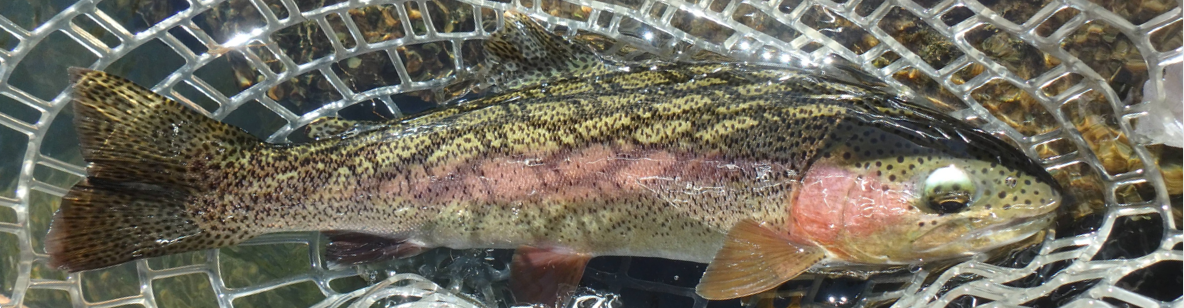
After lunch I approached a spot below a narrow island, and I began casting to a fairly long pocket in the main channel of the river. On the fifth drift the chubby Chernnobyl disappeared, and I was attached to a substantial fish. I battled the strong fighter and actually followed it downstream to some slack water along the bank, and when I slid the net beneath the wide body, I realized that I landed a gorgeous cutbow in the fifteen inch range. The colors were marvelous with a deep copper body, vivid spots, red cheeks and a bright orange slash.

By one o’clock I began to notice an abundant quantity of small pale morning duns, as they danced across the surface of the river in their tenacious attempt to become airborne. This observation prompted me to swap the hares ear for a size 18 beadhead pheasant tail nymph. The natural adults had a distinct pink-yellow hue, and they seemed small, thus the choice of a size 18. I stuck with this combination of flies, until 2:30PM, when I decided to give dry flies a test.

Best of the Day

During the early afternoon phase, when I cast the dry/dropper with the pheasant tail, I hooked another beast of a trout. In this case, the river warrior fought with dogged determination by diving, shaking and rolling. It was all I could do to contain the battler to the pool that I was next too, but eventually I scooped an eighteen inch brown trout into my net. I suspect it was the largest trout of 2025 so far for me. The lip of the brown was adorned with the size 18 pheasant tail.

Long Slick Produced

My switch to the double dry set up with a hippie stomper and cinnamon comparadun for the last thirty minutes yielded two twelve inch browns. One gulped the stomper and the other sipped the comparadun.

By 3:00PM I reached the point, where I normally quit, and the sun was high in the sky and beating down with direct rays. I was reluctant to continue up the river to fight the strong flows, so I hooked my fly to the rod guide and beat a path back to the car.

From a numbers perspective my day on Friday was not comparable to what I have come to expect from the Eagle River while edge fishing. I suspect that the hatches of pale morning duns, caddis, golden stoneflies and yellow sallies are in their early stages, and as the river drops to more manageable flows, the hatches will intensify, and the fishing will improve greatly. The cutbow and large brown trout made my day.  Hopefully I can swing another trip or two to the Eagle River in the next week or two.

Fish Landed: 8

Yampa River – 06/25/2025

Time: 11:00AM – 2:00PM

Location: Steamboat Springs

Yampa River 06/25/2025 Photo Album

I had my eyes on the declining flows on Colorado freestones, and I managed to squeeze in a trip to the Arkansas River on 06/20/2025. The other rivers I typically track carefully on their way down from peak run off are the Eagle River and Yampa River. In the case of the Yampa, flows dipped to the 900 – 1000 CFS range toward the beginning of last week, but because the drive is more than a day trip, and because I had commitments on Tuesday and Thursday, I could not fit in the drive . The Eagle River, on the other hand, was just coming into prime edge fishing range, and I planned to make a trip there in the near future.

Meanwhile, my wife was aching for some wildflower watching and camping, so we made reservations to camp at Steamboat Lake State Park from June 23 through June 25. On Monday we made the drive, and the wildflowers were indeed amazing. Yellow arrowhead balsam root flowers carpeted all the open areas away from trees including the spaces around our campsite. Lupines and Indian paintbrush served as adornments to the massive yellow blankets. During Monday and Tuesday we amused ourselves with hiking and camping activities, including a dicey drive on a rough four-wheel drive road. I own a Kia Telluride, and it possesses all wheel drive, but its clearance is not comparable to a Jeep or other rugged rides geared for rough off road travel.

I white knuckled three miles on a fairly rough “improved” national forest road, and then we turned onto another narrow passage. On my map  this road was shown as even more undeveloped than the first road. I managed to navigate downhill for .7 mile, and this included a couple serious drop offs from some large horizontal rocks, and my concern grew for the return drive. We found a small nook large enough to park, and we hoofed the remainder of the road to the creek and then continued for another .7 mile, until we turned around.

Scene Of Early Success

Jane grabbed for her phone to take photos, and of course it was no where to be found, so that added another concern. We worried about the loss of her phone, our ability to turn around on the narrow dirt road, and I recalled that the Telluride had an AWD lock button, but I was not sure where it was located.

Stunner

We completed the return uphill hike to the car, and fortunately Jane’s phone was placed on the passenger seat. Next she served as my guide, as I executed a tight turnaround in order to face uphill for the return drive. Finally, I got out the thick owners’ manual for the car, and after a bit of searching, I found the AWD lock instructions. We slowly crept up the rocky and rutted road, and at the particularly gnarly spots, I hit the lock button. We made it back to the first national forest road, and then we slowly maneuvered back to the main road. Whew! What a stressful adventure.

Curled with Slash

But this blog is supposed to be about fly fishing. What did any of this have to do with that pursuit? On Wednesday morning Jane and I packed up our camping gear. We were careful to keep fishing items in accessible spots. Steamboat Springs and the Yampa River were along the path on our return to Denver, and I was allotted fishing time.

Similar Looking Fish Nook

We arrived at our favorite parking lot by 10:30AM, and this enabled me to be on the river ready to fish by 11:00AM. The sky was overcast, and the flows were in the 260 CFS range. I thought this would be low, but the river was, in fact, in a prime state for fly fishing. I rolled with my Sage R8 four weight, and I rigged initially with an amber ice dub chubby Chernobyl, an iron sally and a salvation nymph. I got in position to make a couple casts, and within minutes a flotilla of tubers cruised by. One of the outliers splashed by within ten feet of where I was fishing. I was undeterred and on the fourth cast, the chubby dipped, and I hooked up with an outstanding fourteen inch brown trout that inhaled the salvation nymph. I was more than elated. In the same small pocket along the bank I foul hooked another very respectable brown.

Girth

I moved up the river along the right bank, and in a short amount of time I landed a small brown barely over the six inch barrier for counting. Some kayaks and tubers once again passed by, and I carefully waded along the edge to more promising locations. After ten minutes I arrived at a nice long pocket, and I flicked a cast to the midsection. Bam! A fish grabbed one of the nymphs, but I set the hook and connected for a brief period, before the fish tossed the fly and returned to the river. Unfortunately the energy in my fly rod snapped back and flicked the three flies over a cable that spanned the river. The cable was already littered with spinners, monofilament and flies; and my chubby Chernobyl dangled there two feet below the cable. I was in deep trouble. I looked around and found a four foot long branch and used it to insert in the loop above the chubby. After a few failed attempts, I snapped the branch downward with force, and the chubby remained embedded in the branch along with the trailing leader. I recovered the chubby Chernboyl.

Riffles

Unwinding the remaining flies and line seemed like an impossibility, but now that the flies were removed, perhaps I could pull the tapered leader through whatever snarl it belonged to. I grabbed my line and imparted direct pressure, and the line broke free. Guess where it broke? The loop at the end of the fly line separated, and I lost the entire tapered leader along with two nymphs. I knew I had additional tapered leaders in my frontpack, but how was I to reconnect to the fly line? I unwound a seven foot leader tapered to 5X, and it did not have a loop. Standing in a stream did not gain me access to nail knot tying instructions, so I improvised and tied a surgeon’s knot to connect the fly line and butt section of the tapered leader. It worked for the remainder of my day.

Arm’s Length

By now I observed small blue wing olive mayflies and occasional larger pale morning duns, so I used the break to re-rig my line to switch to a double dry approach. For the first fly I tied on a peacock body hippie stomper. Behind it I added a light gray comparadun on a short one foot leader from the bend of the stomper.

Two Beauties at the Tail of This Pool

I began casting to the location of recent rises along with juicy runs and pockets, and I increased the fish count from two to five. One of these additional landed fish was a stunning cutbow of fifteen inches with rosy cheeks and a bright orange slash. I was rather pumped. As the dark clouds moved overhead, the wind began to gust, and my ability to cast accurately was constrained. In addition, the mayflies either halted their emergence, or they got blown off the water, because surface feeding became a historical event.

Excellent Spot

This mini storm that lacked precipitation lasted ten minutes, and then the air calmed, but the clouds remained. I spotted occasional mayflies, but never as dense as the brief period before the weather event. Nevertheless, intermittent rises occurred, when I observed closely. The next fish I managed to hook put up a major tussle and broke off the light gray size 16 comparadun, so I replaced it with a size 16 cinnamon version. It proved to be a stroke of genius. The fish count mounted from five to twelve, before I called it quits at 2:30PM.

Mature Brown Trout

The game during the early afternoon consisted of a lot of observation. I prospected likely spots, but as I did so, I spotted very subtle surface disturbances, and then I honed in on those locations. Some of my best catches resulted from across river casts, where I allowed the comparadun to drift downstream ahead of the hippie stomper. On quite a few occasions, a trout grabbed the comparadun at the tail of a pool right before the fly accelerated.

Such Dark Colors

How was the quality of the fish? Superb. Of the twelve fish landed on the day, two were cutbows, and the remainder were brown trout. Other than the small number two, these browns were unbelievable fish. They were fat and fit and displayed vivid markings. They fought ferociously characterized by fierce head shaking, diving and rolling on the line. I was simply blown away by the 3.5 hours of fishing.

From the Swirls

Adding to my euphoria was the fact that all but the first two fish were fooled by a dry fly. Several times I considered reverting to the dry/dropper, but in each case a hefty brown trout would sip my fly and dissuade me from making the switch. By 2:30PM I arrived at a bridge, and rather than commit to another section, I hooked my flies to the guide and hiked back to the car to greet Jane.

They Keep on Coming

What a day! Twelve stunning fish in 3.5 hours of fishing during a sparse pale morning dun hatch. Dry flies were favored, and downstream casts seemed to do the trick. I overcame a frustrating impediment to my fishing early on, when I lost my tapered leader. Improvisation was the name of the game. I was concerned about low flows and tubers, but neither seemed to pose a barrier to my success.

Fish Landed: 12