Category Archives: Boulder Creek

Boulder Creek – 09/05/2018

Time: 10:00AM – 2:00PM

Location: West of Boulder, CO

Boulder Creek 09/05/2018 Photo Album

I completed errands on Tuesday and attended my physical therapy appointment, and this positioned me for my first day of fly fishing in September 2018. September is generally my most productive month, and with my son Dan’s wedding scheduled for September 14, fishing days were not on the calendar during the forthcoming week.

I was reluctant to undertake a long trip, so I settled on Boulder Creek in the canyon west of Boulder, CO. I also considered the Big Thompson River and Clear Creek, but I was intrigued with the possibility of plopping terrestrials in a canyon setting. Flows were in the 30 CFS range, and I gauged this to be nearly ideal for early September.

A Good Place to Begin

I departed Denver by 8:45 and arrived at a pullout along Boulder Creek by 9:40AM. As I traveled along the creek, I was concerned with the cloudy state of the water, so I stopped four miles up the canyon for a closer look. My inspection confirmed a level of turbidity, but visibility was good to three feet, and given the small nature of the drainage, I concluded that conditions were acceptable. The clarity improved considerably as I traveled west, and after an hour of fishing, murkiness became a non-issue.

I walked downstream along the shoulder of Canyon Boulevard for .2 mile, and then I angled down a steep bank to the edge of the creek. I began my quest for trout n the canyon with a Jake’s gulp beetle, and the first two plops initiated successive temporary hookups. I was pleased with the quick response, but I was also disappointed with my inability to stay connected. My optimism surged as I dropped a few casts in the next plunge pool downstream, but my beginners’ luck would not repeat.

I was about to reverse my direction in order to progress upstream, but I gazed down the canyon, and I was drawn to a series of plunge pools farther east, so I scaled the bank and ambled along the highway for another .1 mile and then repeated my careful descent. Another ten minutes of beetle plopping failed to interest the trout, so I reevaluated and made a change. I exchanged the foam beetle for a hippy stomper with a peacock dubbed body, and beneath the attractor I added a size 14 beadhead hares ear on a thirty inch dropper.

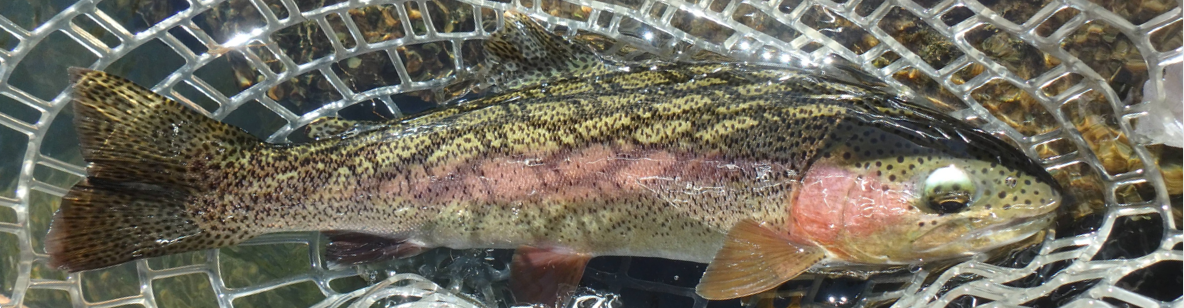
Shimmering Orange Spots

The two fly dry/dropper combination served me quite well, and I built the fish count to fourteen over the next two hours, before I broke for lunch slightly before noon. Two out of every three fish nabbed the hares ear, but an ample quantity of eager brown trout also crushed the hippy stomper on the surface. I adopted the practice of applying floatant to the body as well as the antron wing, and gooping the wing improved the visibility of the fly noticeably. The process of prospecting and moving quickly up the canyon was very enjoyable, and the trout of Boulder Creek were very cooperative.

Sleek

During my entire day the sky was mostly cloudy with only a few brief periods, where the sun broke through. The temperature remained in the sixties, and I wore my raincoat for warmth throughout the four hours. Although rain seemed like an imminent possibility, I never felt a drop, until I was removing my waders at the end of the day.

Appealing Shelf Pools

After lunch I continued with the hippy stomper and hares ear and built the count to twenty, and at this point I decided to experiment with different combinations. First I cycled through a series of changes to the dropper fly, as I tested a salvation nymph and ultra zug bug. The salvation fooled one fish, but after a reasonable trial period I concluded that it under performed the hares ear.

The takes of a Jake’s gulp beetle at the outset of my day made an impression on me, so I reverted to the beetle, but it never induced as much as a look. I concluded that dry/dropper was the approach of choice on Wednesday, so I adopted a three fly dry/dropper configuration. This time I knotted a size 12 Chernobyl ant to my line and then added the beadhead hares ear and an amber body caddis pupa. The hares ear enabled me to increment the fish tally by two to twenty-two, and the Chernobyl provoked a number of refusals and temporary hook ups.

Cascading Creek

I approached a nice pool and observed a few sporadic rises, which I attributed to a blue winged olive hatch. I swapped the caddis pupa for a size 22 RS2, and continued my upstream quest for trout. I expected action on the droppers, but a small brown trout responded to the Chernboyl, and I was both pleased and surprised by this circumstance. A pair of brief taps by trout on the lift gave me hope that the RS2 was in demand, but the small nymph never yielded a trout.

As two o’clock drew nearer, the sky grew increasingly dark, and I spotted a couple caddis, as they dapped the surface of the creek. I intended to quit a 2PM, at which point I needed to remove my three flies, so it was not a huge commitment to take that action early in order to experiment with a size 16 gray deer hair caddis. The ploy paid off somewhat, as I landed a small brown trout on the caddis adult just before I called it a day.

As expected Wednesday’s action consisted almost entirely of small brown trout in the 6 – 10 inch range. The Chernobyl ant and salvation nymph accounted for two fish that made it to my net, and the remaining twenty-two favored the hippy stomper and beadhead hares ear in a ratio of two hares ears for every hippy stomper. Carefree casting to relatively small eager brown trout was what I hoped for, and the results lived up to expectations.

Fish Landed: 24

Boulder Creek – 08/02/2018

Time: 10:00AM – 2:00PM

Location: High gradient section downstream from Boulder Falls

Boulder Creek 08/02/2018 Photo Album

I completed three successive days of fly fishing, and I found myself reviewing the stream flows in search of a destination on Thursday. Three physical therapy appointments provided modest improvement to my inflamed elbow, as the pinching sensation subsided to intermittent burns. I began a regimen of daily icing, nerve glides, and stretches; and my new therapy toy, a yellow flex bar, arrived in the mail. How does one explain this madness? As a fellow angler once told my wife, “he has the disease”. I suppose my continuing passion for fly fishing is a testimony to the complexity and challenge of the sport. After thirty-five years I continue to learn and encounter new and unique experiences. Thursday was August 2, and the summer was flashing by, and I was not about to rest during the prime summer season. That is my explanation for the madness.

I was not interested in a long drive, so I confined my search to Front Range streams. I ruled out the Cache la Poudre after a lackluster day of guided fishing with my friend Dan on July 20. The North Fork of the St. Vrain Creek was flowing at a paltry 21 CFS, so another stream was crossed off my list. The Big Thompson River dropped to 93 CFS, and the lower volume intrigued me, but my recent visit was rather average, and the canyon is heavily pressured by guides with Rocky Mountain National Park visitors. Clear Creek remained an option with flows in the 80 CFS range, but I tested those waters on Monday and Wednesday, and I was seeking some variety. I was encouraged to note that South Boulder Creek dropped to the 134 CFS level, and I love the small tailwater west of Golden, but that option required a hike into the canyon. Boulder Creek was tumbling along in the canyon west of the city at 41 CFS. Based on prior experience I was certain that this level was adequate, and I liked the idea of fishing the high gradient section with numerous plunge pools and highly oxygenated white water. In order to confirm my hunch about Boulder Creek, I searched this blog and found an entry for July 29, 2016, when I enjoyed a twenty fish day in the steep canyon section that I was considering. This clinched it, and I made the short drive to Boulder Canyon.

Sweet Spot

The high temperature for Denver was forecast to reach ninety degrees, and I assumed this translated to the low to mid-80’s in the canyon, so I opted to wade wet. The decision proved to be prescient, as the starting temperature in the mid-70’s quickly warmed to the eighty degree mark. The cold flows of Boulder Creek were very refreshing, and I alternated between climbing the rocky bank and wading up to my knees in the icy current. The flows were as reported and high enough to provide deep pools and runs, yet moderate enough to enable comfortable wading and stream crossing. I rigged up my Orvis Access four weight, crossed the highway, and carefully negotiated a rocky bank to the edge of the creek. A small promising pool appeared just above my entry point.

Served My Needs Early

My 2016 report informed me that I fished a gray stimulator successfully in the morning; and a three-fly dry/dropper configuration consisting of a yellow fat Albert, beadhead hares ear, and salvation nymph produced results in the afternoon. Late in the day a size 16 gray caddis allowed me to add to my growing fish count. This historical knowledge guided me to tie a gray stimulator to my line to begin my day, and I sprayed casts across the pool with great optimism.The stimulator did indeed capture the attention of the stream residents, but the large attractor was apparently close to their desired snack, but not close enough. Splashy refusals ruled the first ten minutes, so I resorted to downsizing.

Resting

I withdrew a size 16 gray deer hair caddis from my fly box and knotted it to my line, and instantly the fish were fooled. I rolled the fish counter to six in the first hour, and the small caddis was the star performer. I repeatedly grasped the fly firmly to remove it from the lips of the netted fish, and despite my care, hair loss became a disease of the wing. The fish did not seem to mind, but it reached a point, where I was challenged to follow the small drifting nearly wingless caddis adult.

I retired the sparse gray caddis and replaced it with another with a full wing, but guess what happened? The persnickety trout once again snubbed my offering. What was going on here? Were these fish selective to a gray body caddis with a minimal wing? During this time I observed four or five small mayflies, as they became airborne and gained altitude over the water. From a distance they appeared to be pale morning duns. Did the fish that I landed in the morning mistake the gray-bodied caddis with a nearly missing downwing for an emerging pale morning dun?

Big for Boulder Creek

I decided to test my theory. I plucked a size 16 light gray comparadun from my box and affixed it to my tippet. Several fish in the pool in front of me rejected the caddis previously, so I covered the same area a second time with the comparadun. Voila! One of the finicky residents rushed to the surface and inhaled the slender comparadun. I moved on and duped two additional brown trout during the remainder of the morning, and that equated to three trout that were bamboozled by the mayfly imitation.

Roadside Rumble, Lunch View

At 11:45 I approached an area where two large trees arched over the creek from both sides. The obstruction dictated that I climb the bank to the shoulder of the highway to bypass the wading blockade, and since I was forty yards above the car, I returned and consumed my lunch.

At noon I resumed my western progression, and I cut down to the creek just above the aforementioned hindering tree branches. I continued to cast the small comparadun with high expectations, but the early afternoon developed into a lull in action. The small gray fly was very difficult to track, and evidence of emerging pale morning duns disappeared prior to my lunch break, so I elected to make a change. Although the air temperature increased to eighty, the sky alternated between high clouds and bright sun in a 50/50 ratio. A slight breeze ruffled the leaves of the trees in the canyon intermittently, and I decided to try a Jake’s glup beetle. The conditions seemed ripe for a plopping terrestrial.

Jake’s Gulp Beetle Delivered 15 Trout to My Net

The hunch was spot on, and two small brown trout charged the foam beetle in the first pool that accepted the telltale splash. The beetle was the smallest one in my box, and I suspect that it was a size 12, but tied with a narrower than usual section of foam. Between twelve o’clock and two o’clock I plunked the beetle in all the likely spots, and more times than not a trout rushed to the top and crushed the terrestrial impostor. Needless to say I had a blast. The fish count skied to twenty-four, before I called it quits fifty yards below the point, where the stream that forms Boulder Falls merged with Boulder Creek. All of the afternoon trout were browns except for a lone brook trout that gulped the beetle in the middle of a deep plunge pool.

Only Brook Trout

Thursday was a fun day on Boulder Creek. True, the largest fish barely reached eleven inches, but I was challenged to uncover the correct fly, and ultimately it became a game of reading the water and executing short drag free drifts to likely holding spots away from the rapidly rushing current. The sun was high in the sky and the thermometer soared, but I was content to wade wet in the clear cold rushing waters among huge boulders, while I netted an abundant quantity of wild trout. I have the disease.

Fish Landed: 24

Boulder Creek – 04/27/2018

Time: 12:00PM – 3:30PM

Location: Pearl Parkway and 55th Avenue

Boulder Creek 04/27/2018 Photo Album

Friday was my one week anniversary since skin surgery, and I felt a pressing urge to fly fish, so I searched for a location with relatively easy wading to minimize the risk of banging the site of my incision on my right leg. Boulder Creek within the City of Boulder was my choice, and it fit my needs nicely.

Friday’s weather was spectacular with blue skies and sunshine, and the air temperature spiked in the seventies. I selected a new section of Boulder Creek, and I arrived at a parking space near the creek at 11:45AM. I decided to down my lunch first rather than lug it in my backpack for a mere thirty minutes. Lug is probably an exaggeration.

Starting Point

After lunch I climbed into my waders and assembled my Loomis five weight, and then I followed a narrow single track path downstream for fifty yards, before I quietly entered the stream. I began with a black peacock ice dub hippy stomper and a beadhead hares ear on a two foot dropper. In the first thirty minutes I witnessed two refusals to the hippy stomper and two momentary connections with small brown trout. Finally I drifted the two fly combination in a narrow ribbon of water between the current and the opposite bank, and a short chubby brown slammed the hares ear. I was on the scoreboard and documented my catch with a photo.

Small but Chubby

The next half hour produced another long distance release, but I played this brown trout for a minute or more before it escaped. I cast to some three foot deep riffles that flowed over some relatively large submerged rocks, and the trout appeared from a hideout between the boulders. It would have been the best fish of the day.

Once again I endured an extended period of inactivity, so I decided to abandon the dry/dropper for a solitary dry fly. My choice was one of the seven size 14 deer hair caddis flies, that I tied on Wednesday. The change proved to be beneficial, as I landed five more small brown trout on the dry fly before I quit at 3:30.

Last Trout of the Day

I covered a significant distance and skipped over a ton of water, as I searched for proven water types. What was productive water on April 27? Nearly all the caddis fanciers appeared where faster current bordered slow-moving areas with some depth. These fish conserved energy in the pools and pounced on food, as it tumbled by on the adjacent aquatic conveyor belt.

A Fish Appeared Where Currents Merge

One fish stood out as the most memorable, and it materialized from a spot that does not match my productive water description. I was slowly wading upstream, when I spotted a single random rise in a long slow pool. Just above the scene of the rise a large angled fallen tree spanned the entire width of the stream. I exited the creek very carefully and then slowly edged my way around the root ball of the dead fall and stopped five feet from the shoreline. At this point I knelt and partially hid behind the tree to prevent the trout from seeing me.

Downstream Drift Under the Log Met with Success

When I was satisfactorily positioned, I fluttered a cast to the center of the pool and allowed it to creep toward the site of the recent evidence of surface feeding. The enticing caddis failed to prompt a reaction, so I continued with two more casts and extended each a bit farther toward the opposite bank. I was about to surrender to the choosey underwater resident, but I decided to lob one more soft cast to the center of the stream. The olive hares ear caddis drifted a foot, when suddenly it was attacked by a voracious Boulder Creek brown trout. Sure it was only nine inches, but I savored the stealthy approach, the challenge of making an accurate cast, and the gratification of seeing a wild trout in my net.

Displayed

Friday was just what the doctor ordered…relatively benign wading, warm weather, a lack of wind, and a slow pace while stalking wild trout in a section of water never previously explored. It was a fun day after a one week layoff.

Fish Landed: 6


Boulder Creek – 12/01/2017

Time: 12:45PM – 3:00PM

Location: City of Boulder

Boulder Creek 12/01/2017 Photo Album

Boulder Creek within the City of Boulder has established itself as my new nearby favorite winter destination. Air temperatures remain fairly consistent with those of Denver unlike other close by Front Range destinations such as South Boulder Creek, Clear Creek and the canyon section of Boulder Creek. Mild winter temperatures are an attraction; however, November 2017 weather has been so conducive to fly fishing, that I rarely needed to resort to the lower altitude alternative. Friday December 1 was an unbelievably balmy day, and I decided to make the short drive up the Boulder Turnpike for yet another day of fly fishing. Yes, you read that correctly. I planed a day of fly fishing in December. I cannot recall fishing in December within the last ten years, although I suspect that I did it sometime in my past.

I left Denver Stapleton at 11:15 and arrived in Boulder by 11:45; however, I attempted to find a different parking location nearer to a heretofore unexplored section of the stream. Unfortunately I was unable to accomplish this goal and ended up at the familiar lot used in prior visits to Boulder Creek. Circling through the back streets of Boulder added thirty minutes to my trip, and by the time I ate my lunch, pulled on my gear, assembled my Orvis Access four weight and ambled to the creek; it was 12:45PM. As forecast, the weather was spectacular with the temperature in the low sixties, and the sun blazed down on the outdoor enthusiasts of Boulder, CO all afternoon.

Doing Its Job

A yellow fat Albert with an attached two foot length of 5X tippet remained in my frontpack from Monday, so I elected to give it another trial. Beneath the large foam attractor I added a salvation nymph and a beadhead hares ear nymph. These stalwart flies remained on my line for the entire two plus hours that I occupied Boulder Creek. The flows were on the low side and comparable to earlier November visits, but the section that I chose to explore offered numerous deep pools, where the stream residents enjoyed adequate cover. My approaches required stealth but not an excessive amount.

Surprisingly This Type of Water Produced

I worked my way upstream for two hours and landed seven brown trout to elevate my record cumulative fish count to a nice round number. Check the fish counter tab if you are curious to discover this milestone. The first hour was quite slow, as I coaxed two small browns into my net. One nipped the hares ear and the other nabbed the salvation. In my mind I conceded that I would not reach the sought after cumulative total, but then I approached a promising section with a long wide riffle of moderate depth. This area and some quality water above it yielded five additional brown trout and enabled the attainment of my cumulative goal for the year. The largest fish on the day measured ten inches, and all the fish landed in the second hour grabbed the hares ear.

Small but Feisty

Landing seven small fish is normally a minor accomplishment, but to do this in December was a welcome experience for this fair weather fisherman. Of course fair weather represented the reason I was on the stream, and I will continue to visit Colorado rivers and streams, as long as mild weather continues to encourage me. Is this the end of my fly fishing season and the start of serious fly tying? Who knows?

Fish Landed: 7


Boulder Creek – 11/20/2017

Time: 12:00PM – 2:30PM

Location: City of Boulder

Boulder Creek 11/20/2017 Photo Album

The mild fall weather continued in November 2017, and I could not resist the temptation to cast some flies. On Thursday November 16 I enjoyed three hours on Boulder Creek within the City of Boulder, so I decided to make another trip to the university town a mere thirty minutes from my home. The flows were decent, and the creek seemed more conducive to cold weather fishing, even though a high in the low sixties is hardly indicative of winter conditions.

I arrived at the parking lot near Boulder Creek by 11:45, and after I downed my small lunch, I pulled on my waders and assembled my Orvis Access four weight and meandered across the park grass to Boulder Creek. I knotted a size 10 black Chernobyl ant to my line as the top indicator fly, and beneath it on a two foot dropper I added a beadhead hares ear nymph and a salvation nymph. These were the same subsurface offerings that delivered six fish to my net on November 16.

Salvation Nymph on the Point

A Good Place to Begin

Over the next 2.5 hours I worked my way upstream with these three flies, and I enticed five brown trout to nab the nymphs during this venture. Two favored the hares ear and three snatched the salvation. Although my catch rate was comparable to my previous visit, I felt as though I never settled into a rhythm. One of the difficulties was the low position of the sun in the southern sky. This circumstance created a variety of lighting challenges including glare, shadows and an alternating combination of both. To combat the lighting complication, I shifted from one side of the creek to the other frequently, and perhaps the repeated movement disturbed the fish.

As Good As It Gets

The temperature did indeed reach the mid-sixties, and I was quite comfortable as I wore my light fleece throughout my time on the stream. I covered the exact same section of the creek that entertained me on the previous Thursday, and by 2:30 I grew weary of the lighting conditions and decided to call it a day.

Although for me 2.5 hours is a relatively brief fishing experience, I was satisfied to land five small brown trout on November 20. I covered a significant amount of water, but the weather was unusually mild for late November, and any fishing success this late in the season is greatly appreciated. The weather for the remainder of the week is forecast to be favorable, so a few more trips and reports may be forthcoming.

Fish Landed: 5


Boulder Creek – 11/16/2017

Time: 9:00AM – 12:00PM

Location: City of Boulder

Boulder Creek 11/16/2017 Photo Album

After a frustrating and disappointing day on Tuesday on Clear Creek, I essentially closed the book on fly fishing in 2017. Surely a cold winter weather pattern was around the corner, and I eagerly welcomed some relaxed fly tying while listening to my favorite playlists. And then Thursday happened. The weather forecast predicted a warm sunny day on Thursday with a high temperature of 72 degrees in Denver. This windfall of mild November weather prodded me to text my Instagram friend, Trevor (@rockymtnangler), and he replied that he was off from work and available to fish on Thursday morning. After a few additional exchanges we agreed to meet in Boulder at 9AM on Thursday morning to sample some urban fishing.

I arrived a bit early, and the timing afforded me an opportunity to realize that I forgot to pack my sunscreen. I had an old backup supply in my fishing backpack, so I extracted it and used up the contents. While I waited for Trevor to arrive, I opened the tailgate, and I was surprised to discover a puddle of water under my fishing bag. Fortunately the bottom of the bag is waterproof, but the start to my fishing day was not very auspicious. I persisted with my preparation after tightening the hose on my hydration bladder, and then I assembled my Orvis Access four weight rod. As I was doing this, Trevor pulled into the space next to me, and since I knew he required some time to prepare, I decided to knot a fly to my line. I stretched out the tippet to find the end of the line, and I was disappointed to notice a wind knot tucked between two surgeons knots. How can this happen? The cause was irrelevant, and I snipped out the three knots and reattached the end of my leader. Three strikes and you are out. Fortunately I was fly fishing and not playing baseball.

That’s Shilling Patiently Waiting at Trevor’s Side

Finally Trevor and I were ready to attack the stream, so we ambled across a patch of lawn to the creek, and we began fishing above a bridge. Trevor began with a buoyant humpy dry fly and a hares ear nymph dropper, and after five minutes of casting, he connected with and landed a nice eight inch brown trout. The creek was in fine condition, and the flows were low but not at a challenging level. I left Trevor in his nice run and moved below the bridge to a very nice deep hole. I cast the beetle upstream and prospected some quality locations for twenty minutes with nothing to show for my efforts. Trevor abandoned his starting point to join me, and I managed to generate a swirl to the beetle as he looked on.

The sight of a surface refusal caused me to reevaluate, and I replaced the beetle with a parachute black ant. This tactic proved successful on many occasions during 2017 particularly in the autumn season. On Thursday, however, the Boulder Creek trout were having none of it. Trevor’s success came from his hares ear dropper, so I borrowed a page from his book and added a RS2 on a two foot dropper. This addition simply increased the number of artificial flies that were ignored by the resident trout.

We decided to move upstream, and we migrated above the bridge and above Trevor’s starting point. Trevor allowed me to inspect his nymphs, and I noted that his size 16 represented a bigger mouthful than my small RS2, so I once again reconfigured. I knotted a hippy stomper with a silver body to my line as the surface fly, and then I added a beadhead hares ear, and a soft hackle emerger. This combination stayed in place for fifteen minutes and resulted in another resounding rejection of my offerings. In a last ditch effort to find a winning combination I replaced the soft hackle emerger with a salvation nymph. My lineup now included the most productive nymphs in my fly box, and I reminded myself that I was playing the percentages.

My luck began to turn in a wide relatively shallow riffle. I tossed the three fly dry/dropper upstream, and as the hippy stomper drifted slowly back through the middle of the riffles it paused, and I reacted with a hook set and stripped in a small brown trout barely over the six inch minimum. It was a small triumph, but after an hour of fruitless casting, I was pleased to land a fish.

Best Fish on Thursday Grabbed a Hippy Stomper

Over the remainder of the morning we progressed upstream beyond several bridge crossings, and the fish counter swelled from one to six, before we called it quits at noon. The third fish to find my net was a ten inch brown trout that swirled and refused the hippy stomper on the first drift, but then savagely attacked the same offering on the next pass. Another fish in the ten inch range grabbed the salvation nymph in a deep depression along the left bank. In addition to the six landed fish, I experienced four or five temporary connections, so the action accelerated significantly during the last 1.5 hours of the morning. The juicy deep pools did not yield fish, and I enjoyed much greater success in riffles and runs of moderate depth.

Thursday was a fun day and restored my confidence after a dismal outing on Tuesday on Clear Creek. The high temperature reached 75 degrees in the afternoon, and the pleasant weather in and of itself made the day memorable. Spending a morning with Trevor and catching up on his life was the main purpose of the outing, and that goal was realized. Landing six brown trout in the middle of November was a welcome bonus. The day on Boulder Creek may have been my last of 2017, but the one week forecast remains relatively mild for late autumn. Who knows, I may report on some more urban fishing days. Stay tuned.

Fish Landed: 6


Boulder Creek – 09/29/2017

Time: 10:30AM – 3:30PM

Location: Canyon west of Boulder, CO.

Boulder Creek 09/29/2017 Photo Album

The sudden influx of cool wet weather in Colorado prevented me from fishing on Wednesday and Thursday, so I was quite anxious to return to a local stream. When I reviewed the Front Range drainages, I learned that Clear Creek, Bear Creek and Boulder Creek flows surged as a result of the steady rain earlier in the week. Of the three Boulder Creek looked the most encouraging, since the cubic feet per second settled out in the thirties. Although this was higher than the period prior to the rains, it remained in the low end of ideal flows. The South Boulder Creek tailwater graph meanwhile looked like a stairway, as the water managers ramped up the outflows from 13 CFS to 246 CFS over a four day period. I was extremely disappointed to see this after two recent banner days on the tailwater northwest of Golden.

Looks Promising

I chose Boulder Creek and managed to arrive at a wide pullout along the highway by 10:15. As I traveled along the stream in the lower end of the canyon near Boulder, the clarity was questionable, but I pressed on. Persistence paid off, as the murkiness subsided considerably by the time of selected a section of the creek to fish, and the passage of time seemed to aid water translucency as well. The weather on the other hand did not change considerably during my time on the water. The air temperature remained in the low fifties, and the sky was shrouded in dense gray clouds during my stay. I wore a fleece layer along with my raincoat, and my New Zealand brimmed hat with ear flaps topped my head all afternoon. Despite dressing for winter conditions I remained on the edge of chilliness.

I began the day with a yellow fat Albert, beadhead hares ear nymph, and an ultra zug bug; but after thirty minutes of casting, I failed to land a fish. Two small river inhabitants nipped the fat Albert, but I was unable to sustain contact. Near the end of this period I managed to land a slender six inch brown trout that snatched the hares ear, but it was clear that the dry/dropper was not setting the world on fire. I removed the three flies and opted for a Jake’s gulp beetle. The large beetle is generally popular in the fall months on front range streams, and two fish showed interest in the fat Albert grasshopper imitation. The terrestrial theory unfortunately proved to be faulty, so I shifted to a size fourteen gray stimulator.

The attractor garnered some attention in the form of refusals, but the fish consistently turned away at the last second. I downsized to a size 16 olive deer hair caddis, and I was quite shocked to discover that the small selective trout of Boulder Creek rejected this offering as well. What could induce these small picky eaters to consume my flies on Friday? I found a nice jumble of flat rocks and paused to eat lunch, while I pondered my next move.

A Close Up of the Parachute Ant

Terrestrials clearly attracted the most attention, so why not downsize again to a parachute black ant? The size 18 ant worked quite well on South Boulder Creek, so perhaps the inhabitants of its sister branch savored it as well. I knotted the small ant with an orange poly wing post to my line, and I began to cast it to the attractive pockets and pools, as I worked my way up the steep gradient section of the creek. Finally I stumbled onto a winning tactic, and four brown trout sipped the ant. All four trout suddenly appeared in slow moving areas tight to the protective cover of large boulders.

An Early Catch

I boulder hopped my way upstream while popping the ant in likely brown trout lairs, but after an hour and four netted fish, the period of time between catches lengthened, and I grew weary of struggling to follow the tiny fly in the dim light created by the overcast conditions. The fish count plateaued at five, and I yearned for a more visible approach, so I converted back to the dry/dropper method. During this return engagement, however, I utilized a size 10 Chernboyl ant as the top fly, and I replaced the ultra zug bug with a salvation nymph. The beadhead hares ear carried over from the first go round in the middle position.

Fishy Area

Over the remaining 1.5 hours I landed an additional five small brown trout, and I was pleased that the dry/dropper approach finally proved effective. Four of the trout consumed the salvation nymph, and one gullible stream resident crushed the Chernobyl ant. By 3:30 I approached a convenient stopping point, and I was very fatigued from climbing over large rocks. The cold temperatures conspired with wet hands to create stiff fingers, so I carefully climbed up the steep bank and ambled back along the shoulder to the car and called it a day.

Boulder Creek Monster

I managed to barely reach double digits, and Friday September 29 was a very challenging day on Boulder Creek. The fish were small and the weather was adverse, but I suppose I was fortunate to register a decent day in the aftermath of cool wet weather. Hopefully additional mild Indian summer days are in my future in 2017.

Fish Landed: 10

Boulder Creek – 08/07/2017

Time: 1:00PM – 3:30PM

Location: Boulder Canyon

Boulder Creek 08/07/2017 Photo Album

I was weary of driving long distances to fish as was the case in the previous week, so I decided to go local on Monday. Flows on Boulder Creek recently dropped to 74 CFS, and the small stream west of Boulder, CO was absent from my 2017 itinerary, so I planned to give it a try. Unfortunately when I woke up on Monday morning, I heard the constant trickle of rain, as it drained down the spouting. When I looked outside, the picture was even worse with low gray clouds shrouding the Denver area. I checked the weather report for Boulder, and it indicated rain and thunderstorms off and on for the remainder of the day. This was not encouraging, and I debated devoting Monday to some procrastinated indoor chores.

It was only misting, when I departed on my daily run, but halfway through the jog the mist transformed to drizzle, and by the time I returned to the house the precipitation was classified as steady rain. I took my time showering and then prepared my lunch, and when I looked to the west, I noticed the sky remained gray, but it was definitely brighter, so I took the plunge and made the drive to Boulder. My best case scenario was getting in some fly fishing. My worst case outcome was a picnic lunch in the car next to Boulder Creek.

I drove up the canyon a good ways, and parked at a wide pullout with a sign about a historical wildfire. It was noon when I arrived, so I sat in the car protected from the misting rain and devoured my light lunch. After lunch I grabbed my Orvis Access four weight and pulled on my waders and fishing backpack and front pack, and I was prepared to fish. I wore my fleece and raincoat and pulled my hood up over my New Zealand billed cap, and I was as waterproof as I could be.

Just as I began walking down the highway, two fishermen returned from the creek and climbed into a Subaru Outback parked at the western end of the parking area. I was concerned that I would be fishing in the wake of these recent waders, but I concluded that I was headed downstream, and by the time I returned to the area they vacated, the fish would be back to their normal habits.

Boulder Creek on a Rainy Day

After walking a short distance along the shoulder of the road, I angled down a steep bank and tied a Chernobyl ant, beadhead hares ear, and salvation nymph to my line. I began casting these flies to likely holding spots, and in the early going I accumulated temporary hook ups, refusals and looks but not landed fish. These fish were supposed to be gullible, so what was going on? Eventually I landed a couple fish on the hares ear, but this was after covering a significant number of promising holes. The fish seemed to be ignoring the nymphs, as they focused on the Chernobyl, but they were unwilling to close their mouths on the fake foam terrestrial.

I finally conceded that my initial fly choices were not desired table fare for the Boulder Creek trout, and I replaced the three flies with a medium olive body size 12 stimulator. This fly enabled me to land a couple more small brown trout, but then it also became a thing of interest but not something to eat. I considered going back to the Chernobyl ant, but then I recalled my success on Friday with Jake’s gulp beetle. Why not give it another trial? I tied on a size 12 beetle and added a beadhead hares ear dropper, and my optimism soared. Early on the beetle attracted two refusals, and then I suffered through another lull with no action.

Needless to say I was rather frustrated. It was raining lightly with heavy cloud cover, and these sort of cool overcast conditions generally portend excellent fishing. The flows remained above average, and generally the trout are not as skittish and remain opportunistic after enduring the high flows of run off. I must mention, however, that the water was quite clear, and I spooked numerous fish, when I approached a pool or pocket too quickly or clumsily.

My best run of near action consisted of some momentary hook ups on the Chernboyl at the outset, and two of these fish appeared to be a bit larger than the small fish that I landed. I returned to the dry/dropper approach with a size 10 Chernobyl ant, beadhead emerald caddis pupa, and beadhead pheasant tail. The caddis pupa and pheasant tail produced on St. Louis Creek, so why not test them on relatively small Boulder Creek?

Crashing Water

I allotted a decent amount of time to these flies, but they failed me. Once again I noted a couple refusals to the Chernobyl, and the nymphs were totally shunned. Something had to change, but what should I try next? The clouds were growing darker and the wind kicked up a bit, and I was fairly certain that more rain was a near term reality. I decided to make my last stand with a size 16 light gray deer hair caddis. Fish were looking to the surface, and caddis are generally always present, and the light gray deer hair caddis is a solid general pattern that covers a lot of bases.

Little Guy

Well it worked. In the remaining half hour I landed three small brown trout on the caddis. A few refusals were in the mix, but the imitation was apparently close enough to convince three fish to eat. I considered replacing the caddis with a light gray size 16 comparadun, in case the trout were tuned into pale morning duns, even though I did not see any, but the density of the rain increased, and I decided to call it quits and seek the shelter of the Santa Fe. I seemed to recall a mention on the Front Range Anglers web site of pale morning duns emerging in the late afternoon. I suppose this theory will need to be tested on another day.

Caddis Lover

Seven small brown trout in 2.5 hours of fishing is not a stellar outing. I was admittedly expecting better fishing in the rainy overcast conditions on a stream that historically produced relatively easy action. I suppose I should celebrate being able to fish in adverse weather conditions, and landing seven fish was actually icing on the cake. Hopefully the weather clears, and I can return to more typical summer conditions for the remainder of the week.

Fish Landed: 7

Boulder Creek – 05/04/2017

Time: 10:30AM – 3:00PM

Location: Boulder Canyon

Boulder Creek 05/04/2017 Photo Album

After a couple days of cool weather and appointments I was anxious to return to my beloved pastime of fly fishing. The weather forecast for Thursday was promising, so I prepared for a trip to Boulder Creek in the canyon west of Boulder, CO. Originally I hoped to visit the Big Thompson River, but a review of flows on the DWR web site indicated an increase and some erratic movement on the chart, so I decided to avoid for a few days until things settled down.

I arrived at a pullout along Boulder Creek at 10AM on Thursday morning, and the weather forecast proved to be accurate, as the temperature climbed into the sixties and the sky was deep blue during my entire stay. The flows were at 52 cfs as advertised on the web site, and clarity was superb. Favorable conditions awaited my entry into Boulder Creek on May 4.

The Lane Next to the Foam Catches My Attention

I began my day with a size 8 Chernobyl ant, emerald caddis pupa and beadhead hares ear, as this combination performed well for me on the North Fork of the St. Vrain Creek on Monday. During the early going the nymphs were ignored, and the Chernobyl ant attracted mostly refusals with the exception of one small brown, that smashed the over sized foam ant imitation.

A Great Start

After a half hour of refusals and one landed fish, I experimented with a gray stimulator in an effort to downsize, but the change failed to elicit any reaction from the Boulder Creek trout. I pondered my next move and considered the fact that the fish were rising to the large Chernobyl but not eating. I deduced that they were looking for a smaller terrestrial, so I switched to a size 12 Jake’s gulp beetle.

A Fan of Nymphs

Voila! This produced, and I landed two additional small trout that gulped the beetle with confidence, before I stopped to eat lunch. After lunch another beetle chomper incremented the fish count by one, and then I spotted occasional blue winged olives hovering above the stream. This observation prodded me to switch back to a dry/dropper arrangement with  a smaller size 10 Chernobyl ant, beadhead hares ear, and RS2.

The fish counter moved from four to ten over the remainder of the afternoon, with one fish taking the RS2, and one nabbing the hares ear. Surprisingly the remainder of the afternoon catch crushed the Chernobyl. Several brown trout feeders in the early afternoon moved at least a foot downstream to catch up to the drifting foam terrestrial. I recognized this as a sure sign of an effective fly.

The Beetle Fooled the Brook Trout

At 2:30 I was frustrated by the increasing rate of refusals to the foam ant, so I reverted to Jake’s gulp beetle and ended the day with an eight inch brook trout. I probably should have switched to the beetle earlier, but it is always easy to look back. On Thursday I landed eleven fish, and all were browns except for the final brook trout, The largest fish was only ten inches, but it was a gorgeous spring day with the leaves beginning to break out on the trees in Boulder Canyon.

Fish Landed: 11

Boulder Creek – 03/30/2017

Time: 2:30PM – 4:30PM

Location: City of Boulder

Boulder Creek 03/30/2017 Photo Album

After three days in Wyoming, I anxiously looked forward to some rest and relaxation upon my return to Denver, CO. However, when I reviewed the weather forecast, I noticed that a winter storm was expected to enter the state on Friday and continue into Saturday with colder and seasonal temperatures following. I could not resist the temptation to take advantage of a beautiful spring day on Thursday with temperatures spiking in the low sixties, so I made a spur of the moment decision and packed the car for a quick trip to Boulder Creek in Boulder, CO.

Jane decided to accompany, so she could complete her walk on the nice trail along the creek, and we managed to depart by 1:30 after a brief lunch. After making the drive and assembling my Orvis four weight, I completed a short hike on the Boulder Creek trail until I was at least .5 mile below my parking space. The temperature was indeed 64 degrees, but a huge gray cloud moved over Boulder and blocked the sun for much of my time on the water. It created one of those illusions, where the gray sky and slight breeze made it seem colder than the actual air temperature. The creek meanwhile was extremely low and flowing at approximately 10 CFS. I correctly surmised that the shallow water and extreme clarity would translate to challenging fishing conditions.

Where I Began

In deference to my accurate assessment I began my fishing venture with a size 12 olive stimulator and trailed a beadhead hares ear nymph. During the first hour I moved upstream cautiously, observed several rare riseforms in slow smooth pools, and scattered several fish. The day was evolving much differently than my previous visit on March 18. Deploying a light stimulator as my top fly was a departure from my standard operating procedure, which dictated a foam attractor, but even this light offering seemed to be spooking the fish in the clear pond-like pools. Actually the splashy entry of the trailing beadhead was most likely the offending culprit, so I made an adjustment and tied a small size 16 gray adult caddis to my line. I was certain that this unobtrusive earth toned fly would turn the tide, but it was ignored by the picky stream residents.

The caddis was difficult to follow in the glare created by the partial sun, and I reached a nice deep run that carved a path along some large bank side boulders, so I replaced the single fly with a size 10 Jake’s gulp beetle and once again trailed the beadhead hares ear. Nothing. I added the dropper because I was casting to a short section where the current velocity masked the splashy entry of the nymph, but when I moved to the next pool, I made the mistake of retaining the invasive hares ear.

Finally I arrived at a very sweet pool with a nice deep angled run at the top that flowed against the south bank of the stream. I paused to observe, and I was rewarded with a view of two or three rises on the left side of the deep center current. I was not certain what the object of affection was for these surface feeding fish, but I guessed that a sparse blue winged olive hatch was in progress. The significant clue was the overcast sky, as BWO’s seem to prefer low light to make their grand entrance into the adult stage of life. Sure enough as I gazed at the pool, I spotted two tiny mayflies, as they slowly fluttered up from the water surface.

I was reluctant to convert to a single CDC blue winged olive given the riffled surface and frustrating glare, so I compromised by knotting a size 14 gray stimulator to my line, and then I added a size 18 beadhead soft hackle emerger to imitate the active blue winged olive nymphs. The move partially worked. On two consecutive early casts I spotted rings near the vicinity of my stimulator, so I set the hook and momentarily connected with a pair of fish. But the Boulder Creek trout were simply teasing me, as the fish escaped after a brief tussle. I suspected that the trout were refusing my large top fly and ignoring the trailing emerger which was intended to match their food source, but I persisted with a few more casts, and finally a drift right down the heart of the main current rewarded me. I quickly fought the eleven inch brown trout and determined that it struck the stimulator, before it bounced free, just as I raised its head to the rim of my net.

Surely the two long distance releases and the thrashing of a hooked fish must have locked the jaws of any remaining inhabitants, but I noted another stray rise, so I lofted another cast to the top of the riffles. Again a rise occurred where I estimated my fly to be, so I reacted with a hook set. Needless to say I was quite disappointed, when I learned that the brown trout in my net was foul hooked by the soft hackle emerger. This was confirmation that the first two fish likely exhibited the same last minute rejection resulting in being foul hooked by the trailer.

The fifteen minute mayfly emergence ended, and I concluded that I disturbed the hot spot beyond repair, so I continued on my path upstream. During the remaining hour I covered quite a bit of water, but I mostly repeated the experience of the first hour. I limited my casting to deep faster water and skipped the smooth pools, but even this fishing selectivity failed to yield another fish. Toward the end a pair of ducks paddled ahead of me, and each time I drew close they flapped their wings and moved upstream to the next pool. This repeated disturbance was certainly not helping my cause given the challenging low water conditions.

Nice Angled Pool

I reeled up my line at 4:30 and made a brief hike back to the car, where I found Jane huddled in the passenger seat. She agreed with my assessment that the gray sky made it seem colder than 64 degrees. After I pulled off my waders and tucked my rod in the case, we drove to the Celestial Seasonings tea room, where we stocked up on mountain chai, which has become extremely scarce in the Denver supermarkets. Next we searched the maps app for local brew pubs, and we settled on Upslope, as it was merely 2.7 miles away from Celestial Seasonings. I ordered an ozo coffee brown ale for Jane and a citra pale ale for myself, and we quaffed our brews inside in front of a huge wall diagram that depicted the evolution of various beer types.

One trout landed in two hours of fishing was certainly a slow catch rate, however, I enjoyed the experience and the challenge of overcoming the difficult conditions. The mountain chai and Upslope pale ale were a nice conclusion to a fun afternoon.

Fish Landed: 1