Clear Creek – 03/12/2025

Time: 1:00PM – 4:00PM

Location: Clear Creek Canyon

Clear Creek 03/12/2025 Photo Album

Wednesday’s forecast promised another mild late-winter day, with temperatures in Denver expected to climb into the upper sixties. The urge to hit a stream was strong, but first, I had to handle a commitment at home—the expected delivery and installation of our new dishwasher. Our fifteen-year-old unit had given up on properly cleansing the top shelf, forcing us into the less-than-enjoyable habit of handwashing. By 10:30 AM, the Home Depot crew had completed the installation, and I was free to chase some trout.

Given the late start, I opted for a short drive to Clear Creek Canyon west of Golden, CO. I arrived at my chosen pullout by 12:30 PM and immediately downed my standard lunch. The section of the creek, where I planned to start, was already covered in shadows, so I made a quick wardrobe adjustment—swapping my short-sleeve undershirt for an Under Armour long-sleeve thermal, layering on my North Face light down, and finishing with a rain shell as a windbreaker. The combination kept me comfortable for the entirety of my outing, even as the late afternoon sun shifted my fishing spots.

Plenty of Ice and Snow Remained Along the Creek

I assembled my old Sage four-weight and followed the south side of the creek for roughly 0.2 miles before scrambling down the steep bank to begin fishing. My starting rig consisted of a size 8 yellow Fat Albert, a 20 Incher, and a size 16 olive Perdigon—a trio that had served me well on the Arkansas River just two days earlier.

For the next hour, I worked my way upstream, managing to land two small brown trout, each around six inches. One fell for the Perdigon, and the other snatched the 20 Incher. It was a far cry from my successful outing on Monday, and despite casting to some very promising pools, my drifts remained largely unproductive. Hoping to change my luck, I swapped the 20 Incher for an Ultra Zug Bug, but that adjustment proved ineffective as well.

One of the Better Fish

By 2 PM, I reached a bridge and climbed up to the highway to cross to the other side. My plan was to continue upstream, but the narrow canyon kept much of the water in the shade, and the chill was beginning to set in. Rather than tough it out, I packed up and moved half a mile west to another wide pullout. Another angler had already claimed a spot directly across from the cars, so I opted to hike along the guardrail for some distance before descending a steep, boulder-strewn bank, carefully using hand grips to steady myself.

Prime Spot

With the change in location, I decided it was also time for a change in tactics. I swapped the Fat Albert for a Peacock Hippie Stomper, thinking that the relatively low flows—24 CFS—might make the large foam hopper too splashy. I kept the 20 Incher but replaced the Perdigon with an Emerald Caddis Pupa.

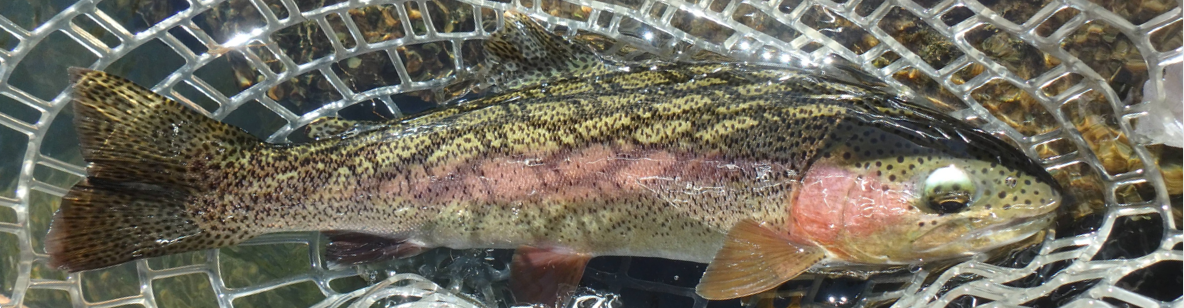
One of Two Rainbows

The adjustment paid off. My catch count climbed from two to seven, before I called it a day at 4:00 PM. A rainbow rose to the Hippie Stomper, while another trout nabbed the Emerald Caddis Pupa. A brown took the 20 Incher, and my final fish—a brown—fell for a size 14 Prince Nymph. There was no single pattern that dominated the action, but the change in flies certainly made a difference.

Last Fish of the Day

Clear Creek, with its narrow, shaded canyon, still had plenty of ice shelves and packed snow along its banks. The cold water likely kept the trout sluggish compared to other rivers flowing through open valleys. Of the seven fish landed, two were rainbows and the rest were browns, with the largest stretching to a modest nine inches.

While it wasn’t a banner day in terms of size or numbers, it was still a rewarding outing. The beauty of the setting and the simple pleasure of being outside were enough to make it worthwhile. With a trip to Phoenix on the horizon, I’ll have to put my fishing ambitions on hold for a bit, but I hope to get back on the water in the final two weeks of March. Stay tuned!

Fish Landed: 7

Arkansas River – 03/10/2025

Time: 11:00AM – 4:00PM

Location: Lower Bighorn Sheep Canyon

Arkansas River 03/10/2025 Photo Album

Forecast highs of 74 degrees in Denver, CO had me seeking fly fishing water on Monday, March 10, 2025. I checked temperatures in various potential destinations, but I could not overlook 72 degrees in Canon City. The wind speeds in the 10 – 15 MPH range gave me pause, but I decided to make the trip regardless. I experienced several productive days in lower Bighorn Sheep Canyon last spring, and this influenced my decision to visit the Arkansas River.

Starting Point

The drive was inconsequential, even though Jane warned that the number of accidents spike after daylight savings time. I arrived at my chosen spot by 10:45AM, and this enabled me to be on the water ready to cast by 11:00AM. I stopped for gasoline in Florence, CO, and the wind was whipping by me at a ridiculous rate; however, the wind, although present, was more moderate at my chosen fly fishing spot.

Number One Was This Rainbow That Grabbed the Olive Perdigon

I rigged my Sage One five weight and wore my light down North Face coat, which proved to be a bit of a mistake, as I was overly warm during the afternoon time frame. To begin my search for trout, I configured my line with a New Zealand strike indicator, a yellow/green Pat’s rubberlegs and a zebra midge. The yellow/green rubberlegs was chosen with the molting golden stoneflies in mind, as both ArkAnglers and Royal Gorge Anglers fly shops reported their presence.

Olive Perdigon Saved the Day

I prospected up along the left bank of the river for fifteen minutes with no response, so I swapped the zebra midge for one of my crystal stones, size 18. Once again my flies were ignored, as I spent 1.5 hours in the late morning exercising my arm. I did connect with a small trout briefly, but it escaped after throbbing my rod for a few seconds.

Nice Catch

Between noon and 12:30PM, I moved to a separate braid of the river, and I switched the crystal stone for a beadhead hairs ear nymph. I encountered another angler, the only one I saw on the river, so I steered clear of him and migrated up the braid for at least fifty yards to allow him space. When I jumped in, I made some drifts through some marginal runs along the far bank, but once again I was met with futility.

Another Fine Wild Brown Trout

At 12:30PM I found a nice rock to serve as my seat, and I downed my three course lunch. After lunch I used my pause to revise my rig. I removed the New Zealand strike indicator and shifted to a dry/dropper system with a size 8 fat Albert as the top fly. Beneath the fat Albert I knotted a size 12 20 incher, and below that I added an olive perdigon. I tied five perdigons within the last week, so I was anxious to baptize them. I also wanted to make sure I was drifting deep with the dry/dropper, and the four foot dropper along with the tungsten bead were geared toward that objective.

Left Bank Produced

I am not sure whether it was the time of day, deeper drifts, flies chosen or the new section of the river; but some combination of factors caused my angling futility to change into hot fishing. One o’clock was the new noon after turning the clocks forward, so that may have been part of the change in fortunes, but I was also certain that utilizing the tungsten bead perdigon was a turning point. Between 1:00PM and 3:00PM I landed ten trout, and all but one were in the twelve to fourteen inch slot. Four were rainbows and the other six were brown trout. At least three of the landed trout were healthy fourteen inch fighters, and I was quite pleased with my successes.

Headed Back

The olive perdigon accounted for six of the trout, the fat Albert duped one aggressive rainbow, and the 20 incher made its presence worthwhile by fooling three fish. The wind was a constant nuisance, but I was able to avoid severe headwinds, although my casting arm was quite fatigued by the end of the day. The action slowed significantly by 3:00PM, and, in fact, I did not land additional fish between 3:00PM and 4:00PM. For the last hour I probed the largest braid of the main river, and this may have also inhibited my ability to catch fish.

Chunky Bow

I was quite pleased with my day of fly fishing on the Arkansas River on Monday, March 10, 2025. The wind was tolerable, and the air temperature was pleasant. I landed ten trout in the twelve to fourteen inch range, and the dry/dropper approach proved to be effective. I also tested my olive perdigon and discovered it to be a solid fish producer. Monday sparked my interest in fly fishing, and I hope more nice weather will encourage another trip in the near future.

Fish Landed: 10

Slower Velocity to the Right

Love the Distinct Spots on This Prize Brown Trout

Eagle River – 03/09/2025

Time: 11:30AM – 5:00PM

Location: Between Avon and Wolcott

Eagle River 03/09/2025 Photo Album

I considered options for fly fishing on Wednesday, March 9, and eventually settled on the Eagle River. The main factor that swayed my decision was a weather forecast of a high of 59 degrees with partial cloudiness most of the afternoon. I was seeking blue wing olive action. Did my decision to fish the Eagle to hit a baetis hatch pan out? Read on.

On Tuesday evening, as Jane and I were returning from dinner with friends in southeast Denver, we hit a curb with the left front tire. The blowout was nearly instantaneous, but the stretch of highway offered no place to pull over for a tire change, so we limped across a bridge and settled in a parking space on a side street. Of course, by now it was dark, and that only added to the challenge ahead of us. I got out of the car and examined the left front tire, and I discovered a four inch gash on the sidewall. The tire was toast.

We opened the hatch and emptied the rear of the car of its contents, which happened to be quite a bit, and then we lifted the floor covering and found the jack. I used my phone to search for how to release the jack, and that met with success; however, we were unable to find the toolkit that included the lug tool. We bought the Tucson three years ago used, and apparently the previous owner kept the tire changing tool kit!

We locked the car and walked back to our house, which was about .5 mile, and we climbed into my Kia Telluride equipped with a screwdriver and flashlights. Fortunately we discovered that the Telluride tool kit was present, and the lug wrench fit the nuts on the Tucson. We quickly installed the temporary spare, and returned to the house.

I planned to leave the house for fishing by 8:00AM on Wednesday morning, but I was not comfortable leaving Jane with a car in need of a new tire and possible alignment, so I delayed my departure. We made the short drive to Les Schwab Tires, and we were near the front of the line. The sales counter person assessed our tire needs, and set everything up for tire replacement and alignment test during the day on Wednesday. I drove Jane home, and I now felt comfortable continuing with my fly fishing plans.

I departed Denver by 8:40AM, and I arrived at my favorite pullout along the Eagle River a bit before 11AM. The sky was very overcast, and the wind was bustling, so I bundled up with my Columbia long sleeved undershirt, my light down coat and my rain shell. I was comfortable for most of the time except after long periods standing in waist deep water. I selected my Sage One five weight to counter the wind, and in case I tangled with tough fish.

Not a Bad Start

Once I was prepared, I hiked a short distance to the river. Another angler occupied the spot that I intended to fish, so I cut downstream a bit to give him space and fished some water that I never sampled previously. I began my day with a size 8 gray-body chubby Chernobyl, a 20 incher and a size 16 olive perdigon. I fished for the next hour through some moderate riffle sections and then the tail of the long pool that was occupied by the other angler. I landed one twelve inch brown trout on the perdigon, and I connected with two additional fish briefly.

Rainbows Became Prevalent

By 12:30PM my feet were crying for relief, and my stomach was growling, so I retreated to the bank and downed my small lunch. After lunch I carefully waded across the tail of the pool, and quite a few rises materialized, so I changed tactics. I swapped the chubby for a peacock hippie stomper, and then I added an eighteen inch dropper and knotted on a CDC BWO. I began casting to rises, and eventually I landed a small brown trout on a downstream drift. I had swapped the CDC BWO for a soft hackle emerger fished on the surface, and it was this fly that duped the small brown. I thought I solved the riddle, but I soon discovered that I was sorely mistaken.

Sweet Spot Yielded Quite a Few Nice Fish

Between 12:30 and 1:30PM I did what Deming warned against. I continued doing the same thing expecting different results. The fish rose in waves, and I repeatedly plopped casts with my CDC BWO or soft hackle emerger above the sighted fish, but my flies were totally ignored. I began to despair that I was going to fish through an intense baetis hatch with only two small fish as my reward.

Jen and Dave Focused

Over the last several years I became acquainted with a friend on Instagram, @jenmenke. She is a fly fishing woman, fly tier, and gardner, and we occasionally exchanged comments. I knew that she and her husband lived in the Eagle, CO area, so I mentioned that I was making the trip on Wednesday, and she replied that she would like to meet up, so I told her where I planned to fish. This all coalesced, when Dave and Jen arrived at my fishing hole by 1:30PM. I quickly waded to shore to greet them, and we chatted for a bit, and then we each waded into the pool. I returned to the tail, while Dave took the midsection, and Jen angled toward the top area.

Stunning

My frustration continued, as I continued to deploy the double dries. The wind gusted and clouds scudded across the sky, and for brief periods fish rose to voraciously feed on what I believed were blue wing olive mayflies. Dave was in shouting distance above me, and he managed to land a trout on a dry that was sort of a classic Adams. I felt a tickle on my ear, and I reached to scratch it, and suddenly I discovered a small size 18 black stonefly in my hand. Could this be what the fish were eating and not blue wing olives? I was skeptical that stoneflies would hatch in dense numbers to create intense feeding, but maybe it was worth a try. I tied on one of my small stonefly imitations, and I gave it a ten minute test. Nothing. I was in a state of frustration, so I waded to shore and decided to circle around Jen and Dave and move into new water above the pool.

Moving Up the River

As I stopped to talk to Jen and Dave, Jen announced that she had several hits on a black RS2, and she landed a couple nice rainbows. This information prompted my to switch back to my dependable dry/dropper method. Once again I tied on a gray chubby Chernobyl, and then I brought back the olive perdigon, and I added a size 20 classic RS2 with a silver bead. I waded in to the very top of the run that entered the vast pool, and I began working the deep runs and pockets in that area. Voila! Even though I spotted many rising fish around me, the fish were also tuned into drifting nymphs. Between 2:30PM and 3:15PM, when Jen and Dave departed, I landed four trout, and they were very nice chunky rainbows in the thirteen to fourteen inch range. I was more than ecstatic with this positive turn of events. I was making ten to fifteen drifts for every successful hit, so it was not easy by any means, but persistence paid off. I also imparted movement in the form of lifts and swings, and several of the trout responded to these tactics.

Decent

I waded to shore and said my goodbyes to the fly fishing couple, and then I resumed my fly fishing progression. As planned, I moved up the river and flicked casts to likely spots where there was moderate depth and holding lies. In each case I spotted rising fish, but with persistence I was able to hook and land quality fish. By the time I reached fourteen trout, I was fifty yards above my starting point, so I exited the river and ambled back along the concrete path.

More Pockets

When I arrived back at the pool, I decided to cut back to the section at the top. When I arrived, fish continued to rise, and I could not ignore the pull of the hatch. I decided to take one last shot at dry flies, as many fish continued to feed on the surface. I tried the CDC BWO and the soft hackle emerger, and I managed to land one trout on each by casting across and allowing a downstream drift to the point were the fish were rising. The sky was dark and the wind continued to gust, but the fish seemed to revel in the adverse conditions for human beings.

Splendid Colors

What a day! The Tucson was ready for pickup by early afternoon. I met two new friends that share common interests, and hopefully there will be many more meetings in the future. And through the experience of Jen, I utilized an RS2, and it led to solid success over the course of Wednesday afternoon. Was I able to cast dry flies and fool fussy trout? No, but with the help of Jen, I resorted to a baetis nymph, and I enjoyed an amazing 2.5 hours late in the afternoon. This was perhaps my best day of 2025 so far, and I look forward to more such days before run off kicks in during May.

Fish Landed: 16

Love the Body Color on This Rainbow

Olive Perdigon – 03/05/2025

Olive Perdigon 03/05/2025 Photo Album

I tied a few of these simple flies in 2020 during Covid to kill time while quarantined. I used them infrequently, and like many new patterns they lingered in my fly box, as I opted for tried and true patterns that I had confidence in.

Slender Nymph

Fast forward to 11/04/2023. If you read this post, you learn that I had an outstanding fall day on the Eagle River, when the olive perdigon delivered superior results for my friend, Dave G. and me. Needless to say, this prompted me to tie a batch, but I must confess that I did not test them to any great extent during 2024. I plan to make amends for this oversight, and as a result I approached my vise and produced five additional olive perdigons. I am confident that if I give them a chance, they will become a new favored fly from my fleece wallet.

A Batch of Five and Associated Materials

This fly is quite easy to tie, although I am not a fan of messing around with UV resin application. I have squeeze tubes, and the caps become a gooey mess. I plan to switch over to product with applicators, but being a frugal fly tier, I am attempting to use up the resin in my tubes. These olive perdigons require only six materials if you count the hook, bead and a black marker. Otherwise, all you need is some grizzly spade hackle fibers, olive thread and UV resin. The result is a very slender heavy fly that rapidly sinks to the bottom. If I can discipline myself, I would like to test these in pocket water, where it is necessary to get the fly to the bottom quickly. Doesn’t it seem like this is a perfect application for the olive perdigon?

Griffiths Gnat – 03/03/2025

Griffiths Gnat 03/03/2025 Photo Album

I searched back in time across this blog, and I found no posts on the Griffiths gnat. I know I have tied some, so I suppose I neglected to write a report on this diminutive fly. It requires only two materials aside from the hook and thread, and those two are peacock herl and grizzly hackle. The aspect of this fly that makes it challenging to tie is its small size.

A Model Griffiths Gnat

I expanded my efforts to fish in lakes over the past several years, and midges comprise a huge portion of the biomass in stillwaters. A Griffiths gnat is purported to be a solid imitation of an adult midge, so adequate quantities in my fly box are highly recommended. I have tied a griffiths gnat to my line from time to time on lakes, but I would characterize my success as sporadic. Unfortunately I knot one of these on my line, when the fish are rising sporadically, and I am not certain what they are eating, so I may be misjudging the source of the trout protein.

A Clump of Four

Apparently I had not tied these in a while, so I counted my supply and concluded that I could use another four, so I settled at my tying station and generated them. I am ready for stillwater action in 2025.

Tricos – 03/01/2025

Tricos 03/01/2025 Photo Album

For an excellent description of my introduction to trico spinners along with a materials table and other information, click on my post of 01/15/2012. After a particularly frustrating day on the South Platte River I created trico spinners using CDC for the spent wing. My post on 02/27/2019 describes this effort to imitate the tiny but abundant mayflies. My post of 12/05/2011 describes my history with sunken tricos. This is also worth a read.

Trico Spinner

I failed to encounter a trico hatch in 2024; however, in an effort to cover all my bases, I counted my supply of spinners in size 20, 22, and 24 and sunken tricos in size 22. I concluded that I needed to tie five additional spinners in size 24, one size 20, and five sunken tricos. I experimented with various materials for tricos over the years, but for this iteration, I used white microfibbet tails, black thread bodies, white antron for the wing, and fine black dubbing for the thorax. For the sunken tricos I added a strand of super hair wound around the hook shank for the abdomen.

Sunk Trico

Hopefully I will encounter a trico hatch and spinner fall in 2025. I need to make a point of visiting the South Platte River in Eleven Mile Canyon, as the trico event is a regular occurence there. As I have learned in the past, it can be an exercise in frustration, but an experienced fly angler needs challenges from time to time.Trico Assortment


St. Vrain Creek – 02/28/2025

Time: 2:15PM – 4:15PM

Location: Near Lyons, CO

St. Vrain Creek 02/28/2025 Photo Album

The last day of February was projected to spike at a high in the upper sixties in Denver, CO, so I researched temperatures in nearby potential fishing destinations. My first outing of 2025 was Boulder Creek, so I decided to journey a bit farther north to St. Vrain Creek. Temperatures in the vicinity of my planned fly fishing venture were predicted to be in the low sixties. That was acceptable to this fair weather angler.

Cutbow Surprised Me

Jane and I took advantage of the gorgeous late winter day to play pickleball, and when I returned home, I downed my lunch and packed the car and departed for my planned fly fishing destination. Once I arrived at my pullout, I wore my Brooks long sleeve thermal undershirt, and I chose not to add any additional layers. I selected my Orvis Access four weight and clamped my Battenkill reel to the butt section, and this line featured the loop, that I repaired using the Restorline kit that I bought at The Fly Fishing Show. It worked quite well.

Cutbow Home

I cut to the stream, when I was prepared, and I knotted a peacock hippie stomper to my line and then added a beadhead hares ear nymph as a dropper. I extended the dropper tippet so that I had approximately three feet of leader below the stomper. The creek was relatively low, and I fishing marginal slots and riffles in the first fifteen minutes. I experienced one refusal to the hippie stomper in a nice deep run, and I landed a sub six inch brown trout on the hares ear.

Decent Brown Took Hippie Stomper

The next phase of my outing, however, took a positive turn. In a long relatively deep pool I flicked a cast toward the right bank. and suddenly the hippie stomper exploded, as a trout consumed the fake attractor. I immediately recognized a nice trout was on my line, and I was proven correct, when I slipped my net beneath a fifteen inch cutbow. What a surprise! The trout had a bronze background color on the body and a thin stripe of scarlet along its sides.

Hippie Stomper Brown Was Right Below the Large Exposed Boulder

Shortly after this reward for my efforts in February, a brown trout rose to slurp the stomper. Two trout on dry flies was more than I could have hoped for. I continued up the stream, as I looked for spots with depth, and I soon discovered that my beadhead hares ear broke off. It was not delivering much interest, so I replaced it with a size 14 ultra zug bug.

Pretty Brown Released

I now moved at a faster pace, as I knew that lingering on marginal water was a waste of time. I sought slower moving locations with a fair amount of depth, and this strategy paid off, as I landed another five over the remainder of my outing to boost the final total to seven. I was quite pleased with seven trout in two hours of fishing including the fifteen inch cutbow.

Love the Scarlet Stripe Visible

Two of the additional landed trout were small rainbows, and the remaining three were brown trout in the nine to eleven inch range. The ultra zug bug accounted for the last five landed fish, as the hippie stomper assumed the role of indicator. I did witness another refusal to the hippie stomper.

Rainbow Came from This Nice Deep Run

By 4:15PM the shadows spanned the entire creek, and my hands were quite chilled, thus forcing me to abandon my sungloves. I covered several very attractive deep pools created by stream improvements, but the fish did not seem to be present in these prime lies. At 4:15PM I stripped in my flies and hooked them to my rod guide and hoofed back to my car.

Friday was a successful day on the last date in February. The one negative to the day was a wet right foot, as I squeezed quite a bit of water from my Smart Wool sock. The wetness began around my ankle, so I will attempt to remedy this situation on Saturday afternoon, if the weather cooperates.

Fish Landed: 7

Wiggle Damsel – 02/19/2025

Wiggle Damsel 02/19/2025 Photo Album

More background on the wiggle damsel is available in my post of 01/06/2020. These flies are mainly reserved for stillwater fly fishing. I often read about damsel emergences on lakes, which motivate trout to gorge on the migrating nymphs, as they move toward reeds and weeds along the shoreline. I have never encountered this situation, but I have tried.

Last year in early June I fished Beaver Lake in the town of Marble, CO, and an abundant quantity of damsel flies were present including some nymphs in the process of emerging on the shoreline rocks. I switched to a wiggle nymph, but I was unable to tap into the action. A reader of this blog commented that damsel nymphs should be fished just below the surface, and I think I was using weight, so that may explain my lack of success. It was a lesson learned, and I will surely try one without using weight should I encounter another promising damsel emergence situation.

Wiggle Damsels from My Storage Container

This fly was designed by Charlie Craven, and it features an articulated body. I love the way the rear section undulates, as I slowly hand twist my retrieve.

I counted my wiggle damsels, and I learned that I had adequate quantities for the new season, so I bypassed additional tying. Last winter I also tied some olive mini leeches, and these could also serve as damsel nymphs. It is always good to have backup.

Purple Haze – 02/18/2025

Purple Haze 02/18/2025 Photo Album

You may begin familiarizing yourself with the purple haze by accessing my 02/15/2021 post. Here I describe my introduction to the purple-bodied attractor, and a materials table is presented. I use purple dubbing for the body, but I believe the original fly uses a purple floss thread.

This fly is a relative newcomer to my winter fly tying progression. I attempted to incorporate its usage into my seasonal fishing routine, but I must admit that it tends to lag my usage of the hippie stomper, stimulators and deer hair caddis. Nevertheless, I have allocated some time to the purple haze over the past several summers, and it has produced a few nice fish.

Flies from Storage

I opened my fly storage containers and counted my purple haze population, and I concluded that I was adequately stocked with eighteen size fourteens present. I decided to skip tying the purple haze this year, but I am prepared to tie more should they suddenly be in high demand and require replenishment.

Yellow Sally – 02/18/2025

Yellow Sally 02/18/2025 Photo Album

My earliest post on the yellow sally was on 02/02/2016, and the latest was 02/26/2020. I read both of these, and they are informative, if you have an interest in yellow sallies. Both describe the circumstances that provoke the usage of a yellow sally dry fly.

It has been a few years since I encountered a dense yellow sally hatch like that which amazed me on the Eagle River. Nevertheless, I spy these small stoneflies fluttering over the water quite often during July, August and early September. They are quite prevalent, so it is a good idea to carry some in your fly box. If you read my earlier posts, you will learn that I experimented with several different styles of yellow sally, but I returned to the basic deer hair version. It is tied in the same way as a deer hair caddis, albeit with yellow deer hair for the wing, a yellow dubbed body and ginger hackle.

From My Storage Box

Although I have not tied additional yellow sallies in several years, when I counted my supply, I concluded that I retained sufficient numbers to get me through the 2025 season. Thinking about yellow sallies makes me anxious for summer, and that is not a good thing, since it is only the middle of February.