Category Archives: South Platte River

South Platte River – 04/30/2021

Time: 10:30AM – 3:30PM

Location: Eleven Mile Canyon

South Platte River 04/30/2021 Photo Album

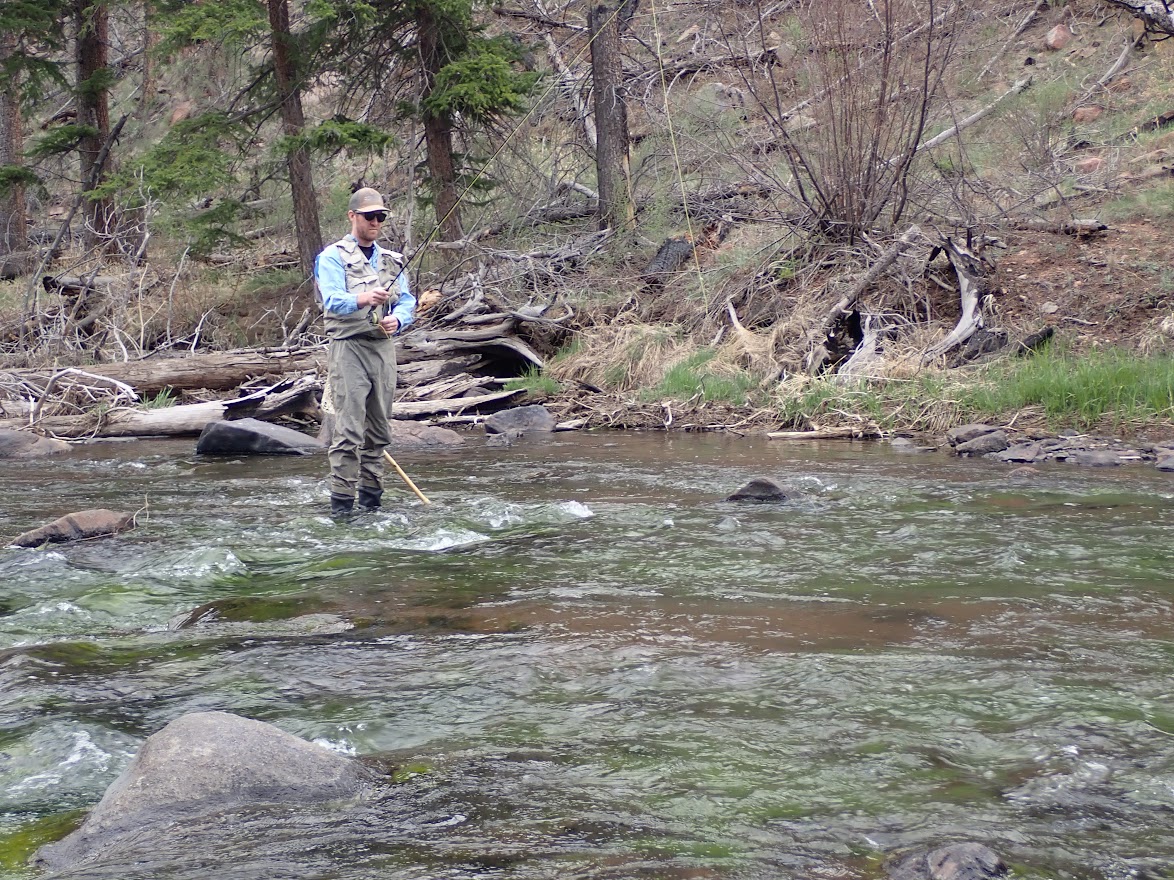
I was weary of somewhat frustrating hatch matching trips and anxious for some active prospecting with dry/droppers. High temperatures were forecast to reach into the upper sixties near Lake George, CO, and the flows continued at a steady 56 CFS, so I paid a visit to the open water of Eleven Mile Canyon. The area that beckoned me was open to all types of fishing including bait, but previous visits convinced me that decent fish remained in spite of the added pressure and harvesting of trout.

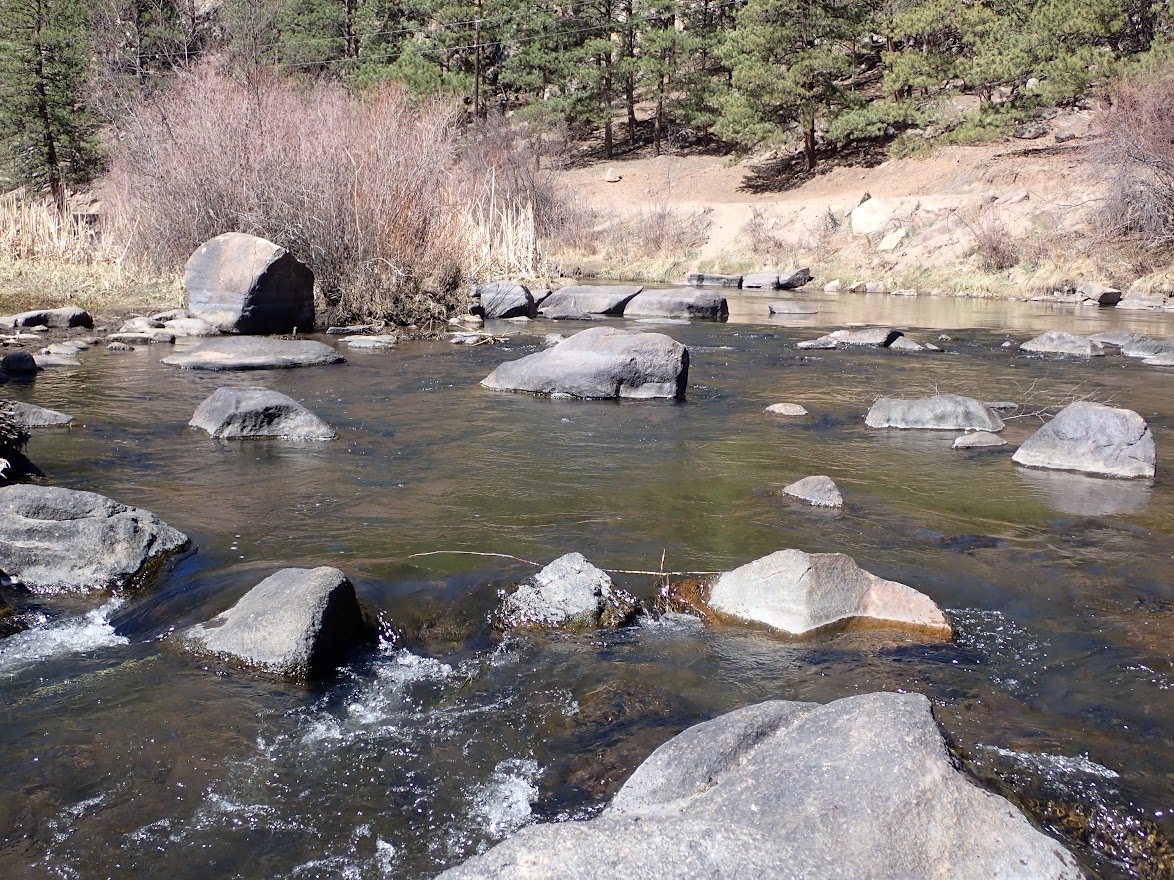
Water at the Start

I arrived at 10:15AM and prepared to fish by 10:30. My preparation included assembling my Sage four weight, and the temperature when I began enabled me to forego any outer layers besides my fishing shirt. Friday was shaping up as a spectacular spring day. In fact, the entire day evolved into a bright blue sky and sunny affair with minimal cloud cover, and the temperature soared to the seventy degree mark. Would the fishing be equally as magnificent?

Beast for This Stretch of River

Salvation Nymph

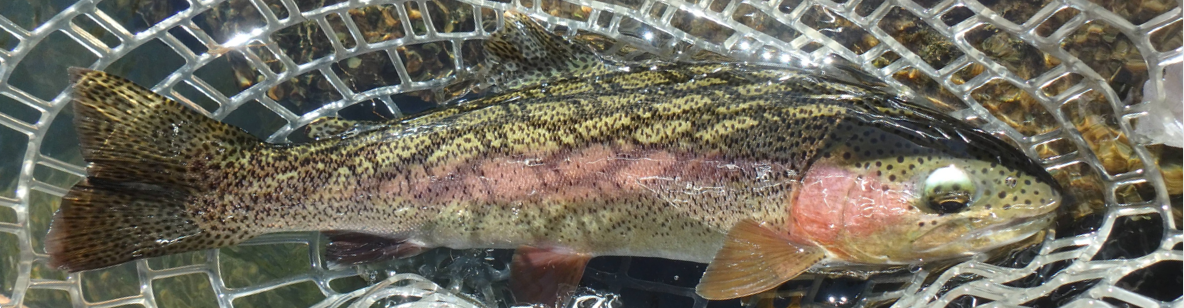
I focused on pocket water during most of my time on the water, and it paid off. I began with a fat Albert, hares ear nymph and salvation and landed two decent trout in the first half hour. Both consumed the salvation, and one was a feisty rainbow, and the other was a brown trout. After the first hour I began to notice small blue winged olives dancing above the surface, so I swapped the salvation for a sparkle wing RS2. This proved to be a mistake, although the RS2 yielded two trout that grabbed the emerger on the swing,  I became disillusioned with the RS2, when I covered some very attractive deep runs and pockets with no action to report.

Prime Deep Run By Exposed Boulders

I ate lunch at noon, and after lunch I decided to return to the salvation/hares ear combination. In spite of the sparse hatch, noticeable rises were a rarity, What a move! Conventional wisdom would suggest that I imitate the prevalent insect, and in this case it was the baetis, but the trout seemed to prefer the salvation nymph. Perhaps the extra weight of the larger and heavier nymph explained the contrarian performance of the salvation.

Watch Band on Back

Likely Productive

For the next couple hours I probed every significant deep pocket and especially seams along deep runs, and I escalated the fish count from four to twelve. Most of the landed trout were browns in the twelve to thirteen inch range, but I also tussled with several muscular rainbows that measured thirteen to fourteen inches. Deep runs and seams, where the current entered pools, were prime producers, and I focused my efforts in those types of stream locations. This manner of fly fishing was exactly the type of carefree prospecting to nonselective fish that I envisioned on the last day of April.

Afternoon Prize

By 2:30PM I ran out of upstream real estate, as I bumped into a trio of newly arrived fishermen, who unknowingly high holed me. I marched back down the road to a downstream spot that featured another stretch of large exposed boulders and pocket water. I was hoping that similar stream structure would translate to success that matched the early afternoon. I applied the same techniques here that served me well earlier, but the magic disappeared. I managed to land three small brown trout to increase the fish count, but I covered some very attractive deep runs and pockets with no success. I am not sure whether to attribute the change in catch rate to the time of day, the different section of the river, or the increased presence of other anglers.

Lovely Run

A fifteen fish day on the South Platte River was just what the doctor ordered. I faced minimal indecision about fly choice, and simply fished the water with a three fly dry/dropper and enjoyed some respectable trout on a gorgeous spring day in a spectacular setting in the Rocky Mountains. Life was good.

Fish Landed: 15

South Platte River – 04/22/2021

Time: 12:00PM – 4:00PM

Location: Eleven Mile Canyon

South Platte River 04/22/2021 Photo Album

After a string of cold April days I looked for a window of fishing opportunity on April 22, 2021. I adopted the practice of checking air temperatures on Weather Underground ahead of stream flows on the DWR web site. Most of my  normal destinations predicted highs in the forties, but the Arkansas River at Salida and the South Platte River by Lake George displayed highs in the fifties. High winds on the Arkansas River ruled out my preferred option, and I settled for the South Platte River in Eleven Mile Canyon. I visited this section of the South Platte on two previous occasions with decent success, and I was fairly certain to interact with the dependable blue winged olive hatch.

I delayed my start from north Denver until 8:30, as I did not wish to arrive too early, when the temperatures were adverse. My strategy worked fairly well, as I arrived at my chosen destination by 10:45AM. The temperature was in the low forties, but the sky was clear blue, and the sun dominated, so I was certain the thermometer would rise to at least the upper forties. Nevertheless, I wore my UnderArmour long sleeved insulated undershirt, my fleece hoodie, my raincoat and my Northface light down coat. For head gear I donned my billed New Zealand hat with ear flaps, and I pulled my raincoat hood over the hat for extra protection against the chilly morning wind. I stuffed handwarmers in my Northface pockets, and I opened a pack of foot warmers for my feet.

Boulder Garden

I approached the stream and rigged my line with a dry/dropper and was prepared to make my initial cast by 11:30AM. My lineup consisted of a fat Albert, iron sally and classic RS2. I prospected the first nice pool that I approached, but the trout were not cooperating, so I paused on a wide flat rock and consumed my lunch.

After lunch I continued my progression up the river by searching some nice pocket water, but once again the fish contracted a case of lockjaw. One of my favorite pools was next, but it was occupied by another angler, so I circled around and dropped into another short series of pockets. I exchanged the RS2 for an orange scud, but the exchange failed to change my angling fortunes. Another nice pool appeared above the pocket water, and I began to fish this section with my dry/dropper, but I exchanged the iron sally for an emerald caddis pupa and reverted to a sparkle wing RS2 as my point fly. Again the trout gave me a resounding thumbs down.

I could see the spectacular bend pool ahead of me, but is was populated by three fishermen. Fortunately, as I was about to by-pass the trio, I began to spot some sporadic rises from the pool that I was occupying. I tried a few dry/dropper casts with lifting and swinging action to simulate the RS2 as emerging blue winged olives, but this ploy did not arouse interest, so I converted to a single dry fly approach. I knotted a CDC BWO to my line, but whether using an upstream cast or across and down, the trout were having none of it. I tried a Klinkhammer emerger and then trailed a beadless soft hackle emerger, and I nicked the lip of one trout with the Klinkhammer, but overall my flies were rudely ignored.

I surrendered to the highly educated trout and moved above the Steve Supple bend pool that was occupied and arrived at the next fine pool above the island and braids. Once again quite a few trout were rising, but in spite of my optimism my efforts were futile. I tried a BWO cripple, that I tied the previous afternoon, but it was shunned, and the size 20 fly appeared to be too large. Eventually I gave up on the selective feeders and moved to the heart of the pool, where a huge vertical wall bordered the east side. I positioned myself across from five or six visible risers, but once again my flies were treated like covid positive specks. The lighting was difficult in the prevalent partial shadows and sun glare, and tracking the drab colored olive imitations was a challenge.

Respectable

I gave up and moved to the top of the pool, where a pair of feeder runs split around an exposed boulder and then rejoined creating a deep single run and pool. In order to better track the flies, I resorted to a triple dry system with a silver body hippie stomper followed by a size 24 CDC BWO on a six inch leader and then a soft hackle emerger on another six inch tippet. I began feeding downstream casts to a glutinous gulper at the tail of the run, and miraculously on the fifth cast a rainbow snatched the soft hackle emerger. I made a swift hook set and eventually coaxed the respectable trout into my net. I was certain that an embarrassing skunking was in my future in spite of wave upon wave of blue winged olives fluttering up from the river, but fortunately I was now on the scoreboard with an almost embarrassing total of one fish.

Handsome

I continued upstream to the next wide pool, but by now the sun appeared, and the hatch dwindled to occasional rises. I paused and mostly observed in this area, but the signs of feeding fish were reduced, and I decided to return to the shadowed area armed with the advantage of a three dry fly set up for better visibility. The revisit worked, and I landed two rainbows of fourteen and fifteen inches in the pool with the high vertical wall. The added visibility of the hippie stomper was a huge plus, and it enabled me to see or approximate where my tiny trailers were at any point in time. Both of the late day catches grabbed the size 24 CDC BWO.

Spread Out

Site of the Last Fish Landed

I quit at 4:00PM and talked to another fisherman from Pennsylvania at Steve’s pool for awhile on my return hike. Thursday was a subpar day from a numbers perspective, but the three landed fish were excellent quality. I also hooked but failed to land three additional fish during my four hours on the river. I could not complain about the weather other than the intermittent gusts of wind. The temperature actually spiked above fifty, and for that I was thankful. The hatch was everything I could have hoped for. Every time a cloud blocked the sun, the wind kicked up, and the rings of rising trout appeared throughout the river. I simply did not have the right imitation for the situation. My theory is that strong wind blows the emerging mayflies off the water quickly, but many of the baetis get dumped back on the surface in a crumpled state, and the fish key on movement from their targeted food source. I am now contemplating tying some size 22 dry flies in the Catskill style with hackle wound around the hook. A fly dancing on hackle tips on the surface of the river may better approximate the clumsy movement of the mayflies, as they attempt to lift off and combat the strong wind.

Fish Landed: 3

South Platte River – 04/12/2021

Time: 11:00AM – 4:00PM

Location: Eleven Mile Canyon

South Platte River 04/12/2021 Photo Album

A cold wind blasted out of the north, as I positioned myself next to some attractive pockets on the South Platte River on April 12, 2021. Given my aversion to cold weather fishing, how did I allow myself to end up in this chilling position? Generally I prefer the air temperature to surpass 45 degrees, and I like the wind velocity to be in single digits. Neither of these conditions were met during my day in Eleven Mile Canyon.

I experienced my best day of 2021 a week ago in the same stretch of river, and I was quite anxious to schedule a return engagement. Unfortunately a variety of circumstances conspired to prevent my return until Monday, April 12. Cold weather and snow provided a hurdle to fishing on April 6 and 7, but I salvaged Wednesday with a day on the ski slopes of Vail Ski Resort. Of course, April 8 was a pleasant spring day, but I devoted that calendar date to helping Jane care for our grandson, Theo. Strong winds plagued Friday, and I used that excuse to avoid a stream. Saturday was the best day of the intervening week from a weather standpoint, but I avoid popular rivers on weekends, so I satisfied my need to fish with a trip to Clear Creek. Sunday was another decent day from a weather perspective, but weekend crowding served as a hurdle to returning to the South Platte River.

Upstream from Start

The above rundown brings us to Monday, April 12. Weather Underground displayed a forecast of high temperatures in Lake George, CO of 50 degrees with high single digit wind velocity. This projection satisfied my two critical weather criteria, so I rolled the dice and made the trip to Eleven Mile Canyon. April was rapidly slipping away, and my opportunities to enjoy my passion were diminishing. I needed to compromise my comfort level in order to take advantage of the disappearing 2021 season.

Starting Point

The drive was uneventful, and I arrived at Lake George by 10:00AM. The dashboard thermometer registered 31 degrees, so I confess that I extended my time in the cozy confines of my car for an extra thirty minutes, as I completed two detours to delay my arrival at my chosen destination. The ploy paid modest dividends, as the temperature climbed to 35 degrees, by the time I exited the Santa Fe to prepare for a day of fishing. For attire I snugged into my fleece hoodie, light down Northface coat, and my New Zealand hat with ear flaps. I searched through my Fishpond fishing bag and extracted my fingerless wool gloves. My Sage One five weight became the fly rod of choice to combat the wind and support the expectation of larger than average fish. I hiked up the dirt road for half a mile and then descended a gradual path to the edge of the river and the scene described in the first paragraph. Could I possibly catch fish in these weather conditions, and how long would I survive the wind and cold?

Hares Ear Nymph in Lip

I used my stiff fingers to rig my line with a yellow fat Albert trailing a beadhead hares ear nymph and ultra zug bug, and I prospected a series of attractive pockets in the area below the medium-sized pool, where I generally pause for lunch. On the third cast the fat Albert plunged, and I set the hook half expecting to be connected to some aquatic moss or vegetation. Much to my surprise a twelve inch rainbow trout splashed about, but after a few brief runs I guided it into my net. I carefully removed my left wool glove to keep it dry; and then I grabbed the trout, posed it for a photo and carefully removed the hook while attempting to keep my hand dry. My optimism soared, but the remaining prime pockets in this section failed to produce.

Lunch Pool

I moved along the left bank to the run that fed the nice lunch pool, and I prospected the shelf pool, current seam and tail out very thoroughly, but the fish were not cooperative. I removed the ultra zug bug and replaced it with a sparkle wing RS2, but the change produced little impact, although I did experience a brief connection tight to a large rock next to the bank. I chomped my lunch at 11:45AM, and then I progressed to the pocketwater that separated the lunch pool from the gorgeous long run and pool that occupied my attention a week ago.

The Big Pool

Initially I cast the dry/dropper system to the seams along the faster runs that fed the pool, but by 1PM I began observing sporadic rises in the gut of the pool, where the river fanned out into the slower moving lower section (photo above). I was not having success with my clumsy dry/dropper set up, so I embraced the opportunity to switch to a dry fly. I removed the three flies as quickly as my cold, stiff fingers allowed, and I knotted a size 22 CDC BWO to my line. This was the same type and size of fly that served me quite well on April 5.

Handsome

Between 1:00PM and 2:30PM I executed downstream drifts and ratcheted the fish count upward from one to eight. I resorted to across and downstream drifts, and the pool dwelling trout responded with frequent assaults. When a cloud blocked the sun, the wind kicked up, and this weather pattern in turn prompted a flurry of rising fish. The 1.5 hours of fast action included an abundant quantity of fruitless casting, but my frequency of success was, nevertheless, quite rewarding. Brown trout were the predominant species, but I also netted a vividly colored cutbow to add diversity to my efforts. Twitching and lifting the fly in front of a fish proved to be a successful ploy, as the trout attempted to snag a fleeing morsel of food. During the process of releasing a fish early in this time period, a gust of wind whipped my left-hand fingerless glove off of an exposed rock and dumped it in the river. I quickly recovered it, but the palm area was wet, and I was forced to fish without coverage on my left hand for the remainder of the day.

Love the Speckles

Unfortunately change is constant in fly fishing, and although the waves of hatching baetis mayflies continued from 2:30 until 4:00PM, my ability to dupe trout consistently ended. I am hard pressed to explain this change. Perhaps the stronger gusts of wind caused the resident trout population to look for a different stage of the mayfly, or maybe cripples became the predominant food supply? Did my efforts to land thrashing fish disturb the water and make the feeders more wary? I suspect this was not the case, because the pool was populated with ten to fifteen feeding fish at many points in time. I swapped the CDC BWO for a soft hackle emerger for a bit, and this change resulted a a pair of temporary hook ups. Next I exchanged the soft hackle emerger for a Klinkhammer BWO, and almost instantly a small rainbow responded with an aggressive strike. But just as quickly the Klinkhammer became another ignored speck on the surface of the river.

Nice One

By 3:30PM I no longer felt my toes, and I began to shiver steadily. I slowly waded to the bank and stood on an exposed rock to remove my stumps from the cold water. This position was less desirable for presenting flies, but I did manage to fool another pretty cutbow, before I could no longer tolerate the wind and cold, and I returned to the Santa Fe.

Ink Spots

On Monday, April 5 I endured adverse weather conditions to notch a ten fish day, so the discomfort at least paid off with double digits. The largest fish was a brown trout that probably measured fifteen inches, and two spectacularly colored cutbows reached fourteen inches. When I checked the dashboard thermometer, as I began to drive back out of the canyon, it displayed 33 degrees. The temperature in Lake George was 41 degrees, and I am certain that the high temperature, where I was fishing never exceeded 40 degrees. I am also convinced that the wind gusted at double digit speeds. Nevertheless, I fished for five hours, survived the wintry conditions and netted double digit trout. The five day forecast for Denver predicts wintry conditions, so I may have to endure another cold day to get my fishing fix. Stay tuned.

Fish Landed: 10

South Platte River – 04/05/2021

Time: 11:30AM – 4:00PM

Location: Eleven Mile Canyon

South Platte River 04/05/2021 Photo Album

Gorgeous weather with a high in the 60’s at Lake George motivated me to take a trip to the South Platte River in Eleven Mile Canyon on Monday, April 4. I arrived at the wide pullout above the long and placid pool in the special regulation section by 10:30AM, and after pulling on my waders and setting up my Sage One five weight, I was prepared to fish by 11:15AM. I hiked up the road for .5 mile and descended on a moderate path to the river. I was delayed by a couple false starts, when I first forgot my sun gloves and then realized that I was without my frontpack.

First Prime Pool on Monday

The river was flowing clear and low at 56 CFS, and it was free of ice. A fair amount of residual snow remained along the east side of the river, as a steep canyon wall prevented the sun’s rays from penetrating for much of the day. I rigged my nymph system with a New Zealand strike indicator, split shot, sucker spawn, and sparkle wing RS2, and then I thoroughly explored some deep pockets and a nice medium sized pool, but the trout exhibited disdain for my offerings. By 11:50AM the fish count was stalled at zero, and I paused to eat my lunch, while I observed the pool. Quite a few swarms of tiny tan or gray colored midges buzzed about just above the surface, and I witnessed five or six very sporadic rises in the pool, while I munched my sandwich and crunched my carrots.

Dark Olive Hue

After lunch I swapped the sucker spawn for a 20 incher and replaced the sparkle wing with a classic RS2. Neither of these fish magnets created interest, so I converted to a dry/dropper with a size 8 fat Albert, beadhead hares ear nymph and sparkle wing RS2, and the RS2 produced a thirteen inch brown trout from the current seam created by a run that fed the lunch pool. I was quite pleased with my initial success, and I moved up the river with renewed optimism. In some deep pockets between the lunch pool and the next larger one, I temporarily connected with a larger fish, but it quickly figured out how to jettison my hook.

I Spent Most of the Day at This Run and Pool

When I arrived at the spectacular long pool fed by two very attractive deep runs that split around an exposed boulder, I tossed the dry/dropper to the faster water. In a brief amount of time I began to notice sporadic rises, and eventually the feeding activity became more steady. This was my sign to switch to a dry fly, and I removed the dry/dropper rig and knotted a size 22 CDC blue winged olive to my line. This proved to be a prescient move, as I fished the olive CDC comparadun for the remainder of the afternoon and accumulated a total of fifteen fish. Yes, Monday afternoon temporarily satisfied my appetite for early season fly fishing action. During one half hour period, when the CDC BWO was being rudely ignored, I switched to a Klinkhammer emerger, and this fly accounted for one fish. When the Klinkhammer was also shunned, I added a six inch tippet extension and tied on a soft hackle emerger to fish in the film, and this fly also notched one fish. After a half hour of experimentation, I observed an abundant quantity of feeding fish, and they ignored my double dry offering, so I reverted to the CDC BWO.

Showing Off the Slash

Reintroduced to the River

Initially I presented a size 20, but it was soundly rejected, so I returned to a size 22, and this enabled me to revisit success. Monday afternoon was simply a baetis feeding blitz. Large gray clouds blocked the sun’s rays for extended time periods, and this prompted wind and low light, and the blue winged olives became a favored food source for the trout. The cycle of clouds followed my brief periods of sunshine repeated often, and I took advantage of the cloud cover to net wild canyon trout. Brown trout dominated the catch; however, I managed one chunky rainbow in the fifteen inch range, and I added three brilliantly colored cutbows that featured vibrant slashes below their jaws.

A Bit More Girth

Lovely Color Scheme

Down and across drifts yielded the most success, and on several occasions I twitched the tiny dry fly in front of a trout, and this erratic movement provoked a vicious take. I actually felt like I figured things out, but that confidence did not last long. Every take was accompanied by at least fifteen fruitless casts, so the trout were not totally convinced that my imitation was a precise copy of the naturals. Nevertheless, it worked better than the other blue winged olive fakes in my fly box, and it produced with enough frequency to keep me focused for nearly four hours in the same pool. A fifteen fish day on April 5 represented a solid success, and I look forward to a return trip to Eleven Mile Canyon. Catching fourteen out of fifteen on a dry fly was simply icing on the cake. The best of the pre-runoff fly fishing is around the corner, and Monday was a great sample of what may lie in my future.

Fish Landed: 15

South Platte River – 11/03/2020

Time: 11:00AM – 3:00PM

Location: Eleven Mile Canyon

South Platte River 11/03/2020 Photo Album

Tuesday’s outing on the South Platte River in Eleven Mile Canyon breaks down into two very different experiences. Between 11:00AM and 2:00PM I endured three hours of frustration. All my action for Tuesday was packed into the final hour.

The temperature in Denver was forecast to stretch into the mid-seventies, and the high for Lake George near the South Platte River was predicted to reach 62 degrees. The weather prognosticators were quite accurate based on my assessment after spending the late morning and afternoon in the area. The gauge for the South Platte River below Eleven Mile Reservoir is out of service, but I suspect the flows registered in the 60 CFS range.

Looked Like Ideal Nymphing Water

I arrived at a pullout by 10:30 and decided to explore an area outside the special regulation section. I geared up with the Sage four weight and pulled on my North Face light down coat to ward off the chill, while I began my quest for trout in shadows on the eastern side of the river. The steep canyon walls along the left side of the road blocked the low sun for much of the day, and a significant amount of snow remained from last weekend’s storm. The temperature when I began at 11:00 AM was in the low fifties.

I used my New Zealand indicator tool to attach a tuft of chartreuse poly to my line and then crimped a split shot above the last knot on the tippet. Beneath these nymphing accessories I knotted an orange-yellow yarn egg and a RS2. I prospected the deeper water over the next forty-five minutes, but evidence of local trout was absent. I began in some shadowed areas and quickly moved into a nice area bathed in sunlight, but neither produced even a nibble to my flies. I grew frustrated and decided to move to the special regulation area, where presumably a more dense population of trout existed. I theorized that the presence of more fish translated to a higher probability of success.

This Pool Earned a Few Casts

I drove up the canyon toward the dam to the area that I frequently fish, but all the parking spaces were occupied, so I reversed direction and parked .3 mile downstream from my usual spot. The bank in this area is quite steep, so I walked upstream, until I found a relatively gradual path covered with packed snow, and I carefully edged my way down to the river and then followed some footsteps through the snow to the first nice pool. Before I could unhook my line to make a cast, I spotted another angler, so I circled around him and approached a second favorite pool. Once again another fisherman was present, so I resumed my hike in the snow. The next pool was much smaller than the first two, but it was unoccupied, so I covered it thoroughly with my egg and RS2 combination. This cycle of bumping into other fishermen and casting to less desirable spots in between continued until 2:15PM, when my frustration reached its peak, and I decided to call it quits. The cold water from the dam numbed my feet, the fish were uncooperative, and in spite of these negatives, fishermen were everywhere.

I Exited Via That Steep Path in the Snow Below the Orange Sign

I climbed a steep snow packed trail to the road and hiked .4 miles to the Santa Fe. Rather than accept a skunking I decided to walk an additional .2 mile to a wide pullout above a huge long slow moving pool. Upon my arrival I noted that the entire area was vacant, so I scrambled down a jumble of snow covered rocks to the edge of the river one-third of the way from the downstream end of the pool. I slowly waded upstream along the left side while methodically scanning the bottom of the river for shadows or moving forms. Alas, my attempt to sight fish proved futile, as I never spotted a trout. I reversed direction with the intent of finding the snowy path to climb back to the road, but for some reason I decided to inspect the bottom one-third of the pool. Much to my surprise I began to observe sporadic rises directly across from my position and downstream.

Nice Length

I watched for a few minutes, and the evidence of feeding fish convinced me to make a last ditch attempt to catch one. I patiently removed the strike indicator, split shot and two flies and knotted a size 24 CDC BWO to my line. I began delivering downstream casts to the feeding trout below my position, and nearly every drift was greeted with a small dimple, but my swift hook sets simply hurled the fly back in my direction. After ten minutes of frustration, I paused to evaluate and decided to switch to a size 22 soft hackle emerger with no bead. I applied floatant liberally to the body and began to cast. I fired a few casts to the small pod of fish directly across from me with no success, and then I turned my attention to the subtle feeders across and downstream. I began executing reach casts, so the fly line landed upstream of the fly, and on the fourth drift a fish bulged on the emerger. I responded with a lift and felt the underwhelming weight of a small brown trout. Since I was in skunk status, I quickly determined that it was six inches long and reluctantly added the small trout to my mental fish count log.

I turned my attention to several persistent risers downstream from the fish that I landed, and after quite a few fruitless casts, I connected with my best fish of the day, a fifteen inch rainbow. The slab ‘bow demonstrated some fine fighting techniques, but I eventually coaxed it into my net for a photo session. For the next forty-five minutes I persisted in my effort to fool pool risers, and I managed to add a fourteen inch rainbow to my fish count. The soft hackle emerger lost its allure, so I swapped it for a Klinkhammer BWO, and the small low riding baetis emerger imitation duped the third fish of the day. During this time period I also broke off a soft hackle emerger on a fish that felt heavier than any fish that occupied my net. I was not particularly happy about that turn of events. Also in the area across from me I connected with two fish that felt similar to the landed rainbows, but each managed to escape, before I could slide them into my net.

Satisfying

Downstream Drifts in the Bottom End of the Pool

My total time on the South Platte River was four hours, but approximately one hour was consumed by lunch, wading, walking and moving the car. Of the three hours of actual fly fishing, two were unproductive and frankly quite boring. I am not a big fan of fishing nymphs with an indicator, and doing so with low confidence translated to wandering thoughts and low expectations. The last hour of dry fly action salvaged my day and provided the opportunity to land six fish, although only three made it to my net. It was a nice day, and once I escaped the other fishermen, I focused on catching trout on dry flies in November. I cannot complain.

Fish Landed: 3


Middle Fork of the South Platte River – 10/06/2020

Time: 10:30AM – 2:00PM

Location: Tomahawk State Wildlife Area

Middle Fork of the South Platte River 10/06/2020 Photo Album

I landed some quality fish on Monday from the Arkansas River; however, I was dissatisfied with the fish count, so I decided to visit another never before fished stretch of river. I chose the MIddle Fork of the South Platte River at the Tomahawk State Wildlife Area. I read positive reviews on this section, and the salesperson at ArkAnglers raved about it, when I stopped to look for a new New Zealand indicator tool after fishing on Monday. I consider myself an above average fly fisherman, but my day at Tomahawk humbled me. The conditions could not have been more challenging, so I should probably reserve judgment, until I try it again under more favorable circumstances.

The drive from the Woodlands Motel in Salida to the Tomahawk area north of Hartsel was approximately an hour. The man at the fly shop told me that there were two entrances, and I decided to seek the second one, as I headed north on CO 9, but I somehow missed the sign and traveled five miles beyond it. I finally realized that I was moving farther away from the stream and executed a turnaround. As I headed in a southeastern direction, I finally saw the sign. It was paralleling the highway and tilted toward southbound traffic, so I felt vindicated in missing it. I followed a reasonably smooth dirt road, until I arrived at the largest parking lot, and I grabbed a space facing south. I was the only car in the lot, although several were visible in other smaller pullouts on the opposite side of the river.

I quickly assembled my Sage four weight and pulled on my waders and began hiking along a well worn path that paralleled the right or northeastern side of the river. The water was extremely low, and the air temperature was already in the sixties. A cool breeze blew intermittently, so I wore my raincoat as a windbreaker; however, by lunch time I rolled it into a tight cylinder and stuffed it in my backpack. Low, clear water, a bright blue sky with no cloud cover, and wind foreshadowed a tough day.

Lots of Exposed River Bed

I decided to hike ten minutes from the parking lot to escape the typically highly pressured nearby sections. After the requisite distancing I cut to the river (really more like a creek) and commenced my day. I began with a hippie stomper, iron sally and pheasant tail nymph; and in the early going I scattered quite a few fish. The shadow from my overhead line seemed to spook the fish, and very few deep holes that offered reasonable cover were evident. After half an hour of futility, I arrived at a nice V-shaped deep trough next to a high bank on the left. A strong current ran five feet way from the bank, and I was drawn to the space between the current seam and the bank. I began casting the dry/dropper to the top of the deep area, and on the fifth drift a substantial fish elevated to inspect the hippie stomper. On a subsequent cast the same look with a closed jaw occurred.

Since my blind prospecting was proving futile, I decided to focus on this now visible fish, and I began a sequence of fly changes. I cycled through a Jake’s gulp beetle, a stimulator, a caddis, an ant, and a pool toy hopper; but none of these imitation morsels caused the targeted fish to even take a look. I decided to move on, but this was probably the closest I came on Tuesday to hooking and landing a fish over the six inch minimum.

A Deep Trough Proved Unproductive

I paused to eat my lunch at noon, and then I continued my upstream migration. In total I covered at least a mile, and the number of attractive fish holding locales was limited. At 1:00PM I approached a spot, where some murky water re-entered the river from a small irrigation channel. At the time I was fishing an olive stimulator with a sunken epoxy ant, and two brown trout refused the stimulator. Once again the rare sighting of two fish motivated me to try some alternative dry flies; and I drifted an Adams, deer hair caddis, parachute ant, CDC BWO, and gray comparadun along the edge of the discolored seam; and only the deer hair caddis generated additional looks.

After twenty minutes I surrendered to the picky eaters and continued my upstream progression, but I never saw or even spooked another fish. The sun was bright and the air temperature soared into the upper seventies, and the high plain provided no shade to blunt the intensity of the sun’s rays. I decided to cut my losses and hiked back to the car for an early departure. I probably spent more time walking and changing flies than fishing. Over the course of my 3.5 hours I tested a hippie stomper, stimulator, parachute ant, olive-brown deer hair caddis, gray deer hair caddis, gray comparadun, Jake’s gulp beetle, pool toy hopper, parachute hopper, iron sally, pheasant tail nymph, salvation nymph, sunken ant and RS2. Only the hippie stomper and olive-brown deer hair caddis drew interest.

Tuesday was a humbling experience at the Tomahawk State Wildlife Area. If I return, I will choose a time when flows are considerably higher. Zero fish landed in 3.5 hours of fishing made me appreciate even more the many productive days that I experienced this summer.

Fish Landed: 0

South Platte River – 06/04/2020

Time: 10:30AM – 2:00PM

Location: Eleven Mile Canyon

South Platte River 06/04/2020 Photo Album

Three unproductive trips to lakes reinforced my desire to visit some flowing water, but the nagging question was where? Based on my review of the stream flow data on the DWR web site, it was clear that tailwaters offered the only viable option, as the Colorado freestones climbed toward their peaks. I contemplated the South Platte River for my trip on May 29, but the idea of a solo excursion of that length within eight weeks of heart surgery discouraged me, and I opted for nearby Bear Creek. Friday was a fun comeback outing, but I yearned for the possibility of tangling with trout of greater size.

The weather forecast for the week of June 3 projected highs in the upper 80’s and low 90’s. At the start of the week I suggested to Jane a trip to the South Platte River in Eleven Mile Canyon, and she agreed. Jane could share the driving and track my well being, as I logged some sorely needed stream time. I checked the flows on Thursday morning, and 83 CFS was the current reading, and I knew from history that this level was nearly ideal. I was, however, bothered by the slope of the line, as it rose from 60 to 83 over the last few days.

I packed most of my gear on Wednesday night, and on Thursday morning we threw Jane’s bicycle and folding chair in the Santa Fe, and we hit the road by 8AM. This departure time enabled us to pull into a wide parking space by 10:00AM, and my wading boots were wet by 10:30AM. I elected to utilize my Sage four weight in case of wind, and after contemplating wet wading I opted to wear my waders. Ironically I am a fisherman, who does not particularly like to get wet.

As Good a Place as Any to Start

Quite a few competing fishermen were in the canyon, as the South Platte River represents one of a limited number of tailwaters that provide manageable flows during the run off time period. In spite of the greater than normal population of anglers, I found a nice starting spot at the bottom of a lengthy section of pocket water. Jane departed on a two hour hike, while I extended my leader and tied on a size 6 yellow fat Albert, a beadhead hares ear, and a salvation nymph. I decided to rely on the historically top producing flies from my fly box. I began lobbing casts upstream, and I allowed the three fly configuration to drift through some very attractive deep riffles and runs. After ten such passes I was surprised with a lack of action, but then just as the fat Albert entered a deep hole in front of a large submerged rock, it dipped, and I set the hook on a nice twelve inch brown. This was my largest post-operative fish, and I enjoyed a brief celebration. The much appreciated brown trout nipped the salvation nymph.

On the Board

I moved on through some additional juicy pockets, but the local trout were ignoring my three fly offering. A few caddis buzzed about along with a rare size 20 mayfly, but then I spotted a pair of size 12 or 14 golden stoneflies. I reacted to this observation by swapping the salvation nymph for an iron sally. The move paid dividends, when I landed three additional brown trout in the 12 -13 inch range shortly before noon. All three trout came from a narrow but deep ribbon of water that flowed between a large exposed boulder and the fast main current. I probed many more attractive places during the morning with no response, but I was nevertheless pleased by this sudden reversal of fortunes. All three of the hungry brown trout gobbled the tumbling iron sally, and this circumstance vindicated my switch.

Iron Sally Got It Done

A Fine Fish

I crossed the river and returned to Jane’s shady retreat along the dirt road, just after she returned from her hike. I grabbed my lunch and stool, and we relaxed and chatted for twenty minutes, before I resumed my quest for trout. I hiked back along the shoulder of the road, and while Jane looked on, I carefully lowered myself down a steep bank and crossed the river, until I was positioned just above my exit point. Between 12:30PM and 2:00 PM I continued my upstream progression at a steady rate, and I prospected all the likely runs and pockets. I was pleased to have the entire river to myself until the last thirty minutes, when a solo angler appeared above and below me.

After Lunch Rainbow

Deep Riffles in Front of Large Boulder Produced the Rainbow

For the first twenty minutes after lunch I failed to discover any signs of trout in spite of passing through quality water, so I made another modification to my lineup. I replaced the unproductive hares ear with an emerald caddis pupa, but maintained the trailing iron sally. Shortly after this adjustment the fat Albert dipped in a deep riffle near the opposite side of the river, and I quickly lifted the rod tip and found myself attached to a rambunctious rainbow trout. The silver bullet streaked up and down the river, until I eventually leveraged it into my net. The pink striped trout displayed an emerald caddis pupa in its mouth, and it extended to fourteen inches; the best fish of the day.

Pretty Typical for Thursday

For the remainder of the afternoon I worked my way upstream and methodically cast to all the likely trout lies while adding three more brown trout to the count. All were in the twelve to thirteen inch range, and one feasted on the emerald caddis pupa, one crushed the fat Albert, and the other grabbed the iron sally. Some clouds moved in and blocked the sky for a short while, and a flurry of raindrops descended but not enough to force a retrieval of my raincoat. Between 2:30 and 3:00PM I approached a young angler above me, and I looked back on another single fishermen in the water that I just covered. I gently released my eighth fish and waded across the river and then returned to the car.

Another Deep Trough

In 3.5 hours of fly fishing I landed eight trout, and all were twelve inches or greater. This was my best outing by far since my surgery, I was quite pleased with the outcome. Quite a few promising spots failed to deliver, and the larger, slow moving pools were not productive. I focused my efforts in long deep runs next to current seams, and riffles of moderate depth or large deep pockets were also favorite trout lairs. Afternoon cloud cover probably kept the high temperature in the upper seventies, and the scenery was exceedingly spectacular. I love the large boulders and spaced out pines that characterize the South Platte drainage. Jane had a great time as well, so hopefully I can convince her to make another trip in the near future. I noticed that the flows have gradually elevated to 93 as of June 5.

Fish Landed: 8

South Platte River – 04/08/2020

Time: 10:30AM – 4:30PM

Location: Eleven Mile Canyon

South Platte River 04/08/2020 Photo Album

My fishing outing on Wednesday, April 8 was an example of quality over quantity. In an ideal world I enjoy both, but sometimes my fortunes follow an either/or scenario. On Tuesday I learned that the surgery that was scheduled originally for March 16 and then cancelled was rescheduled for April 16. Because of the corona virus pandemic, I was surprised to learn of the resumption of elective surgery this soon, but I made the decision to go with it. Hopefully the surgery will progress to completion this time, and I can recover to reasonable fishing shape by the time the rivers and streams recede to fishable levels in late June or early July.

With the advent of the scheduling change I decided to take advantage of another fine spring day to visit a Colorado river, and I chose the South Platte River in Eleven Mile Canyon for my Wednesday adventure. The high temperature was forecast to reach the upper fifties, and the stream flows were tumbling through the canyon at 80 CFS. I knew from this blog and previous experience that these levels are very conducive to fishing. The fly shop reports touted dry fly action on midges and blue winged olives.

Quite a few vehicles were parked along the nine mile access road, but I was fortunate enough to claim a spot just before the first of the twin tunnels. A surprising amount of snow remained on the north and western facing canyon walls, but the open areas that received plentiful sunlight were clear. When I arrived, the thermometer was stuck on 41 degrees, so I pulled on my North Face light down coat and assembled my Sage four weight rod. I hiked down the dirt road a short distance, until I found a reasonably manageable path down the steep bank to the river. Once I reached the shoreline of the river, I continued downstream for another .2 miles, until I reached a nice pool.

Lunch Pool

I began my search for South Platte River trout with a yellow fat Albert, 20 incher, and super nova baetis; but when I paused for lunch at 11:45, the fish count was locked on zero. Needless to say it was a frustrating morning. I did detect two very brief nips, but never felt the weight of the fish. Just before lunch I prospected a very attractive run and pool, where I normally add a fish or two to my count, but I was disappointed by a lack of success despite covering the water very thoroughly. I experimented with a few fly changes and switched the super nova for a sucker spawn fly and my recently tied partridge and orange, but luck was not my friend. In a last ditch effort to turn my fortunes around I substituted a sparkle wing RS2 for the partridge and orange.

The Area Beyond the Fast Water Delivered

As I sampled my lunch goodies, I observed the pool and spotted two very separate rises in the shelf pool on the right side of the fast center run. This observation prompted me to wade to the opposite bank to approach the area of rising fish from a different angle. Unfortunately the rises never repeated, so I shifted my attention to the riffle on the opposite side of the run, that I covered quite exhaustively prior to lunch. Amazingly on the third cast the fat Albert dipped, and I set the hook quickly, and a very nice trout with a bright pink stripe announced that it was not happy with the hook prick. I fought the battler up and down the run a few times, before I managed to thump it into my net. My first fish of Wednesday was a beauty that created a significant sag. It probably measured in the sixteen inch range, but it displayed an ample amount of poundage coming out of the winter. I was also interested to learn, that it grabbed the 20 incher, although I was certain that the RS2 would be the productive fly.

Plenty of Width

Once I photographed and released my highly sought after prize, I resumed casting to the riffle on the opposite side of the fast current. I allowed some casts to float deeper in the run below me, and on one of these longer floats I felt a grab, as I began to lift the flies to make another cast. Although this rainbow did not approach the size of the first one, it may have been stronger pound for pound, as it put up a spirited fight, before I slid it into my net. The muscular rainbow approximated thirteen inches, and my optimism spiked considerably compared to the morning session.

A Second Fine Rainbow

Having disturbed the lunch run and pool considerably, I pressed on in an upstream direction. While eating lunch I noticed another angler in the appealing pool above me, but as I prospected some deep pockets in between, I was pleased to see that the pool was vacant. I lobbed three to five cast to three promising pockets with no results, and then I quickly claimed one of the better pools in the canyon. Two nice deep runs fed the wide smooth area, and since I was rigged with a dry/dropper arrangement, I skipped immediately to the top. I carefully covered both entering runs with my three fly offering, but I was disappointed to discover that the trout did not savor my menu choices.

A Favorite Spot

As this scenario unfolded, I began to observe rising fish where the larger of the two entry runs fanned out into the wide, smooth pool. I abandoned the dry/dropper approach and quickly knotted a CDC blue winged olive to my 5X tippet. The timing of the rises was relatively spaced, but clearly several trout were attuned to the small mayflies that now began to dance and flutter on the surface. It took me quite a few casts and a few position changes, but eventually I lobbed a cast directly across and accompanied it with an upstream midair mend. The small speck of fluff imitating a blue wing olive was smacked aggressively, and I swooped a very fine thirteen inch brown trout into my net. I anticipated the blue winged olive hatch, and now I notched my first dry fly success of the day.

Pleased With This One

The hatch at this stage in the early afternoon was relatively sparse and developed in small waves. A cloud would block the sun, and this created a breeze, and BWO’s appeared. They were blown by the wind and tumbled across the surface, and a series of feeding fish would respond. After a short frenzy the sun reappeared, I basked in the sun, and the surface action abruptly ended. During one of the extended calm, sunny periods I decided to move on to sample another segment of Eleven Mile Canyon.

A man and woman arrived in the section characterized by a series of deep pockets just above the pool, so I circled around them and re-entered the river thirty yards upstream. I converted back to the dry/dropper technique for the faster pocket water; however, this time I featured a size 8 black Chernobyl ant, bright green caddis pupa, and sparkle wing RS2. The pockets were not productive, nor was the nice long pool downstream from my favorite bend pool on the entire river.

Bend Pool Beckons

I was actually astonished to see the bend pool just down from the first tunnel vacant of fishermen, as this sight is a rarity. The river braids around a small narrow island with one channel feeding the bend pool from the south and the larger branch feeding water from the west. I was on the northwest side of the pool, so I advanced to the section at the top where a wide riffle enters. The dry/dropper remained on my line, so I opted to take advantage of the set up in the faster water of medium depth while observing the lower pool for rising activity. I could see a cluster of quite nice trout spaced throughout the riffle, but despite some very focused prospecting, I was unable to tempt any of them to nab the drifting caddis or RS2. Meanwhile the middle and lower sections of the pool were alive with actively feeding fish.

I once again went through the re-rigging process, and I began with a CDC BWO. The next hour was the most frustrating segment of my day, as I cycled through two sizes of CDC olives, a Klinkhammer style BWO, and a Craven soft hackle emerger; but none of these options appealed to the selective feeders in front of me. I cast to the middle area, the current seam, the eddy between two exposed boulders and the slow moving tail section. They all contained actively feeding fish, but I failed to guide any into my net. I pricked two fish, and I attribute the quick escapes to very tentative takes. My flies were clearly missing a key triggering characteristic compared to the naturals. During windy conditions I always assume that movement is the missing element.

Downstream from the Afternoon Pool

Deming’s quote, “Insanity is continuing to do the same thing and expecting different results” looped through my brain, and I cut my losses and moved upstream. I gravitated to the western channel and fired some casts to several likely fish holding areas, but the the tiny olive was not a solid searching fly, so I moved on fairly quickly to the next favorite pool. This spot with slow moving water is directly below the tunnel and features a tall vertical rock wall on the east bank. Half the river was shrouded in shadows by the time I arrived, but I circled around a huge boulder and positioned myself in front of it while looking across to the shaded portion. I was immediately pleased to see some regular rises twenty-five feet across and down from my position, but how was I to follow my tiny tuft of CDC in these unfavorable lighting conditions? I decided to give it a try and simply lift, when I saw a rise, where I approximated my fly to be. It worked on the third drift, I raised the rod tip and felt decent weight, as a fish sent vibrations through my four weight. Unfortunately the joy of hooking a fish in challenging conditions was short lived, as the attached live body quickly slipped free of the tiny size 24 hook.

Smallest Fish of the Day

I paused to blot and dry my fly, and luckily the feeding fish resumed their afternoon routine. Once again I executed a straight across cast and immediately flicked an upstream mend. This time a fish rose five feet downstream from the previous one, and I once again elevated the rod tip and felt a connection. Unlike the previous episode, however, I remained in touch with an eleven inch brown trout and quickly slipped it into my net. When I resumed casting, the wind died back, and the sun broke through the clouds, and the calm sunny break halted the ravenous feeding. Some sporadic activity remained, and I attempted my blind cast and set method for a bit, but then rising futility drove me onward.

My Late Afternoon Spot

I investigated the very attractive faster run at the top of the pool, but I was armed with a tiny dry fly, and the trout were not revealing their presence. I quickly waded through the wide shallow connector section and approached a vast wide pool. The lower half of the pool was only a few feet deep and extremely clear. I deemed this another recipe for frustration and immediately waded to the midsection, where I could reach the upper and middle portion of the pond-like section. I paused to observe, and several larger than average trout hovered below the surface and sipped olives in a rather leisurely manner. Could I fool these discerning eaters? I began making long casts to the area, and I managed to elicit several nose to fly inspections, but something did not conform to the standards of my potential eaters. I gave up on these middle of the pool snobs, and waded toward the feeder lanes in the top third. I once again stopped to observe, and I spotted a couple rises in a moderately faster current close to the boulder strewn west bank.

I began flinging casts across the current with an upstream reach and tracked my tiny fly through the area between the bank and a large exposed boulder to my right. It took ten drifts, and I was about to surrender, when a fourteen inch brown trout smacked the olive, just as the fly began to drag at the end of the float. This brown trout fought more like a rainbow, as It made several long streaking runs upstream, but I maintained a tight line and swept my net underneath another wild prize. I was actually contemplating quitting, but this burst of success refocused my attention.

Aggressive Brown Trout

What next? I moved back toward the east bank and looked once again at the midsection, where I failed to fool some nice trout earlier. They were now rested, and they resumed their finicky feeding. The hatch at this point was more advanced, and although not very dense, quite a few airborne mayflies were visible. Should I try for the center stage trout a second time? Why not? I began to toss casts above the sporadic feeders with an air mend and allowed the fly to drift downstream to their position. Shockingly, after six fruitless casts I saw a nose tip up, and my fly disappeared. I executed a swift lift, and chaos ensued. A fifteen inch rainbow rocketed upstream and then reversed direction several times, while I maintained constant upward and then side pressure. In this instance the fly fishing gods favored me, and I dipped my net beneath a gorgeous, fat rainbow trout. A sub par day was morphing into a quality day after all.

Pleased to Land This Ultra Selective Trout

After my heart rate subsided, I sopped the moisture from my fly, dipped it in desiccant and fluffed the wing. I peered across the pool and noted several fish rising at the base of the current seam that earlier produced a brown trout twenty yards upstream. I targeted these fish, but they were ignoring my tiny olive. My peripheral vision revealed several active fish at the extreme tail of the pool, just before where the water tumbled over a wide flat submerged rock. I examined the flies on the water, and I noticed that they were in a state of constant motion, as they fluttered in their attempt to break free of the surface film. My CDC olive by comparison looked very rigid and inert. I pondered the matter and wondered whether one of my soft hackle emergers might imitate a cripple, and whether the soft hackle and fluoro fiber might create a greater illusion of motion?

I gave it a try. I replaced the CDC olive with a size 22 soft hackle emerger with no bead and applied floatant to the body and wing. I moved downstream toward the shallow tail, and flicked a cast above the scene of the feeders. On the third drift a fish aggressively smacked the wet fly, and I paused a fraction of a second, before I set the hook, and once again a tussle developed. Similar to the first brown trout from the pool, this fish battled hard, but I once again held the upper hand. Again my net sagged under the weight of a robust fourteen inch brown with a vivid black spot pattern over a light silvery body. Needless to say I was on a cloud.

Black Spots on Light Background

The sun reappeared, and the hatch waned, and a glance at my watch revealed that it was nearing 4:30PM. I did not wish to advance farther upstream, and I was averse to waiting out the lull in the hatch, so I clipped my hook to the rod guide and sought a reasonable path up the very steep bank to the road. I barely succeeded in cresting the lip of the bank and returned through the tunnels to my waiting Santa Fe.

What a day! Of course, seven fish in six hours of fishing is a below average catch rate, but the quality of the fish was outstanding. All but one landed fish were thirteen inches or greater, and several exhibited exceptional heft. Five of my netted fish were on dry flies, and I always favor surface action over subsurface. Getting skunked in the tunnel pool was a huge disappointment, but how was I to know? If this is my last outing before surgery, I will fondly remember the day.

Fish Landed: 7
South Platte River – 11/20/2019

Time: 11:30AM – 3:00PM

Location: Eleven Mile Canyon

South Platte River 11/20/2019 Photo Album

A forecast of 68 degrees in Denver had me anxiously anticipating another day of fishing in 2019. Fly tying is a pleasant winter diversion, but being out on the stream is a far better option. November 19 is late in the season for this avid fair weather fly fisherman, and a lot depended on my chosen destination for what could possibly represent my last day in 2019.

My day on Friday on the Cache la Poudre River was nice, but it confirmed that rainbows were more willing eaters than spawning brown trout at this time of year. What streams offered the highest ratio of rainbow trout to brown trout? The Big Thompson River, South Boulder Creek and the South Platte River immediately came to mind. I quickly ruled out the Big Thompson under the assumption, that 68 degrees in Denver translated to fairly chilly temperatures at the higher elevations near Estes Park. South Boulder Creek was interesting, as the flows returned to 89 CFS, but I was concerned that the narrow canyon walls would shield the warming impact of the sun, and snow and ice might remain from storms during the prior week.

More Snow Than I Expected

The projected high temperature in Lake George near Eleven Mile Canyon was 60 degrees, and the releases from Eleven Mile dam registered flows of 99 CFS. These two factors weighed heavily in my decision, and I made the two plus hour drive to Eleven Mile Canyon on Tuesday morning. Unfortunately as I advanced along the dirt road that provides access to Eleven Mile, I was disappointed to discover significant remaining accumulations of snow throughout the canyon. Apparently the factor that ruled out South Boulder Creek was an equal negative in Eleven Mile, although fly fishing in this area did not require an extensive hike in a manner similar to that of South Boulder Creek.

Icy Perch

I found a plowed pullout along the road and prepared for a day of fishing. The temperature on the dashboard display was in the upper thirties, so I pulled on my Under Armour undershirt, a fleece, and my North Face light down in addition to my New Zealand billed cap with ear flaps. I added some fingerless woolen gloves to my array of winter attire, and I never regretted the multi-layer approach during my 3.5 hours of fishing. I assembled my Sage four weight and hiked toward the dam a short distance. I faced a new challenge; the task of getting down the steep bank that separates the access road from the South Platte River.

The Path to the River

After a short walk I encountered three “paths” that enabled me to descend to the river’s edge. I placed paths in quotation marks, because they were simply large sunken footprints in deep snow. I elected to maneuver down the set closest to the dam and carefully stepped down backwards to avoid a face first fall. The ploy worked, and I reached a nice pool unharmed.

With flows at 99 CFS and relatively deep snow lining the banks, I decided to deploy a deep nymphing rig. I looped a thingamabobber to my line and added a split shot, orange scud and beadhead size 20 RS2. I prospected some attractive deep runs between 11:30 and noon, but I encountered no evidence of the presence of trout. A layer of clouds blocked the sun’s warming rays, and the air temperature lagged my expectations, so I found a large rock that was devoid of snow and consumed my small lunch. At this point in my day I was not optimistic that a trout would grace my net, even though I only fished for thirty minutes.

A Splash of Color in November

After lunch I migrated upstream to a very attractive pool, and I prospected the tail and midsection with an abundant number of casts, but again the trout were uncooperative. I allotted many more drifts to each prime location than was my normal summer practice, but patient persistence was not translating to success. Finally I arrived at the gorgeous deep trough that ran along the main current seam near the top of the pool, and much to my amazement the indicator paused on the first cast, as the flies tumbled out of the whitewater froth and into the deep slower moving slot. I reacted with a hook set, and the torpedo streaked downstream, and within seconds my line was limp, and the first connection of the day slid into the long distance release column. I persisted in the same area, and once again the indicator paused, and again I hooked a strong trout that chose a downstream escape route and managed to shed my fly. Given my misgivings over my ability to land a fish on the cold November day, you can imagine my state of mind after two consecutive escape episodes. The twin incidents did, however, elevate my confidence and prodded me to persist in my pursuit of South Platte River trout. Gaining knowledge of which fly duped the trout would have been welcome, but the releases pointed to the small classic RS2 with a small hook gap.

I once again progressed upstream along the river and carefully avoided ice patches and packed snow, until I arrived at another large quality pool. Earlier I spotted another angler in the area, but he was absent by the time I arrived, so I covered the large pool very thoroughly. I was certain that the large prime hole would produce fish, but it did not. I decided to exchange the orange scud for a 20 incher, since it was weighted and when combined with the split shot would provide deeper drifts.

The next section of the river was comprised of faster chutes and short pockets, and I made some cursory casts, but when results were not forthcoming, I continued on to the gorgeous pool below the first tunnel. This pool entertained me and friends on numerous occasions, and I was somewhat optimistic that it might erase my skunking on November 19.

The Area That Produced

I moved immediately to the nice riffles that spanned the river at the top of the pool, and I sprayed casts across the entire area, but my hopes sank, as the flies only collected moss and aquatic debris. I took three steps downstream and once again executed casts starting within eight feet of my position and then extending outward. In the blink of an eye the indicator dipped, I set the hook and a spirited rainbow trout thrashed near the surface. The pink striped fighter performed some acrobatic maneuvers, but eventually I guided the fish into my net and observed the 20 incher in its lip. The skunking was avoided, and I silently congratulated myself for persistence and a hard earned reward.

A Welcome Catch

I continued probing the upper section of the pool, and on a subsequent cast I felt a jolt, as the flies began to swing at the downstream end of the drift. Again a rambunctious rainbow trout appeared, but once again I maintained tension and eventually slid my net beneath its swirling body. The second trout of the day was a mirror image of number one, but this specimen displayed the RS2 in its lip.

I worked my way down the pool for another ten minutes, and then I resumed my upstream progress. Just above the top of the pool a small relatively shallow shelf pool appeared, and although I judged it to be relatively marginal, I flicked a cast to the top. Imagine my amazement, when after a short drift I lifted to make sure that the flies were not hung up, and I found myself attached to a nine inch brown trout that gobbled the 20 incher.

Happy for Any Size

I continued onward for another hour, and I thoroughly fished two additional first-class locations, but I was unable to recreate the magic of the tunnel pool. The sun broke through for a few short time periods, but for the most part a thin layer of clouds prevented significant warming. I suspect the temperature topped out in the fifty degree range, and my feet and fingers reminded me of the chilly circumstances. By 3PM my confidence once again plummeted, and this mental state when combined with my gnarled fingers and numb feet prompted me to return to the car to call it a day.

Last Hour Spent in This Area

My return hike necessitated two river crossings, and I utilized the same packed footsteps that aided my descent to climb to the road. Tuesday was a challenging day, but I am proud to report that I landed three trout and connected with two others. In retrospect I underestimated the impact of the narrow canyon and the temperature differential between Lake George and Eleven Mile Canyon. I enjoyed a day outside in the middle of November, and I avoided an injury in spite of the dangerous snow and ice conditions. I consider Tuesday, November 19, 2019 a success.

Fish Landed: 3

Fingerless Wool Gloves Were Effective

South Platte River – 10/16/2019

Time: 11:00AM – 3:00PM

Location: Eleven Mile Canyon; outside special regulation area

South Platte River 10/16/2019 Photo Album

After my near skunking on the South Platte River in Eleven Mile Canyon on 10/01/2019, I desperately wanted another shot at redemption. I scheduled a return visit for 10/04/2019, but my fall on the Big Thompson River on 10/03/2019 scuttled that plan. Finally the weather and a day without commitments enabled me to visit the tailwater in South Park on 10/16/2019.

The temperature at the start of my fly fishing adventure was around fifty degrees, but sunshine and the lack of clouds allowed the air to warm up quickly, and it reached a high of around seventy degrees in the afternoon. In short, Wednesday developed into a glorious autumn day in Colorado.

Cutbow Before Lunch

I decided to fish outside the special regulation area, as historically I enjoyed excellent results there. I suspect that fly fishermen are drawn to the catch and release water and ignore the open stretches under the assumption that the bait fishermen harvest the best fish. As a devoted contrarian I suspect that the spin casters bypass very productive sections of harder to fish pocket water, and these stretches are tailored to my style of fishing.

Relatively Low Flows

Flows were 66 CFS on Wednesday, and the water was extremely clear. These conditions were more challenging than usual for the South Platte River, and the skittish behavior of the fish attested to the demanding circumstances.

Pool Toy Hopper Fan

I began with a tan pool toy hopper, and beneath it I tied a salvation nymph and beadhead soft hackle emerger. The salvation was intended to be an attractor nymph, and the soft hackle emerger anticipated a blue winged olive emergence. The hopper and salvation were consistent members of my lineup throughout the day; however, the soft hackle emerger was exchanged for a beadhead hares ear nymph in the early going. A slow period after lunch prompted me to swap the hares ear for a 20 incher. In both cases I sensed that my flies were not getting deep enough, and increasing the size and weight of one of the nymphs was a response to this concern. Over the course of the day the pool toy hopper duped five trout, and the salvation nymph accounted for the remainder. The hares ear nymph and 20 incher simply served the role of a split shot. Nevertheless I was certain that the addition of a heaver fly was key to my level of success.

Overhead View

By the end of the day I managed to land twenty trout, but achieving this total was a test of my persistence and ability to make adjustments. I spooked untold numbers of trout in the slower moving pools, and I debated moving to a small single dry at times but never pulled the trigger. Instead I elevated my stealth and skipped around most of the smooth areas, where the river residents were on high alert and were extremely particular about their choice of a meal.

The Type of Water That Produced

I also monitored the type of water that yielded the most success and devoted my energies to places with matching structure. Medium velocity riffles of moderate depth were the ticket, and several spots that matched this description produced multiple trout. The hopper paused or stopped on occasion after an upstream cast and dead drift, but more often a hungry trout attacked the salvation during a swing at the end of a drift, or when I lifted the flies to execute another cast.

Large Black Spots

Of the twenty fish that visited my net, two were rainbows, and the rest were brown trout. I spotted two sets of trout in the spawning act, and I suspect this activity curtailed feeding by the larger, mature browns. The largest brown trout landed were likely in the eleven to twelve inch range, and this size range was small compared to my usual experience on this stretch of the river.

In summary I managed to land twenty fish on a gorgeous fall day in October. I demonstrated flexibility and adjusted to the tougher than normal conditions. I modified the weight of my offerings, exercised caution, analyzed the water type and applied that knowledge to my prospecting strategy. Hopefully periods of mild weather will enable me to extend the season for another month.

Fish Landed: 20