Category Archives: Frying Pan River

Frying Pan River – 10/1/10

Time: 12:00PM – 5:00PM

Location: Between MM12 and MM13 the downstream border of public water

Fish Landed: 22

Frying Pan River 10/01/2010 Photo Album

Change is constant in fly fishing. Having fished the Pan on Thursday, I thought I had it all figured out for Friday. Since we’d only been there for a half day, I asked Bill and Judy if I could stay another evening at Bachelor Gulch and return to the Frying Pan on Friday. They agreed, so I was 1.5 hours away from Basalt for another day of fly fishing on the Frying Pan River. Friday was similar to Thursday with a clear blue sky and no clouds to be seen. The high temperature was probably in the mid-70’s. I left Bachelor Gulch at around 10AM and stopped for gas and a Subway sandwich along my way. The rest of the group planned to play tennis at the tennis center, and then drive to Boulder to begin the weekend festivities.

I arrived at my destination along the Frying Pan by 11:30 and quickly munched down my Subway sandwich and lunch on a streamside rock. I was confident that I’d seen what was going on Thursday, and I’d catch a bunch of fish on Friday. This would turn out to be true, but the path to success was different than my expectations. The first thing I noticed was that more fishermen were on the water on Friday. I parked in the same spot where the guide parked on Thursday, and there was a fisherman below me. I jumped in 20 yards above him at a spot where the river fanned out a bit, and I had 30 yards of open water before another fisherman was visible.

Downstream View of Frying Pan on Friday

I expected another hatch of small mayflies so I decided to fish nymphs with an indicator. I formed a theory that the deep indicator method is more effective for nymphs during a hatch as the nymphs exhibit more movement as they bounce along the riverbed and portray more movement when lifted from the water or when swinging from a deeper starting point at the end of the drift. I tied on a beadhead hares ear and below that an RS2, then added a split shot and strike indicator.

Beadhead Hares Ear

Baetis Nymph

I began flicking the nymphs directly upstream and also up and across and covering the typical water that holds trout. My success was immediate. Over the next two hours, I picked up 13 trout of medium size fishing the nymphs in this manner. In nearly every deep slot or pocket and even in some fairly shallow spots, I hooked at least one trout. Eventually I moved within a couple of riffles of the fisherman above me, but not close enough to affect his fishing. He continued moving upstream at approximately the same pace that I was moving. I thought that perhaps I shouldn’t fish the water that he recently disturbed, but gave it a try anyway, and didn’t really seem to see much impact. He looked down a few times when my rod was bent with a fish.

Thistle Flower

At 2PM I reached a point where the stream narrowed and the current became quite forceful. I retraced my steps downstream to a point where I could cross back to the road, and then I walked up the road to another nice spot where the river widened a bit. Unfortunately this area contained 4-5 fishermen spaced out pretty evenly, so there wasn’t room for another. I went back downstream and fished a 30 yard section where the river was channeled next to the road with a high bank. This was definitely not as desirable as other areas, but there were some nice deep pockets and slots along the bank that I prospected with the nymphs. Unfortunately other than a hook up and early release at the start, the stretch proved to be unproductive.

It was now around 2:30PM and the hatch had ended and fishing slowed perceptibly. I decided to drive downstream to the lower edge of the public water below the dam and see if fishermen were also in that area. I parked in my usual spot for this stretch and hiked to the pool where two large fallen trees span the river to an island. Amazingly there weren’t any fishermen in this area. I still had my nymphs on the line, so I began prospecting the tail area and hooked a decent rainbow in short order from behind a large rock next to the bank just above my position. I moved out a bit toward the middle of the tail and experienced a momentary hook up as the nymphs swept past a rock across and below me. As I turned to shoot a cast up and across, I spotted a plastic object floating on the surface. I quickly guessed it was a fly box, so I clutched my wading staff and quickly but carefully worked my way over to the bottom of the pool just above the point where some of the water spills to the small far channel that bends around the island. I reached down and snared the fly box. It was one of the cylindrical boxes used by Taylor Creek when you purchase flies. I glanced at it and stuffed it in my front pack. I could check it out later.

Contents of Floating Fly Box Found

I moved back toward the left center of the pool facing upstream and continued casting my nymphs. By now it was a bit after three and most of the pool and run were in shadows. I began to notice sporadic rises, and as I cast the frequency picked up until a couple fish up and to my left were rising in a fairly regular rhythm. Once again the Frying Pan River was going to deal me a serving of good fortune.

I reeled up my line and stared at the water for a couple minutes, but I couldn’t see any dense form of food that would explain these regularly rising fish. Without any evidence to select a fly, I guessed based on the time of year and time of day that the trout were feeding on a sparse hatch of blue wing olives or baetis. I tied on a CDC BWO with a light olive body and cast it directly upstream where I’d seen one of the fish rising. I couldn’t see my fly so lifted it to create movement in hopes I could spot it. Much to my surprise, there was weight on my line, and I played a nice 12 inch brown to my net. I used my shirt to sop up the moisture from the fly and dried it and fluffed the wing and tossed another cast up and to my left. Once again I had difficulty following the fly in the glare, but I saw a rise where I estimated my fly was, and set the hook, and I was attached to another nice brown trout. This put my fish count at 16, and these fish were nicer than any that I’d caught earlier in the day up closer to the dam.

Solid Rainbow

Fat Brown Trout Caught Early in Hatch

The next hour would prove to be another highlight of my summer of 2010. I moved to my left as I felt I could follow the tiny BWO when casting from left to right. By now fish were rising all over the place and I could see occasional naturals drifting and fluttering on the surface. My imitation looked like a small piece of gray lint, not very unlike the naturals. But as more fish rose and more natural competition appeared, my fly became less desirable and I noticed quite a few refusals. In the process of false casting vigorously to dry the CDC wing, I snapped it off. I tied on another one but with a denser wing and slightly darker larger body. This fly was universally rejected, and I was beginning to despair. I selected a tiny one from my foam pocket with a sparse CDC wing, and as I was tying it to my line, I heard a voice from the street behind me, “Yo. Do you mind if I wade across at the tail and fish the other side?” I replied, “Go ahead” and refocused on attaching my tiny CDC BWO.

The small sparse CDC BWO began to produce. I picked up a pair of chunky medium size fish, one brown and one rainbow on the third BWO imitation I’d tried. I moved up along the bank so that I was now casting directly across or perpendicular to the main current and doing a curve cast or instant mend and fishing mostly downstream to the 8-10 rising fish in front of me right at the point where the main current in the middle of the river fanned out into a nice riffle and pool. Meanwhile I kept glancing downstream and the gentleman with white hair and a ball cap who had accosted me from the road, had waded in to the river five feet and was working on his line with his back to me. He must have been in this position for at least 15 minutes while I was catching the couple fish described.

This CDC BWO Took Six Nice Trout Late Friday Afternoon

He looked like the general in White Christmas, and I envisioned him as a retired military officer who was an intense expert fly fisherman. I refocused on my fishing and the risers now that I discovered a fly that was producing. I noticed there were 4 or 5 fish casually rising and sipping perhaps 20 feet across from me. As I had a side view, I could tell these were larger fish. I began working curve casts straight across with a couple mends and one of the larger fish rose right when the fly began to drag a tiny bit at the downstream end of the drift. Would this fish rise again? I shot a couple more casts and drifted the same lane. On the second cast, the large fish emerged and sipped in my fly. The fight was on, and I eventually coaxed a beautiful fat rainbow into my net. It spanned my new longer net from tip to tail.

Beauty with BWO in Corner of Lip

As I was working to photograph and release this prize the white haired fisherman declared, “Nice fish. What did you get him on?” I replied, “A tiny blue winged olive”. He was now across and 10-15 feet downstream from me.

I quickly worked to soak the water out of the fly and refluff the CDC wing. When I had the fly in working order, I shot a cast across and above where the rainbow had materialized. Meanwhile the general was now facing toward me and still working at tying on a fly or untangling a line. It didn’t take long after landing the fine rainbow before a trout tipped up and sipped in the BWO. The fight was on and this guy dove and shook and flashed all the characteristics of a brown. Eventually I brought the brown to my net and it was a beauty and comparable in size to the previous rainbow. My new fishing companion couldn’t contain himself, and yelled, “It’s hard to stand over here and watch you catch these nice fish.” I replied that his fly was barely on the water.

Finally the general was ready to fish. While I worked my fly to dry and fluff it, he finally shot a cast upstream and it didn’t take long before he hooked up with a fish. The fish didn’t appear to be that large when it came near the surface, but it took him down to the tail of the pool where he waded downstream and eventually netted it. At this point he announced that he foul hooked it. Next he asked me what size leader I was using. I replied 5X. He seemed to be in disbelief. I was back in business and made some shorter casts to nearer regular risers and landed a 10 inch brown. I glanced over at my companion and I saw him lift his fly in a hook set motion and almost simultaneously a fish rose next to his fly. I asked if the fish went for his fly, and he said he could not hear me over the roar of the river. But shortly afterward, he mentioned that he broke his fly off and he was using 7X! I was catching fish with my tiny BWO on 5X, and he was breaking off flies with his fine 7X.

Castle View

The hatch was beginning to wane, and I managed to bring a 22nd fish to net while the new friend continued to work on his fly and line. The fish near me nearly stopped rising, and now most of the risers were further away from me on the opposite side where I had difficulty getting a good drift due to the intervening currents. The other fisherman was in perfect position to cast upstream to these fish. The stream was now totally covered in shadows, and I was feeling quite chilled standing in the icy flows with just my fishing shirt for warmth. I decided to leave the nice rising fish for my friend and go back to the car for my fleece. But after I climbed the bank and walked back to the car, I looked at my watch and noticed it was 5PM, and I had a 3.5 hour drive ahead of me, so I elected to call it quits.

I removed my waders and broke down my rod and climbed in the car. I did a U turn and rolled down my window to possibly say something to the other fisherman as I drove by. I assumed he now had the pool all to himself with some risers still entertaining him. As I approached the spot where I’d been fishing I looked down and no one was there. In the course of the hour or so that he was near me, I didn’t see him make more than five casts!

Golden Cottonwoods

But what an unexpected treat the late afternoon proved to be. I landed 9 fish mostly bigger and stronger than the first 13 including the two 15+ inch bruisers. It was another epic day on the Frying Pan. 

Frying Pan River – 9/30/10

Time: 1:30PM – 5:00PM

Location: Between MM12 and MM 13

Fish Landed: 14

Frying Pan River 09/30/2010 Photo Album

While attending my nephew’s wedding in Houston, TX in early May, one of my brother-in-law’s friends approached me and asked if I would go fishing with him when they came to Colorado at the end of September to attend the CU vs. UGA college football game. I replied that I’d love to. As the date approached, I contacted my brother-in-law, Bill, and found out that they were staying at their Ritz Carlton time share at Bachelor Gulch near Beaver Creek. I considered the Eagle River, Frying Pan River, Roaring Fork and Yampa River. The Eagle is a freestone river, and I have not experienced much success there late in the season when the flows are low, so I ruled this out for novice fishermen even though it was very convenient.

I’ve had great success on the Frying Pan in September and October with decent hatches on the tailwater, so I recommended this as our destination. I called Taylor Creek Fly Shop and made reservations for guided wade fishing the Frying Pan River for the two Georgia fishermen for September 30. Eventually we changed the reservation to ½ day to better accommodate their schedules and Bill’s late arrival on Wednesday night.

Bill and Jeff Eat Lunch in Basalt

I drove to the Ritz Carlton after work on Wednesday and hung out with Jeff and his wife Gail and my sister-in-law Judy and ate dinner at the Ritz Carlton. The girls arranged to rent bikes in Glenwood Springs and bike Glenwood Canyon while we fished, and then we would all meet at the Riverside Café next to the fly shop at the end of the day. I drove Jeff and Bill to Basalt in the minivan, and we grabbed a tasty lunch at Val’s Gourmet Deli. Bill and Jeff met their guide Ollie at 12:45, and I followed the guide’s car to a pullout along the Frying Pan between MM12 and MM13. I left Bill and Jeff in good hands with the guide and hiked along the road a ways upstream where I entered the river and began fishing.

Jeff and Bill Ready to Fish Frying Pan River

It was 1:30PM by the time I began casting. Initially I tied on a green drake comparadun hoping that they were still hatching, and that I could pound up some fish on the large visible fly. This worked in the first pocket as I landed a small brown, but as I continued fishing, it didn’t receive any more interest. I spotted some small mayflies in the air, so I added an RS2 dropper. This produced a few fish, but the green drake kept sinking as it absorbed water, so I clipped it off and tied on a Chernobyl ant, then a beadhead hares ear, then the RS2.

The BWO hatch intensified between 2 and 3:30PM, and I picked up medium sized browns and rainbows during this time period primarily on the RS2. At one point, I noticed some sporadic rises, so I switched to a CDC BWO. I landed one fish, but noticed more refusals than takes, so I went back to the triple fly set up with the RS2 on the point. During the period of hatching activity, I landed 7 trout as six grabbed the RS2 and one liked the beadhead hares ear. When the action slowed, I decided to return to the spot where I’d left Bill and Jeff with the guide.

Deeply Colored Brown

Jeff Works the Water

Ollie Instructs Bill on Backhand Cast

They were still near their starting point, but on the opposite bank. I snapped a photo of each of them then proceeded downstream 30 yards or so and worked my way back up to their position. I landed five additional trout over the remainder of the afternoon up until 5PM. The average size of these fish was larger than the early afternoon fish. The largest fish was a brown that fell to the Chernobyl ant. I also landed two on the beadhead hares ear, and the last two succumbed to a light gray caddis and a light yellow caddis.

Nice Brown Landed by Dave on Chernobyl

Dave Shows His Catch

Jeff, Dave and Bill

Judy and Gail arrived at around 4:15 and watched as Bill and Jeff finished their day. As Bill and Jeff cautiously waded back to the roadside with assistance from Ollie, I worked my way up to a position in front of Judy. I also noticed a couple unrelated to our group was sitting on a rock next to the stream observing the action. When I was directly in front of Judy, I spotted three trout stacked up in a nice slot behind a boulder. I clipped off the three fly set up and tied on a light gray comparadun as I spotted a few light colored mayflies in the air and on the water. This got inspected but refused. I also observed some caddis dapping on the surface, so next I tried a light yellow size 16 deer hair caddis. On the fifth cast directly behind the rock, the lead trout rose and sipped in my fly. I set the hook and landed a fine brown trout in front of the fans. On that note I called it quits and drove the guys back to the fly shop in Basalt. After they’d returned their equipment, we all met at the Riverside Café next door to the fly shop for appetizers and drinks, and then we strolled to the main street of Basalt and ate dinner at Barnard’s. 


Frying Pan River – 9/5/10

Time: 10:00AM – 4:00PM

Location: Across from spring then island area below mile marker 12

Fish Landed: 18

Frying Pan River 09/05/2010 Photo Album

On Sunday morning Jane and I packed up the tent and all our camping gear early. Jane wanted to get back to Denver early, so we drove to the spring along the Frying Pan together where Jane filled her water bottle and departed for home. I planned to fish the Frying Pan on Sunday and return later, so I parked at the spring and prepared to fish across from the spring in the morning. I tied on a parahopper and beadhead hares ear then RS2 and waded below the line of trees between the road and river. I fished the pocket water then worked my way across and covered some attractive runs along the south bank. I couldn’t entice any action over the following 1.5 hours, so I waded back to the road and drove back toward the dam at around 11:30.

Spring Along the Frying Pan River

The upper Frying Pan appeared to be quite crowded on Sunday, with fishermen occupying all the nice locations. I hoped to fish the long run at the western boundary of the public water, but several fishermen occupied this desirable location. In addition a family with a guide was entrenched above the long run in the pool area next to the pullout. I decided to eat my lunch and observe the river for openings. While sitting on the bank, I could see the family and guide below me. I also spotted a medium size brown in a narrow slot between some heavy current and the bank right in front of me.

When I resumed fishing, I floated my three fly combination through the slot where I ate lunch and momentarily hooked the brown I’d observed. I concluded I could work my way upstream from that point and fish the obscure slots and pockets at the bottom of the island and then head up the right channel and see if any fishermen occupied the sweet pool below the large cube rock at the head. I landed four small brown trout in the pocket water below the island and then on the lower end of the right channel around the island. I was amazed to discover no fishermen in the nice run and pool below the large rock, so I positioned myself at the tail. I expected another fisherman or two to come crashing through the willows at any time, but it never happened.

Cube Rock Pool on Sunday

Initially I spotted some fish toward the tail of the pool and attempted to entice them with the hopper/dropper then switched through a number of flies. But it didn’t take long before some hatching action commenced at around 1:15 or 1:30. There were some clouds in the sky, but it was mostly sunny with gusty winds coming into play occasionally. I was anxious to try the new flies I’d purchased, so I prospected with both before any real hatch activity got underway. I received a couple refusals, but concluded the fish weren’t interested since they hadn’t seen enough naturals yet. When the green drake imitations didn’t work, I switched to the red-olive comparadun that I use to imitate the red quills. I was assuming that these mayflies would appear first. I managed to land a small brown on this fly along the left side of the pool, but the red quills never materialized as they did on Thursday closer to the dam.

Red Quill Comparadun Caught One

In early May I experienced two fantastic days of fishing on the Arkansas River when I encountered the fabled caddis hatch. The next couple hours on the Frying Pan represented a third highlight of the 2010 season. The green drakes began to emerge in earnest at around 1:30. I spotted two rises next to a medium size rock along the left bank. I tossed the purchased flies in this area, but received no attention. What should I do now? The new killer flies weren’t working. I reverted back to the comparaduns that disappointed me on Thursday. I tied on the comparadun with the dark olive sparkle yarn body and fluttered it down to the place where the fish had risen. It worked. I hooked and landed a medium size brown. Next I spotted a single rise in the nervous water at the tail of the riffle where it entered the pool. I popped the comparadun into the riffles and as it floated through the sweet spot it was engulfed by a large mouth. I played the brown and eventually landed it. This brown had a huge hook jaw and measured the length of my net opening, but the hook was embedded awkwardly in the hooked jaw, and when I used my hemostats to remove, broke the point off.

Nice Chunky Brown

For some inexplicable reason, I replaced the olive sparkle yarn comparadun that had just caught two nice fish with a different comparadun. This fly had an exaggerated tall deer hair wing and an abdomen constructed with an olive dubbing and maroon thread ribbing. As it worked out, this proved to be a stroke of genius. I moved up above the pool to the top of the island. There were at least ten juicy deep pockets in this area and I fully expected to bump into other fishermen, but it never happened. The next hour in this area was magical. I cast the comparadun to the pockets and held my rod high so the line didn’t touch the water and introduce drag. In nearly every pocket, one or two fish would magically appear and inhale the green drake that was easily visible with the high wing. It is hard to describe the feeling of confidence one gets when there is a good hatch, and the fisherman has found the imitation that the fish take with confidence. I landed eight trout in this manner, half browns and half rainbows, and the fish were averaging 13 inches in length but well fed and chunky.

Once I’d exhausted all the nice pockets and tasty water at the top of the island I circled back down the road to the car and added a few more of the maroon ribbed comparaduns to my patch. Next I noticed no fishermen in the smaller left channel between the island and the road, so I decided to give that area a test.

Pretty Rainbow

I dropped down the bank to the bottom of the left braid. This water was smoother and slower than the water above, and the green drake wasn’t producing so I switched to a light gray comparadun. My theory was that the pale morning duns generally prevail in late to mid-afternoon after the intense green drake hatch. This proved to be a valid theory, and I landed an additional four trout as I worked my way up the left channel to the top of the island again. The last two were very nice chunky fish, one a brown and one a rainbow that sipped in the light gray dun with confidence in the last two small pools at the top of the channel. I had spotted the rainbow from the top of the island and made several efforts to entice it with casts from above. In this case the upstream presentation worked.

When I reached the top of the island I fished my way up through the fast channel with the light gray dun. I covered the slack water along the edge, but didn’t have any luck. I skirted the bend pool at mile marker 12 and dropped back down to the river above the large flat rock where I’d caught some nice fish last summer. The rock creates a long eddy where you actually have to get on the rock and cast downstream so the eddy brings the fly back toward the rock. I spotted a couple decent fish rising as I walked by on the road, but once I got in position lying on the flat rock, I couldn’t bring any of the fish to the top for my fly. It was now 4PM so I decided to call the day a success and begin the four hour drive back to Denver. 

Frying Pan River – 9/3/10

Time: 12:00PM – 1:00PM

Location: Run at downstream border of public water below dam where two fallen trees span the river

Fish Landed: 3

Frying Pan River 09/03/2010 Photo Album

As I drove back down the road to beyond the dam, I passed Jane on her way to the campground from Denver. I turned around to tell her our campsite number, and she suggested that I needed to quit fishing at 1PM so we could drive to the festival and park and find our way around. This meant I’d have virtually no hatch time on Friday.

I decided to drive to the bottom edge of the public water below the dam and try nymphing the juicy run in that area. I’d eat my lunch when I got back to the campground. I tied on a beadhead hares ear on the top, and then a beadhead pheasant tail on the bottom and began casting three quarters upstream and working the tail of the run. On one of the swings near the tail a small brown nailed the BHHE.

I noticed a couple early green drakes struggling on the surface and followed one to the point where a trout emerged from under the log at the very tail and slurped it in. This prompted me to remove the nymph rig and tie on a green drake comparadun. I cast the dry and gave it a downstream drift to the point where I’d seen the trout rise to a natural. Sure enough it happened again, but this time the brown fell for my fake green drake.

I crossed 2/3 of the way across the tail and then waded up a bit to the far side of where the center current fanned out around some submerged boulders. This was nice deep water that I knew held decent fish. Once again I spotted a solitary rise on the other side of the center current. I cast repeatedly while mending my line to avoid drag from the strong center current. After perhaps 10-15 casts, a rainbow rose and snatched my green drake. It was now 1PM, so I quickly waded back to the more shallow tail and crossed back to the bank and road.

Jane and I enjoyed the concert immensely on Friday. People-watching the entire Aspen crowd was almost as interesting as the music. It was quite hot in the late afternoon sun, but by the time Wilco emerged on the stage, we were putting on our ski caps, gloves and multiple layers.

Devotchka on the Stage

The next morning after breakfast, Jane and I packed all our hiking belongings into the RAV and drove out the road that parallels the upper Frying Pan and then does switchbacks on an old railroad bed to the trailhead for a hike to Lyle Lake and Mormon Lake. We’d done this hike numerous times, and Jane wanted to accomplish it as a milestone after her hip replacement surgery. She did it, but did experience some soreness over the last .5 miles.

Dave Rests on Steep Ascent

Numerous Trout Rose Behind Dave at Mormon Lake

After the hike we drove back to Basalt to buy some ice. I stopped at the Taylor Creek Fly Shop and bought six green drake dry flies since I wasn’t happy with the effectiveness of my comparaduns on Thursday, and I planned on spending Sunday on the Frying Pan again. After buying the flies, Jane and I had drinks and appetizers at the Riverside Bar and Grill next to the Frying Pan River in Basalt.

Jane Relaxes at Riverside by Frying Pan

Purchased Green Drake Slayer

Purchased Green Drake Fly

Upper Frying Pan River – 9/3/10

Time: 10:00AM – 11:30AM

Location: Thomasville lime kilns to bridge

Fish Landed: 7

Upper Frying Pan River 09/03/2010 Photo Album

Friday was Jane’s birthday, and she would be arriving around noon and then we planned to attend the Aspen Snowmass Jazz Festival. The first band performed at 4PM, the second at 6PM and Wilco, the main act, at 8PM. I assumed we would need to leave by around 3PM, and I could fish until 2PM. This would allow me to experience the early phase of the hatch assuming it materialized similar to Thursday.

I formulated a plan to fish the upper Frying Pan above Ruedi Reservoir in the morning while the water below the dam was still cold, then reverse tracks and hit the tailwater from noon until 2PM. It almost worked this way. I drove along the reservoir then up the road along the stream through Meredith and Thomasville. I parked at a large wide pullout across from the Thomasville lime kilns. After putting on my waders and stringing my rod, I scrambled down the steep bank next to the pullout and was on the water just a little past 10AM. I tied on a green body elk hair caddis trailing a beadhead RS2 to begin. This combination was on my line from the end of the previous day. This drew two refusals, so I clipped both flies off and tied on a light gray deer hair caddis. This fly didn’t even prompt any refusals, so I clipped it off and added a yellow sally. The yellow sally received some attention with a refusal. As I was changing flies I was moving upstream through some pretty sweet water and knew there were fish ignoring my offerings.

Thomasville Lime Kilns

I decided I was being too fine, and tied on a Chernobyl ant trailing a beadhead hares ear. This proved to be my best combination. The Chernobyl ant brought two rainbows to the surface as I hooked and landed my first fish of the morning. Next I spotted a subtle rise on the right side a couple feet out from a rock along the bank. I flicked the combination so the nymph splashed down where the rise was observed, and bam, a brown snatched the nymph.

Nice Rainbow on Friday Morning

I continued moving upstream prospecting with the Chernobyl/BHHE and came to a long smooth pool. Within eight feet of the lip of the pool, a rainbow grabbed the trailing BHHE. The next juicy long pool came behind a cabin. 2/3 of the way up the pool I spotted a trout in the clear water and cast my flies in front of it. The rainbow tipped up and grabbed the Chernobyl, but shook free as I lifted and set the hook.

Sweet Pool on Upper Frying Pan

At the very top of the long pool the current ran against a rock ledge wall on the far side. In the slack water on the near side of the current, I landed three browns on the BHHE as it slowly tumbled along the current seam. It was now approaching 11:15 so I looked for an exit route and quickly found a gap where I could scramble up the hill and then found the road and hiked back to the minivan. 

Frying Pan River – 9/2/10

Time: 1:00PM – 5:00PM

Location: Around mile marker 13, below first bridge after dam spillway

Fish Landed: 15

Frying Pan River 09/02/2010 Photo Album

Jane’s birthday occurred on Friday of Labor Day weekend this year, and she ordered tickets for the Aspen Snowmass Jazz Festival at Snowmass ski area. The headline band that we both love was Wilco. I earned the job of driving to the Roaring Fork valley on Thursday and snagging a campsite for the weekend. I planned to fish on Thursday and Friday morning, and then we would attend the concert Friday, hike on Saturday and drive back to Denver on Sunday.

Frying Pan Rainbow on Thursday


I got off to a reasonably early start by 9:10AM and arrived at the pullout less than a mile below Ruedi Dam at around12:30PM. I chose to fish where Jeff Shafer and I began in August 2009. It was very sunny and bright when I entered the river, and the flows seemed high. The number of fishermen seemed to be down a bit, so I was concerned that fishing would be poor. Well I didn’t need to be worried. I began fishing a yellow Letort hopper trailing a beadhead hares ear, and suffered several refusals to the hopper. But this didn’t last long before I began to notice mayflies on the water. Consistent with last summer, the first mayflies to appear were red quills. These mayflies are a size 14-16 with a maroon color abdomen with medium olive rib. The fish were having none of my red-olive comparadun, but after a bit of frustration, I switched to the light gray comparadun. This may have coincided with the start of PMD’s, but it worked. I landed four trout in the lower portion of the area where the stream gently flows toward the roadside bank. I then moved to the upper portion of the area, and landed another five on the light gray comparadun.

Lots or Rising Fish in This Area


While this was going on, green drakes began to pop and by 2PM they were emerging at a pretty rapid rate. Surely the fish must switch to these large morsels. I clipped off my productive light gray comparadun and tied on a green drake comparadun made with dark olive sparkle yarn. I worked the juicy riffles and pools for the next hour or so during the dense green drake hatch and managed to land three fish. I switched among three different colors of comparaduns, but I was dissatisfied with the productivity of my flies in spite of duping three fish. The natural duns were fluttering and tumbling on the surface of the water and appeared to be much larger than my comparaduns. I don’t know whether it was due to their actual size being larger or the constant motion portrayed more mass.

Dave's Green Drake Comparadun

The period between 1:30 and 3:30 was intense with red quills, green drakes and PMD’s overlapping. In addition to the variety of insects on the water, the wind would gust from time to time making the atmosphere even more chaotic.

When the drakes thinned out at around 3-3:30PM, I switched to a size 16 sulfur comparadun that I tied for Pennsylvania, and this produced three additional trout. The first one was landed at the very top of the stretch I fished in a big pool behind a large midstream boulder. The water above the boulder was fast and unattractive, so I exited the stream and hiked back down the road beyond the minivan to the area that receives heavy pressure from guides and their clients. By this time late in the afternoon, the guides departed, and I pretty much owned the shallow wide riffles where I’ve always caught fish. In this area I landed two eleven inch rainbows that tipped up and sucked in the sulfur comparadun.

Little Maud, No. 6

By 5PM insect activity died back, and I decided to drive up the road to Little Maud campground and secure a campsite for the busy weekend ahead. There were quite a few sites unoccupied, so I snagged number 6 and put up the tent and made dinner. 

Frying Pan River – 07/16/2005

Time: 10:00AM – 4:00PM

Location: Below Reudi Reservoir

Frying Pan River – 07/16/2005 Photo Album

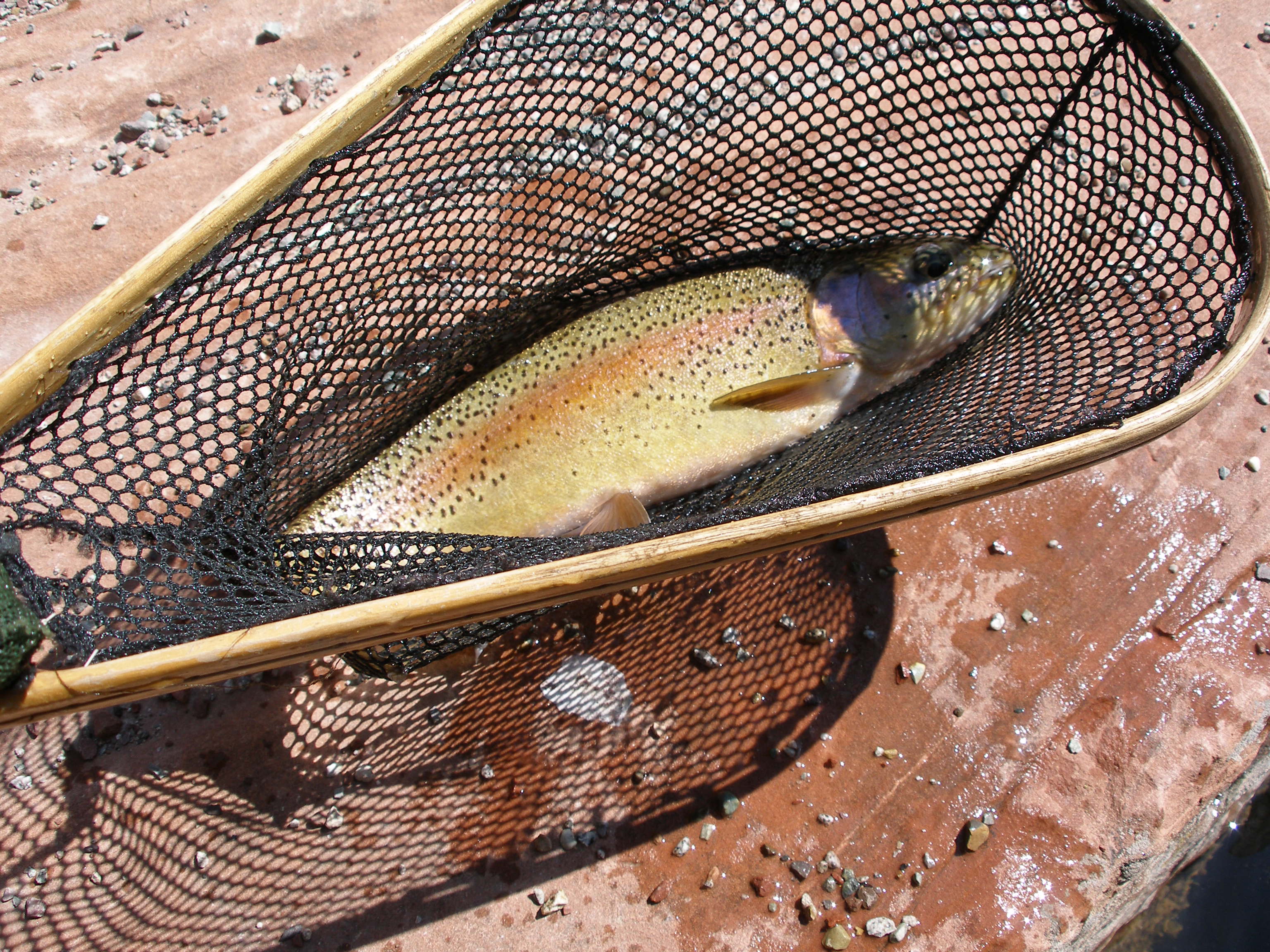
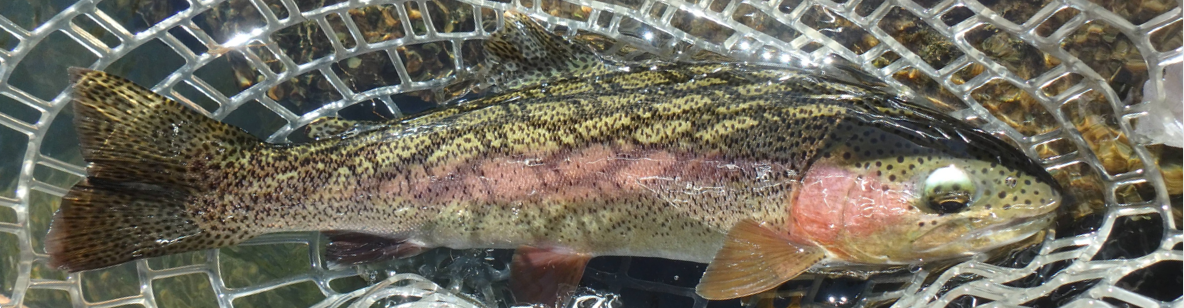
We camped at Little Maude after arriving late Friday night and snagging one of the last camp sites available. Jane dropped me off at the downstream border of the upper public water around 10AM. I began fishing a yellow Letort hopper with a beadhead hares ear. There was a nice long run feeding into a beautiful pool in the private water. I saw several fish flash to the hopper, but none made the mistake of eating my imitation. Toward the top of the run, I hooked and landed a beautiful rainbow (see photo) on a beadhead pheasant tail, that replaced the original hares ear.

Frying Pan Rainbow

Frying Pan Rainbow

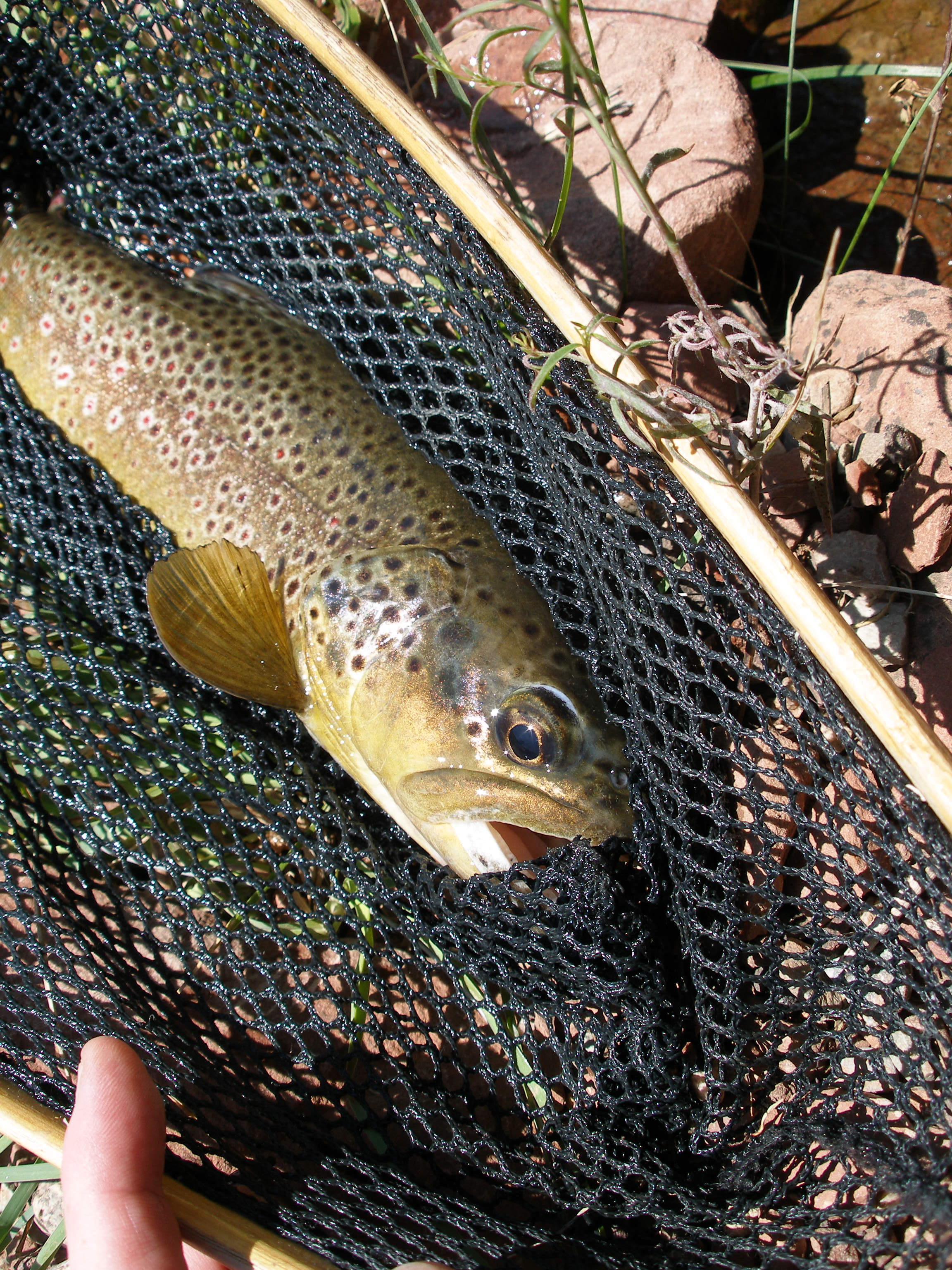
I continued working upstream and caught three small browns. When I approached the area with the log forming a dam, where Jeff and Martin and I began previously, four fishermen appeared above me. I worked the slack water next to the large rock along the bank below the log and picked up a nice brown (Frying Pan Brown photo).

Frying Pan Brown

Frying Pan Brown

I broke for lunch, and Jane picked me up and took me back to the camp site. After lunch she dropped me off at the spring in the next stretch of public water downstream. I walked down the road a bit and began fishing pocket water. The Pan was clear and flowing at nice levels. I tied on a Madam X with grey body and then attached a beadhead hares ear. There were some nice pockets, and I had some looks, but no hook ups. I spotted some large mayflies emerging and a couple rises, so I put on three types of green drakes, but no success ensued. Then I thought perhaps PMD’s were emerging, so I tried one of them. Again no success. I fished from 1-3 with no luck, but I knew there were fish, so I switched over to nymphing with a beadhead pheasant tail and a beadhead hares ear combination. It was magical, and I caught five trout in the next hour, mostly on the BHHE.

I exited the stream and walked back to the spring to meet Jane, but when I arrived at the pick up point early, Jane was not present, so I crossed the road and found a nice deep run near the road. I cast the nymphs and quickly picked up two browns. At 4PM I stopped and waited for Jane.

Fish Landed: 12