Category Archives: Colorado River

Colorado River – 10/15/2015

Time: 11:30AM – 3:30PM

Location: Upstream from the Pumphouse access area

Fish Landed: 2

Colorado River 10/15/2015 Photo Album

I fished the Colorado River at the Pumphouse access area twice in October a year ago. In both cases, I fished for only two or three hours, and this is roughly half the time I normally devote to a river or stream that is not within an hour of Denver. On my second trip Jane and I hiked the Gore Canyon Trail, and this provided a great overview of the vast amount of water available at this public area along the middle reaches of the Colorado River. I was itching to make another trip with the intent of hiking farther east along the trail to sample water that I never had time to explore in 2014.

I selected Thursday October 15 to be that day. The weather forecast projected clear dry weather in the Pumphouse area with a high temperature in the low 70’s. Balmy summer-like temperatures continued into the middle of October, and I did not intend to waste my good fortune. Jane agreed to accompany me, so we loaded the car and departed by 8AM. This enabled us to arrive at the Pumphouse parking area by 10:45, and I prepared to fish by rigging my Sage One five weight. The air temperature was in the low fifties, so I pulled on my fleece sweater and wore it for my entire time on the water, although I must admit that I was quite warm during the middle of the afternoon. Some thin clouds provided cover for the first couple hours, and this combined with intermittent wind made me appreciate the extra layer.

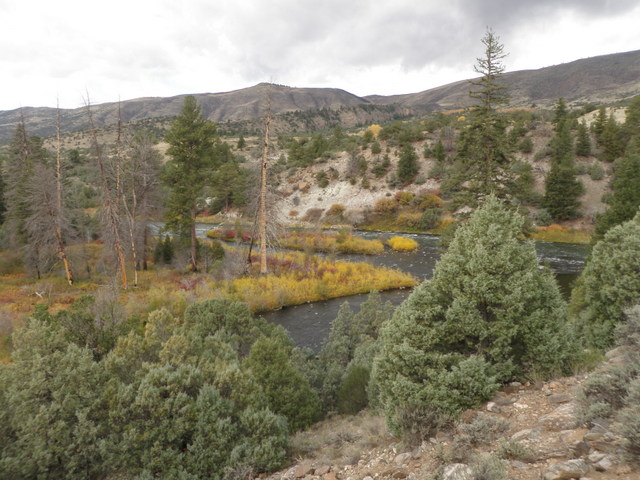
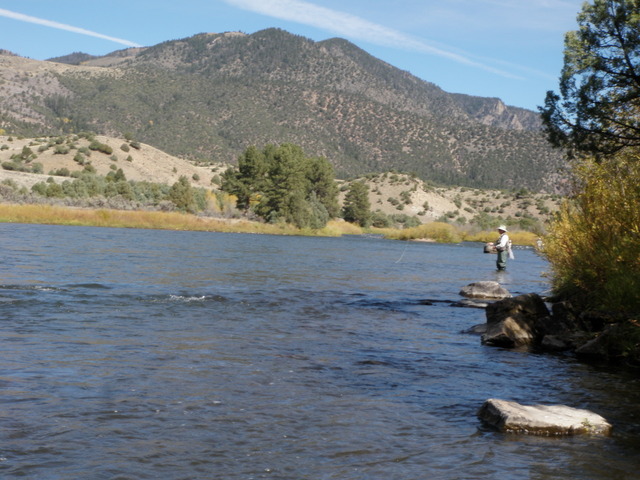
The Merger of Two Channels Below an Island Is Just Beyond the Fisherman

Jane and I entered the Gore Canyon Trail and hiked for .5 mile until we reached a spot where the river merged after splitting around a long island. Jane spread out her blanket here and designated the area as her base camp. She told me to move ahead, and she planned to hike out the fisherman path along the river and meet me after she got established. Unfortunately I hiked farther than we expected, and we never rendezvoused until I returned to the parking lot at the end of the day.

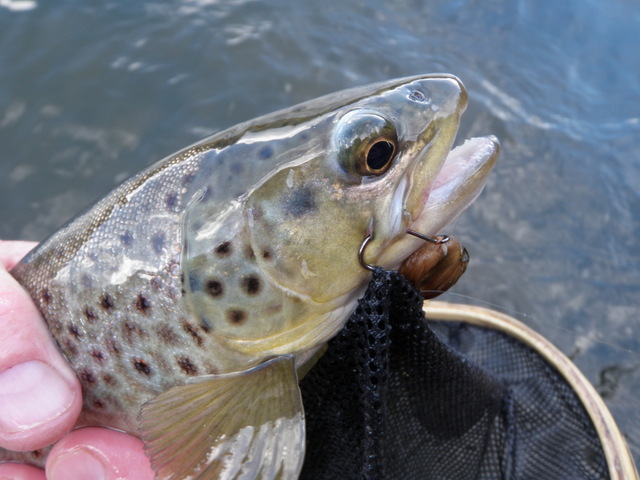
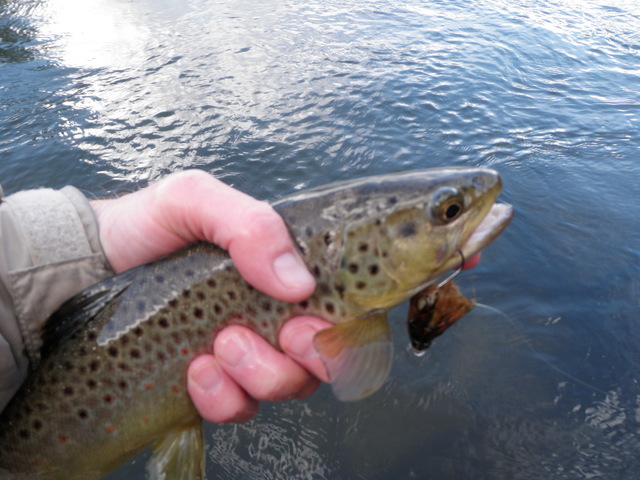
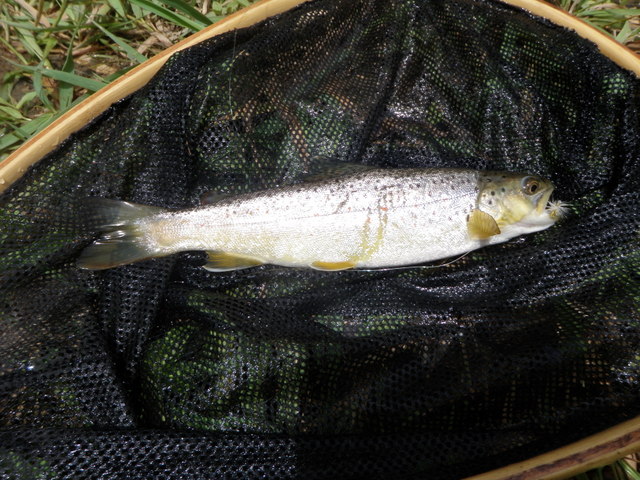
I was not sure where I would fish, but I started on the trail and hiked until I passed the island. The next section of the river was a wide deep pool, and I was intimidated by such a large featureless body of water, so I continued until I arrived at the first fast segment. Here I configured my tapered leader with a Thingamabobber, split shot, iron sally nymph, and salvation nymph. These flies did not deliver results despite some very attractive deep runs and pockets, so I switched out the salvation for an ultra zug bug. Finally after thirty minutes of fishing, an eleven inch brown snagged the ultra zug bug as I began to lift in a narrow slot along the bank.

Best Catch of the Day

I continued to fish in this manner from 11:30 until 3:00, and the only reward for my efforts was a small brown trout. I changed the ultra zug bug for a beadhead soft hackle emerger after an hour, as I hoped that blue winged olives might be in the drift despite the clear sunny day. I also removed the iron sally and replaced it with a pine squirrel leech part way through my time on the river. I covered a half mile of the river including some gorgeous deep runs, pools and pockets, but I was frustrated in my efforts to catch fish.

By 2:45 I reached a place where a very large rock formed a barrier to my progress. Rather than attempt to scale the steep obstacle to proceed, I decided to turn around. I used this as an opportunity to swap reels, and I switched to my sinking tip line and then knotted a sparkle minnow to the end. For the next forty-five minutes I threw the streamer in all the likely places and aggressively manipulated the minnow imitation in all directions and at various retrieval speeds. The flashy fly looked great as it darted and twitched, but I could not even generate a follow.

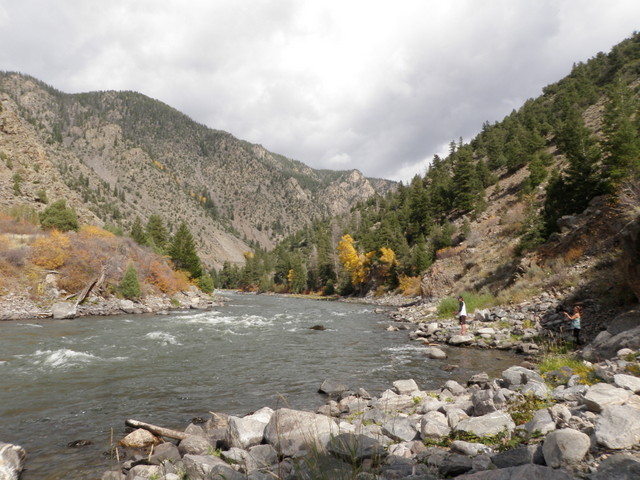
A Big River

Eventually I worked my way to the large pool above the island, and at this point I found the path and returned to the confluence area. Jane had already returned to the car, but I paused to strip the sparkle minnow through the delicious pool and eddy just below the confluence of the two channels. I saw and felt nothing, so I began to question whether the sparkle minnow was the correct choice for autumn brown trout. I removed the flashy fly and replaced it with a peanut envy. I tied a batch of these over the winter, but I have yet to connect on a fish with my recent handiwork. The articulated olive streamer looked great in the water, as it exhibited pulsing movement, but the fish did not seem to agree. By 3:10 I gave up on the deep eddy and headed back to the parking lot. I stopped at a couple attractive spots along the path and made five or six casts, but again my efforts to catch a Colorado River trout on a streamer were thwarted.

The scenery was gorgeous, and the weather was more like summer, but the fishing proved to be quite challenging on the Pumphouse section of the Colorado River on October 15. If I return to this location, I will try to time my visit to a different month when more insect activity might spur the trout to become visible feeders. Prospecting such a huge body of water is a daunting proposition, and I learned that it can be unproductive as well.

Colorado River – 10/11/2014

Time: 2:15PM – 4:15PM

Location: Pumphouse access

Fish Landed: 1

Colorado River 10/11/2014 Photo Album

After visiting the Pumphouse access area of the Colorado River with my friend Steve on Tuesday October 7, I was very curious about the water upstream from the boat launches. Steve and I fished up the river perhaps .3 mile, but we stopped at some gorgeous water below a large island, and the Gore Canyon Trail continued. I really wanted to explore the river in the canyon as far as one could reasonably access it.

The weather on the weekend was forecast to continue its glorious trend, and Jane was interested in undertaking a hike somewhere in the mountains, so I suggested the Gore Canyon Trail. It was a two hour drive to Pumphouse, but I convinced her it was a very scenic area that she had never visited. I also searched Gore Canyon Trail on Google and discovered that the length was 1.5 miles one way, but one could continue another mile if not averse to scrambling over boulders.

Looking Back at the Tip of a Large Island

Looking Back at the Tip of a Large Island

Saturday did indeed develop into a very nice day weather wise with high temperatures in the upper sixties before some clouds rolled in during the late afternoon resulting in some brief showers and a cool wind. Jane and I began hiking the Gore Canyon Trail at approximately 11AM, and we covered the entire trail by noon. After the island above the attractive water featuring various merging currents, one trail split off and followed the river while the official Gore Canyon Trail ascended the steep slope of the canyon and then traversed high above the water. After approximately a mile, the trail gradually descended and ended in a boulder field right next to the river.

Jane and I found some large rocks in the sun and ate our lunches, but we were not alone, as two groups of fishermen arrived shortly after we began to eat. Apparently the additional mile into the canyon meant scrambling over the large rocks next to the river, and I assume that eventually a fisherman or hiker would encounter a place where the steep canyon walls prevented additional progress toward the east. The end of the trail was not marked at all, and Jane and I speculated that we missed a turn that would have kept us high above the river. On our return hike we searched carefully for such a turn off but never found one, thus we concluded that we hiked to the end of the trail.

Fishermen at the End of the Trail

Fishermen at the End of the Trail

As we hiked out and back on the trail, we counted at least twenty other fishermen between Pumphouse and the end point, but the Colorado River is such a large body of moving water that plenty of space remained. Naturally before we left Denver I asked Jane’s permission for two hours of fishing time, so when we returned to the parking lot I prepared to fish. I elected my Scott six weight rod, as it is perfect for the large deep flows of the Colorado River. I made sure to stuff my spool of sinking tip line in my fishing backpack, and then Jane and I once again hiked east on the trail.

I was hoping to start at the water below the large island, but when we arrived another fisherman was already enjoying the juicy deep runs and eddies. Jane set up her folding chair on the gravel beach, and I crossed the south braid next to the island and began fishing the north channel where it bordered the northern edge of the island. My first flies were a gray pool toy, beadhead hares ear, and an ultra zug bug. This threesome is developing into my standard starting combination of flies. The first nice pool behind some large boulders was quite attractive so I spent fifteen minutes there, but had no success.

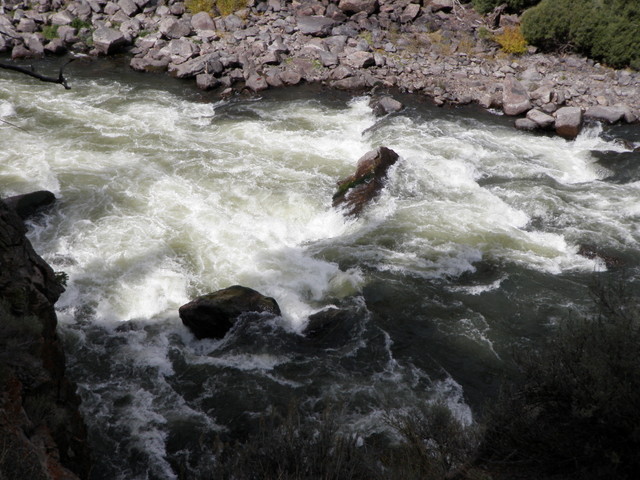
A Very Dangerous Rapid

A Very Dangerous Rapid

After abandoning the starting pool, I continued around a bend and fished along the north side of the island. I had the water to myself, but I moved rather quickly as the runs and pockets in this stretch were quite marginal. The river on the north side was essentially a wide fast riffle, so I crossed the island and forded the south braid and returned to Jane. The fisherman occupying my favored destination remained, so I continued downstream below him. The river made a large bend below the island and then as the main current angled back toward the middle of the river, it formed a nice twenty-five foot wide pool that continued for a length of around seventy feet.

I fished this pool thoroughly with my three flies, but again I saw no sign of fish. Once again I reeled up the flies and climbed the bank until I found the Gore Canyon Trail, and then I walked farther downstream to the area where I caught two fish and observed numerous rises on Tuesday. I carefully observed the water in this area for rising fish, but seeing none, I once again prospected likely places with the three fly combination. After ten minutes of fruitless casting, the sky clouded up and the wind picked up, and I noticed a few sporadic rings on the surface.

I moved up a bit until I could execute a backhand roll cast, and on the third drift the hopper paused, and I hooked a small brown. The bend in my rod was short lived as the fish quickly broke free, and I was disappointed to miss my opportunity to prevent a skunking. Now the sky grew darker and the frequency of rising trout increased, so I moved up the river a bit to gain a better position closer to the visible fish. Once I was settled in my new position I swapped the ultra zug bug for a soft hackle emerger with the hope that the fish were seeing a lot of subsurface BWO nymphs and emergers.

The two fish that were rising in the smooth water above where I had the first hook up showed no interest in my offerings, and then I hooked a branch on a backhand cast, and this forced me to disturb the water to rescue my flies. Once again I gazed upstream and spotted a few rises in a faster current below a protruding rock that was positioned farther out and away from the bank. I decided to study the water for a bit in hopes of confirming that blue winged olives were the insects that enticed the trout to the surface. Initially I could not find any evidence of a hatch, but then I glanced at a smooth spot next to the eddy downstream and a bit to the side of the rock. Finally I saw a flotilla of tiny mayflies with upright wings silhouetted against the sun glare on the smooth water.

This discovery caused me to consider converting to a CDC olive, but between the swirly water and the sun glare, I knew I would never be able to see my fly, so I cast the trio of flies to the run and along the seam between the fast and slack water. The combination of adverse lighting factors was so difficult that I could not even see the pool toy and its bright neon pink indicator tuft. My answer to this frustrating circumstance was to remove the pool toy and replace it with a chubby Chernobyl, and the bulky white poly wing of this fly did in fact improve my ability to follow.

Unfortunately shuffling the top fly was all for naught, as the fish ignored the emerger and the hares ear, and after ten minutes the rising fish ceased their feeding. The sky brightened at this point and the quantity of tiny mayflies in the glare spot dwindled. Once again I looked upstream to an extended stretch of smooth water and again I observed a couple rises. Insanity is continuing to do the same thing and expect different results, so I must be insane because I repeated the whole process once again. I waded to a new position below the pair of rises, and I lobbed the three flies above the location of the fish. Again the fish ignored my flies and stopped rising.

By now the hatch ended, but the sky remained gray and the air temperature began to plummet. I was frustrated with my futile attempts to match the hatch with an emerger, and I planned to experiment with streamer fishing, so I decided now was the time. I sat on a rock and removed my spool of floating line and replaced it with a sinking tip line. I rummaged through my fleece patch and ripped out a large ugly sulpzilla with a silver conehead and knotted this to the end of my short stout leader. I began chucking the heavy weighted fly toward a current seam fifteen feet across from my position, and then I stripped, jigged and swerved it back to my feet.

The Only Fish of the Day

The Only Fish of the Day

I repeated these steps as I worked my way up toward a protruding rock and varied my retrieve motions and speed. Just when I was ready to denounce streamer fishing as a waste of time, and as I was midway between where I began and the exposed rock, my rod began to throb. I quickly set the hook and felt the weight of a fish! My first thought was that I foul hooked a fish with my huge streamer. I used the flex of my Scott six weight to apply side pressure and guided a twelve inch brown trout into my net. When I got a closer look, I rejoiced to see that the articulated streamer hook was clearly in the mouth of my little meat eater.

Meat Eater

Meat Eater

I took a few photos to prove to myself that I actually caught a fish on a streamer and avoided a Saturday skunking, and then I resumed fishing with renewed enthusiasm. Of course, streamer success comes in small doses, and on my second cast I snagged a solid immovable object. I waded upstream in an effort to pull in a different direction to save my sculpzilla, but despite the heavy leader I left the ugly olive streamer on the river bottom. It was now approaching 4PM, and Jane had passed by me on her return to the parking lot thirty minutes prior. My allotted fishing time was near an end, and it was quite chilly, so I reeled in my line and called it quits. I really wanted to see if I could repeat the streamer success, but other factors trumped this desire.

Colorado River – 10/07/2014

Time: 11:00AM – 4:00PM

Location: Pumphouse recreation area and upstream

Fish Landed: 4

Colorado River 10/07/2014 Photo Album

Discovering new water is always fun, and it was such a proposal that my friend Steve sent me in the form of an email a week prior to Tuesday October 7. Steve and his wife Judy own a condo in Steamboat Springs, and Steve inquired if I would be interested in accompanying him on a three day fishing trip. He proposed using his place in Steamboat as a home base, and we would fish surrounding rivers and streams. It did not take long for me to accept this enticing invitation. I responded positively, but then began experiencing the signs of a head cold on Thursday as mentioned in my last blog post. I was undeterred, however, and by Tuesday the cold was on the downside, and on a positive note, the weather continued to be unseasonably warm and dry.

Steve arrived at my house at 8:30 on Tuesday morning, and we were on our way to the Colorado River at the Pumphouse access. I never fished this middle section of the Colorado River, but I read quite a few glowing reports on the quality of the fishing. Steve researched the location and the directions ahead of time, so I was in good hands as we drove west on interstate 70 to Silverthorne where we exited and continued north on route 9. After passing Green Mountain Reservoir we continued another six miles until we turned on to a packed dirt road with a sign indicating 10.5 miles to Pumphouse. The dirt road stretch was simply gorgeous as we traveled through a wide valley with sagebrush that blended into aspen trees and then evergreens on the surrounding hills.

After seven miles we made a large curve to the right and descended to the rim of Gore Canyon. Another three miles, and we found ourselves turning right to the BLM Pumphouse access area which contained three boat launches, parking lots and a campground. We quickly climbed into our waders and assembled our rods, and began our quest for fish. There were two groups of three or four fishermen, and they appeared to have guides, and the groups were fishing right next to the boat ramps. Steve and I knew nothing about the hierarchy of prime locations since we were new to Pumphouse, so we began fishing in a nice pool between the two boat ramps.

I chose my Scott six weight for the Grand River and began by rigging it with a strike indicator, weighted 20 incher, and beadhead hares ear and entered the water just above Launch #3. Steve waded into the edge of the river twenty yards above me and also began with two nymphs including a beadhead pheasant tail and a RS2. As we began prospecting the deep slowly flowing water, we noticed some sporadic rises in the middle of the river beyond casting range. After 15 to 20 minutes, Steve shouted that he had one and quickly landed the first fish of the day, a feisty brown trout. As he released his catch, he informed me that the pheasant tail was favored by the hungry trout, so I stripped in my line and replaced the hares ear with a salvation nymph.

Steve Drifts Nymphs at Pumphouse

Steve Drifts Nymphs at Pumphouse

The air temperature was fifty degrees when we began, but with the bright sunshine overhead, the temperature quickly escalated to the upper 60’s. The only blemish on the spectacular October weather was occasional windy periods during the afternoon. I wore my raincoat as a windbreaker for the entire day, and I never felt uncomfortably warm. After converting to the salvation nymph I hooked a fish at the end of my drift as I began to lift to make another cast, but the curious fish quickly performed an escape maneuver and thwarted my efforts to land it. Steve meanwhile landed a second brown trout in the first hour at which time we both felt hungry and returned to the car where we consumed our lunches.

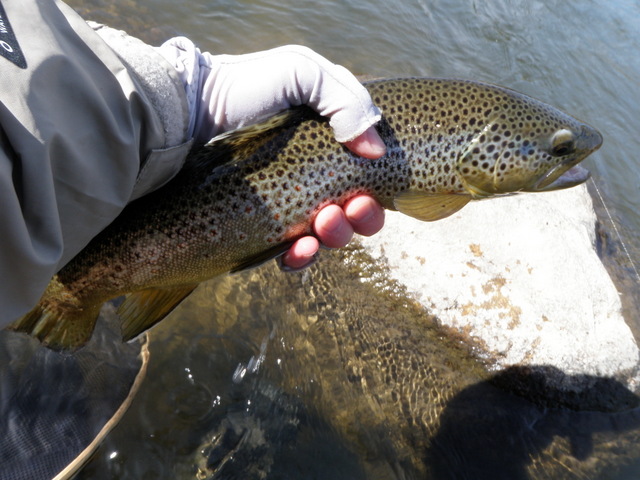
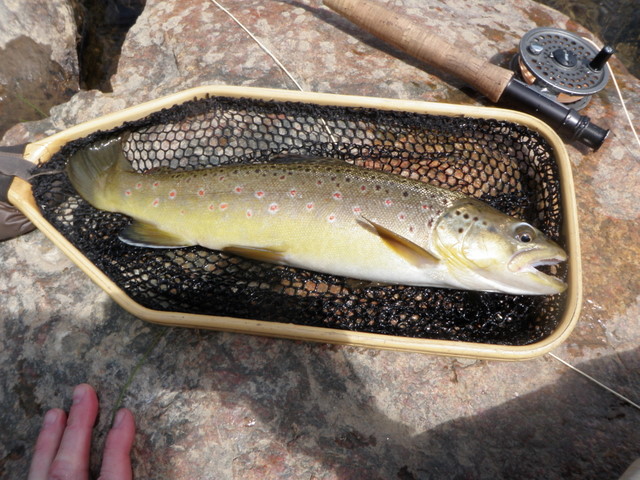
After lunch we hiked up Gore Canyon a short distance to get above a group of fishermen who were stationed around an island just above the boat ramp that was across from the camping area. During the 1-2PM time period a fairly dense hatch of very small size 22 blue winged olives erupted. During the first half of the hatch no fish were rising, so I moved the salvation nymph to the upper fly and then added a soft hackle emerger as the bottom offering. I found a flat pointy rock that jutted into the river three or four feet and used it as a casting platform for up and across drifts of the nymphs. After quite a few passes through the deep pool, a fish bumped my fly and I set the hook. A strong battle ensued, but I finally netted a gorgeous sixteen inch brown trout with dark spots and a deep olive coloration, and the soft hackle emerger was tucked in the corner of its mouth. A photograph was in order, and then I set the muscular fighter free to fight another day.

Fine Brown Settled Down

Fine Brown Settled Down

Next I continued fishing upstream in the deep pool, but my flies got wedged between some rocks, and the water was too deep to wade so I broke off the soft hackle emerger. Although the soft hackle had delivered a fine first fish, it required numerous casts in a time when a heavy hatch was evident in the air and on the water. I selected a RS2 and used it as my new point fly. I moved up along the bank a bit farther to a spot where the river gained a bit of velocity as it flowed over a submerged boulder, and in the V behind the rock I hooked and landed a thirteen inch brown on the RS2. I was encouraged by this sudden success on the previously unexplored water of the Colorado River at Pumphouse.

After releasing fish number two, I gazed upstream and spotted some fish rising in a steady rhythm in the next pool. I had recent success with the nymphs, and I was reluctant to remove the split shots, indicator and two flies but after observing for a few minutes, I could not resist the allure of fishing dry flies to steady risers. As quickly as possible I removed all the nymphing paraphernalia, and tied on the smallest CDC BWO that I could find in my foam patch. Of course by the time I was finally ready to cast, the fish stopped rising. Despite this setback I managed five or six futile backhand casts and actually generated a refusal from a brown trout in the vicinity.

Once again I gazed upstream to another nice deep run off to the side of a strong deep current, and again I noticed a flurry of rises from three or four fish along the current seam. The lighting at this spot was very poor with shadows extending over the water from tall trees on the bank and sun glare interspersed with the shadows. In addition I had virtually no room for a back cast. By the time I got in position to make a cast and dried the wet CDC wing, the fish once again ceased rising. Once again I did generate a refusal and actually nicked the fish on the hook set, but the dry fly fishing was proving to be quite a challenge.

I was having great difficulty seeing the tiny olive in the glare and shadows and riffles, and the fish ended their surface feast. A nice stretch of riffles over moderate depth was just ahead, so I decided to return to a dry/dropper approach before opting for nymphing. I tied on a Chernobyl ant, beadhead hares ear, and soft hackle emerger and waded upstream to the tail of a huge long pool. Once again the tease began, and I saw a few regularly rising fish. I was committed to the dry/dropper now, so I executed a backhand roll cast of the three flies above the closest rise, and on the third drift the Chernobyl paused, and I set the hook and landed a twelve inch brown on the hares ear.

Shortly after releasing this fish, I roll cast farther upstream and more toward the left, and this resulted in a second twelve inch brown once again on the hares ear. Perhaps I had solved the puzzle. One more fish continued to rise farther above the spot of the last catch, but I tangled my line around the rod and by the time I resumed, the rising ended. I now found myself prospecting in big water with no rises or signs of fish to give their position away, and this proved fruitless.

Steve walked back downstream to meet me, and we decided to quit at 3:15PM, but before doing so, we both agreed to hike up the trail to check out a place where the river appeared to merge after splitting around a large island. We were scouting for future reference. When we arrived at the merge point, there was a large foam pool bordered by multiple eddies, and it was one of the fishiest places I had ever seen. I could not resist the urge to make some casts, and Steve encouraged me to give it a try. I began casting to the top of a riffle where the current from the small south channel ran into the larger main river. After five or six casts I allowed the Chernobyl to drift deep into the nook of the merging currents right next to the foam, and I thought the Chernobyl disappeared. I raised the rod tip to bring the foam fly into view, and suddenly I felt weight. I accelerated the lift into a hook set, but after the momentary weight, the fish was gone. Judging from the type of water I was in, this may have been the best fish of the day, but I’ll never know.

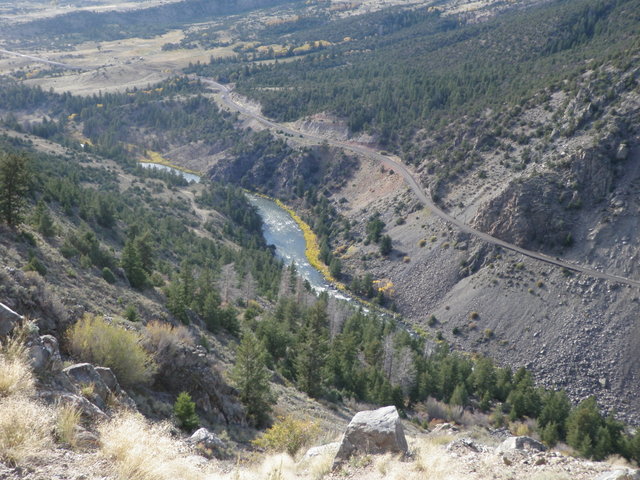
Colorado River at West End of Gore Canyon

Colorado River at West End of Gore Canyon

With that disappointment we hiked back on the Gore Canyon Trail to the parking lot and returned our gear to the back of Steve’s car. Next we were on our way to Steamboat Springs, but we both saw enough of the Colorado River at Pumphouse to commit to a future trip.


Colorado River – 06/30/2014

Time: 9:00AM – 7:00PM

Location: Lone Buck access at Hot Sulfur Springs State Wildlife Area

Fish Landed: 7

Colorado River 06/30/2014 Photo Album

David Luther called early during the week of June 23 to remind me that he and his family would be in Winter Park from June 28 – July 2, and he invited Jane and I to join them for a few days. He was particularly interested in collaborating on some fishing. Fortunately Jane and I planned to return from our camping trip to the Frying Pan River on Saturday, so a trip to Winter Park fit in our plans. I called David back and asked if we could drive to their condo on Sunday and do some activities and then make Monday a fishing day. David approved of the plan and sent us directions to the condo.

On Sunday morning Jane and I packed our suitcases, bicycles, and fishing gear; and we departed for the Indian Peaks Resort. The Luther’s vacation condo was actually near Fraser, CO, but the town of Winter Park was only four miles away. It was a gorgeous day in the mountains and actually on the cool side. Since it was not a fishing day for David, his wife Becky was in charge of choosing an activity. Jane and I suggested a bike ride from Fraser to Winter Park and back, and Becky quickly embraced this idea. We jumped in our cars and drove to a bicycle rental shop on the southern edge of Fraser, and the Luthers rented cruisers and helmets.

We were right next to the trail, so once their seats were adjusted, we began our leisurely ride to Winter Park. It turned out to be a fun afternoon as we stopped at a restaurant in Winter Park for lunch and then continued on to Winter Park ski area where we rode the Zephyr lift to the top of the mountain. Here we found a snow bank and posed for photos and watched some crazy mountain bikers cruise down upper Hughes at a high rate of speed. Apparently youth knows no fear.

For our return trip David and his daughter Sarah and I biked on the Fraser River Trail, and it twisted and turned around several lakes and along the Fraser River. David L. and I were both scouting the stream as a possibility for Monday’s fishing expedition. It was high but clear with numerous slack water areas that appeared to be fishable despite the runoff level. When we returned the bikes, we spoke to the gentleman manning the fly shop and asked for his suggestion on where to fish the next day. He was hesitant to suggest a spot, but he did mention the upper Colorado River at the downstream end of Byers Canyon as a solid choice. When we returned to the condo, David L. and I researched stream flows on the various options and also reviewed several fly shop reports. We concluded that the upper Colorado was probably our best bet from a stream flow perspective, so that became our destination.

We woke up fairly early on Monday, and Jane departed quickly so she could make a 9:30 tennis match. David L. and I ate a light breakfast and then prepared lunches for our day on the river. I drove the Santa Fe so Becky and Sarah could use the rental car, and we reached Hot Sulphur Springs and the bottom of Byers Canyon by 8:30. We stopped and looked into the canyon, but we decided to move on as the steep canyon walls would probably shade the water until noon, and we wanted more warmth and daylight. A short distance beyond the bridge over Byers Canyon we found a turn off to Lone Buck access, and we descended a steep rough dirt road to the river and then made a left turn and drove to a small turnaround.

David Luther Almost Ready to Fish on Monday Morning

David Luther Almost Ready to Fish on Monday Morning

I straddled a fire pit for my parking space in order to get off the turnaround, and then David L. and I prepared to fish. Almost instantly mosquitoes began to swarm around David L.’s head so we both doused ourselves in sunscreen and insect repellent. Once we were geared up, we hiked on the dirt road and then cut down to an irrigation canal that paralleled the river. A path along the canal provided us additional downstream access, but eventually after a 20 minute hike we encountered a fence and a no fishing sign, and this is where we began our fishing day.
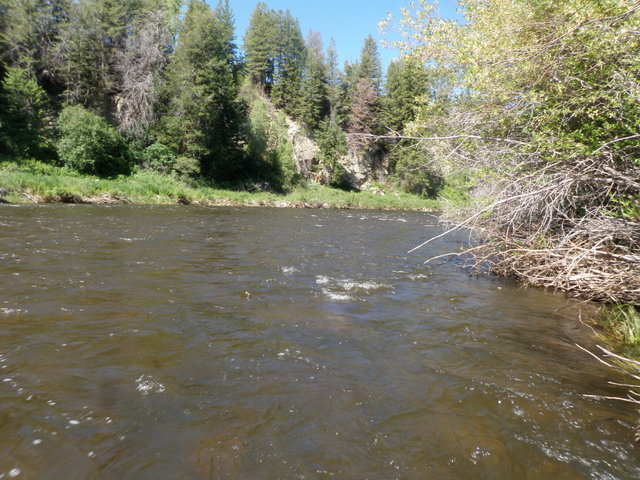
The Colorado River Was High and Slightly Stained

The Colorado River Was High and Slightly Stained

David L. committed to streamers and added a weighted head to his line to improve the sink rate. In contrast, I elected to fish with a Chernobyl ant and a beadhead hares ear nymph and began to move upstream along the bank seeking slack areas where fish could escape the high and slightly stained water. The flows were actually around 750 cfs, and for a large stream bed like the Colorado that is not extreme, but the water was moving at a fairly rapid pace in the middle of the channel. The Chernobyl and hares ear did not produce as I covered a fair amount of water and began to despair that there were no fish in this wide stretch of river. I read several articles that said the Colorado above the confluence of the Williams Fork was suffering due to withdrawals for the Front Range and the warming impact of the shallow Windy Gap Lake.
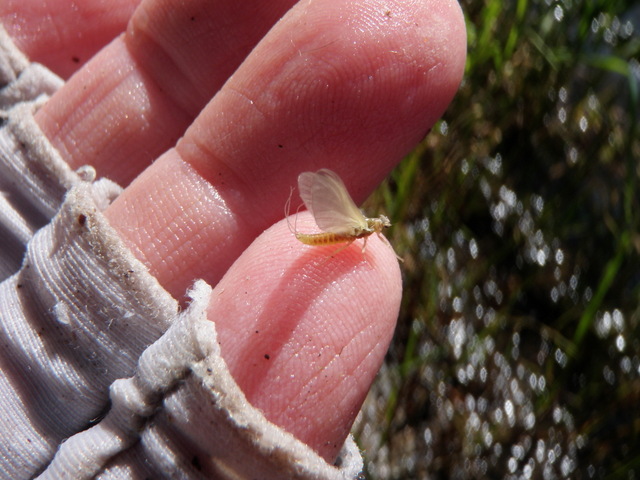
A Pale Morning Dun

A Pale Morning Dun

By eleven o’clock I began to notice a few mayflies emerging along the edge of the river and after ten minutes or so the intensity of the hatch increased. In fact between 11 and 12:30 I fished through an intense pale morning dun hatch. There were emergers and cripples and duns all over the surface, but the fish didn’t seem to be interested. Initially I tried adding a pheasant tail nymph as a dropper, but it had no impact. When greater numbers of duns appeared on the surface, I converted to a single light gray comparadun; the fly that has served me well on the Colorado River during PMD hatches later in the summer. I spotted two or three surface rises, but that was the extent of surface interest despite an intense hatch that lasted 1.5 hours. Toward the end of the hatch I spotted a cinnamon colored parachute dun in my front pack that I’d purchased for the PMD hatch on the Frying Pan River, so I clipped off the ineffective comparadun and replaced it with the purchased fly.
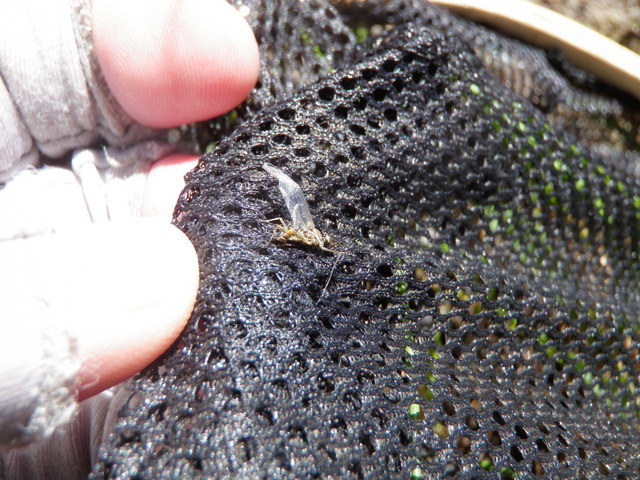
Never Emerged

Never Emerged


Much to my surprise as I drifted the fly to my right in some slightly faster water, a fish rose and sucked it in. I played the fish for a brief period and then my line went limp, and when I reeled it up, I discovered that the fly was gone as apparently I’d tied a poor knot.

When the pale morning dun hatch ended, I tied on a yellow Letort hopper as I hoped it might imitate a golden stonefly, as I spotted these large insects during visits in previous years. I also exchanged the hares ear nymph for an iron sally since one report suggested that yellow sallies were beginning to appear. Finally after an hour or two of fishing, a small brown snatched the iron sally, and I had my first fish of the day. Shortly after this bit of action, I added a salvation nymph as my third fly, and this produced a chunky eleven inch rainbow.

Unfortunately these two fish would be my only catches during three and a half hours of intense morning fishing. Finally David L. appeared with a big grin on his face, and we decided to walk back to the car for our lunches. David L. informed me that he had a great morning and landed at least six fish including quite a few in the fifteen inch range. He showed me his streamer, and it was an ugly olive concoction with a wide pearl chenille body.

After lunch I decided to jump on the streamer bandwagon, so I stashed my four weight Sage in the Santa Fe and got out my Loomis five weight. I swapped my floating line for a sinking tip line and extended the short 0X leader with some additional 2X. David L. looked at my streamer box and pointed to a sculpzilla that I purchased for my Argentina trip, so I tied the big olive weighted monstrosity to my short heavy leader. I was now prepared to go deep and ugly.

David L. negotiated a crossing of the wide river so he could reach a deep drop off near the opposite bank. His ability to cross was proof that the river had recently descended to manageable levels for fishing. I meanwhile circled back to the area I’d fished in the morning with my ineffective dry/dropper combination. I now concluded that I was not getting deep enough, and the water remained too high and cold for fish to be looking for food on the surface.

I began working the sculpzilla in a variety of techniques including tossing upstream and allowing to dead drift, throwing three quarters upstream and allowing it to swing, and stripping as the streamer reached the end of its drift. I even executed a dangle and simply allowed the streamer to hang and pulse downstream. It wasn’t long before I felt a tug shortly after I dropped the big ugly in some frothy water behind an exposed boulder, and I set the hook and battled a nice hard fighting fish. The fish charged downstream and circled back up toward the hooking point, and then streaked downstream a second time. Once I stopped the run, the fish made a sharp stop and turn and the fly line fell limp. How could a trout escape such a large hook? I can’t answer my own question, but the fish did in fact fight for and achieve its freedom.

I continued working the streamer with renewed focus and felt another tap on the swing, and then also experienced multiple taps on the dangle. I lost confidence in the sculpzilla so I switched to a large dragonfly nymph. This had a wide body like the Luther streamer, but did not contain any flash. The dragonfly nymph was a bust so I next tied on a big black woolly bugger with a beadhead and flashabou strands in the tail. Again I found myself simply exercising my arm. I was observing a fair number of caddis on the shrubs along the river, and each time I pushed aside a branch so I could move upstream, several would flit over the river.

Black Woolly Bugger Spent Some Time on the Line

Black Woolly Bugger Spent Some Time on the Line

Perhaps the Nicest Fish of the Day

Perhaps the Nicest Fish of the Day


I decided to tie some tippet to the bend of the woolly bugger and add a second fly; an emerald caddis pupa. I’m guessing this was an unconventional approach, but it was a combination of streamer fishing and wet fly swinging. Much to my surprise this method yielded two decent brown trout and in both cases I cast to the very top of a long run, and the fish nabbed the caddis pupa as it began to drag downstream with the current.
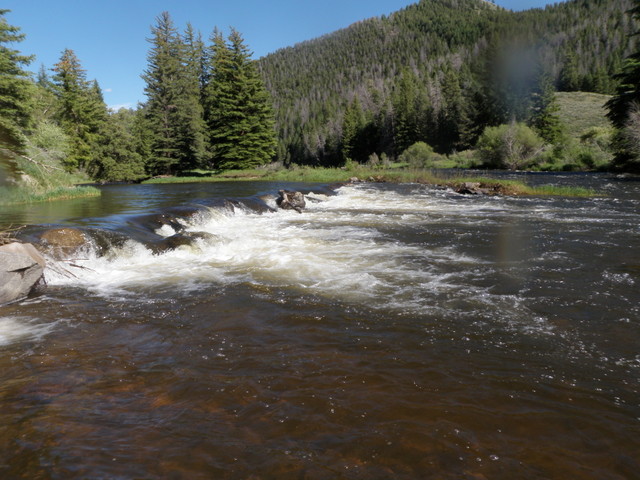
A Small Cascade

A Small Cascade

I stuck with the bugger and caddis combination for much of the remainder of the afternoon until I reached a three foot waterfall just below a small midstream island. It was now late afternoon and the sky clouded up a bit and I didn’t feel like continuing further so I retreated to the car. I’d moved through some very attractive water next to the bank so I decided to revert back to my dry/dropper approach for the remainder of the evening. I secured my Loomis five weight back in the case, and extracted the Sage that remained in the back of the Santa Fe. At least I would not need to take time to rebuild my rod and line.
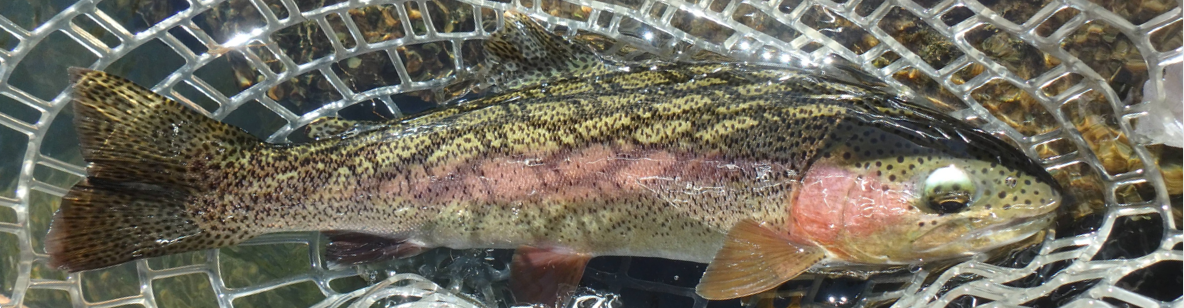
Another Nice Colorado River Brown Trout

Another Nice Colorado River Brown Trout

For the next several hours I worked my way back upstream from the Santa Fe to beyond the waterfall with the Chernobyl ant and salvation nymph. I covered quite a bit of water, but I did have enough success to keep things interesting. Three nice browns were landed with each in the chunky 12-13 inch range. In addition I foul hooked two fish and had another nice fish that shed my fly.

By 7PM I’d gone 50 yards above the waterfalls, and the water above me did not appear to be very appealing so I began hiking back down to the car. Along the way I spotted David L. on the opposite bank working a girdle bug through likely holding spots. I motioned that I was returning to the car, and he signaled that he would cross and return as well.

It was a long day of fishing and I only landed seven fish in ten hours, but I experimented with some streamers and had some fun with the dry/dropper combination late in the day. David L. proved to me that streamers can be quite effective, and I was pleased to discover that the Colorado River above the Williams Fork confluence does hold a fair number of decent fish.
Colorado River – 07/17/2013

Time: 9:30AM – 4:00PM

Location: Sunset lease, second access west of Parshall

Fish Landed: 5

Colorado River 07/17/2013 Photo Album

With Dave Lach, an employee of Air Products and a friend of my fishing buddy Jeff Shafer, spending the coming weekend fishing in Colorado, I decided to make a scouting expedition to the Colorado River to determine whether it was worthwhile for Dave L. to make the detour to Parshall to fish on Saturday on his way to the Frying Pan River.

The reports indicated that fishing was four stars with pale morning duns, yellow sallies, and caddis present. I’m somewhat skeptical of these reports since I’ve been burned by them, and the fly shops tend to overhype the conditions to attract customers and they are notoriously shabby in keeping the information current. I made one trip to the Colorado River in 2012, and it was very difficult fishing. In 2011 I visited this stretch of river three times with poor results. In the three years prior to 2011, however, I experienced some of the best fishing I’ve ever had in Colorado. So what would 2013 be, Jekyll or Hyde?

I had everything prepared Tuesday night so that I launched from my house by 6:40 and this enabled me to avoid the morning traffic rush and I was the first car in the parking lot at the Sunset access point by 9AM and I was in the water fishing by 9:30AM. Fortunately I doused myself in insect repellent prior to descending the sagebrush bank to the river where swarms of mosquitoes buzzed my ears with every step through the shrubs and grasses along the river.

I decided to head downstream first and walked as far as I could along the north bank and then crossed at the top of an island and began walking down the south side of the island. I spotted another fisherman in the north braid and then another fishermen fishing downstream at the bottom end of the island in the south channel so I tied on a Chernobyl ant and beadhead hares ear and quickly covered the center run at the top of the south braid with no success.

When I got to the top of the island I moved to the south bank where there is some nice smooth water in shadows with moderate depth. The north channel fisherman had now moved to the top of the island as well, and he opted to test the nice riffles along the north bank. Ultimately I had my eye on the beautiful long pool just above me, so I was concerned the other guy would usurp my target water. As I began prospecting the ten feet of water out from the bank, I spotted a few sporadic rises, and determined that the dry/dropper wasn’t what they were seeking so I began a game of trial and error with dry flies. I tried a light gray caddis and a light gray comparadun and a parachute ant. There were a bunch of spinners bobbing above the riffles to my left, so I dug in one of my boxes and found a rusty/tan sulfur spinner I’d tied for Pennsylvania and tested it for awhile as well. None of these offerings did the job and I moved up to a point where a gentle current angled toward the bank and then deflected parallell to it.

In this area I spotted two fish working, I think, although it may have been one cruiser doing a circular route. I believe, however, that a smaller fish was in the nervous water where the current angled and this fish made two or three splashy rises separated by quite a bit of time. The other fish was a large cruiser that was in the slow water just above the angled current and five feet out from the bank. I know this fish was larger because I could see the back fin and the tail out of the water, and the distance from nose to tail was substantial. Unfortunately I placed all the flies I mentioned including double dries over these fish and they would not respond so after an hour of fishing I moved on with nothing to show for my efforts.

I moved on to the previously mentioned long pool as the other fisherman retreated back to the north channel next to the island. The long pool is probably half a football field long and is characterized by a wide riffle at the head that angles toward the south bank and then the main current flows along the bank but there is nice water with decent depth twenty feet out for most of the length of the pool. I elected to wade to the riffle area at the top using the shallow barren north water, and then I decided to tie on a yellow Letort hopper and salvation nymph. The Chernobyl was difficult to see in the sun glare, and the large wing of the hopper was much more visible. I also hoped that the yellow fly might be mistaken for a golden stonefly.

All this was good in theory, but it didn’t pan out in my real life application. I fanned casts across the entire width of the riffle where it enters the long pool and deepens and then worked downstream shooting longer casts close to the bank. It was a lot of exercise with only a swirling refusal to the hopper in the eddy seam below an exposed rock to show for the effort. After this thorough coverage of the long pool area I decided to move on to the next juicy pool upstream. This required a hike along the south bank through swarms of mosquitoes, and when I arrived next to the pool I decided to eat my lunch early as it was approximately 11:15AM.

Looking Up the River

Looking Up the River

After lunch I retraced my steps to the tail of the pool and crossed to the north side and as I did this I spotted some rising fish at the left tail. Having seen the spinners bopping above the riffles, I decided to give the sulfur yellow-rust spinner another try. This turned out to be a prescient move as I landed a pair of thirteen inch browns that smacked the spinner. I was pretty excited to get on the scoreboard, and the fact that they took the spinner was icing on the cake. In additon I experienced a heart stopping swirl, a refusal, in the same area.

First Trout of the Day, 13" Brown

First Trout of the Day, 13″ Brown

I paused to seine the river with my net and found a solitary PMD dun so I replaced the spinner with a size 16 light yellow comparadun, and this created another slashing refusal and then I connected on a fish near the bank, but the weight on the rod was only momentary as the fish escaped. Just above the scene of these near misses I could see a nice fish working the deep trough next to the bank. I positioned myself and made quite a few casts above the fish by shooting line high and letting the fly flutter down into the slow current. In spite of my best presentations I could not fool the nce cruising brown.

Fish Were Rising in Area Next to Grassy Bank

Fish Were Rising in Area Next to Grassy Bank

I finally surrendered to the fish at the tail of the pool and moved up to the midsection where I paused to observe for rises, but none were forthcoming. The top third of the pool looked like nymphing water so I added a strike indicator, small split shot and a beadhead hares ear and pheasant tail, and worked my way back down to the middle as I cast the flies to the current seam and the deep water along the edge of the riffles. I began noticing quite a few yellow sallies buzzing through the air, and then spotted two random rises so I gave up on the nymphs and went back to a fresh never before used yellow sally. I cast the yellow sally to the places where I’d seen a rise, but nothing was doing.

Having now covered the entire pool from top to bottom I elected to hike back to where I began the day. I was above the island and below the long pool and I began to cast to the area where I’d spotted a large brown working in the morning. The yellow sally wasn’t attracting any attention but I spotted another single PMD dun, so I exchanged them, and the PMD also failed to bring any fish to the surface. I pondered my next move and decided to add a parachute ant with an orange wing post as my second dry fly, and similar to the Eagle River, a large fish made my heart stop when it put its nose against the ant but refused to sip it. I made a few more casts, and then switched the fat bump ant for a skinny version. After some more drifts a ten inch brown aggressively attacked the PMD and I had my third fish on the day.

Having disturbed the area on the south bank I turned my attention to the nice long run along the north bank. and here I landed two small browns on the skinny ant. After I’d fished the north bank I waded back to the top of the long pool and observed the area for quite a while hoping a fish would give itself away. I was particularly focused on the nice deep run along the south bank, but nothing cooperated so I quit at 4PM and battled through the mosquitoes to the parking lot and escaped to make my two plus hour drive back to Denver.

Colorado River – 07/07/2012

Time: 9:00AM – 3:30PM

Location: Kemp-Breeze lease below Parshall and Williams Fork confluence

Fish Landed:3

Colorado River 07/07/2012 Photo Album

Usually in early July I’m checking stream flows and looking for any flowing water that might be at a fishable level. This year, however, I’m just trying to figure things out. Run off never occurred and most every river and stream in Colorado has been at a nice level for fishing throughout May and June and early July. But what of the hatches? Usually the hatches on the freestone streams take place as the rivers drop back to fishable levels. But what about this year? Are they early or will they occur in mid to late July?

I’ve been following several fly shop reports on fishing conditions, but these always tend to overstate the hatches as they are trying to attrack Front Range fishermen to their drainages and shops. As I considered where I wanted to fish on Saturday, I remembered reading on the Blue Quill Angler (usually one of the more reliable sites as the fly shop is not near one single river) that PMD’s were hatching on the Colorado River near Parshall. The weather was expected to be overcast on Saturday with cool temperatures and the flows on the Colorado River were slightly below 400cfs. The combination of all these factors led me to conclude this was the place to be. I had great success on the Colorado River in 2008 and 2009, but 2010 provided me with quite a few disappointing trips. I decided to give the Colorado another chance.

The reports mentioned that the hatches typically took place in the morning, so I got off to a very early start to make sure I was there in case this was true. Of course the report may have been referring to the extremely warm temperatures of the past several weeks and that was the case on Saturday, but I wasn’t taking any chances. I left the house at 6:30AM and reached the parking lot by 8:30AM and was on the river fishing by 9:00. The mosquitos were out, but not as intense as in the past, but I still coated my hands, neck and face with Off.

I walked to the handicapped platform and looked up and down the river. Of course there was a fisherman planted in the very spot that I love to start at above the platform, so I hiked down the fisherman path to the bridge, across the bridge, and then dropped down to fish along the south bank. I tied on a yellow Letort hopper and trailed a beadhead hares ear. I was not going to overanalyze the situation. I methodically worked my way up along the bank fishing ten feet out and then over close to the bank, but the fish were having none of it.

Eventually I approached the small island across from and slightly below the wooden platform and fanned casts over the beautiful deep run across from the dock. As I was doing this, I noticed two rises, one towards the top of the run and one in the middle area. After I’d covered the area with my hopper/dropper with no success, I clipped off the two flies and replaced with a light gray caddis size 16. Amazingly on a downstream drift towards the middle of the run, a fish rose but refused my caddis. It seemed like a larger fish judging from the sound it made. That was it, however, as I couldn’t entice any more interest from that fish or any others in the vicinity of the island and handicapped platform.

After quite a bit of casting I switched to nymphs and tied on a beadhead hares ear and below that a beadhead pheasant tail, which imitates the nymph of a pale morning dun. I focused hard on running my nymphs through the deep run, but no takes. I switched out the flies and tried a beadhead caddis of varying colors as well as a zebra midge larva. Finally I gave up on the run and my nemesis fisherman had by now moved across the river to the south bank and then up toward the top right side of the nice run through the center of the river.

It was eleven AM and I was bored with the lack of action so I decided to head back to the car and eat my lunch early in case a hatch emerged around noon. This would also give the other fisherman some time to clear out if he was headed up the river. I ate in the car to avoid the mosquitos, and it got quite warm as I didn’t want to open windows for fear of getting inundated with stinging insects. After lunch I headed straight to the spot where I’d planned to begin in the morning, and it was wide open with no competition.

I gave up on nymphing and returned to the Letort hopper with a beadhead pheasant tail. In the nice riffle water of moderate depth above the platform I finally landed a nine inch brown on the beadhead pheasant tail. Perhaps this was a sign that fish were moving to the nymphs in the drift prior to a hatch. I worked my way across the river casting the hopper/dropper upstream, but to no avail. Next I was sure I could coax some action from the attractive water between the middle current and the bank on the right side. I worked up along the bank but to no avail. I didn’t even see any rises, but as I got to the very top of the slow water I hooked and landed a pair of tiny brown trout that weren’t worth counting.

Colorado River at Parshall

I was pretty frustrated and tired as I retreated along the south bank and crossed back to my starting point. At least I’d seen a few sporadic rises in this area. I removed the hopper and tied on a Chernobyl ant for buoyancy and added the beadhead hares ear and beadhead pheasant tail. Surely this three fly combination would draw the interest of some fish. I worked the closer current seam below a submerged rock and then waded out a bit and cast to the next seam across from me. As the large foam attractor drifted to the tail, I began to lift and recast. Unfortunately as I did so a large mouth emerged and chomped down on the Chernobyl. There really wasn’t much I could have done. The force of me lifting vs the chomping of what seemed like a decent fish resulted in a break off. I lost the best opportunity for a decent fish along with three decent flies.

This re-energized my efforts and I worked my way across and then up along the left side of the mid-stream current, but again I was simply wearing out my shoulder with no reward for my efforts. Finally near the top of this stretch, I hooked and landed a six inch brown barely worth counting, but I did. I decided to reverse direction and cast repeatedly to the edge of the main current seam as I waded back down to my initial starting point. The sky was still cloudy and I spotted occasional PMD’s and more yellow sallies, but nothing was coming to the surface in response to these aquatic insects.

I decided to sit down on a log and observe and take stock. I almost dozed off, but I did notice quite a few yellow sallies. They tended to make fast vertical plunges to the surface of the water and then flutter a bit and then take off. I assume this was egg laying. At the same time I noticed the sporadic steady flight of mayflies which I assumed were PMD’s. The PMD hatch was extremely sparse, but perhaps the fish had long memories and  tuned in to the mayflies. Finally I saw a fish rise across from my log and decided to resume fishing. I tied on a size 14 yellow sally and tossed it to the smooth area between two submerged rocks. On the second or third cast a fish darted to the surface and sucked down my yellow sally. My third fish of the day was another nine inch brown.

One of Three Small Brown Trout Landed

I sat back down on the log and looked for more such rises, but they didn’t materialize and even the sparse hatching activity of the PMD’s and yellow sallies subsided. There were some large dark clouds to the south and the rumbling of thunder, so I decided to head back to the car and call it quits. All in all it was a very disappointing day in early July. Was I too early for the hatches or did they already occur? I’ll have to keep searching for answers on the streams of Colorado.


Colorado River – 8/14/10

Time: 11:30AM – 6:00PM

Location: Breeze Access

Fish Landed: 2

Colorado River 08/14.2010 Photo Album

I researched my fishing logs from 2008 and 2009 to see what sort of success I experienced on the Colorado River around the middle of August. I was encouraged to discover several outings with good BWO hatches and some PMD hatches late in the afternoon or in the evening. I checked with Dan, and he was available to fish on Saturday, so Jane and I planned a weekend camping trip that included a day of fishing on the Colorado for Dan and me. We packed the van with all our essential camping gear on Monday before the movers boxed up all our belongings. We suffered through a stressful week of false starts on closing for our new home, so we welcomed the getaway camping weekend.

9026 E 35th Avenue

Jane and I finally successfully closed on our new house on Friday, so we loaded a few remaining items and went to the supermarket to buy food for the weekend. We departed for the mountains and targeted a pair of campgrounds on Colorado 125 northwest of Granby, Sawmill Gulch and Denver Creek. We stopped in Winter Park at a deli and picked up sandwiches. When we arrived at Sawmill Gulch, we cruised the campground and found no openings, so we moved on north for another three miles to Denver Creek. Here we discovered most of the trees had died from the pine beetles and had been sawed down to prevent injury from blow downs. There was a circle of camp sites on the east side of the highway, and then another on the west side next to Willow Creek. We chose the Willow Creek side and set up the tent and ate our deli sandwiches. Dan arrived at around 8:30 after the sun had set and the temperature dove significantly.

Denver Creek Campsite

Dan decided to sleep under the stars on the camp pad that wasn’t being used. When we awoke on Saturday morning, it was cold with thick frost covering the picnic table, the stove, and Dan’s sleeping bag. Dan admitted he was quite chilly during the night and didn’t sleep that well.

Dan Slept Here Under the Stars


Saturday Morning Frost

We made some hot tea and waited for the sun to rise above the hill to the east. Fortunately we chose a site that didn’t contain many trees and the solar energy of the sun warmed things up quickly. After we’d eaten and cleaned up, we took a drive north on CO 125 to the top of Willow Creek Pass to explore for hiking trails that Jane could use while Dan and I fished. We returned to the campground and made lunches and took off for the Colorado River. By the time we drove to the Breeze access and geared up and walked to the river to begin fishing it was around 11:30AM. The sun was out and the sky was a brilliant shade of blue. I was concerned that the fishing would be slow, but hung my hopes on the reports of late afternoon hatches.

We initially hiked toward the pool with the strong center current, but when we got close and entered the river, there were two pairs of fishermen ahead of use. We reversed course and hiked back down the north side of the river. Of course the mosquitoes were fearsome, and we stopped to lather up with repellant. We walked down the path on the north bank to a point where we could cut to the nice riffle area at the head of the long pool. I tied on a yellow Letort hopper and a beadhead hares ear. I used a Letort hopper as well, but added a trailing beadhead pheasant tail. Dan worked the left side and I paralleled him from around thirty feet out in the center of the river.

Dan Readies for Cast on Colorado River

After advancing a few feet, Dan spotted a rise to his hopper and set the hook, but snapped off both flies. Maybe the day wouldn’t be so bad. I worked upstream with no success and eventually switched from the beadhead pheasant tail to a light gray size 16 deer hair caddis. Towards the top of the riffles, a trout sipped the caddis, but I also broke off the fly when I set the hook. We both exhausted the attractive riffle water so decided to wade to the south bank and stash our rods and eat lunch on a large wide rock to avoid the mosquito swarm.

Rods Stashed for Lunch

After lunch we crossed back to the north side and hiked down the path to the top of the island. We crossed to the point of the island then hiked down the north side to the bottom. We began working up the right channel facing upstream where Jeff Shafer landed a 20 inch rainbow a year ago. Dan saw two refusals, but I had no luck whatsoever. When we moved to the top of the south braid, we waded to the bottom section of the long pool along the south bank. Here I observed some subtle rises. By this time there were some scattered puffy white clouds in the sky, and when the sky ducked behind them, the wind would kick up. I had Dan try for the trout that had risen first. The rise showed a couple feet from the bank in shallow water no more than a foot or so deep. I tied a parachute black ant on behind Dan’s hopper. Dan placed some nice casts over the spot of the rise, but couldn’t coax a rise. While Dan was casting to this fish, I spotted another subtle rise higher up in the glassy smooth tail of the pool.

The Long Pool

I added a parachute ant to my hopper as well, and took my turn on the fish higher up. On the third drift, a decent 13 inch brown darted to the surface and sipped my ant. We moved on and again spotted a few subtle rises. Again Dan took first shot and cast from below. I suggested that Dan check his cast high so the flies would gently flutter down to the surface with less immediate drag. He did this in expert fashion, but still couldn’t draw a response. After ten casts or so, I tried for the same fish from the side, and the small brown darted up and grabbed my ant.  I can’t explain it other than the fact that I was casting from the side and the fish didn’t see any line; whereas, the line was in view when Dan cast from directly downstream.

Crescent Moon

We continued working our way up along the right bank a bit. I spotted a rise in front of me no more than eight feet away. Dan was to my right and below me another five feet or so and he popped a cast above the spot of the rise. I watched as a small brown darted to the surface and gobbled Dan’s hopper. Dan made a soft hook set; perhaps overreacting to snapping off flies at the beginning of the outing, and hooked the fish for a few seconds only to have the fish break free. We moved up along the bank some more, but didn’t spot any more rises. It was now around 5PM and the sky was once again devoid of clouds, and the air remained quite warm. Dan and I retreated to a log at the top of the island and sat down and observed the water for a half hour. By 5:45 nothing had changed and the sky continued to be cloudless, so we decided to return to the campground to prepare dinner. Perhaps there was some late activity before darkness, but we didn’t wait to find out. 

Colorado River – 07/29/2010

7/29/10

10:00AM – 3:30PM

Breeze Access near Parshall

7 Trout

Colorado River 07/28/2010 Photo Album

Olive Deer Hair Caddis


Yellow Sally


I had such great success on the Colorado River last year that I don’t want to miss any in 2010. For this reason, I elected to drive two hours to the Colorado at Parshall on Thursday. A week ago I had a reasonable day, but the main PMD hatch had not kicked in yet. My notes from the previous two years told me that it was the end of July when I hit the dense PMD hatches.

I arrived nice and early and was on the river by 10AM. There was only one other car in the parking lot at the Breeze access, but the mosquitoes were still present. I put my waders on to protect my legs, then lathered up with copious amounts of DEET. As I was gathering my fishing gear to take off for the river, I noticed a fly rod and reel lying on the ground at the edge of the parking lot near where I’d parked. It didn’t look broken and there wasn’t any identification, so I picked it up and placed it in the back of the van.

I headed straight to my go to place…the long pool with a deep main current nearly down the center. This time there were no other fishermen present. I had the whole area to myself. It remained partly cloudy, but sunnier than the areas I’d driven through such as Winter Park and Fraser. I tied on a yellow sally and light gray caddis (see photos above) and began prospecting the area roughly in the middle of the long pool where the run fanned out in a nice deep riffle. No fish were showing interest, and I didn’t see any surface activity whatsoever. I decided to rig up with an indicator and a pair of nymphs and go deep along the seam next to the strong main current. I snagged and ripped off the split shot and a pair of flies. I decided to persist and rigged up again, and this time caught a small brown 10-11 inches long. I continued fishing the entire left side of the current until I reached the top of the run, then returned to mid-pool and found a stump to sit on while I ate my lunch. I observed the water and began  to see some rises, and two fish showed themselves several times.

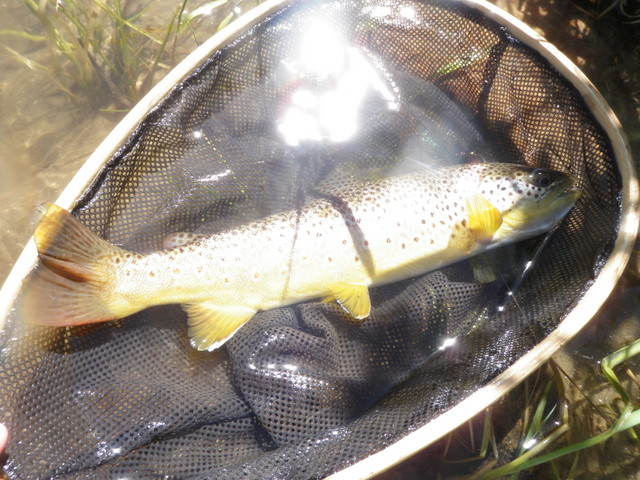
I finished my lunch and pulled the insect repellant from my backpack and lathered up once again. Could these rises be the beginning of a PMD hatch? I tied on the money fly, the light gray comparadun. After quite a bit of casting to multiple rises, a 13 inch brown sucked in the comparadun. After releasing the fish, I tried to interest the remaining sporadic risers in the comparadun, but they weren’t fooled. Perhaps fish were rising at the tail of the pool similar to the previous Thursday? I fought my way through the tall grass to the very tail of the pool and did notice a few very sporadic rises. I wasn’t seeing any PMD’s (I only saw a total of two), but did spot some yellow sallies and occasional caddis. I tied on the yellow sally/olive caddis double. I began more or less prospecting since the rises had long ceased, and on a cast directly upstream around 10-15 feet and 5 feet out from the bank, a trout slashed at my flies. I set the hook and a strong battle ensued. I eventually landed the brown and photographed. It was quite a net-filler and extended from the tip of the net to the beginning of the handle (see photo below).

Net Filler from Colorado on Thursday

Amazingly, both flies were in the large brown’s mouth. Did it take both flies or did one just work into its mouth during the battle? We’ll never know the answer to that. The brief hatch appeared to be over, and I didn’t want to go deep again, so I decided to cross the river slowly and carefully and walk up the right bank and search for telltale rises. I waded the very edge of the river on the right side to avoid going into the vegetation and create a mosquito swarm. Amazingly I didn’t spot any rises in the juicy right pool from the center current over to the bank. I waded the entire edge and prospected at a couple places without consequence.

When I arrived at the head of the run, I decided to continue working my way up the river prospecting the riffles in the same manner that I’d done a week ago with the yellow sally and caddis. Once again the skies were darkening, and after I’d fished out one section of angled riffles, I waded to the shore and put on my raincoat. I continued working my way and managed to land three additional browns prospecting in this manner. Two grabbed the yellow sally and one took the caddis. When I got to the spot where I’d quit and exited to the path and then the bridge a week ago, I decided to explore the water between me and the bridge. There always seemed to be fishermen there, so I guessed it was attractive water.

By now the wind was gusting and I could hear thunder but still distant. The attractive water appeared just below a small island where the wide shallow channel on my side merged with a swifter but narrower channel coming from the left. The two merged and created a nice little deeper slower area right in front of me. The skies opened and I pulled my hood up over my head and wore my western hat on top of the hood. It was effective but surely not fashionable. The rain pelted the river for three to five minutes, and I paused for part of the time. When the rain slowed to a steady shower, I noticed the swallows were working and skimming the water occasionally. I looked closely and several fish were working the water near me. One was a decent sized rainbow that cruised back and forth not more than eight feet above me occasionally sipping something. I couldn’t see any PMD’s or caddis on the water. What could they be eating? I stared at the water intently for several minutes and spotted a small mayfly spinner close to 16-18. It had a green body, not dark olive or light yellow/green, but green.

I looked in my fly boxes that contain some of the flies I tied for Pennsylvania and spotted the cornuta spinners. These were actually a bit too large and bit too dark green, but I didn’t have many options. I tied one on and began casting. It was very difficult to follow the fly in the dim light among rain dimples and some broken current. I think I had a couple looks from the rainbow but no take. But on one cast when I couldn’t find my fly, I went to lift and recast and felt weight and hooked a decent brown. I landed the 13” fish and removed the cornuta spinner from the upper lip.

I fished the spinner a bit longer, but as quickly as the spinner fall had commenced, it ended. The area that was alive with fish sipping spinners for fifteen minutes or so was now totally dead. The rain had now dwindled to drizzle, and I moved up closer to the junction of the currents. I went back to the yellow sally and caddis and prospected some attractive water for a bit, but found no action. I was now quite close to the bridge and feeling chilled, so I found the path and exited the river. The mosquitoes were swarming me as I crossed the bridge and hiked to the highway. I had to pause along the shoulder of route 40 and remove my backpack and apply more DEET.

I debated circling back through the lot and then heading back to the river again, but decided I was quite chilled and tired. I removed the rod I’d found when I got back to the car and discovered it was an Orvis four piece 6 weight. The section holding the reel was stuck to the first section part way apart. The reel was a Reddington reel and there was nice fly line in it. I decided to take it home and see if I could separate the sections using ice like I’d done with my old Sage once before.

As I drove back along the river on route 40, I looked down at the river and noticed a stream of brown water on the right side. Apparently it had stormed quite a bit somewhere and washed a bunch of sediment into the river. The decision to leave when I did was looking pretty good.

Colorado River – 7/22/10

Time: 10:00AM – 4:00PM

Location: Kemp-Breeze and Breeze Access Areas

Fish Landed: 9

Colorado River 07/22/2010 Photo Album

I almost finished all the June closing work by Wednesday, July 21, with a couple hours of work remaining. I decided to take off on Thursday to make a longer fishing trip because I had to be back on Friday to pick Dan up at the airport from his trip to China. I wanted to try the Colorado again as I hoped the PMD hatch had begun, and I didn’t want to miss any of this hatch action. The forecast called for cloudiness in the afternoon with the threat of thunderstorms.

I got off to a nice early start and arrived at the first fisherman access west of Parshall and began fishing at around 10AM. There were a number of cars in the lot, but not full like occurs when the fishing is very hot. When I got to the stream by the handicapped platform I could see two separate fishermen positioned near where I hoped to fish. I walked down along the north bank and crossed below the island across from the platform. The mosquitoes were intense and swarmed around my arms and head in spite of a heavy dose of high percentage DEET. I fished up the smaller channel on the far side of the island with a yellow Letort hopper and beadhead hares ear and landed one small brown trout. When I got to the top of the island I crossed and fished the nice run and riffle opposite the platform. One of the fishermen was 30 yards above me, and I didn’t want to crowd him. I didn’t have any success so switched to a double nymph set up with a strike indicator. I tied on a beadhead hares ear and put a beadhead pheasant tail on the point. This didn’t produce any fish, so I crossed back over below the island again and hiked upstream along the bank to an area where I’d previously seen many fishermen. There was a wide riffle about 3-4 feet deep and I probed this water with the nymphs and again had no action. Next I walked back along the bank toward the parking lot and stopped opposite the second fisherman who was now working the far bank area. I didn’t want to get too close, so decided to break for lunch at around 11 and went back to the parking lot.

I felt constrained on where I could fish, so decided to drive to the second access, and see if there was more open water. There were a couple cars in the lot, and I walked out along the high bluff so I could look back up the river to the sweet spot where I had previous success. I didn’t see any fishermen there, so I returned to the car and ate my lunch. After lunch I hiked out along the ridge, then down the steep hill, then turned left and went up along the north side of the river to the targeted run and pool. When I entered the river at the tail of the pool and looked up, two fishermen were sitting on the bank. I’d spent all this time to get to the desired area, and now it was occupied. Meanwhile I spotted several rises at the lip of the pool. I looked closely and saw a few PMD’s floating on the surface, so I tied on a size 16 light gray comparadun, my go to fly for PMD hatches. On perhaps the third cast of the comparadun, a spunky 13 inch brown rose and sucked in the fly.

Colorado River Brown

I continued casting where I saw rises, but couldn’t entice anymore fish. The hatch only lasted 15 minutes at most. What should I do now? Would it be bad manners to cross to the opposite bank and fish across from the two fishermen who by now had returned to fishing the pool? I decided to cross and see how they reacted. I walked up along the far bank and went above them by 30 feet or so. I didn’t get a good feeling about fishing close to them, so I moved upstream beyond the long run and pool. Between the long run and pool there was a succession of three or four sections where the current tumbled over some rocks then flowed on an angle toward either bank. I removed the comparadun and tied on a size 14 yellow sally as I’d noticed quite a few dapping the water. I caught a small rainbow on the yellow sally. I was also noticing occasional caddis dapping the water, so I tied tippet on to the bend of the yellow sally and added a light gray caddis and fished a two dry fly setup.

Two Fishermen in My Pool
Blue Heron

I systematically worked my way through the next three stretches of riffle/runs prospecting with the two dry fly configuration and landed six nice brown trout mostly ranging between 13 and 15 inches. Four inhaled the yellow sally and two others attacked the caddis on the end. Most of the action occurred at the tail of the run or at the head of the run. It wasn’t total blind casting as I spotted occasional subtle rises, and when I did, I placed my flies in the vicinity of the rise, and was typically rewarded. I’d reached nine fish caught on the day and approached the bridge separating the first access area and the one I was currently in, so I exited and hiked across the bridge then back down route 40 to the parking lot. Some nasty clouds were brewing to the west, so I put on my raincoat and returned to the river, this time going right and reaching the long pool where I’d had so much success the previous summer. I prospected the riffles, the far bank, and the eddy around some rocks on the far side at the top of the pool, but had no success. The wind started gusting and sheets of rain burst from the sky, so I retreated to the bank and stood and watched the water as it was pelted. I did this for five minutes or so hoping to see some sort of hatch instigated by the overcast conditions, but nothing was changing, so I reeled up my flies and called it a day.

Colorado River – 7/15/10

Time: 12:00PM – 3:00PM

Location: Kemp-Breeze, first leased access after Parshall

Fish Landed: 0

Colorado River 07/15/2010 Photo Album

After my poor results on Wednesday, I could not foresee enduring another slow day on the Eagle River, so I decided to cut my losses and drive to the Colorado River near Parshall. The downside to this strategy was that I would spend the morning driving, and once again be on the river during the afternoon. Thursday was once again forecast to be a hot dry clear July day. I had to wait for the dew to dry on my tent before packing it up, so I didn’t leave the campground until around 9:30AM. It was still a two hour drive to the Colorado as I had to go north to I70, then east to Silverthorne, then north to Kremmling, then east to Parshall.

When I arrived at the parking lot, there were quite a few cars there. I immediately applied DEET to ward off the insatiable mosquitoes and then ate my lunch at the picnic table in the center of the parking lot. After lunch I put on my waders and set up my rod and walked to the stream. There were some fishermen near the stretch I like, but enough space for me to enter at the lower end. I began fishing with the yellow Letort hopper trailing a beadhead hares ear. In short order I foul hooked a small brown that refused the hopper, but I set the hook and nailed it with the trailing nymph.

I moved across the river, but was not moving any fish. As I cast repeatedly, I noticed quite a few yellow sallies descending to the water, then taking off again. I decided to tie on a size 16 yellow sally fly, and had no luck with this fly. I caught a natural out of the air in front of me and examined it. It appeared to be larger than a size 16, so I tied on a size 14 2XL lime green trude. This was close in size, but perhaps too dark in color. This didn’t generate any interest, so I found a nice yellow sally imitation with a quill body that I’d tied from A.K. Best’s Flybox book. This was a great looking fly, but again it did not produce.

Colorado River Devoid of Fishermen

I was making all these fly changes as I crossed the river to the far side and worked my way up along the right bank covering the water from the deep mid-river run to the south bank. At one point after some strong gusts of wind, I noticed several trout rise, so I decided to fish a double dry fly with the lime green trude in front and a parachute ant on the end. Two trout swirled to the ant, but refused to take it.

I continued working the right side to the top of the sweet area. I did hook a fish that took off down the river toward the top of the nice area, but the fish got off as I tried to turn it and bring it back toward me. Toward late afternoon the sparse yellow sally action slowed down, and I’d reached the end of the area I desired to fish, and it didn’t appear that conditions were going to change, so I called it a day and headed back to Denver. I got skunked on the Colorado River in July.