Author Archives: wellerfish

Yampa River – 06/25/2025

Time: 11:00AM – 2:00PM

Location: Steamboat Springs

Yampa River 06/25/2025 Photo Album

I had my eyes on the declining flows on Colorado freestones, and I managed to squeeze in a trip to the Arkansas River on 06/20/2025. The other rivers I typically track carefully on their way down from peak run off are the Eagle River and Yampa River. In the case of the Yampa, flows dipped to the 900 – 1000 CFS range toward the beginning of last week, but because the drive is more than a day trip, and because I had commitments on Tuesday and Thursday, I could not fit in the drive . The Eagle River, on the other hand, was just coming into prime edge fishing range, and I planned to make a trip there in the near future.

Meanwhile, my wife was aching for some wildflower watching and camping, so we made reservations to camp at Steamboat Lake State Park from June 23 through June 25. On Monday we made the drive, and the wildflowers were indeed amazing. Yellow arrowhead balsam root flowers carpeted all the open areas away from trees including the spaces around our campsite. Lupines and Indian paintbrush served as adornments to the massive yellow blankets. During Monday and Tuesday we amused ourselves with hiking and camping activities, including a dicey drive on a rough four-wheel drive road. I own a Kia Telluride, and it possesses all wheel drive, but its clearance is not comparable to a Jeep or other rugged rides geared for rough off road travel.

I white knuckled three miles on a fairly rough “improved” national forest road, and then we turned onto another narrow passage. On my map  this road was shown as even more undeveloped than the first road. I managed to navigate downhill for .7 mile, and this included a couple serious drop offs from some large horizontal rocks, and my concern grew for the return drive. We found a small nook large enough to park, and we hoofed the remainder of the road to the creek and then continued for another .7 mile, until we turned around.

Scene Of Early Success

Jane grabbed for her phone to take photos, and of course it was no where to be found, so that added another concern. We worried about the loss of her phone, our ability to turn around on the narrow dirt road, and I recalled that the Telluride had an AWD lock button, but I was not sure where it was located.

Stunner

We completed the return uphill hike to the car, and fortunately Jane’s phone was placed on the passenger seat. Next she served as my guide, as I executed a tight turnaround in order to face uphill for the return drive. Finally, I got out the thick owners’ manual for the car, and after a bit of searching, I found the AWD lock instructions. We slowly crept up the rocky and rutted road, and at the particularly gnarly spots, I hit the lock button. We made it back to the first national forest road, and then we slowly maneuvered back to the main road. Whew! What a stressful adventure.

Curled with Slash

But this blog is supposed to be about fly fishing. What did any of this have to do with that pursuit? On Wednesday morning Jane and I packed up our camping gear. We were careful to keep fishing items in accessible spots. Steamboat Springs and the Yampa River were along the path on our return to Denver, and I was allotted fishing time.

Similar Looking Fish Nook

We arrived at our favorite parking lot by 10:30AM, and this enabled me to be on the river ready to fish by 11:00AM. The sky was overcast, and the flows were in the 260 CFS range. I thought this would be low, but the river was, in fact, in a prime state for fly fishing. I rolled with my Sage R8 four weight, and I rigged initially with an amber ice dub chubby Chernobyl, an iron sally and a salvation nymph. I got in position to make a couple casts, and within minutes a flotilla of tubers cruised by. One of the outliers splashed by within ten feet of where I was fishing. I was undeterred and on the fourth cast, the chubby dipped, and I hooked up with an outstanding fourteen inch brown trout that inhaled the salvation nymph. I was more than elated. In the same small pocket along the bank I foul hooked another very respectable brown.

Girth

I moved up the river along the right bank, and in a short amount of time I landed a small brown barely over the six inch barrier for counting. Some kayaks and tubers once again passed by, and I carefully waded along the edge to more promising locations. After ten minutes I arrived at a nice long pocket, and I flicked a cast to the midsection. Bam! A fish grabbed one of the nymphs, but I set the hook and connected for a brief period, before the fish tossed the fly and returned to the river. Unfortunately the energy in my fly rod snapped back and flicked the three flies over a cable that spanned the river. The cable was already littered with spinners, monofilament and flies; and my chubby Chernobyl dangled there two feet below the cable. I was in deep trouble. I looked around and found a four foot long branch and used it to insert in the loop above the chubby. After a few failed attempts, I snapped the branch downward with force, and the chubby remained embedded in the branch along with the trailing leader. I recovered the chubby Chernboyl.

Riffles

Unwinding the remaining flies and line seemed like an impossibility, but now that the flies were removed, perhaps I could pull the tapered leader through whatever snarl it belonged to. I grabbed my line and imparted direct pressure, and the line broke free. Guess where it broke? The loop at the end of the fly line separated, and I lost the entire tapered leader along with two nymphs. I knew I had additional tapered leaders in my frontpack, but how was I to reconnect to the fly line? I unwound a seven foot leader tapered to 5X, and it did not have a loop. Standing in a stream did not gain me access to nail knot tying instructions, so I improvised and tied a surgeon’s knot to connect the fly line and butt section of the tapered leader. It worked for the remainder of my day.

Arm’s Length

By now I observed small blue wing olive mayflies and occasional larger pale morning duns, so I used the break to re-rig my line to switch to a double dry approach. For the first fly I tied on a peacock body hippie stomper. Behind it I added a light gray comparadun on a short one foot leader from the bend of the stomper.

Two Beauties at the Tail of This Pool

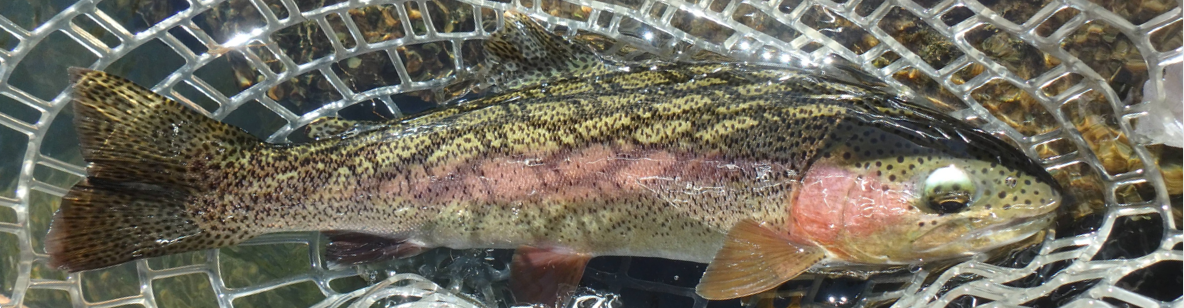
I began casting to the location of recent rises along with juicy runs and pockets, and I increased the fish count from two to five. One of these additional landed fish was a stunning cutbow of fifteen inches with rosy cheeks and a bright orange slash. I was rather pumped. As the dark clouds moved overhead, the wind began to gust, and my ability to cast accurately was constrained. In addition, the mayflies either halted their emergence, or they got blown off the water, because surface feeding became a historical event.

Excellent Spot

This mini storm that lacked precipitation lasted ten minutes, and then the air calmed, but the clouds remained. I spotted occasional mayflies, but never as dense as the brief period before the weather event. Nevertheless, intermittent rises occurred, when I observed closely. The next fish I managed to hook put up a major tussle and broke off the light gray size 16 comparadun, so I replaced it with a size 16 cinnamon version. It proved to be a stroke of genius. The fish count mounted from five to twelve, before I called it quits at 2:30PM.

Mature Brown Trout

The game during the early afternoon consisted of a lot of observation. I prospected likely spots, but as I did so, I spotted very subtle surface disturbances, and then I honed in on those locations. Some of my best catches resulted from across river casts, where I allowed the comparadun to drift downstream ahead of the hippie stomper. On quite a few occasions, a trout grabbed the comparadun at the tail of a pool right before the fly accelerated.

Such Dark Colors

How was the quality of the fish? Superb. Of the twelve fish landed on the day, two were cutbows, and the remainder were brown trout. Other than the small number two, these browns were unbelievable fish. They were fat and fit and displayed vivid markings. They fought ferociously characterized by fierce head shaking, diving and rolling on the line. I was simply blown away by the 3.5 hours of fishing.

From the Swirls

Adding to my euphoria was the fact that all but the first two fish were fooled by a dry fly. Several times I considered reverting to the dry/dropper, but in each case a hefty brown trout would sip my fly and dissuade me from making the switch. By 2:30PM I arrived at a bridge, and rather than commit to another section, I hooked my flies to the guide and hiked back to the car to greet Jane.

They Keep on Coming

What a day! Twelve stunning fish in 3.5 hours of fishing during a sparse pale morning dun hatch. Dry flies were favored, and downstream casts seemed to do the trick. I overcame a frustrating impediment to my fishing early on, when I lost my tapered leader. Improvisation was the name of the game. I was concerned about low flows and tubers, but neither seemed to pose a barrier to my success.

Fish Landed: 12


Arkansas River – 06/20/2025

Time: 10:30AM – 3:30PM

Location: Near Salida

Arkansas River 06/20/2025 Photo Album

I was pumped up to edge fish the Arkansas River on Wednesday, but a spike in flows caused me to doubt my plan, and I detoured to the South Platte River. As I considered options for Friday, June 20, I renewed my desire to test the receding flows on the Arkansas River. The DWR graph for Nathrop indicated that the flows leveled out at 1800 CFS, and they were on a downward curve to the 1550 CFS range on Friday morning. This was all I needed for motivation to make the two hour and forty-five minute drive to Salida. My illness waned to a minor irritation, so that was another positive factor for a day of fishing. The high temperature in Denver was forecast to reach one hundred degrees, so that was a concern, although the snow melt and high flows were expected to buffer against the high air temperatures, unlike the South Platte River where no such volume offset was available.

The Descent to the River

High but Clear

I arrived at my chosen destination a bit after 10:00AM, and I was prepared to fish by 10:30AM. Normally I would have fit together my Sage One five weight, but its status was still listed as “repairing” on the Far Banks web site. Hmm, I wonder how active the repairing is? Instead I pulled out my Scott four piece six weight. I bought this rod for my trips to Alaska and Argentina, but I had not used it in a couple years. I am a nonconformist, when it comes to reels, as I am right handed but have my reel set up to be reeled with my right hand. You may ask how this works? If I hook a fish, I normally just strip line to bring it in. If I end up using the reel, I make a quick hand switch and hold the rod with my left and reel with my right. At any rate, I thought I remembered that the reel on the Scott was set up to wind left handed, and this was an impediment to my usage.

Finally on the Board

As I prepared to fish, I pulled out the reel with the six weight line , and I was pleased to learn that it was set up for right handed reeling. With this advantageous discovery, I decided to deploy the Scott six weight on Friday. I was fishing a big river, with high water, and strong gusts of wind and the possibility of larger than average fish. A six weight made a lot of sense.

Salvation Did the Trick

I hiked along the river for .4 mile and then angled down a steep bank. The river was indeed running fast and tight to the banks, but clarity was quite good. I began my day with a yellow Letort hopper fished solo. I read that golden stoneflies were present, and I figured the size 10 Letort hopper was a solid imitation. The hopper gambit was a total bust, so I switched to a yellow fat Albert trailing an iron sally and salvation nymph. In the forty-five minutes before lunch I notched two refusals to the fat Albert. It made me wonder, whether I abandoned the yellow hopper pattern too soon.

Another Representative Trout

After lunch I resumed my progress along the left bank. The lesson I learned was that the speed of the current was the prime factor dictating trout holding locations. In the morning I wasted time fishing very marginal relatively shallow runs and riffles next to the bank, as the current was a bit too swift. The key to finding trout was current breaks such as trees and large boulders. If I found slower moving current with some depth near these structures, I generally found trout.

Tough Wading Here

Between noon and 3:30PM I landed nine trout. This included a splendid pair of fifteen inch brown trout along with a pair of smaller relatives, but the rest were respectable browns in the twelve to thirteen inch slot. All these fish were quite healthy, and they put up spirited fights. They were probably extra combative, since they probably had not experienced a hook in quite some time.

Hot Spot Among Rocks

The size of the fish was more than acceptable, although the catch rate was fairly average. Of course, had I hooked the five refusals and landed the four fish that escaped, my day would have looked considerably more impressive. Two of the larger long distance releases broke off both nymphs in their frenzied efforts to escape. Why are the best fish always the ones that get away?

Long One

By 2:30PM I suffered a lengthy pause in action, and refusals to the fat Albert were prevalent, so I decided to try a double dry. I removed the dry/dropper elements and switched to a size 12 yellow stimulator and trailed a size 14 olive-brown deer hair caddis. These flies yielded two brown trout, with the second and last fish on dries being a very fine fifteen inch brown trout.

Better View

Boulder Field

Nine fish in 4.5 hours of fishing was fairly lackluster; however, I tangled with some very nice trout that required careful fish playing skills. I improved my ability to identify likely fish holding locations. If I do the Arkansas River edge fishing again, I will be more selective with my casting. Rediscovering my Scott six weight was perhaps the highlight of the day, and it will surely see more action during edge fishing season, if my Sage five weight remains out of commission.

Fish Landed: 9

South Platte River – 06/18/2025

Time: 10:30AM – 2:30PM

Location: Eleven Mile Canyon

South Platte River 06/18/2025 Photo Album

Baby sitting duties prevented me from fly fishing last Wednesday; however, I salvaged a fun day on a lake on Friday, June 13. Hurdles to the pursuit of chasing trout continued to plague me, as I contracted an illness that took me out of action late on Fathers Day through Tuesday; however, by Wednesday morning my energy was back. One nuisance symptom of my condition remained, but I felt well enough to embark on a fishing trip.

But where should I go? I eagerly tracked the receding flows on the freestones I love to frequent, as run off wanes, and I was surprised to see that the Arkansas River was already within the range of edge fishing. The Yampa River in Steamboat was actually prime for edge fishing, but the long trip made that option unworkable. I was nearly settled on the Arkansas, but when I checked the flows on Tuesday, I noticed a distinct spike in flows at the Salida and Nathrop gages. I was concerned that heavy rain on Tuesday caused the sudden increase, and perhaps this was accompanied by a loss of clarity. It was too late to call a fly shop.

Next to the Large Rock on the Right

When I checked again early on Wednesday morning, the spike leveled out at 1800 CFS at Nathrop, but I was reluctant to risk the long drive, and I wanted to leave before the fly shops opened at 8AM, so I defaulted to the South Platte River at Lake George. The graph of flows there was nearly an unending straight line in the 85 – 90 CFS range. I had decent success on my last visit there on 06/10/2025, and I assumed that conditions would be similar. I made the drive to Eleven Mile Canyon.

Very Respectable

By the time I arrived, geared up and assembled my Sage R8 four weight, it was 10:30AM. I began my day with a peacock hippie stomper trailing a size 16 olive-brown body deer hair caddis on an eighteen inch section of tippet. As I stood on the bank making my first couple casts, a trout rose next to a rock, and it was no more than five feet away from me. I dropped the flies in the current without even casting and allowed them to drift along the rock, and on the second pass, a very respectable thirteen inch brown trout aggressively smacked the caddis. It was quite an auspicious start to me day.

Early Beast

I added a second small brown, as I advanced up the river, but then the fly fishing gods exacted their payback for my early good fortune. First, I set the hook into nothing and launched the flies into a tree limb high above the river. After some persistence and an excessive struggle, I was able to bend the branch tip down to the river, where I was able to unravel and rescue the flies. Next I failed to pause to allow the flies to straighten before making the forward cast, and this error along with some gusting wind, caused the flies to confront me in a massive snarl. It was so bad that I had to cut off both flies and dispose of the tangled leader that connected the stomper to the caddis.

Fine Looking Area

After these two time consuming disruptions to my karma, I made a thirty foot cast across the river to a nice riffle next to some overhanging branches. I really thought it was a futile effort, but much to my amazement a decent fish smacked the hippie stomper. I raised the rod and connected and in the process lifted the nose of a decent-sized rainbow above the surface, but in a flash the fish was gone. I stripped my line in and discovered that both flies broke off, and I suspect I scarred the knot on the hippie stomper in my efforts to unravel the tangle.

Nice Rainbow

What else could go wrong? One more thing. I finally settled into a rhythm and began prospecting likely trout lairs, when another angler appeared and waded into the river no more than twenty yards above me. I was dumbfounded. I fished out a remaining attractive section, and then I climbed the bank and moved upstream. As I passed the angler, I told the invader that I assumed he did not see me, and that explained his presence in my space. He said that was the case, and then uttered “life can be hard”. I was again dumbfounded and simply shook my head. There was no apology or offer to move somewhere else. I hiked along the road a good distance, offering him a courtesy he did not extend to me, and then I cut back to the river.

Pleased

By now at least an hour had elapsed, but I began to fish my double dry in earnest, and the results were outstanding. I spotted very sporadic rises, and small caddis dapped the surface occasionally, and my hippie stomper and deer hair caddis seemed to be of interest to the river inhabitants. I boosted the fish count from two to fifteen, before I paused on an exposed mid-river rock for lunch. Among my catch were a couple twelve inch rainbows and four browns in the twelve to thirteen inch range, and one seventeen inch cutbow. Yes, you read that correctly. The beast rose and crushed the hippie stomper at the very top of a long pocket. I was shocked by this outlier.

Productive Water Ahead

After lunch at 1:00PM the game changed. The fish stopped responding to my double dries. I spotted a light yellow body mayfly slowly ascending toward the sky, so I swapped the caddis for a pale morning dun. Nothing. By 1:30PM I decided to replace the comparadun with a light gray deer hair caddis, and while paused to make the changeover, I pulled out my stream thermometer. I submerged it for more than two minutes in a spot with some depth along fast moving current, and it registered 66 degrees. Before I plunged it into the water, it displayed 77 degrees, so I knew it was functioning properly. 66 degrees represents the threshold of when one should stop fishing in order not to harm trout by playing them in elevated stream temperatures.

Cutbow Monster

It was only 1:30, so I decided to drive up the river toward the dam with the hope that the water temperature would be lower near the bottom release. I parked where I normally stop on early spring outings, and I hiked to the same sections that I was familiar with. I made some casts at the top of a nice long entering run to a medium sized pool, and this provoked a splashy refusal. Next, however, I once again tested the water temperature, and I was surprised to learn that the thermometer continued to register 66 degrees. I used my better judgement and called it quits at 2:30PM. The air temperature on the dashboard display was 80 degrees, as I began my return journey.

Fifteen trout landed in two and a half hours of fishing is very respectable, and quite a few were above average beauties. This was accomplished in spite of a series of time consuming disruptions. I fished only dry flies, and the fish were quite receptive to my offerings. The hot spots were the cushion in front of large exposed boulders, and quite often the trout grabbed the caddis, as I began to lift in front of the boulder to make another cast. Slight twitches and movement seemed to instigate trout predator behavior. The warm water temperatures were a disappointment, and I am concerned with a heat wave in the forecast for the remainder of the week. Could the water managers increase the flows? I am thankful that I carry a stream thermometer.

Fish Landed: 15

Curtain Ponds – 06/13/2025

Time: 1:30PM – 3:30PM

Location: Near Copper Mountain

Curtain Ponds 06/13/2025 Photo Album

On 06/17/2024 I endured a similar experience on Clear Lake, and on that occasion I salvaged a decent day of fly fishing by moving on to the Curtain Ponds. On 06/13/2025 I repeated that same cycle of events. Clear Lake was dead, so I cut my losses and migrated west along Interstate 70 to the Curtain Ponds near Copper Mountain. I drove in my waders, so upon my arrival at the ponds, I was essentially ready to fish.

Small Waves Greeted Me

My Sage four weight was already rigged with the mini chubby, a prince nymph and a hares ear; so I decided to give the three fly configuration a test at the outset. The sun was out most of the time, but intermittent clouds created wind and riffles. I fired casts toward depressions fifty feet from shore, and in the early going I managed to land two small brook trout that grabbed each of the trailing nymphs, as I began to strip the flies back toward me. This success, however, failed to reoccur, and the nymphs continually picked up vegetation from the weed beds, so I modified my approach.

Brilliant

I replaced the mini chubby with a peacock body hippie stomper, and then added a size 16 olive-brown deer hair caddis on an eighteen inch dropper. The double dry performed quite well, and I carried on with the combination for the rest of the afternoon. I snapped off the two flies on a bush at one point, but I replaced them with another set of stomper and caddis.

Getting Closer to the Bank

During my two hours on the pond, I landed twenty-two small brook trout. They were all within the six to eight inch range, but they were perfect gems with iridescent vermiculation along their backs and bodies along with orange bellies and white tipped fins.

A few of the catches molested one of the flies, as they sat motionless, but more frequently they attacked the caddis, as I began to strip. I allowed the flies to sit for ten to twenty seconds, and then I gave them a quick pop to create a wake from the stomper. This was followed by a second pop, and then, if no take resulted, I stripped faster back toward my position. I estimate that seventy percent of the hookups were produced by the caddis, and the remainder resulted from the hippie stomper. Refusals were part of the game, but takes far outnumbered the indecisive snubs.

Scintilating

For the third time this spring, I enjoyed a double. That is, I caught two trout on the same cast. In this case the larger brook trout engulfed the hippie stomper, and while I was playing it to my net, a smaller fish grabbed the trailing caddis. This was the first double on dries for this season.

Third Double of 2025

By switching locations I managed to salvage a decent day. Of course the fish were small, but I still had a blast fooling the small battlers. Not every cast was successful, and the sudden slashing of a hungry brook trout was always a surprise. I suspect that Clear Lake is off my list for 2025.

Fish Landed: 22


Clear Lake – 06/13/2025

Time: 11:15AM – 12:30PM

Location: Clear Lake on Guanella Pass

Clear Lake 06/13/2025 Photo Album

My grandson Benny was ill and unable to attend daycare on Wednesday and Thursday, so us grandparents stepped in to provide care. This eliminated those two days from consideration for fly fishing. On Friday morning I had a doctor’s appointment at 8AM, but I decided that I could visit a relatively local lake, if I prepared ahead of time.

Big Horns

That is, in fact, what transpired, and I set out for Clear Lake on Guanella Pass after my appointment. I had decent success in the small mountain impoundment in previous years in early June, so I decided to give it another test. I arrived by 10:45AM, and after I pulled on my waders and boots and assembled my Sage four weight, I hiked a short distance to my favorite spot. Alas, as I slowly scrambled down the bank to the edge of the lake, I discovered four anglers surrounding my favorite spot.

Target Area Surrounded by Anglers

I surrendered to the crowd, and I established a position north of the other fishermen. The lake was already quite low, and for the most part the surface was smooth under very bright sunshine. These were not prime conditions. I rigged with a peacock hippie stomper and olive-brown deer hair caddis, and I began to fan casts to the mirror-like surface. The next twenty minutes tested my patience, as the flies sat unmolested. I failed to observe a single surface rise during my entire time at Clear Lake. I began to experiment with different retrieves including pops and stops and steady strips, but none of these tactics generated interest from a fish.

Hippie Stomper and Deer Hair Caddis

Slowly the competing anglers began to depart, and I interpreted this as a bad sign. The last of the folks that were present, when I arrived, moved on, but a young man in shorts with a spinning rod descended above me, and he began to launch long casts to the far shoreline. He seemed to have a bobber with a spinner beneath it, and the bobber scooted along the surface creating a wake. Eventually he crossed to the opposite bank and worked his way north and away from the area that I wished to occupy.

Smooth Like a Mirror

While this was going on, I decided to kill time and allow the water to rest, so I pulled out my lunch and relaxed on a large boulder. Once my lunch was completed, I changed my set up to consist of a tan body mini chubby Chernobyl, a prince nymph and a beadhead hares ear nymph. I crossed to the opposite shoreline, and I began lobbing casts in a southward direction, as I covered the deep drop off that produced in previous years. In spite of some nice casts and thorough coverage of the area, I was unable to generate even a look, until finally the top fly bobbed, and I set the hook. I quickly stripped in a six inch brook trout, and I was pleased to avoid a skunking at Clear Lake. I continued working my way along the bank, until I reached shallow water, and then I called it quits and modified my plan for the remainder of the day.

Fish Landed: 1

South Platte River – 06/10/2025

Time: 10:30AM – 3:00PM

Location: Eleven Mile Canyon

South Platte River 06/10/2025 Photo Album

With Ireland and jet lag in the rearview mirror, I was anxious to return to Colorado waters. Run off was in full swing, so my choices were limited to tailwaters or lakes. I checked the flows on the South Platte River at Lake George, and I learned they were in the 88 CFS range, and my choice became a no brainer. I love Eleven Mile Canyon, and flows in that range were a bit low but well within my desired range. Air temperatures were projected in the upper seventies, and that reinforced my desire to visit the canyon tailwater.

Prime Water

I arrived at my chosen pullout by 10AM, and as I geared up at the tailgate of my car, another angler ambled by on his way to fish the section that I chose. This irked me a bit, but it was open water, and he got there first. I wore only my fishing shirt and stuffed my raincoat in my backpack. My rod choice was my old Sage four weight. I was in a position to begin casting by 10:30AM, and my line displayed a size 14 peacock body hippie stomper and a beadhead hares ear nymph. In the early going I managed a pair of relatively small brown trout, and the hares ear accounted for both; however, spots that looked very attractive failed to produce. The hippie stomper was attracting attention in the form of looks and refusals, so I concluded that the fish were looking toward the surface for their meals.

Looking Up the Canyon

I removed the long dropper leader and the hares ear, and I replaced them with a one foot tippet with a size 14 olive-brown body deer hair caddis. Cha-ching. This pairing clicked, and I moved the fish count from two to ten before I broke for lunch at noon. Credit goes to Max of Charlies Fly Box who posted an Instagram video that recommended caddis in the riffles for fast action. His advice was accurate.

Olive-Brown Deer Hair Caddis on Its Nose

After lunch I continued my advancement through pocket water and riffles, and I increased the fish count to fourteen by 1:00PM. By now the sun was bright and the air temperature was in the upper seventies, and it seemed that these conditions placed the trout in a state of lethargy. The double dry suddenly failed to attract interest, so after a long dry spell, I returned to the dry/dropper methodology. I spotted one solitary golden stonefly, so I chose a tan body mini-chubby Chernboyl as my top fly. Beneath it I brought back the hares ear, and then I added a second nymph in the form of a salvation nymph. The length of the leader from mini chubby to salvatoin was around four feet.

Pockets to Pick

I cast to all the likely spots, but it was as if the river was a victim of a recent fish kill. I removed the salvation and replaced it with an olive perdigon. After an enormous amount of casting and moving, I managed to land two nice rainbow trout in the final two hours. One bow snagged the hares ear, and the other clamped down on the olive perdigon.

Promising

On the day I landed four rainbow trout with one chunky specimen approximating thirteen inches in length. A brown trout stretched the tape to thirteen as well, and the other rainbows were around twelve inches in length. The remainder of the catch were less than a foot long.

Another Fine Rainbow

While both dry flies were working, the deer hair caddis was preferred over the hippie stomper. I estimate that the ratio of caddis dry fly takes to hippie stomper takes was seven caddis for every three stompers. Moderate depth riffles and medium depth and long pockets were the most productive river structures. The big deep pools were a waste of casting energy.

Run Near the Bank Delivered

A sixteen fish day, while most of the waterways were blown out with high water, was appreciated greatly. The last two hours were tough, but the morning action was fast and very entertaining. Perhaps another visit to the South Platte is in my future.

Fish Landed: 16


River Suir – 06/04/2025

Time: 9:30AM – 4:30PM

Location: Near Ballymacarbry

River Suir 06/04/2025 Photo Album

Kevin, my guide, suggested that our day on Wednesday might be more challenging than Tuesday. His lowering of my expectations was prescient.

Frenchy

Once again he collected me from the B&B at 9:00AM, and we proceeded to the Clonanav shop. I snugged on my waders and wading boots over my layers of fleece, light down, and a rain shell. I was glad for all the layers, even though we enjoyed long intervals of sunshine. Periods of overcast, wind, and light rain between the sunshine made my choice of attire proper.

Mayfly

The River Suir is a powerful river, and although the Irish guides complained about low water for the time of year, it seemed to be running swiftly from bank to bank. Kevin fixed me up with a Klinkhammer dry and a frenchy dropper, and I was off and running. For Wednesday Kevin brought along a wading staff, and I was pleased to have it; however, it was longer and heavier than I was accustomed to.

Big Fast Moving River

Since the River Suir is a larger waterway, I was forced to make long casts. My line had a shooting head, and it took me quite awhile to adjust to this line configuration. For me, the hard part was lifting the long line to recast after a drift. I was waiting too long, and stripping the front section into the rod, and this then required abundant casting to get the shooting head back outside the guides. Once Kevin demonstrated how to pick up, when the orange section was at the tip, my casting improved significantly, although probably not up to the expertise of those who do it frequently.

Keeping It Wet

The other issue was the glare on the water, and this was especially problematic, when I zinged out a sixty foot cast. I was out casting my vision. Nevertheless, I managed to land four brown trout before lunch including a dink six incher, a thirteen incher, and a fourteen inch fish. The last morning fish was a very fine trout in excess of fifteen inches, but exceedingly fat, and it demonstrated the hardest fight of the trip. This fish craved the bottom of the river, and it dove repeatedly. At one point Kevin readied his net, and this angered the fish and goaded him into another extended fight that included diving and head shaking.

Fat One

After lunch we moved upstream to some very attractive water, where a long seam bordered a strong center run. During the afternoon session, I alternated between chucking a streamer, dry/dropper and a single dry fly. I experienced hits and brief hookups with the streamer and one connection on the caddis dry. In the latter case a sizeable brown moved a foot beneath the water and then crushed the dry fly, but I only nicked its lip, and it dashed downstream to safety. It was the most visual take of the trip.

Silvery

I doubled the fish count from four to eight, and this included a pair of fish in the fifteen to sixteen inch range along with a pair of sub one foot browns. For the last hour we moved to the River Nire, my home on Tuesday, and I covered a riffle section and a long slow-moving pool. Once again I took advantage of the shooting head, and Kevin taught me to aim high, so the line turned over and fluttered down on the extremely smooth water of the large pool. This avoided slapping the line down with the risk of spooking fish. Fish were rising sporadically throughout the pool, but I was unable to tempt a bite despite a fly change to a small olive comparadun. Finally in an act of desperation, Kevin returned me to the dry/dropper technique, and on the first cast after the change, a hard charging brown in the fifteen to sixteen inch range grabbed the frenchy. This was number eight, and as a light rain changed into steady precipitation, we called it quits.

End of Day Pool

Wednesday was an eight fish day that could have easily been double digits, had I improved my conversion rate. I caught five very respectable browns, but most importantly I learned some new techniques and improved their application. Hopefully I can reinforce them during future outings in the western U.S.

Fish Landed: 8


River Nire – 06/03/2025

Time: 10:00AM – 4:00PM

Location: Private water.

River Nire 06/03/2025 Photo Album

With streams raging with run off in Colorado, I booked two days of fly fishing with Clonanav Fly Fishing in Ireland. The trip was not purely for fly fishing; as Jane, Amy, and Amy Jo joined me. Jane is my wife, Amy is my daughter, and Amy Jo is a friend. We launched our self-planned tour of Ireland on May 26 in Dublin, and the ladies dropped me off at the Glasha Farmhouse on Monday, June 2, and then they proceeded to Dungarvan on the southern coast for a couple days of relaxation, before we all returned to the states on Thursday.

Deep Pool

Enough about our trip. The purpose of this blog is to report on my fly fishing adventures, so I will move on to that topic. My guide, Kevin, collected me at 9AM on Tuesday morning in his spiffy Range Rover, and he transported me to the fly shop only a mile or two away. I pulled my provided waders and wading boots on and then slid into my light down coat and a raincoat. It was quite overcast and windy (common in Ireland), as we proceeded to the River Nire. We drove through a pair of gates and over a rough and barely visible two track, and we eventually parked in a pasture next to the stream.

Off and Running

Proud Fisherman

The River Nire was just as I imagined an Irish stream. Long and placid, deep pools were separated by short sections of sluicing faster water, and large deciduous trees arched over the waterway. I opted not to bring my fishing gear, and Kevin had two GuideLine rods rigged and ready to cast. The rods were secured in rod holders over the hood of the Range Rover. The four weight GuideLine was far softer than what I was accustomed to, so it took me a bit to adjust.

Another Irish Brown

Like a Lake

On my first cast I failed to load the rod, and this resulted in a short cast to some slow water twenty feet from my position. I lifted to execute a better cast, and I was shocked to feel the weight of a decent fish. Unfortunately it escaped, but what a start!

Surprised by This One

At the outset I was using a Klinkhammer dry with a pink and white wing post, and beneath this attractor was a size 18 flashback pheasant tail nymph. During the morning I primarily persisted with this arrangement, and it resulted in ten magnificent brown trout in my net. My expectation going into this trip to Ireland was catching five to ten small brown trout per day. Guess again. I landed thirteen in total on the day, and nearly all were in the fifteen to twenty inch range along with a pair of browns twenty inches or more. Wow, did these fish fight. Diving and head shaking were integral to their combative repertoire.

Look at the Bulk

After lunch I added three additional magnificent browns, and I had at least another four temporary connections. Two of the afternoon catch extended beyond twenty inches. It was simply outstanding.

This Section Really Produced

As mentioned earlier, the Klinkhammer and pheasant tail produced early, but the pheasant tail got swapped for a Frenchy perdigon part way through the morning. Two trout crushed the dry with the remainder duped  by one of the nymphs.

And Again

After lunch I fished mostly the dry/dropper, but we experimented with a tiny gray streamer as well. I detected one strong bump with the jigging streamer, but the pursuer failed to grab the fly a second time. My day ended in a stunning pool with a size 16 caddis with a yellow indicator on top for visibility. I fished it solo, and although I only landed three in the PM, two represented the largest of the day.

All In

Fishing in Ireland is more akin to Pennsylvania than Colorado. I made relatively long casts, and in many cases it reminded me of lake fishing. Patience was a necessity in these instances, as the fly chugged along slowly, but often enough a grab occurred after I waited out the drift. Tomorrow is another day. Hopefully Kevin was exaggerating how much today was above the norm to lower my expectations.

Fish Landed: 13

Nice Bend

Splendid

South Platte River – 05/24/2025

Time: 10:30AM – 3:30PM

Location: Eleven Mile Canyon

South Platte River 05/24/2025 Photo Album

As I mentioned in my post of 05/20/2025, I was set to visit the South Platte River, when I was distracted by the temporary low flows on the Arkansas River and made that my destination on Monday. Friday was my day to follow through on my initial inclination. I made the trip to the South Platte River in Eleven Mile Canyon. The high temperature was projected to reach the low seventies in nearby Lake George, CO, and the flows were actually running a bit low at 58 CFS.

Looking Ahead

For this trip to Eleven Mile I decided to experiment with a new stretch of the river. I usually frequent the upper special regulation section below the dam, but I admire the open water area, as I drive by. Sure, the bait fishermen are able to ply the river with their offerings, but I have learned historically on other streams that wily fish remain that are able to avoid the drifting worms and power bait. The key is to probe out of the way and difficult to reach spots, and these types of water exist in abundant quantity in Eleven Mile Canyon.

Number Two

Typical Productive Water

I slowly drove up the canyon while scanning the river for faster sections, until I finally found an area that exhibited the characteristics that I was seeking. The temperature was in the low sixties, so I pulled on my rain jacket for extra warmth, and I rigged my Sage R8 four weight. By 10:30AM I was on the river, and I began my angling day with a size 8 tan-body pool toy hopper, an orange scud and an olive perdigon. Between 10:30AM and 11:45AM I prospected all the likely seams, slots, pockets and riffles; and I notched four trout in my fish count. Two were rainbows and two were brown trout. One aggressive rainbow crushed the pool toy hopper, and the others grabbed  the nymphs. After twenty minutes the orange scud failed to deliver, so I substituted a beadhead hares ear nymph, and it attracted one rainbow, while the other two trout favored the olive perdigon.

Did the Job

Colorful Rainbow

After lunch on a nice flat rock, I continued up the river, and I built the fish count to seven. The three additional trout chose the hares ear, and in the process of landing one of the nicer rainbows, the olive perdigon broke off. I always grieve the loss of a perdigon, and the expensive tungsten bead, and I did not wish to expose more to that risk, and the trout seemed to like the hares ear, so I dipped into my fleece wallet for a PMD supernova to replace the perdigon.

Pocket Water Delight

By one o’clock I encountered a group of elementary age kids splashing and playing on a huge exposed boulder in the middle of the river. The river in the upstream area was wide and shallow and slow moving, so I retreated to the car and advanced up the road for .2 mile. I parked and jumped into another narrow section that contained deep pockets, plunge pools and exposed boulders. This was exactly the type of structure that I was seeking.

Seams Always Good

For the remainder of my afternoon I probed the likely spots, and I increased the fish count from seven to seventeen. Two nice brown trout in the fourteen inch range graced my net during this phase of my day. Both of the large trout emerged from lies in front of large exposed boulders, where the current deflected off the upstream face. Part way through the afternoon time frame, the PMD supernova was separated from my tippet, and I replaced it with a salvation nymph. Of the ten trout landed, as I moved the fish count from seven to seventeen, two consumed the supernova, one mauled the pool toy, one nabbed the salvation nymph and the remainder picked off the hares ear.

One of the Better Fish

Emerged from the Current Seam

My theory held. The section featured fast water with pockets and slots and hidden seams, and I used my dry/dropper to probe each possibility. Most fishermen prefer the deep pools and the entering runs as obvious fish magnets, and I avoided these spots that are normally pressured by the bait dunkers. I would not characterize the fishing as sizzling, but rather steady. Not all promising locations yielded results, but if I moved at a steady pace and persisted, I was able to create adequate action.

Covered in Spots

Nice Brown from in Front of the Large Boulder

Aside from the two fourteen inch browns, I netted quite a few trout in the eleven to twelve inch range, and I recalled at least four decent fish that shed my fly hook after brief fights. On the day I estimate that the ratio of browns to rainbows was roughly 50/50.  Overall it was a fun day. I always enjoy discovering new streams or different sections of rivers that produce favorable results. I will definitely do more exploration of Eleven Mile Canyon.

Fish Landed: 17

End of Day Double


Arkansas River – 05/20/2025

Time: 11:30AM – 3:30PM

Location: Near Buena Vista

Arkansas River 05/20/2025 Photo Album

As I waded through my options for fishing on Friday, May 16, 2025; I reviewed the flows on the various Front Range streams. This survey of the DWR flow data taught me that the South Platte River was the one remaining moving water alternative, and I decided Eleven Mile Canyon would be my choice on Tuesday, May 20, 2025. However, after a series of cool weather days, I checked the stream conditions on the Arkansas River at Nathrop, and I was surprised to learn flows dropped from the 800 CFS range to the low 500’s. Could I squeeze in one more day on the Arkansas, before it blew up again, when run off resumed? I called the fly shop in Buena Vista, and Thomas answered and told me that the river was indeed clear and dropping and a viable fishing option.

I succumbed to the allure of the new area of the Arkanasas River, and made the drive to Buena Vista. Along my route I saw digital signs warning of the danger of high wind. Was my decision to fish in severe weather conditions a good one?

Flows Were Up a Bit but Decent

I stopped at the Buena Vista fly shop and introduced myself to Thomas and purchased a spool of 4X tippet and continued on my way to the parking area near my chosen fly fishing location. The temperature, when I exited the Telluride was 56 degrees, but the wind was gusting and made it feel much chillier, so I pulled on my long sleeve thermal undershirt, my fleece hoodie and my North Face light down coat. I forgot to pack my rain shell, which I normally use as a windbreaker. I also decided against wearing my wide brimmed western hat in favor of my billed New Zealand hat with ear flaps. This may sound like overkill for 56 degrees, but I was comfortable for most of the morning and early afternoon. For a fly rod I pulled my Sage One five weight from its tube to combat the wind.

More Clear Pockets

I hiked the .15 mile path to the top of the bank overlooking the river, and then I followed the trail downstream for .2 mile, before I negotiated the bank and positioned myself along the river’s edge. I wanted to explore the downstream area, since I did not start there on my earlier trip. To begin my search for trout, I selected an amber ice dub body size 8 chubby Chernobyl, and then I added an iron Sally and an olive perdigon.

A Winner

The river was a bit higher than my earlier visit, and this forced me to limit my casting to the west bank with minimal coverage of the center of the river. I prospected for thirty minutes until lunch at noon, and I managed to land three brown trout. Much to my amazement one crushed the chubby Chernobyl and the others grabbed the olive perdigon.

In Front of the Boulder Produced

After lunch I resumed my progress, and my success was limited to a couple temporary hookups. It was at this time that I waded to a spot, and when I placed my right foot between two rocks, it slipped causing me to temporarily lose my balance. My rod was in my right hand, and I reached down with that hand to prevent a fall, but I also placed the rod across two exposed rocks. Although I did not fall, I did suddenly lean to the right to rebalance, and this act snapped the Sage One in the butt section. Needless to say I was not happy, but after a bit of berating myself for my stupidity, I regained my composure. I removed the flies, broke down the rod, and returned to the car; which, fortunately was not far away. I returned the broken rod to its case and pulled out my back up five weight Loomis.

Promising

I returned to the river and resumed from the scene of my unfortunate accident. I exchanged the iron sally for a 20 incher and maintained the perdigon. These flies remained in place, until I snagged something in front of a large exposed rock, and the location was too precarious to allow a rescue, so I ended up snapping off all three flies. When I rigged anew, I substituted an olive-black Pat’s rubber leg for the 20 incher.

Chubby Eater

Using these fly combinations I increased the fish count from three to eight, before I called it a day around 3:30PM. The chubby Chernobyl accounted for two fish, the rubber legs logged one, and the remainder nabbed the olive perdigon. My day was rather slow, and I covered a lot of water to generate the eight fish day. The wind was a huge hassle. It gusted frequently from the north and created a frustrating headwind. My most effective casts were up and across with long drifts across from my position and downstream. Most of the landed fish appeared from deep lies in front of or next to large submerged or exposed boulders. I suspect that the lack of insect activity and the cold snow melt caused the fish to hug structure and not move very far for food.

One of the Better Fish

The size of the fish was quite favorable with nearly all being in the twelve to thirteen inch range. In one place I made a cast across a fast current to a wide slow moving pool below a large boulder, and as the flies began to swing, a fish grabbed one of the nymphs. I set the hook and turned the fish temporarily and exposed the side of a fairly long brown trout. I suspect it may have been the largest fish I’ve seen in my newly discovered stretch of the river.

Lovely Spot

I suspect I should have adhered to my original inclination and fished the South Platte, but high winds were in the forecast there as well. Breaking my rod was a bummer, but landing eight nice brown trout under challenging conditions during a lull in run off was actually a decent accomplishment  Nevertheless, tailwaters and lakes are in my future.

Fish Landed: 8